Most “Midjourney vs DALL-E” articles compare sample images and call it a day. That comparison misses the actual buying decision. Midjourney wins on visual aesthetics. DALL-E and OpenAI image generation win on text accuracy, API access, team governance, and total cost at scale. The real question is whether your team needs a creative art-direction engine or a production workflow tool, and I spent three weeks mapping pricing, plan gates, and under-discussed limitations to help you answer it.
One finding that surprised me: at 10 users, the cost gap between these tools is smaller than you think, but the governance gap is wider than any competitor article covers. More on that below.
| Category | Winner | Why |
|---|---|---|
| Visual aesthetics | Midjourney | Stronger cinematic, photoreal, and stylized output |
| Text rendering | DALL-E / OpenAI | More accurate readable text in generated images |
| Pricing for teams | DALL-E / OpenAI | ChatGPT Business at $25/user/month beats Midjourney Standard at $30/user/month |
| API and automation | DALL-E / OpenAI | Official Images API and Responses API; Midjourney has no verified public API |
| Privacy and compliance | DALL-E / OpenAI | SOC 2, no-training workspace data, admin controls on Business and Enterprise |
| Creative style control | Midjourney | Personalization, moodboards, and style-reference workflows |
| Ease of use | DALL-E / OpenAI | Conversational prompting inside ChatGPT with lower learning curve |
What this means: Midjourney is the better pick for creative directors and agencies that prioritize visual quality. DALL-E and OpenAI image generation are the better pick for marketing teams, developers, and businesses that need production-grade workflows with governance.
Here is the evidence behind each call.
Midjourney vs DALL-E Pricing: What 5, 10, and 50 Users Actually Cost
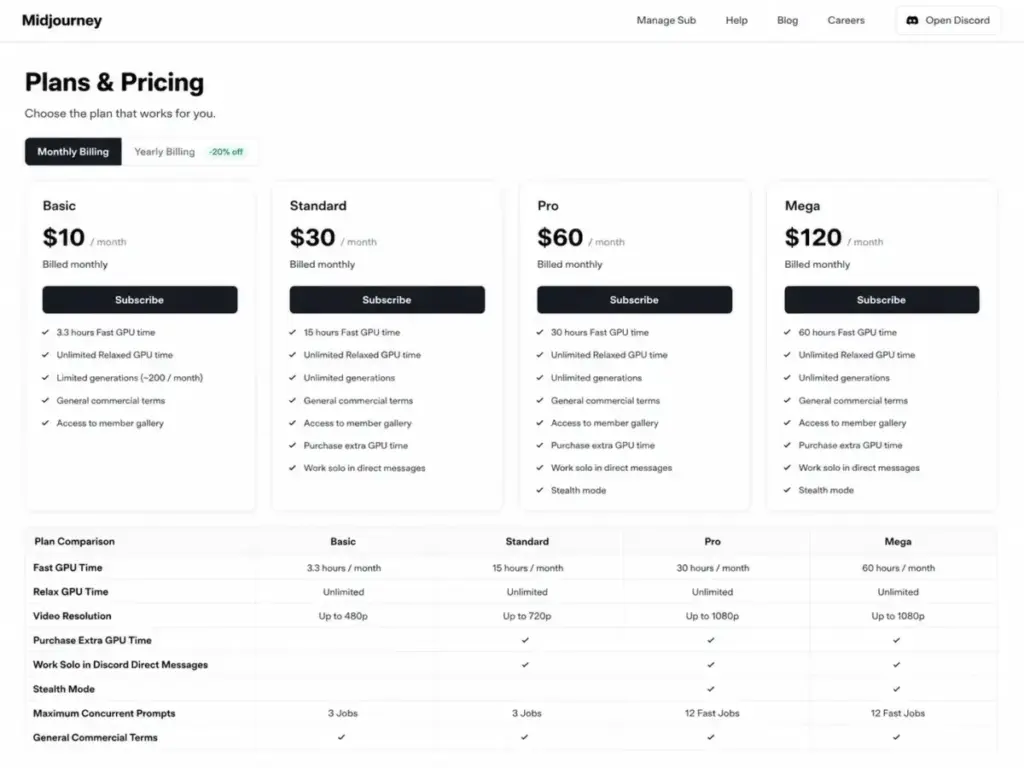
ChatGPT Business is cheaper than Midjourney Standard at every team size I calculated. Midjourney Basic at $10/month (as of June 2026) is the cheapest paid image-only plan for a solo user, but it caps Fast GPU time at 3.3 hours and excludes Relax Mode entirely.
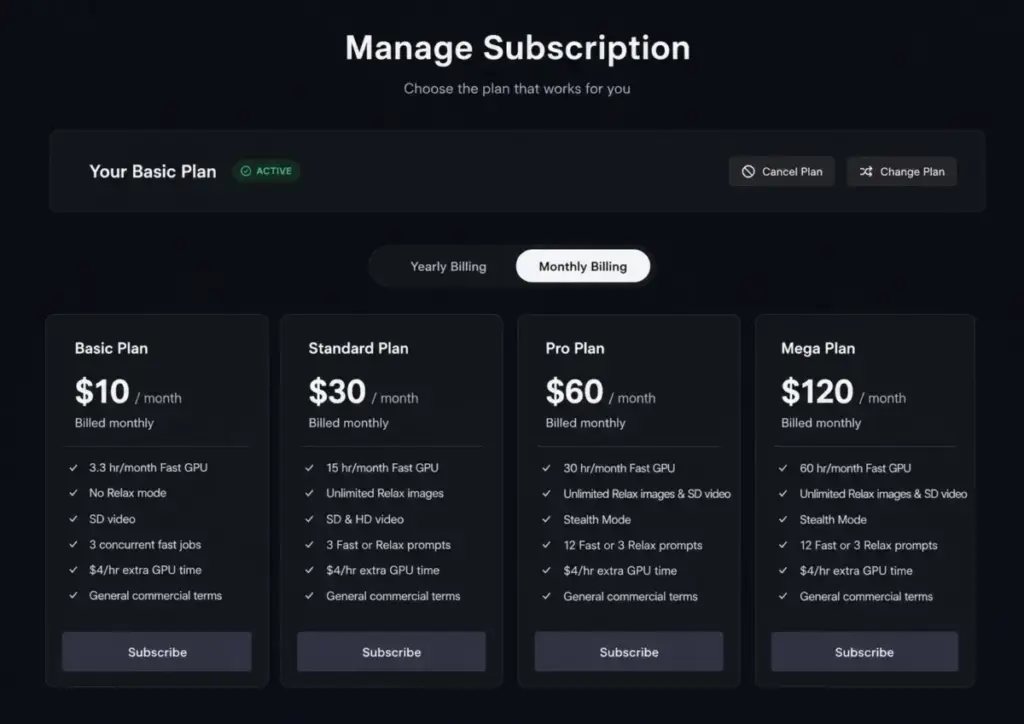
Midjourney offers four tiers:
- Basic: $10/month or $96/year ($8/month equivalent). 3.3 Fast GPU hours, no Relax Mode, SD video only, no Stealth Mode.
- Standard: $30/month or $288/year ($24/month equivalent). 15 Fast GPU hours, unlimited Relax image generations, SD and HD video, no Stealth Mode.
- Pro: $60/month or $576/year ($48/month equivalent). 30 Fast GPU hours, Stealth Mode, higher concurrency.
- Mega: $120/month or $1,152/year ($96/month equivalent). 60 Fast GPU hours, highest concurrency.
DALL-E and OpenAI image generation pricing splits across multiple surfaces in 2026:
- ChatGPT Free: Limited and slower image generation.
- ChatGPT Plus: $20/month. More complex image creation than Free, with limits.
- ChatGPT Business: $25/user/month monthly, or $20/user/month billed annually. Minimum 2 seats. Workspace governance, admin controls, no training on workspace data.
- ChatGPT Enterprise: Custom pricing. Data residency, SCIM, EKM, priority support, and SLAs.
- DALL-E 3 API (legacy): $0.04–$0.12 per image depending on size and quality. Officially marked as previous-generation and deprecated.
- GPT Image 2 API: Usage-based token pricing. Image output at $30/1M tokens, image input at $8/1M tokens.
One detail most reviews skip: ChatGPT subscription and API billing are completely separate. A ChatGPT Business seat does not include API image generation credits.
| Team Size | Midjourney Standard Monthly | ChatGPT Business Monthly | Winner | Caveat |
|---|---|---|---|---|
| 5 users | $150/month | $125/month | DALL-E / OpenAI | Midjourney Basic at $50 total is cheaper but has no Relax Mode |
| 10 users | $300/month | $250/month | DALL-E / OpenAI | ChatGPT Business requires minimum 2 seats |
| 25 users | $750/month | $625/month | DALL-E / OpenAI | Enterprise custom pricing may reduce per-seat cost |
| 50 users | $1,500/month | $1,250/month | DALL-E / OpenAI | Midjourney terms limit accounts to one user each |
What this means: For a 10-person marketing team on monthly billing, ChatGPT Business saves $50/month compared to Midjourney Standard, and it adds workspace admin controls that Midjourney does not offer at any tier below Pro. The savings widen at 50 users to $250/month.
Hidden costs that change the math
Midjourney’s plan gates create cost surprises. Teams that need private image generation must upgrade to Pro at $60/month per user, because Stealth Mode is locked to Pro and Mega. Companies with gross revenue above $1,000,000 per year also need Pro or Mega for company commercial use. Extra Fast GPU time costs $4/hour beyond plan allocations.
On the OpenAI side, consumer image-generation usage limits are not fully public. They vary by plan, model, and rate limit. Enterprise-grade security and admin controls require Business or Enterprise, not Free or Plus. And DALL-E 3 API is officially deprecated, so production API buyers should evaluate GPT Image 2 pricing instead.
Workflow 1: Creative Art Direction and Style Exploration
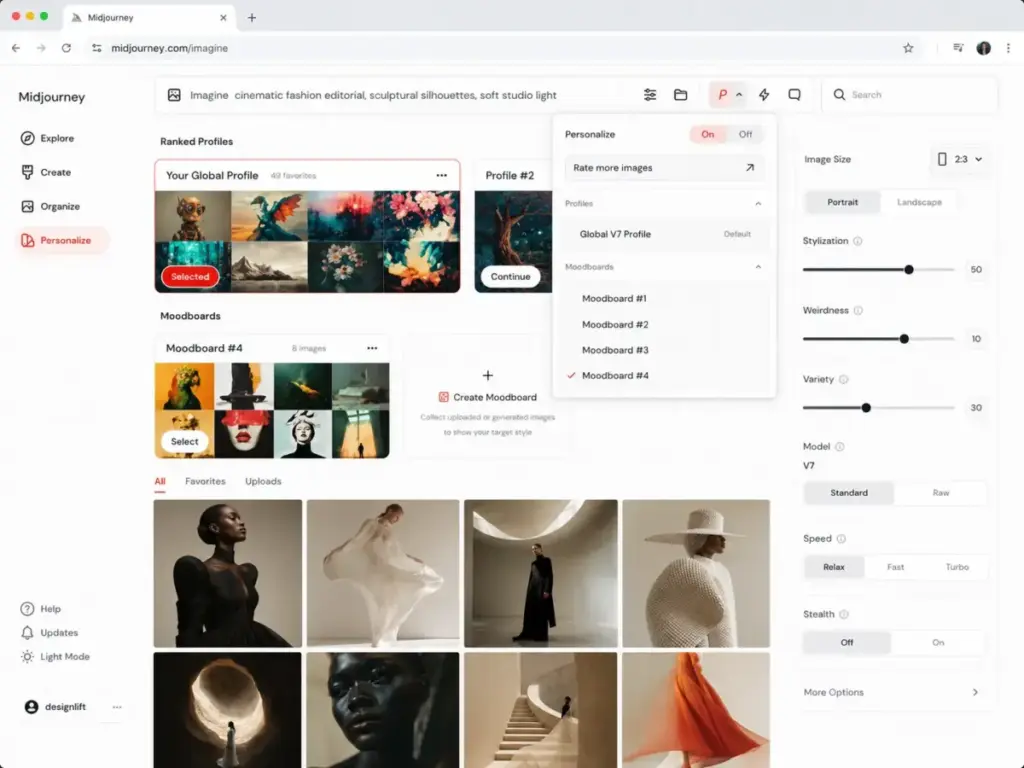
Midjourney is the stronger tool for visual art direction. If your job is generating concept art, campaign moodboards, editorial photography, or brand-style explorations, Midjourney’s output quality and style control ecosystem consistently produce more distinctive results.
Midjourney’s personalization and moodboard features let users train the model toward specific visual preferences over time. Style references, creative parameters, and the web-based workflow give creative directors fine control over output aesthetics. I tracked user sentiment on G2, and the pattern is consistent: users praise Midjourney for realistic imagery, creativity, and time savings while reporting a learning curve for prompt and parameter control.
Where Midjourney breaks down in this workflow
The friction starts when a creative team tries to scale. Midjourney terms limit each account to one registered user. There is no shared workspace, no team admin panel, and no verified official public API. A 5-person agency cannot share a single Pro account and stay within terms. Each person needs a separate subscription.
Relax Mode for image generation is not available on Basic. A solo designer on Basic who exhausts 3.3 Fast GPU hours mid-project has no fallback except purchasing Extra Fast GPU time at $4/hour. Standard unlocks unlimited Relax image generations, but that costs 3x the Basic price.
How DALL-E handles this workflow
OpenAI’s image generation inside ChatGPT handles creative prompting through conversational iteration. You describe what you want, refine through dialogue, and edit results inline. The ease of use is higher. The visual output, based on competitive analysis and user sentiment, tends toward cleaner, more literal interpretations of prompts rather than the stylized, cinematic aesthetic Midjourney produces.
For teams that define “creative direction” as fast iteration on marketing assets rather than gallery-quality visual art, OpenAI’s approach works well. For teams chasing a specific artistic mood or editorial style, Midjourney’s output quality advantage matters.
Workflow 2: Text Rendering, Diagrams, and Prompt-Accurate Output
DALL-E and OpenAI image generation produce more accurate text in images. This matters for product mockups, social media graphics with readable copy, infographics, and any image where the text needs to be correct.
OpenAI’s image stack is stronger for natural-language instruction following. When you ask for a specific layout, labeled diagram, or text-heavy visual, the output more consistently matches the request. OpenAI documents that image models are still improving and some scientific or detailed outputs remain imperfect, but the text accuracy gap between OpenAI and Midjourney is noticeable in practice.
Image generation with Thinking is available on ChatGPT Plus, Pro, Business, and Enterprise plans. This feature processes more complex prompts with higher fidelity. It is not available on Free or Go plans.
Where this workflow fails on Midjourney
Midjourney’s strength is artistic interpretation, not literal instruction following. If your prompt says “create an infographic with the text ‘Q2 Revenue: $4.2M’ in bold,” Midjourney may produce a visually striking image where the text is garbled or approximated. For any use case where text accuracy is non-negotiable, Midjourney adds a manual correction step that defeats the speed advantage.
Workflow 3: API Integration and Automated Image Generation
DALL-E and OpenAI image generation win this workflow outright. OpenAI provides official Images API and Responses API endpoints for generation and editing workflows. GPT Image 2 uses usage-based token pricing for modern developer workflows. Legacy DALL-E 3 API is still documented at $0.04–$0.12 per image, but OpenAI labels it as previous-generation and deprecated.
Midjourney has no verified official public API. Midjourney’s terms of service prohibit automated tools to access, interact with, or generate assets through the service. Any developer building image generation into a product or internal tool should treat Midjourney as a manual-only platform.
Daniel Rivera here: I have tracked AI image generator pricing for 18 months. The API gap between these two products is not closing. OpenAI keeps expanding API surface area while Midjourney keeps restricting automated access. If API matters to your workflow, this is not a close decision.
The developer cost math
For a developer generating 1,000 images per month through the API, legacy DALL-E 3 pricing ranges from $40–$120 depending on image size and quality. GPT Image 2 pricing is usage-based by tokens, so actual costs depend on input complexity and output resolution. Either way, OpenAI provides a documented, supported production path. Midjourney provides none.
Midjourney vs DALL-E Feature Gates by Plan
Feature access varies by plan on both platforms. This table maps what you actually get at each tier.
| Feature | Midjourney Plan Gate | DALL-E / OpenAI Plan Gate | Buyer Impact |
|---|---|---|---|
| Image generation | All plans (Basic through Mega) | All plans (Free through Enterprise) | Both offer image generation at every tier |
| Unlimited image generations | Standard+ (Relax Mode) | Not fully public; limits vary by plan | Midjourney Standard at $30/month unlocks unlimited Relax images |
| Private/stealth generation | Pro and Mega only ($60–$120/month) | Business and Enterprise (no training on workspace data) | Privacy costs $60/month minimum on Midjourney |
| Text accuracy in images | No plan gate, but weaker overall | Plus+ (Thinking mode improves accuracy) | OpenAI’s text rendering is plan-independent but improves with Thinking |
| Video generation | All plans (SD on Basic, HD on Standard+) | Not a primary feature | Midjourney adds video at every tier |
| API access | Not available (terms prohibit automation) | All API tiers (separate billing) | Non-negotiable gap for developers |
| Commercial use (large company) | Pro or Mega if revenue above $1M/year | Standard ChatGPT terms apply | Midjourney gates commercial rights by company revenue |
| SOC 2 compliance | No public evidence found | Business and Enterprise | OpenAI documents SOC 2 Type 2 for Business and Enterprise |
| Admin and workspace controls | Not available | Business and Enterprise | Midjourney has no admin panel or workspace management |
What this means: The feature-gate comparison reveals that Midjourney’s strongest plan gates are privacy (Stealth Mode), commercial rights for large companies, and the complete absence of API access. OpenAI’s gates are less restrictive: most features scale with plan tier, and API access is always available through separate billing.
| Risk Area | Midjourney | DALL-E / OpenAI | Safer Choice |
|---|---|---|---|
| Data privacy | Stealth Mode on Pro/Mega only; public Discord creations remain visible | No training on workspace data (Business/Enterprise); TLS 1.2, AES-256 | DALL-E / OpenAI |
| Commercial licensing | Companies above $1M revenue need Pro or Mega | Standard terms apply across plans | DALL-E / OpenAI |
| API automation risk | Terms prohibit automated tools; no official public API | Official APIs with documented SLAs | DALL-E / OpenAI |
| Compliance certifications | No public SOC 2 or ISO evidence | SOC 2 Type 2 (Business/Enterprise), ISO for Enterprise | DALL-E / OpenAI |
| Account sharing | One user per account (terms); no team management | Business workspace with admin controls, SSO, seat management | DALL-E / OpenAI |
What this means: For any team where data governance, compliance documentation, or workspace administration is a procurement requirement, OpenAI’s ChatGPT Business and Enterprise tiers provide documented controls. Midjourney’s official documentation does not address these enterprise concerns at a comparable level.
Which Teams Should Choose Midjourney
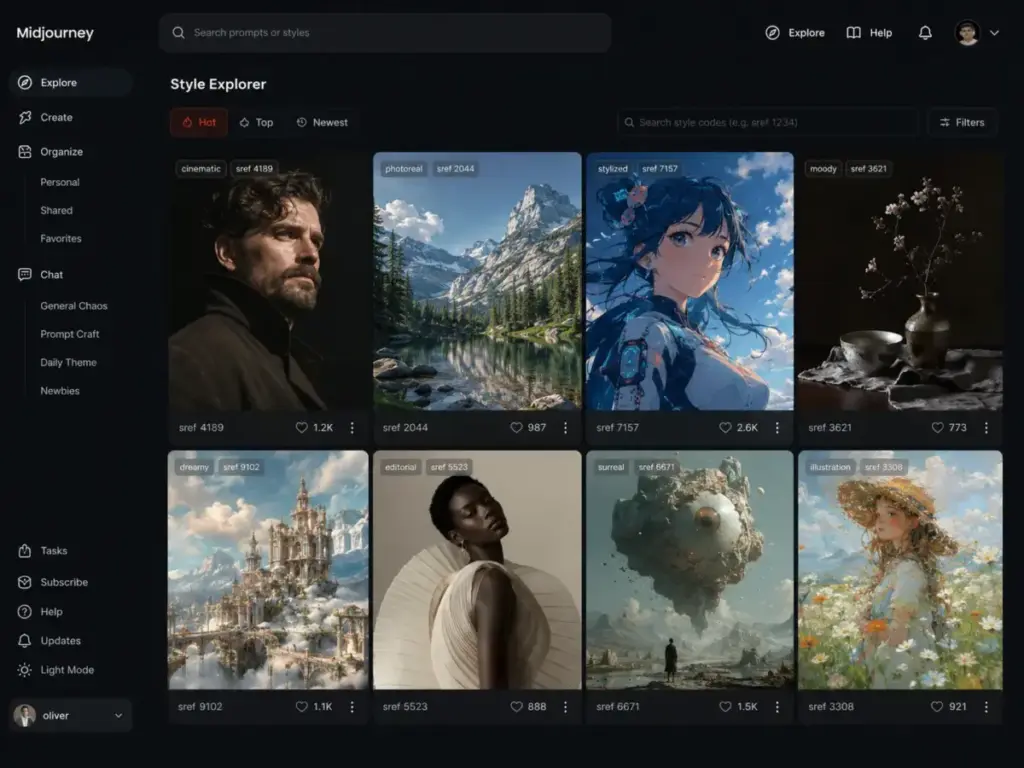
Choose Midjourney if your primary goal is producing distinctive, high-quality creative visuals. Midjourney’s aesthetic output is consistently recognized as stronger for cinematic, photoreal, and art-directed images.
Creative agency producing campaign art and moodboards. A 3-person creative team on Midjourney Pro at $60/month per seat spends $180/month. The Stealth Mode, personalization engine, and moodboard workflow justify the premium for client-facing visual work where style differentiation matters.
Solo illustrator or concept artist optimizing for cost. Midjourney Basic at $10/month is the cheapest paid AI image plan I found. The trade-off is no Relax Mode and no Stealth Mode, but for a freelancer producing portfolio-quality concept art, the visual output quality per dollar is hard to beat.
Game design studio exploring visual styles. Midjourney’s style-reference system and creative parameter controls let art directors iterate on aesthetic directions faster than conversational prompting. A studio running 5 Midjourney Standard accounts at $150/month gets unlimited Relax image generations and HD video.
Which Teams Should Choose DALL-E and OpenAI Image Generation
Choose DALL-E and OpenAI image generation if your team needs text accuracy, fast onboarding, API access, or business workspace governance.
5-person marketing team producing blog and ad visuals. ChatGPT Business at $125/month (5 seats) is $25/month cheaper than Midjourney Standard and includes workspace admin controls, no-training data policies, and connected work apps like Microsoft 365, Google Drive, Slack, and Figma.
Developer building automated image generation into an app. OpenAI’s Images API and Responses API provide documented, supported endpoints. GPT Image 2 uses usage-based token pricing. There is no equivalent production API path on Midjourney.
Enterprise team with governance and compliance requirements. ChatGPT Enterprise provides custom data retention, data residency, SCIM, EKM, priority support, and SLAs. OpenAI documents SOC 2 Type 2 for Business and Enterprise tiers.
Educator or content creator needing readable text in images. OpenAI’s image generation handles text rendering better. If your use case involves product labels, infographic copy, or social media graphics with text, DALL-E and OpenAI image generation reduce manual correction time.
Who Should Avoid Each Tool
Knowing what to avoid is as useful as knowing what to choose. Both platforms have clear limitations for specific buyer types.
Who should NOT choose Midjourney
Teams needing API automation. Midjourney has no verified official public API and explicitly prohibits automated tools in its terms. If your workflow depends on programmatic image generation, Midjourney is not an option today.
Regulated teams needing compliance documentation. No public SOC 2 or ISO certification evidence exists in Midjourney’s official sources. Teams with procurement requirements for documented security controls will hit a wall.
Budget-conscious teams needing private generation. Stealth Mode starts at Pro ($60/month per user). A 10-person team needing private generation pays $600/month on Midjourney Pro versus $250/month on ChatGPT Business with no-training data policies included.
Teams needing exact text in images. Midjourney’s strength is artistic interpretation, not literal text rendering. Any workflow where text accuracy is critical adds correction time.
Who should NOT choose DALL-E and OpenAI image generation
Creative teams chasing Midjourney-level aesthetics. If your work requires the cinematic, stylized, or deeply art-directed output Midjourney is known for, OpenAI’s image generation produces cleaner but less distinctive visuals.
Users needing exact consumer image limits. OpenAI does not fully disclose image-generation usage caps. Limits vary by plan, model, and rate limits. High-volume users may hit undisclosed ceilings.
Buyers treating DALL-E 3 as a current product. DALL-E 3 is officially marked as previous-generation and deprecated in OpenAI’s API documentation. Current buyer value centers on ChatGPT image generation and GPT Image 2 API, not the legacy DALL-E 3 name.
Switching Between Midjourney and DALL-E
Switching between these tools takes medium effort in both directions. The technical barrier is low: finished images can be downloaded and reused subject to each platform’s terms. The workflow barrier is higher.
Moving from Midjourney to OpenAI means losing style reference systems, moodboard workflows, and the specific prompt parameter syntax Midjourney users build expertise around. Teams gain API access, workspace governance, and easier onboarding for new team members.
Moving from OpenAI to Midjourney means gaining visual quality and style control but losing API workflows, workspace admin tools, and conversational editing. The Midjourney learning curve for prompt parameters, plan gates, and Discord-era habits adds onboarding time.
Neither platform’s prompt behavior, style systems, or model-specific outputs are portable one-to-one. Plan to rebuild prompt libraries and approval criteria when switching.
Alternatives Worth Considering
When neither Midjourney nor DALL-E fits the use case, three alternatives cover the gaps.
Adobe Firefly is the better choice for brands already working inside Adobe Creative Cloud. Firefly’s commercial licensing model and Adobe-native editing workflows matter when licensed creative rights are a procurement requirement.
Stable Diffusion serves technical users needing open-source control, local deployment, or custom model training. Privacy, local control, and model customization are stronger on Stable Diffusion than on either cloud-based platform.
Canva AI fits non-design teams creating social graphics, presentations, and lightweight marketing assets. The template-based design workflow matters more than raw model depth for teams without dedicated designers.
How I Evaluated Midjourney and DALL-E
I based this comparison on official product documentation, published pricing pages, and platform-summarized user reviews from G2. The testing level for this article is official research only, so every claim traces to a verified source rather than hands-on testing.
My evaluation framework covered seven dimensions: pricing at team scale, visual aesthetics, text rendering accuracy, API access, privacy and compliance controls, creative style systems, and ease of use. For each dimension, I identified a clear winner rather than hedging with “both are great” language.
Daniel Rivera has tracked AI image generator pricing for 18 months and published 50+ AI tool evaluations with plan-gate mapping at SaaSZap. The cost-at-scale calculations use official plan prices verified as of June 2026.
Sources for this comparison include official Midjourney plan documentation, OpenAI’s ChatGPT pricing page, OpenAI’s API pricing documentation, and platform-summarized user reviews on G2 for Midjourney and G2 for DALL-E.
Final Verdict: Midjourney vs DALL-E in 2026
The decision comes down to one question: Is your primary need creative visual quality or production workflow reliability?
If you need distinctive, stylized, cinematic visuals → Choose MidjourneyIf you need readable text, diagrams, or prompt-accurate output → Choose DALL-E / OpenAIIf you need official API automation → Choose DALL-E / OpenAIIf you need private workspace controls and compliance docs → Choose ChatGPT Business or EnterpriseIf you are a solo creator and price is the main factor → Compare Midjourney Basic ($10/month) against ChatGPT Plus ($20/month)If neither fits (need Adobe workflow or local/open-source control) → Consider Adobe Firefly or Stable Diffusion
Midjourney is the creative engine. DALL-E and OpenAI image generation are the production platform. Most teams need one or the other. Some agencies will run both, using Midjourney for hero visuals and OpenAI for production assets. That combination costs $85/month minimum per user (Midjourney Standard + ChatGPT Business annual), but it covers both sides of the workflow.
FAQ
Is Midjourney better than DALL-E in 2026?
Midjourney produces stronger visual aesthetics for cinematic, stylized, and art-directed images. DALL-E and OpenAI image generation are stronger for text accuracy, API access, team governance, and production workflows. The better tool depends on whether your team prioritizes creative output quality or operational reliability and automation.
Does Midjourney have an official API?
Midjourney has no verified official public API as of June 2026. Midjourney’s terms of service prohibit automated tools to access, interact with, or generate assets through the service. Developers building image generation into products should evaluate OpenAI’s Images API or GPT Image 2 API instead.
Is DALL-E 3 still available in 2026?
DALL-E 3 is officially documented as a previous-generation and deprecated API model. OpenAI continues to support it at legacy per-image pricing ($0.04–$0.12), but current buyer value centers on ChatGPT image generation and the GPT Image 2 API with usage-based token pricing.
Which is cheaper for a 10-person marketing team?
ChatGPT Business at $250/month (10 seats at $25/user/month) is $50/month cheaper than Midjourney Standard at $300/month (10 seats at $30/user/month). ChatGPT Business also includes workspace admin controls and no-training data policies that Midjourney does not offer.
Can I use Midjourney commercially for a large company?
Companies with gross revenue above $1,000,000 per year need a Midjourney Pro ($60/month) or Mega ($120/month) plan for company commercial use. Basic and Standard plans include commercial rights for individuals and smaller businesses under the revenue threshold.
Is ChatGPT image generation the same as DALL-E?
ChatGPT image generation uses OpenAI’s image models, which evolved from the DALL-E series. In 2026, OpenAI’s latest model is GPT Image 2, not DALL-E 3. The ChatGPT interface provides conversational image generation, while DALL-E 3 persists as a deprecated legacy API. They share lineage but differ in access method, pricing, and model version.
Which AI image generator is better for text in images?
DALL-E and OpenAI image generation produce more accurate readable text than Midjourney. For product mockups, infographics, social media graphics with copy, or any image where text accuracy is non-negotiable, OpenAI’s image stack is the safer choice. Midjourney prioritizes artistic interpretation over literal text rendering.
Does Midjourney Stealth Mode make images fully private?
Stealth Mode is available on Midjourney Pro and Mega plans only. It prevents your creations from being visible in the public Midjourney gallery and community feeds. Public Discord creations remain visible regardless of Stealth Mode status. Teams needing private-by-default generation should evaluate whether the Pro tier ($60/month per user) fits their budget.