Stealth Mode is the feature buyers most often assume Midjourney includes by default. It does not.
Private-by-default generation sits behind the $60/month Pro plan, and even then it does not hide anything you make in a public Discord channel. That single plan gate is a preview of how this whole decision works.
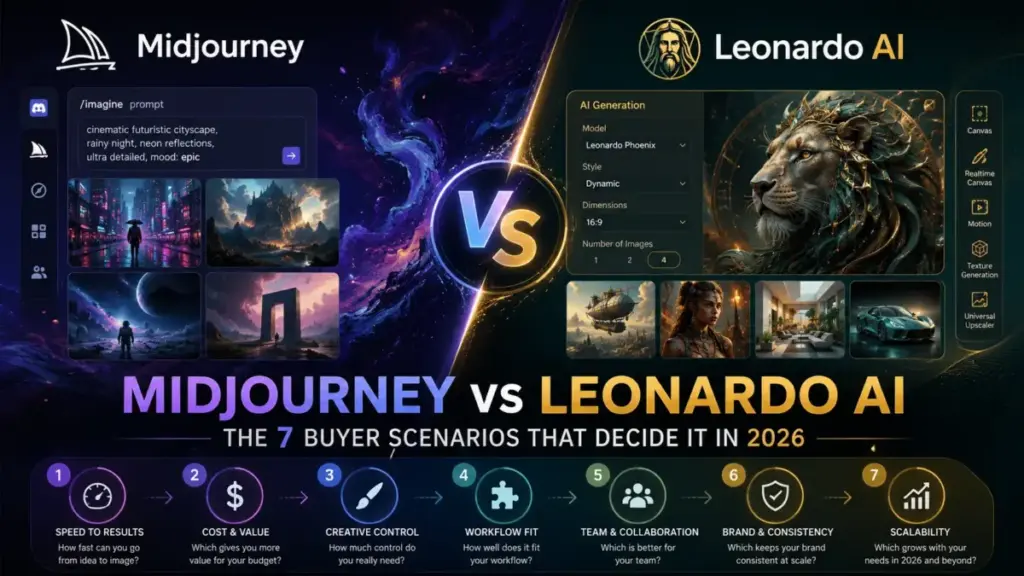
Midjourney vs Leonardo AI is not a fight over which model draws prettier pictures. It is a fight over what happens after the pretty picture: who owns it, whether a second person can log in, whether an API can call it, and what your monthly bill looks like at 10 seats.
Both are strong text-to-image AI models that belong on any serious shortlist.
They also both sit near the top of most rankings of the best AI image generators, so the choice comes down to fit, not quality alone.
Here is the short version. Choose Midjourney if you are a solo creator or art director who values default aesthetic quality over workflow control, and you do not need an API or shared team seats.
Choose Leonardo.Ai if you need free entry, editing tools, custom model training, team collaboration, or programmatic generation through an official API. Everything below is the evidence, the pricing math, and the plan gates behind that split.
Quick Verdict: Midjourney vs Leonardo AI
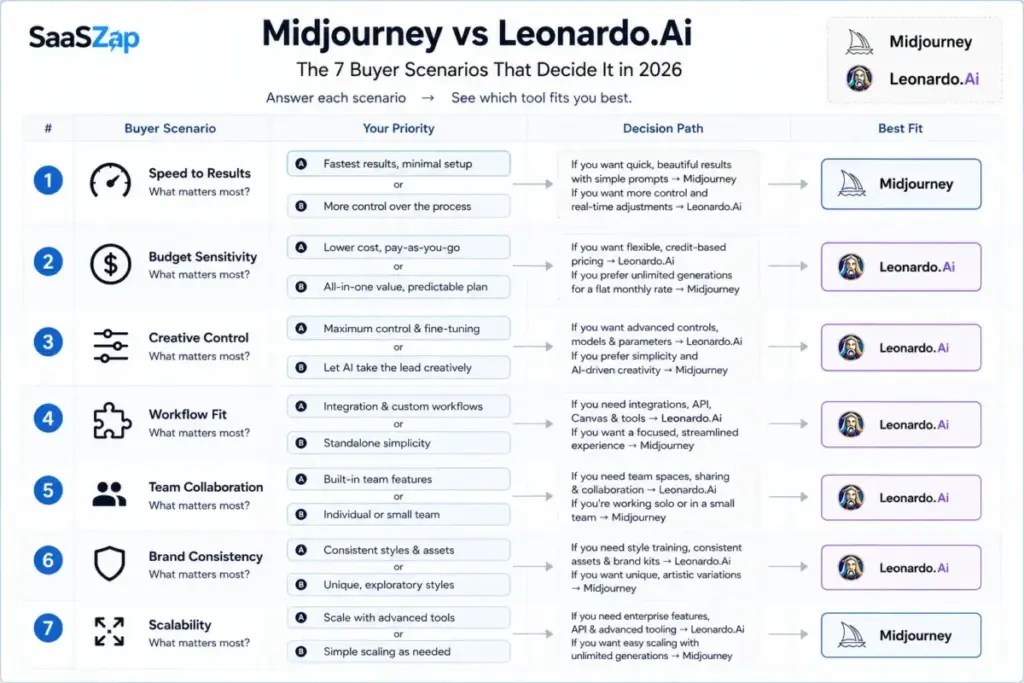
This table names a winner for each buying dimension. Two entries land on Depends because the honest answer changes with your plan and company size.
| Category | Winner | Why |
|---|---|---|
| Default aesthetic output | Midjourney | Stylized, art-directed results are its core positioning |
| Free entry | Leonardo.Ai | 150 daily tokens on the free plan; Midjourney has no free tier |
| Cheapest paid individual plan | Midjourney | Basic is $10/mo vs Leonardo Essential at $12/mo |
| Official API and automation | Leonardo.Ai | PAYG API; Midjourney docs say no public API except rare exceptions |
| Team seats and shared workflows | Leonardo.Ai | Team Starter and Growth ship shared token pools; no matching Midjourney team plan found |
| Editing and workflow control | Leonardo.Ai | Editor, upscaler, background remover, custom models, Realtime Canvas |
| Privacy by default | Depends | Midjourney Stealth is Pro/Mega only; Leonardo paid plans include private generations |
| Commercial rights clarity | Depends | Midjourney has a $1M revenue ownership rule; Leonardo free output vests in Leonardo |
| Video breadth | Leonardo.Ai | Broader video and animation; Midjourney does 5-second image-to-video |
| Security and compliance signals | Leonardo.Ai | Public SOC 2 Type I/II and GDPR statements; no Midjourney equivalent found |
What this means: Midjourney wins one dimension outright, aesthetic default, and ties two. Leonardo.Ai wins the operational dimensions that decide team and business purchases.
If your buying committee cares about API, seats, and compliance, this is already close to settled. If you are one person chasing a look, the single win Midjourney holds may be the only one you care about.
Midjourney vs Leonardo AI at a Glance
| Attribute | Midjourney | Leonardo.Ai |
|---|---|---|
| Best for | Solo creators and art directors | Teams, developers, businesses |
| Starting price | $10/mo (Basic) | $0 (Free), $12/mo (Essential, ex tax) |
| Practical tier | Standard $30 or Pro $60 | Premium $30 (ex tax) |
| Free plan | None | 150 daily tokens |
| Setup difficulty | Low for prompting | Medium, more concepts |
| Main strength | Default aesthetic output | Workflow control and API |
| Main weakness | No API, no team seats | Token accounting, model choice |
What this means: The two rows that decide most purchases are free plan and API, and Leonardo owns both. Midjourney’s starting price looks lower until you add the ownership rule for larger companies, which pushes a compliant business to the $60 Pro tier.
How We Compared
This comparison is documentation-based. I did not run a private lab test of image quality, so I will not claim one tool produces objectively better art.
That judgment stays where the market puts it: Midjourney for stylized default output, Leonardo.Ai for control.
Every price, plan gate, feature, and rights term below comes from official 2026 sources, checked on July 2, 2026. Midjourney pricing and gates come from the official Comparing Plans page; Leonardo.Ai pricing comes from its official pricing page, and API details from the official API docs.
Where a ranking article and an official page disagreed, the official page won. Several current search results still say Midjourney has no video or has an API, and the official docs contradict both.
The main limitation: Leonardo annual self-serve pricing and exact per-model API costs were not visible in the official page text checked here, so they are flagged as unverified rather than guessed.
I also found no public SOC 2 or security certification page for Midjourney, which I treat as not found, not as proof of absence.
If You Need the Best Default Look, Choose Midjourney
Midjourney is the stronger pick when your success metric is a striking image with minimal prompt engineering. Its positioning as an independent research lab centers on aesthetic interpretation, and the search consensus backs that reputation for stylized output.
The current default model is V8.1, released April 30, 2026 and made default June 10, 2026, with faster generation and tighter prompt adherence per the official version docs. For a concept artist or art director, this is the whole value: type a mood, get a usable frame.
Our Midjourney review goes deeper on the model behavior.
Here is the hype test. “Best image quality” is a real strength for ideation, but it does not survive contact with a business workflow.
The moment you need a shared login, an API call, or a private-by-default output on a cheap plan, the aesthetic edge stops mattering. So this scenario is narrow on purpose.
It fits the solo creator who works alone, exports finished images by hand, and does not need governance. That is a legitimate buyer, and for that buyer Midjourney is the answer.
If You Have No Budget, Choose Leonardo.Ai
Leonardo.Ai has a free plan with 150 daily tokens. Midjourney has no free tier in its official pricing, so a zero-budget user cannot even start there.
That gap decides the beginner scenario before features enter the conversation. A student, hobbyist, or someone testing the category pays nothing to try Leonardo.Ai, and $10/month minimum to try Midjourney Basic.
There is a catch worth stating. A token is not a fixed image, and Leonardo’s own pricing notes say consumption varies with the compute each generation needs.
So 150 daily tokens is a real trial, not an unlimited one, and heavy models drain it faster.
Free also carries a rights cost. Under Leonardo’s terms, output created by free subscribers has its intellectual property vest in Leonardo, while paid subscribers own their content.
The free plan is for learning, not commercial delivery. Our Leonardo AI review walks through where the free tier stops being enough.
If You Need an API, Choose Leonardo.Ai and It Is Not Close
Leonardo.Ai has an official pay-as-you-go API. Midjourney does not offer a public API for normal users, and its community guidelines prohibit automation and third-party scripts except in rare exceptions.
This is the clearest disqualifier in the comparison. If you are building generation into a product, a marketing pipeline, or any repeatable automated workflow, Midjourney removes itself by policy, not by capability.
Leonardo’s API bills separately from the free and web subscriptions. You create API keys, add credits, and usage is deducted from a non-expiring balance in real time, with a usage-cost calculator and webhooks documented.
Higher-volume buyers can arrange custom API pricing through sales. The billing separation is the plan gate developers miss.
Paying for Ultimate does not give you API access, and buying API credits does not enable the web unlimited tiers. Budget both lines separately if you need both.
Exact per-model API prices were not visible in the official page text checked here, so I will not quote a per-image figure. The reliable claim is structural: one tool has a documented public API, the other prohibits automation.
If You Run a Team, Choose Leonardo.Ai
Leonardo.Ai publishes team plans. Midjourney does not publish a comparable team plan in its captured official docs, and its terms restrict sharing one account among multiple users.
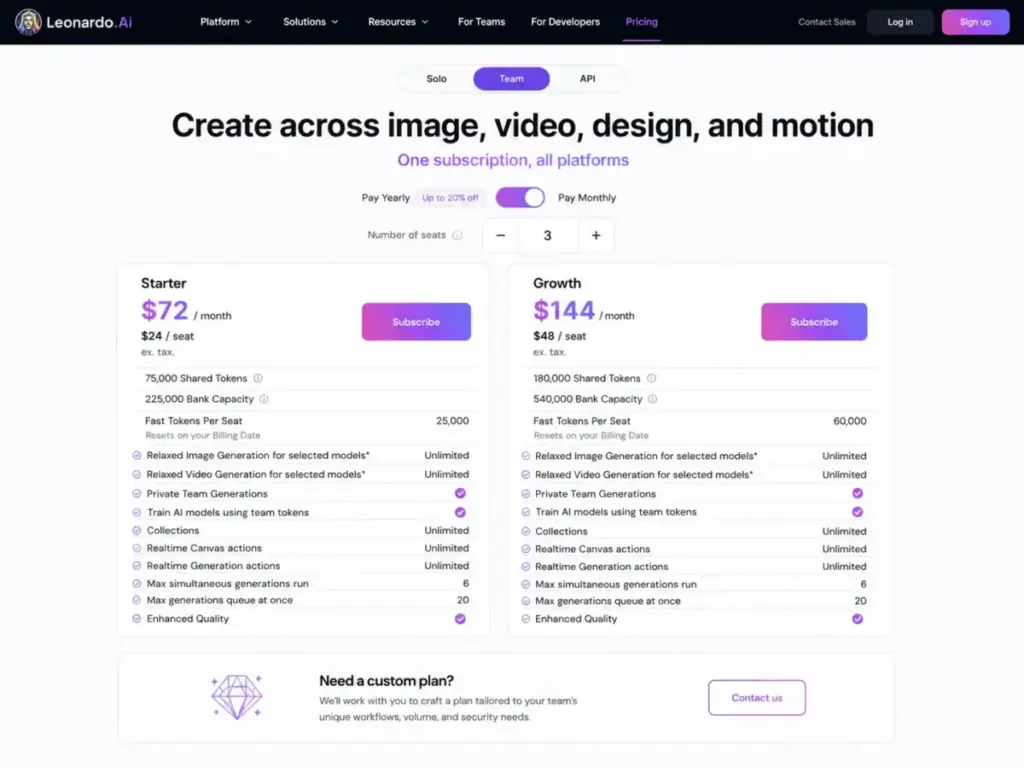
For a design department or agency, that is a governance problem, not a preference. Leonardo Team Starter runs $24/seat/month (shown as $72/month) and Team Growth runs $48/seat/month (shown as $144/month), each with shared token pools, team private generations, and team management tools.
Midjourney’s structure forces one paid account per person because account sharing is restricted. There is no shared token pool, no team space, and no central admin surface documented.
Each seat is a separate subscription and a separate login to manage. The failure mode shows up in month two, not day one.
A five-person team on Midjourney is five individual bills and five isolated asset libraries with no shared workspace. On Leonardo, it is one shared pool and one admin view, and that difference outweighs any aesthetic gap for collaborative production.
If Privacy or Ownership Is a Dealbreaker, It Depends
This is where a clean winner would be dishonest. Both tools have privacy and rights gates that can disqualify them for the wrong buyer.
Midjourney Stealth Mode, which keeps your generations private, is only available on Pro ($60/month) and Mega ($120/month). It also does not hide content you generate in a public Discord channel, so privacy depends on both the plan and where you work.
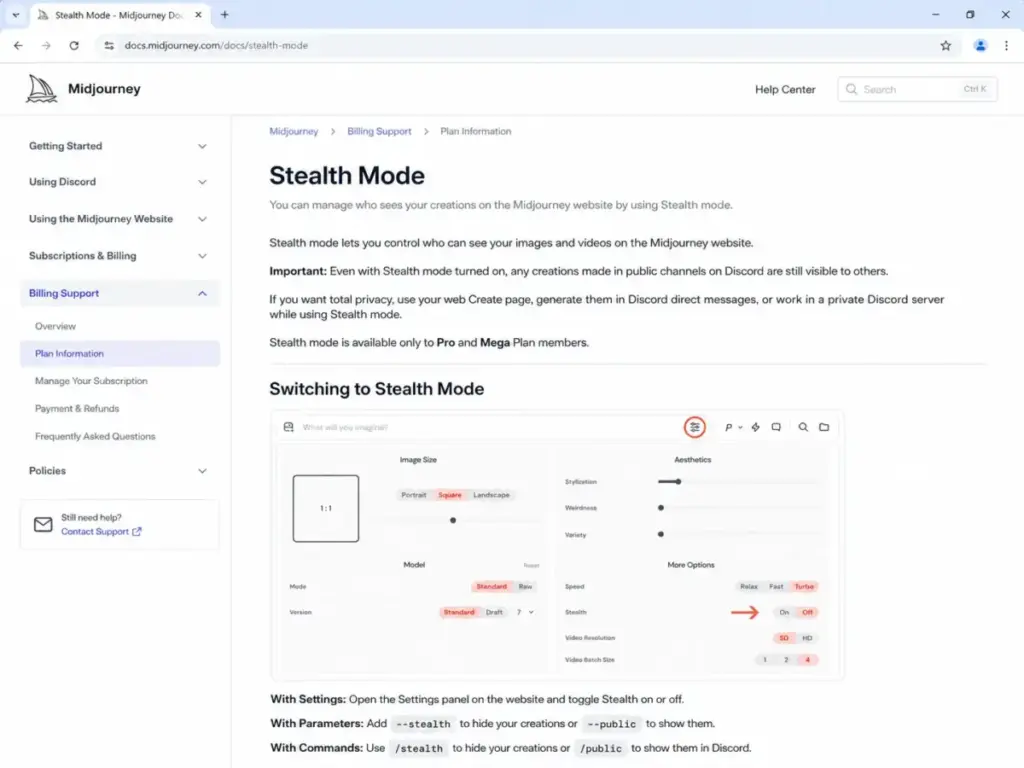
Midjourney’s terms add a revenue rule most comparisons omit. A company with more than $1,000,000 in annual gross revenue must subscribe to Pro or Mega to own its generated assets.
Below that threshold, ownership applies to the fullest extent with exceptions, but default content may still be public and remixable.
Leonardo’s rights model splits by payment status. Paid subscribers own their content, and their private paid content is not used to train new products without written consent, while free subscriber output vests in Leonardo.
So the honest verdict is conditional. A privacy-sensitive buyer under $1M revenue who wants Midjourney’s look needs at least Pro for Stealth.
A business that wants clear paid ownership and private generation without a public-gallery default leans Leonardo on a paid plan. Neither is safe on its cheapest or free option.
If You Need Image and Video Together, Lean Leonardo.Ai
Both tools generate video in 2026, so the old “Midjourney has no video” claim is stale. The real comparison is workflow breadth, not a yes-or-no answer.
Midjourney turns images into 5-second videos. All tiers can generate video in Fast Mode, Standard through Mega can generate HD video in Fast Mode, and relaxed SD video is limited to Pro and Mega per the official video docs.
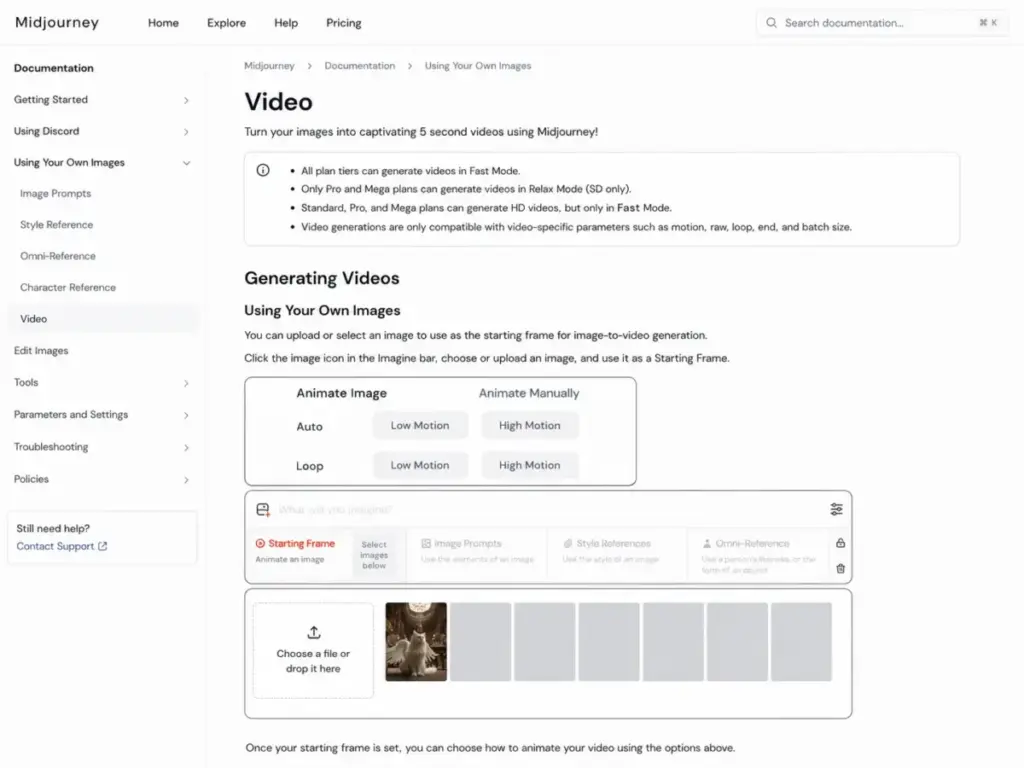
Leonardo positions a broader video and animation surface with multiple models, and its unlimited relaxed video is gated to the Ultimate plan for selected models only.
If video is central to your work, Leonardo’s range and editing tools give it the edge, though you should also weigh dedicated tools on our list of the best AI video generators.
The caveat on both sides is the word unlimited. Leonardo’s unlimited relaxed generation applies only to selected models and can slow under demand.
Midjourney’s Relax jobs can wait roughly 0 to 30 minutes depending on queue state, and its terms say unlimited plans may be rate limited.
If You Are Over $1M Revenue and Want Midjourney, Read the Fine Print First
A company past $1,000,000 in annual gross revenue cannot own Midjourney assets on Basic or Standard. Ownership requires Pro or Mega under Midjourney’s terms.
This turns a $10 or $30 plan into a $60 minimum for a compliant business. The revenue threshold is a pricing decision disguised as a rights clause, and it is easy to miss until legal review catches it.
Leonardo does not tie ownership to a revenue number in its captured terms. Paid subscribers own their content regardless of company size, which is simpler for a growing business to reason about.
If your finance or legal team will scrutinize output rights, model this as a Pro-or-Mega Midjourney cost from the start, or default to a Leonardo paid plan where the ownership rule is flat.
Pricing Comparison: Starting Price vs Practical Tier
Starting price is misleading here because the two tools sell different units. Midjourney sells Fast GPU time and relaxed modes; Leonardo sells fast tokens, token banks, and API credits.
Here are the official individual plans, checked July 2, 2026. The full Midjourney pricing breakdown lists every Fast GPU and Stealth gate.
The Leonardo AI pricing details page covers token allotments and private-generation gates by plan.
| Plan | Monthly (USD) | Key limits |
|---|---|---|
| Midjourney Basic | $10 | 3.3 Fast GPU hours, no Relax Mode |
| Midjourney Standard | $30 | 15 Fast GPU hours, unlimited relaxed images |
| Midjourney Pro | $60 | 30 Fast GPU hours, Stealth Mode, unlimited relaxed images and SD video |
| Midjourney Mega | $120 | 60 Fast GPU hours, Stealth Mode, unlimited relaxed images and SD video |
| Leonardo Free | $0 | 150 daily tokens, no paid ownership treatment |
| Leonardo Essential | $12 (ex tax) | 8,500 fast tokens, token bank, private creations, 10 models, 2 concurrent |
| Leonardo Premium | $30 (ex tax) | 25,000 fast tokens, 20 models, 3 concurrent, unlimited relaxed images (selected models) |
| Leonardo Ultimate | $60 (ex tax) | 60,000 fast tokens, 50 models, 6 concurrent, unlimited relaxed image and video (selected models) |
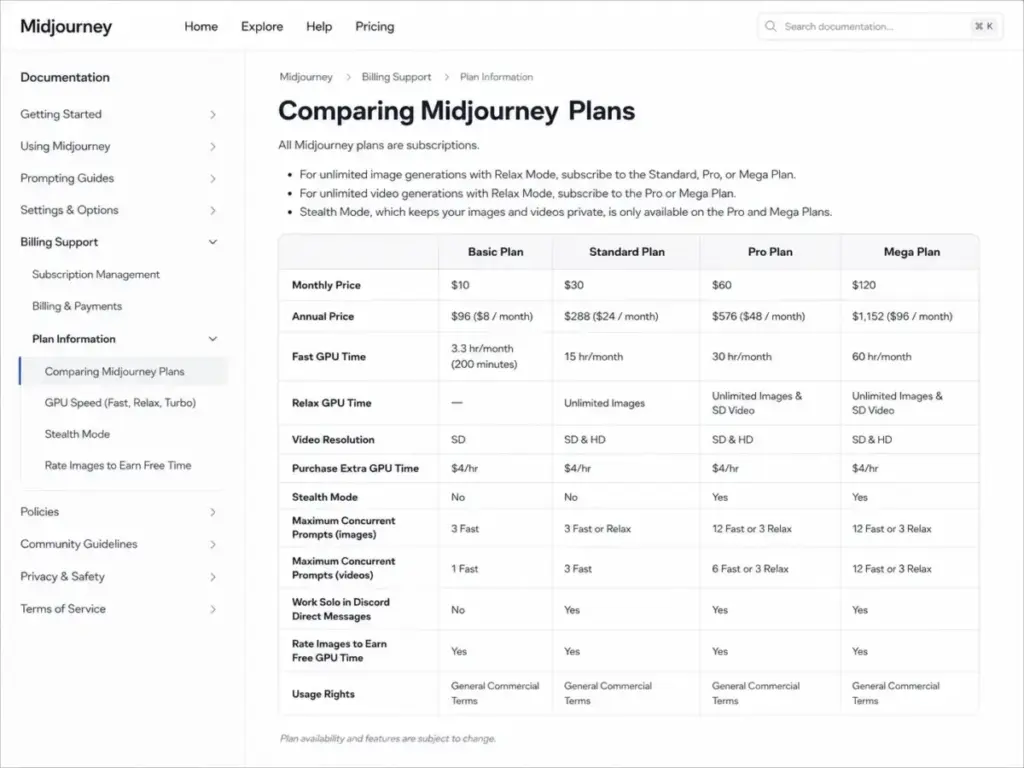
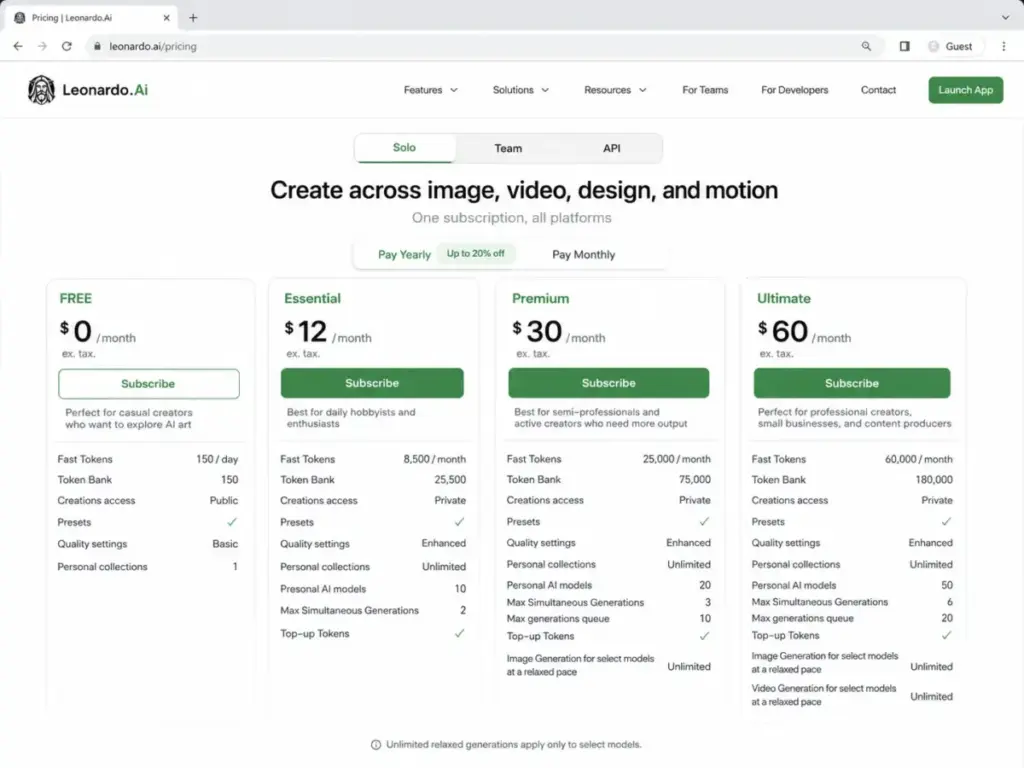
What this means: Midjourney Basic is the cheapest paid door at $10, but it has no Relax Mode, so your 3.3 Fast GPU hours are the whole month. The practical Midjourney tier is Standard at $30 for unlimited relaxed images, or Pro at $60 once privacy or business ownership enters.
Leonardo’s practical individual tier is Premium at $30, where relaxed generation on selected models turns on. Midjourney’s annual billing takes 20% off, paid upfront: $96, $288, $576, and $1,152 for the four tiers.
Leonardo’s annual self-serve pricing was not verified in the official page text checked on July 2, 2026, so treat monthly as the confirmed figure.
Cost at Scale: 5, 10, 25, and 50 Seats
Team cost is where the single-price comparison breaks. This table assumes Midjourney Standard as one account per user ($30/seat) versus Leonardo Team Starter at $24/seat.
Team Starter displays as $72/month, which implies a 3-seat starting bundle, so the per-seat math is fairest at 3 or more seats.
| Seats | Midjourney Standard | Leonardo Team Starter | Winner |
|---|---|---|---|
| 5 | $150/mo | $120/mo | Leonardo.Ai |
| 10 | $300/mo | $240/mo | Leonardo.Ai |
| 25 | $750/mo | $600/mo | Leonardo.Ai |
| 50 | $1,500/mo | $1,200/mo | Leonardo.Ai |
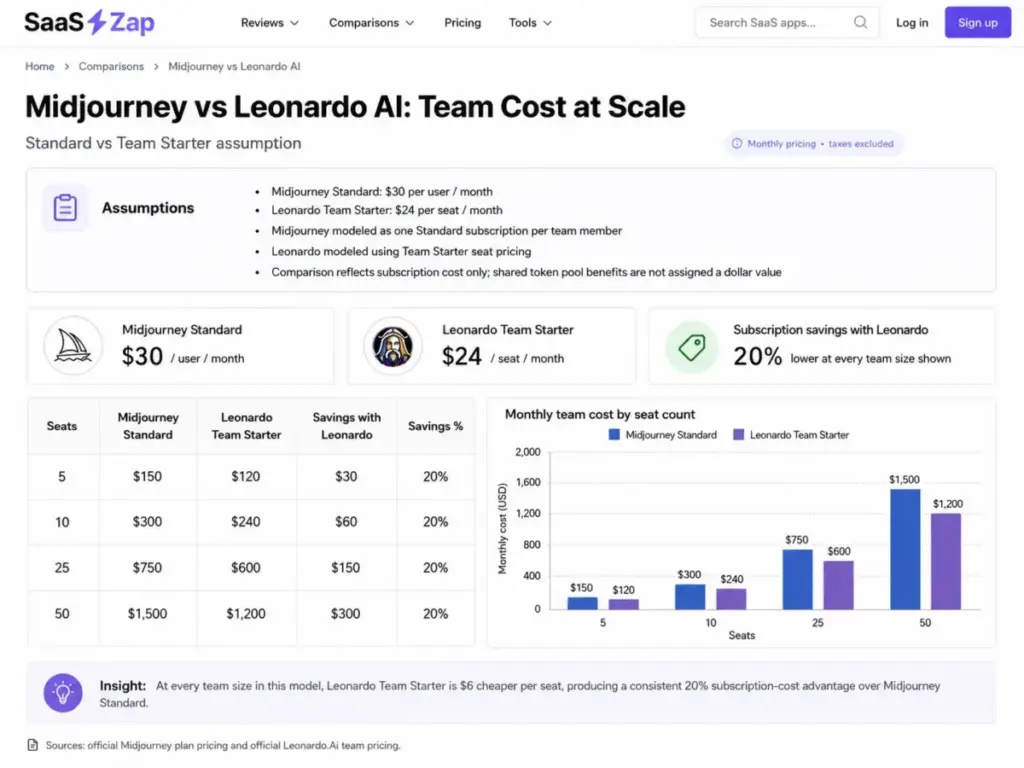
What this means: On this assumption, Leonardo is about 20% cheaper per seat at every team size, and it adds shared tokens and admin that Midjourney’s per-account model does not provide. These are not identical products, so read this as budget planning, not a claim that a token equals a GPU hour.
Hidden Costs Both Sides Bury
Midjourney charges $4/hour for extra Fast GPU time once your monthly allotment runs out. Annual plans require a full year paid upfront, and there are no refunds for the current billing period after you cancel.
Leonardo’s listed prices exclude tax, and top-up tokens require an active subscription and are consumed after your monthly and rollover tokens. API credits are billed separately from any web plan, so a team that wants both web and API access pays two lines.
Feature Comparison Matrix
Each row names a winner and the plan gate that matters. This is the plan-gate map: the difference between a feature existing and a feature being available on the plan you can afford.
| Feature | Midjourney | Leonardo.Ai | Winner |
|---|---|---|---|
| Default aesthetic output | V8.1, strong stylized results | Strong, control-first | Midjourney |
| Editing tools | Editor with Remix, Vary Region, Pan, Zoom Out | Editor, upscaler, background remover, Realtime Canvas | Leonardo.Ai |
| Custom model training | Not documented | 10 to 50 personal models by plan | Leonardo.Ai |
| Video | Image-to-video, 5-second clips, HD in Fast Mode | Broader video, relaxed video on Ultimate | Leonardo.Ai |
| Official API | None except rare exceptions | PAYG API, keys, webhooks | Leonardo.Ai |
| Team seats | One user per account | Team Starter and Growth, shared pool | Leonardo.Ai |
| Private by default | Stealth Mode on Pro/Mega only | Private creations on paid plans | Leonardo.Ai |
| Concurrency | Plan-based prompt limits | 2 to 6 simultaneous by plan | Leonardo.Ai |
| Unlimited relaxed | Standard+ images, Pro/Mega SD video | Selected models only, may slow | Depends |
| Security signals | No public SOC 2 found | SOC 2 Type I/II, GDPR statements | Leonardo.Ai |
What this means: Midjourney’s one clear win is the default look. Leonardo takes nine rows because it is built as a workflow platform, not a generation engine, so a checklist longer than “make a nice image” tilts the matrix hard.
Automation and Workflow Comparison
Automation is the sharpest divide between these tools, and it is a policy divide, not a capability one. Leonardo supports programmatic generation; Midjourney forbids it for normal accounts.
Midjourney’s community guidelines prohibit automation and third-party scripts except in rare exceptions. So the batch workflows people build with bots against Midjourney sit outside its terms and can put an account at risk.
That is a failure mode you inherit the day you try to scale output. Leonardo’s automation runs through the documented API with keys, endpoints, and webhooks.
A marketing team can trigger generation from a content pipeline, and a product can request images on demand, all billed against a non-expiring credit balance.
For a repeatable workflow, this is the whole decision. Manual, one-image-at-a-time work suits Midjourney; anything that runs without a human clicking generate needs Leonardo or a different tool entirely.
Usage Limits, Tokens, and GPU Hours
The pricing units matter more than the sticker prices, and most comparisons skip them. Midjourney meters Fast GPU time and offers Relax Mode; Leonardo meters fast tokens with a token bank and top-ups.
Here is the usage math. Midjourney Standard gives 15 Fast GPU hours a month, and extra Fast time costs $4/hour once that runs out.
Relax Mode then covers unlimited relaxed images on Standard and above, but Relax jobs can wait roughly 0 to 30 minutes depending on queue. Leonardo’s token, by contrast, is not a fixed image.
Its pricing notes say token use depends on the compute each generation needs, so a heavy model burns tokens faster than a light one. Essential’s 8,500 fast tokens and Ultimate’s 60,000 are ceilings measured in compute, not in image count.
The predictability verdict cuts both ways. Midjourney’s GPU hours are easier to reason about for steady daily use, since an hour is an hour.
Leonardo’s tokens flex with model choice, which rewards planning and punishes heavy experimentation. Do not treat a GPU hour and a token as interchangeable; they measure different things.
Integrations and Ecosystem
Neither tool is integration-rich the way a CRM is, so judge the ecosystem, not a plugin count. Midjourney’s core surfaces are its web Create flow and Discord, with no public API to wire into other apps.
Leonardo sits inside the Canva ecosystem after Canva’s 2024 acquisition, while continuing to operate as an independent web platform. Its API and documented mobile apps give it more reach into external workflows than Midjourney offers.
The ecosystem consequence is about where your work lives. If your team already publishes through Canva, Leonardo’s ownership by the same parent is a practical adjacency, and the Canva AI review shows where the two overlap.
If you work standalone and export finished images, Midjourney’s lack of integrations rarely bites.
Support, Security, and Admin Controls
Security signals are where enterprise procurement quietly kills a tool, and this is the least balanced section in the comparison. Leonardo publishes SOC 2 Type I and Type II accreditation and GDPR-related privacy statements, including commercial-customer data-processing context.
I found no public SOC 2 or equivalent security certification page for Midjourney in this research. That is not proof one does not exist, but a procurement team that requires documented compliance will struggle to approve a tool it cannot verify.
Admin controls follow the same pattern. Leonardo Team plans include shared workspaces, team private generations, and management tools, while Midjourney’s one-account-per-user model has no documented central admin surface.
Support expectations should stay modest on both sides. Midjourney’s terms disclaim guarantees of quality, uptime, or reliability, and Leonardo’s terms note no promise of 100% availability and possible throttling for excessive usage.
For a business, that means neither tool ships an SLA you can lean on without checking current contract terms.
Ease of Use and Setup
Setup difficulty depends on your role, not on a single easier-or-harder verdict. For pure prompting, Midjourney is fast: type a prompt in the web Create flow or Discord and get output.
It is not Discord-only anymore, which corrects a common stale claim. For a repeatable workflow, though, Leonardo asks more upfront.
The web interface and templates lower the first-hour friction, but tokens, model choice, editing tools, Blueprints, and API billing add concepts a beginner has to learn.
The human-in-the-loop reality applies to both. AI outputs are not guaranteed unique, and Leonardo’s own terms say so, so a person still reviews, selects, and often edits before anything ships.
Neither tool removes the review step; they change how fast you reach a candidate image.
Migration and Setup Difficulty
Switching between these tools is medium difficulty for solo creators and harder for teams. Generated images and videos export as files, but the parts that create lock-in do not transfer.
| Direction | Difficulty | What does not transfer |
|---|---|---|
| Midjourney to Leonardo | Medium | Prompt behavior, style references, personalization |
| Leonardo to Midjourney | Medium to high | Custom models, API workflows, team spaces, shared token pools |
What this means: Prompt dialects differ, so a prompt tuned for Midjourney rarely behaves the same in Leonardo. Custom-trained models and API pipelines have no export path between the two, which makes leaving Leonardo costly for developers and teams.
Keep your own prompt and asset records; there is no documented model-weight or workspace migration between platforms.
Where Midjourney Wins
Midjourney’s wins cluster around a single solo creator chasing a look. These are real, and they are narrow.
It leads on default aesthetic output for art direction and moodboarding, and on cheapest paid individual entry at $10.
It is also fastest for low-setup prompting when you just want a strong frame, and it fits the creator who never needs a second seat, an API, or a compliance review.
Where Leonardo.Ai Wins
Leonardo’s wins cluster around teams, developers, and businesses. These are the operational dimensions that decide larger purchases.
It leads on free entry, official API access, team seats with shared tokens, editing and custom-model breadth, and public security signals like SOC 2.
It also carries flat ownership rules for paid users, with no revenue threshold attached. For anyone building a workflow rather than a single image, Leonardo is the safer default.
Who Should Choose Midjourney
Choose Midjourney if you match at least two of these buyer profiles. The pattern is a single creator who trades control for a strong default result.
First, you are a solo artist, illustrator, or art director whose output is judged on aesthetic quality. Second, you work manually and export finished images by hand, with no need for automation.
Third, your budget starts at $10/month and you do not need a free trial to commit. Fourth, you do not need shared seats, an API, or documented compliance.
If your company clears $1M in revenue, add the ownership rule to your plan choice and budget for Pro at $60 to keep asset rights clean.
Who Should Choose Leonardo.Ai
Choose Leonardo.Ai if you match at least two of these profiles. The pattern is a team, developer, or business that needs workflow and governance, not just an image.
First, you want to start free or you are price-sensitive at team scale, where per-seat cost runs about 20% below Midjourney Standard. Second, you need an official API for a product or an automated pipeline.
Third, you run a design team or agency that needs shared seats, a shared token pool, and team private generations. Fourth, you need editing, upscaling, background removal, or custom model training in one place.
Fifth, your procurement requires documented security such as SOC 2 and GDPR handling. Any one of these is enough to make Leonardo the safer default over Midjourney.
Who Should Avoid Both
Neither tool is the right answer for every image job, and pretending otherwise is how buyers end up disappointed.
Avoid both if you need accurate typography or text-in-image, where general generators still struggle. Avoid both if you need photorealistic, brand-locked product photography with strict consistency.
Avoid both, too, if you need regulated enterprise procurement with contract terms neither tool documents publicly.
If those describe you, start with focused Midjourney alternatives built for typography or product photography.
The Leonardo AI alternatives list covers options for teams that need different rights or procurement terms.
Alternatives to Midjourney and Leonardo.Ai
If neither fits, three tools cover the common gaps. Verify current pricing on each before you buy, since AI pricing changes quickly.
| Alternative | Choose it if |
|---|---|
| Ideogram | You need accurate typography, lettering, or logos |
| Adobe Firefly | Your team lives in Adobe and needs brand-safe, procurement-ready output |
| Canva AI | Non-designers need generation inside a publishing workflow |
Choose Ideogram if accurate lettering, logos, and typography matter most, which is the weakest area for both tools here. See the Ideogram review for its text-rendering strengths.
Choose Adobe Firefly if your team already lives in Adobe apps and needs brand-safe, procurement-friendly generation. The Adobe Firefly review covers the enterprise workflow fit.
Choose Canva AI if non-designers need generation inside a broader publishing workflow. Leonardo is part of Canva after the 2024 acquisition, so the two ecosystems increasingly overlap for template-first teams.
Final Verdict
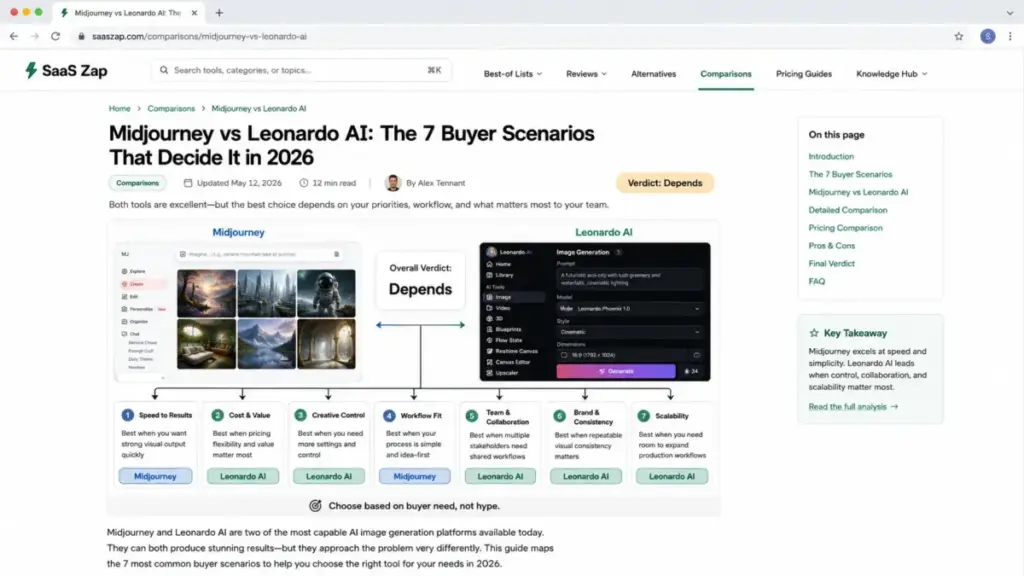
Midjourney vs Leonardo AI resolves by buyer type, not by a single champion. The image quality debate is the least useful part of the decision.
Pick Midjourney if you are a solo creator or art director, you value default aesthetic output, you can pay at least $10/month, and you need no API, no seats, and no compliance review. If your company clears $1M in revenue or you need privacy, budget for Pro at $60.
Pick Leonardo.Ai if you need a free starting point, an official API, team seats, editing and custom models, or public security signals. At 5 to 50 seats it also runs about 20% cheaper per seat on the Standard-versus-Team-Starter assumption above.
The deciding factor is almost always operational: seats, API, and rights. If you feel any of those in your requirements, Leonardo is the fit; if you feel none of them, Midjourney’s look is yours to enjoy.
FAQ
Which is better, Midjourney or Leonardo AI?
Neither wins outright. Midjourney is better for solo creators who want the strongest default aesthetic with minimal setup.
Leonardo.Ai is better for teams, developers, and businesses that need free entry, an API, shared seats, editing tools, or compliance signals. The right pick depends on whether your needs are creative-solo or operational-team.
Is Leonardo AI free?
Yes, partly. Leonardo.Ai has a free plan with 150 daily tokens, which is enough to test the tool but not unlimited, since token use varies by model.
The catch is rights: under Leonardo’s terms, output created by free subscribers has its IP vest in Leonardo, so the free tier is for learning, not commercial delivery.
Does Midjourney have a free trial?
No. Midjourney’s official pricing has no free tier, and the cheapest paid door is the Basic plan at $10/month.
If you want to try AI image generation at zero cost, Leonardo.Ai’s free plan is the practical starting point instead.
Does Midjourney have an official API?
No, not for normal users. Midjourney’s community guidelines state it does not provide an API except in rare exceptions, and they prohibit automation and third-party scripts.
If you need to build generation into a product or pipeline, Leonardo.Ai’s pay-as-you-go API is the tool that supports it.
Which is cheaper for a 10-person team?
Leonardo.Ai, on the fairest available assumption. Ten Midjourney Standard accounts run $300/month, while Leonardo Team Starter at $24/seat runs $240/month for 10 seats and adds shared tokens and admin.
These are different products, so read it as budget guidance rather than a feature-for-feature match.
Does Leonardo AI own my images?
It depends on your plan. Paid Leonardo subscribers own their content, and private paid content is not used to train new products without written consent.
Free subscribers are the exception: their output IP vests in Leonardo under the terms, which is why free is not suitable for commercial work.
Can Midjourney make videos?
Yes. Midjourney can turn images into 5-second videos, all tiers generate video in Fast Mode, and Standard through Mega can make HD video in Fast Mode, while relaxed SD video is limited to Pro and Mega.
Any article claiming Midjourney has no video is out of date for 2026.
Should I switch from Midjourney to Leonardo AI?
Yes, if you have hit a wall on API access, team seats, or editing and custom models, since those are structural gaps in Midjourney.
No, unless you actually need those, because your prompt style and references will not transfer cleanly. Solo creators happy with the output rarely gain enough to justify the switch.