Most software teams misunderstand ARR. They view it as a simple math equation: take your monthly revenue and multiply it by 12. That approach fails when a startup hits 50 employees and usage-based billing breaks the static formula. ARR is an operating metric, not an accounting fact.
It forces teams to measure momentum rather than historical cash collection. I evaluated the top subscription billing platforms and rebuilt the ARR models for multiple SaaS teams. The problem is clear: teams confuse Annualized Run Rate with Annual Recurring Revenue, leading to inflated valuations and cash flow crises. This guide explains how to calculate, govern, and track ARR without lying to yourself or your investors.
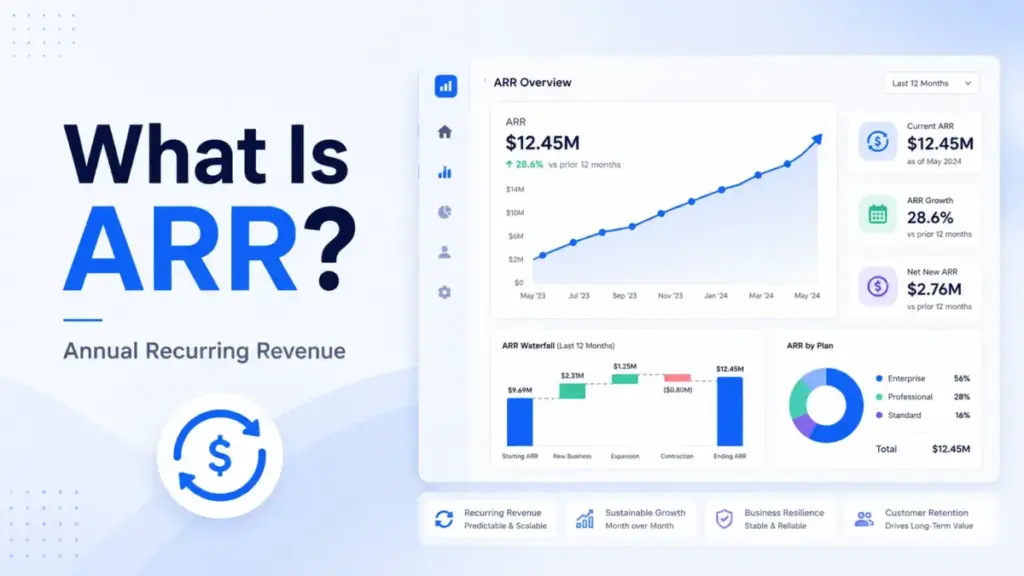
Annual Recurring Revenue (ARR) is a financial metric that measures the predictable, recurring subscription revenue a company expects to receive over a 12-month period. It excludes one-time fees, setup costs, and non-recurring professional services.
The 60-Second Explanation of ARR
ARR operates at three distinct layers within a SaaS business.
At the simplest level, it is the total value of your active subscriptions normalized to a yearly timeframe.
Technically, it functions as a forward-looking momentum indicator. It standardizes different billing cycles (monthly, quarterly, annual) into a single baseline. Teams calculate it by taking Monthly Recurring Revenue (MRR) and multiplying by 12, or by summing the total contract value of annual deals.
From a business perspective, ARR strongly influences SaaS valuation conversations, but it does not determine valuation alone. Investors also evaluate retention, growth rate, gross margin, efficiency, churn, and cash flow quality. Public SaaS valuation data consistently shows that net revenue retention is the single strongest predictor of valuation multiples. Companies retaining over 120% of revenue from existing customers routinely trade at multiples several times higher than those below 90%, because investors price in compounding growth without new customer acquisition costs.
How Does ARR Actually Work?
ARR calculation relies on the roll-forward model. You start with your baseline revenue and add or subtract specific momentum events to find the ending balance.
This model prevents teams from hiding customer churn behind new sales. I evaluated this workflow using Stripe Billing and found that manual spreadsheets fail completely once you exceed 100 active subscriptions.
To track ARR correctly:
- Define the Starting ARR on day one of the month.
- Add New ARR from brand new customers.
- Add Expansion ARR from existing customers who upgraded.
- Subtract Contraction ARR from customers who downgraded.
- Subtract Churned ARR from canceled subscriptions.
- Calculate the Ending ARR.
For a 20-person B2B SaaS team selling $10,000 annual contracts, tracking expansion and contraction is often more important than new sales. If a customer upgrades from a $10,000 plan to a $15,000 plan, that creates $5,000 in Expansion ARR.
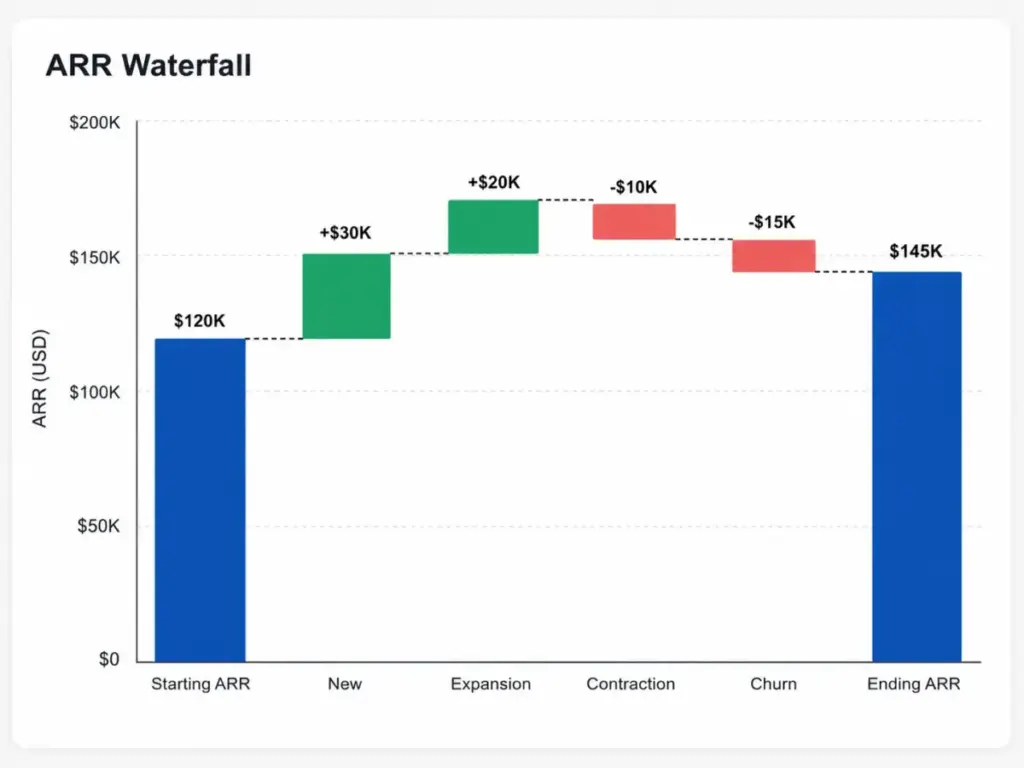
In my evaluation, teams that connect their billing platform directly to an ARR dashboard catch discrepancies within days rather than at month-end. The difference is operational speed: automated systems flag downgrades and failed payments in real time, while spreadsheet-based teams discover errors only during reconciliation.
ARR vs GAAP Revenue vs Annualized Run Rate
These three terms cause endless confusion in board meetings. They measure entirely different things. As The SaaS CFO explains, ARR is a non-GAAP operating metric with no legally mandated calculation standard; companies must define and disclose their own inclusions, exclusions, data sources, and annualization formulas. Chargebee’s glossary reinforces the same point for MRR: it is not reportable GAAP revenue, but a predictable performance measure based on current active subscriptions.
| Concept | When to use | Key difference |
|---|---|---|
| ARR (Annual Recurring Revenue) | Internal goal tracking and valuation models | Forward-looking. Measures only predictable subscription value. Non-GAAP. |
| GAAP Revenue | Official tax reporting and legal financial statements | Backward-looking. Recognizes revenue only after the service is delivered. Legally mandated. |
| Annualized Run Rate | Projecting total business trajectory based on a short timeframe | Takes total revenue (including one-time fees) and projects it forward. Often inflates growth. |
ARR Formula Examples by Billing Model
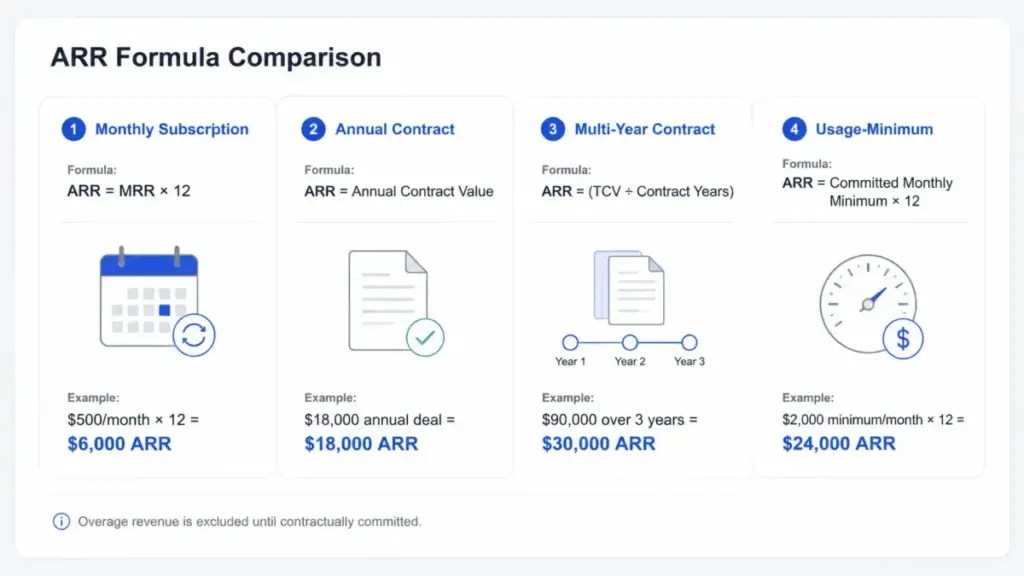
The “MRR x 12” shortcut only works for the simplest case. Real SaaS billing requires different formulas depending on contract structure.
Monthly subscriptions: A customer pays $500/month. ARR = $500 x 12 = $6,000.
Annual contracts: A customer signs a 1-year deal for $18,000 paid upfront. ARR = $18,000. You do not divide by 12 and multiply back; the contract itself defines the annual value.
Multi-year contracts: A customer signs a 3-year deal for $90,000 total. ARR = $90,000 / 3 = $30,000. Alternatively, as The SaaS CFO documents: (Total Contract Value / Contract Duration in Months) x 12.
Usage-based with committed minimum: A customer commits to $2,000/month minimum usage. ARR = $2,000 x 12 = $24,000. Any overage above the $2,000 floor stays outside the ARR calculation until the customer contractually commits to a higher baseline.
ARR vs MRR vs ACV vs TCV vs Bookings vs Billings
Finance teams and sales teams use these terms interchangeably. They should not.
| Term | Definition | Includes one-time fees? | Time horizon |
|---|---|---|---|
| ARR | Annualized value of active recurring subscriptions | No | 12-month forward snapshot |
| MRR | Monthly value of active recurring subscriptions | No | 1-month forward snapshot |
| ACV (Annual Contract Value) | Average annualized revenue per customer contract | Sometimes (depends on company policy) | Per-contract, annualized |
| TCV (Total Contract Value) | Full value of a contract across its entire term | Yes | Full contract duration |
| Bookings | Total value of new contracts signed in a period | Yes | Point-in-time commitment |
| Billings | Cash invoiced to customers in a period | Yes | Cash collection period |
The critical distinction: ARR and MRR strip away one-time fees to isolate predictable subscription value. Bookings and TCV include everything the customer committed to pay, regardless of whether it recurs. A $100,000 TCV deal with $30,000 in professional services only contributes $70,000 / contract years to ARR.
What to Include and Exclude in ARR
The SaaS CFO recommends that every finance team maintain a written ARR policy document. Without one, sales reps and accountants will classify revenue differently.
| Include in ARR | Exclude from ARR |
|---|---|
| Core subscription/license fees | One-time onboarding and setup fees |
| Recurring platform add-ons (contractually committed) | Professional services (training, consulting, custom dev) |
| Committed minimum usage fees | Variable overage above the committed floor |
| Recurring support/maintenance contracts | Hardware or physical product sales |
| Auto-renewing annual contracts | Refunds and credits (subtract from ARR when issued) |
The gray zone is usage-based revenue. If a customer’s overage consistently exceeds the committed minimum for 6+ consecutive months, some finance teams reclassify the higher amount as the new baseline. This practice requires disclosure. Investors penalize inconsistency harder than conservatism.
Step-by-Step Implementation for SaaS Teams
Setting up an ARR tracking system requires strict data hygiene. I built this workflow in ChartMogul and Baremetrics.
1. Standardize Your Billing Data
Clean your raw billing data first. You must separate recurring subscription items from one-time setup fees. If you sell a $12,000 annual software license plus a $3,000 onboarding fee, only the $12,000 contributes to ARR.
2. Implement the Roll-Forward Model
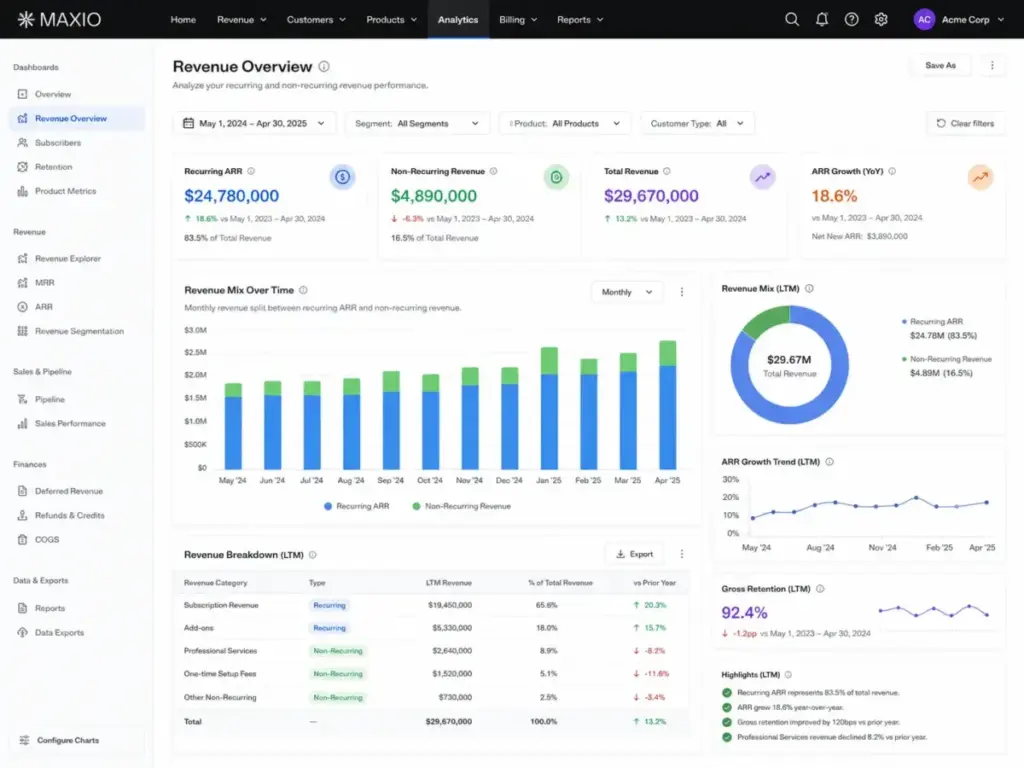
Connect your payment gateway (like Stripe) to an analytics tool (like Maxio). The system must automatically categorize every payment into New, Expansion, Contraction, or Churned ARR. Do not rely on manual tagging.
3. Establish Usage-Based Rules
Usage-based pricing (or AI-hybrid pricing) complicates ARR. You cannot reliably predict usage. Establish a conservative baseline. If a customer commits to $1,000 a month in minimum usage, that equals $12,000 ARR. Any overage revenue remains outside the ARR calculation until they commit to a higher tier.
The Mistakes That Waste Your First Month
I see teams fail repeatedly when they attempt to build ARR dashboards in Excel.
First, they include one-time professional services in their MRR calculation. This error artificially inflates the ARR. When those services end, the ARR appears to crash, causing panic among investors.
Second, they miscalculate Annualized Run Rate. They take an exceptionally strong month (which included a massive one-time enterprise setup fee) and multiply the total by 12. This creates a fake projection that the company can never hit again.
Third, they fail to account for paused subscriptions. If a subscription is paused, define a policy before reporting ARR. Some teams treat long pauses (90+ days) as Churned ARR, while others move them into a suspended category and exclude them from active ARR until reactivation. The key: pick a rule, document it, and apply it consistently.
Common Misconceptions About ARR
Misconception: ARR is a strict accounting rule governed by law.
Reality: ARR is a non-GAAP operating metric. As The SaaS CFO notes, no legal standard dictates exactly how you must calculate it. That is why a written internal policy covering inclusions, exclusions, and annualization method is non-negotiable.
Misconception: You just multiply MRR by 12.
Reality: Multiplying MRR by 12 only works for simple monthly subscriptions. Annual contracts require you to take the contract’s annual value directly. Multi-year contracts require normalization: (TCV / contract months) x 12.
Misconception: Usage-based billing cannot generate ARR.
Reality: It can, but only the committed baseline portion counts. Spikes in usage do not equal recurring revenue. Maxio’s documentation recommends treating variable overage as non-recurring until the customer contractually commits to a higher floor.
Misconception: ARR and GAAP revenue should match.
Reality: They almost never match. GAAP revenue recognizes income after service delivery (backward-looking). ARR projects active subscription value forward. A customer who prepays $60,000 for a 1-year contract generates $60,000 ARR on day one, but GAAP recognizes only ~$5,000/month as the service is delivered.
When to Use and When to Avoid
Use ARR when:
- Tracking core business momentum
- Pitching venture capital firms
- Evaluating customer success team performance (via net revenue retention)
Avoid ARR when:
- Filing official tax returns
- Paying sales commissions on one-time implementation fees
- Running a pure pay-as-you-go transactional business without subscription commitments
How to Measure Success
Tracking ARR is useless if you do not track the underlying health metrics.
| Metric | Meaning | Why it matters |
|---|---|---|
| Net Revenue Retention (NRR) | Percentage of ARR retained from existing customers, including expansion and contraction. | NRR above 100% means your business grows even if you acquire zero new customers. |
| Gross Revenue Retention (GRR) | Percentage of ARR retained, excluding expansion revenue. | GRR isolates churn. It shows exactly how much of your base is leaving. |
| ARR Growth Rate | The month-over-month or year-over-year percentage increase in total ARR. | Investors use this to benchmark your trajectory against industry standards. |
What Good ARR Governance Looks Like
Good governance separates the sales team’s optimism from the financial reality.
Before proper governance, a sales rep closes a $24,000 deal that includes $12,000 in software and $12,000 in custom development. The CEO reports $24,000 in new ARR to the board. Three months later, the finance team realizes the error and has to restate the numbers downward.
After implementing a tool like Maxio, the system automatically splits the invoice. It recognizes the $12,000 software fee as $12,000 ARR and isolates the $12,000 development fee as non-recurring revenue. The board sees accurate numbers on day one.
Tools That Make ARR Easier
You will outgrow spreadsheet tracking around $1M ARR. At that point, purpose-built tools become necessary.
| Tool | Best for | ARR-related feature | Caveat |
|---|---|---|---|
| Stripe Billing | Stripe-first startups | Built-in billing metrics and subscription analytics | Reporting can feel basic for complex B2B contracts with multi-year terms |
| ChartMogul | SaaS analytics teams | ARR/MRR/churn segmentation with deep cohort analysis | Requires clean, well-structured billing data to produce accurate outputs |
| Baremetrics | Small SaaS teams | Visual SaaS metrics dashboard with real-time ARR tracking | Less suited for complex enterprise billing with custom invoicing |
| Maxio | B2B SaaS finance ops | ARR tracking, automated billing, and ASC 606 revenue recognition | Enterprise-oriented; setup and pricing reflect that complexity |
| Chargebee | Subscription and hybrid billing | Usage-based and hybrid billing workflows with subscription analytics | Pricing tiers and initial configuration complexity can vary significantly |
If you need to align your sales team with your financial data, integrating your CRM directly with your billing platform solves the data silo problem. Read our guide on how to choose the best CRM software to build a solid foundation.
FAQ
What is the difference between MRR and ARR?
MRR is Monthly Recurring Revenue. ARR is Annual Recurring Revenue. For simple subscription models, ARR equals MRR multiplied by 12.
Does ARR include one-time fees?
No. ARR only includes predictable, recurring subscription revenue. You must exclude setup fees, consulting charges, and one-time hardware sales.
How do you calculate ARR for multi-year contracts?
You calculate the annual value of the contract. A 3-year contract worth $30,000 total provides $10,000 in ARR.
Can usage-based pricing count towards ARR?
You only include the minimum committed spend in your ARR. Unpredictable overages and pure pay-as-you-go usage do not count as recurring revenue.
Why do investors care about ARR?
Investors care about ARR because it predicts future cash flow. High ARR indicates product-market fit and predictable growth, which lowers the risk of investment.
When should a startup start tracking ARR?
Startups should track ARR from day one. Early tracking builds the data history required for cohort analysis and future funding rounds.
When You Need Software
- You spend more than 2 hours a month reconciling billing spreadsheets.
- Your sales team reports different revenue numbers than your finance team.
- You have a mix of monthly, annual, and usage-based billing plans.
- You are preparing for a funding round or audit.
- You cannot easily separate expansion revenue from new sales.
How to Choose the Right Tool
- Verify integration with your payment gateway (e.g., Stripe, Paddle).
- Check if the tool handles your specific billing model (e.g., usage-based vs flat-rate).
- Ensure the reporting includes cohort analysis and net revenue retention.
- Evaluate the data export capabilities for your accounting software.
- Review the pricing structure to ensure it scales with your revenue, not just seat count.
ARR Dashboard Policy Checklist
This checklist doubles as a governance framework. Before sharing ARR numbers with investors or your board, confirm every item.
- [ ] Written ARR policy exists, defining inclusions and exclusions.
- [ ] Policy specifies the annualization formula (MRR x 12, TCV / months x 12, or trailing method).
- [ ] One-time fees are tagged and excluded from all MRR/ARR calculations.
- [ ] Professional services revenue is separated at the invoice level.
- [ ] Usage-based revenue rules are documented (committed floor vs. overage).
- [ ] Paused subscriptions are reclassified as Churned ARR on pause date.
- [ ] Reactivations are tracked as a distinct category, not merged into New ARR.
- [ ] Payment gateway (Stripe, Paddle, Chargebee) feeds directly into the analytics tool.
- [ ] Expansion and Contraction events are auto-tagged by the billing system.
- [ ] A single ARR dashboard is shared across sales, finance, and leadership.
- [ ] ARR-to-GAAP reconciliation runs at least quarterly.
- [ ] Policy review happens annually or when the pricing model changes.
Beginner Checklist
- [ ] Define what qualifies as recurring revenue for your business.
- [ ] Separate all one-time fees from subscription fees.
- [ ] Connect your payment gateway to an analytics platform.
- [ ] Establish rules for handling paused subscriptions.
- [ ] Document your policy for usage-based minimums.
- [ ] Set up automated tagging for upgrades and downgrades.
- [ ] Share a single ARR dashboard with your leadership team.