Most teams that search for “sales enablement” expect a definition about content and training. The real 2026 version is closer to an operating system for how sellers find information, learn, coach, engage buyers, and prove their work connects to revenue. The gap between those two ideas explains why so many enablement programs fail within the first year.
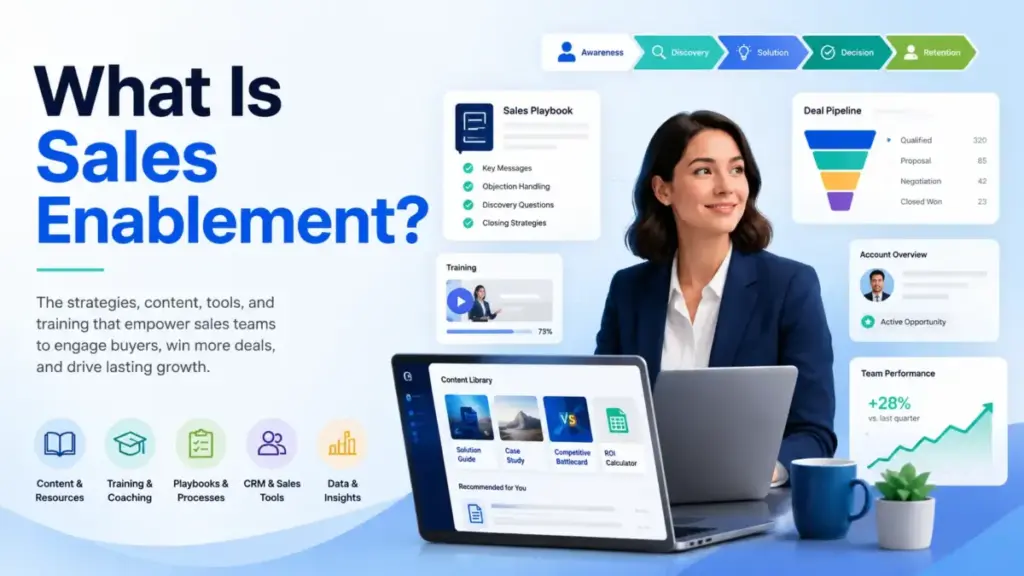
Sales enablement is the ongoing, cross-functional process of giving sellers the content, training, coaching, tools, buyer context, and workflow guidance they need to engage buyers effectively and improve measurable sales outcomes. Gartner defines it as providing the sales organization with information, content, and tools that help sellers sell more effectively. HubSpot describes it as an iterative process of giving sales teams the resources they need to close more deals.
That much is easy to agree on. The harder question, and the one most definitions skip, is why so many teams invest in enablement and still watch reps build their own slides, ignore the content library, and revert to whatever worked two quarters ago.
This guide explains how sales enablement actually works, what it includes beyond content, which tools support it, how to measure whether it changes anything, and when a team is ready for an enablement platform versus a simpler system. If you are evaluating CRM software and sales tools for your team, understanding enablement is the context that makes those decisions sharper.
Quick Answer: What Is Sales Enablement? Sales enablement is a cross-functional discipline that equips sellers with approved content, structured training, coaching, buyer engagement tools, and CRM-connected workflows so they can have better conversations, close more deals, and produce outcomes leaders can measure. It is not a content library. It is not sales training alone. It works only when content, skills, workflow, and measurement connect.
The 60-Second Explanation of Sales Enablement
For someone new to the term
Sales enablement means giving your sales team the right materials, skills, and guidance at the right moment so they can sell better. Think of it as the difference between a rep searching through 200 Google Drive files for the right case study and a system that surfaces the approved case study inside the CRM record the rep is already working in.
For someone building a revenue team
Sales enablement connects go-to-market strategy to repeatable seller execution. It includes content management (decks, battlecards, one-pagers, pricing docs), structured onboarding and training, coaching programs tied to call review and skill gaps, buyer engagement tools like digital sales rooms, and analytics that show which enablement activities correlate with pipeline progress and closed revenue.
For someone reporting to a CRO or VP of Sales
Enablement is the function responsible for translating business goals into seller behavior change, then measuring whether that change produces revenue outcomes. According to a Gartner press release from April 2026, organizations with AI-driven enablement functions are predicted to achieve 40% faster sales stage velocity than those using traditional enablement approaches by 2029. That same research found that organizations collaborating on enablement content with marketing and service are 2.4 times more likely to achieve strong commercial growth.
How Sales Enablement Actually Works
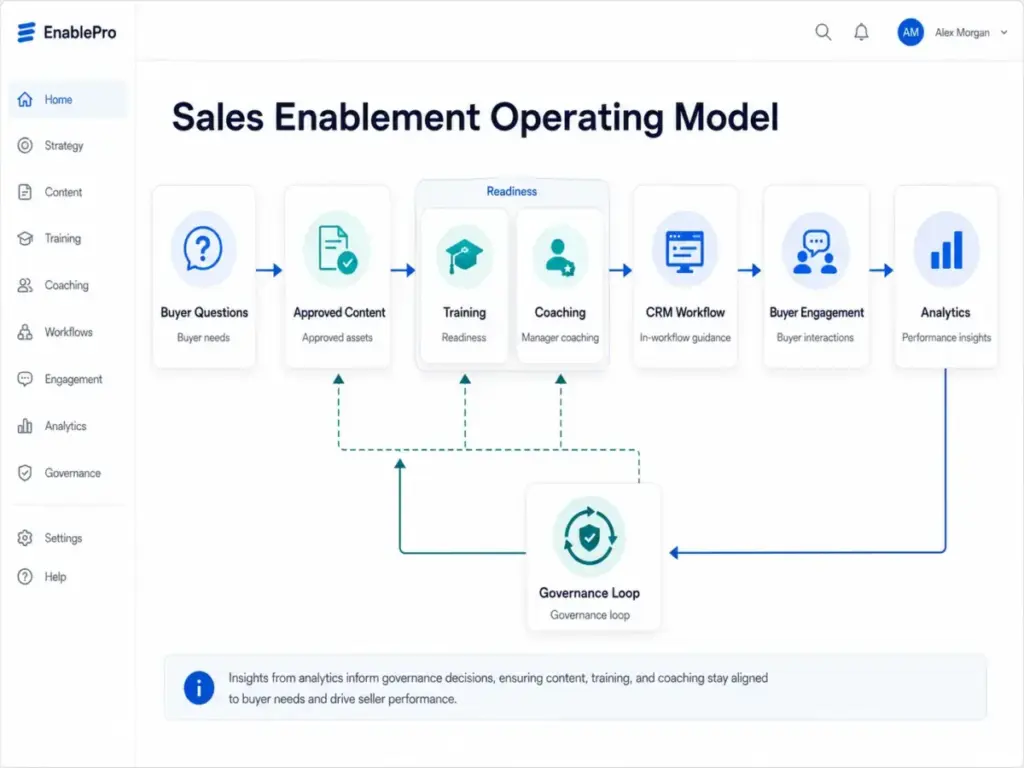
Sales enablement works by turning go-to-market strategy into repeatable seller execution. A program typically starts by identifying buyer questions, sales stage friction, rep skill gaps, and content gaps.
Enablement teams then package approved messaging, case studies, playbooks, objection handling, competitive guidance, onboarding, role plays, and learning modules into systems sellers can use in their daily workflow.
Modern platforms connect these assets to CRM records, deal stages, personas, industries, and engagement analytics so reps find the right asset, managers coach against real behavior, and leaders see which activities correlate with pipeline management progress.
Where enablement breaks
The failure points matter more than the process description. Enablement breaks when:
- Content becomes a graveyard. Marketing produces 50 decks. Reps use 3. The rest sit untouched because they are not tagged, not searchable, not connected to deal context, and not governed for freshness.
- Training stays in the classroom. Reps complete onboarding certifications and forget the material within weeks because there is no reinforcement, no role play, no manager coaching.
- Sellers leave workflow to use it. If the enablement system lives in a separate portal that reps must log into outside their CRM, adoption drops sharply.
- Leaders measure activity, not outcomes. Tracking content downloads or training completion without connecting those numbers to ramp time, win rate, or deal velocity tells you nothing about whether enablement works.
- AI recommendations ignore governance. AI that surfaces content outside the approved library or generates answers from unverified sources creates compliance and trust risk.
Shayne Jackson, VP Analyst at the Gartner Sales Practice, put it directly: “Traditional enablement was built as a reactive support function, not as a system engineered to drive measurable seller performance.” (Gartner Newsroom)
Sales Enablement vs Related Concepts
One reason enablement confuses buyers is that it overlaps with several adjacent disciplines. Here is how they differ:
| Concept | Primary purpose | Typical owner | Key output | How it relates to enablement |
|---|---|---|---|---|
| Sales enablement | Equip sellers with content, training, coaching, and workflow guidance | Sales enablement, RevOps, or shared | Playbooks, training programs, content governance, analytics | The discipline itself |
| Sales operations | Optimize sales process, data, territory, compensation, forecasting | Sales ops / RevOps | CRM configuration, territory plans, comp models, reporting | Enablement uses the process and data that ops builds |
| Sales training | Teach skills: discovery, negotiation, objection handling, methodology | L&D, enablement, or external vendors | Courses, certifications, workshops | Training is one layer within enablement |
| Sales engagement | Automate outbound sequences: emails, calls, cadences | SDR/BDR managers | Sequences, templates, activity tracking | Engagement tools execute; enablement informs what to say |
| Revenue enablement | Extend enablement to marketing, CS, partners, all customer-facing teams | RevOps or enablement | Cross-functional programs, shared content, unified analytics | Revenue enablement is the broader evolution |
Eric Zines, Principal Analyst at Forrester, noted that the line between sales content management and sales readiness has converged to the point where “the Venn diagram is now a circle.” (Forrester blog)
Step-by-Step: How to Build a Sales Enablement Program
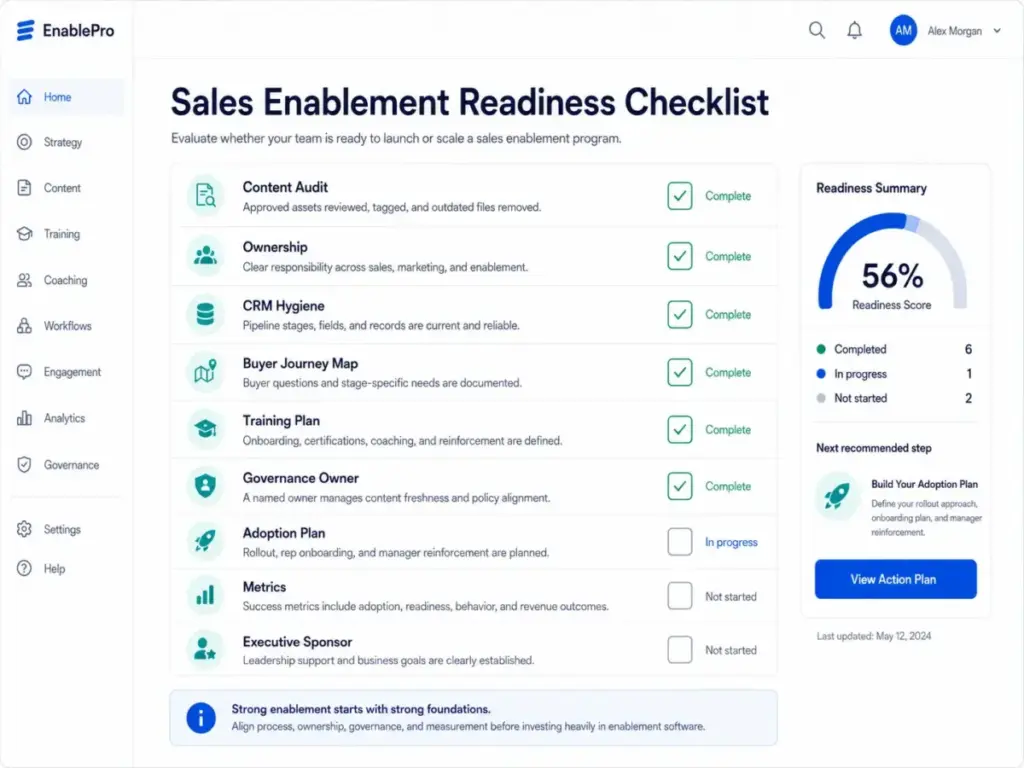
Step 1: Define the commercial problem
Start with the business outcome you need to fix: slow ramp time, inconsistent messaging, low content usage, weak discovery, long deal cycles, declining win rate, poor product launch execution, or disconnected sales and marketing.
Step 2: Map the buyer journey and sales stages
Identify what buyers ask, what sellers need, and which assets or skills are required at each stage. Most enablement programs fail because they produce content that does not map to a specific buyer question at a specific deal stage.
Step 3: Audit existing content
Remove stale material. Identify missing assets. Tag approved assets by persona, industry, use case, sales funnel stage, competitor, and product line. Enterprise enablement also includes approved answers for RFPs, security questionnaires, implementation proof, and procurement-ready technical content, an area most SERP definitions ignore entirely.
Step 4: Build priority playbooks
Start with the few motions that matter most: new-hire onboarding, discovery, competitive deals, product launch, enterprise security review, renewal, or expansion.
Step 5: Connect enablement to daily seller workflow
Surface content and training inside CRM, sales automation tools, email, call review, or digital sales room tools rather than forcing reps into a separate portal.
Step 6: Add coaching and reinforcement
Use call review, role play, certifications, manager scorecards, and spaced reinforcement so training changes behavior, not just knowledge.
Step 7: Measure adoption and outcomes
Track adoption, content health, training readiness, seller behavior, and revenue impact. See the metrics framework below.
Step 8: Create a governance loop
Review stale content, seller feedback, buyer engagement, lost-deal notes, and field objections monthly or quarterly.
The Mistakes That Waste Your First Six Months
- Creating more content before auditing existing content. Most teams already have material. They have a findability and freshness problem, not a volume problem.
- Treating enablement as a marketing-only function. HubSpot specifically states that sales and marketing both own it in many companies. Enablement without seller input produces assets sellers do not trust.
- Measuring downloads instead of deal impact. Content downloaded does not mean content influenced a deal. Connect content usage to stage progression and win rates.
- Forcing sellers to leave CRM. If a rep has to open a second app to find a battlecard, they will build their own version locally.
- Buying enterprise software before defining governance. A dedicated enablement platform requires a content owner, a governance process, and CRM discipline. Without those, the platform becomes another content graveyard.
- Over-trusting AI suggestions without approved source libraries. AI recommendations are only as good as the content they draw from. Without content governance, AI surfaces stale or off-brand material.
- Skipping manager coaching. Training teaches concepts. Coaching changes behavior. Without coaching, reps revert to old habits within weeks.
Common Misconceptions About Sales Enablement
Misconception: Sales enablement is just a shared folder of sales decks. Reality: A content repository is one layer. Effective enablement includes training, coaching, playbooks, analytics, CRM workflow integration, buyer engagement tools, and content governance.
Misconception: Sales enablement and sales training are the same thing. Reality: Training teaches skills. Enablement supports ongoing execution with content, guidance, coaching, workflow tools, and performance measurement. Training is a component, not the whole system.
Misconception: Marketing owns sales enablement alone. Reality: Most frameworks position enablement as cross-functional. In practice, the best programs have a dedicated enablement function that bridges sales, marketing, and product.
Misconception: Buying a sales enablement platform automatically fixes enablement. Reality: Technology helps only if the content is trusted, current, searchable, aligned to deal context, adopted by sellers, and measured against outcomes.
Misconception: Sales enablement is only for enterprise teams. Reality: Small teams also need enablement. They may need lighter systems, a governed Google Drive folder, CRM-native features, or a simple knowledge base, before adopting enterprise platforms with complex governance and quote-based pricing.
When to Use a Dedicated Platform vs Simpler Systems
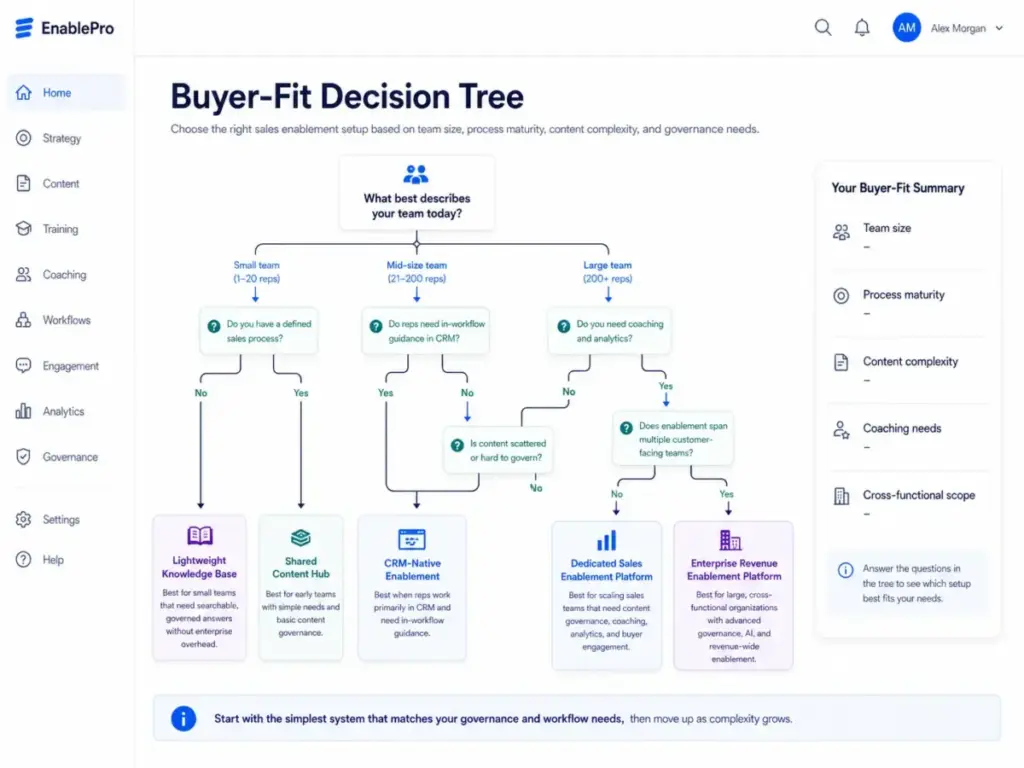
Not every team needs Highspot, Seismic, or Mindtickle on day one. I think about this as a maturity ladder:
| Team maturity | Enablement system | When to move up |
|---|---|---|
| Early stage (2-5 reps, no defined process) | Governed shared drive + CRM hygiene + simple playbooks | When reps consistently ask “where is the deck for X?” and content is scattered |
| Growing (5-15 reps, defined process) | CRM-native enablement (Salesforce Sales Programs, HubSpot Sales Hub) + basic LMS | When content volume exceeds what one person can govern manually |
| Scaling (15-50 reps, multiple products or segments) | Dedicated enablement platform (Highspot, Seismic, Showpad, Mindtickle) | When coaching, digital sales rooms, analytics, and multi-team enablement require specialized tooling |
| Enterprise (50+ reps, global, partner channel) | Revenue enablement platform with AI, governance, conversation intelligence, and buyer engagement | When enablement spans sales, marketing, CS, and partner teams |
Sales Enablement Software: 5 Platform Examples
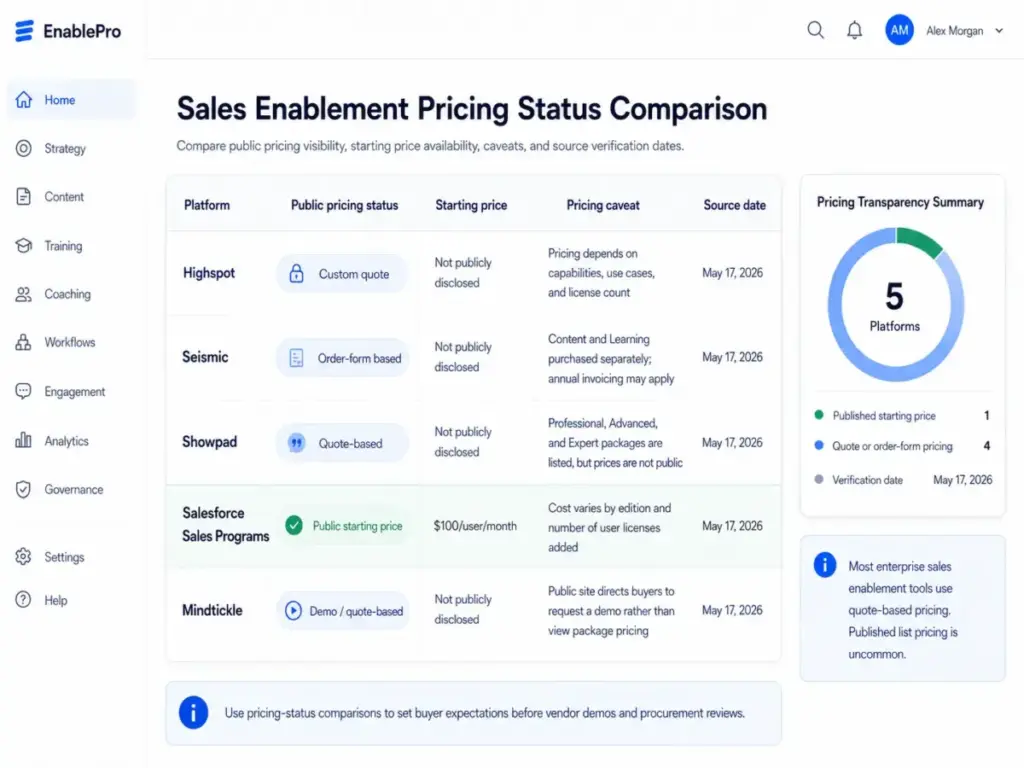
The enablement platform market has consolidated around a handful of major vendors recognized in Gartner’s 2025 Magic Quadrant for Revenue Enablement Platforms and Forrester’s Revenue Enablement Wave. Here are five examples with pricing-status caveats:
| Platform | Core focus | Pricing model | Starting price | Key caveat |
|---|---|---|---|---|
| Highspot | Content, training, coaching, sales plays, digital rooms, analytics | Custom quote based on capabilities, use cases, and license count (pricing page) | Not publicly disclosed | CRM integrations included at no extra cost |
| Seismic Enablement Cloud | Content management, learning, coaching, content automation, buyer engagement, enablement intelligence | Order-form-based; Seismic Content and Seismic Learning purchased separately (product descriptions) | Not publicly disclosed | Fees invoiced annually in advance unless otherwise specified |
| Showpad | Content management, sales readiness, buyer engagement, analytics | Quote-based; Professional, Advanced, and Expert packages (pricing page) | Not publicly disclosed | Advanced adds AI governance, Roleplay AI, certifications; Expert adds AI-powered search |
| Salesforce Sales Programs | CRM-native enablement: guides, videos, scripts, templates, milestones, dashboards | Per-user per-month (pricing page) | $100/user/month (as of May 2026) | Cost varies by edition and number of user licenses added |
| Mindtickle | Revenue enablement: training, content, AI role plays, coaching, conversation intelligence, digital rooms | Demo/quote-based (request a demo) | Not publicly disclosed | Subscription includes Readiness Package with training, roleplays, coaching, and analytics modules |
What this means: Most enterprise enablement platforms use quote-based or order-form pricing. Salesforce Sales Programs is one of the few with a published starting price. If you are a small team comparing these, the pricing opacity is part of the buying reality, not an oversight. Budget conversations require demos and scoped proposals.
How to Measure Sales Enablement (5-Layer Metrics Framework)
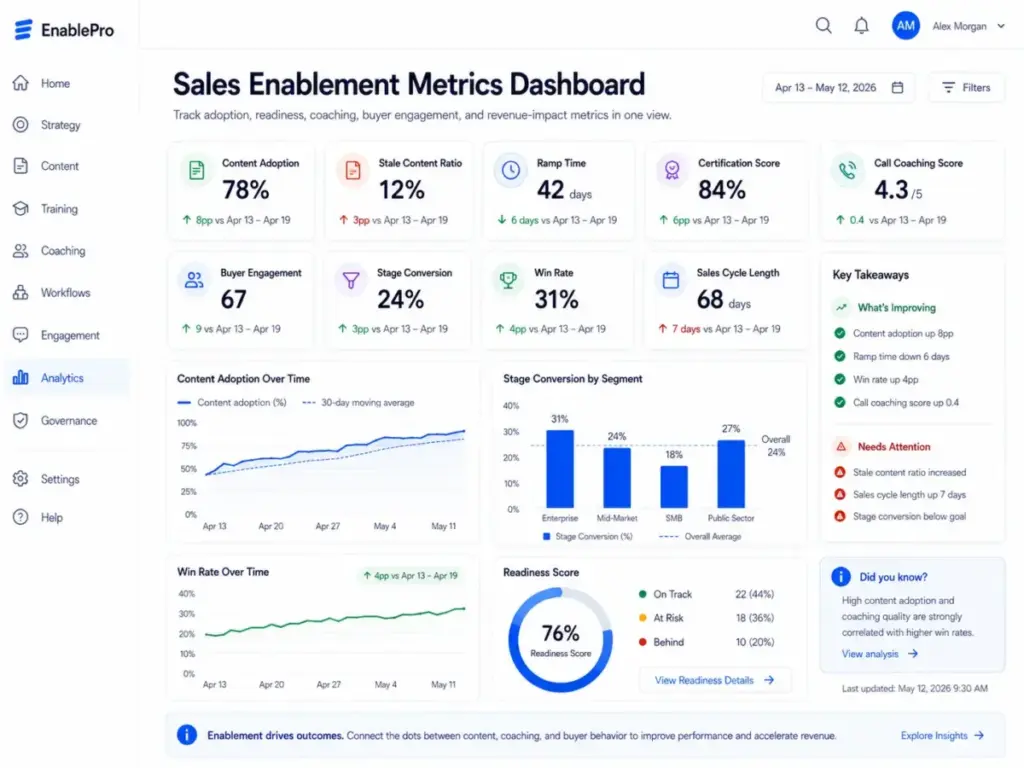
Measuring content downloads alone tells you nothing. I recommend separating enablement metrics into five layers, each answering a different question:
| Layer | What it measures | Example metrics | The question it answers |
|---|---|---|---|
| 1. Platform adoption | Are sellers using the system? | Content search rate, login frequency, asset access rate | “Do reps even open the enablement platform?” |
| 2. Content health | Is the content current and useful? | Stale content ratio, content coverage by stage, search success rate | “Can reps find what they need, and is it trustworthy?” |
| 3. Training readiness | Are sellers learning and retaining? | Training completion, certification pass rate, role-play score, spaced reinforcement score | “Do reps know the material?” |
| 4. Seller behavior | Is enablement changing how reps sell? | Coaching completion, call quality score, content usage per deal, playbook adherence | “Are reps actually doing things differently?” |
| 5. Revenue impact | Is enablement improving outcomes? | Ramp time, time to first deal, quota attainment, win rate, stage conversion, sales cycle length, pipeline velocity, content-influenced revenue | “Does enablement produce more revenue?” |
What this means: Layers 1-3 are leading indicators. Layers 4-5 are lagging indicators. Most teams get stuck measuring Layer 1 (adoption) and calling it success. The real proof is Layer 5, but you cannot get there without the layers in between.
According to Gartner’s sales enablement research, 65% of B2B sales organizations are expected to transition from intuition-based to data-driven decision making by 2026, using technology that unites workflow, data, and analytics.
What Good Sales Enablement Looks Like
Before enablement: Reps search Slack, email, and shared drives for the latest pricing deck. Three reps send three different versions to the same prospect. A new hire takes 6 months to close their first deal. Nobody knows which content influenced which deal.
After enablement: Reps find the current pricing deck inside their CRM record. Content is tagged by persona, industry, and deal stage. New hires complete structured onboarding with certifications, role plays, and manager coaching, and they close their first deal in 3 months. Leaders see which content and training programs correlate with higher win rates and shorter sales cycles.
The shift is not about technology. It is about connecting content, skills, workflow, and measurement into a system that changes how sellers actually behave.
Sales Enablement Tools and Categories
Beyond the five platforms detailed above, the broader enablement ecosystem includes:
- CRM platforms (Salesforce, HubSpot Sales Hub, Pipedrive, Zoho CRM) for deal management and pipeline workflow
- Conversation intelligence (Gong, Salesloft, Outreach) for call review, coaching signals, and buyer engagement data
- LMS and training tools (Allego, SalesHood, Spekit) for onboarding, certifications, and reinforcement
- Digital sales rooms (Showpad Shared Spaces, Highspot Digital Rooms, Mindtickle DSR) for buyer-side engagement
- Content management systems for marketing asset governance
- Knowledge management tools for sales forecasting context and competitive intelligence
The Gartner 2025 Magic Quadrant for Revenue Enablement Platforms evaluated vendors including Highspot, Seismic, Showpad, Mindtickle, Allego, Bigtincan, Spekit, Mediafly, Pitcher, and SalesHood, confirming that the market is consolidating around AI-driven, compliance-aware platforms.
FAQ
What is sales enablement in simple terms?
Sales enablement is the process of giving sellers the right content, training, coaching, and tools at the right time so they can have better buyer conversations and close more deals. It goes beyond a content library to include ongoing learning, CRM-connected workflows, and outcome measurement.
What does a sales enablement team do?
A sales enablement team creates and governs sales content, builds onboarding and training programs, facilitates coaching between managers and reps, manages the enablement technology stack, and measures whether enablement activities improve seller performance and revenue outcomes.
Who owns sales enablement, sales or marketing?
Both. HubSpot states that sales and marketing commonly own enablement in many companies. The most effective programs have a dedicated enablement function that bridges both teams, with content governance shared and training delivery tailored to seller needs.
Is sales enablement the same as sales training?
No. Sales training teaches skills like discovery, objection handling, and negotiation. Sales enablement is broader: it includes training but also covers content governance, coaching, buyer engagement, CRM workflow integration, and performance analytics.
What is the difference between sales enablement and sales operations?
Sales operations optimizes the sales process: CRM configuration, territory planning, compensation, forecasting, and reporting. Sales enablement equips reps with the content, skills, and guidance to execute within that process. Ops builds the system. Enablement helps sellers use it.
Do small SaaS teams need sales enablement software?
Not necessarily. A team with fewer than 10 reps and no defined sales pipeline process should start with CRM hygiene, a governed content folder, and simple playbooks. Dedicated enablement platforms add value when content volume, coaching complexity, and team size justify the investment.
How do you measure sales enablement ROI?
Separate metrics into adoption (are reps using it?), content health (is it current?), training readiness (do reps know the material?), seller behavior (are they changing?), and revenue impact (ramp time, win rate, quota attainment, pipeline velocity). Revenue-layer metrics take 2-3 quarters to show results.
What are common sales enablement mistakes?
Creating more content without auditing what exists, treating enablement as marketing-only, measuring downloads instead of deal impact, forcing sellers to leave CRM, buying software before defining governance, and skipping manager coaching are the most common failures.
How does AI affect sales enablement in 2026?
AI contributes through content recommendation, call and meeting intelligence, AI role play feedback, training generation, CRM next-best action prompts, digital room personalization, and analytics. The caution: AI should use approved content sources and respect content governance policies. Ungoverned AI recommendations risk surfacing stale or off-brand material.
Can Salesforce be used as a sales enablement platform?
Salesforce Sales Programs delivers CRM-native enablement including guides, videos, scripts, templates, milestones, and progress tracking. It works well when the enablement need is tightly coupled with CRM workflow. Teams needing advanced content governance, AI coaching, digital sales rooms, or multi-team enablement across marketing and CS typically evaluate dedicated platforms alongside or on top of Salesforce.