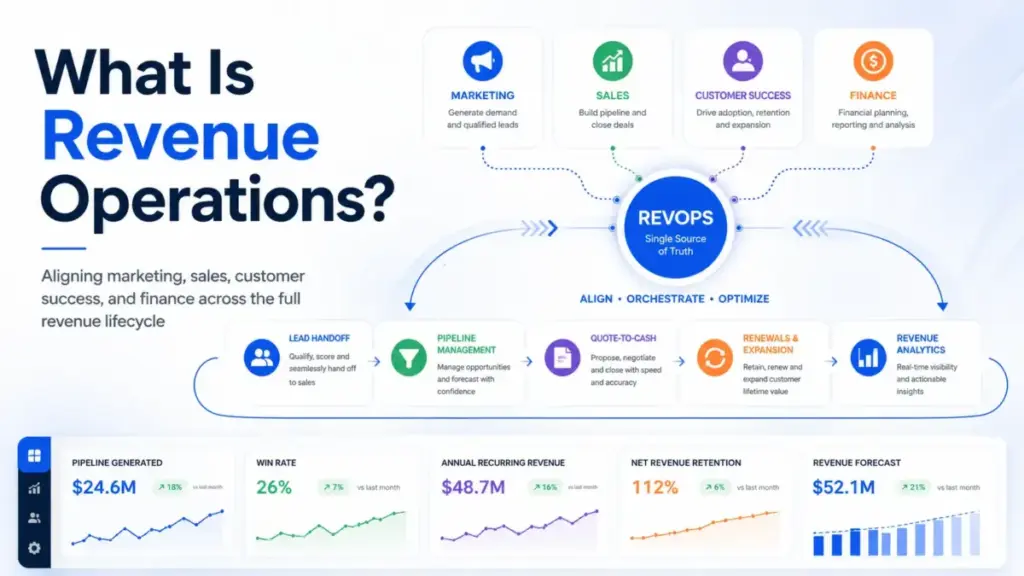
Most SaaS teams think RevOps is about aligning sales and marketing. It is not. Revenue Operations is an operating model that gives one function accountability for every handoff that touches revenue, from the first marketing-qualified lead to the final renewal invoice.
That includes finance. That includes customer success. And that is where most definitions on the internet stop short. Forrester defines RevOps as the convergence of sales, marketing, and customer success operations into a single operational model designed to drive predictable revenue growth.
Teams regularly bolt a “RevOps” title onto an existing sales ops role and wonder why forecast accuracy stays flat. The problem is not the title. The problem is that nobody owns the full lifecycle. Marketing generates leads that sales cannot close because the scoring model was never calibrated.
Customer success flags churn risks that finance never sees because the billing system runs on a different database. RevOps fixes this by putting one team in charge of the data, the process, and the handoff points across all four functions.
If your team is still running separate ops functions for sales, marketing, and CS, this guide explains what RevOps actually looks like in practice, where the failure points hide, and when the model stops making sense. For context on how this connects to your sales pipeline architecture, start there.
Quick Answer: Revenue Operations (RevOps) is a B2B operating model that unifies sales, marketing, customer success, and finance operations under one team. It centralizes data governance, process design, and technology management to eliminate revenue leakage at handoff points. RevOps differs from sales ops by owning the full customer lifecycle, not just the pipeline. Teams typically adopt it when growing complexity creates friction across multiple go-to-market tools and departments.
The 60-Second Explanation of Revenue Operations
RevOps means different things depending on who you ask. Here is how the concept breaks down across three layers.
Simple definition: RevOps is one team that manages the tools, data, and processes across sales, marketing, customer success, and finance so that revenue does not leak between departments.
Technical definition: RevOps centralizes the go-to-market tech stack, enforces a single data model across CRM, MAP, CSP, and billing systems, and designs the handoff workflows between lifecycle stages. It typically owns CRM administration, lead routing logic, quote-to-cash configuration, territory design, and reporting infrastructure.
Business definition: RevOps exists because departmental silos create revenue leakage. When sales, marketing, and CS each run their own tools and metrics, forecast accuracy drops, pipeline velocity stalls, and renewal rates become unpredictable. RevOps solves this by treating the entire revenue lifecycle as one system with measurable stage-gate criteria at every transition.
The distinction matters. Sales ops optimizes the pipeline. Marketing ops optimizes campaigns. RevOps optimizes the connections between them, including the finance handoffs that most teams ignore until a deal falls apart during contract review.
How Revenue Operations Actually Works
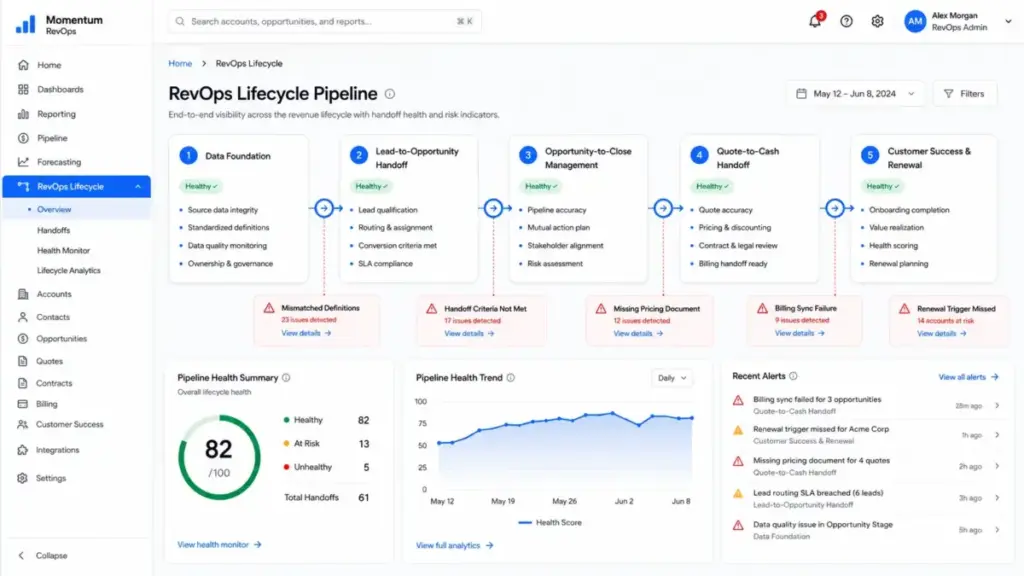
RevOps is not a philosophy. It is a pipeline with specific stages, owners, and failure points. Here is what the operating model looks like when it functions correctly.
Stage 1: Data foundation. RevOps establishes a single source of truth. This means one CRM record structure, one contact lifecycle definition, and one set of field-level governance rules. Every system, from marketing automation to billing, writes to the same customer record. If your CRM says a contact is “Sales Qualified” and your MAP still has them as “Marketing Qualified,” you have a data governance problem that no dashboard can fix.
Stage 2: Lead-to-opportunity handoff. RevOps defines the exact criteria for when a lead moves from marketing to sales. This is not a checkbox. It is a scored, time-bound trigger with fallback routing. If a lead meets the threshold but no rep accepts within 4 hours, it routes to a backup. If the lead is rejected, the reason codes feed back into the scoring model.
Stage 3: Opportunity-to-close management. RevOps standardizes pipeline stages, exit criteria, and forecast categories. Every deal must meet specific conditions before advancing. A deal in “Negotiation” that has no pricing document attached is a data quality issue RevOps catches before the forecast call.
Stage 4: Quote-to-cash handoff. This is the stage most RevOps definitions skip. RevOps owns the handoff from closed-won to finance. That means CPQ configuration, approval routing, contract generation, and billing system sync. When a rep closes a deal at a custom discount and finance finds out during invoicing, RevOps failed at this stage.
Stage 5: Customer success and renewal. RevOps routes the customer record to CS with full context: deal terms, implementation scope, and health score baseline. Renewal triggers fire 90 days before contract end, with expansion signals surfaced from product usage data.
Where things break: The most common failure point is Stage 2 and Stage 4. Lead handoff breaks because marketing and sales define “qualified” differently. Quote-to-cash breaks because finance operates on a separate system with separate approval logic. In practice, teams with otherwise excellent CRM hygiene often discover that manual contract errors at the finance handoff quietly erode deal value. The loss only surfaces when someone audits the gap between closed-won amounts and actual invoiced revenue.
RevOps vs Related Concepts
The terminology in this space gets confusing fast. Here is how RevOps compares to the functions it often gets confused with.
| Concept | What It Owns | Scope | When to Use |
|---|---|---|---|
| Revenue Operations | Full lifecycle: lead to renewal to expansion | Cross-functional (sales + marketing + CS + finance) | Teams with 50+ employees or 3+ GTM tools |
| Sales Operations | Pipeline, territory, quota, forecasting | Sales team only | Teams where sales is the dominant GTM motion |
| Marketing Operations | Campaign execution, lead scoring, attribution | Marketing team only | Teams where marketing runs independently |
| CS Operations | Onboarding, health scoring, renewal management | Customer success only | Teams with dedicated CS function |
| Business Operations | Company-wide process and resource management | All departments including non-revenue | Larger orgs needing operational efficiency beyond GTM |
What this means: RevOps is not sales ops with a new title. The difference is lifecycle ownership. Sales ops ends when the deal closes. RevOps tracks that deal through invoicing, onboarding, adoption, renewal, and expansion. If your “RevOps” team does not touch anything after closed-won, you have sales ops with a fancy name.
In many RevOps implementations, the hardest part is not the org chart change. It is getting finance to share their quote-to-cash workflow with a team that historically reported to the CRO. That political friction stalls more RevOps rollouts than any technology gap.
Step-by-Step Implementation
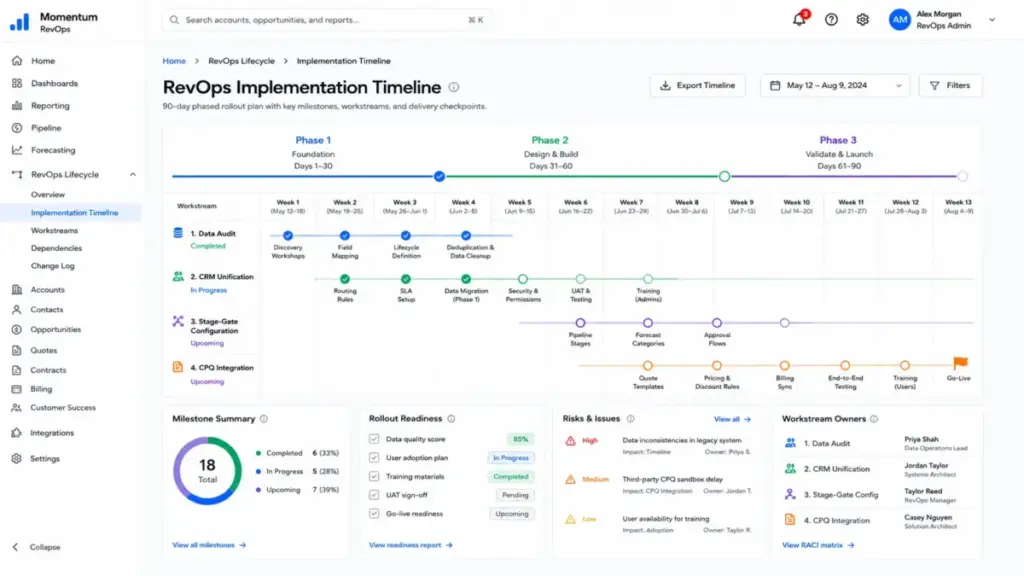
Implementing RevOps is not a weekend project. Here is the sequence that consistently produces results, based on common patterns across SaaS teams at different maturity stages.
Step 1: Audit your current handoffs
Before you restructure anything, map every handoff between marketing, sales, CS, and finance. Document who owns each transition, what data passes between systems, and where manual work happens. Most teams find 3-5 handoff points that rely on spreadsheets or Slack messages instead of automated workflows.
This is where lead scoring definitions matter. If your MQL criteria do not match what sales considers qualified, that gap shows up here.
Step 2: Unify your data model
Pick one system of record. For most SaaS teams under 500 employees, that is the CRM. Define a single contact lifecycle with clear stage definitions. Every field that exists in your MAP, CSP, or billing system must map back to the CRM record.
This does not mean one tool for everything. It means one data architecture. HubSpot Operations Hub, for example, lets you sync data across tools while maintaining a single customer record. Salesforce Revenue Cloud does the same for enterprise teams through its Data Cloud layer.
Step 3: Define stage-gate criteria
Every lifecycle stage needs measurable exit criteria. A lead does not become an opportunity because a rep says so. It becomes an opportunity when it meets 3+ scoring criteria, has a verified budget signal, and has been accepted within the SLA window. Write these rules down. Put them in the CRM.
Step 4: Build the quote-to-cash bridge
Connect your deal desk to finance. This means CPQ (configure, price, quote) integration, approval routing for non-standard terms, and automated contract generation. Teams that skip this step end up with a 2-week gap between “closed-won” in the CRM and “invoiced” in the billing system. That gap costs you cash flow and forecast accuracy.
Step 5: Instrument the metrics layer
RevOps without measurement is just process documentation. Build dashboards that track handoff velocity, stage conversion rates, and revenue attribution across the full lifecycle. More on the specific metrics below.
The Mistakes That Waste Your First Quarter
The same mistakes show up repeatedly when teams launch RevOps. Here are the ones that cost the most time.
Mistake 1: Renaming sales ops and calling it done. If your RevOps team only touches pipeline and forecasting, you renamed a function without changing the model. RevOps must own marketing handoffs, CS data, and finance workflows to work.
Mistake 2: Starting with technology before process. Buying Clari or LeanData before mapping your handoff points is like buying a GPS before deciding where you are going. The tool should enforce the process, not define it.
Mistake 3: Ignoring the finance handoff. Quote-to-cash is the most neglected stage in RevOps. If your billing team still manually processes contracts from email attachments, your RevOps pipeline has a hole. Connect CPQ to billing. Automate approval routing. This is where revenue actually leaks.
Mistake 4: No data governance from day one. RevOps requires a single data model. If you launch without field-level governance rules, you will spend six months cleaning up duplicate records and conflicting lifecycle definitions. Define your data standards before you migrate anything.
Mistake 5: Treating RevOps as a cost center. RevOps should report to the CRO or CEO, not to a department head. If RevOps reports to the VP of Sales, it will always prioritize pipeline over lifecycle. The operating model requires cross-functional authority.
Does this scale? At 10-15 people, a single RevOps generalist handles the entire function. At 50+, you need specialists for data, tools, and process. At 200+, you need a RevOps leader with direct reports covering each GTM function. The org structure changes, but the principle stays the same: one team, full lifecycle ownership.
Common Misconceptions About RevOps
Misconception: “RevOps is just sales ops and marketing ops merged.”
Reality: RevOps includes CS operations and finance handoffs. Merging sales and marketing ops without adding lifecycle ownership beyond closed-won is a reorg, not RevOps.
Misconception: “You need a dedicated RevOps platform to do RevOps.”
Reality: RevOps is an operating model, not a software category. You can run RevOps on HubSpot, Salesforce, or even a well-structured spreadsheet system. The tools matter less than the process design and data governance.
Misconception: “RevOps eliminates the need for department-specific ops roles.”
Reality: RevOps centralizes the handoffs and data layer. Individual departments still need functional expertise. A RevOps team does not replace the marketing ops specialist who builds email workflows. It ensures those workflows connect to the rest of the lifecycle.
Misconception: “Only enterprise companies need RevOps.”
Reality: The operating model scales down. A 30-person SaaS startup with 3 GTM tools and growing deal complexity benefits from RevOps structure. The trigger is complexity, not headcount.
Misconception: “RevOps is primarily about dashboards and reporting.”
Reality: Reporting is an output, not the function. RevOps designs the processes that generate the data. If your RevOps team spends 80% of its time building reports, it is functioning as a BI team, not a revenue operations team.
When to Use RevOps and When to Avoid It
Adopt RevOps when:
- Your team exceeds 50 employees across sales, marketing, and CS
- You run 3+ disconnected GTM tools (CRM, MAP, CSP, billing)
- Forecast accuracy is below 80% and you cannot identify why
- Lead handoff between marketing and sales takes more than 24 hours
- Quote-to-cash involves manual steps that delay invoicing by a week or more
- Your sales forecasting process relies on gut feel instead of stage-gate data
Avoid RevOps when:
- Your team is under 15 people and everyone sits in the same room
- You have one GTM motion (e.g., founder-led sales only)
- Your current ops structure is working and scaling without handoff friction
- You do not have executive sponsorship to give RevOps cross-functional authority
The maturity signal is friction, not size. If a 25-person team has clean handoffs and accurate forecasts, they do not need a formal RevOps function. If a 100-person team has three separate definitions of “qualified lead” across departments, they needed RevOps six months ago.
How to Measure RevOps Success
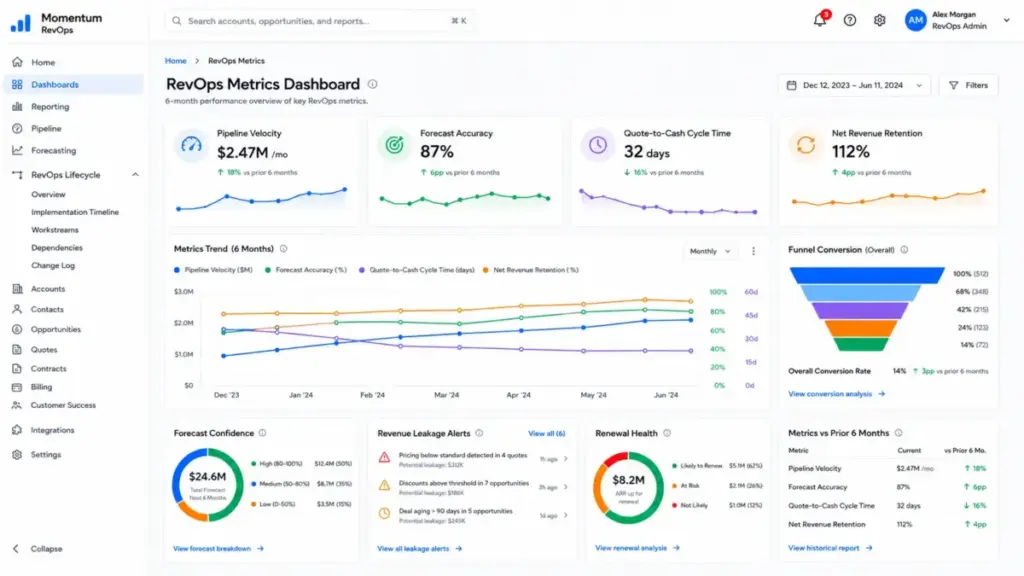
RevOps is measurable. Here are the metrics that matter, organized by what they actually tell you.
| Metric | What It Measures | Why It Matters for RevOps |
|---|---|---|
| Pipeline velocity | Speed of deals through stages | Reveals handoff bottlenecks between functions |
| Lead-to-opportunity conversion | Marketing-to-sales handoff quality | Validates scoring model and SLA compliance |
| Forecast accuracy | Predicted vs actual revenue | Proves stage-gate criteria are working |
| Quote-to-cash cycle time | Days from closed-won to first invoice | Exposes finance handoff gaps |
| Net revenue retention | Renewal + expansion minus churn | Measures full-lifecycle RevOps impact |
| Data quality score | Percentage of records meeting governance standards | Tracks the foundation everything else depends on |
| Handoff SLA compliance | Percentage of transitions completed within time windows | Identifies where the pipeline stalls |
What this means: If you are only tracking pipeline velocity and win rates, you are measuring sales ops, not RevOps. The differentiator is quote-to-cash cycle time and net revenue retention. Those metrics prove the operating model works beyond the pipeline.
One metric that most RevOps frameworks skip: data decay rate. How fast do your CRM records become stale? If a significant share of your contact records have outdated job titles within a single quarter, your CRM data integrity is degrading faster than your processes can compensate.
What Good RevOps Looks Like: Before and After
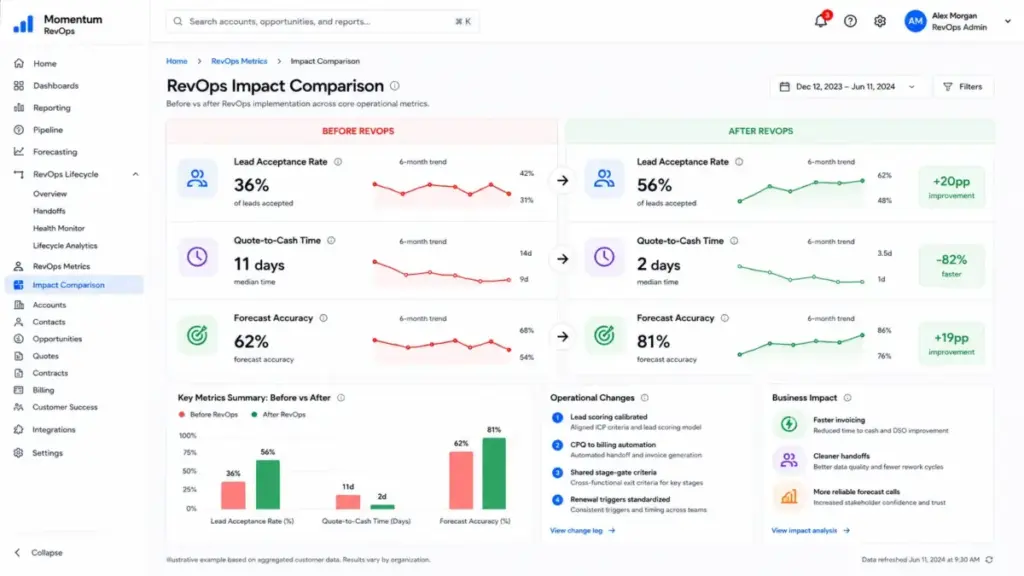
The following is an illustrative scenario, not an industry benchmark. It represents the type of improvement teams typically report after formalizing RevOps.
Before RevOps (example: 80-person SaaS team):
Marketing generates leads monthly. Sales accepts a fraction. Nobody tracks rejected leads. Closed-won deals take over a week to reach finance for invoicing. CS gets customer records without deal context. Renewal conversations start 30 days before expiration. Forecast calls rely on spreadsheet reconciliation.
After RevOps (same team, 6 months later):
Lead acceptance improves because the scoring model gets recalibrated with sales feedback. Rejected leads route back with reason codes that improve future scoring. Closed-won deals hit billing within days via automated CPQ-to-invoice workflow. CS receives full deal context including custom terms and implementation scope. Renewal triggers fire at 90 days. Forecast discipline tightens because stage-gate criteria replace gut-feel estimates.
The difference is not magic. It is process design at the handoff points. The tools stayed the same. The data governance changed.
Tools That Make Revenue Operations Easier
RevOps is tool-agnostic, but some platforms make the operating model easier to implement. Here is what the landscape looks like by maturity level.
For teams starting RevOps (under 100 employees):
HubSpot Operations Hub provides data sync, programmable automation, and data quality tools within the HubSpot ecosystem. If your team already runs HubSpot CRM, this is the lowest-friction entry point. Operations Hub Professional starts at $800/month (as of May 2026, per HubSpot’s pricing page).
For scaling teams (100-500 employees):
Salesforce Revenue Cloud combines CPQ, billing, and revenue intelligence into the Salesforce platform. It covers the quote-to-cash gap that most CRM platforms leave open. Clari adds AI-powered forecasting and pipeline inspection that surfaces deal risks before they hit the forecast call. LeanData handles lead-to-account matching and routing at scale.
For teams focused on conversation intelligence:
Gong captures and analyzes customer interactions across the lifecycle. For RevOps, the value is in connecting conversation signals to pipeline data so that stage-gate criteria reflect actual buyer behavior, not just CRM checkbox status.
If you are evaluating CRM platforms for your RevOps foundation, start with whether the platform supports a unified data model across sales, marketing, and CS. That matters more than any individual feature.
For teams comparing CRM options specifically, our HubSpot vs Salesforce analysis covers the architectural differences that affect RevOps readiness.
When You Need RevOps Software
You need dedicated RevOps tooling when:
- Manual data entry between systems takes more than 5 hours per week
- Your CRM has more than 3 integration points with no data governance layer
- Forecast calls require manual spreadsheet reconciliation
- Lead routing rules exceed what your CRM’s native automation can handle
- Quote-to-cash involves email-based approvals
You do not need dedicated tooling yet if:
- Your team runs on one CRM with native marketing and CS features
- Your deal volume is under 50 per month
- Your current handoff processes work without manual intervention
How to Choose the Right RevOps Tool
- Data model compatibility: Does the tool support your existing CRM’s object structure?
- Handoff automation: Can it enforce SLAs at stage transitions?
- Quote-to-cash coverage: Does it connect deal desk to billing?
- Reporting depth: Does it track lifecycle metrics, not just pipeline metrics?
- Integration count: How many native integrations exist with your current stack?
- Data governance: Does it include duplicate detection, field validation, and decay monitoring?
RevOps Readiness Checklist
Use this checklist to assess whether your team is ready for a formal RevOps function:
- [ ] We have a documented lead lifecycle with defined stage transitions
- [ ] Marketing and sales agree on MQL/SQL definitions
- [ ] Our CRM is the single source of truth for customer data
- [ ] Quote-to-cash is automated from deal close to invoice
- [ ] CS receives full deal context when a customer is onboarded
- [ ] Renewal triggers fire automatically at a defined interval
- [ ] We track forecast accuracy monthly and it exceeds 75%
- [ ] Data governance rules exist for key CRM fields
- [ ] One person or team is accountable for cross-functional handoffs
- [ ] We can measure pipeline velocity across the full lifecycle, not just sales stages
If fewer than 5 items are checked, start with a CRM implementation plan before formalizing RevOps. You need the data foundation first.
Related Resources
If your main RevOps challenge is data foundations, our customer lifecycle mapping guide explains how to define the stages that RevOps enforces. For teams that need to fix CRM foundations before layering RevOps on top, the CRM software overview and sales automation explainer cover the building blocks. Teams managing contact data across multiple systems should also review our contact management fundamentals.
FAQ
Is RevOps just sales ops with a new name?
No, unless your team treats it that way. Sales ops owns pipeline and forecasting. RevOps owns the full lifecycle including marketing handoffs, CS data, and finance workflows like quote-to-cash. If your “RevOps” person only touches sales tools, you renamed the role without changing the scope.
Can a small team actually do RevOps?
Yes, if the complexity warrants it. A 30-person SaaS company running HubSpot CRM, a separate MAP, and a billing system already has handoff friction. One RevOps generalist managing the data model and handoff rules can improve forecast accuracy and reduce manual work. The trigger is system complexity, not headcount.
Should RevOps report to the CRO or the CEO?
Report to whoever has cross-functional authority. If the CRO owns sales, marketing, and CS, report to the CRO. If the CRO only owns sales, RevOps needs CEO-level sponsorship to enforce standards on marketing and finance. Without cross-functional authority, RevOps becomes sales ops wearing a different badge.
Will RevOps make our tech stack more expensive?
Not necessarily. RevOps often reduces tool sprawl by consolidating redundant systems. The cost is in headcount and implementation time, not software. Most teams save money by eliminating 1-2 tools that duplicate CRM functionality.
How long does a RevOps implementation take?
Plan for 90 days to reach baseline functionality. Data audit and CRM unification take the first 30 days. Stage-gate configuration and handoff automation take 30-60 days. Quote-to-cash integration and metrics dashboards fill the final month. Full optimization is ongoing.
Do I need a RevOps platform, or can I use my existing CRM?
Start with your CRM. If you run HubSpot or Salesforce, both have native tools for data sync, automation, and basic revenue reporting. Add specialized tools like Clari or LeanData only when your deal volume and routing complexity exceed what native CRM automation can handle.
What is the difference between RevOps and GTM operations?
Go-to-market operations typically covers sales and marketing alignment. RevOps extends further by including CS operations and finance handoffs. Think of GTM ops as a subset of RevOps. If your GTM ops team does not touch renewals or billing, it is not yet RevOps.
Is RevOps worth it for a product-led growth company?
Yes, if your PLG motion generates enough volume to create handoff friction. Self-serve signups that convert to sales-assisted deals need clear routing rules. Product usage signals that trigger CS engagement need automated workflows. RevOps structures these transitions so they scale without manual intervention.