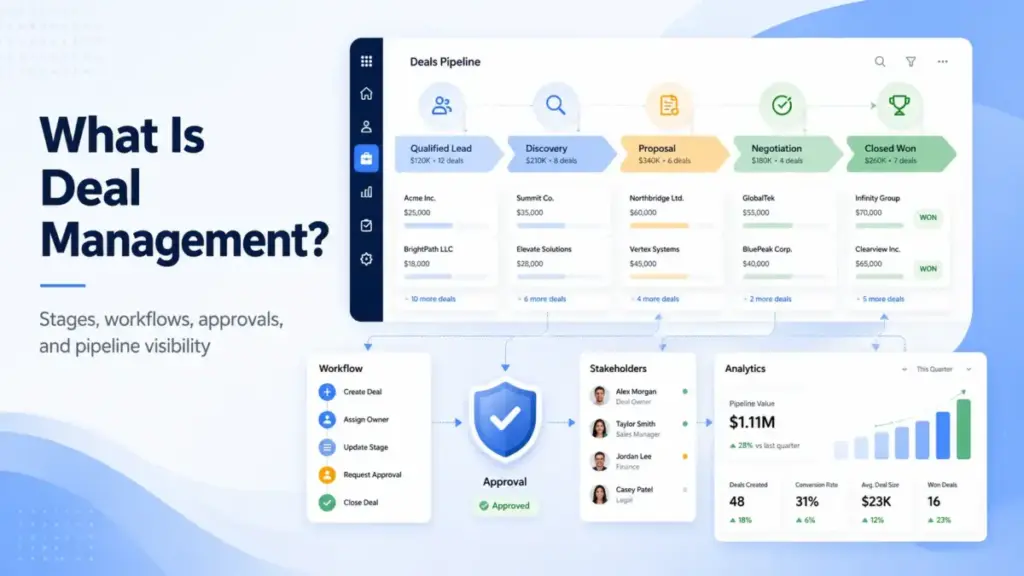
Most sales teams think deal management means dragging cards across a pipeline board. That framing leaves out the parts that actually determine whether deals close or collapse: stage criteria, next-step discipline, pricing approvals, stakeholder tracking, and forecast accuracy. Deal management is the operating system for deal quality, not just deal movement.
If your CRM software shows a healthy pipeline value but your forecast keeps missing, the problem is almost certainly a deal management problem. The pipeline looks full. The deals inside it are not qualified, not progressing, and not governed.
This guide explains what deal management includes, how it works, how it differs from pipeline management and CRM, which tools support it, which metrics prove it is working, and when to formalize the process.
Quick Answer: Deal management is the structured process of organizing, tracking, prioritizing, and progressing sales opportunities from qualification through close. It connects stage criteria, next actions, stakeholder data, pricing approvals, and forecast rules into a repeatable workflow inside or alongside a CRM platform. It differs from pipeline management (which tracks aggregate stage flow) and from CRM (which is the system of record). Deal management governs individual deal execution and quality.
What Deal Management Actually Means
Deal management is the structured method for organizing, tracking, maintaining, and prioritizing sales opportunities as they move through defined stages. According to HubSpot’s glossary, a repeatable deal management approach reduces missed handoffs, clarifies ownership, and increases the predictability of conversions.
That definition covers the basics. Here is the fuller picture across three layers.
The Simple Version
Deal management means keeping every open sales opportunity organized with an owner, a next step, a value, a close date, and a stage. When a lead becomes qualified, it enters the pipeline as a deal. Someone owns it, tracks it, and moves it forward until it closes or gets disqualified.
The Operational Version
A deal management workflow starts when a lead becomes a qualified opportunity. The CRM creates a deal record with an owner, company or contact association, expected value, close date, stage, source, next action, stakeholders, notes, documents, and products or quotes. The deal then moves through stages such as qualification, discovery, proposal, negotiation, approval, commit, closed-won, or closed-lost. At each stage, the team checks entry and exit criteria, logs buyer activity, updates risk signals, routes approvals when discounts or terms exceed guardrails, and uses reporting to identify stalled deals, forecast exposure, and win-rate patterns.
The Business Version
For revenue leaders, deal management is the control layer that turns CRM data into reliable forecasts and consistent selling behavior. It answers three questions every week: which deals are real, which deals are stuck, and which deals need intervention. Without it, pipeline reviews become opinion sessions, forecasts reflect hope instead of evidence, and pricing discipline breaks down.
Salesforce frames the adjacent concept of opportunity management as software that helps sales teams track and manage potential deals after a lead has been qualified, with attention to steps, documents, and stakeholders, according to their opportunity management page.
How Deal Management Works
Deal management follows a repeatable sequence. Each step depends on the previous one, and skipping steps is where most processes break down.
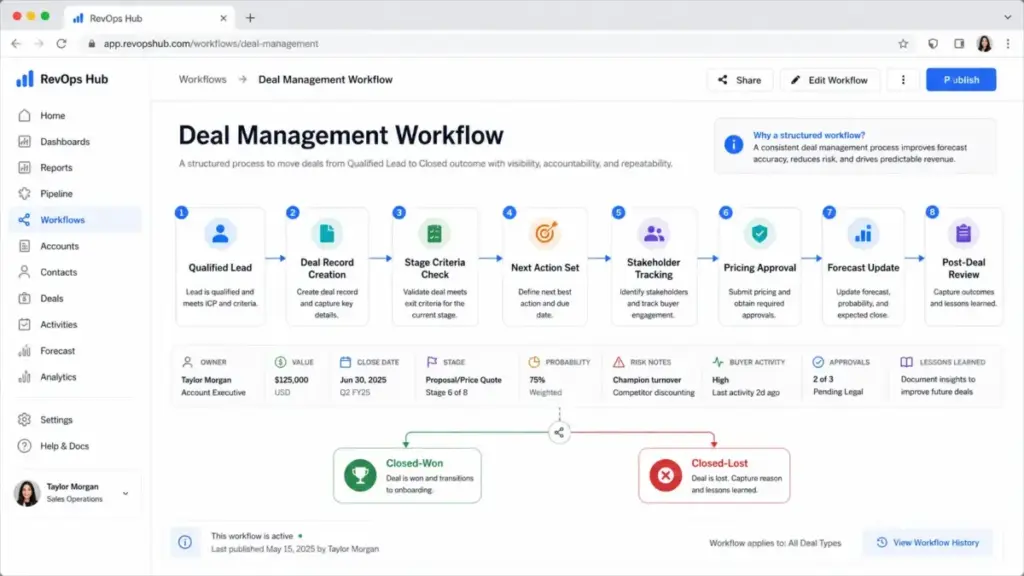
Step 1: Qualification gate. A lead becomes a deal only when it meets defined qualification criteria. Separating leads, contacts, accounts, and opportunities prevents the pipeline from getting polluted with unqualified interest.
Step 2: Deal record creation. The CRM or deal platform creates a deal record with the minimum required fields: account, contact, decision maker, value, close date, source, product or service, next step, last activity, stage, probability, and risk notes.
Step 3: Stage progression. The deal moves through defined stages. Each stage has a plain-English definition, required fields, an owner, entry criteria, and exit criteria. The stages track buyer progress, not internal optimism.
Step 4: Activity capture and next-step discipline. Every open deal requires a dated next action. Deals with no recent buyer activity get flagged as stale.
Step 5: Pricing and approval routing. Deals that exceed margin, term, compliance, or approval thresholds route through pricing, discount, legal, or finance guardrails before advancing.
Step 6: Reporting and review. The team builds reporting around pipeline value, stage conversion, deal age, win rate, sales velocity, forecast category, weighted pipeline, slipped deals, and no-next-step deals.
Step 7: Weekly pipeline inspection. Managers review what changed, what stalled, what risk emerged, and what specific buyer action is required next. The focus is movement, not just value.
Step 8: Closed-deal analysis. Monthly review of closed-won and closed-lost data feeds lessons back into qualification criteria, stage definitions, playbooks, pricing approvals, and forecast rules.
Where things go wrong: deals sit in “proposal” with no buyer-confirmed next step. Close dates get pushed based on hope. Discount approvals happen after the rep already promised a price. Stale deals inflate pipeline value, and the forecast becomes fiction.
Deal Management vs Pipeline Management vs CRM vs Deal Desk
Competitors in the SERP use these terms interchangeably. They are not the same thing.
| Concept | What it is | Primary owner | System of record | Success metric |
|---|---|---|---|---|
| CRM | The platform that stores customer, contact, and opportunity data | Sales ops or admin | The CRM itself (Salesforce, HubSpot, etc.) | Data completeness and adoption rate |
| Pipeline management | Managing the aggregate flow of deals across stages | Sales manager | CRM pipeline view | Pipeline coverage and stage conversion |
| Opportunity management | Tracking individual qualified deals through defined steps | Account executive or rep | CRM opportunity record | Win rate and deal velocity |
| Deal management | The full operating process: stage rules, next steps, pricing approvals, stakeholder tracking, risk scoring, and forecast governance | Sales manager + sales ops + deal desk | CRM + approval workflows + reporting | Forecast accuracy, deal quality, and margin discipline |
| Deal desk | The governance layer for complex deals requiring pricing, discount, legal, or finance approval | Deal desk manager or finance | CPQ, approval workflows, contract tools | Approval cycle time and discount rate |
The key distinction: a CRM stores data. Pipeline management tracks flow. Deal management governs execution. A visual Kanban board is only the interface. Good deal management also requires qualification criteria, ownership, activity capture, deal health signals, approvals, and reporting.
Types of Deal Management
Deal management is not a single workflow. Different business models require different approaches.
CRM-Based Deal Management
A sales pipeline inside a CRM where reps manage opportunities, contacts, activities, stages, tasks, and forecasts in one system. This is the most common type and fits most B2B sales teams with repeatable deal cycles.
Deal Desk or Approval-Based Deal Management
A structured workflow for complex B2B deals involving pricing, discounts, legal review, finance approval, CPQ, quote generation, and contract handoff. Teams that sell configurable products or negotiate custom terms need this layer on top of CRM pipeline tracking.
Partner or Channel Deal Management
A process where vendors, distributors, resellers, or partners register and update deals to prevent conflict, protect margins, and forecast channel revenue. Standard CRM pipeline views often fail for partner ecosystems because partners lack direct CRM access.
Account-Based Deal Management
A strategic process for enterprise accounts where stakeholder mapping, mutual action plans, and multi-threading are central. This type appears in sales with buying committees of 6+ stakeholders and cycles longer than 90 days.
Retail or Agreement Deal Management
A pricing and promotion workflow for retailer-vendor agreements, customer-specific price exceptions, and rebates. Vendavo and Zilliant frame this as defining deal parameters including customer history, discount levels, and operational constraints.
AI-Assisted Deal Management
A modern layer that summarizes meetings, detects missing next steps, predicts deal risk, drafts follow-ups, enriches records, and supports forecasting. Gartner predicts that by 2029, sales organizations with AI-driven enablement functions will achieve 40% faster sales stage velocity than those using traditional enablement approaches, according to a Gartner newsroom prediction.
The caveat: AI deal management features depend on CRM data quality, activity capture, and configured workflows. AI can summarize activity, detect gaps, and suggest next actions. It cannot fix bad stages, poor qualification, or missing buyer engagement data.
How to Implement Deal Management
Implementation order matters. Teams that buy a CRM and skip process definition end up with a database nobody trusts.
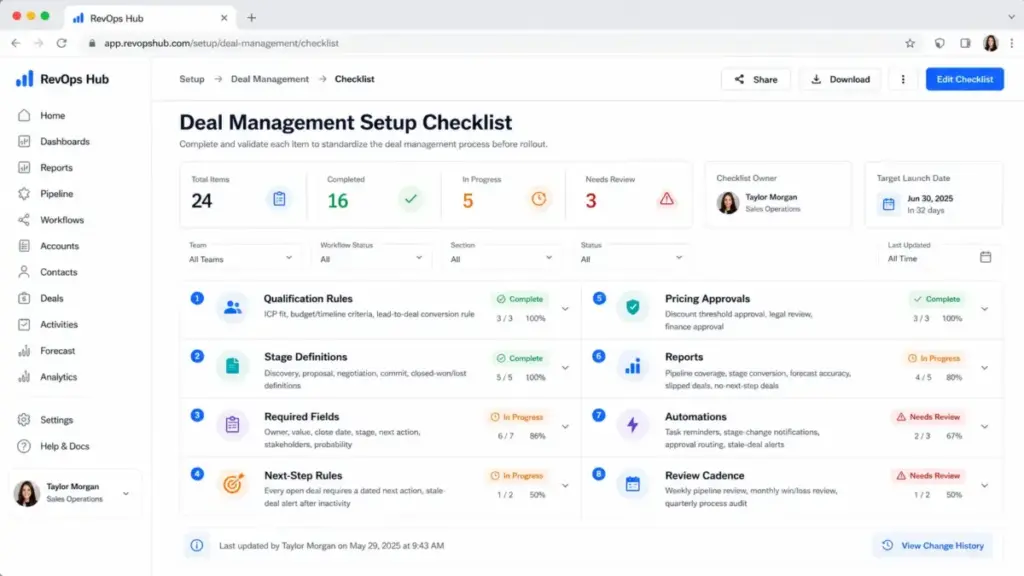
- Define qualification criteria first. Separate leads from deals so the pipeline is not polluted with unqualified interest. “Follow-up” and “in progress” are not stages. “Discovery call completed, budget confirmed” is.
- Set the minimum deal record. Account, contact, decision maker, value, close date, source, next step, stage, probability, and risk notes. Missing fields create bad data. Too many fields reduce adoption.
- Require a dated next action on every open deal. Flag stale opportunities with no recent buyer activity. This single rule catches more problems than any dashboard.
- Add pricing and approval guardrails. Deals exceeding margin, term, or approval thresholds route through finance, legal, or management before advancing.
- Build reporting around movement, not value. Start with stage conversion, deal age, win rate, slipped deals, and no-next-step deals.
- Run weekly pipeline reviews and monthly win/loss reviews. Inspect what changed, what stalled, and what specific buyer action is required next. Feed closed-deal lessons back into qualification and stage rules.
- Automate admin tasks last. Reminders, stage-change notifications, and meeting summaries. Automate these after the process works manually.
Common Mistakes and Misconceptions
The 7 Mistakes That Break Deal Management
- Treating every lead as a deal before qualification. This inflates pipeline value and makes forecasts unreliable. A lead expressing interest is not a deal until it meets defined criteria.
- Using too many pipeline stages or vague labels. “Follow-up” and “in progress” give managers no information. Each stage should reflect a buyer milestone, not an internal action.
- Letting reps choose close dates based on hope. Close dates should reflect buyer-confirmed milestones, not quarterly targets. Close-date push rate is one of the clearest signals of process failure.
- Measuring only pipeline value without inspecting deal age, next action, risk, and stage conversion. A $2M pipeline with 60% of deals stale for 30 days is not a $2M pipeline.
- Automating broken workflows before fixing stage rules and data quality. Automation amplifies whatever process exists. If the process is bad, automation makes it fail faster.
- Ignoring pricing approvals, discount limits, and legal handoffs until late in the sales cycle. Late-stage pricing surprises kill deals or erode margin.
- Buying a CRM but failing to define ownership, review cadence, and coaching expectations. The CRM is infrastructure. The process is what creates value.
5 Misconceptions About Deal Management
Misconception: Deal management is the same as CRM.
Reality: A CRM stores customer and opportunity data. Deal management is the sales process, workflow, rules, and review cadence used to move opportunities forward inside or alongside the CRM.
Misconception: Deal management only matters for enterprise sales.
Reality: Complex enterprise deals need more governance, but even small teams benefit from defined stages, next-step discipline, follow-up automation, and pipeline review.
Misconception: A visual pipeline equals good deal management.
Reality: A Kanban board is the interface. Good deal management also requires qualification criteria, ownership, activity capture, deal health signals, approvals, and reporting.
Misconception: AI deal management can replace sales managers.
Reality: AI can summarize activity, detect gaps, and suggest next actions. Managers still need to coach reps, inspect strategy, validate assumptions, and handle exceptions.
Misconception: Closing more deals is always the goal.
Reality: Deal management also protects profitability, pricing consistency, and agreement compliance. Closing a deal at a 40% discount with unapproved terms is not a win.
Limitations and When NOT to Use Heavy Deal Management
Deal management is not universally necessary, and overbuilding the process creates its own problems.
Limitations
Bad CRM data makes deal management misleading. Stale stages, inflated values, missing next steps, and subjective close probabilities create false forecast confidence. The process is only as good as the data feeding it.
Too much stage complexity reduces adoption. If reps perceive the CRM as administrative burden, the process breaks down. The goal is the minimum structure that produces reliable data, not the maximum structure that looks thorough on a slide deck.
Deal management does not replace sales skill. It can reveal risk and enforce structure, but it cannot create buyer urgency or solve weak qualification by itself.
When to Formalize Deal Management
Your team has more open opportunities than reps can reliably track manually. Deals require multiple touchpoints or stakeholders. Forecasts are unreliable. Follow-ups get missed. Discounts or approvals are inconsistent. Managers need pipeline visibility. Or the business sells through partners or complex B2B workflows.
When NOT to Invest in Heavy Deal Management Software
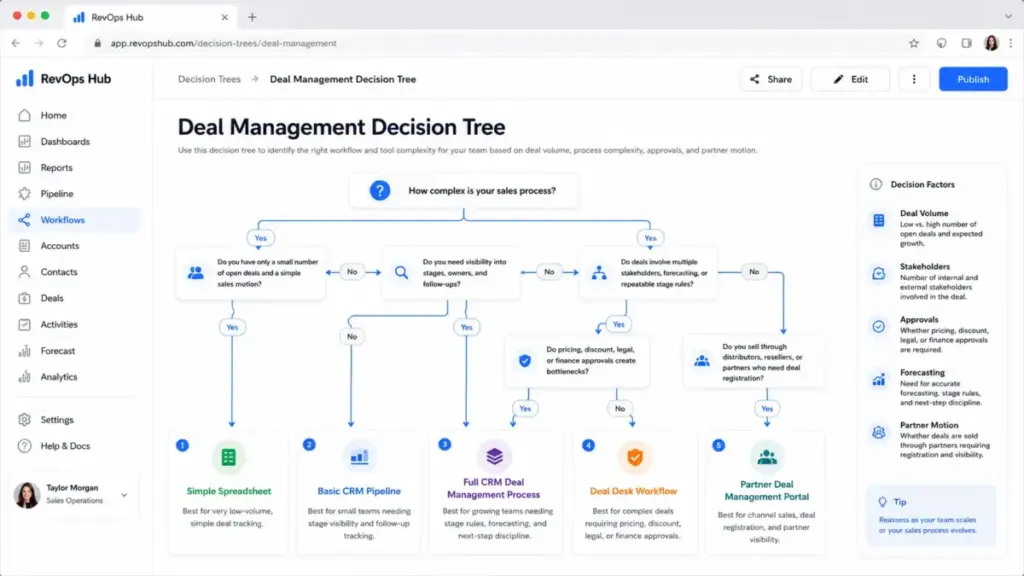
You have only a handful of simple one-call transactions. You do not have a repeatable sales process yet. There is no CRM adoption plan. No one is willing to enforce stage hygiene, field quality, and review cadence. In these cases, start with a lightweight spreadsheet or simple CRM and define the process before adding advanced automation.
How to Measure Deal Management Results
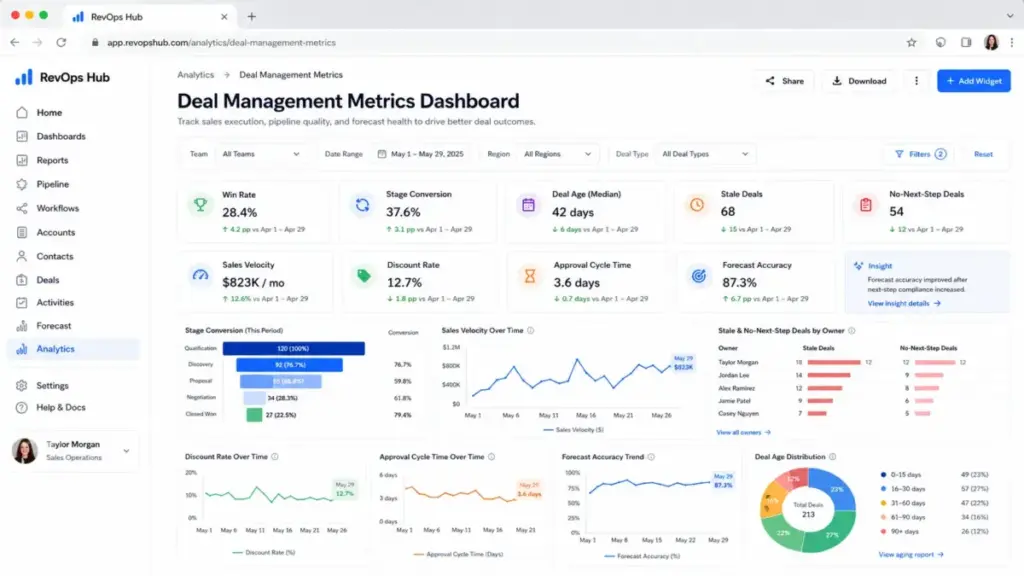
Measuring pipeline value alone tells you almost nothing about deal quality. These metrics reveal whether the process is working.
| Metric | What it measures | Why it matters |
|---|---|---|
| Win rate | Deals closed-won / total deals closed | Shows whether qualification and stage management improve outcomes |
| Stage-to-stage conversion | % of deals progressing from one stage to the next | Identifies where deals stall or leak from the pipeline |
| Average deal size | Mean revenue per closed-won deal | Tracks whether pricing discipline holds or discounts erode value |
| Sales cycle length | Days from deal creation to close | Reveals whether stage discipline accelerates or drags the process |
| Sales velocity | (Deals x Value x Win Rate) / Cycle Length | Combines key metrics into a single throughput number |
| Pipeline coverage | Pipeline value / quota or target | Shows whether enough qualified pipeline exists to hit the number |
| Forecast accuracy | Forecast vs actual closed revenue | The ultimate test of deal management quality |
| Slipped deal % | Deals that missed their projected close date | Exposes close-date optimism and weak buyer commitment |
| No-next-step deals | Open deals without a dated next action | The fastest leading indicator of pipeline decay |
What these numbers mean together: If win rate improves but forecast accuracy stays flat, reps close better but stage deals incorrectly. If sales velocity rises with discount rate, the team trades margin for speed. No single metric tells the story.
Tools That Support Deal Management
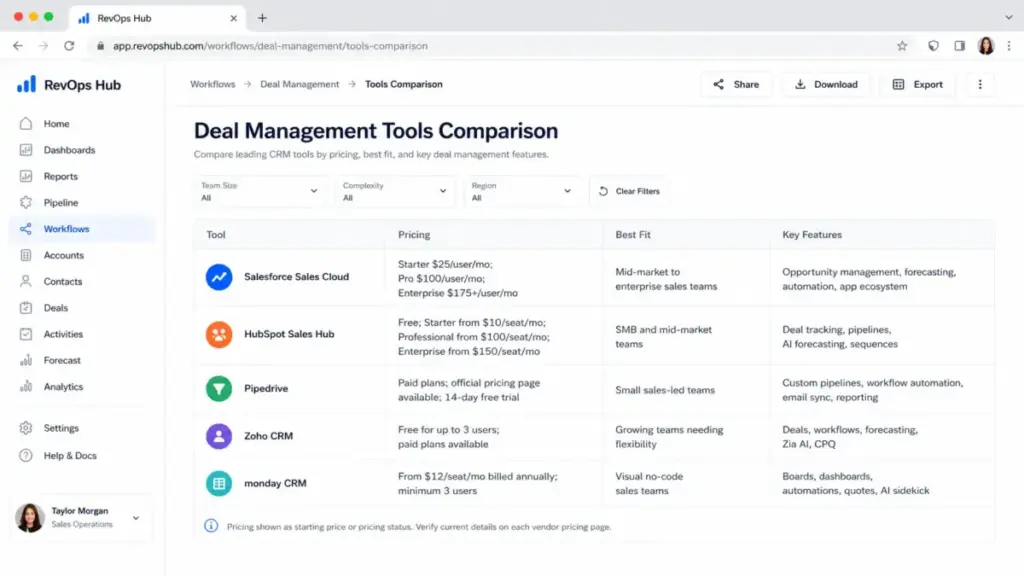
Deal management is a process, not a product. But the right CRM or deal platform makes the process repeatable. Here are five tools that implement deal management workflows, based on official documentation reviewed as of May 2026.
| Tool | Pricing status | Best fit | Key deal management features | Caveats |
|---|---|---|---|---|
| Salesforce Sales Cloud | Free Suite at$0, Starter at $25/user/mo, Pro at $100/user/mo, Enterprise at $175/user/mo (official pricing) | Mid-market to enterprise teams needing deep customization and ecosystem | Opportunity management, pipeline management, forecasting, quote and order tracking, AI and automation options, partner and app ecosystem | Requires configuration, admin expertise, and potentially paid add-ons. Final cost varies by edition, users, AI features, integrations, and services. |
| HubSpot Sales Hub | Free at$0/mo, Starter at $10/mo per seat, Professional at $100/mo per seat, Enterprise at $150/mo per seat (official page) | SMB and mid-market teams wanting lower-friction CRM entry with marketing alignment | Deal tracking, pipelines, automated follow-ups, AI-powered forecasting, custom objects on Enterprise, reporting, sequences | Advanced automation, forecasting, custom objects, and conversation intelligence require higher tiers. |
| Pipedrive | Official pricing page available; 14-day free trial confirmed (official site) | Sales-led teams prioritizing visual pipeline and deal tracking simplicity | Custom pipelines, Kanban-style dashboard, deal and contact history, workflow automation, lead routing, email and calendar sync, reports | No confirmed free plan. Advanced forecasting, reporting, permissions, and support depend on tier. Check thepricing page for current plan prices. |
| Zoho CRM | Free edition for up to 3 users; paid plans published on theofficial pricing page | Flexible teams needing deals, workflows, forecasting, CPQ, and low-code customization | Deals, workflows, reports, dashboards, forecasting, CPQ on Professional, Zia AI assistant, territory management, custom functions | AI, CPQ, territory management, and deeper customization require higher tiers. |
| monday CRM | Plans start from 3 users; official listing indicates monday CRM starts from$10/user/month (pricing page) | Visual, no-code deal management with boards, dashboards, and automations | Contacts and deals, dashboards, custom boards, quotes and invoices, custom automations, email and activity logging, AI Sidekick | Exact price depends on region, plan, billing cycle, and seats. Some features and limits differ by tier. |
Salesforce approaches deal management through opportunity management with full forecasting, CPQ, and partner ecosystem support. HubSpot combines deal records, pipelines, automated follow-ups, and AI-powered forecasting with lifecycle stages that show the lead management handoff point. Pipedrive focuses on visual pipeline simplicity with Kanban-style deal movement. Zoho CRM layers deals with CPQ, Zia AI, and territory management. monday CRM delivers no-code boards, automations, and AI Sidekick.
How to Choose the Right Deal Management Tool
Choosing a tool before defining your process is the most common mistake. Start with the process, then match it to software.
- Define your deal stages first. Write them on paper before evaluating any CRM. If you cannot describe your stages without the software, you are not ready.
- Count your deal volume. Fewer than 20 open deals at any time? A spreadsheet or basic CRM pipeline works. More than 50? You need sales automation and reporting.
- Map your approval needs. If pricing, discounts, or contract terms require sign-off from finance, legal, or management, you need approval routing, not just a pipeline board.
- Check plan gates before committing. Advanced automation, AI features, forecasting, and custom reporting are often locked behind mid-tier or enterprise plans. The starting price is almost never the price you will pay.
- Test with real deals, not demo data. Import your actual pipeline and run it through two weekly reviews. If the tool creates friction at review time, it will create more friction at scale.
- Evaluate CRM adoption, not just CRM features. A tool your reps refuse to update produces worse data than a spreadsheet they maintain daily.
Deal Management Beginner Checklist
Use this checklist to audit your current deal management process or build one from scratch.
- [ ] Qualification criteria defined: clear rules for when a lead becomes a deal
- [ ] Deal stages mapped: each stage has a name, definition, entry criteria, and exit criteria
- [ ] Required deal fields set: account, contact, value, close date, source, next step, stage
- [ ] Ownership assigned: every deal has one owner responsible for progression
- [ ] Next-step rule enforced: every open deal has a dated next action
- [ ] Stale deal flag active: deals with no activity for 14+ days are flagged automatically
- [ ] Pricing guardrails set: discount or term thresholds trigger approval before advancing
- [ ] Weekly pipeline review scheduled: inspect movement, not just value
- [ ] Win/loss review monthly: closed-deal lessons feed back into stage rules and qualification
- [ ] CRM field completeness tracked: required fields have completion rate targets
- [ ] Forecast vs actual compared: forecast accuracy measured and reviewed quarterly
Frequently Asked Questions
What is deal management in sales?
Deal management is the structured process of organizing, tracking, and progressing sales opportunities from qualification through close. It includes deal records, stage progression, next-step discipline, pricing approvals, stakeholder tracking, and forecast governance.
What is the difference between deal management and pipeline management?
Pipeline management tracks the aggregate flow of deals across stages: total pipeline value and stage conversion rates. Deal management governs individual deal execution: whether each deal has a qualified buyer, a dated next step, approved pricing, and accurate forecast data.
Can AI replace deal management?
AI can assist by summarizing meetings, flagging stale deals, detecting missing next steps, and supporting forecasting. It cannot replace the process. AI outputs depend on data quality, configured workflows, and rep adoption.
Do small teams need deal management?
Yes, but structure should match complexity. Even a 3-person team benefits from defined stages, required next steps, and a weekly pipeline review. A simple CRM with clear stage rules often works better than a complex platform nobody maintains.
What is a deal desk?
A deal desk is a centralized team or workflow that reviews and approves complex deals involving non-standard pricing, discounts, or legal terms. Teams need one when approval exceptions happen frequently enough to require formal governance.
What fields should every deal record have?
At minimum: account name, primary contact, decision maker, expected value, close date, source, product or service, current stage, probability, next step with date, last activity date, and risk notes.
What is the difference between deal management and opportunity management?
Salesforce uses “opportunity management” to describe tracking deals after lead qualification. Deal management is the broader concept: it adds stage governance, pricing approvals, stakeholder mapping, forecast discipline, and review cadence on top of opportunity tracking.