Hunter does not charge per seat. It charges per credit, which changes the entire cost conversation for outbound teams.
That single design choice is why a five-person SDR pod and a solo founder can pay the same monthly price on the same plan. It is also why the headline number on the pricing page tells you almost nothing about what you will spend.
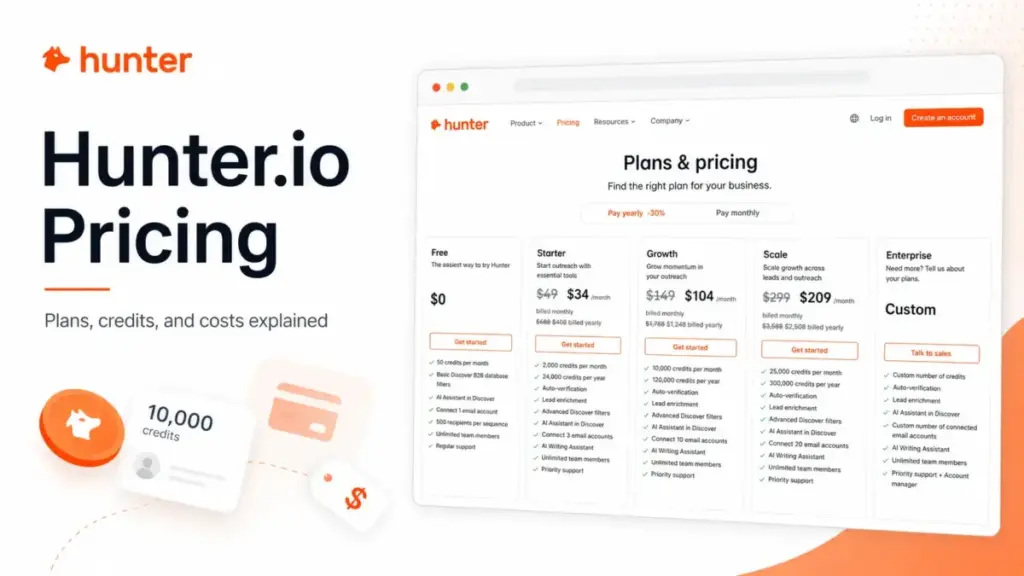
Paid plans start at $49 per month for Starter, dropping to an effective $34 per month if you commit to a year. The plan most active outreach teams land on is Growth at $149 per month, or $104 per month billed yearly. The gotcha nobody puts in the ad is that credits and connected sending accounts, not seats, decide when your bill jumps. This guide breaks down every plan, the real cost per contact, the add-ons that expire, and who should pick something else. For the feature-by-feature side of the product, see our Hunter.io review.
All pricing here was checked against Hunter’s official pricing page and help center on July 2, 2026.
Quick Pricing Verdict
| Question | Answer |
|---|---|
| Starting paid price | $49/month (Starter), or $34/month billed yearly |
| Free plan | Yes, 50 credits/month, 1 sending account, 500 recipients per sequence |
| Best plan for most active teams | Growth, $149/month or $104/month billed yearly |
| Plan to avoid | Starter, once you run 4+ sending accounts or steady high-volume prospecting |
| Biggest hidden cost | Credit burn plus connected email account slots (add-ons from $10/month) |
| Cheaper alternative to compare | Snov.io Starter at $39/month for solo or very small teams |
| Pricing verified | July 2, 2026 |
Hunter is priced for the sending motion, not the org chart. If your constraint is people, Hunter is cheap. If your constraint is volume, read the credit math before you buy.
The Advertised Price vs the Real Price
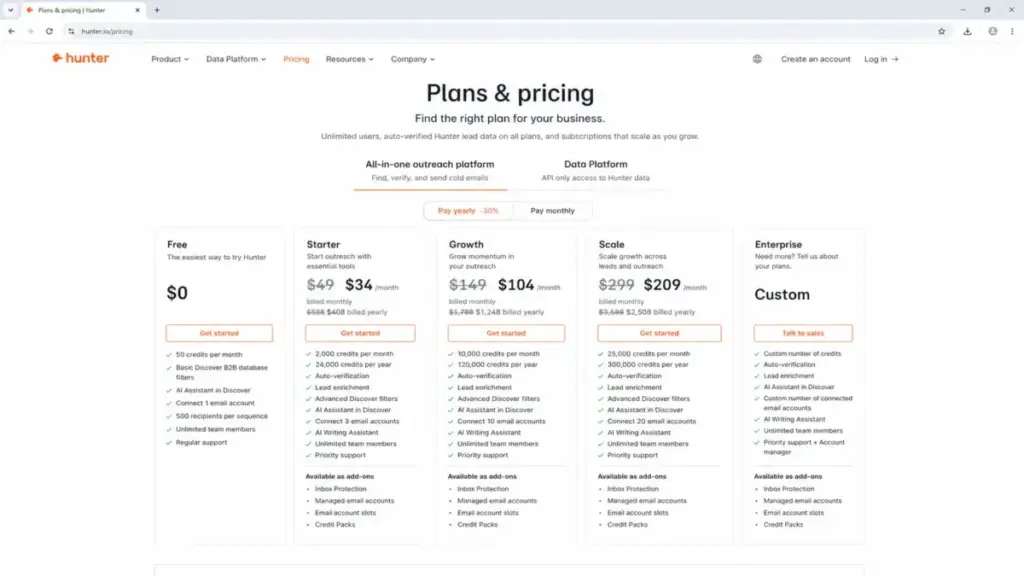
The pricing page shows four numbers: $0, $49, $149, $299. None of them is what most teams actually plan around.
Two things sit underneath every plan. The first is the yearly discount, which cuts the effective monthly rate by 30 percent. The second is the credit ceiling, which is the real spending limit on how many contacts you can find and verify each month.
| Plan | Advertised monthly | Effective monthly billed yearly | Annual total | The real monthly ceiling |
|---|---|---|---|---|
| Free | $0 | $0 | $0 | 50 credits, 1 sending account |
| Starter | $49 | $34 | $408 | 2,000 credits, 3 sending accounts |
| Growth | $149 | $104 | $1,248 | 10,000 credits, 10 sending accounts |
| Scale | $299 | $209 | $2,508 | 25,000 credits, 20 sending accounts |
| Enterprise | Custom | Custom | Custom | Custom credits and accounts |
Source: Hunter pricing page and All-in-One Outreach plan documentation, checked July 2, 2026.
Read the far-right column, not the far-left one. A team that burns through 2,000 credits by the third week is not on a $49 plan, it is on a plan that stopped working, and the next stop is $149.
How Hunter.io Credits Actually Work
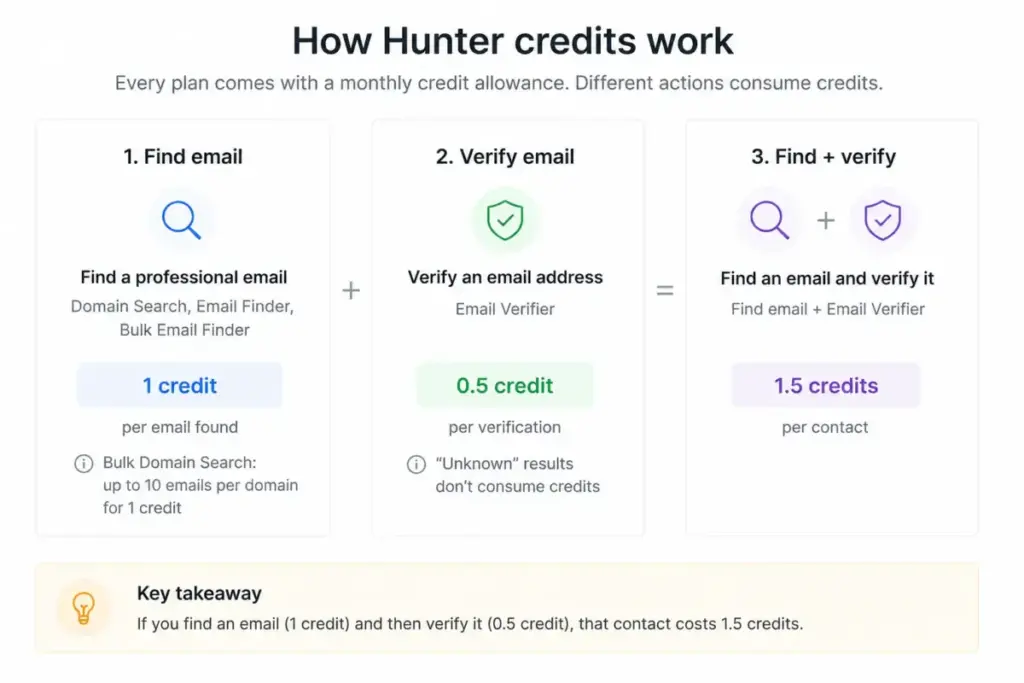
Every All-in-One Outreach plan draws from one shared credit pool. Finding and verifying pull from the same balance, so mixed work drains faster than the headline number suggests.
Finding a professional email through Domain Search, Email Finder, or Bulk Email Finder costs 1 credit per found address. Bulk Domain Search is the efficient path: it can return up to 10 emails per domain or company name for a single credit.
Email verification costs 0.5 credit per verification on these plans. Verifications that come back as “unknown” do not consume a credit, which slightly softens the cost of dirty lists.
The number that trips people up is the found-and-verified contact. If you find an address (1 credit) and then run an explicit verification on it (0.5 credit), that one contact cost you 1.5 credits.
Real capacity by workflow
The plan’s usable output depends on how you split credits between finding and verifying. Here is what each monthly allowance buys in the three common patterns.
| Plan | Finding only (1 credit) | Verifying only (0.5 credit) | Find + verify same contact (1.5 credits) |
|---|---|---|---|
| Free (50) | 50 contacts | 100 verifications | ~33 contacts |
| Starter (2,000) | 2,000 contacts | 4,000 verifications | ~1,333 contacts |
| Growth (10,000) | 10,000 contacts | 20,000 verifications | ~6,666 contacts |
| Scale (25,000) | 25,000 contacts | 50,000 verifications | ~16,666 contacts |
Capacity figures are calculated from Hunter’s published credit rates, checked July 2, 2026.
If your prospecting always includes a verification step, cut the advertised credit count by roughly a third to estimate real contact volume. That is the difference between planning a campaign and running out mid-month.
What a contact really costs
Divide the plan price by its credit allowance and the unit economics get clearer, especially on annual billing where the discount lands on every credit.
| Plan | Cost per credit (yearly) | Cost per found email (yearly) | Cost per found + verified contact (yearly) |
|---|---|---|---|
| Starter | ~1.7 cents | ~1.7 cents | ~2.6 cents |
| Growth | ~1.0 cent | ~1.0 cent | ~1.6 cents |
| Scale | ~0.8 cent | ~0.8 cent | ~1.3 cents |
Figures derived from annual plan totals divided by annual credit allowances.
The per-contact cost nearly halves from Starter to Scale. Volume buyers are not just paying more, they are paying less per contact, which is the argument for sizing up before you buy credit packs.
The Five Hidden Costs Nobody Mentions
The sticker price is honest. The problem is that four or five separate line items sit next to it, and most pricing articles skip them.
1. Credit exhaustion forces an upgrade
Credits do not roll over on monthly plans, and they run out faster than teams expect once verification enters the mix. A team doing find-plus-verify on Starter has about 1,333 usable contacts, not 2,000.
When that ceiling hits mid-month, you either buy a credit pack or jump a tier. Both cost real money, and the jump from Starter to Growth is $100 per month.
2. Connected email account slots can force a plan jump before credits do
This is the cost that catches sales teams. Free includes 1 connected sending account, Starter 3, Growth 10, and Scale 20.
If you run cold email across five inboxes to protect email deliverability, Starter’s three-account cap blocks you before you touch its credit limit. You are pushed to Growth for the accounts, not the credits.
Additional sending accounts are available as an add-on from $10 per month each. Managed email accounts and custom domains, where Hunter buys and configures the mailboxes for you, start at $6.00 per month.
Inbox Protection is listed as an add-on on paid plans, but its exact price was not confirmed in the public pricing table, so budget for it as a checkout-time cost rather than a fixed number.
3. Credit packs expire and are non-refundable
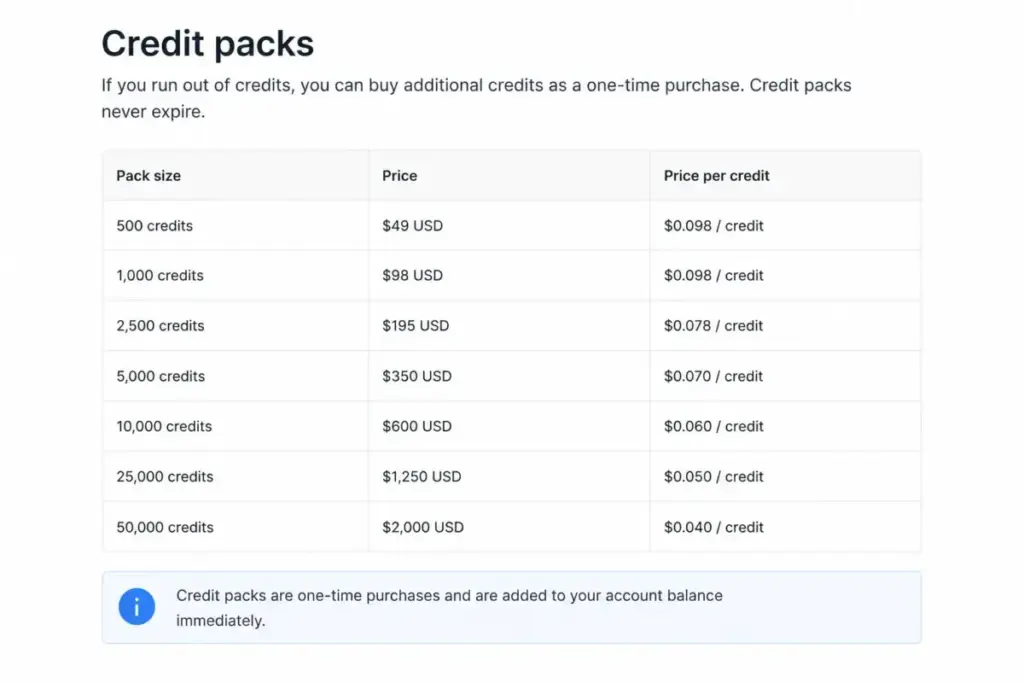
You can top up without upgrading by buying credit packs on Starter, Growth, and Scale. They are not available on Free, Data Platform, or Enterprise plans.
Two rules matter. Credit packs expire after 3 months, and they are non-refundable once purchased.
| Credit pack | Starter price | Growth price | Scale price |
|---|---|---|---|
| 100 credits | $10 | $7.50 | $5 |
| 1,000 credits | $70 | $52.50 | $35 |
| 10,000 credits | $400 | $300 | $200 |
Source: Hunter credit packs help documentation, checked July 2, 2026.
Notice the pack price drops with your plan tier. A 10,000-credit pack costs $400 on Starter but $200 on Scale, so the plan you are on quietly changes the price of every overage.
4. Annual billing is cheaper but locked in
The 30 percent yearly discount is real, and for a committed team it is the single easiest saving. But yearly plans bill once for the full 12 months, and pausing is not available the way it is on monthly.
Cancellation stops the next renewal. It does not reverse a charge that already processed, and Hunter does not refund unused or partially used time after payment.
For a team testing whether Hunter fits the workflow, the annual commitment is the wrong bet. Start monthly, confirm the credit math holds, then switch to yearly.
5. The Data Platform is a different product wearing the same brand
API and bulk buyers often assume the standard plans cover them. They do not. Hunter separates its Data Platform from All-in-One Outreach, and the two are not interchangeable.
Data Platform plans are yearly, built for API or bulk use, and run on separate Search and Verification credit quotas rather than one shared pool. They do not include Sequences, Signals, or Discover, and credit packs are not offered on them.
Switching an existing account from All-in-One to Data Platform can stop active sequences and remove connected email accounts. If you run cold email through Hunter, the Data Platform is not an upgrade, it is a lateral move into a different toolset.
Plan-by-Plan Breakdown
Here is the full table, then what each tier is actually for.
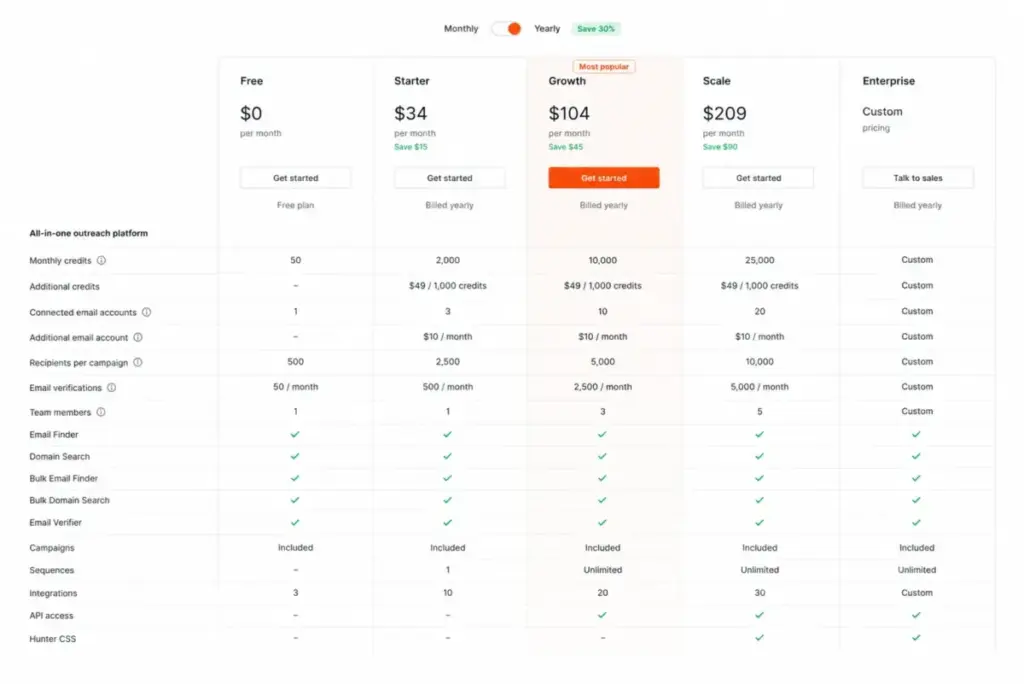
| Plan | Monthly | Yearly (effective/mo) | Credits/month | Sending accounts | Recipients per sequence | Support |
|---|---|---|---|---|---|---|
| Free | $0 | $0 | 50 | 1 | 500 | Regular |
| Starter | $49 | $34 | 2,000 | 3 | 2,500 | Priority |
| Growth | $149 | $104 | 10,000 | 10 | 5,000 | Priority |
| Scale | $299 | $209 | 25,000 | 20 | 15,000 | Priority |
| Enterprise | Custom | Custom | Custom | Custom | Custom | Priority + account manager |
Source: Hunter pricing page and All-in-One Outreach documentation, checked July 2, 2026. All plans include unlimited team members who share the credit pool.
Free
Best for testing Hunter or running very light prospecting. Includes email finding and verification, one sending account, Sequences, Discover, the Leads CRM, API access, and integrations.
Avoid relying on Free for real outbound. Fifty credits is roughly 33 found-and-verified contacts a month, and the single sending account caps any serious cold email motion.
Starter
Best for solo users, freelancers, recruiters, and link builders who outgrew Free. The 2,000 credits and priority support are the real upgrade, plus premium Discover filters and lead enrichment.
Avoid Starter the moment you need a fourth sending inbox. Three connected accounts is the wall most small teams hit first.
Growth
Best for active outreach teams running multiple inboxes. Jumping from 3 to 10 sending accounts and from 2,000 to 10,000 credits is the step change, and yearly billing pulls the price to $104 per month.
This is my recommendation for most teams that run steady prospecting and lead nurture sequences. It is the plan where the per-contact cost drops and the account limit stops getting in your way.
Scale
Best for high-volume teams that need the largest self-serve tier: 25,000 credits, 20 sending accounts, and 15,000 recipients per sequence. Credit packs are also cheapest here.
Avoid Scale if your credit use is bursty rather than steady. A Growth plan plus occasional credit packs can be cheaper than paying for 25,000 credits you only touch some months.
Enterprise
Best for teams that need more than 25,000 credits per month or 300,000 per year, custom sending-account limits, or a dedicated account manager. Pricing is custom, so treat any number you see elsewhere as unverified.
Feature gates that change the decision
The plan table hides several limits that only appear when you scale a specific workflow.
| Feature gate | Free | Starter | Growth | Scale | Enterprise |
|---|---|---|---|---|---|
| Discover filters | Basic | Advanced | Advanced | Advanced | Advanced |
| AI Discover searches/month | 10 | 50 | 150 | 300 | 300 |
| Signals | 10 | 20 | 200 | Effectively unlimited | Custom |
| Saved leads | 100,000 | 2,000,000 | 10,000,000 | 30,000,000 | Custom |
| Credit packs | No | Yes | Yes | Yes | No (custom contract) |
| Priority support | No | Yes | Yes | Yes | Yes + account manager |
Source: Hunter pricing page, checked July 2, 2026.
Signals is the sleeper gate. It jumps from 20 on Starter to 200 on Growth, so intent-driven teams have another reason to skip Starter entirely.
When the Free Plan Stops Working
Free is a real plan, not a time-limited trial, and it includes more than most vendors give away. But it is fenced in specific ways that matter for outbound.
Free includes 50 credits a month, one sending account, 500 recipients per sequence, Sequences, Discover, the Leads CRM, API access, integrations, and unlimited team members. That covers light, occasional prospecting.
| Included on Free | Excluded from Free |
|---|---|
| 50 credits/month | Credit packs |
| 1 sending account | Extra email accounts |
| Sequences and Discover | SMTP/IMAP sending |
| Leads CRM and API access | Link tracking and custom tracking domain |
| Basic Discover filters | Automatic lead verification |
| Regular support | AI Writing Assistant for Sequences |
| Unlimited team members | Priority support and premium Discover filters |
Source: Hunter Free plan help documentation, checked July 2, 2026.
The exclusions that end the honeymoon are the single sending account, no SMTP/IMAP, and no credit packs. Once you need a second inbox or your own sending setup, Free is done and Starter is the floor.
Monthly vs Yearly Billing
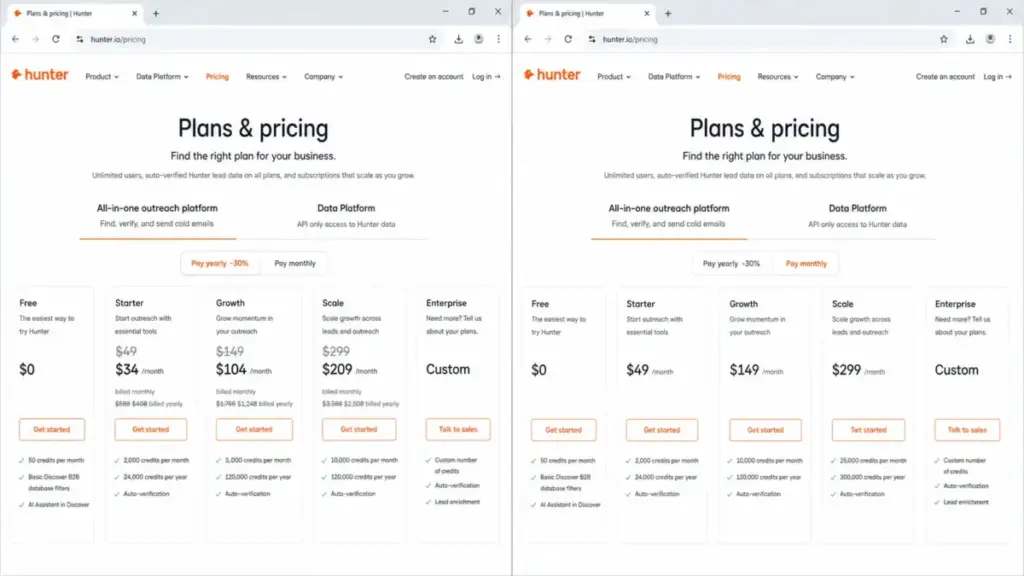
The discount is straightforward. The operational difference is not.
Monthly plans reset credits each month, carry no annual commitment, and can be cancelled or paused. Yearly plans cost 30 percent less per month, bill once for the full term, and make the entire year’s credits available upfront, expiring at the end of the 12-month cycle.
| Factor | Monthly | Yearly |
|---|---|---|
| Effective price | Full rate | 30% lower |
| Credit delivery | Resets each month | Full year available upfront |
| Commitment | None, cancel or pause anytime | 12 months, one charge |
| Refund on cancel | Stops renewal, no refund of processed charge | Stops renewal, no refund of unused time |
| Best for | Testing, seasonal, uncertain volume | Steady, confirmed monthly usage |
Source: Hunter billing and cancellation help documentation, checked July 2, 2026.
Pick yearly only after a monthly trial proves your credit and sender needs. The upfront-credit design is generous for steady teams and punishing for anyone whose plans change in month two.
Real Cost by Team Size
Hunter is not per seat, so the scaling question is not “how many people” but “how many sending accounts and how much volume.” Here is what teams actually pay, before add-ons.
| Sending accounts | Recommended plan | Monthly | Annual | Notes |
|---|---|---|---|---|
| 3 or fewer | Starter | $49 | $408 | Works if volume stays under ~1,300 find-and-verify contacts |
| 5 | Growth | $149 | $1,248 | Starter’s 3-account cap forces the jump, not credits |
| 10 | Growth | $149 | $1,248 | 10 accounts and 10,000 credits are both included |
| 20 | Scale | $299 | $2,508 | 20 accounts included; check credit headroom |
| 25 | Scale + slots or Enterprise | $299 + from $50 | $2,508 + add-ons | Add ~5 accounts from $10/month each, or move to sales |
| 50+ | Enterprise | Custom | Custom | Beyond self-serve account limits |
Source: Hunter pricing page, All-in-One documentation, and add-on pricing, checked July 2, 2026.
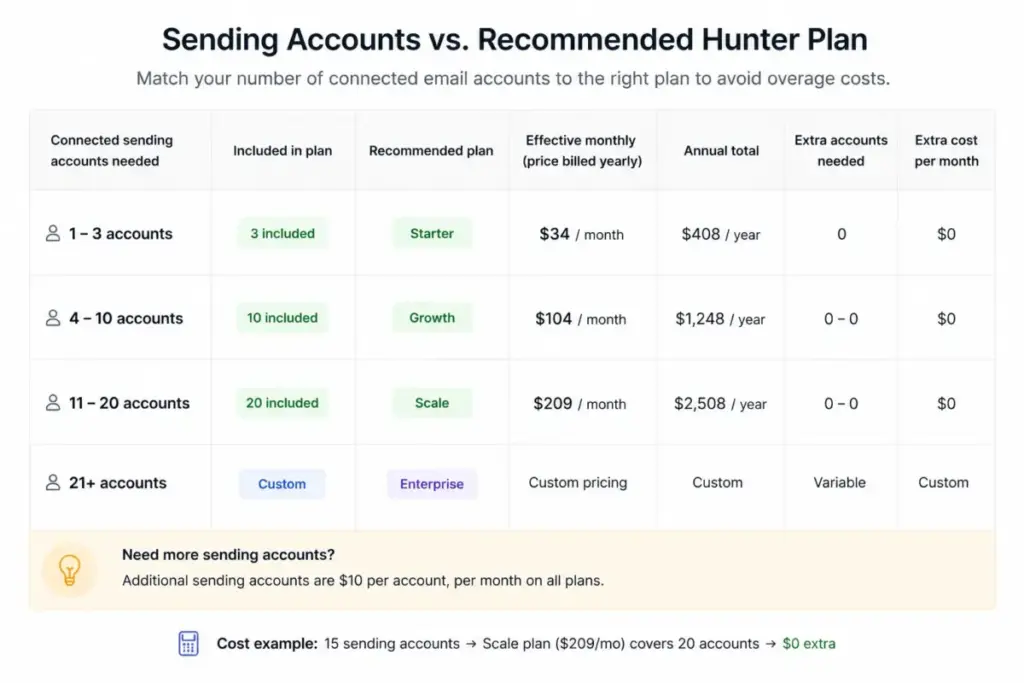
Because seats are free, a 10-person team on Growth pays the same $149 as one person on Growth. That is the strongest argument in Hunter’s favor and the thing per-seat rivals cannot match at this price.
Hunter.io Data Platform and API Pricing
If you are buying for enrichment, an API pipeline, or bulk verification, this section is your section. The standard plans are not built for you.
The Data Platform is yearly, API and bulk focused, and uses separate Search and Verification credit pools instead of the shared All-in-One pool. It leaves out Sequences, Signals, Discover, and credit packs, because it is a data product, not an outreach product.
The trap is switching. Moving an active All-in-One account to Data Platform can stop running sequences and strip connected email accounts, so it is not a plan you toggle casually.
Developers who only need programmatic finding and verification may fit the Data Platform well. Teams who need to send from Hunter should stay on All-in-One and treat the API as an add-on to that, not a replacement.
Which Plan to Avoid, and Which to Choose
Start with your limiting factor, not the price. For most buyers it is one of four things: credits, sending accounts, recipient caps, or support.
The plan to avoid is Starter for any team running four or more sending inboxes or doing steady high-volume prospecting. Its 3-account cap and 2,000-credit ceiling turn into forced upgrades or repeated credit-pack buys within weeks. Starter is fine, and often ideal, for a single operator who stays under roughly 1,300 find-and-verify contacts a month.
Here is the decision path.
- Testing Hunter or prospecting a few contacts a week: Free.
- Solo SDR, recruiter, founder, or link builder under ~1,300 contacts/month and 3 inboxes: Starter.
- Active team with 4 to 10 sending accounts or 3,000 to 6,000 monthly contacts: Growth.
- High-volume team up to 20 inboxes or ~16,000 monthly find-and-verify contacts: Scale.
- Above 25,000 credits/month or beyond 20 sending accounts: Enterprise.
Plan fit by buyer type
| Buyer | Plan | Why |
|---|---|---|
| Freelancer or link builder | Starter | Enough credits for targeted outreach, one or two inboxes |
| Recruiter running steady sourcing | Starter or Growth | Growth if inboxes or Signals volume climb |
| Founder-led sales | Starter to Growth | Growth once a second and third rep join the sending motion |
| Agency running client outreach | Growth | Multiple inboxes and 10,000 credits cover several campaigns |
| High-volume SDR team | Scale | 20 inboxes, 25,000 credits, cheapest credit packs |
| API or enrichment pipeline | Data Platform or Enterprise | Programmatic use, not Sequences |
Hunter.io Pricing vs Competitors
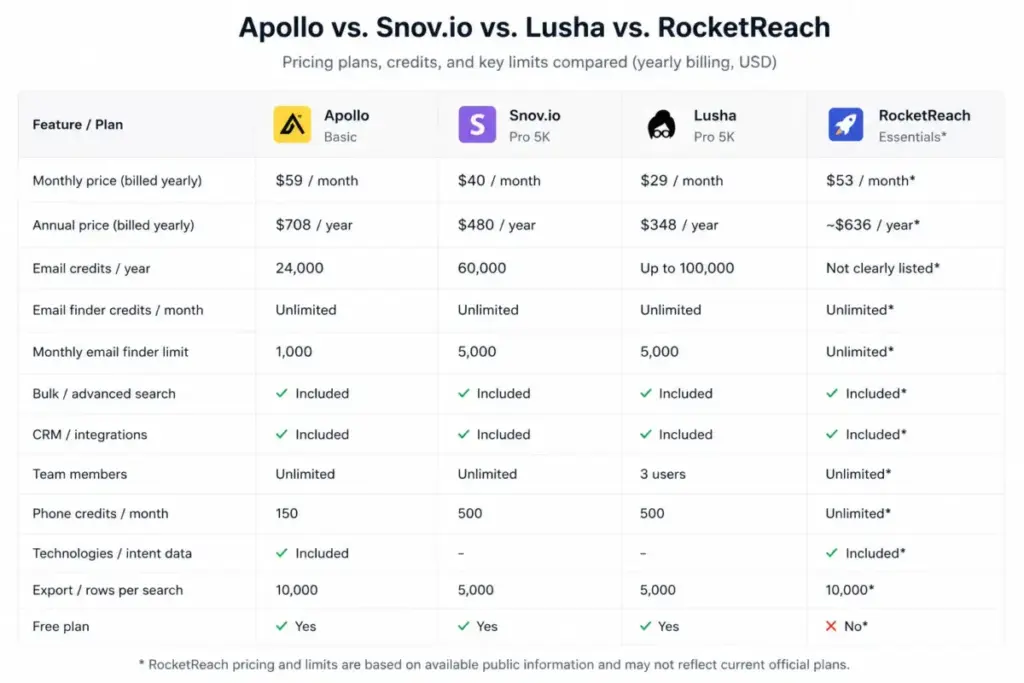
The right comparison is not sticker price, it is billing model, because Hunter’s unlimited seats change the math for teams.
| Tool | Starting price | Billing model | Free plan | Cost for a 10-person team |
|---|---|---|---|---|
| Hunter Growth | $149/mo ($104 yearly) | Flat, unlimited seats, credit pool | Yes, 50 credits | $149/mo total |
| Apollo.io | $49/seat/mo (Basic, annual) | Per seat plus fair-use | Yes | ~$490/mo on Basic |
| Snov.io | $39/mo (Starter, 1,000 credits) | Flat, unlimited seats | Trial/free tier | $39 or $99/mo if credits fit |
| Lusha | Free up to 40 credits/mo | Credit and seat based | Yes | Contact Sales above 5 users |
| RocketReach | Free, 5 lookups | Per user lookup tiers | Yes | ~$690/mo on Essentials |
Sources: official Apollo, Snov.io, and Lusha pricing pages checked July 2, 2026; RocketReach figures are G2 or provider-supplied and caveated.
Against Apollo.io, Hunter wins hard on team economics. A 10-person team is roughly $149 on Hunter Growth versus around $490 on Apollo Basic, because Apollo charges per seat and Hunter does not.
Against Snov.io, the comparison tightens. Snov.io also offers unlimited seats and starts cheaper at $39 per month, so for a solo user or tiny team on modest volume, Snov.io can be the better value. Verify current Snov.io credit limits before switching, since credits, not seats, decide fit there too.
Lusha and RocketReach solve a different problem. Lusha reveals phone numbers at 10 credits each versus 1 credit for an email, and RocketReach sells per-lookup tiers, so both fit buyers who need phone data more than email finding and cold email sequences. Hunter is email-first, and it does not compete on phone coverage.
Is Hunter.io Worth the Price?
For email-led outbound run by a team, yes. For phone-heavy or multichannel sales engagement, no.
Hunter is worth it if your motion is finding and verifying business emails and running cold email sequences, and if you value not paying per seat. A three-person pod on Growth at $149 gets the same access a solo user does, which is rare at this price.
It is not worth it if you need phone numbers, deep multichannel engagement, a full sales CRM, or contact volume that pushes you into custom territory every month. In those cases Apollo.io, ZoomInfo, Lusha, RocketReach, or a waterfall enrichment stack will serve you better.
The deciding number is your monthly find-and-verify volume against your sending-account count. If both stay inside Growth’s ceilings, Hunter is one of the cheaper serious options. If either regularly overflows, price out Scale plus packs against Enterprise before you renew.
How to Avoid Overpaying for Hunter.io
Small billing choices move the number more than the plan name does.
- Prove the workflow on a monthly plan first, then switch to yearly for the 30 percent cut once your volume is steady.
- Estimate credits as find-and-verify (1.5 credits per contact), not as the headline count, so you buy the tier that actually holds your month.
- Use Bulk Domain Search where you can, since it returns up to 10 emails per domain for a single credit.
- Match the plan to your sending-account count first; do not pay for Growth’s credits only to be blocked by Starter’s 3-account cap, or the reverse.
- Buy credit packs only for genuine spikes, and buy them on the highest plan you are on, because pack prices fall as the tier rises.
- Skip annual if your usage is seasonal or uncertain, because there is no refund on unused time.
- If you only need programmatic finding or verification, price the Data Platform separately instead of overbuying an All-in-One tier you will not fully use.
How We Verified This Pricing
Every price, credit rate, limit, and add-on above comes from Hunter’s official pricing page and public help center, checked on July 2, 2026. Capacity and per-contact figures are calculated from Hunter’s published credit rates, not estimated.
SaaS pricing changes. Hunter’s own changelog shows 2025 updates including a Unified Credit System, extra credit packs with monthly lead verification, and the new Scale plan, which is why some older articles still show separate search and verification counts or plan names that no longer exist.
Treat any page that lists a “Business” plan or separate finding and verification quotas as out of date, and confirm the live number on Hunter’s pricing page before you buy. Custom Enterprise and some add-on prices, including Inbox Protection, are set at checkout or by sales and are not published as fixed figures.
FAQ
Is Hunter.io free?
Yes. The Free plan gives 50 credits a month, one sending account, 500 recipients per sequence, Sequences, Discover, and API access, with no time limit. It is enough for light prospecting but not for team outbound.
How much does Hunter.io cost in 2026?
Paid plans are $49/month (Starter), $149/month (Growth), and $299/month (Scale), or $34, $104, and $209 per month respectively on annual billing. Enterprise is custom.
Does Hunter.io charge per user?
No. All plans include unlimited team members who share the credit pool, which is why Hunter is cheap for teams and priced instead around credits and sending accounts.
What are Hunter.io credits?
Credits are the shared currency for finding and verifying emails. Finding costs 1 credit per email, Bulk Domain Search returns up to 10 emails per domain for 1 credit, and verification costs 0.5 credit.
Can I just buy more credits instead of upgrading?
Yes, through credit packs on Starter, Growth, and Scale. They expire after 3 months and are non-refundable, so they suit spikes rather than steady monthly volume, and upgrading is usually cheaper for recurring needs.
Should I pay monthly or yearly?
Yearly saves 30 percent and delivers the whole year’s credits upfront, but it bills once and cannot be refunded for unused time. Start monthly to confirm fit, then switch to yearly.
Can I use Hunter.io for just one month?
Yes. There is no dedicated pay-as-you-go plan, but you can subscribe to a monthly plan and cancel the renewal, keeping access to the end of the billing period.
What happens when I cancel Hunter.io?
Cancellation stops future renewals. It does not reverse a charge that already processed, and Hunter does not refund unused or partially used subscriptions after payment.
Does Hunter.io include phone numbers?
Hunter is built around email finding and verification, not phone data. If phone numbers are core to your outreach, tools like Lusha or RocketReach are a closer fit.
Is Hunter.io cheaper than Apollo.io?
For teams, usually yes. A 10-person team is about $149/month on Hunter Growth versus around $490/month on Apollo Basic, because Apollo charges per seat and Hunter does not.