Half of the leads sitting in your CRM right now are not ready to buy. That is not a guess. Marketo Engage puts the number at roughly 50% of leads in any given system. The gap between capturing a lead and closing a deal is where most marketing automation programs either build pipeline or build a graveyard of ignored contacts.
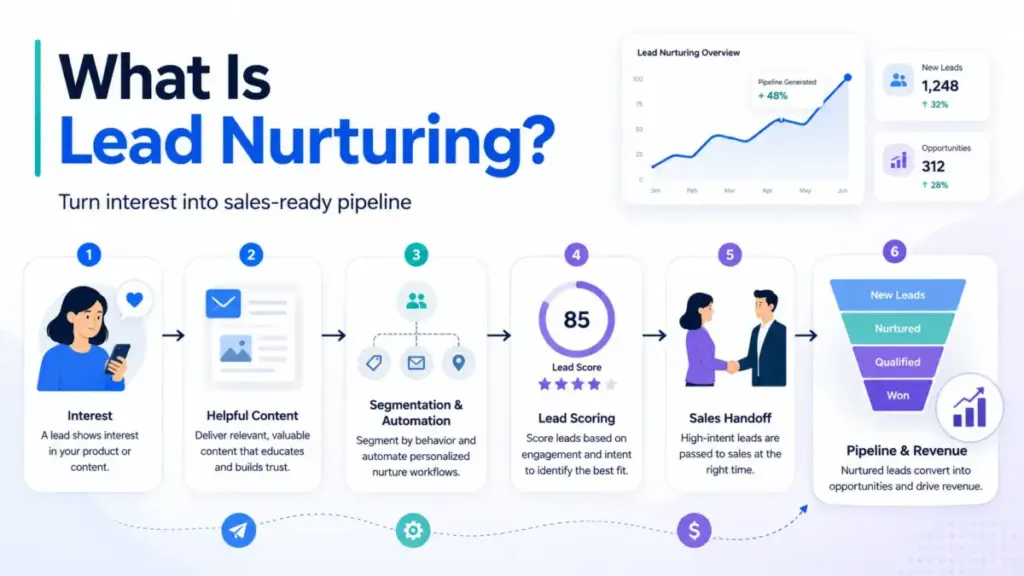
Lead nurturing is the process of building relationships with potential buyers by delivering relevant, personalized, and timely information after lead capture and before sales readiness. It is not a synonym for drip email. It is a governed system that uses buyer signals, segmentation, content, timing, and sales handoff rules to move interested contacts toward readiness without forcing a premature sale.
This guide covers how lead nurturing works as an operational loop, the six types of nurture workflows, the metrics that actually prove ROI, common mistakes that turn automation into spam, and five tools that support nurture campaigns (with pricing caveats). If you are evaluating email marketing platforms or marketing automation software, this is the concept sitting underneath every workflow you will build.
Quick Answer: Lead nurturing is the process of developing relationships with leads after capture by delivering relevant content, tracking engagement, scoring readiness, and routing qualified contacts to sales. It differs from lead generation (which creates leads) and lead scoring (which ranks them). It works best when sales cycles are long, buyers need education, and marketing has consent to communicate.
What Lead Nurturing Actually Means
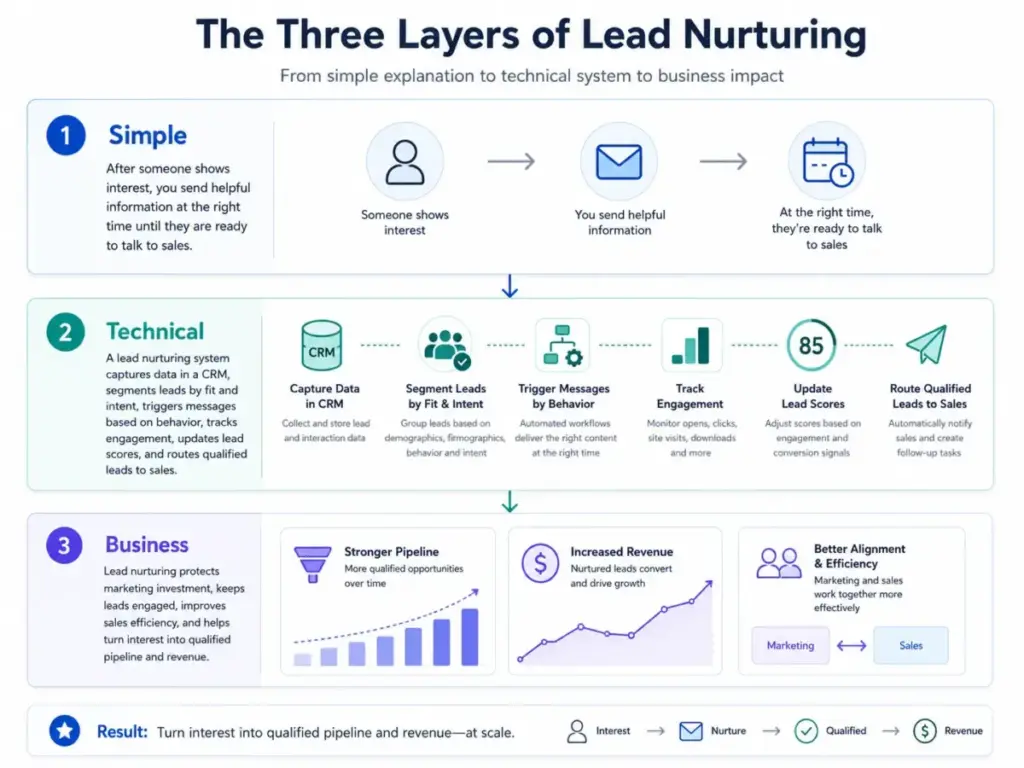
Lead nurturing is one concept with three layers of complexity depending on who is asking.
The simple version: After someone fills out a form, downloads a resource, or starts a free trial, lead nurturing sends them the right information at the right time until they are ready to talk to sales.
The technical version: A lead nurturing system captures behavioral and demographic data in a CRM or marketing automation platform, segments contacts by fit and intent, triggers communications based on actions or lifecycle stage, tracks engagement across channels, updates lead scores, and routes contacts to sales when agreed readiness criteria are met. The system includes suppression rules, consent controls, frequency caps, and closed-loop reporting from sales outcomes back into marketing.
The business version: Lead nurturing keeps your marketing investment productive after the initial conversion. Without it, captured leads decay. Sales teams waste time on unqualified contacts. Pipeline velocity drops because no one is educating buyers between first touch and demo request. According to IBM, lead nurturing builds relationships through relevant resources and personalized content that guide leads through the sales funnel.
The Salesforce State of Marketing Report notes that 83% of marketers recognize a shift toward personalized, two-way messaging, but only one in four are satisfied with how they use data to power those moments. That gap between knowing personalization matters and executing it well is exactly where lead nurturing lives.
How Lead Nurturing Actually Works
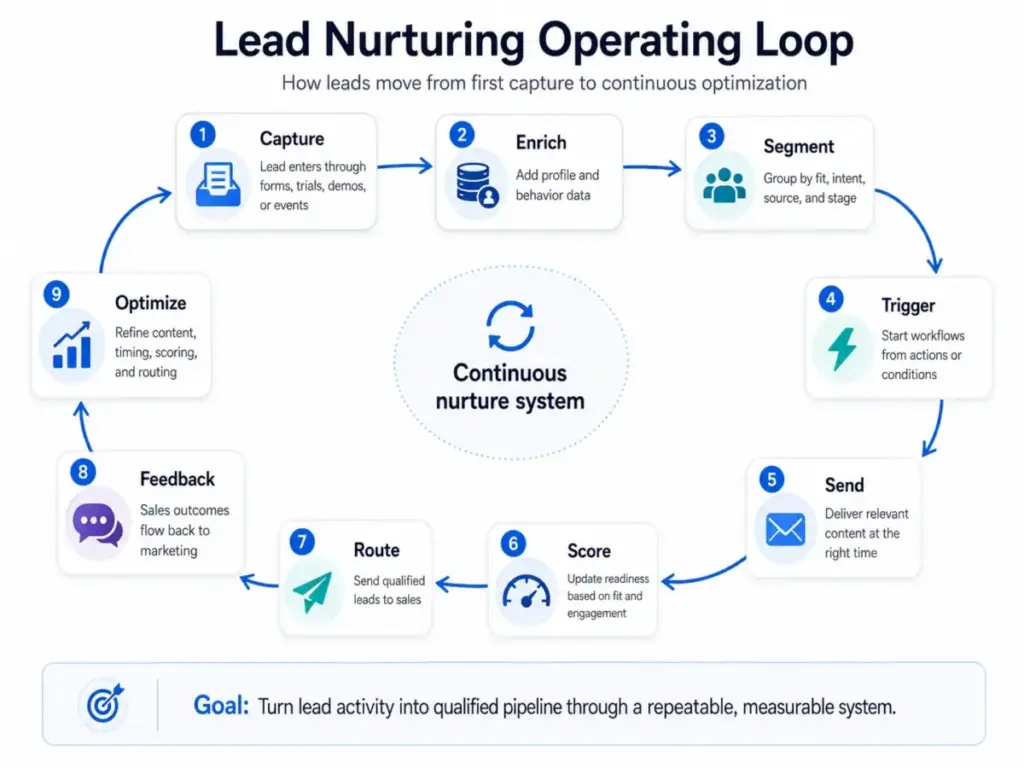
Lead nurturing is not a single email sequence. It is an operating loop with nine stages. Understanding where the loop breaks is more useful than memorizing a definition.
The Lead Nurturing Operating Loop
- Capture. A lead enters the system through a form submission, webinar registration, content download, trial signup, or demo request.
- Enrich. The system stores profile data (job title, company size, industry) and behavioral data (pages visited, content consumed, emails opened) in a CRM or marketing automation platform.
- Segment. Leads are grouped by source, persona, company fit, pain point, product interest, lifecycle stage, and consent status. A marketing manager from a 200-person SaaS company who downloaded a pricing guide is a different segment than a developer who signed up for a free trial.
- Trigger. Communications fire based on actions or conditions: form submission, webinar attendance, pricing-page visit, abandoned checkout, product usage threshold, or inactivity.
- Send. The system delivers stage-specific content: educational assets early, comparison and proof content mid-funnel, demo invitations or ROI calculators late-funnel.
- Score. Lead scoring combines fit signals (company size, role, budget) with intent signals (pricing page visits, demo requests, email clicks). Negative signals (unsubscribes, spam complaints, inactivity) reduce the score.
- Route. When a lead meets agreed readiness criteria, the system routes them to sales with context: source, content consumed, pain point, recent behavior, and a suggested next step. Not just a score.
- Feedback. Sales reports outcomes back to marketing: accepted, rejected (with reason), or recycled. This feedback adjusts scoring models and segment definitions.
- Optimize. Review monthly. Remove weak content. Update stale offers. Adjust triggers based on sales feedback and funnel conversion data.
Where the loop breaks: Most failures happen at stages 3 (poor segmentation), 6 (scoring every click equally), 7 (routing without context), and 8 (no sales feedback). Oracle’s lead nurturing framework confirms that anticipating buyer needs based on profile characteristics and buying stage requires lead management technologies that track behavior and trigger actions automatically.
Lead Nurturing vs Related Concepts
Lead nurturing sits between lead generation and sales engagement. The boundaries matter because confusing them causes workflow overlap and wasted automation.
| Concept | What it does | When it happens | Key difference from lead nurturing |
|---|---|---|---|
| Lead generation | Creates or captures new leads | Before nurturing | Generates the contact; nurturing develops it |
| Lead capture | Collects contact information via forms, landing pages, or signups | At the moment of conversion | A single event, not an ongoing process |
| Lead scoring | Ranks leads by fit and intent | During nurturing | Scoring is one input to nurturing, not a replacement |
| Lead nurturing | Develops leads through content, triggers, and routing until sales-ready | After capture, before sales handoff | The sustained relationship-building process |
| Sales engagement | Direct outreach by sales reps via calls, emails, LinkedIn | After marketing qualifies and routes | Human-led, not automated |
| Customer marketing | Retention, expansion, and advocacy programs | After purchase | Targets existing customers, not prospects |
What this means: Lead generation and lead nurturing are sequential, not interchangeable. Mailchimp’s own resource center distinguishes between the two: lead generation creates leads, while nurturing works with leads that already expressed interest to move them toward purchase. If your team is generating leads but not converting them to qualified opportunities, the problem is usually in the nurture stage, not the capture stage.
Six Types of Lead Nurturing Workflows
Not every nurture workflow is a drip sequence. The type of workflow determines the trigger, content, and exit criteria.
Email Nurture
Automated email sequences after a form fill, webinar registration, demo request, abandoned cart, or content download. This is the most common type and the one most teams build first.
Behavior-Based Nurture
Messages triggered by actions: pricing-page visits, product usage, email clicks, repeat website visits, or resource downloads. Behavior-based nurture responds to intent signals rather than following a fixed schedule.
Lifecycle-Stage Nurture
Content matched to awareness, consideration, evaluation, onboarding, expansion, renewal, or reactivation stages. Each stage has different questions and different content needs.
Sales-Assisted Nurture
Marketing automation combined with sales tasks, alerts, sequences, and human follow-up when a lead reaches readiness thresholds. This is where marketing and sales handoff rules matter most.
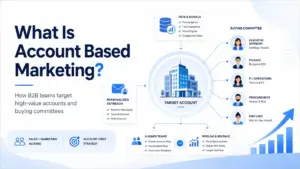
Account-Based Nurture
Nurturing multiple stakeholders in the same target account using account fit, buying group engagement, and role-specific content. Common in B2B SaaS with long sales cycles and buying committees.
Re-Engagement Nurture
Campaigns for inactive leads, cold opportunities, no-show demos, expired trials, and contacts that previously disqualified themselves. Re-engagement is where most teams discover their nurture graveyard.
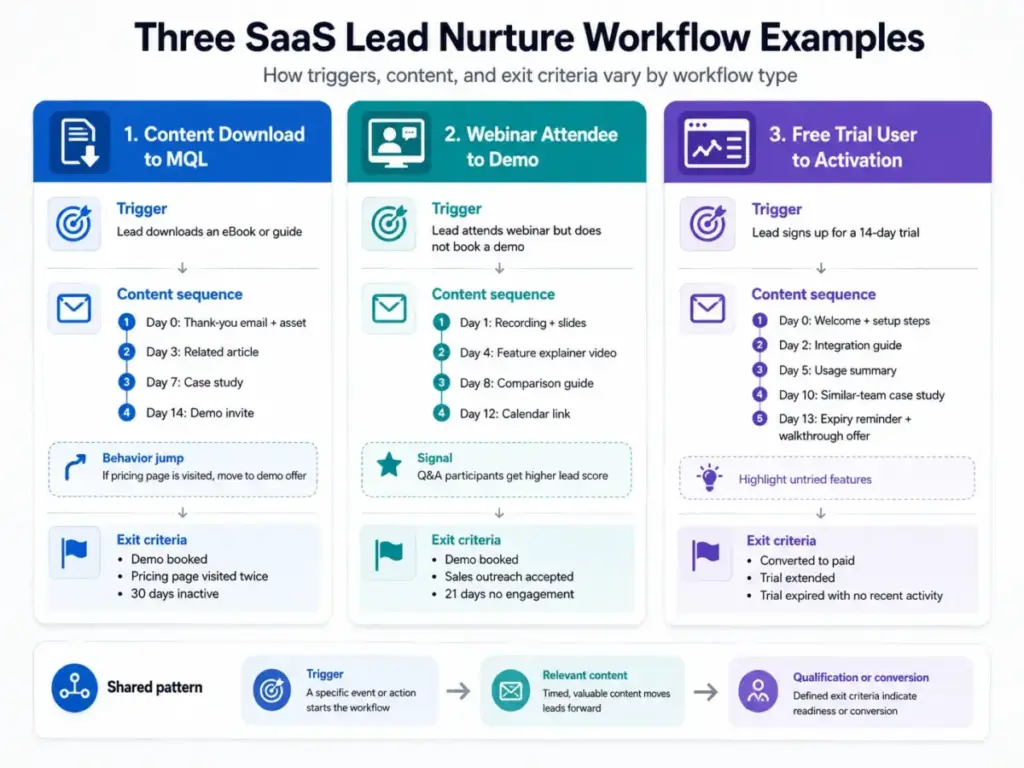
Three SaaS Nurture Workflows That Actually Work
Theory is easy. Implementation is where teams get stuck. Here are three example workflows mapped to real SaaS motions.
Content Download to MQL
A marketing manager downloads an eBook on CRM migration. Day 0: a thank-you email with the asset. Day 3: a related article on migration pitfalls. Day 7: a case study from a similar company. Day 14: an invitation to a live Q&A. If the contact visits the pricing page between Day 0 and Day 14, they skip ahead to a demo offer. If they do not open any email after Day 7, they move to a re-engagement path.
Exit criteria: Demo booked, pricing page visited twice, or 30 days of inactivity.
Webinar Attendee to Demo
A product director attends a webinar but does not book a demo. Day 1: a recording plus the slide deck. Day 4: a short video showing the feature discussed. Day 8: a comparison guide versus the tool they mentioned in the Q&A chat. Day 12: a direct ask with a calendar link. Attendees who asked questions during the session get a higher lead score and a personalized follow-up from sales.
Exit criteria: Demo booked, sales outreach accepted, or 21 days without engagement.
Free Trial User to Activation
A developer signs up for a 14-day trial. Day 0: welcome email with the three setup steps that correlate with activation. Day 2: a check-in with a link to the integration guide. Day 5: a usage summary showing which features they have and have not tried. Day 10: a case study from a similar team. Day 13: a reminder that the trial expires tomorrow, with an offer to extend or schedule a walkthrough.
Exit criteria: Trial converted to paid, trial extended, or trial expired with no activity in the last 5 days.
The Mistakes That Turn Nurture Into Spam
Reddit threads on lead nurturing are full of practitioners calling their workflows “graveyards for cold leads.” The failure modes are consistent.
Sending generic sequences to every lead. If the same 5-email drip goes to a CMO and an intern, the CMO unsubscribes and the intern ignores it. Segmentation is not optional.
Treating lead nurturing as only email. Nurture can include retargeting ads, in-app messages, direct mail, LinkedIn touches, and SMS. Email is the most common channel, not the only one.
Routing leads to sales without context. A lead score of 85 means nothing if sales does not know what the lead downloaded, which pages they visited, or what problem they are trying to solve. The handoff needs source, last action, content consumed, score reason, and a recommended next step.
Scoring every click equally. Opening a newsletter is not the same as visiting the pricing page three times. Assign different weights to different actions, and include negative scoring for spam complaints, bounces, and inactivity.
Ignoring consent and suppression rules. Before launching any workflow, verify consent status, set frequency caps, configure unsubscribe handling, add suppression after sales ownership, remove invalid contacts, and review regional compliance.
Measuring opens instead of pipeline movement. Opens tell you the subject line worked. They do not tell you whether nurture is creating qualified opportunities. Measure funnel outcomes.
Launching complex workflows before a simple baseline works. Start with one segment, one trigger, and five emails. Prove it converts before adding branches, conditions, and AI personalization.
Common Misconceptions About Lead Nurturing
Misconception: Lead nurturing is the same as lead generation.
Reality: Lead generation creates or captures leads. Lead nurturing develops existing leads after capture until they are ready for a buying conversation. They are sequential steps, not synonyms.
Misconception: Lead nurturing is just a drip campaign.
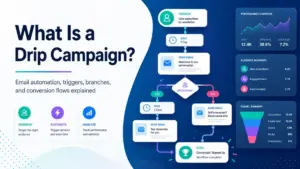
Reality: A drip sequence is one tactic. Modern nurturing includes segmentation, behavior triggers, scoring, routing, retargeting, sales alerts, lifecycle content, and CRM feedback. Drip is the starting point, not the system.
Misconception: More emails mean better nurturing.
Reality: Relevance, timing, consent, and buyer stage matter more than volume. A well-timed comparison guide after a pricing-page visit outperforms 10 generic newsletters.
Misconception: AI can fully automate nurturing without strategy.
Reality: AI helps personalize content, optimize send times, score leads, and draft copy. Teams still need clear goals, governed data, human escalation rules, and regular performance reviews. HubSpot’s 2026 State of Marketing frames AI as a baseline capability rather than a differentiator, with 61% of marketers believing marketing is experiencing its biggest disruption in 20 years.
Misconception: Open rate is the main success metric.
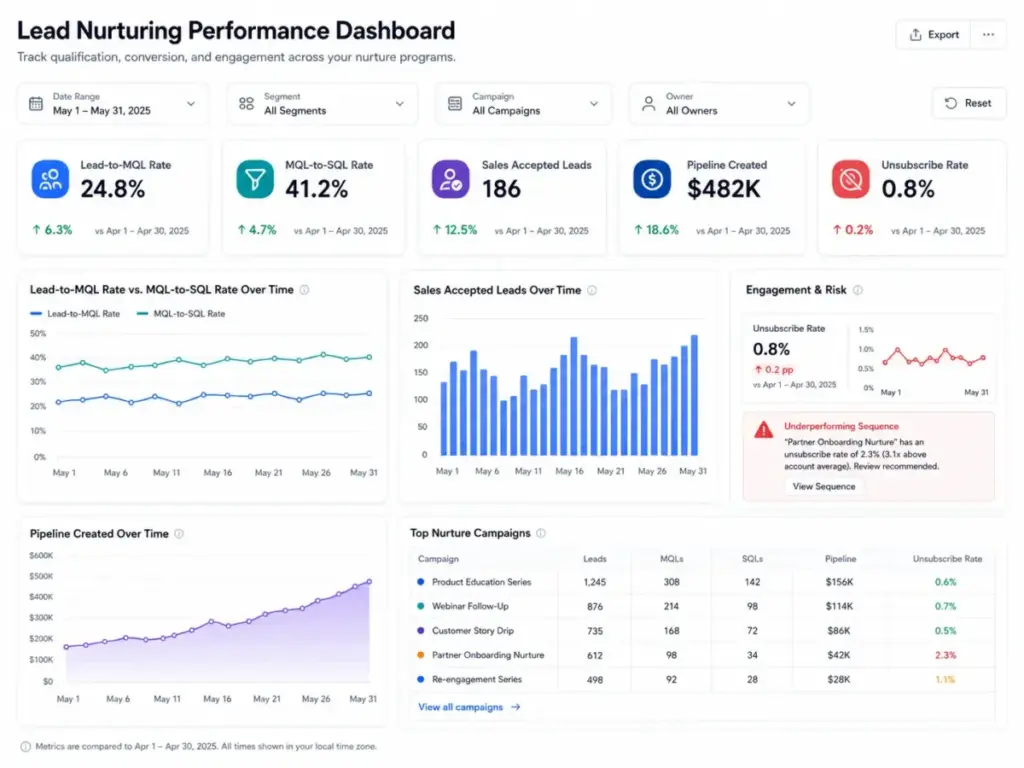
Reality: Useful metrics include lead-to-MQL rate, MQL-to-SQL rate, pipeline created, demo conversion, sales accepted lead rate, unsubscribe rate, velocity, and cost per qualified opportunity.
How to Measure Lead Nurturing Results
Email engagement metrics tell you whether your messages are being read. They do not tell you whether nurturing is producing revenue. Separate the metrics into four layers.
| Metric | What it measures | What it proves | What it can mislead about |
|---|---|---|---|
| Email click rate | Content relevance per message | Whether the content matches the audience | Does not prove pipeline movement |
| Unsubscribe rate | Audience fatigue or irrelevance | Whether frequency and targeting are appropriate | Low unsubscribe does not mean high engagement |
| Lead-to-MQL rate | Conversion from captured lead to marketing qualified | Whether nurture is qualifying leads | MQL definitions vary; quality depends on criteria |
| MQL-to-SQL rate | Marketing-to-sales handoff acceptance | Whether sales agrees leads are qualified | Sales rejection reasons matter more than the rate |
| Sales accepted lead rate | How often sales accepts nurtured leads | Whether routing and context are sufficient | High acceptance with low close rate means scoring needs work |
| Demo booking rate | Conversion from nurture to sales conversation | Whether the nurture path drives action | Demos without follow-through waste sales capacity |
| Pipeline created | Dollar value of opportunities from nurtured leads | Whether nurture contributes to revenue | Pipeline is not revenue until it closes |
| Sales cycle length | Time from lead capture to close | Whether nurture accelerates buying decisions | Shorter is not always better if deal quality drops |
| Revenue influenced | Closed revenue from contacts who went through nurture | Whether nurture contributed to business outcomes | Attribution models affect the number |
| Cost per qualified opportunity | Total nurture cost divided by qualified opportunities | Whether the program is efficient | Depends on how “qualified” is defined |
What this means: HubSpot’s 2026 marketing statistics report that 93% of marketers say personalization improves leads or purchases, and that lead quality and MQLs rank as a top metric. The metrics table above separates what marketing can measure from what actually proves business impact. If your team only tracks opens and clicks, you are measuring the channel, not the program.
When to Use Lead Nurturing and When to Skip It
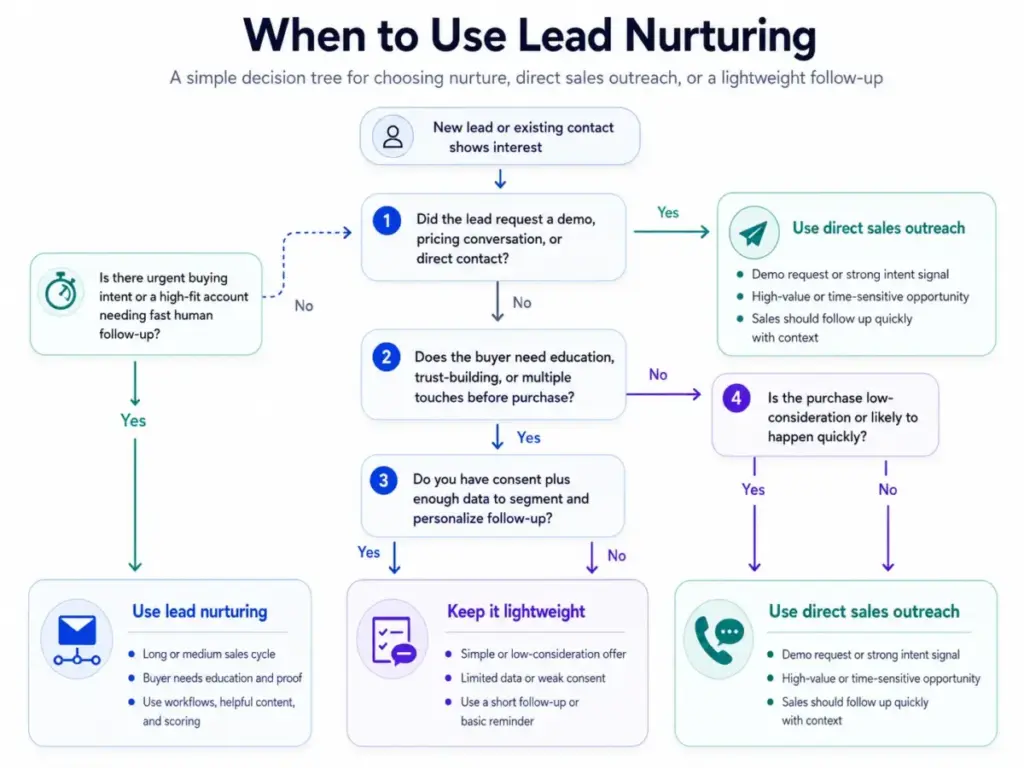
Use lead nurturing when:
- Leads show interest but are not ready to buy
- The sales cycle is longer than a single interaction
- Multiple stakeholders are involved in the buying decision
- Product education matters before a sales conversation is useful
- Sales capacity is limited and reps need warmer leads
- The company already has lead capture but weak conversion to qualified opportunities
- Gartner reports that 75% of B2B buyers prefer a rep-free sales experience, which means buyers are self-educating longer before engaging sales
Avoid or keep lightweight when:
- Purchase decisions are immediate and low-consideration
- The contact list lacks opt-in consent
- Data quality is too poor to segment (no job title, no company, no source)
- The offer is transactional and does not require education
- Sales needs direct outreach immediately (inbound demo request from a decision-maker)
- The team cannot monitor unsubscribes, spam complaints, and handoff quality
Five Tools That Enable Lead Nurturing (With Pricing Caveats)
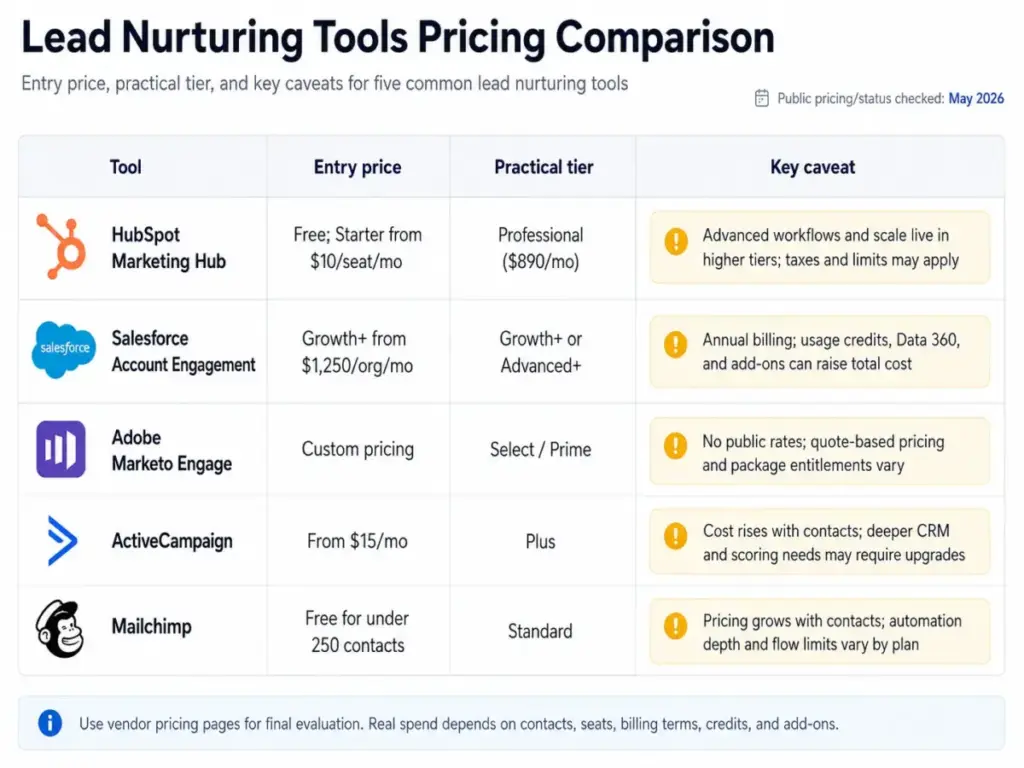
Lead nurturing is not a feature. It is a capability that spans workflow automation, email, CRM, scoring, and reporting. The tools below implement nurture in different ways at different price points.
| Tool | Nurture features | Entry pricing (as of May 2026) | Key caveat |
|---|---|---|---|
| HubSpot Marketing Hub | CRM-powered workflows, forms, email automation, segmentation, lead scoring, journey orchestration, Salesforce sync | Free at $0/mo; Starter from $10/mo per seat; Professional from $890/mo (3 seats) | Prices in USD, subject to tax; discount availability and product limits may apply |
| Salesforce Account Engagement | B2B lead nurturing and scoring, Salesforce CRM alignment, Agentforce campaign creation, multichannel messaging, Data 360 | Growth+ from $1,250/org/mo; Advanced+ from $4,400/org/mo (billed annually) | May require additional Einstein Request Credits, Messaging Credits, Data 360 credits, and optional add-ons |
| Adobe Marketo Engage | Omnichannel campaigns, automated nurture programs, multi-step journeys, AI personalization, account-based marketing | Custom pricing; Growth, Select, Prime, and Ultimate packages available | Does not publish exact public rates; licensing is per 1,000 contacts with entitlements varying by package |
| ActiveCampaign | Multi-step marketing automation, segmentation, goals, automation recipes, behavioral triggers, predictive sending | Starter from $15/mo | Starter limits automations to 5 actions; CRM is an add-on; actual cost depends on contacts and tier |
| Mailchimp | Marketing Automation Flows, contact tagging, targeted emails, customer journeys, ecommerce follow-up | Free for accounts under 250 contacts | Automation flow steps and total flows are plan-dependent; billing, overages, and features vary by plan |
What this means: Entry pricing tells you the starting point, not the operating cost. HubSpot’s free plan supports basic nurture, but workflow automation, A/B testing, and advanced scoring require Professional at $890/month. Salesforce Account Engagement includes lead nurturing and scoring in its Growth+ tier, but credits and add-ons can increase the total. Adobe Marketo Engage does not publish prices at all, so buyers need to request a quote. ActiveCampaign is the most accessible entry point at $15/month, but the Starter plan’s 5-action automation limit constrains real nurture workflows. Mailchimp can start free, but automation depth depends on the plan.
For more detail on individual platforms, see our Mailchimp review and ActiveCampaign evaluation.
Your First 30-Day Lead Nurturing Checklist
This checklist covers what to do before, during, and after launching your first nurture workflow.
Week 1: Foundation
- [ ] Define the business goal: demo bookings, trial activation, MQL creation, or pipeline
- [ ] Map the buyer journey and identify what a lead needs to know at each stage
- [ ] Audit your contact data: do you have job title, company size, source, and consent status?
- [ ] Choose your marketing automation platform or confirm your current tool supports nurture workflows
Week 2: Build
- [ ] Segment leads by source, persona, company fit, pain point, and lifecycle stage
- [ ] Choose one trigger to start: form submission, webinar attendance, or pricing-page visit
- [ ] Create 3 to 5 stage-specific content pieces (educational early, proof mid, action late)
- [ ] Set frequency caps, suppression rules, and unsubscribe handling before anything sends
Week 3: Score and Route
- [ ] Define lead scoring criteria: fit signals, intent signals, and negative signals
- [ ] Set the readiness threshold that triggers a sales handoff
- [ ] Configure the handoff to include source, content consumed, pain point, recent behavior, and a suggested next step
- [ ] QA the entire workflow: send test emails, verify triggers, check suppression
Week 4: Launch and Measure
- [ ] Launch the workflow to one segment
- [ ] Monitor unsubscribe rate, spam complaints, and email deliverability daily for the first week
- [ ] Review lead-to-MQL and demo booking rates after 14 days
- [ ] Collect sales feedback: are nurtured leads being accepted, rejected, or recycled?
When You Need Lead Nurturing Software
You need dedicated software when:
- Your team captures more than 100 leads per month and cannot follow up manually
- Sales reps report that leads are “not ready” or “not qualified”
- You have content but no automated way to deliver it based on buyer behavior
- Your sales cycle is longer than 30 days and requires multiple touchpoints
- You want to measure which marketing activities produce qualified pipeline, not just traffic
You do not need it yet when:
- You have fewer than 50 leads per month and can follow up with personal email
- You have not defined what a qualified lead looks like for your sales team
- Your contact list lacks basic consent and segmentation data
If you are evaluating tools, start with a platform that combines email, automation, CRM, and scoring. Our best sales and marketing software guide compares options by team size and budget.
How to Choose the Right Lead Nurturing Tool
- Define the workflow first. Decide what trigger, content, scoring, and routing you need before comparing tools. The tool serves the workflow, not the other way around.
- Check automation depth by plan. Entry plans often limit automation steps, active flows, or branching logic. Verify that the plan you can afford supports the workflow you designed.
- Verify CRM integration. Lead nurturing requires CRM data for segmentation and routing. If your CRM and marketing automation platform do not sync, scoring and handoff break.
- Evaluate scoring flexibility. Some platforms offer basic lead scoring on lower tiers. Others lock it behind enterprise plans. Check where scoring sits in the pricing structure.
- Assess reporting beyond email. You need funnel conversion, pipeline attribution, and sales feedback reporting. If the platform only reports opens and clicks, you will not know whether nurture produces revenue.
- Test consent and suppression controls. Before buying, verify that the platform supports suppression lists, frequency caps, consent management, and regional compliance (GDPR, CAN-SPAM, CASL).
- Start with one tool, not a stack. If you are building your first nurture program, a single platform that combines email, automation, and CRM (like HubSpot or ActiveCampaign) is easier than integrating three separate tools.
For platform-specific analysis, see our Klaviyo review for ecommerce nurture and our Brevo evaluation for sends-based pricing.
FAQ
What is lead nurturing in simple terms?
Lead nurturing is the process of staying in contact with potential buyers after they show interest, sending them relevant information until they are ready to talk to sales. It starts after lead capture and continues until the lead becomes a qualified opportunity or disengages.
What is the difference between lead generation and lead nurturing?
Lead generation creates new leads through ads, content, events, or referrals. Lead nurturing develops those leads after capture by delivering targeted content, tracking engagement, and routing them to sales when readiness criteria are met. Generation fills the funnel. Nurturing moves leads through it.
Is lead nurturing the same as email marketing?
No. Email is the most common channel for nurture, but lead nurturing also includes retargeting, in-app messaging, sales alerts, SMS, and direct mail. Lead nurturing is a strategy that uses multiple channels, scoring, segmentation, and CRM data. Email marketing is one channel within that strategy.
How many emails should a nurture sequence have?
There is no fixed number. Start with 3 to 5 emails per workflow and measure completion and conversion rates. The right length depends on your sales cycle, content depth, and buyer stage. A free trial nurture might need 5 emails over 14 days. A long-cycle B2B enterprise nurture might run 8 to 12 emails over 90 days.
How do I know when a lead is ready for sales?
Define readiness using a combination of fit (company size, role, budget), intent (pricing-page visits, demo requests, content downloads), recency (activity in the last 7 to 14 days), and negative signals (unsubscribes, bounces, inactivity). Sales and marketing should agree on these criteria before launching the workflow.
What metrics prove lead nurturing works?
Track lead-to-MQL rate, MQL-to-SQL rate, sales accepted lead rate, demo booking rate, pipeline created, sales cycle length, and revenue influenced. Email metrics (opens, clicks, unsubscribes) measure channel performance but do not prove business impact on their own.
Can AI automate lead nurturing completely?
AI can help with content personalization, send-time optimization, lead scoring, and workflow drafting. Teams still need to define goals, govern data quality, set escalation rules, review performance, and maintain consent compliance. AI handles execution at scale. Strategy, governance, and human judgment remain manual.
What should happen after someone downloads a lead magnet?
Send a thank-you email with the asset immediately. Follow up 2 to 3 days later with related content. Track whether they visit your pricing page, open subsequent emails, or return to the site. If they engage, continue the nurture sequence. If they do not, move them to a re-engagement path after 14 to 21 days of inactivity.
Does lead nurturing work for B2B SaaS?
B2B SaaS is one of the strongest use cases for lead nurturing because sales cycles are longer, buying committees have multiple stakeholders, product education matters, and trial-to-paid conversion requires activation support. Gartner reports that 75% of B2B buyers prefer a rep-free sales experience, which makes automated nurture the primary way to educate and qualify leads before a sales conversation.
What is the biggest lead nurturing mistake?
Sending the same generic email sequence to every lead regardless of segment, intent, or stage. This produces high unsubscribe rates, low engagement, and sales teams that ignore marketing-qualified leads because they have been burned by low-quality handoffs before.
Review limitation: This guide is based on official product documentation, published pricing pages, vendor feature descriptions, and third-party research from Salesforce, HubSpot, Gartner, and IBM. I did not deploy live multi-month nurture campaigns using each platform, so workflow credit consumption, enterprise pricing, and advanced scoring behavior should be confirmed directly with each vendor.