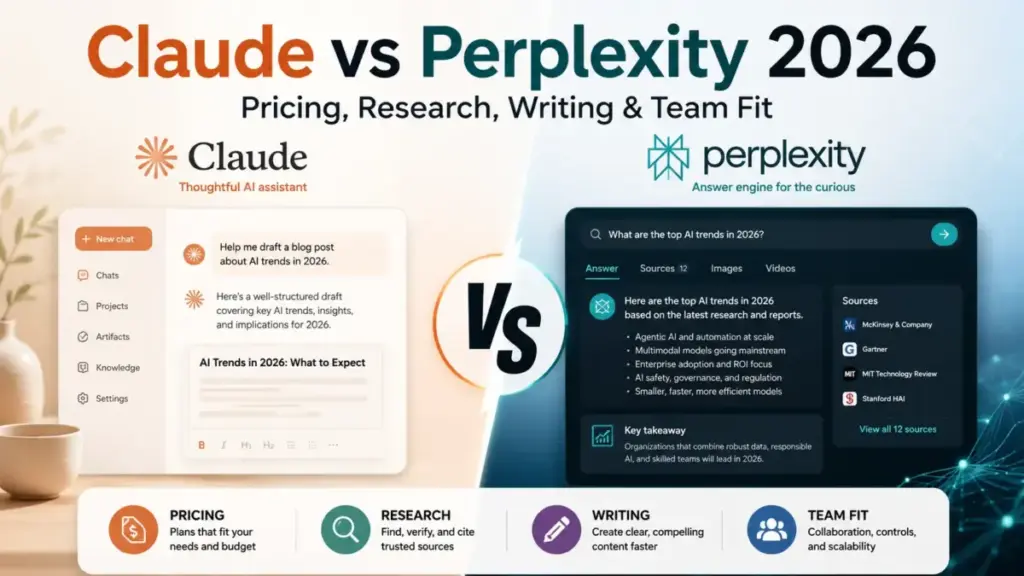
Most comparison articles frame Claude vs Perplexity as a $20/month chatbot showdown. That framing is wrong. It hides the real differences: how each tool handles team pricing at scale, which features are gated behind which plan, and what happens when you need cited sources versus polished prose in the same workflow. The common “both are AI chatbots” comparison breaks down the moment you look at Claude pricing tiers or Perplexity AI pricing structures for a 10-seat team.
The real decision is not which AI is smarter. It is whether the buyer needs a reasoning-and-writing workspace or a cited answer engine. Among top AI chatbots, these two tools occupy opposite ends of the same market. This evaluation is based on independent editorial research, analyzing official product documentation, pricing pages, feature gates, and third-party editorial assessments verified as of June 2026.
Quick verdict: Claude vs Perplexity at a glance
| Category | Winner | Why |
|---|---|---|
| Pricing and team cost at scale | Claude | Team Standard at $20/seat/month (annual) vs Perplexity Enterprise Pro at $34/seat/month (annual) |
| Research and source citations | Perplexity | Built as a source-first answer engine with premium citations |
| Writing, reasoning, and coding | Claude | Positioned and reviewed as stronger for long-form synthesis and code |
| Enterprise security and governance | Tie | Both offer SSO, SCIM, SOC 2, and HIPAA-aligned controls |
| Ease of individual onboarding | Tie | Both have free plans with web and mobile access |
| API and automation | Depends | Claude for model API and coding; Perplexity for real-time web search API |
The Short Answer
Choose Claude if your workflow ends in writing, coding, analysis, or long-form synthesis. Choose Perplexity if your workflow starts with current information, source discovery, or cited research briefs.
For a 5-to-50-seat team comparing annual seat costs, Claude Team Standard is the lower-priced option. For premium citations and work-app search, Perplexity Enterprise Pro has the stronger feature set. If enterprise governance matters most, compare Claude’s Compliance API and audit logs against Perplexity’s SOC 2 Type 2 and GDPR-aligned controls before committing.
If both research and writing carry equal weight, the practical answer is: use both. Perplexity gathers evidence; Claude turns it into finished output.
How We Compared Claude and Perplexity
This comparison covers pricing, research workflow, writing and coding capability, enterprise security, team cost at scale, and buyer fit. Both products were evaluated using official documentation, published pricing pages, and third-party editorial analysis from G2 (verified June 2026).
Testing level: official research only. This means claims like “I tested both tools” do not appear here. Every factual statement maps to official product data or attributed third-party sources.
Pricing was verified on June 19, 2026, using Claude’s pricing page and Perplexity’s enterprise pricing page. One limitation: Perplexity’s month-to-month enterprise pricing was not visible in the fetched official data, so all Perplexity enterprise figures use annual billing. Claude Enterprise usage is billed separately at API rates, which means seat pricing alone does not capture total cost.
Claude vs Perplexity Pricing Compared
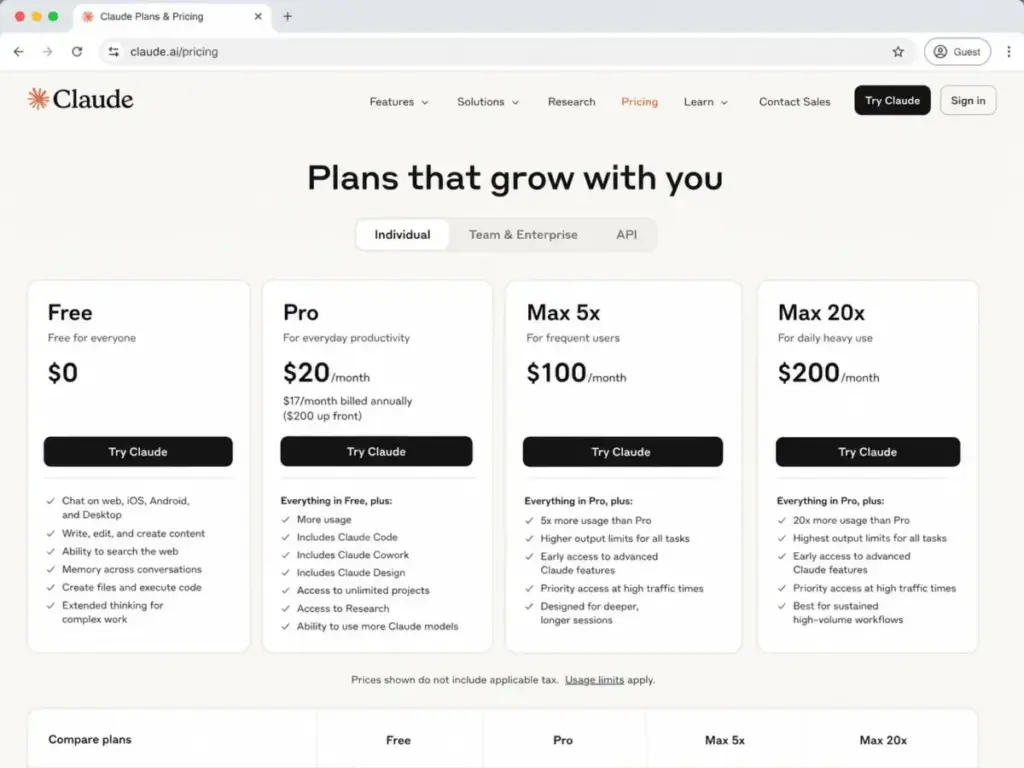
What Claude Costs in 2026
Claude starts free. The free plan includes web search, memory, file creation, code execution, and connectors, all subject to usage caps.
Pro costs $20/month or $200/year (equivalent to roughly $17/month annualized). Pro adds more usage, Claude Code, Cowork, Design, unlimited projects, Research, and Microsoft 365 and Outlook access.
Max 5x costs $100/month. Max 20x costs $200/month. Both expand session capacity and add priority access. Think of Max as a volume multiplier: 5x or 20x more capacity than Pro per session.
Team Standard costs $25/seat/month billed monthly or $20/seat/month billed annually. Teams range from 5 to 150 seats. Team Premium costs $125/seat/month monthly or $100/seat/month annually, adding 5x the usage of Standard seats.
Enterprise starts at $20/seat plus usage billed at API rates. That structure separates seat access from metered consumption, which changes budgeting for heavy enterprise use.
A caveat on Enterprise pricing: Claude Enterprise separates seat access from API-metered usage. A team running high-volume workflows may see usage charges exceed the seat cost. Model and budget this before rollout.
What Perplexity Costs in 2026
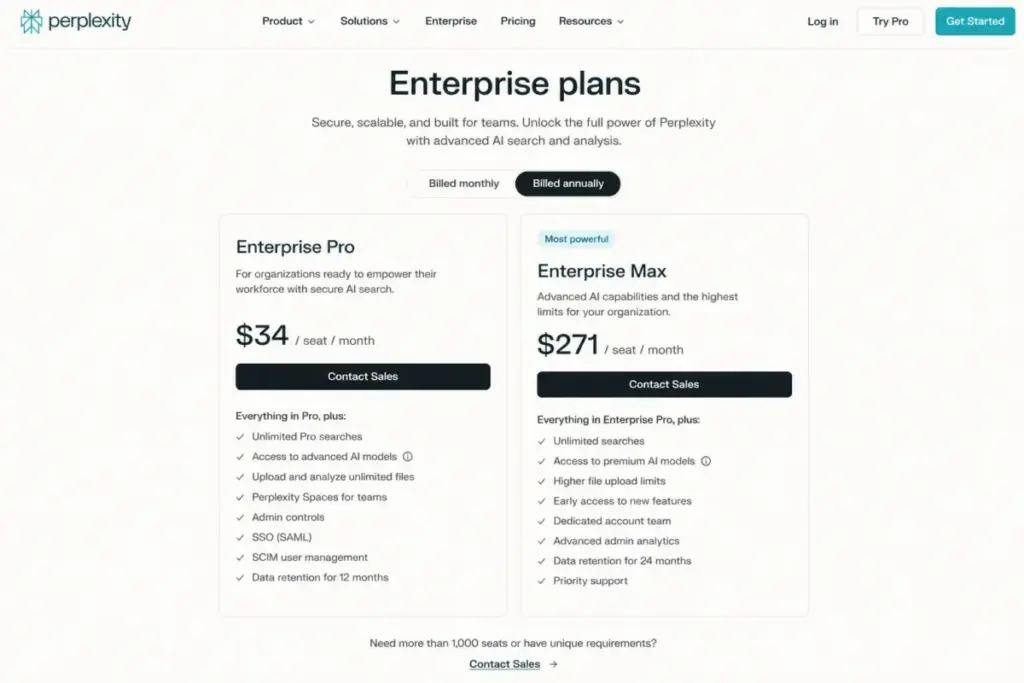
Perplexity starts free with basic AI answer engine access and synced apps.
Pro is shown at $17/month when billed annually. Pro adds latest AI models, model selection across GPT, Claude, Gemini, and Sonar, plus reports, documents, apps, and premium sources including proprietary financial and scientific data.
Enterprise Pro costs $34/seat/month billed annually. It adds no-training-on-data guarantees, team file and work-app search, premium citations, SSO, SCIM, user management, 2x file uploads, and dedicated enterprise support.
Enterprise Max costs $271/seat/month billed annually. It adds advanced reasoning models (including Claude Opus), deep research at scale, and support for larger datasets and files.
Month-to-month enterprise pricing was not confirmed in the official data fetched. Treat all Perplexity enterprise figures as annual-billing rates.
Team Cost at Scale
The comparison below uses Claude Team Standard (annual) against Perplexity Enterprise Pro (annual). These are the closest team-tier equivalents. Comparing consumer Pro plans misses the point for teams that need admin controls, SSO, and data governance.
Annualized monthly team cost: Claude Team Standard vs Perplexity Enterprise Pro
| Team size | Claude Team Standard (annual) | Perplexity Enterprise Pro (annual) | Lower cost |
|---|---|---|---|
| 5 users | $100/month | $170/month | Claude |
| 10 users | $200/month | $340/month | Claude |
| 25 users | $500/month | $850/month | Claude |
| 50 users | $1,000/month | $1,700/month | Claude |
What this means: Claude Team Standard costs 41% less than Perplexity Enterprise Pro at every scale point. But the comparison is not pure apples-to-apples. Perplexity Enterprise Pro includes premium citations, work-app search, and no-training guarantees that Claude Team Standard gates differently. Buyers should compare what each tier includes, not just the seat price.
Hidden costs to watch: Claude taxes not included, Enterprise usage billed separately at API rates, Max capacity framed as multiples of Pro (hard to predict spend). Perplexity enterprise prices are annual-only in published data, API pricing is separate from subscription pricing, and premium sources are plan-gated.
How Claude and Perplexity Handle Research
Perplexity is an answer engine. It was built for real-time web research with source citations attached to nearly every response. Pro Search and Deep Research run queries across the web and return cited summaries. Premium sources tap proprietary financial and scientific databases. The result: a research workflow where every claim links back to a source URL.
Claude added web search and a Research feature in its Pro tier. But research is not Claude’s origin story. Claude’s web search is a tool it can call, not its default operating mode. Responses don’t automatically carry inline source URLs the way Perplexity’s do.
According to G2 editorial analysis by Sagar Joshi, Perplexity is stronger for real-time web search, source citations, fast factual answers, and research-heavy workflows.
For a market analyst running competitive research, Perplexity delivers cited briefs faster. For a content strategist who needs a quick fact-check before writing, Perplexity gets the answer with sources. Claude can search the web, but the citation density and source-first design favor Perplexity.
Winner: Perplexity. Source-backed research is its core function, not an add-on feature.
How Claude and Perplexity Handle Writing and Coding
Claude handles long-form writing and coding the way Perplexity handles source retrieval: it is the core job.
Claude’s Projects feature lets you organize context, files, and instructions into reusable workspaces. Artifacts generate documents, code, and visualizations inline. Claude Code provides an agentic coding assistant. Cowork runs background tasks. These are not surface features; they shape how analysts, writers, and developers build real output.
Perplexity can generate text. But its strength is the answer, not the artifact. Long-form document creation, multi-file coding projects, and iterative drafting are not Perplexity’s primary design target.
According to G2 editorial analysis, Claude is better suited for writing, coding, complex documents, conversational depth, and context handling.
Feature-to-plan gate comparison
| Feature | Claude plan gate | Perplexity plan gate | Buyer impact |
|---|---|---|---|
| Web search | Free (limited) | Free | Both accessible on free tier |
| Projects and file organization | Pro (unlimited) | Not a core feature | Claude advantage for document-heavy work |
| Claude Code / coding assistant | Pro | Not applicable | Claude exclusive |
| Cowork (background tasks) | Pro | Not applicable | Claude exclusive |
| Deep Research | Pro (Research) | Pro (Deep Research) | Both offer research on paid plans |
| Premium source citations | Not a core feature | Pro | Perplexity advantage for cited research |
| Model selection (GPT, Gemini, etc.) | Not available | Pro | Perplexity lets you pick across vendors |
| Team file and work-app search | Team/Enterprise | Enterprise Pro | Perplexity bundles this in Enterprise Pro |
| SSO and SCIM | Team | Enterprise Pro | Both require paid team plans |
| No training on customer data | Team (default) | Enterprise Pro | Similar tier gating |
What this means: If the job is writing a 3,000-word report from research notes, Claude has the workspace for it. If the job is generating a cited market scan with premium data sources, Perplexity has the retrieval pipeline. The plan-gate table shows that AI chatbots compete on different axes, not on a single feature checklist.
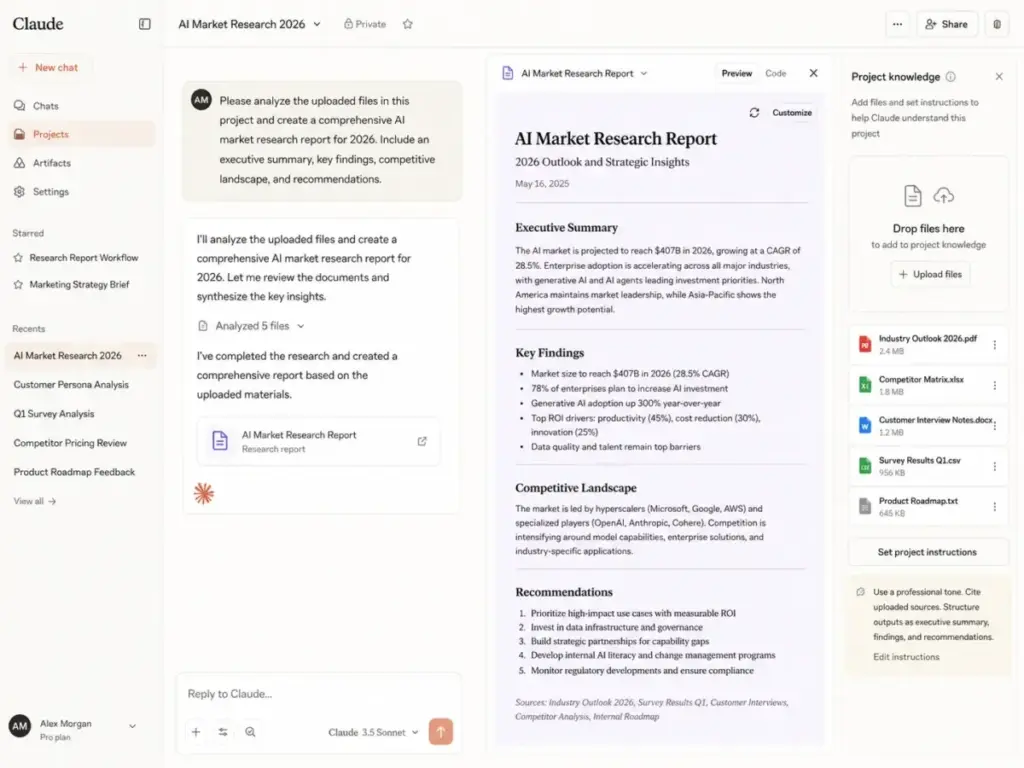
Winner: Claude. Writing, reasoning, and coding are structural strengths, not bolt-on features.
Enterprise Security and Governance
Both Claude and Perplexity position enterprise tiers with security controls. The overlap is significant, but the details differ.
Enterprise security comparison
| Control | Claude Enterprise | Perplexity Enterprise Pro/Max |
|---|---|---|
| SSO | Yes (Team and above) | Yes (Enterprise Pro) |
| SCIM provisioning | Yes (Enterprise) | Yes (Enterprise Pro) |
| Audit logs | Yes (Enterprise) | Not confirmed in fetched docs |
| Compliance API | Yes (Enterprise) | Not confirmed in fetched docs |
| Custom data retention | Yes (Enterprise) | Not confirmed in fetched docs |
| IP allowlisting | Yes (Enterprise) | Not confirmed in fetched docs |
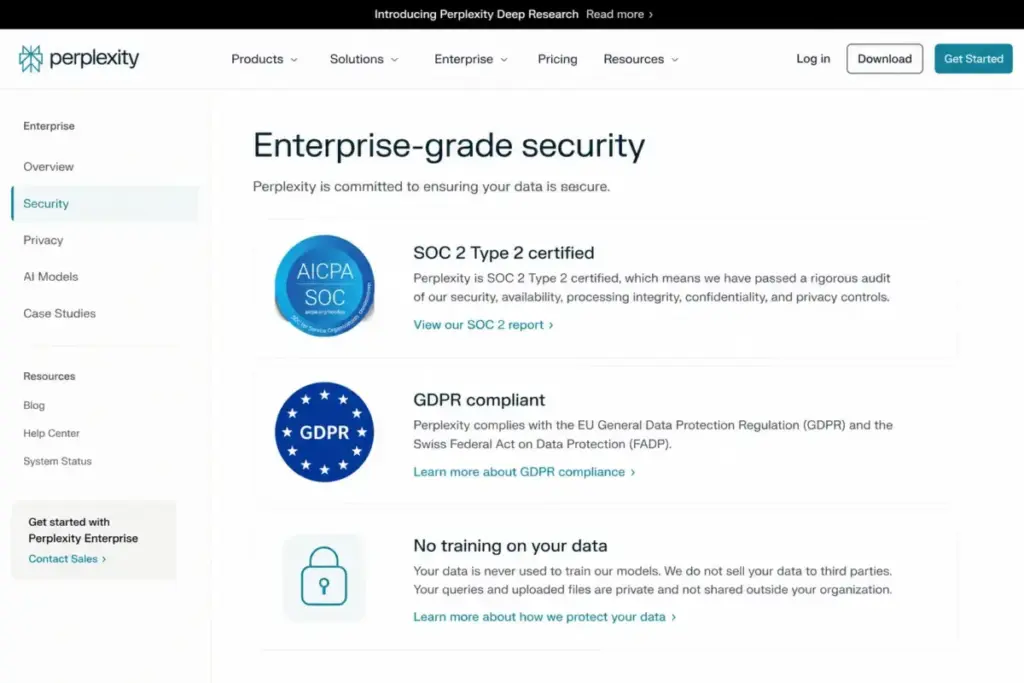
| SOC 2 | Resources via Anthropic Trust Center | SOC 2 Type 2 certified |
| GDPR | Not explicitly stated in fetched docs | GDPR-compliant per security page |
| HIPAA-aligned | HIPAA-ready offering (Enterprise) | HIPAA-aligned safeguards per security page |
| No training on data | Team default | Enterprise Pro default |
| Spend controls | Yes (Enterprise) | Not confirmed in fetched docs |
What this means: Claude Enterprise offers deeper granularity in governance controls: audit logs, Compliance API, custom retention, IP allowlisting, and spend controls. Perplexity counters with SOC 2 Type 2 certification and explicit GDPR compliance claims. For a security-conscious buyer, the comparison is not about which is “more secure.” It is about which set of controls matches the organization’s compliance requirements. Both deserve a security review before rollout.
Winner: Tie. Both have strong enterprise security positioning, but the specific controls differ. Match to your compliance needs.
Who Should Choose Claude
Choose Claude if the workflow ends in a written document, a code project, an analysis, or a plan. Claude is built for synthesis, not search.
Scenarios where Claude wins:
- Developer or product manager using AI for coding and analysis. Claude Code and Projects are positioned for coding, reasoning, complex files, and execution-heavy workflows. No equivalent exists in Perplexity.
- 10-seat US team comparing annual AI workspace cost. Claude Team Standard at $20/seat/month billed annually costs 41% less than Perplexity Enterprise Pro at $34/seat/month billed annually.
- Solo writer or marketer turning research into articles. Claude’s long-context handling, file work, and Artifacts output make it the stronger drafting tool. Pair it with Perplexity for source gathering.
- Analyst building structured reports from unstructured inputs. Projects, Artifacts, and code execution let you organize and transform data inside Claude’s workspace.
Avoid Claude as the primary tool if every answer must be source-first and citation-heavy by default. Claude can search the web, but it is not wired for citation density the way Perplexity is.
Who Should Choose Perplexity
Choose Perplexity if the workflow starts with current information, source discovery, or market scans. Perplexity is built for retrieval, not drafting.
Scenarios where Perplexity wins:
- Research analyst needing cited market scans. Perplexity offers source-backed answers, premium citations from financial and scientific databases, model selection, and Deep Research. That pipeline does not exist in Claude’s feature set.
- SEO team or journalist fact-checking claims. Real-time web answers with inline citations save time versus asking Claude to search and then manually verifying its sources.
- Team needing premium data sources. Enterprise Pro unlocks proprietary data from sources like PitchBook and Statista. Claude does not offer equivalent premium source access.
- Buyer who wants to pick AI models per query. Perplexity Pro lets you switch between GPT, Claude, Gemini, and Sonar per question. Claude only runs Claude models.
Avoid Perplexity as the primary tool if you need deep drafting, code collaboration, long-context reasoning, or polished narrative output more than source discovery.
When You Should Use Both
Many comparison articles force a single winner. Real workflows don’t work that way. The highest-value approach for research-to-writing tasks is to use both tools in sequence.
A practical 4-step workflow:
- Source discovery in Perplexity. Run a Pro Search or Deep Research query. Collect cited answers, source URLs, and data points.
- Source verification. Review Perplexity’s citations for accuracy and relevance. Flag gaps.
- Synthesis in Claude. Paste verified research into a Claude Project. Use Artifacts to build structured output: reports, articles, analysis, or code.
- Final review. Cross-check Claude’s output against Perplexity’s cited sources for factual alignment.
This pairing avoids a false binary. Perplexity excels at step 1. Claude excels at step 3. Trying to force one tool into both roles creates friction. For teams evaluating AI writing and research tools, treating these as complementary is more productive than choosing one.
Switching Between Claude and Perplexity
Switching difficulty is medium in both directions. The migration is workflow-based, not database-based. There is no one-click export from Claude to Perplexity or vice versa.
What you may need to recreate when switching:
- Saved threads and conversation history
- Prompt libraries and instruction sets
- Project files and workspace connectors (Claude)
- Team permissions, SSO, and admin policies
- File uploads and organizational knowledge
Claude supports organization data export in Team and Enterprise plans. Perplexity workspace content and saved threads should be reviewed against current export and admin controls before migration.
The real switching cost is habit, not data. Each tool trains a different workflow muscle. Moving from Perplexity’s citation-first research to Claude’s project-based synthesis (or back) takes adjustment time.
Alternatives Worth Considering
If neither Claude nor Perplexity fits, three alternatives cover adjacent needs.
ChatGPT is the general-purpose all-rounder. It combines research, writing, coding, and multimodal features in a single interface. It lacks Perplexity’s citation density and Claude’s project depth, but it covers the broadest range. Buyers exploring ChatGPT alternatives will find both Claude and Perplexity on that list.
Google Gemini fits teams already standardized on Google Workspace. Gmail, Docs, Drive, and Google Search integration may matter more than raw AI capability for some buyers. Compare ChatGPT and Gemini for ecosystem context.
Microsoft Copilot serves Microsoft 365 organizations that prioritize admin-led deployment and Office-native workflows. Enterprise buyers with Microsoft tenant governance requirements should evaluate Copilot before Claude or Perplexity. Check out Microsoft Copilot alternatives for a broader view.
Final Verdict
There is no single winner for Claude vs Perplexity. The right tool depends on where the buyer’s workflow starts and where it ends.
Claude wins for writing, coding, team cost at scale, and long-form synthesis. At $20/seat/month annually for Team Standard, it is also the more cost-efficient team option.
Perplexity wins for cited research, real-time web answers, premium source access, and source-backed content briefs. Its Enterprise Pro tier costs more per seat but bundles citation and retrieval features that Claude does not match.
For budget-conscious individual users, Claude Pro and Perplexity Pro both land near $17–$20/month. The tiebreaker is whether you write more than you research, or research more than you write.
For teams, model the total cost including Claude’s API-metered Enterprise usage and Perplexity’s annual billing constraints before choosing. The seat price alone does not capture the full picture.
FAQ
Is Claude better than Perplexity?
Claude is stronger for writing, coding, and long-form synthesis. Perplexity is stronger for cited web research and fast source-backed answers. The better tool depends on whether your work ends in a document or starts with a question.
How much does Claude cost in 2026?
Claude Free costs $0. Pro costs $20/month or $200/year. Team Standard starts at $20/seat/month annually. Enterprise starts at $20/seat plus API-rated usage. Pricing verified June 2026.
How much does Perplexity cost in 2026?
Perplexity Free costs $0. Pro costs $17/month billed annually. Enterprise Pro costs $34/seat/month annually. Enterprise Max costs $271/seat/month annually. Pricing verified June 2026.
Which is better for research, Claude or Perplexity?
Perplexity. It is built as an answer engine with inline source citations, premium data sources, and Deep Research. Claude can search the web, but research is not its primary design.
Which is better for writing, Claude or Perplexity?
Claude. Projects, Artifacts, and long-context handling make it the stronger tool for drafting reports, articles, and structured documents. Perplexity focuses on retrieval, not composition.
Can Perplexity replace Claude?
No, unless your work is entirely research-based. Perplexity lacks Claude’s project workspace, coding assistant, and long-form synthesis tools. For source-first workflows, Perplexity handles the job. For everything after the research phase, Claude is the better fit.
Do I need both Claude and Perplexity?
Yes, if your workflow involves both research and writing. Use Perplexity for source discovery and Claude for synthesis. This pairing avoids forcing one tool into a role it was not designed for.
Which one is cheaper for a team?
Claude Team Standard at $20/seat/month (annual) costs less than Perplexity Enterprise Pro at $34/seat/month (annual) at every team size from 5 to 50 seats.