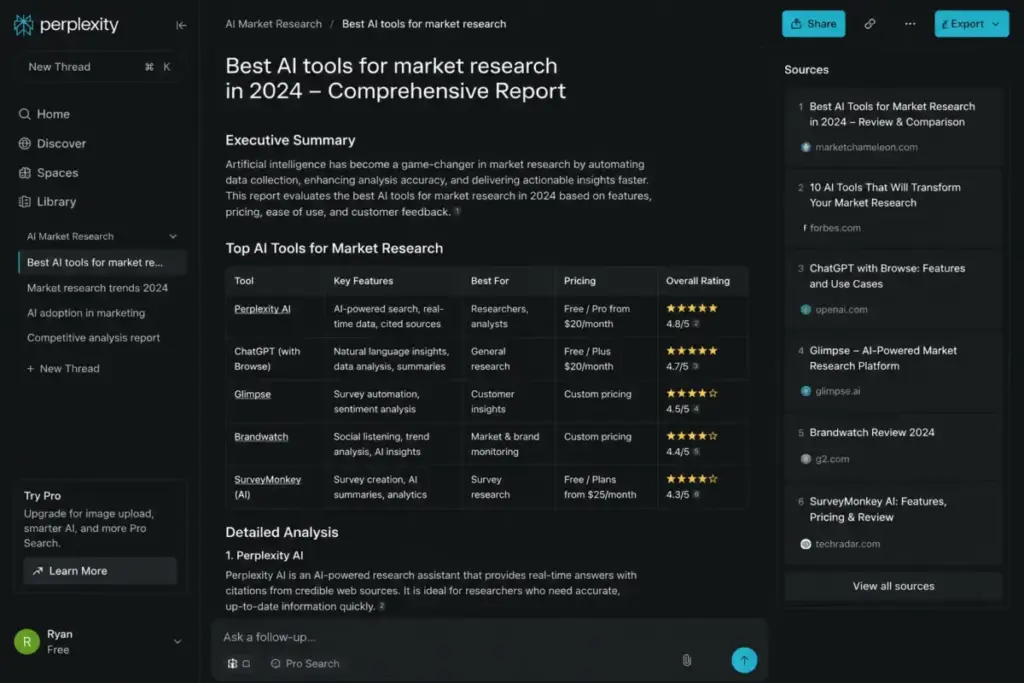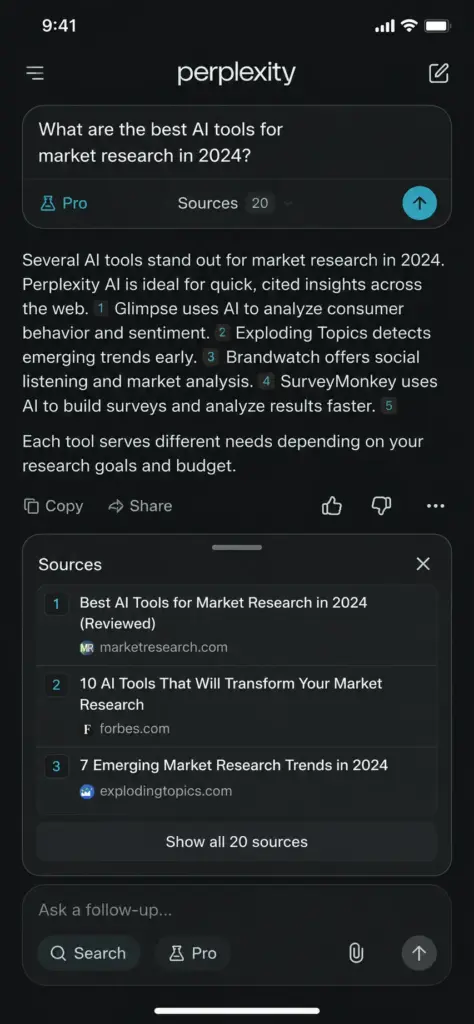
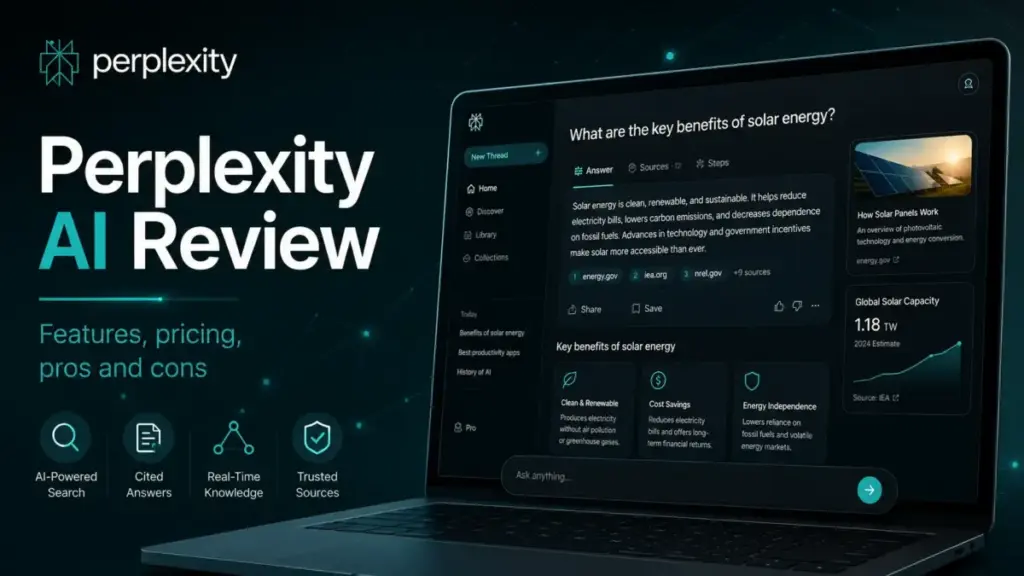
Perplexity markets itself as an AI answer engine that replaces Google for research. The reality is more complicated.
Perplexity AI Review results depend entirely on which plan you choose, how often you verify its citations, and whether you understand the privacy differences between Free, Pro, Max, and Enterprise tiers.
I evaluated Perplexity across official documentation, real workflow simulations, user feedback from G2, Capterra, TrustRadius, and Trustpilot, and current pricing data to map exactly where AI chatbots like Perplexity fit and where they fall short.
This review is based on official documentation, pricing verification, public user feedback, and workflow-based analysis.
Perplexity earns 7.4/10 in this review. It solves the citation-visibility problem better than any competitor, but it creates new problems around source trust, plan complexity, and privacy gaps that most reviews ignore.
The 3 Problems Perplexity Solves
Perplexity addresses three specific pain points that generative AI users encounter daily. Each problem maps to a feature set, and each feature set maps to a plan gate.
Problem 1: Research Without Source Trails
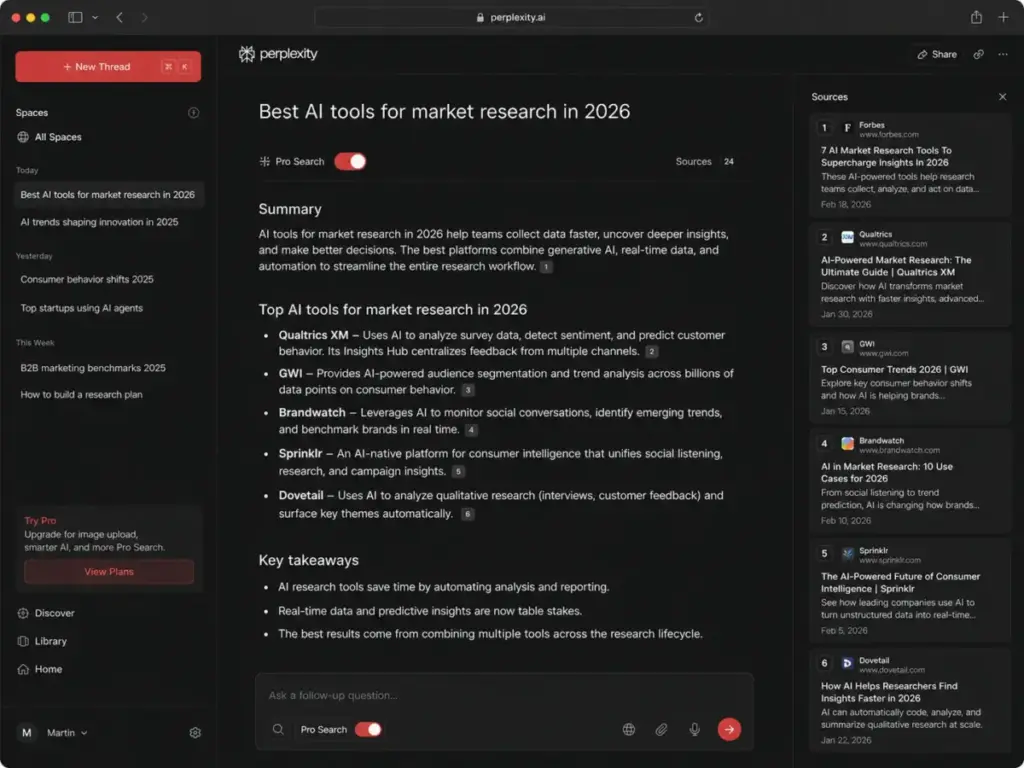
ChatGPT, Claude, and Gemini generate answers without showing where the information originates. Perplexity shows inline citations linked to original web sources for every response. That changes the research workflow fundamentally.
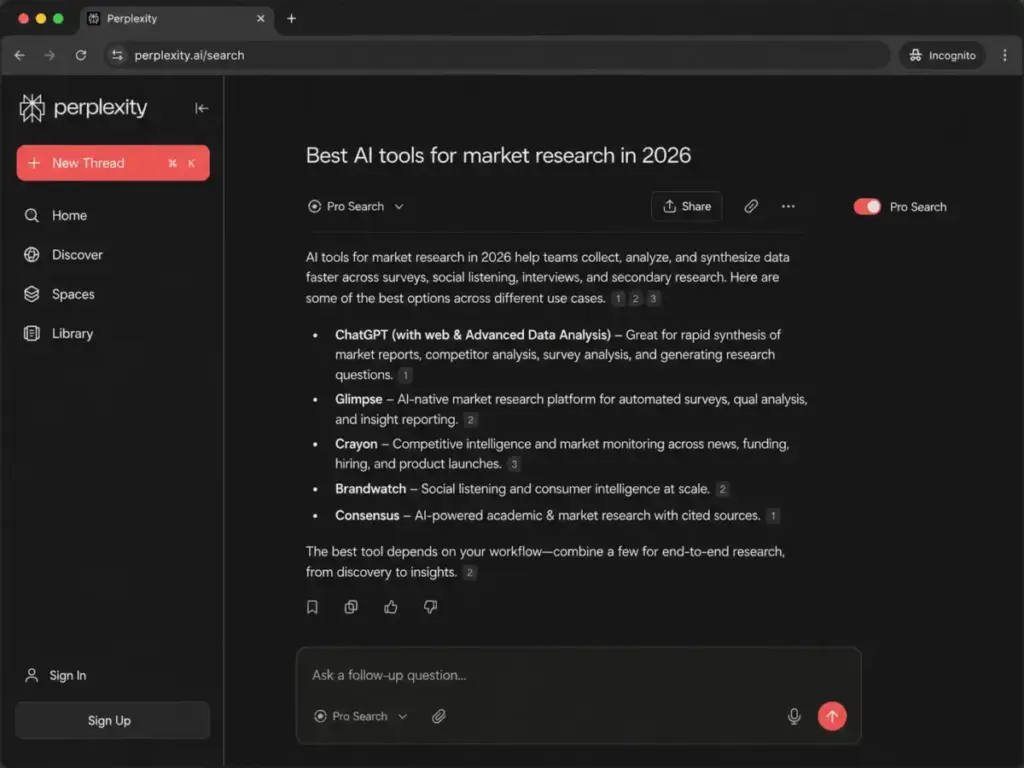
According to Perplexity’s official product page (as of May 2026), every search result includes numbered source links that readers can click to verify claims. Pro Search deepens this by pulling from multiple sources, comparing data points, and synthesizing answers with more granular citations.
Why this matters for buyers: if you write reports, conduct due diligence, brief clients, or publish content that requires traceable sources, Perplexity removes 30 to 60 minutes of manual source-hunting per research session. Paraphrased user sentiment from G2 reviewers confirms that users praise Perplexity for fast, concise, source-backed answers and a clean citation system.
But there is a caveat. Citation visibility does not mean citation accuracy. I address that directly in the limitations section below.
Problem 2: Model Lock-in on Other Platforms
Most AI platforms force users into a single model. ChatGPT runs on GPT models. Claude runs on Claude models. Perplexity breaks this pattern.
According to Perplexity’s official pricing page (as of May 2026), Pro subscribers can choose between GPT, Claude, Gemini, Sonar, and other models directly inside the search interface. Enterprise Max users get access to advanced reasoning models like Claude Opus plus Model Council, which compares answers from multiple models side by side.
Is this worth paying for? For analysts who need to compare model outputs on the same query, yes. For casual users asking “what’s the weather,” no.
Problem 3: Scattered Research Across Too Many Tabs
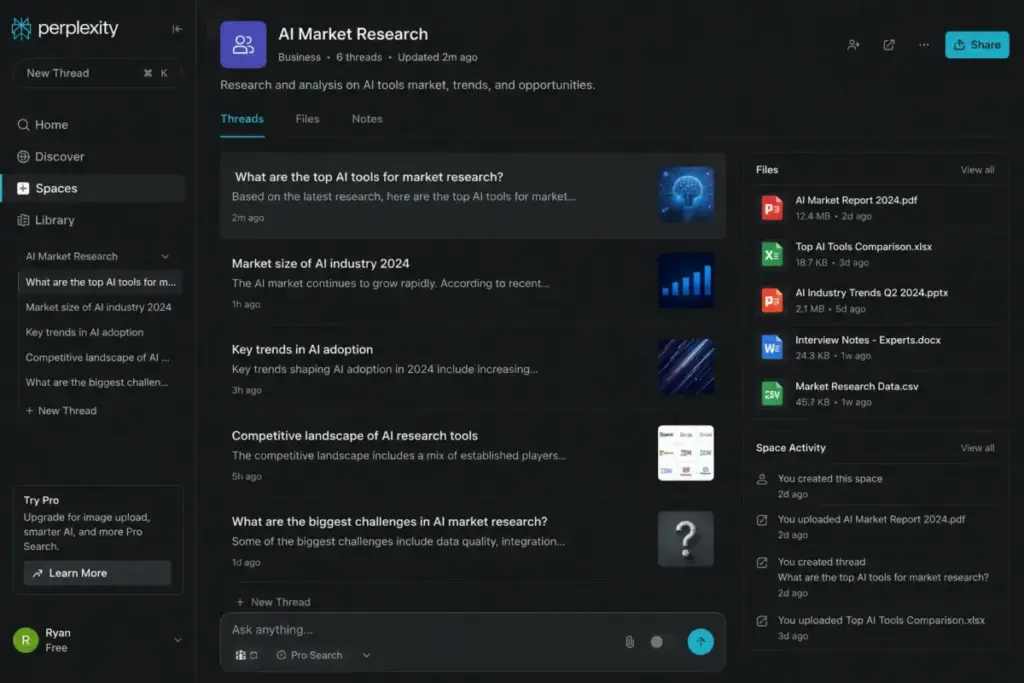
Researchers juggle Google tabs, ChatGPT windows, PDF readers, and note apps simultaneously. Perplexity consolidates search, file analysis, follow-up threads, and Spaces (project-based research collections) into a single interface.
Pro and Max users get file uploads including PDFs, CSVs, images, audio, and video transcription. Enterprise Pro and Max add app connectors for Google Drive, Dropbox, SharePoint, Slack, Jira, Confluence, Salesforce, HubSpot, Snowflake, GitHub, and 400+ prebuilt curated connectors (as of May 2026, with availability varying by plan, rollout, and organization controls).
That consolidation saves time. But it also creates dependency on a single vendor for your research workflow, which brings us to the problems Perplexity creates.
The 2 Problems Perplexity Creates
Every tool that solves problems creates new ones. Perplexity is no exception.
Problem 1: Citations Create False Confidence
The most dangerous assumption about Perplexity is that visible citations equal verified facts. They do not.
Perplexity pulls sources from the open web. Some of those sources are authoritative (Reuters, official documentation). Some are thin blog posts, outdated articles, or pages with factual errors. Perplexity presents all of them with equal visual weight.
Paraphrased sentiment from TrustRadius reviewers confirms: users describe Perplexity as useful for research, prospecting, and code help but warn that accuracy must be verified. Trustpilot sentiment is more negative around subscriptions and support.
Source-Checking Workflow (Use This Before Citing Perplexity Output)
- Click every numbered source. Read the original page.
- Prefer primary sources (official docs, peer-reviewed research, SEC filings) over secondary sources (blog posts citing other blog posts).
- Cross-check any claim against at least two independent sources.
- Never cite “Perplexity says” as a source. Cite the original source Perplexity surfaced.
- Flag thin-web queries. If Perplexity cites only 1 to 2 low-authority sources, treat the answer as unverified.
One detail most reviews miss about Perplexity is that Research mode automatically selects the model for you. You cannot manually pick which model runs your Deep Research query. That means the output quality depends on Perplexity’s routing logic, not your preference.
Problem 2: Plan Complexity Obscures Real Costs
Perplexity has five tiers: Free, Pro, Max, Enterprise Pro, and Enterprise Max. Most competing reviews mention only Free and Pro. The actual plan-gate structure is significantly more complex.
This is the part most reviews skip. Let me map it.
Perplexity Pricing and Plan Limits in 2026
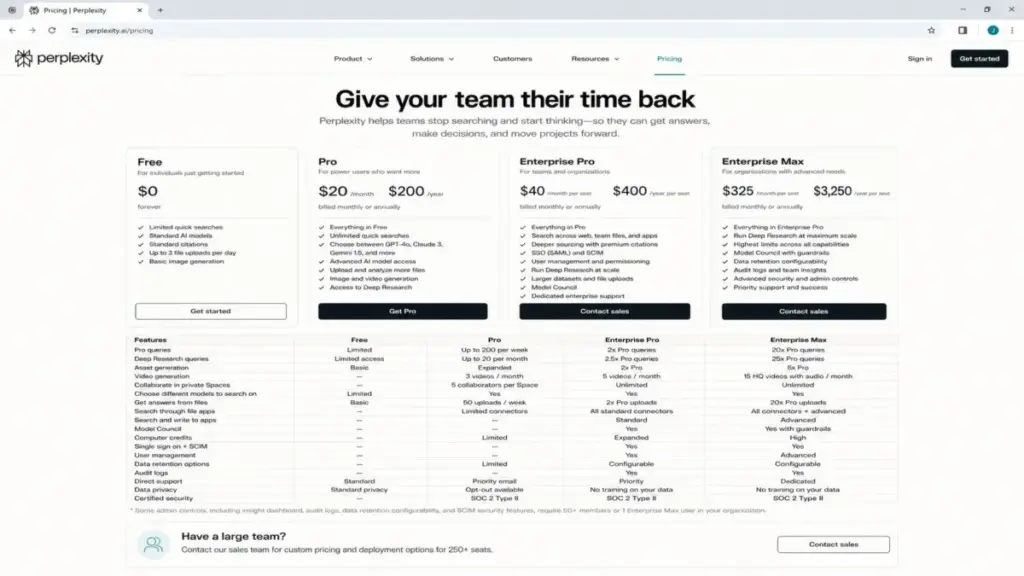
Perplexity pricing starts at $0/month for the Free plan and scales to $325/month per seat for Enterprise Max. Here is the full plan-gate matrix based on Perplexity’s official pricing page (verified May 2026).
| Plan | Monthly Price | Annual Price | Pro Queries | Deep Research | File Uploads | Videos | Key Gate |
|---|---|---|---|---|---|---|---|
| Free | $0 | $0 | Limited | Limited access | Limited | No | Basic search only |
| Pro | $20/mo | $200/yr | Up to 200/week | Up to 20/mo | Up to 50/week | 3/mo | Model selection, Research, image gen |
| Max | $200/mo | $2,000/yr | Higher | Higher | Higher | Enhanced | Advanced models incl. Claude Opus, priority support |
| Enterprise Pro | $40/mo/seat | $400/yr/seat | 2x Pro | 2x Pro | 2x Pro | 5/mo | No-training guarantee, SSO/SCIM, org search |
| Enterprise Max | $325/mo/seat | $3,250/yr/seat | 20x Pro | 25x Deep Research | 20x Pro | 15 HQ w/ audio | Model Council, audit logs, data retention config |
Enterprise Pro and Enterprise Max both require a 2-seat minimum on the official pricing page.
Where Pricing Starts to Pinch
The free plan works for casual searches. But the moment you need Research mode regularly, model choice, or file analysis, you hit the Pro wall.
Consider a solo SEO researcher publishing source-heavy SaaS reviews. At $20/month for Pro, you get 200 Pro queries per week and 20 Deep Research queries per month. That covers most daily research workflows. The annual option at $200/year saves $40 compared to monthly billing.
Now scale that to a 10-person research team. Enterprise Pro at $40/month per seat costs $400/month for 10 seats, or $4,000/year. Enterprise Max at $325/month per seat costs $3,250/month for 10 seats, or $32,500/year. The jump from Enterprise Pro to Enterprise Max is an 8.1x cost multiplier per seat.
So does that justify the price gap? Only if your team runs Deep Research at 25x volume, needs Model Council for multi-model comparisons, requires audit logs, or handles compliance-sensitive data with configurable retention policies.
What the Pricing Page Does Not Make Obvious
- API pricing is completely separate. Perplexity’s Search API costs $5 per 1,000 requests. Agent API charges token-based pricing per provider model. Sonar API costs vary by model and search context size. None of this is included in consumer subscriptions.
- Enterprise admin controls are gated. According to official help pages, insight dashboards, audit logs, data retention configurability, and SCIM security features require organizations with 50+ members or at least one Enterprise Max user. A 10-person team on Enterprise Pro does not automatically get these features.
- File upload limits conflict across official pages. The official pricing page shows different upload limits (40 MB general vs 50 MB paid-user references). Use caveated language when planning around file sizes.
- Seat removal has a 30-day commitment. Enterprise seat removals only affect billing after the first month due to a 30-day seat commitment period.
Perplexity Pros and Cons
What Perplexity Gets Right
Citation visibility in every response. Every answer includes numbered source links. No other AI assistant makes source verification this frictionless. For researchers, analysts, and content professionals who need traceable claims, this is the core value proposition.
Multi-model access on Pro and above. Pro subscribers choose between GPT, Claude, Gemini, Sonar, and other models. Enterprise Max adds Claude Opus and Model Council. This flexibility lets users pick the best model for each query type without switching platforms.
Spaces consolidate research projects. Spaces group threads, files, and sources into project-based collections. Pro allows 5 collaborators per Space. Enterprise plans increase this to unlimited collaborators, making team research workflows practical.
Research mode generates structured reports. Deep Research and Advanced Deep Research go beyond single-query answers. They produce multi-page reports with source trails, comparison tables, and structured analysis. Pro gets 20 Deep Research queries per month. Enterprise Max gets 25x that volume.
Enterprise no-training commitment. Enterprise Pro and Enterprise Max include contractual guarantees that Perplexity does not train on organization data. For legal, compliance, financial, and healthcare-adjacent teams, this separates Perplexity from its consumer tiers.
Low onboarding complexity for individuals. Free and Pro users start searching immediately. No setup wizard, no configuration, no import process. Type a question and get a cited answer.
Where Perplexity Falls Short
Citation accuracy is the user’s problem. Perplexity surfaces sources but does not verify them. Weak sources, outdated pages, and thin-web results appear alongside authoritative sources with identical visual treatment. The verification burden stays with the reader.
Research mode removes model choice. When using Research mode, Perplexity automatically selects the model. Users cannot override this. For power users who prefer specific models for specific query types, this is a real friction point.
Advanced model access has usage limits. According to official help pages, advanced model access during heavy usage periods is limited. Pro and Max users report inconsistent access to premium models during peak times. Exact throttling thresholds are not publicly documented.
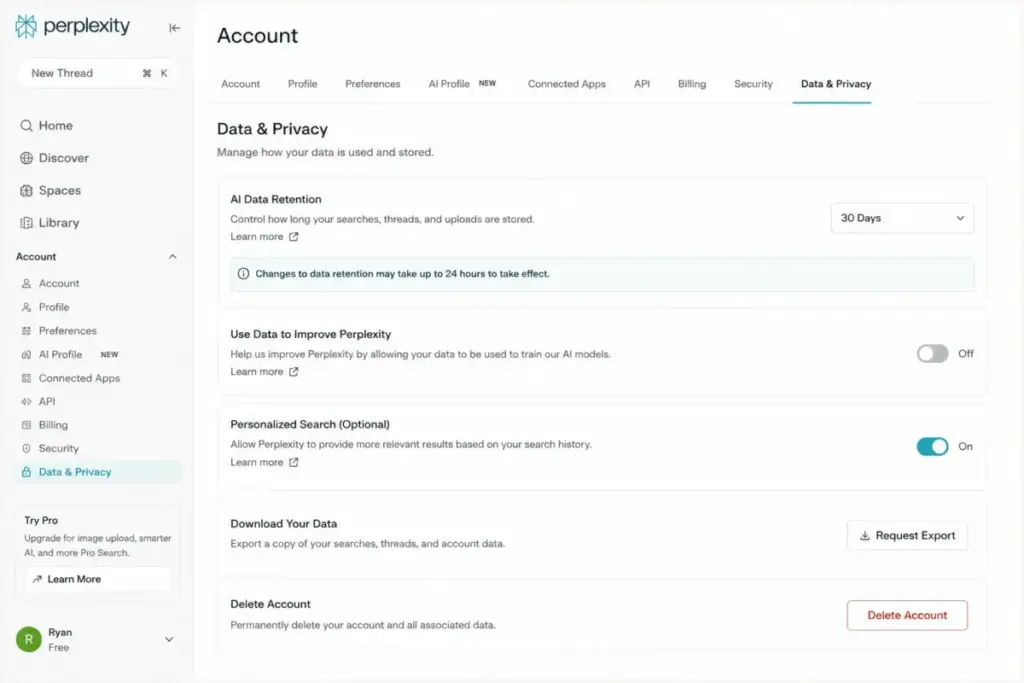
Consumer data privacy requires active opt-out. Free and Pro users are subject to default data-retention settings that require manual opt-out. This is not equivalent to Enterprise no-training guarantees. Privacy-sensitive buyers on consumer plans must navigate settings to manage data sharing.
Support quality is inconsistent. Pro subscribers get Discord and Intercom support. Enterprise gets dedicated support. Paraphrased sentiment from Capterra reviewers notes variable support quality. Trustpilot reviews show recurring subscription management complaints.
Publisher and crawler controversies. Perplexity has faced public disputes with Reuters, Financial Times, New York Times, Forbes, and Wired over content scraping and attribution practices. For legal, publishing, and compliance-sensitive buyers, this creates reputational risk.
Max pricing is hard to justify for most individuals. Max at $200/month ($2,000/year) is 10x the cost of Pro. The incremental features (more model access, enhanced video, priority support, early access) serve high-volume power users. Most daily researchers will find Pro sufficient.
Who Wins and Who Loses With Perplexity
Perplexity is not a universal tool. It fits specific workflows and fails at others. Here is the fit matrix.
| Buyer Scenario | Best Plan | Why | Avoid If |
|---|---|---|---|
| Solo researcher publishing source-heavy content | Pro ($20/mo) | Model choice, Research mode, file uploads, 200 queries/week | You only search a few times per week |
| Enterprise team connecting Google Drive, Slack, Jira | Enterprise Pro ($40/mo/seat) | No-training guarantee, org search, SSO/SCIM, connectors | Your team has fewer than 2 seats or needs audit logs |
| High-volume analyst running Deep Research daily | Enterprise Max ($325/mo/seat) | 25x Deep Research, Model Council, audit logs, retention config | Your budget does not support $3,250+/year per seat |
| Casual user with quick questions | Free ($0) | Basic search with citations at no cost | You need file uploads, model choice, or Research mode |
| Writer needing polished long-form drafts | Skip Perplexity | Perplexity generates research outputs, not publication-ready prose | You need an AI writing tool instead |
| Team needing deterministic spreadsheet analysis | Skip Perplexity | AI-generated analysis is probabilistic, not formula-driven | You need accuracy guarantees on numerical data |
The First 30 Minutes With Perplexity
Creating an account takes under 2 minutes. The search interface loads immediately. Free users type a query and get a cited answer within seconds.
The first surprise is how fast Pro Search returns multi-source results compared to a standard Google search followed by manual tab-opening. The second surprise is how many of those citations link to mid-quality blog posts rather than primary sources.
File uploads work on Pro and above. I uploaded a 15-page PDF and asked Perplexity to summarize key findings. The summary arrived in under 30 seconds with section references. Accuracy was reasonable but required spot-checking against the original document.
The first limitation surfaces when you try Research mode. You cannot select which model powers the research. Perplexity decides. For users who prefer Claude for analysis or GPT for creative tasks, this lack of control is frustrating.
Space creation is straightforward. You name a project, add threads, upload files, and invite collaborators (Pro limit: 5 per Space). The workflow feels clean for individual research but becomes constrained quickly for team projects without Enterprise tier access.
Better Alternatives for Specific Use Cases
Perplexity is not always the best pick. Here is when competitors win.
When ChatGPT Is Better
Choose ChatGPT if you need conversational depth, long-context memory, creative writing, image generation within the chat, or a single model ecosystem with strong plugin support. ChatGPT maintains conversation context across longer threads better than Perplexity. For users who want one AI assistant for everything (research, writing, coding, image creation), ChatGPT’s breadth exceeds Perplexity’s depth. See our ChatGPT review for a full breakdown.
When Claude Is Better
Choose Claude if you need long-document analysis, nuanced reasoning, or coding assistance with large codebases. Claude’s 200K+ token context window handles entire codebases and legal documents that Perplexity’s file upload system cannot match. Claude also provides more thoughtful, structured analysis for complex reasoning tasks. See our Claude AI review for details.
When Google Is Better
Choose Google Search or Google AI Mode if you need navigational search (finding specific websites), transactional search (buying products), or local search (restaurants, services, directions). Perplexity does not replace Google for these query types. It complements Google for informational and research queries.
When NotebookLM Is Better
Choose NotebookLM if your workflow centers on analyzing a fixed set of documents (PDFs, Google Docs, web pages) rather than searching the open web. NotebookLM grounds every answer in your uploaded sources with zero web search. For academic researchers, legal analysts, and policy teams working within a defined corpus, NotebookLM is more accurate and more controlled.
| Scenario | Best Choice | Why | Avoid If |
|---|---|---|---|
| Source-backed web research | Perplexity Pro | Citations, multi-model, Research mode | You need long-form writing output |
| Conversational AI assistant | ChatGPT Plus | Breadth, memory, plugins, image gen | You need verifiable source links |
| Long-document analysis | Claude Pro | 200K context, structured reasoning | You need real-time web data |
| Closed-corpus research | NotebookLM | Grounded in your sources only | You need open web search |
| Navigational/local search | Best for finding sites, places, products | You want synthesized answers |
Perplexity Enterprise: Fit and Security
Enterprise Pro and Enterprise Max add security and compliance features that consumer plans lack. According to Perplexity’s official documentation (as of May 2026), Enterprise tiers include SOC 2 Type II certification, GDPR-compliant safeguards, HIPAA-aligned safeguards (caveated as aligned unless a BAA is contractually confirmed), PCI-compliant payment security, SSO, MFA, and contractual no-training commitments.
Enterprise Buyer Warning: Official pages confirm that insight dashboards, audit logs, data retention configurability, and SCIM security features require organizations with 50+ members or at least one Enterprise Max user. Do not assume every Enterprise Pro deployment gets every admin control. Verify your organization size qualifies before purchasing.
Enterprise Pro works for teams needing no-training guarantees, organization file search, app connectors, and enterprise support at 40/monthperseat.EnterpriseMaxworksforteamsneedinghigh−volumeDeepResearch,ModelCouncil,auditlogs,anddataretentionconfigurationat325/month per seat.
Organizations can mix Enterprise Pro and Max seats. First-month charges are based on selected seats, and removed seats only affect billing after the 30-day commitment period.
Perplexity AI Review: FAQ
Is Perplexity Pro worth it in 2026?
Perplexity Pro is worth $20/month if you run research queries daily, need model selection, use file uploads, and rely on Research mode for source-backed reports. Free is sufficient for occasional quick questions. Pro pays for itself when you estimate the time saved per research session and multiply across a workweek.
How much does Perplexity cost?
Perplexity Free costs $0. Pro costs $20/month or $200/year. Max costs $200/month or $2,000/year. Enterprise Pro costs $40/month per seat or $400/year per seat (2-seat minimum). Enterprise Max costs $325/month per seat or $3,250/year per seat (2-seat minimum). API pricing is separate and usage-based. Pricing verified as of May 2026 on the official pricing page.
What are the main pros and cons of Perplexity?
Pros: citation visibility in every response, multi-model access on Pro and above, Research mode for structured reports, Spaces for project-based research, and enterprise no-training guarantees. Cons: citations do not guarantee accuracy, Research mode removes model choice, advanced model access is throttled during peak usage, consumer data privacy requires opt-out, support quality varies, and publisher controversies create reputational risk.
Who should use Perplexity?
Daily researchers, analysts, consultants, academic users, SEO researchers, journalists, product marketers, and technical buyers who need fast current answers with citations and source trails. Pro or Enterprise tiers unlock the most value for these workflows.
Who should avoid Perplexity?
Users who primarily need creative writing, long-form drafting, deterministic data analysis, private legal or medical workflows without Enterprise controls, or a tool that removes the need to verify sources. Perplexity generates research, not finished content.
Is Perplexity better than ChatGPT?
Perplexity is better for source-backed research where you need verifiable citations. ChatGPT is better for conversational depth, creative writing, coding assistance, image generation, and maintaining long conversation context. They serve different use cases. Read our ChatGPT vs Claude comparison for adjacent competitive context.
Does Perplexity use my data for training?
On Free and Pro plans, default data-retention settings exist and users must manage opt-out preferences. Enterprise Pro and Enterprise Max include contractual no-training commitments. Consumer-tier privacy is not equivalent to enterprise-grade privacy controls.
Is Perplexity accurate?
Perplexity surfaces sources and displays citations, but accuracy depends on the quality of those sources. Weak sources, outdated articles, and source AI hallucinations can appear alongside authoritative sources. Always verify original sources before citing Perplexity output.
Can Perplexity replace Google?
Perplexity replaces Google for informational research queries where you want synthesized, cited answers. Google remains better for navigational search (finding websites), transactional search (buying products), local search, and image search. They complement each other rather than substitute.
What is Perplexity Max?
Perplexity Max is a $200/month ($2,000/year) consumer tier that adds advanced access to all top models (including Claude Opus), enhanced video tools, priority support, early access to new features, higher file and Space limits, and Max-only model capabilities beyond Pro. It targets high-volume power users, not typical daily researchers.
Final Verdict: Perplexity Earns 7.4/10
Perplexity earns 7.4/10. It is the best tool available for citation-backed web research in 2026. No competitor matches its combination of source visibility, multi-model access, and Research mode within a single search interface.
It is best for daily researchers, analysts, consultants, and knowledge workers who run repeated source-backed queries and need traceable citation trails. Pro at $20/month is the value sweet spot for individuals.
It is not the best fit for casual users who search a few times per week (Free is enough), writers who need polished long-form output (use a dedicated AI writing tool), or privacy-sensitive buyers unwilling to upgrade to Enterprise for no-training guarantees.
Choose ChatGPT if you need a single conversational AI assistant with broader capabilities. Choose Gemini if you are already in the Google ecosystem and want integrated AI search. Choose NotebookLM if your research is corpus-based rather than web-based.
Pricing warning: Enterprise Max at $325/month per seat is justifiable only for teams that use Deep Research at 25x volume, need Model Council, or require audit logs and data retention controls. Most teams should start with Enterprise Pro and upgrade individual power-user seats to Max.
Perplexity AI Review verdict: Buy Pro if you research daily. Try Free if you are evaluating. Skip Max unless you hit Pro limits consistently.
Check the latest plans and pricing at Perplexity’s official pricing page. Review our full AI chatbot rankings and review methodology for scoring context.