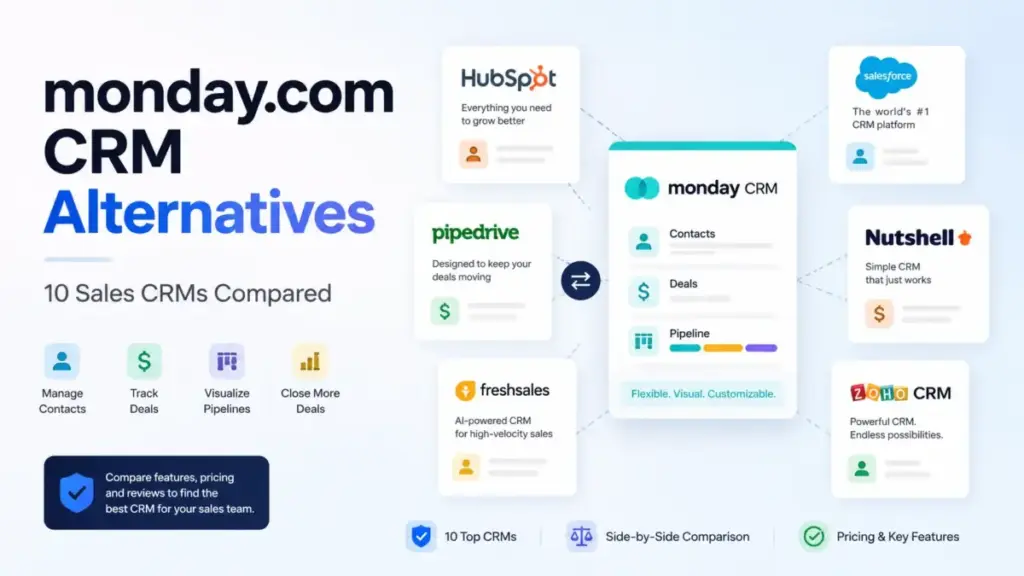
monday CRM advertises $12/seat/month on the Basic plan. A solo founder cannot buy one seat. The minimum purchase is three seats, so the real starting cost is $36/month before a single deal enters the pipeline. Scale that to 10 users on the Pro plan, and the bill reaches $280/month billed annually, with dashboards, automations, and workspace limits still gated by tier.
That seat-bucket pricing model is the single biggest reason teams start searching for CRM software alternatives. But pricing is not the only friction point. Public review sentiment on Capterra and Gartner Peer Insights flags clunky email workflows, setup complexity for connected boards, and feature gates that push teams toward higher plans faster than expected.
This guide compares 10 monday.com CRM alternatives by the specific pain that triggers each switch: seat-bucket costs, shallow sales pipelines, weak email workflows, missing outbound calling, free-plan availability, enterprise scalability, and post-sale project delivery. Every price is verified against official pages as of May 2026. Every recommendation maps to a CRM platform switching trigger, not a generic “best overall” label.
Quick Verdict: Best monday CRM Alternatives by Switching Trigger
| If you are leaving monday CRM because… | Best alternative | Why |
|---|---|---|
| Seat-bucket pricing wastes money on unused seats | Nutshell | $13/user/month, no seat minimums, unlimited contacts |
| You need a purpose-built sales pipeline, not a workspace | Pipedrive | Sales-first deal management with visual pipeline |
| Email workflows feel clunky | HubSpot Sales Hub | Native email sequences, meetings, and live chat on free plan |
| Outbound calling and SMS are central to your process | Close | Built-in calling, SMS, Power Dialer on Growth plan |
| You want a strong free or low-cost CRM entry point | HubSpot CRM | $0 free plan with deal tracking, chat, and meetings |
| You need enterprise CRM scalability | Salesforce Sales Cloud | Deepest governance, AI, forecasting, and API ecosystem |
| You need CRM plus post-sale project delivery | Insightly | Deals convert to projects inside the same platform |
What this means: no single monday CRM alternative wins everywhere. The right switch depends on whether the buyer is escaping seat-bucket pricing, shallow sales features, weak email workflows, or a setup-heavy workspace model. I mapped each trigger to a different platform because the SERP is full of generic lists that recommend Asana and ClickUp as “monday alternatives” without clarifying that those tools cannot replace a sales CRM.
The monday CRM Problem Map
monday CRM is not a bad product. It is a flexible workspace platform that added CRM boards on top of an existing work-management engine. For teams that want sales workflows connected to project delivery, that flexibility is a genuine strength. The problems show up at specific pressure points.
Seat-Bucket Pricing and the 3-Seat Minimum
According to monday’s official support documentation, pricing works in seat buckets starting at a minimum of 3 seats, then ascending in multiples of 5. A 2-person team pays for 3 seats. A 6-person team pays for 8. One Capterra reviewer summarized the friction directly:
“The pricing structure becomes expensive if you need many seats or advanced features, and some important functions are only available in higher-paid plans.” (Aqiral M., Verified User, Capterra)
That bucket model means solo founders and small teams often pay for capacity they never use.
Email Workflows and Sales-Specific Depth
monday CRM’s board-first architecture prioritizes visual flexibility over opinionated sales workflows. Teams that want purpose-built pipeline controls, email sync, forecasting, lead routing, and sales reporting often outgrow the board model. Public review sentiment supports this: a Capterra reviewer noted the email feature “feels clunky to me and unintuitive” (Kadance K., Verified User).
Feature Gates Across Plans
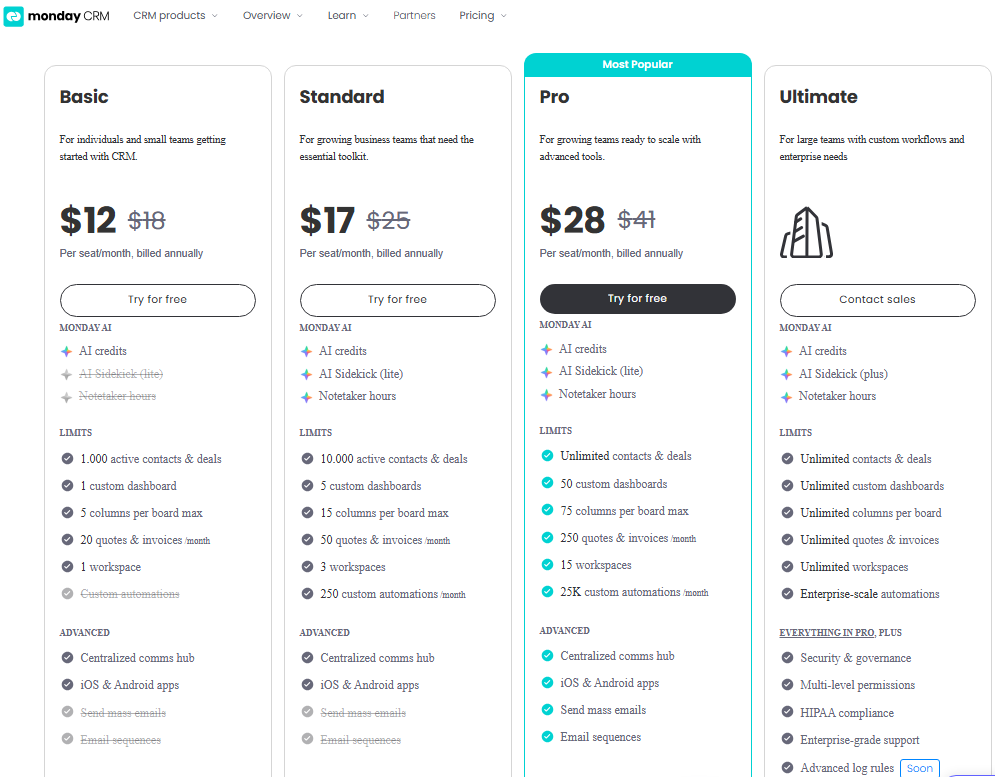
According to monday CRM’s pricing page, the Basic plan ($12/seat/month) caps active contacts and deals, limits dashboards, and excludes quotes, invoices, and advanced automations. Standard ($17/seat/month) unlocks more contacts and columns. Pro ($28/seat/month) adds forecasting, advanced analytics, and higher automation limits. Ultimate requires contacting sales. I keep coming back to this gap because it shapes every recommendation in this guide: the plan a buyer can afford and the plan a buyer actually needs are rarely the same on monday CRM.
Alternatives That Fix the Pricing Problem
Freshsales: Best Value for AI and Built-in Phone

Freshsales is the strongest monday CRM alternative for teams leaving because of pricing pressure combined with a need for built-in sales communication.
Freshsales pricing starts at $0 for up to 3 users on the free plan, with Growth at $9/user/month billed annually. A 10-user team on Growth pays $90/month, compared to monday CRM’s $120/month on Basic or $280/month on Pro.
Freshsales does better than monday CRM in built-in phone, Kanban records, and Freddy AI email features at a lower entry price. The tradeoff: a smaller third-party ecosystem than HubSpot and less cross-functional work-management flexibility than monday.com.
Choose Freshsales if your team needs a sales CRM with AI and calling at an aggressive SMB price point. Avoid if you need CPQ (that is an add-on) or if you want a combined sales-and-marketing journey platform (Freshsales Suite is a separate product).
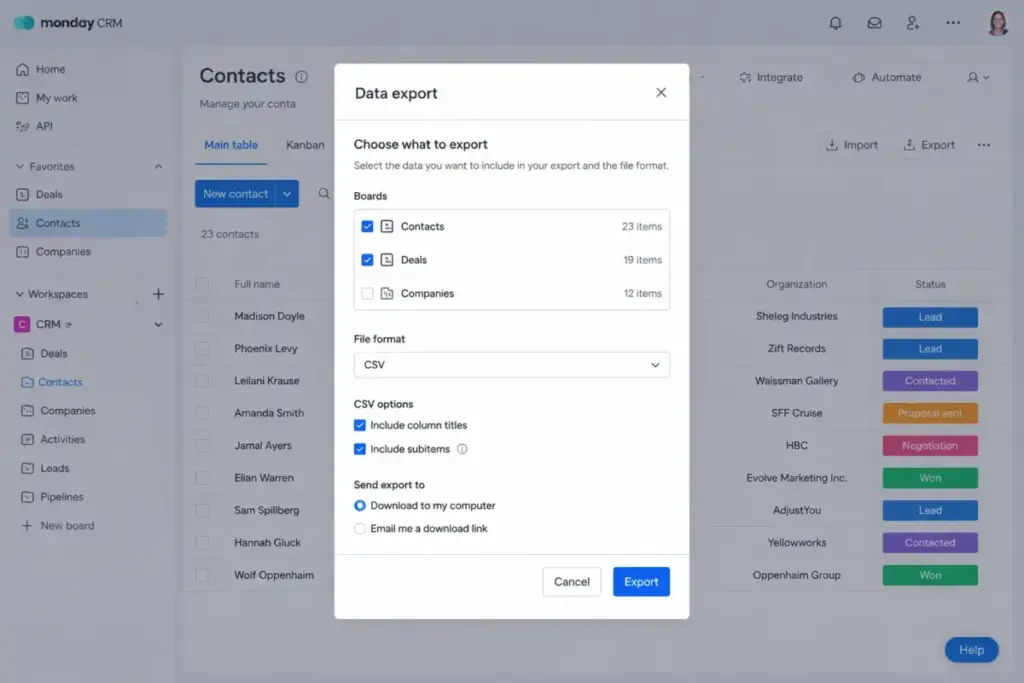
Migration difficulty: Low. CSV import covers contacts and deals. Workflow rebuild is minimal for teams on monday CRM Basic.
Zoho CRM: Best Budget CRM Suite

Zoho CRM fits small teams that want lower-cost CRM depth and access to the wider Zoho ecosystem without paying for unused seats.
According to Zoho CRM’s pricing page, the Free Edition is available for up to 3 users with leads, deals, workflows, reports, and mobile access. Standard is commonly listed at $14/user/month billed annually. A 10-user team on Standard pays $140/month.
Zoho CRM does better than monday CRM in traditional CRM depth, lead management, and Zia AI on higher tiers. The tradeoff: the interface and customization can feel more complex than monday’s visual boards, especially for non-technical teams.
Choose Zoho CRM if your team wants a free starting point with room to scale into a broader business app ecosystem. Avoid if your team values visual simplicity over configuration depth.
Migration difficulty: Medium. Data import is straightforward, but workflow configuration and Zoho ecosystem setup take longer than monday CRM’s board-based approach.
Nutshell: Best No-Seat-Minimum SMB CRM

Nutshell directly solves monday CRM’s seat-bucket pain. According to Nutshell’s pricing page, Foundation starts at $13/user/month billed annually with no seat minimums or maximums and unlimited contacts and storage on all CRM subscriptions.
A 10-user team on Foundation pays $130/month. That is $10 less than monday CRM Basic with no wasted seats and no contact limits.
Nutshell does better than monday CRM in transparent SMB pricing, email and calendar sync, and form/landing page tools included at lower tiers. The tradeoff: less flexible for non-sales project workflows and advanced custom work management than monday.com.
Choose Nutshell if you are a solo founder or small team that wants per-user pricing without seat-bucket math. Avoid if you need advanced reporting or API-style enterprise capabilities (those require Pro or higher tiers).
Migration difficulty: Low. Nutshell is designed for SMB onboarding with CSV import and a 14-day free trial, no credit card required.
Capsule CRM: Best Simple Relationship CRM

Capsule CRM targets small businesses that find monday CRM too configurable and want a cleaner relationship CRM without setup overhead.
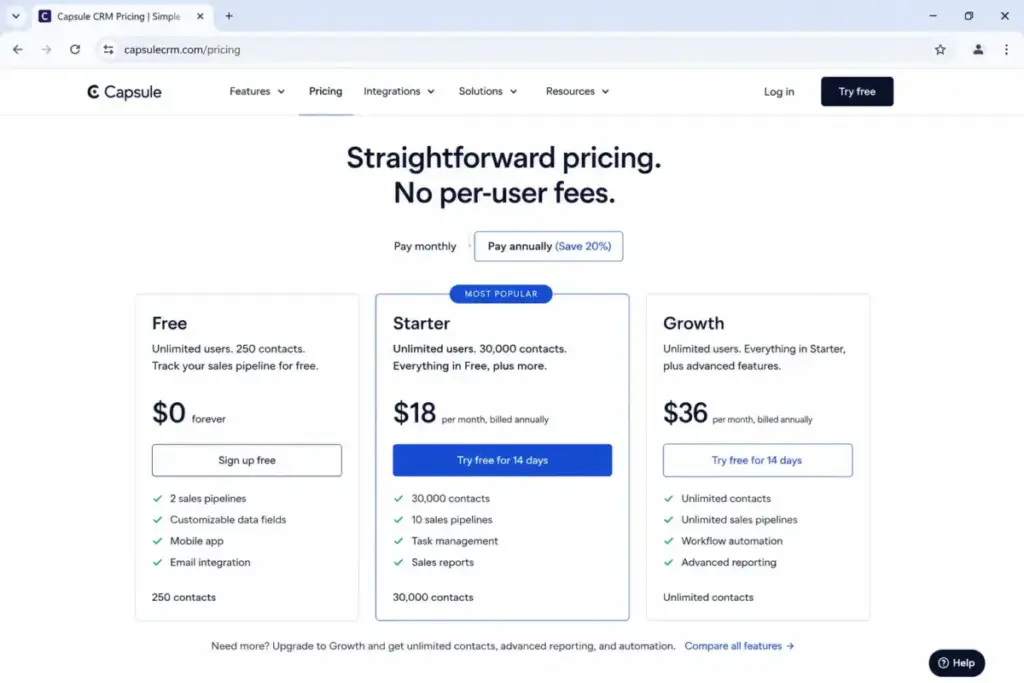
Capsule’s signup page shows a free plan for up to 2 users with 250 contacts and 1 sales pipeline. Starter is commonly listed at $18/user/month billed annually based on 2026 third-party references. A 10-user team on Starter pays $180/month.
Capsule does better than monday CRM in adoption speed and relationship management simplicity. The tradeoff: less powerful for advanced automation, enterprise reporting, and complex custom workflows.
Choose Capsule if your team prioritizes quick CRM adoption over configuration depth. Avoid if you need workflow automation (that requires the Growth tier) or if your contact list exceeds 250 on the free plan.
Migration difficulty: Low. Contact and opportunity import is simple. The main risk is losing automation workflows built in monday CRM, since Capsule’s automation starts on paid tiers.
Alternatives That Fix the Sales Pipeline Problem
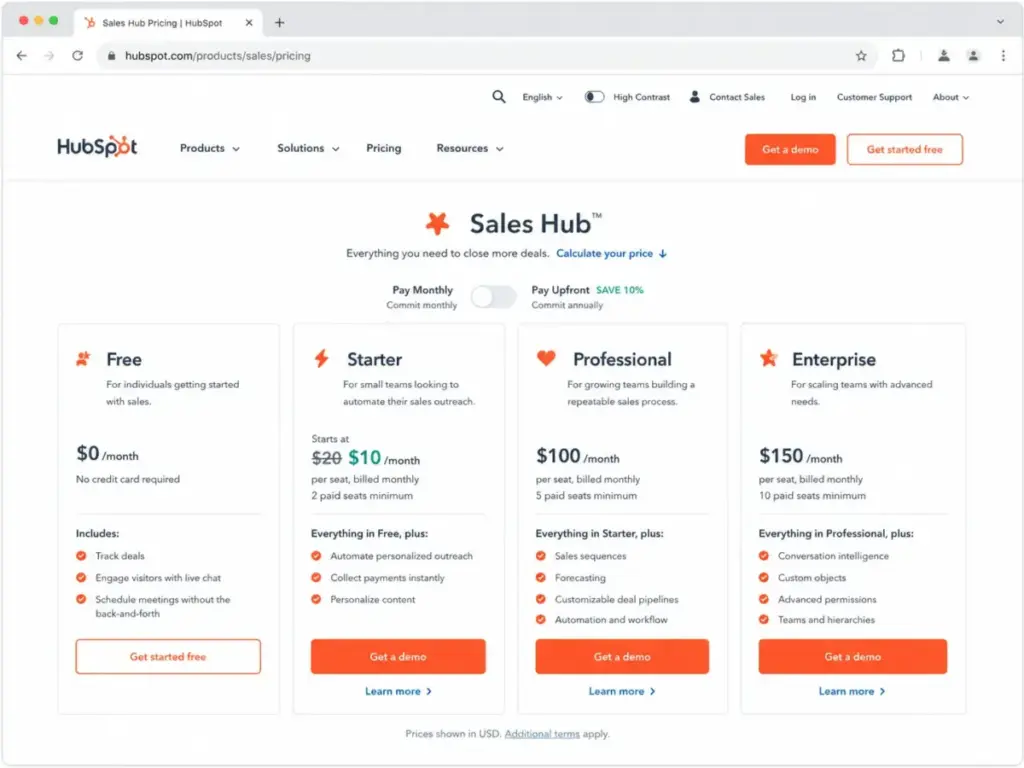
HubSpot Sales Hub: Best Free CRM and Sales-Marketing Ecosystem

HubSpot Sales Hub is the strongest monday CRM alternative for teams that want a true CRM ecosystem with free tools, sales engagement, meetings, live chat, and a path to marketing handoff.
According to HubSpot’s official product page, the free plan costs $0/month and includes deal tracking, live chat, and meetings. Starter is shown from $20/seat/month list price. Professional jumps to $100/seat/month. A 10-user team on Starter pays $200/month at list price; Professional would cost $1,000/month.
HubSpot does better than monday CRM in CRM depth, sales automation, AI forecasting on higher tiers, and broader platform expansion. The tradeoff: costs jump sharply from Starter to Professional, and HubSpot is less flexible as a general work-management canvas than monday.com.
I evaluated this comparison across official documentation and pricing data. The hidden math matters here: a team that starts on HubSpot Free will eventually need Professional for sequences, forecasting, and custom reports. That $100/seat/month tier is where the real cost lives, and it dwarfs monday CRM Pro at $28/seat/month. The question is whether the CRM depth justifies the premium.
Choose HubSpot if your team needs a free CRM starting point with room to grow into marketing, service, and operations hubs. Avoid if your budget cannot absorb the Starter-to-Professional jump and you do not need marketing handoff.
Migration difficulty: Medium. Contact and deal import works well. Workflow rebuild takes longer because HubSpot’s automation architecture is more structured than monday’s board-based rules.
Pipedrive: Best for Sales Pipeline Simplicity

Pipedrive is the strongest monday CRM alternative for sales teams that like monday’s visual pipeline but want a CRM designed around deals, activities, forecasting, and sales rep adoption.
Pipedrive’s plan structure includes Lite, Growth, Premium, and Ultimate. Based on 2026 pricing references, Lite starts at $14/seat/month billed annually. A 10-user team on Lite pays $140/month. Pipedrive’s official pricing page confirms that add-ons are charged per company, not per user.
Pipedrive does better than monday CRM in opinionated sales pipeline workflow and deal management. The tradeoff: Lite lacks key features such as automations and full email sync, and add-ons can increase total cost. Less useful for cross-functional project management than monday.com.
Choose Pipedrive if your sales team wants a CRM that prioritizes deal flow over workspace flexibility. Avoid if you need the Lite tier to include automations and email sync (those sit on Growth and above).
Migration difficulty: Low. Pipedrive’s data import handles contacts, deals, and activities. Sales teams adopt Pipedrive quickly because the pipeline UI requires minimal configuration.
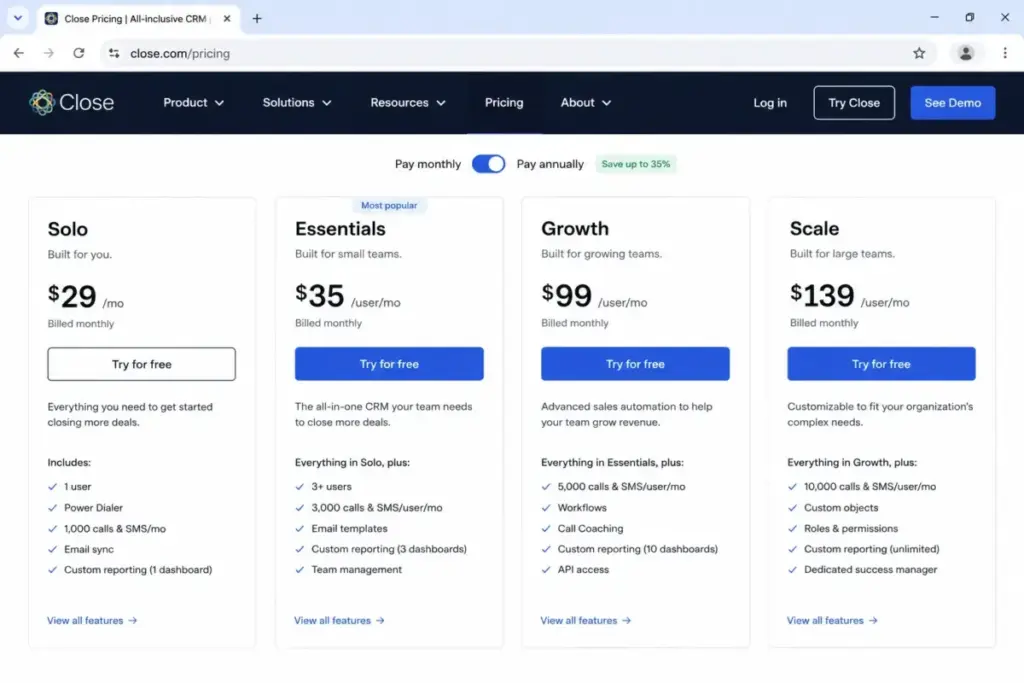
Close: Best for Outbound Sales Calling and SMS

Close is the strongest monday CRM alternative for outbound teams that need built-in calling, email, SMS, and power dialer workflows rather than a board-based CRM.
According to Close’s pricing page, Solo starts at $9/seat/month billed annually but is limited to 1 user, 10,000 leads, and no workflows. Essentials starts at $35/seat/month for teams. A 10-user team on Essentials pays $350/month.
Close does better than monday CRM in centralized inbox, built-in calling, SMS, and outbound sales workflow. The tradeoff: more expensive for teams once Solo is not enough, and weaker for project delivery and cross-functional operations.
Choose Close if your sales team calls all day and needs a CRM built around phone, email, and SMS in one interface. Avoid if you need a team CRM for under $35/seat/month or if post-sale project delivery matters (Close does not cover that workflow).
Migration difficulty: Medium. Contact import is straightforward, but rebuilding monday CRM board automations into Close’s workflow system requires rethinking the sales process around communication channels.
Alternatives That Fix Scale, Ecosystem, and Delivery Gaps
Salesforce Sales Cloud: Best for Enterprise CRM Scalability

Salesforce Sales Cloud is the strongest monday CRM alternative for growing companies that need enterprise-grade governance, forecasting, AI, APIs, and long-term scalability.
According to Salesforce’s pricing page, Starter Suite costs $25/user/month with a 30-day free trial. A 10-user team on Starter Suite pays $250/month. The Agentforce Sales Enterprise tier adds AI, automation, pipeline management, forecasting, opportunity scoring, and conversation intelligence.
Salesforce does better than monday CRM in enterprise CRM depth, partner ecosystem, and long-term platform extensibility. The tradeoff: heavier implementation, admin burden, and total cost. Too much for many small teams.
This is where the buyer misconception matters most. Teams that outgrow monday CRM often assume Salesforce is the obvious next step. It can be, but only if the organization has (or plans to hire) a Salesforce admin. The implementation cost is often material, and the gap between Starter Suite and full Sales Cloud is where budgets break.
Choose Salesforce if your team is growing past 25 users and needs advanced governance, forecasting, and API access. Avoid if you do not have admin capacity or if your team is under 10 users with a simple sales process.
Migration difficulty: High. Salesforce implementation involves data mapping, workflow redesign, user training, and often third-party consulting. This is not a weekend migration.
Copper CRM: Best for Google Workspace Teams

Copper CRM is the strongest monday CRM alternative for Google Workspace-first teams that want CRM adoption inside Gmail and Google workflows.
According to Copper’s pricing page, Starter costs $9/seat/month billed annually with a 1,000-contact limit. Basic is $23/seat/month. Professional is $59/seat/month. A 10-user team on Starter pays $90/month; on Professional, $590/month.
Copper does better than monday CRM in native Google Workspace orientation and Gmail-first relationship management. The tradeoff: less attractive for Microsoft-first teams, and contact limits plus automation gates push many teams beyond Starter.
Choose Copper if your team lives in Gmail and Google Calendar and wants CRM data surfaced inside Google apps. Avoid if your team uses Microsoft 365 or if your contact list exceeds 1,000 (Starter’s cap forces an upgrade quickly).
Migration difficulty: Medium. Google Workspace integration setup is smooth, but rebuilding monday CRM’s board automations into Copper’s workflow system takes effort on Professional tier.
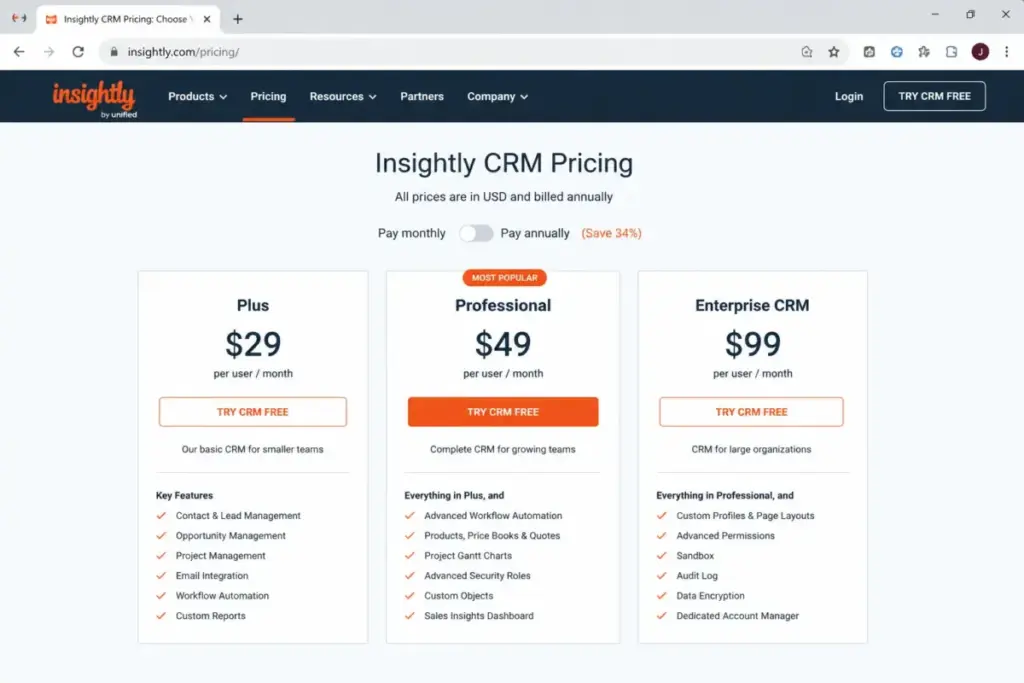
Insightly: Best for CRM Plus Post-Sale Project Delivery

Insightly is the strongest monday CRM alternative for teams that use monday CRM to manage both sales and post-sale delivery but want stronger lead routing, workflow automation, and optional marketing/support modules.
According to Insightly’s pricing page, CRM Plus starts at $29/user/month billed annually with a 14-day free trial. A 10-user team on Plus pays $290/month.
Insightly does better than monday CRM in converting deals into projects within the same platform, with workflow automation on Professional and AI Copilot on higher tiers. The tradeoff: higher starting price than monday CRM Basic and less visually flexible as a general work OS.
Honestly, Insightly is the alternative most monday CRM switchers overlook. If post-sale delivery is part of your workflow, losing that capability in a switch can hurt more than the pricing savings you gain. Insightly preserves that deal-to-project handoff while adding stronger CRM lead routing.
Choose Insightly if your deals convert into client projects and you need that continuity. Avoid if marketing automation is critical (that starts from $99/account/month as a separate product) or if AppConnect integration needs apply (starting at $249/account/month with a required technical setup fee listed on Insightly’s pricing page).
Migration difficulty: Medium. Contact and deal import works through CSV. The main effort is mapping monday CRM board structures into Insightly’s lead, opportunity, and project modules.
Pricing Comparison: Starting Price vs Practical Tier at 10 Users
Comparing starting prices tells you almost nothing about real CRM cost. The table below shows what each platform charges at the tier where sales teams actually get the features they need, plus the 10-user annual cost.
| Product | Starting price | Practical sales-ready tier | 10-user monthly cost (annual) | Free plan | Trial |
|---|---|---|---|---|---|
| monday CRM | $12/seat/mo | Pro ($28/seat/mo) | $280/mo | No | 14-day |
| Freshsales | $0 (3 users) | Growth ($9/user/mo) | $90/mo | Yes (3 users) | 21-day |
| Zoho CRM | $0 (3 users) | Standard ($14/user/mo) | $140/mo | Yes (3 users) | 15-day |
| Nutshell | $13/user/mo | Foundation ($13/user/mo) | $130/mo | No | 14-day |
| Capsule CRM | $0 (2 users) | Starter ($18/user/mo) | $180/mo | Yes (2 users) | 14-day |
| HubSpot | $0 (unlimited) | Starter ($20/seat/mo) | $200/mo | Yes | No |
| Pipedrive | $14/seat/mo | Growth (~$29/seat/mo) | ~$290/mo | No | 14-day |
| Close | $9/seat/mo | Essentials ($35/seat/mo) | $350/mo | No | 14-day |
| Salesforce | $25/user/mo | Starter Suite ($25/user/mo) | $250/mo | No | 30-day |
| Copper | $9/seat/mo | Basic ($23/seat/mo) | $230/mo | No | 14-day |
| Insightly | $29/user/mo | Plus ($29/user/mo) | $290/mo | No | 14-day |
What this means: Freshsales at $90/month for 10 users on Growth is the cheapest practical CRM option in this set. monday CRM’s Pro tier at $280/month sits in the upper-middle range, more expensive than 6 of the 10 alternatives at their practical tiers. The hidden cost trap is not the starting price. It is the gap between the advertised entry plan and the plan where automation, forecasting, and reporting actually work. For monday CRM, that gap is $120 to $280/month at 10 seats.
I did not score this product based on brand popularity alone. Pricing on this page reflects official pages checked in May 2026. Annual billing applies unless noted.
Migration Difficulty Matrix
Every CRM switch carries risk. This table estimates what each migration requires based on data portability, workflow rebuild, and learning curve.
| Alternative | Difficulty | Main risk | Typical timeline |
|---|---|---|---|
| Freshsales | Low | Workflow rebuild minimal on Basic | 1-2 weeks |
| Zoho CRM | Medium | Ecosystem configuration complexity | 2-4 weeks |
| Nutshell | Low | Limited advanced customization post-switch | 1-2 weeks |
| Capsule CRM | Low | Automation loss if on monday CRM Pro | 1 week |
| HubSpot | Medium | Workflow architecture is more structured | 2-4 weeks |
| Pipedrive | Low | Add-on decisions affect budget | 1-2 weeks |
| Close | Medium | Process redesign around calling/SMS | 2-3 weeks |
| Salesforce | High | Requires admin, consulting, data mapping | 4-12 weeks |
| Copper | Medium | Google Workspace dependency | 2-3 weeks |
| Insightly | Medium | Board-to-module structure mapping | 2-4 weeks |
What this means: 4 of the 10 alternatives are low-difficulty migrations. Salesforce is the only high-difficulty switch, and that difficulty is the price of enterprise depth. For teams on monday CRM Basic with fewer than 500 contacts, Freshsales, Nutshell, or Pipedrive offer the lowest-friction path out.
How to Choose the Right monday CRM Alternative
Do not pick a monday CRM alternative by feature count. Pick by the pain that triggered your search.
- If seat-bucket pricing is the trigger: Compare Nutshell ($13/user/month, no minimums) against Freshsales Growth ($9/user/month). Both charge per user with no seat buckets. Nutshell includes unlimited contacts on all plans. Freshsales includes a free plan.
- If you need a purpose-built sales CRM: Compare Pipedrive (visual pipeline, activity-based selling) against Close (built-in calling, SMS, email). Choose Pipedrive for deal-stage management. Choose Close for outbound call volume.
- If email workflows are the pain: HubSpot Sales Hub gives you email sequences, meetings, and live chat on the free plan. No other alternative in this list matches HubSpot’s email workflow depth at zero cost.
- If you need enterprise scale: Salesforce is the only option in this list with deep governance, compliance, AI forecasting, and partner ecosystem. The cost is implementation complexity.
- If you need CRM plus post-sale delivery: Insightly converts deals into projects. monday CRM does this too, but Insightly adds stronger lead routing and workflow automation.
- If budget is the only concern: Freshsales Growth at $90/month for 10 users is the lowest practical cost. HubSpot Free at $0 is the cheapest starting point, but the practical tier jumps to $200/month.
Which monday CRM Alternative Should You Avoid?
Not every alternative fits every team. Here are the scenarios where a specific switch would make things worse.
- Avoid Salesforce if your team is under 10 users and you do not have (or plan to hire) a dedicated CRM admin. The implementation cost and admin burden will exceed the value gained.
- Avoid Close if post-sale project delivery is part of your workflow. Close is built for outbound sales communication, not project management.
- Avoid Capsule CRM if your contact list exceeds 1,000 on day one. The free plan caps at 250 contacts, and Starter at 30,000. But workflow automation only starts on Growth, so teams with complex sales processes will hit limits quickly.
- Avoid Copper if your organization runs Microsoft 365. Copper’s value is tied to Google Workspace integration. Without Gmail and Google Calendar, the product loses its core differentiator.
- Avoid Zoho CRM if your team dislikes configuration. Zoho’s depth is its strength and its adoption barrier. Teams that valued monday’s visual simplicity may find Zoho’s interface overwhelming.
When to Stay with monday CRM
Switching is not always the right call. Stay with monday CRM if:
- Your team uses monday.com for both sales AND project management in a single workspace. No alternative in this list replicates that dual-purpose flexibility as cleanly.
- Your team is already on Pro and uses connected boards, automations, and dashboards across departments. The migration cost of rebuilding cross-functional workflows often exceeds the pricing savings from switching.
- Your contact volume is under 25,000 and your automation needs fit within Pro’s limits. monday CRM Pro is a capable CRM for teams that do not need enterprise governance or outbound calling.
- Your team adopted monday CRM recently and has not yet explored its CRM-specific features. Some frustrations stem from configuration gaps, not product gaps.
The stay signal is strongest when monday CRM’s work-management flexibility is a genuine daily advantage, not just a feature on paper.
Review limitation: This comparison uses official pricing pages, product documentation, and verified Capterra/Gartner Peer Insights user feedback. I did not deploy each tool with a live sales team, so workflow credit consumption, enterprise quote ranges, and real-world onboarding timelines should be confirmed with each vendor directly.
Final Verdict: Best monday CRM Alternative for Most Teams
For the majority of teams leaving monday CRM because of seat-bucket pricing and sales workflow depth, Freshsales is the strongest overall alternative. At $9/user/month on Growth with a free plan for up to 3 users, built-in phone, Kanban records, and Freddy AI email features, it delivers more CRM value per dollar than monday CRM Basic while eliminating the 3-seat minimum.
By buyer type:
- Best free option: HubSpot CRM ($0, unlimited users, deal tracking, meetings, and live chat)
- Best value: Freshsales Growth ($90/month for 10 users, AI and calling included)
- Best for pure sales pipeline: Pipedrive (visual deal management, fast adoption)
- Best for outbound calling: Close (built-in phone, SMS, Power Dialer)
- Best for enterprise scale: Salesforce Sales Cloud (governance, AI, forecasting)
- Best for CRM plus delivery: Insightly (deal-to-project conversion)
- Best for Google Workspace teams: Copper (Gmail-first CRM)
The stay-vs-switch signal: if monday CRM’s workspace flexibility is central to your daily operations and your team uses connected boards across departments, switching carries a higher cost than most alternatives save. If you are using monday CRM only for sales pipeline and the seat-bucket pricing frustrates you, the switch to Freshsales or Nutshell pays for itself in the first billing cycle.
FAQ
Is monday CRM too expensive for a small team?
Yes, if your team has fewer than 3 people. monday CRM’s 3-seat minimum means a solo founder pays for 3 seats at $36/month on Basic. Nutshell at $13/user/month with no minimums or Freshsales with a free plan for up to 3 users both cost less for teams of that size.
Can I replace monday CRM with a free CRM?
Yes, if your needs are basic pipeline tracking and contact management. HubSpot CRM offers a $0 free plan with unlimited users, deal tracking, live chat, and meetings. Freshsales and Zoho CRM also offer free plans for up to 3 users. The limitation: free plans lack automation, advanced reporting, and forecasting on all three platforms.
Will I lose my project management workflows if I switch from monday CRM?
Yes, unless you choose Insightly, which converts deals into projects within the same platform. Most CRM alternatives in this guide focus on sales pipeline management only. If post-sale delivery is part of your monday CRM setup, factor in the cost of replacing that workflow separately.
Should I switch from monday CRM to Salesforce?
No, unless your team is growing past 25 users and you have admin capacity. Salesforce Starter Suite costs $250/month for 10 users, which is less than monday CRM Pro. But the real cost is implementation: data mapping, workflow redesign, and admin maintenance. For teams under 15 users with a simple sales process, Pipedrive or Freshsales offer better value.
Is Pipedrive better than monday CRM for sales teams?
Yes, if your team’s primary need is visual deal management and activity-based selling. Pipedrive’s pipeline UI requires less configuration than monday CRM’s board setup. The tradeoff: Pipedrive Lite lacks automations and full email sync. Teams that need those features pay for Growth at approximately $29/seat/month, which is close to monday CRM Pro pricing.
Can I try these monday CRM alternatives before committing?
Yes, for all 10 alternatives. HubSpot, Freshsales, Zoho, and Capsule offer free plans. The remaining 6 offer 14-day to 30-day free trials. Nutshell’s trial requires no credit card. Salesforce offers the longest trial at 30 days.
What is the cheapest monday CRM alternative for 10 users?
Freshsales Growth at $90/month for 10 users billed annually. That is $190/month less than monday CRM Pro at the same team size. The next cheapest practical option is Nutshell Foundation at $130/month with no seat minimums and unlimited contacts.
Is monday CRM actually a CRM or a project management tool?
monday CRM is a CRM product built on top of monday.com’s work-management platform. It adds CRM boards, contact management, deal tracking, and automations to the workspace engine. The architecture gives it flexibility but also means it lacks some opinionated sales features found in purpose-built CRMs such as Pipedrive, Close, or HubSpot.

Related Articles
See also other reviews