The $6 Starter price on the ElevenLabs pricing page hides the number that actually decides your bill: credits. ElevenLabs sells plans in monthly credit buckets, not minutes, and how fast those credits burn depends on which model you run, whether you generate in the app or over the API, and whether you need a real voice clone or just a stock voice.
That is the gap most pricing articles skip. They reprint the plan cards, call credits “minutes,” and move on. So a creator reads “30,000 credits” and assumes 30 minutes of audio, then watches the balance drop faster than expected on a multilingual project and wonders what went wrong.
This guide maps every public ElevenLabs plan to what it actually unlocks, separates in-app credits from API character pricing, and shows where the real cost lands once commercial rights, Professional Voice Cloning, workspace seats, and pay-as-you-go top-ups enter the picture.
Pricing here was verified on the official pricing page on June 24, 2026. ElevenLabs is research-evaluated from official documentation and pricing pages, not hands-on lab testing, so every number traces back to a public source.
If you are weighing voice generation against other AI tools for content creation, the credit model is the thing to understand before you pick a tier.
Quick Pricing Verdict
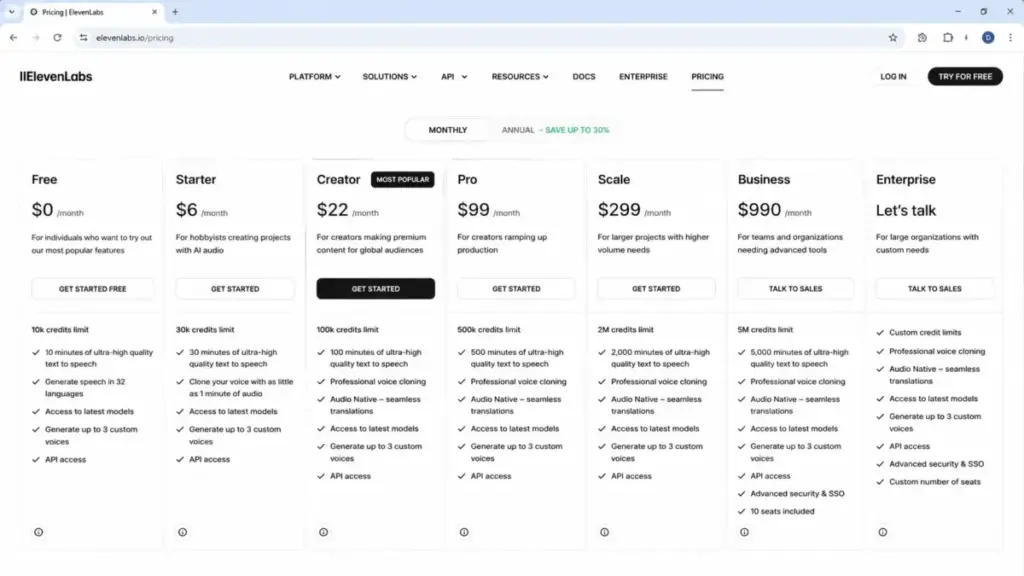
| Decision | Answer (verified June 24, 2026) |
|---|---|
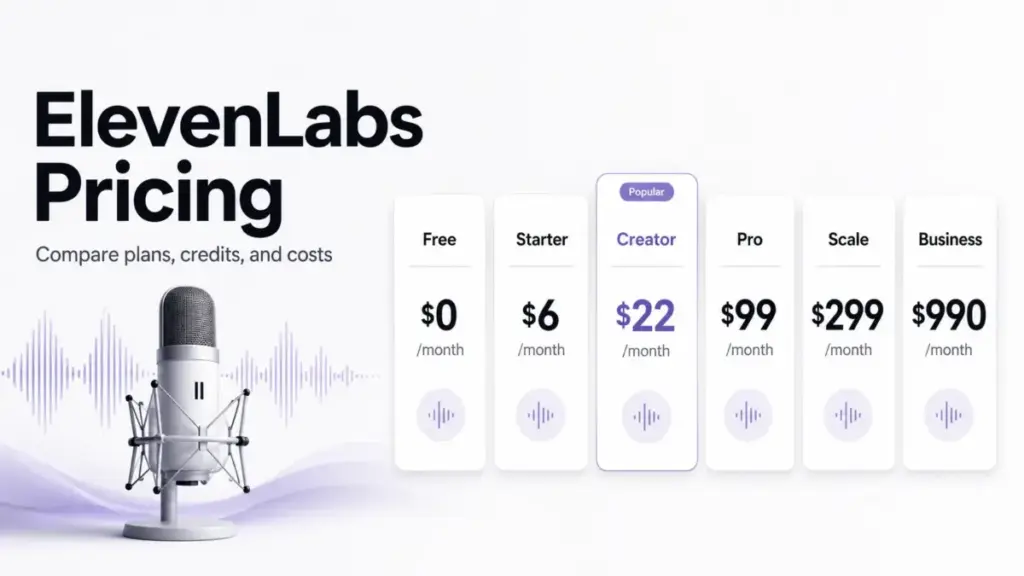
| Starting price | Free at $0/month; cheapest paid plan is Starter at $6/month |
| Free plan or trial | Free plan available (no credit card to start). No confirmed timed free trial of a paid plan |
| Best plan for most creators | Creator at $22/month (Professional Voice Cloning included) |
| Plan to avoid | Business at $990/month for small teams that need credits but not 10 seats |
| Biggest hidden cost | Commercial rights are gated, plus pay-as-you-go top-ups and separate API model rates |
| Best alternative if too expensive | Cartesia (unlimited workspace seats) or a usage-based API like OpenAI for high-volume developers |
The short version: ElevenLabs is genuinely cheap to start and gets expensive in two specific places, professional voice work and team seats. Everything below is about spotting those jumps before they hit your card.
The Advertised Price vs The Real Price
The cleanest way to misread ElevenLabs is to trust a blog table from six months ago. Several pages still ranking in 2026 list Starter at $5, Scale at $330, and Business at $1,320. The current official page shows different numbers, and the gaps are large enough to wreck a budget plan.
| Plan | Stale price still circulating | Current official price |
|---|---|---|
| Starter | $5/month | $6/month |
| Scale | $330/month | $299/month |
| Business | $1,320/month | $990/month |
Scale and Business are both cheaper now than the stale figures suggest, which is good news, but it also means any cost-at-scale math built on the old numbers is wrong by hundreds of dollars a month. The advertised entry price is honest. The risk is the layer underneath it: credits that vary by model, commercial rights that start one tier up, and seat counts that force a big jump for teams.
How ElevenLabs Credits and API Pricing Actually Work
Here is the thing most guides get wrong. ElevenLabs does not have one price for “usage.” It has several, and they live in different products.
ElevenLabs runs on generative AI voice models, and the model you pick is what moves the cost. In the app (ElevenCreative), your plan gives you a monthly pool of credits. The Free plan includes roughly 10 minutes of text-to-speech in the interface; the credit number does not translate cleanly to minutes because higher-quality and multilingual generations consume credits faster than basic ones.
Over the API (ElevenAPI), pricing is quoted in characters per model, not in app credits, which is why the in-app credit count and the API character allowance for the same plan do not match.
This matters because what an API is here is a separate billing surface with its own rates. A developer reading the plan card sees credits; the API calculator shows included characters. Both are real. They are just measuring different things.
| Usage type | How it is measured | Rate (where published) |
|---|---|---|
| In-app text-to-speech | Plan credits | Included in monthly plan pool |
| API TTS, Flash/Turbo | Characters | $0.05 per 1,000 characters |
| API TTS, Multilingual v2/v3 | Characters | $0.10 per 1,000 characters |
| Speech to Text (Scribe v1/v2) | Audio hours | $0.22 per hour |
| Speech to Text (Scribe v2 Realtime) | Audio hours | $0.39 per hour |
| Speech Engine extra calls | Call minutes | $0.080 per minute ($0.160 burst) |
| Music | Minutes | $0.150 per minute |
| Voice Isolator / Voice Changer / Sound Effects | Minutes | $0.120 per minute |
| Dubbing v1 | Minutes | $0.33 per minute (watermarked) or $0.50 per minute (no watermark) |
The usage math that trips people up: Multilingual v2/v3 over the API costs twice as much per character as Flash/Turbo. If your workflow defaults to the higher-quality multilingual model, you are spending at $0.10 per 1,000 characters instead of $0.05, and your monthly allowance evaporates at double speed.
That is not a bug. It is a model choice with a price tag, and it is the single biggest reason two users on the same plan get wildly different bills. Credits are also charged per generation request, not per download, so re-rendering the same line three times costs three times, even if you keep only one take.
Plan-by-Plan Breakdown and Feature Gates
This is the part that decides your plan, so read the gates, not the prices. Annual figures below use the official rule that an annual subscription includes two free months, which works out to roughly 10 monthly payments. The exact annual total should still be confirmed at checkout.
| Plan | Monthly | Annual (est.) | Credits / key limits | Best for |
|---|---|---|---|---|
| Free | $0 | $0 | 10k credits, ~10 UI minutes, 3 Studio projects, non-commercial with attribution | Testing the voices |
| Starter | $6 | ~$60 | 30k credits, ~30 UI minutes, 20 Studio projects, commercial license, Instant Voice Cloning | Solo commercial use, light dubbing |
| Creator | $22 ($11 first month) | ~$220 | 121k credits, Professional Voice Cloning | Serious creators who need a real voice clone |
| Pro | $99 | ~$990 | 600k credits, 192 kbps audio, 44.1 kHz PCM via API | Production audio and API output quality |
| Scale | $299 | ~$2,990 | 1.8M credits, 3 workspace seats, 3 Professional Voice Clones, team collaboration | Small teams of up to 3 |
| Business | $990 | ~$9,900 | 6M credits, 10 seats, 10 Professional Voice Clones, low-latency TTS as low as 5c/minute | Larger teams and high volume |
| Enterprise | Custom | Custom | Custom credits and seats, SSO, BAAs, custom SLAs/DPA, elevated concurrency | Compliance-bound organizations |
Starting price: Free at $0/month, with paid plans from $6/month. Official pricing page. Prices exclude taxes, levies, and duties.
Now the gate map, because the prices alone do not tell you what flips on at each step.
| Capability | Free | Starter | Creator | Pro | Scale | Business | Enterprise |
|---|---|---|---|---|---|---|---|
| Commercial license | No | Yes | Yes | Yes | Yes | Yes | Yes |
| Instant Voice Cloning | No | Yes | Yes | Yes | Yes | Yes | Yes |
| Professional Voice Cloning | No | No | Yes | Yes | Yes | Yes | Yes |
| 192 kbps audio | No | No | Not on public card | Yes | Yes | Yes | Yes |
| 44.1 kHz PCM via API | No | No | No | Yes | Yes | Yes | Yes |
| Workspace seats | No | No | No | No | 3 | 10 | Custom |
| Low-latency TTS (from 5c/min) | No | No | No | No | Not on public card | Yes | Yes |
| Custom SSO / HIPAA BAA / custom SLA | No | No | No | No | No | No | Yes |
Three gates carry the whole decision. Commercial rights start at Starter, so any monetized output rules out Free. Professional Voice Cloning starts at Creator, which is why Creator, not Starter, is the real plan for anyone building a branded or personal voice.
And workspace seats do not appear until Scale, which means the price for collaboration jumps from $99 (Pro, single user) to $299 (Scale, 3 seats) the moment a second teammate needs their own login.
Pro deserves a specific note because its pitch is quality, not seats. It adds 192 kbps audio and 44.1 kHz PCM output over the API. If you are producing audiobooks or broadcast-grade audio and pushing it through the API, that is the gate you are paying $99 to clear. If you are a solo creator posting to YouTube, you almost certainly do not need it, and Creator at $22 is the smarter buy.
The Hidden Costs Nobody Puts on the Plan Card
1. Commercial rights are a paywall, not a checkbox
Free-plan output is non-commercial and must carry attribution. The moment you put a voice into a client video, a paid course, an ad, or anything monetized, you need at least Starter at $6/month. It is a small jump, but it is a hard gate. Budgeting Free for commercial work is the most common mistake, and it is a licensing problem, not a feature limitation.
2. Pay-as-you-go top-ups
When included credits run out, ElevenLabs offers pay-as-you-go (PAYG) prepaid balance. It is available on self-serve tiers including Free, requires a payment method and funds, and has a minimum top-up of $5. Subscription credits are consumed before PAYG balance, so your top-up only kicks in after the monthly pool is empty. Auto top-up defaults to a $20 recharge triggered when the balance drops to $10.
3. PAYG does not unlock higher-plan features
This is the trap. Topping up adds usage, not capability. A Free-plan user who buys PAYG balance still sits under the Free tier’s voice-slot limits and feature gates. You cannot prepay your way into Professional Voice Cloning or workspace seats. If you need those, you upgrade the plan; PAYG only buys more generations at your current tier.
4. PAYG balance expires
Unused PAYG credits expire 12 months after purchase, and top-ups are non-refundable. Buy only what you expect to use within the year.
5. Taxes and model-rate surprises
Every self-serve price excludes taxes, levies, and duties, so your line-item total runs higher than the sticker. And because API usage bills per model, a workflow that leans on Multilingual v2/v3 at $0.10 per 1,000 characters costs double a Flash/Turbo workflow at $0.05. The plan card never shows you that split.
When the Free Plan Stops Working
The Free plan is a real product, not a crippled demo. You get 10,000 credits a month, around 10 minutes of in-app text-to-speech, three Studio projects, and access to text-to-speech, speech-to-text, sound effects, and music. For evaluating voice quality before you commit, it is enough.
It stops working at four predictable points. The first and most common is commercial use: the second your audio earns money or ships to a client, attribution-bound non-commercial output is a non-starter, and you move to Starter.
The second is voice cloning, since Free has limited custom voice slots for Voice Design but not the cloning that begins on paid tiers. The third is volume, because 10 minutes a month disappears fast on any regular publishing schedule. The fourth is production quality and API output, which is a Pro-level concern.
Most users who outgrow Free do not jump far. They land on Starter or Creator, and that is usually the correct move.
Real Cost Scenarios: 5, 10, 25, 50, and 100 Users
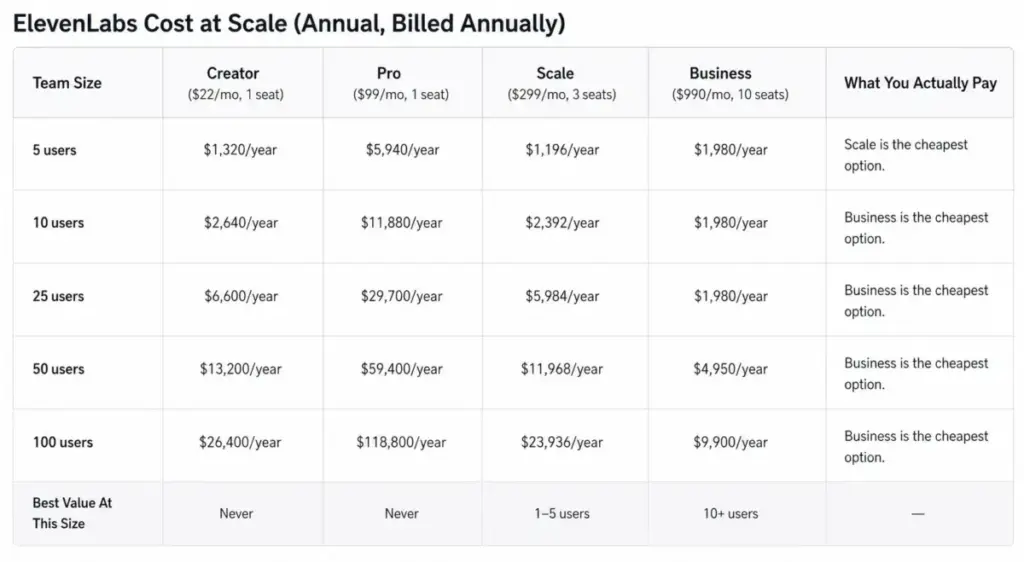
Seat math is where ElevenLabs gets blunt. Scale includes 3 workspace seats. Business includes 10. There is nothing in between on the public plans, so a five-person team that needs five real logins skips Scale entirely and lands on Business.
| Team size | Recommended plan | Monthly | Annual (est.) | Notes |
|---|---|---|---|---|
| 5 users | Business | $990 | ~$9,900 | Scale caps at 3 seats, so 5 collaborators push you to Business |
| 10 users | Business | $990 | ~$9,900 | Business includes 10 seats and 6M credits, the public-plan ceiling |
| 25 users | Enterprise | Custom | Custom | Past 10 seats you need Enterprise or multiple workspaces |
| 50 users | Enterprise | Custom | Custom | Enterprise covers more seats plus SSO, SLAs, and concurrency |
| 100 users | Enterprise | Custom | Custom | Cost depends on credits, seats, concurrency, support, and volume discount terms |
The honest read: if you only need more credits, not more people, do not buy Business for the seats you will not use. But if you genuinely have five teammates each needing their own access, $990/month is the entry price for collaboration, and there is no cheaper public path. This assumes you want real per-seat access rather than sharing one login, which most security-conscious teams should.
Monthly vs Annual Billing
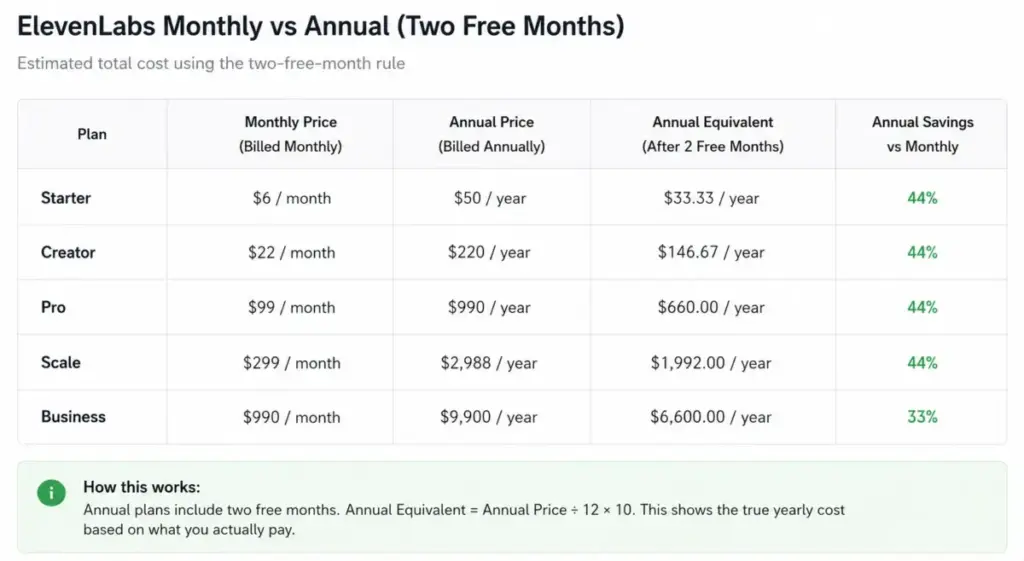
ElevenLabs annual subscriptions include two free months, which is effectively a 16.7% discount, since you pay for 10 months and use 12.
| Plan | 12 monthly payments | Annual (est., 10 months) | Estimated saving |
|---|---|---|---|
| Starter | $72 | ~$60 | ~$12 |
| Creator | $264 | ~$220 | ~$44 |
| Pro | $1,188 | ~$990 | ~$198 |
| Scale | $3,588 | ~$2,990 | ~$598 |
| Business | $11,880 | ~$9,900 | ~$1,980 |
For a 10-seat team on Business, the annual commitment saves close to $1,980 a year. The savings only matter if you are confident you will keep the plan for a full year, so commit annually once your usage is stable, not during your first month of testing. Confirm the exact annual total at checkout, since the displayed amount is the figure that governs your contract.
Which ElevenLabs Plan Should You Choose?
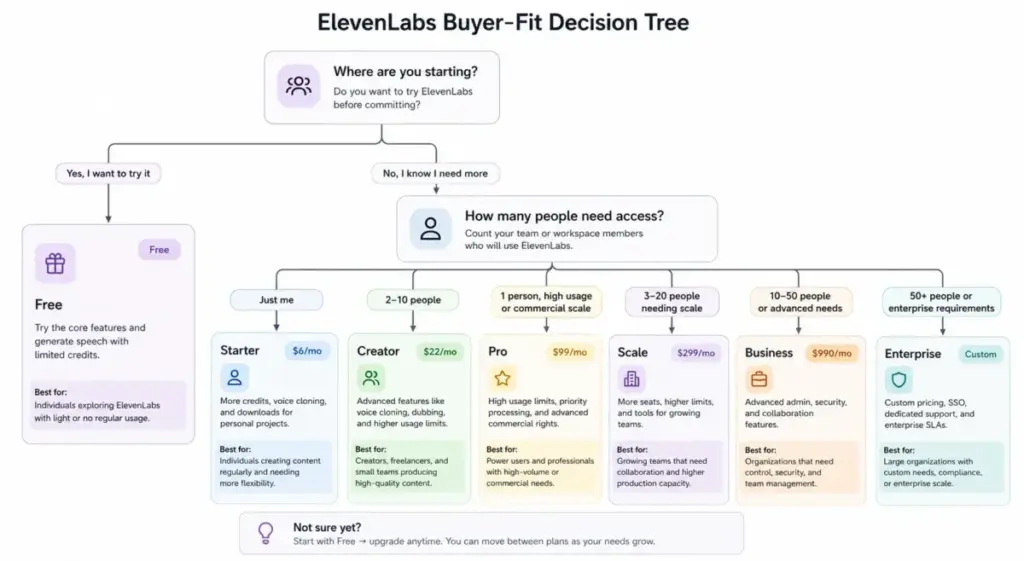
Run your needs through this decision order and stop at the first match.
Personal testing, no money involved: stay on Free. You get enough to judge the voices.
Any commercial output, solo: Starter at $6/month. It clears the commercial-rights gate and adds Instant Voice Cloning and Dubbing Studio. This covers most freelancers doing light voiceover.
You need a real, consistent branded or personal voice: Creator at $22/month. Professional Voice Cloning starts here, and the credit pool jumps to handle regular publishing. For most serious creators, this is the plan.
Production-grade audio through the API: Pro at $99/month for 192 kbps and 44.1 kHz PCM output. Audiobook narrators and broadcast workflows live here. Everyone else can skip it.
A team of up to 3 sharing a workspace: Scale at $299/month for 3 seats and team collaboration.
A team of 4 to 10, or high volume: Business at $990/month for 10 seats, 6M credits, and low-latency TTS.
Compliance, SSO, HIPAA BAA, or more than 10 seats: Enterprise. Do not try to force self-serve plans to cover regulated workloads.
Which Plan Should You Avoid?
Business is the plan small teams overbuy. At $990/month it makes sense for 4 to 10 real seats or genuinely high volume. It does not make sense for a two-person team that just wants more credits, because you would be paying for eight seats you will never assign. If credits are your only constraint, a lower plan plus PAYG top-ups is cheaper than jumping to Business for capacity alone.
The mirror-image mistake is forcing Pro at $99 onto an occasional video creator who fits comfortably inside Creator at $22. Pro’s value is API output quality, not raw credits. If you are not pushing broadcast-grade audio through the API, the extra $77 a month buys you headroom you do not use.
ElevenLabs Pricing vs Competitors
The mistake here is forcing every competitor into one per-user number. They bill differently, so a clean apples-to-apples seat comparison is misleading. Here is the honest context by billing model.
| Tool | Starting price | Billing model | Free plan | Seat note |
|---|---|---|---|---|
| ElevenLabs | $0 free; $6/month Starter | Hybrid: plan credits plus PAYG and API model rates | Yes | Seats begin at Scale (3) and Business (10) |
| Cartesia | $0 free; Pro shown at $5 list / $4 current | Usage credits and agent minutes | Yes | Unlimited workspace seats and voice slots on every plan |
| Resemble AI | $0 to start (Flex); TTS $0.0005/second | Pay-as-you-go plus seat and voice add-ons | Usage-based | Seats are a $20/user/month add-on; 10 seats ≈ $200/month plus usage |
| Speechify Studio | $0 free; Starter $19/month; Creator $49/month | Flat subscription with Studio credits | Yes | No public 10-seat team price disclosed |
| Murf AI | $0 free; Creator from $19/month; Business from $66/month | Subscription | Yes | Team-seat mechanics not fully visible publicly |
| OpenAI API | No subscription minimum | Usage-based tokens/minutes | No SaaS-style free plan | No seat cost |
Two of these change the calculus directly. Cartesia is the one to price-check if seat cost is your pain point, because unlimited workspace seats on every plan means a 10-person team is not staring at a $990 jump. For high-volume developers who only need straightforward text-to-speech, OpenAI’s usage-based audio pricing carries no seat overhead at all. GPT-Realtime-2 runs $32 per 1M input tokens and $64 per 1M output tokens, with realtime translate at $0.034/minute and realtime whisper at $0.017/minute. The failure mode you cannot accept decides the pick: if it is per-seat cost, look at Cartesia; if it is raw API spend, model OpenAI; if it is voice realism and cloning depth, ElevenLabs is still the reason most people are here. If you also weigh broader AI subscriptions, our ChatGPT pricing breakdown and Claude pricing guide cover the chat-model side of the same budget.
Is ElevenLabs Worth the Price?
For a solo creator who needs realistic voice and commercial rights, yes. Starter at $6 or Creator at $22 is affordable for the output quality, and the voice realism is the reason ElevenLabs leads its category.
Reddit sentiment in 2026 lines up with that read: users rate the quality highly but warn buyers to size the plan to their actual character counts rather than the headline price, and several note that Creator is solid value for limited explainer-video work, with scaling being the real cost question.
It is not worth it in two cases. High-volume developers with simple text-to-speech needs should price-check usage-based API alternatives before committing, because per-character and per-minute math can favor a leaner provider.
And any organization with strict compliance needs, HIPAA BAAs, custom SSO, or specific SLA and DPA terms should go straight to Enterprise rather than stretching a self-serve plan that was never built for regulated data.
The people who clearly should pay: monetized YouTubers, podcasters, course creators, audiobook narrators, agencies, and product teams embedding branded or cloned voices. The people who should not: casual users doing non-commercial testing, who belong on Free.
How to Avoid Overpaying for ElevenLabs
A few moves keep the bill honest.
Match the model to the job. Run Flash/Turbo at $0.05 per 1,000 characters when you do not need multilingual depth, instead of defaulting to Multilingual v2/v3 at $0.10. That alone can halve API spend.
Do not re-render carelessly. Credits bill per generation request, not per download, so every retake costs. Draft the script first, then generate.
Use PAYG for spikes, not as a plan. If you only occasionally exceed your credit pool, a $5 top-up is cheaper than upgrading a whole tier. But remember PAYG does not add features, only capacity.
Stop short of Business if you only need credits. Two or three people who need volume but not 10 seats are better served by a lower plan plus top-ups than by an eight-seat overbuy.
Buy annual only after usage stabilizes. The two-free-month discount is real, but locking in during a test month risks paying for a year you do not use.
Skip Pro unless you push audio through the API at broadcast quality. Creator covers most publishing workflows for a quarter of the price.
Check the startup grant. ElevenLabs runs a Startup Grants Program offering 12 months free and 33 million characters valid for 12 months. If you qualify, that is the cheapest way in by a wide margin.
FAQ
How much does ElevenLabs cost in 2026?
Plans run from Free at $0/month to Business at $990/month, with Enterprise priced custom. The paid tiers are Starter $6, Creator $22, Pro $99, Scale $299, and Business $990, all verified on the official pricing page on June 24, 2026, and all excluding taxes.
Is ElevenLabs free for commercial use?
No. Free-plan output is non-commercial and requires attribution. Commercial rights start at Starter ($6/month), which is the cheapest way to use ElevenLabs audio in monetized or client work.
Why did my credits run out so fast?
Credits are charged per generation request, not per download, and higher-quality or multilingual models consume them faster. A workflow on Multilingual v2/v3 burns roughly twice the characters per generation as Flash/Turbo, so the same plan lasts half as long.
Does ElevenLabs charge per character or per minute?
Both, depending on the surface. In-app text-to-speech uses plan credits, the TTS API bills per 1,000 characters, and services like Music, Dubbing, and Speech Engine bill per minute. There is no single universal unit.
What is ElevenLabs PAYG and does it unlock features?
Pay-as-you-go is prepaid usage balance with a $5 minimum top-up, available on self-serve tiers including Free. Subscription credits are spent before PAYG. It buys more generations, not more capability, so it does not unlock Professional Voice Cloning, workspace seats, or higher-tier features.
What happens to my PAYG balance if I don't use it?
Unused PAYG credits expire 12 months after purchase, and top-ups are non-refundable. Buy only what you expect to use within a year.
Does ElevenLabs have a free trial?
There is a Free plan you can start without a credit card, but no confirmed timed free trial of a paid plan. By contrast, some competitors like LOVO offer a 14-day Pro trial that drops to a free plan afterward, with no card required to begin.
Which plan includes voice cloning?
Instant Voice Cloning starts at Starter ($6). Professional Voice Cloning, the higher-fidelity option, starts at Creator ($22) and is the main reason to choose Creator over Starter.
Is Business required for a 5-person team?
Effectively yes, if each person needs their own seat. Scale includes only 3 workspace seats, so a five-person team moves up to Business at $990/month, which includes 10 seats.
Does ElevenLabs offer an annual discount?
Yes. Annual subscriptions include two free months, roughly a 16.7% saving versus 12 monthly payments. For a 10-seat Business team that is about $1,980 a year. Confirm the exact annual total at checkout.
The Bottom Line
ElevenLabs prices itself like a cheap creator tool and behaves like one until you hit a gate. Commercial rights at Starter, Professional Voice Cloning at Creator, and workspace seats at Scale and Business are the three places the cost actually moves. Get those right and the entry prices are fair for the quality.
The buyers who overpay are the ones who treat credits as minutes, default to the expensive model without noticing, or buy Business for seats they never assign. Size the plan to your character counts and your headcount, not to the headline, and ElevenLabs stays affordable for exactly the work it is best at. For broader budget planning across tools, our SaaS pricing guides apply the same model-by-model math to the rest of your stack.