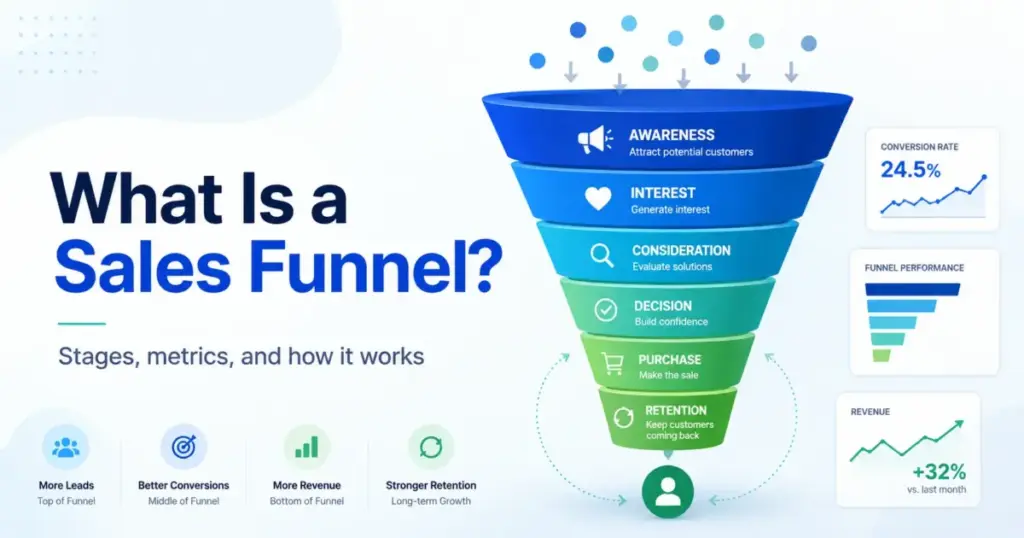
A sales funnel is not a magic sequence that turns strangers into customers. It is a measurement model that shows where buyers gain or lose confidence as they move from first awareness to a signed deal. IBM defines it as a visual roadmap of the customer journey from awareness to purchase. That definition holds, but it misses the operational layer that makes funnels useful in 2026: data instrumentation, stage exit criteria, and handoff rules.
I have spent eight years helping CRM software teams map their buying journeys, and the pattern I see most often is this: companies draw a funnel diagram, label the stages, then never connect those stages to actual CRM records or buyer questions.
The diagram looks clean. The data stays messy. This guide explains how a sales funnel works, how it differs from a sales pipeline, which stages and metrics matter, how to build one that reflects real buyer behavior, and which SaaS tools support each part. My analysis draws on official product documentation, published research from Gartner and McKinsey, and pricing data verified in May 2026.
Quick Answer: A sales funnel is a visual model that maps how prospects move from awareness through evaluation to purchase. It divides the buying journey into observable stages, each with goals, buyer questions, conversion events, and metrics. Unlike a sales pipeline (which tracks rep actions and deal stages), a funnel is buyer-centric. In SaaS, funnels extend beyond purchase into onboarding, retention, and expansion.
The 60-Second Explanation of a Sales Funnel
For beginners
A sales funnel describes the path a potential customer takes before buying. Picture a wide opening at the top where many people first hear about your product. As they learn more, some lose interest and leave. The group narrows at each step until a smaller number actually purchases. The “funnel” shape represents this natural reduction.
For practitioners
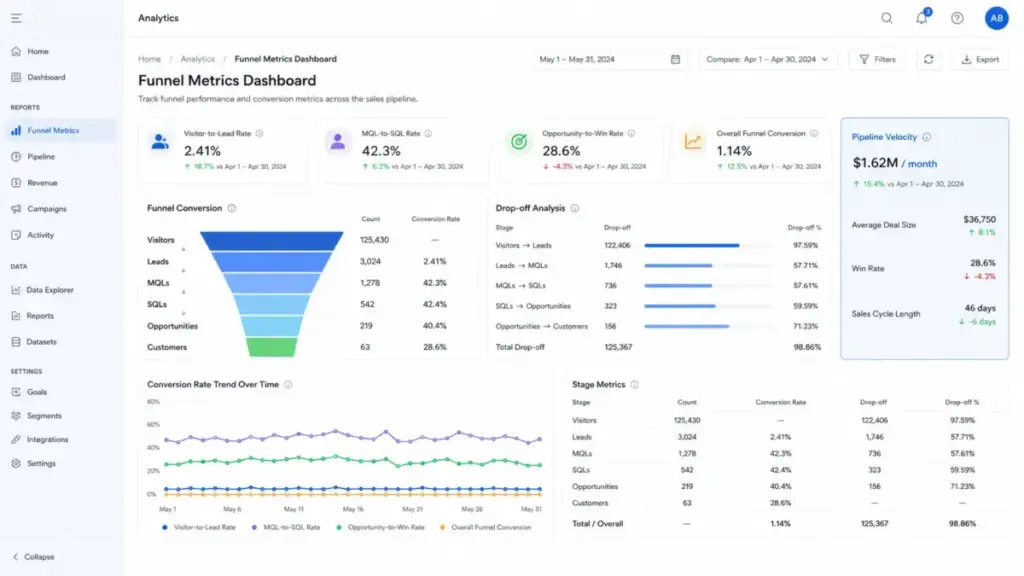
A sales funnel divides the buying journey into measurable stages: awareness, interest, consideration, decision, and purchase. Each stage has an entry trigger (a form fill, a demo request), an exit trigger (a qualification call, a contract signed), and a conversion rate. Teams track visitor-to-lead, lead-to-MQL, MQL-to-SQL, SQL-to-opportunity, and opportunity-to-win rates. The funnel connects CRM records, marketing automation, product analytics, and reporting dashboards.
For business leaders
A sales funnel is a revenue visibility tool. It shows where prospects enter, where they stall, and where they exit. A Gartner survey (March 2026) found 67 percent of B2B buyers prefer a rep-free buying experience. McKinsey reports that B2B customers now use an average of ten interaction channels (McKinsey). That makes funnel visibility and self-service content more important than a static diagram on a whiteboard.
How a Sales Funnel Actually Works
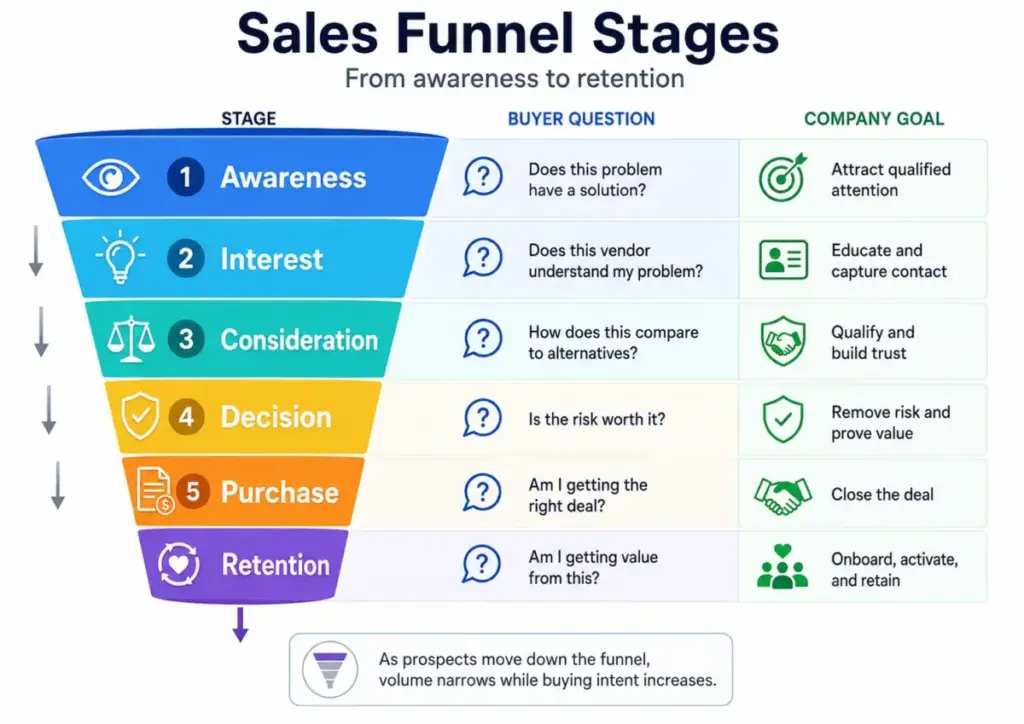
A sales funnel works by assigning goals, buyer questions, content, tools, and metrics to each stage of the buying journey. The point is not to force every prospect through the same path. It is to see where people drop off and improve the next best action.
Here is how each stage operates in a typical SaaS sales funnel:
| Stage | Buyer Question | Company Goal | Common Asset | CRM Signal | KPI |
|---|---|---|---|---|---|
| Awareness | “Does this problem have a solution?” | Attract qualified attention | Blog posts, ads, social content | Website visit, ad click | Visitor-to-lead rate |
| Interest | “Does this vendor understand my problem?” | Educate and capture contact | Guides, webinars, gated content | Form fill, email subscribe | Lead capture rate |
| Consideration | “How does this compare to alternatives?” | Qualify and build trust | Comparison pages, case studies | Demo request, pricing page visit | MQL-to-SQL rate |
| Decision | “Is the risk worth it?” | Remove risk, prove value | Free trial, ROI calculator, security docs | Proposal sent, trial activated | SQL-to-opportunity rate |
| Purchase | “Am I getting the right deal?” | Close the deal | Contract, onboarding plan | Contract signed, payment received | Win rate, deal size |
| Retention | “Am I getting value from this?” | Onboard, activate, retain | Onboarding guides, health checks | Product usage, support tickets | Churn rate, NPS |
| Expansion | “Do I need more from this vendor?” | Upsell, cross-sell, referral | Expansion offers, new features | Upgrade request, referral | Expansion revenue, CAC payback |
Where things go wrong: Most funnel breakdowns happen at three points. First, the marketing-to-sales handoff, where MQL definitions are vague and leads sit untouched. Second, the demo-to-proposal gap. Third, the post-purchase gap where new customers receive no proactive engagement until renewal.
“B2B buyers are progressing through critical buying tasks in more autonomous ways, and sellers cannot rely on static collateral to carry influence in those moments.” — Alyssa Cruz, Senior Principal Analyst, Gartner Sales Practice
Sales Funnel vs Sales Pipeline vs Marketing Funnel vs Customer Journey
This is the confusion I encounter most often when working with sales teams. These four terms are related but not interchangeable.
| Concept | Perspective | Owner | Unit of Analysis | Common Metrics | Best Use Case |
|---|---|---|---|---|---|
| Sales funnel | Buyer-centric | Marketing + Sales | Buyer stage | Conversion rate, drop-off, funnel velocity | Understanding where buyers gain or lose confidence |
| Sales pipeline | Seller-centric | Sales team | Deal/opportunity | Win rate, deal size,sales forecast accuracy | Tracking rep activities and deal progression |
| Marketing funnel | Demand generation | Marketing team | Lead/campaign | Cost per lead, MQL rate, attribution | Measuring campaign effectiveness and lead quality |
| Customer journey | Full lifecycle | Cross-functional | Customer relationship | NPS, retention, expansion, lifetime value | Mapping every touchpoint from first touch to advocacy |
| Flywheel | Momentum-based | Entire company | Customer experience | Referral rate, word-of-mouth, organic growth | Emphasizing retention and advocacy over acquisition |
The practical difference: a sales funnel asks “where are buyers dropping off?” A sales pipeline asks “which deals are reps working on?” A marketing funnel asks “which campaigns generate qualified leads?” Salesforce distinguishes the funnel as buyer-centric and the pipeline as rep-centric (Salesforce). HBR argues that AIDA-style funnels assume buyers move sequentially, which reflects an inside-out process rather than actual buyer behavior (HBR).
Start with a funnel and a pipeline. Add the journey view when retention and expansion become revenue priorities.
Step-by-Step: How to Build a Sales Funnel
Step 1: Define the buying motion
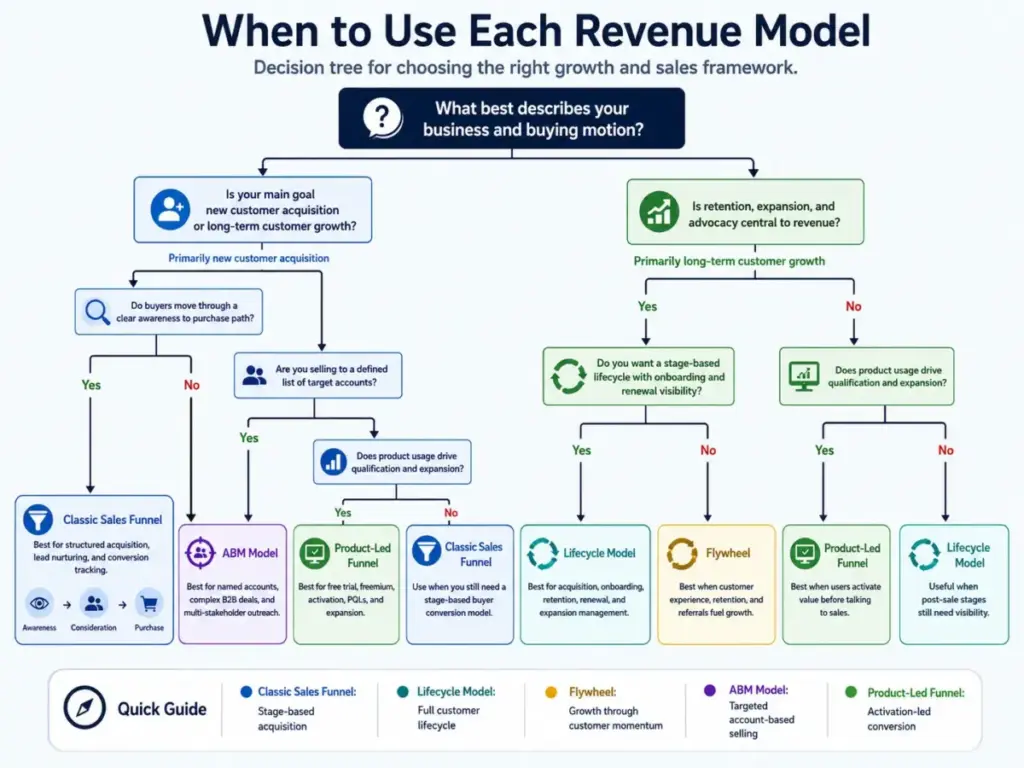
Decide whether your sales process is self-service, sales-led, partner-led, product-led, or hybrid. A product-led SaaS company with a free trial has a fundamentally different funnel than an enterprise sales team running six-month procurement cycles. The buying motion determines your stage definitions, content needs, and tool requirements.
Step 2: Map real buyer questions by stage
Do not start with internal sales tasks. Start with what buyers ask at each point: “Does this problem have a solution?” at the top, “How does this compare?” in the middle, “Is the risk worth it?” at the bottom. If your funnel stages do not connect to real buyer questions, you are building a reporting structure, not a buying experience.
Step 3: Define stages with clear entry and exit criteria
This is where most funnels fail. A lead becomes an MQL only when it meets specific criteria (job title, company size, engagement score), not when a marketer says so. An SQL becomes an opportunity only after fit and intent are confirmed on a discovery call, not when a rep drags a card across a CRM board.
| Stage | Entry Trigger | Exit Trigger | Owner | Next Action |
|---|---|---|---|---|
| Visitor | Site visit, ad click | Form fill or chat | Marketing | Nurture or qualify |
| Lead | Form fill, content download | Meets MQL scoring threshold | Marketing | Route to SDR |
| MQL | Score threshold met | Discovery call completed | SDR | Pass to AE or recycle |
| SQL | Fit + intent confirmed | Proposal requested | Account Executive | Send proposal |
| Opportunity | Proposal sent | Contract signed or lost | Account Executive | Negotiate or close |
| Customer | Contract signed | First value event achieved | Customer Success | Onboard and activate |
Step 4: Choose conversion events and connect data sources
Map specific conversion events: form fill, demo request, trial activation, pricing page visit, discovery call, proposal viewed, contract signed. Then connect CRM records, marketing automation, website analytics, and product analytics so you can track a prospect from first touch to retained customer without manual gaps.
Step 5: Create stage-specific content
For TOFU (top of funnel), use educational articles and social posts. For MOFU (middle of funnel), use comparison pages and case studies. For BOFU (bottom of funnel), use demos, ROI calculators, and security documentation. For post-purchase, use onboarding guides and expansion offers.
Step 7: Set handoff rules
Define who owns each stage transition. Marketing routes MQLs to SDRs within what timeframe? SDRs pass SQLs to AEs with what information? AEs hand new customers to Customer Success with what onboarding brief? Without handoff rules, leads stall at the transition points.
Step 8: Measure and improve the weakest stage
Track stage conversion, drop-off, sales cycle length, win rate, CAC payback, expansion, and retention. Then improve the stage with the weakest impact on revenue. If your visitor-to-lead rate is strong but your SQL-to-opportunity rate is low, the problem is qualification, not traffic.
The Mistakes That Waste Your First Month
Mistake 1: Using generic stages that do not match your real sales process. A five-person startup selling a $29/month tool does not need the same funnel stages as an enterprise vendor with a 180-day procurement cycle. Customize stages to your actual buying motion.
Mistake 2: Confusing funnel analytics with pipeline task management. The funnel tells you where buyers drop off. The pipeline tells you what reps are doing. Treating them as the same model creates muddy data and conflicting reports.
Mistake 3: Overvaluing lead volume at the top. Volume matters only if leads fit the target customer profile and progress toward qualified opportunities. A funnel packed with 10,000 unqualified leads is more expensive to operate than a funnel with 500 qualified ones.
Mistake 4: Ignoring post-purchase retention. For SaaS, onboarding, activation, retention, expansion, and referrals often determine long-term revenue. A funnel that ends at purchase misses the stages where most SaaS revenue compounds.
Mistake 5: Measuring only last-click attribution. Funnel analytics mislead teams when attribution rules are poorly defined. If your CRM only credits the last touchpoint before a demo, you undervalue every educational touchpoint that built trust earlier.
Mistake 6: Automating nurture before messaging is validated. Automation scales the process you already have. If targeting, messaging, qualification, or handoffs are weak, automation scales the problem.
When a funnel dashboard lies: Duplicate contacts, missing lifecycle definitions, rep-updated stages without objective criteria, and attribution gaps all create misleading reports. Before trusting your funnel metrics, audit CRM data hygiene: deduplicate contacts, enforce lifecycle definitions, and require objective exit criteria.
Common Misconceptions About Sales Funnels
Misconception: A sales funnel and sales pipeline are the same thing.
Reality: A funnel is buyer-centric and maps the journey. A pipeline is seller-centric and tracks rep actions and deal stages. They complement each other, but they answer different questions.
Misconception: Every sales funnel should use awareness-interest-decision-action stages.
Reality: Stages need to match the actual buying process, sales motion, product complexity, and customer segment. A product-led SaaS funnel has stages like trial activation, product-qualified lead, and expansion that AIDA does not cover.
Misconception: The goal is to push as many leads as possible into the top of the funnel.
Reality: Volume without qualification creates operational drag. A 10-person sales team processing 5,000 unqualified leads per month spends more time disqualifying than selling.
Misconception: A funnel ends at purchase.
Reality: For SaaS, onboarding, activation, retention, expansion, and referrals often determine whether the customer generates positive lifetime value. Gartner notes that B2B buyers are 1.8 times more likely to complete a high-quality deal when supplier-provided digital tools combine with a sales rep, rather than being used independently (Gartner B2B Buying Journey). That hybrid approach extends well beyond the initial close.
Misconception: Automation fixes a broken funnel.
Reality: If your targeting, messaging, or handoff rules are weak, automation amplifies the problem. Fix the process first. Automate second.
When to Use a Sales Funnel and When to Avoid One
Use a sales funnel when:
- Your business needs a repeatable way to attract, qualify, nurture, and convert prospects
- Marketing and sales teams need shared definitions for MQL, SQL, and opportunity
- Leadership needs visibility into conversion rates and revenue predictability
- Multiple channels (website, email, social, events, product trials) influence the buying journey
- You need to identify which stage has the highest drop-off and fix it
Avoid relying on a simple funnel diagram alone when:
- The purchase is highly relationship-led with named accounts (add an ABM layer)
- Customers buy through long procurement cycles with multiple decision-makers (add a buying committee view)
- Product-led usage is the main conversion signal (add a product-qualified lead stage)
- Customer retention and expansion matter more than new-lead acquisition (add a lifecycle or flywheel view)
- Your sales cycle is under 24 hours and transactional (a full funnel adds overhead without insight)
The right model depends on your revenue structure. For most SaaS teams, a funnel plus lifecycle view covers both acquisition and retention.
How to Measure Sales Funnel Success
| Metric | What It Measures | Why It Matters |
|---|---|---|
| Visitor-to-lead rate | Percentage of site visitors who become identified leads | Measures top-of-funnel content and capture effectiveness |
| Lead-to-MQL rate | Percentage of leads that meet qualification criteria | Measures targeting and lead quality |
| MQL-to-SQL rate | Percentage of MQLs accepted by sales | Measures marketing-sales alignment |
| SQL-to-opportunity rate | Percentage of qualified leads that become active deals | Measures discovery and qualification rigor |
| Opportunity-to-win rate | Percentage of opportunities that close | Measures sales execution and competitive positioning |
| Average deal size | Revenue per closed deal | Measures pricing strategy and deal packaging |
| Sales cycle length | Days from first touch to closed deal | Measures funnel efficiency and buyer experience |
| Pipeline velocity | Revenue potential moving through the funnel per day | Combines deal count, deal size, win rate, and cycle length |
| CAC (customer acquisition cost) | Total sales and marketing spend per new customer | Measures funnel cost efficiency |
| Churn rate | Percentage of customers who cancel in a given period | Measures post-purchase funnel effectiveness |
| Expansion revenue | Additional revenue from existing customers (upsell, cross-sell) | Measures lifecycle funnel value |
What Good Funnel Execution Looks Like
Before: A 15-person sales team tracks leads in a spreadsheet. Marketing sends all form fills to sales without scoring. Reps call every lead in the order received. Win rates fluctuate month to month, and the CEO gets a guess instead of a forecast.
After: The same team uses a CRM with defined stages, automated lead routing, and scoring. SDRs receive only MQL-qualified leads. The dashboard shows conversion rates by stage, and the CEO can forecast revenue within 10 percent accuracy. Lost-deal reasons are tracked, and the team improves the weakest stage each quarter.
The difference is not the funnel diagram. It is the data, the definitions, and the discipline.
SaaS Tools That Support Sales Funnels
Different tools support different parts of the funnel. Here is how five SaaS platforms implement funnel functionality:
| Tool | Category | Funnel Role | Key Feature | Pricing Status (as of May 2026) | Caveat |
|---|---|---|---|---|---|
| HubSpot Sales Hub | CRM | Deal tracking, lead management, pipeline reporting, forecasting | Customizable deal stages with sales analytics | Free at $0/month; Starter from $10/seat/month; Professional from $100/seat/month; Enterprise from $150/seat/month | Displayed Starter pricing is a limited-time discount for new customers; verify current packaging on HubSpot’s pricing page |
| Salesforce Sales Cloud | CRM | Lead progression, opportunity scoring, pipeline management, forecasting | Built-in AI, deal tracking, business analysis | Starter Suite at $25/user/month; Pro Suite at $100/user/month; Enterprise at $175/user/month | Pricing varies by edition, region, and add-ons; verify terms with Salesforce |
| Pipedrive | CRM | Visual pipeline, activity tracking, stage conversion analysis | Drag-and-drop pipeline with conversion rate tracking | Tiered CRM pricing varies by features, users, and support level | Exact plan prices require checking the official pricing page |
| Zoho CRM | CRM | Funnel charts, lead and deal management, workflows, reports | Funnel chart visualization showing drop-off through stages | Free Edition for 3 users with leads, deals, workflows, and reports | Paid tier pricing requires verification on Zoho’s pricing page |
| ClickFunnels | Funnel builder | Landing pages, lead funnels, sales funnels, upsells, email follow-ups | Step-by-step funnel builder with templates and A/B testing | Launch at $97/month ($81/month billed annually); Scale at $197/month ($164/month billed annually) | Plan limits on contacts, email sends, workspaces, and domains vary by tier; verify on ClickFunnels pricing |
The distinction that matters: CRM platforms (HubSpot, Salesforce, Pipedrive, Zoho CRM) manage the data, stages, and analytics behind the funnel. Funnel builders (ClickFunnels) build the landing pages and checkout flows. Marketing automation platforms handle the nurture sequences between stages. These are complementary roles, not substitutes.
For teams evaluating CRM options, I have written detailed breakdowns of HubSpot CRM review, our Salesforce CRM review, and the Pipedrive review that cover pricing, feature gates, and limitations in depth.
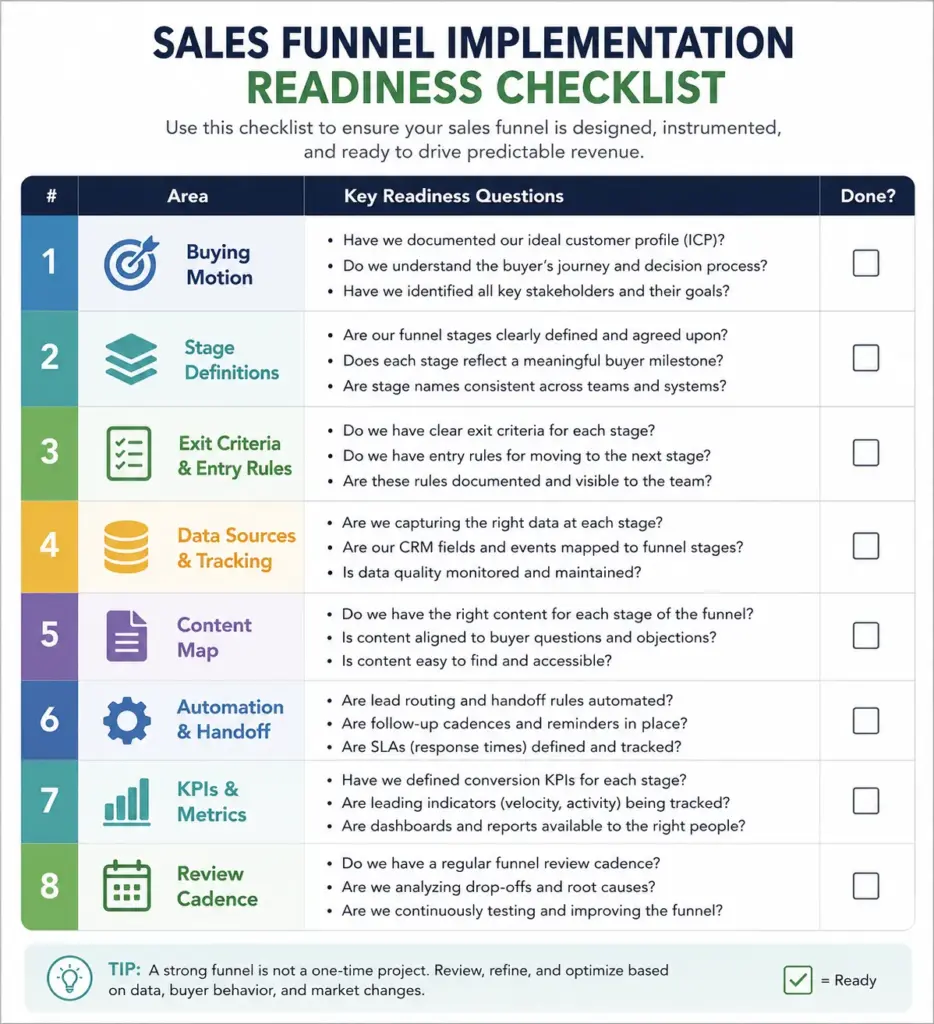
Sales Funnel Readiness Checklist
Use this checklist to assess whether your team is ready to build or improve a sales funnel:
- [ ] I have defined the buying motion (self-service, sales-led, product-led, or hybrid)
- [ ] I have mapped buyer questions for each stage of the journey
- [ ] I have written entry and exit criteria for each funnel stage
- [ ] I have identified the conversion event that triggers each stage transition
- [ ] I have connected my CRM to marketing automation and website analytics
- [ ] I have created content for top, middle, and bottom of funnel
- [ ] I have defined handoff rules between marketing, sales, and customer success
- [ ] I have set up a dashboard that tracks conversion rate by stage
- [ ] I have documented the process for recording lost-deal reasons
- [ ] I have scheduled a quarterly funnel review to improve the weakest stage
- [ ] I have verified that my CRM data is clean (no duplicates, lifecycle stages defined)
FAQ
What is a sales funnel in simple terms?
A sales funnel is a model that shows how people move from first hearing about a product to buying it. Many people enter at the top (awareness), but only a fraction reach the bottom (purchase). Each stage represents a step where buyers either continue or drop out.
What is the difference between a sales funnel and a sales pipeline?
A sales funnel is buyer-centric. It maps the journey from the customer’s perspective: what they need to know and feel at each stage. A sales pipeline is seller-centric. It tracks what sales reps do: calls made, proposals sent, deals won. A funnel answers “where are buyers dropping off?” A pipeline answers “what are reps working on?”
What are the stages of a sales funnel?
Common stages include awareness, interest, consideration, decision, and purchase. SaaS funnels often extend to onboarding, retention, and expansion. The specific stages depend on the buying motion: a product-led funnel adds trial activation and product-qualified lead stages that a traditional AIDA funnel does not include.
Do sales funnels still work in 2026?
Yes, but they need updating. With 67 percent of B2B buyers preferring rep-free experiences and buyers using ten-plus channels, funnels need to account for self-service, digital-first buying, and nonlinear paths.
How do I know if my sales funnel is leaking?
Track conversion rates between each stage. If your visitor-to-lead rate is 5 percent but your MQL-to-SQL rate drops to 2 percent, the leak is at marketing-sales handoff. Common causes: unclear MQL definitions, slow response times, misaligned messaging.
Should retention be part of the sales funnel?
For SaaS businesses, yes. Onboarding, activation, retention, and expansion often generate more lifetime revenue than the initial sale. A funnel that ends at purchase misses the most important revenue stages.
Do I need a CRM to build a sales funnel?
Not at the start. A team with under 50 leads per month can use a spreadsheet and clear stage definitions. Once lead volume or deal complexity grows, a CRM becomes necessary to track stages, automate handoffs, and report on conversion metrics.
What is TOFU, MOFU, and BOFU?
TOFU is top of funnel: the awareness stage where prospects discover your brand. MOFU is middle of funnel: the consideration stage where prospects evaluate options. BOFU is bottom of funnel: the decision stage where prospects are ready to buy. These terms are used in content planning to match the right content type to the right stage.
Which funnel model is best for a SaaS startup?
A product-led funnel works best for SaaS startups with a free trial or freemium model. It adds stages like trial activation, product-qualified lead (PQL), and expansion that traditional AIDA funnels do not cover. For sales-led SaaS, a standard funnel with CRM-connected stages is the starting point.
How many stages should a sales funnel have?
There is no fixed number. A simple B2C funnel may have 3-4 stages. A complex B2B SaaS funnel may have 7-10 stages. The right number depends on sales cycle length, product complexity, and decision-makers involved. Start with fewer stages and add detail as your data shows where clarity is needed.