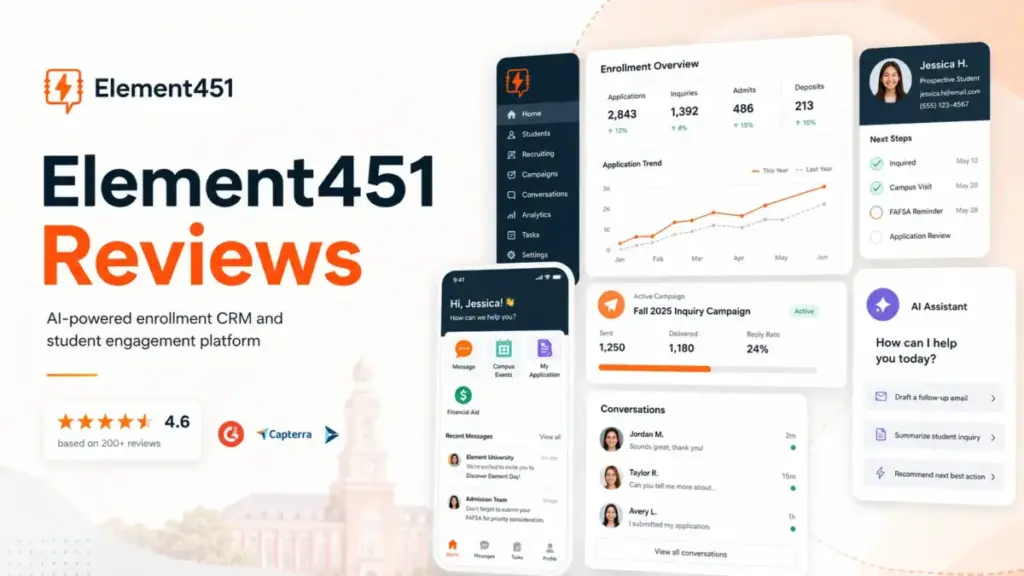
Most Element451 Review content online treats this platform like a standard per-seat CRM. It is not. Element451 is a higher-ed student lifecycle platform with quote-based annual pricing, AI agent teams organized around enrollment workflows, and a modular structure where fit depends on which modules your institution actually needs. If you are comparing it on a per-user monthly cost, you are starting with the wrong framework.
I evaluated Element451 by reviewing its official pricing calculator, product pages, module structure, security documentation, third-party review data, and higher-ed CRM competitor pages. I did not invent private pricing or claim lab access to internal institution data.
My review methodology follows SaaSZap’s editorial standards. Before reading further, understand that Element451 is CRM software built for higher education, not for general business sales teams. If you need a CRM for higher education, this review will help you decide whether Element451 fits your institution or whether a competitor is the better pick.
TL;DR by Institution Type
Element451 fits some institutions well and others poorly. The table below maps the buying decision by institution type before you read the full breakdown.
| Institution Type | Best Fit Verdict | Main Reason | Pricing Risk | Better Alternative If Not a Fit |
|---|---|---|---|---|
| Community colleges | Good fit | Special pricing available, multi-channel engagement | Lower, with community college pricing tier | Ellucian CRM Recruit for Banner-centered campuses |
| Regional universities | Strong fit | Full module coverage across admissions, marketing, engagement, success | Moderate, depends on module mix | Slate if deep application review is priority |
| Graduate schools and continuing education | Moderate fit | Marketing and engagement modules are strong | Moderate | HubSpot CRM for marketing-first teams |
| Large universities with complex admissions | Conditional fit | AI agents are useful, but complex committee review may need more depth | Higher, enterprise support tier likely needed | Slate for medical school or committee-based review |
| Salesforce-centered campuses | Weak fit | Native Salesforce integration exists, but duplication risk is high | High, paying for two platforms | Salesforce Education Cloud as primary CRM |
| Teams without internal CRM ownership | Poor fit | AI agents and integrations require institutional data ownership | High, implementation stalls without an owner | TargetX or managed service CRM |
Platform Architecture: What Element451 Actually Is
Element451 is not a classic sales CRM. It is a student engagement and lifecycle platform designed specifically for higher education institutions. Understanding its architecture matters more than scanning a feature list, because the buying decision depends on which modules and agents your campus actually needs.
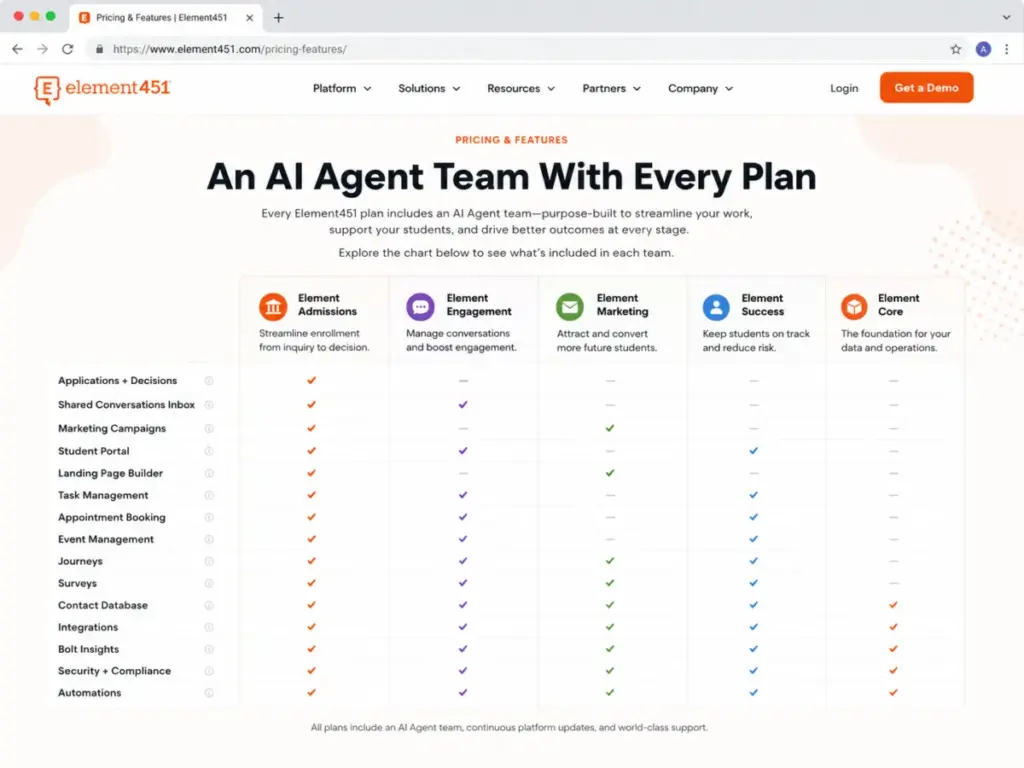
The foundation is Element Core, which ships with every package. Element Core includes the CRM + CDP (CRM database and customer data platform combined), the shared conversations inbox, task management, forms, automations, integrations, the Bolt Knowledge Hub, admin and security tools, Bolt Insights for analytics, and an optional Snowflake Data Share add-on. Think of Element Core as the operating system: every other module runs on top of it.
On top of Element Core, institutions select from four modules:
- Element Admissions: Applications, decisions, application reading and scoring, transcript evaluation, fraud detection, financial aid advising, admissions events, and international applicant support.
- Element Engagement: Lead capture, 24/7 inbound communication via AI agents, website engagement, and a unified inbox for email, text, phone, and WhatsApp where supported.
- Element Marketing: Student search, RFI follow-up, campaign creation, lead generation, personalized outreach, email and SMS campaigns, and landing pages.
- Element Success: At-risk student detection, advising appointments, orientation events, student belonging, campus events, student-athlete engagement, and career support.
Each module comes with its own set of Bolt AI Agents. These are not generic chatbots. Bolt Agents include the Application Reader Agent, Transcript Evaluation Agent, Financial Aid Advisor Agent, Campaign Creator Agent, Copywriter Agent, Lead Gen Agent, Landing Page Builder Agent, and over a dozen others, each tied to a specific higher-ed workflow. The platform positions itself as no-code, meaning everyday users can configure agents and workflows without developer help, but institutions still need someone who owns the contact management data, integration mappings, and knowledgebase content.
What This Actually Costs in 2026
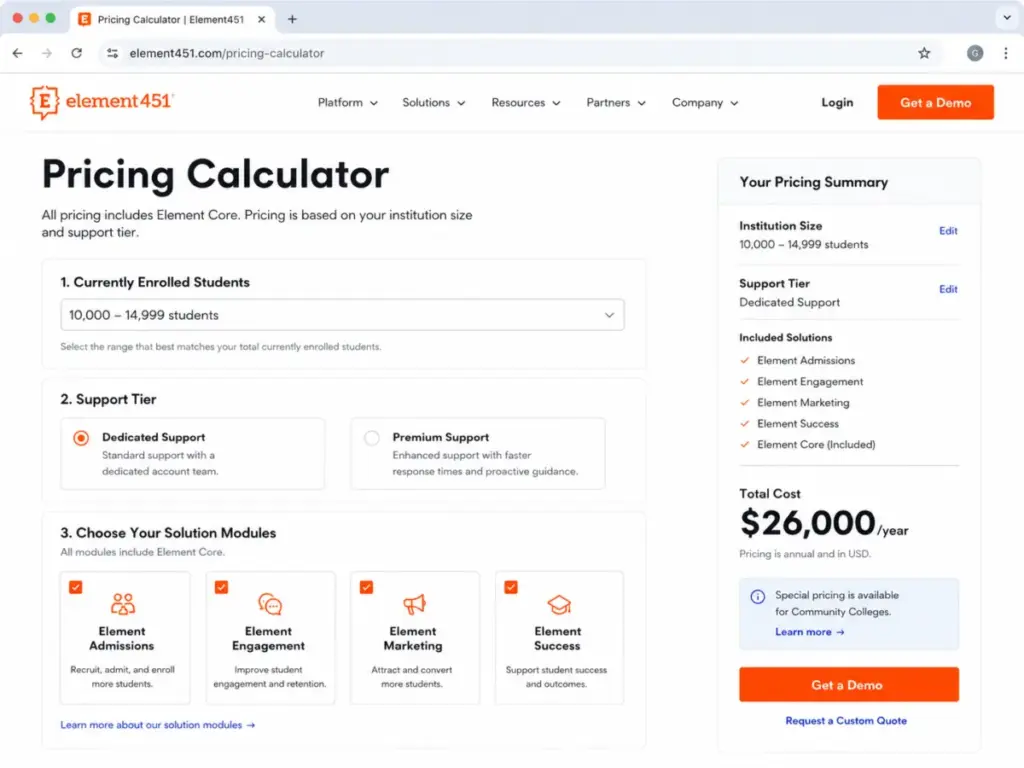
Element451 pricing is annual, quote-based, and tied to institution size and support tier. There is no published per-seat monthly rate.
The official Element451 pricing page does not publish a universal price. It says pricing is annual, based on institution size and support tier, with special pricing available for community colleges. The calculator on the pricing page showed a total cost of $26,000/year during my May 13, 2026 research. That number is a starting reference for the visible calculator state, not a guaranteed quote for every institution.
Third-party pricing references paint a slightly different picture:
| Source | Starting Price Listed | Pricing Model | Date Verified |
|---|---|---|---|
| Element451 official pricing calculator | $26,000/year (visible calculator state) | Annual, quote-based, by institution size and support tier | May 13, 2026 |
| GetApp | $20,000/year flat rate | Annual | May 13, 2026 |
| Capterra | $20,000/year flat rate | Annual | May 13, 2026 |
| ITQlick | $32,000/year (starts at) | Annual | May 13, 2026 |
The gap between $20,000 and $32,000 across sources tells you something important: official pricing varies by module selection, institution size, and support tier. The $20,000 figure on Capterra and GetApp likely reflects a baseline listing, not a configured quote. The $32,000 ITQlick reference may reflect a different module combination or support level.
Here is what the math looks like across four buying scenarios:
| Scenario | Likely Modules | Support Tier | Estimated Annual Cost |
|---|---|---|---|
| Small college evaluating Engagement only | Element Core + Engagement | Dedicated Support | Requires quote, likely near $20,000-$26,000 range based on third-party references |
| Community college using Engagement + Marketing | Element Core + Engagement + Marketing | Dedicated Support, community college pricing | Requires quote, community college pricing may reduce cost |
| University using Admissions + Engagement + Success | Element Core + Admissions + Engagement + Success | Dedicated Support | Requires quote, likely above $26,000 |
| Enterprise institution needing premium support, SSO, integrations, governance | Full module suite | Premium Support | Requires quote, likely well above $32,000 |
Two support tiers are visible on the pricing page: Dedicated Support and Premium Support. Premium Support almost certainly adds to the annual cost, though the exact premium is not published. Institutions evaluating Element451 should request quotes for both tiers during the demo process.
The hidden math here is not about per-seat cost. It is about module stacking. Each additional module adds cost, and the total depends on how many workflows you plan to run through the platform. A school buying only Engagement will pay less than a university licensing Admissions, Marketing, Engagement, and Success together. Budget comparison against per-seat CRMs like Salesforce or HubSpot requires converting Element451’s annual flat rate into a per-user equivalent based on your team size, which most directory sites do not do for you.
For Admissions Teams
Element451’s admissions module is built to move students from inquiry to enrolled, with AI agents handling the repetitive work that bogs down admissions staff.
Element Admissions covers the full application cycle. The Applications + Decisions workflow lets institutions collect, review, and act on applications within the platform. The Bolt Application Reader Agent can read and score applications using criteria defined by the institution. The Bolt Transcript Evaluation Agent automates transcript review, and the Bolt App Fraud Detector Agent flags suspicious applications.
Financial aid is integrated directly into admissions through the Bolt Financial Aid Advisor Agent, which handles common student questions about aid packages, FAFSA, and institutional awards. Admissions events management is built in, covering campus visits, open houses, and virtual events. International applicant support is included, though institutions should verify language and document handling during their demo.
For lead scoring and applicant prioritization, the platform uses its CRM + CDP layer to track engagement signals across channels and surface which prospects are most likely to convert.
The parent and family support workflow is also available, allowing institutions to communicate with applicant families through the shared conversations inbox.
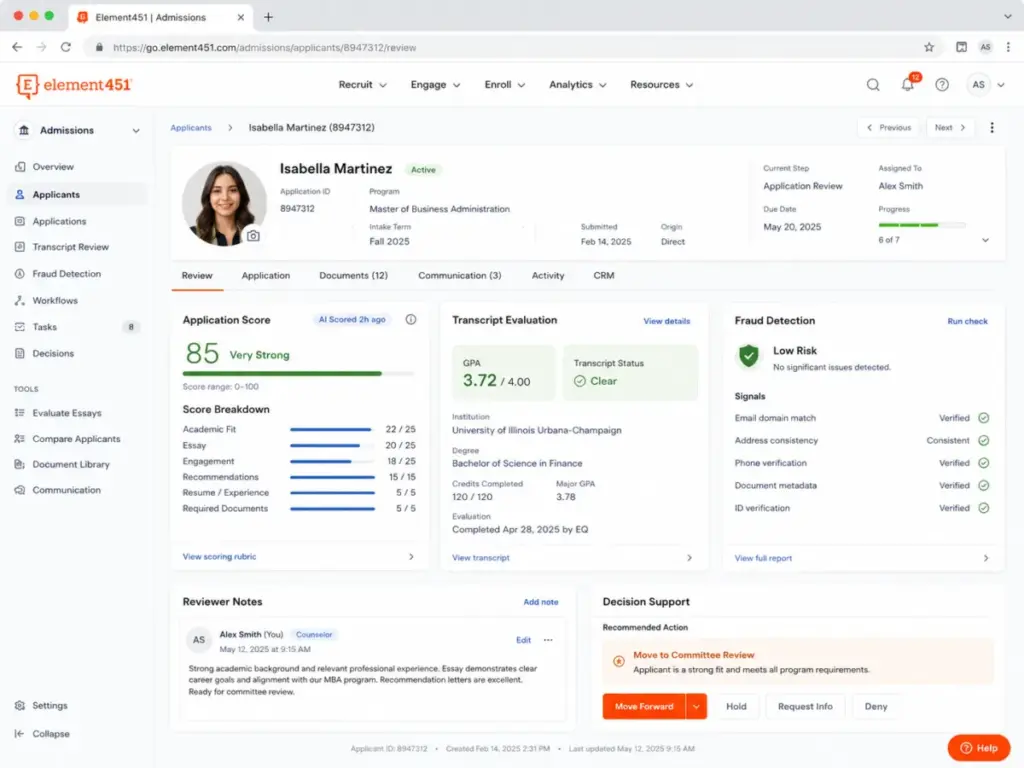
Competitor verdict: If your school needs very deep, specialized application review for medical schools, law schools, or other programs with complex committee-based evaluation, Slate by Technolutions may be the better fit. According to Niche’s higher-ed CRM comparison, Element451 has less depth in complex application review. For most undergraduate and graduate admissions workflows, Element451’s AI-assisted approach is strong.
For Enrollment Marketing Teams
Element451’s marketing module focuses on campaign speed and personalization, not generic CRM record keeping. The value proposition is simple: launch targeted campaigns faster with AI agents doing the drafting and optimization work.
Element Marketing includes the Bolt Campaign Creator Agent, which builds campaign structures based on institutional goals. The Bolt Copywriter Agent generates email and SMS copy. The Bolt Lead Gen Agent captures and qualifies prospects from web forms, landing pages, and RFI submissions. The Bolt Landing Page Builder Agent creates pages without requiring a web developer.
Student search, RFI follow-up, and multi-channel outreach across email and SMS are core capabilities. WhatsApp support is available where the channel is supported. Marketing campaigns integrate with the shared conversations inbox, so admissions and marketing teams see the same student interaction history.
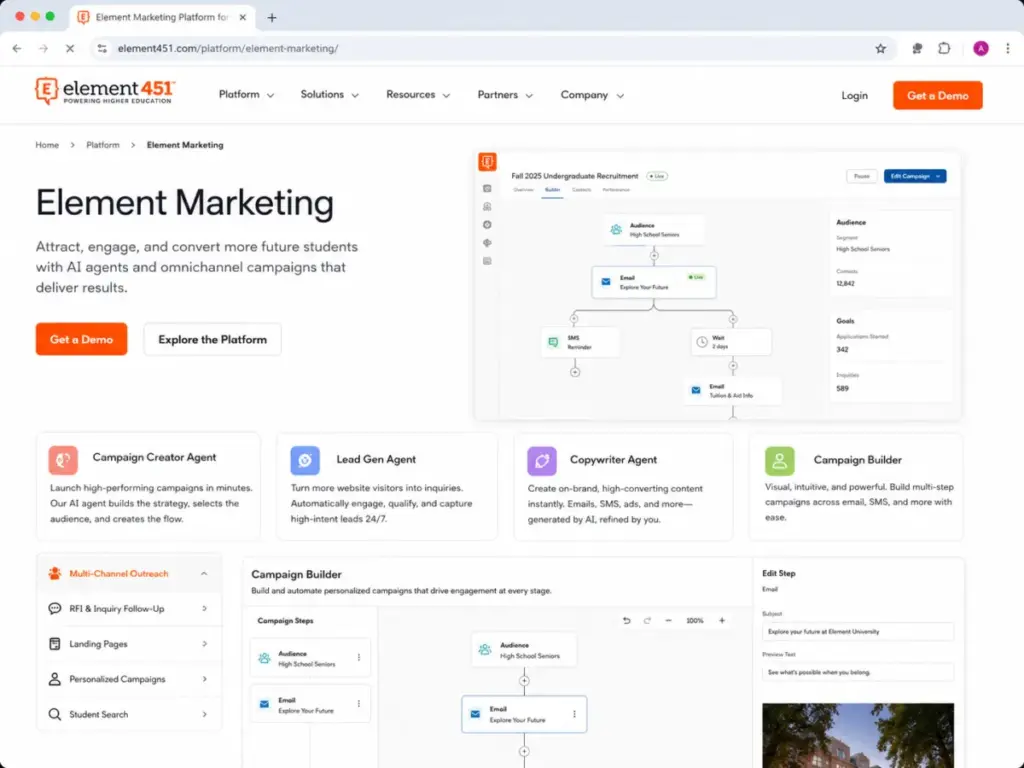
The practical benefit is workflow automation applied to enrollment marketing. Instead of manually building each email sequence, the AI agents draft content that staff review and approve. This matters for institutions with small marketing teams that need to run large-scale outreach without proportional headcount increases.
What to verify in a demo: Ask to see campaign approval workflows, AI-generated content review steps, and how the platform handles opt-out compliance for SMS and email.
For Student Success and Retention Teams
Element451 extends past enrollment into student retention and success, which separates it from admissions-only tools.
Element Success targets at-risk student detection, advising appointments, orientation events, and ongoing student engagement. The Bolt Academic Advisor Agent, Bolt Career Counselor Agent, Bolt Campus Life Advisor Agent, and Bolt Peer Advisor Agent each address different student touchpoints.
The StudentHub Portal gives students a self-service interface for appointments, tasks, and campus resources. Student journey tracking follows individuals from prospect through alumni, with nudges and support workflows triggered by engagement signals or academic indicators.
Orientation events, student-athlete engagement, and career support are included in the module, though the depth of each feature varies and should be evaluated against your institution’s existing student success tools.
What to verify in a demo: Data freshness is the single most important factor. Ask how quickly SIS and LMS data flows into Element451’s student records. Ask about LMS trigger configuration, escalation rules for at-risk students, advising handoff workflows, and reporting granularity. If your SIS data is stale by 24 hours, the at-risk detection loses much of its value.
The AI Governance Problem
This is the section most Element451 reviews skip entirely, and it matters more than the feature list.
Element451’s AI agents run on institutional knowledge. The Bolt Knowledge Hub is where institutions load approved content, policies, procedures, and program details that agents use to answer student questions. This creates a governance obligation that many enrollment teams underestimate.
Approved knowledge sources: Every Bolt Agent pulls from the Knowledge Hub. If the knowledgebase contains outdated program requirements, incorrect financial aid figures, or stale deadline information, the agent will surface that bad data to students. Institutions must assign a knowledgebase owner who reviews and updates content on a defined schedule.
Agent escalation rules: When a Bolt Agent cannot answer a question or encounters a sensitive situation, it needs to hand off to a human. Institutions must configure escalation rules and verify they work. During a demo, ask to see what happens when a student asks about a topic not covered in the Knowledge Hub.
Hallucination risk: AI agents can generate responses that sound confident but contain errors. Element451’s approach of grounding agents in approved knowledge sources reduces this risk compared to open-ended LLMs, but it does not eliminate it. Staff oversight of agent conversations is necessary.
FERPA-sensitive data: The platform handles student records subject to FERPA. Any AI agent interaction that surfaces or references protected student data must follow FERPA guidelines. The official security and compliance page states Element451 is FERPA-aligned, but the institution remains responsible for how data is used within the platform.
Audit logs: Element451 provides audit logs for tracking changes and access. Verify during your evaluation that agent conversations are logged and reviewable.
Stale SIS or LMS data: If the integration between your SIS/LMS and Element451 has sync delays, agents may provide answers based on outdated enrollment, course, or financial data. Ask about sync frequency and error handling.
It is worth noting that Gravyty criticizes CRM-centered AI models for requiring ongoing knowledgebase maintenance, arguing this creates hidden operational cost. This is a competitor claim, not a proven fact, but the underlying concern about maintenance workload is legitimate and institutions should plan for it.
Integrations, Security, and Compliance
Element451 connects to the systems higher-ed institutions already run, with security controls that meet common compliance requirements.
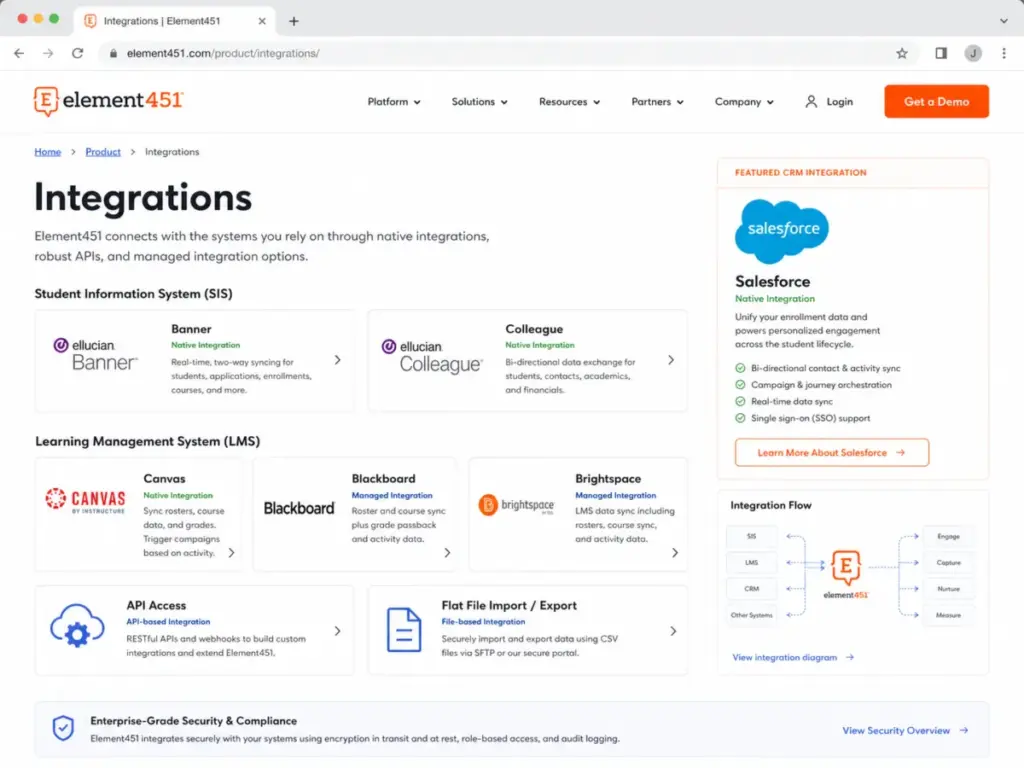
The official integrations page lists managed integrations, native integrations, APIs, and flat file import/export. Key integration categories include:
- SIS integrations: Connections to student information systems, including native integrations with Banner and Colleague.
- LMS integrations: Native course integrations with Brightspace, Canvas, and Blackboard.
- CRM and admissions systems: Native Salesforce integration and connections to other CRM platforms.
- Communication and collaboration: Integration with communication tools through the shared conversations inbox.
- Document services: Parchment for transcript and document exchange.
- Payment systems: Integrations with Stripe, PayPal, authorize.net, and CashNet per third-party listings on Software Advice and GetApp.
- Data tools: Zapier, Airtable, Google Sheets, Microsoft Excel connections. Optional Snowflake Data Share add-on.
- API access: Available for custom integrations.
While Element451 positions itself as no-code, institutions still need someone who owns data mapping between SIS/LMS and the CRM, manages integration health, and handles flat file imports when native connectors do not cover a system.
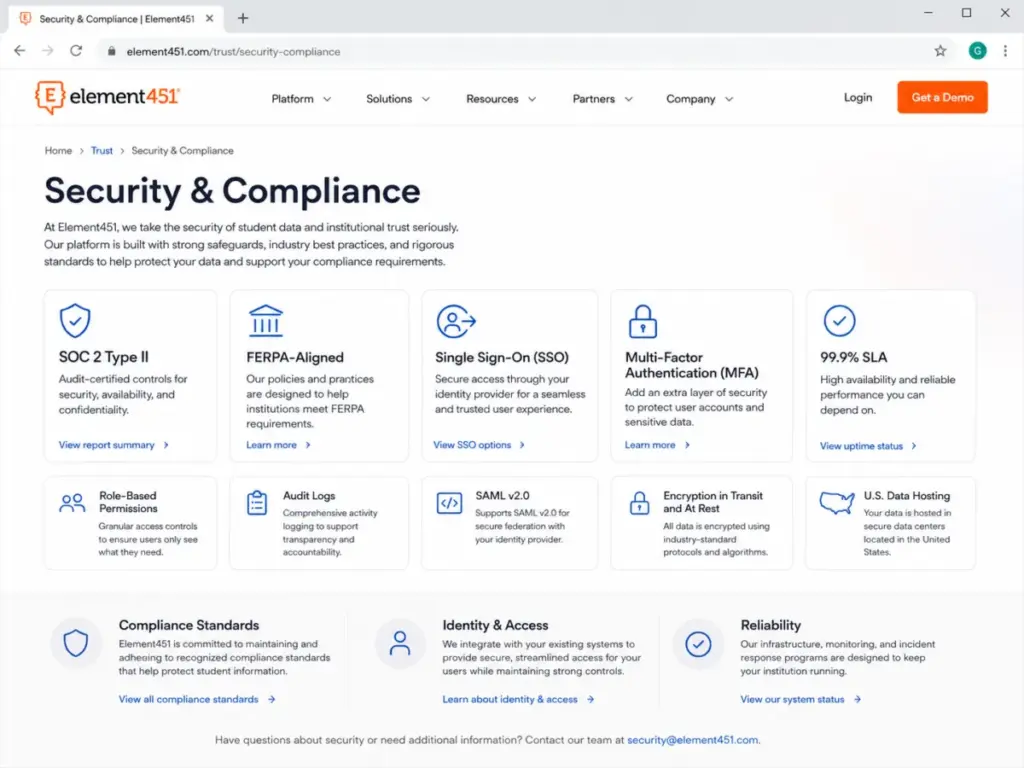
Security and compliance documentation is strong. Verified claims from the official security page:
- SOC 2 Type II certified
- FERPA-aligned
- Built on AWS (AWS Advanced Technology Partner)
- Encryption at rest and in transit using TLS 1.2+
- MFA and SSO with SAML v2.0 support
- Role-based permissions
- Audit logs and data retention controls
- 99.9% uptime SLA with uptime monitoring
- US data hosting
- Regular penetration testing
- Institution owns its data
- TX-RAMP certified, VITA certified
- PCI-DSS compliant
- 508 compliant
- GDPR support
HIPAA note: The official security page states that Element451 does not house HIPAA information. Do not assume HIPAA coverage.
Element451 Pros and Cons
The pros and cons below are based on official product documentation, third-party review data, and competitive analysis. I am separating what is verified from what comes from third-party opinion.
- AI agent teams built around higher-ed workflows: Bolt Agents are not generic chatbots. Each is designed for a specific enrollment or student success task, from application reading to financial aid advising to campaign creation.
- Annual pricing tied to institution size rather than contact count: Unlike per-seat CRMs, Element451 pricing scales by institution rather than by the number of users or contacts, which can be more predictable for larger teams.
- Modules across admissions, engagement, marketing, and success: The platform covers the full student lifecycle rather than just one phase.
- No-code platform positioning: Everyday users can build forms, campaigns, and workflows without developer help.
- Strong security documentation: SOC 2 Type II, FERPA alignment, SSO, MFA, encryption, audit logs, and 99.9% SLA are all documented on the official security page.
- Official integrations across SIS, LMS, CRM, communication, and payment systems: Banner, Colleague, Canvas, Blackboard, Brightspace, Salesforce, Stripe, PayPal, and more.
- Quote-based pricing limits self-serve budget comparison: You cannot get a final price without a formal demo and quote, which slows evaluation for budget-conscious teams.
- AI agent setup requires institutional knowledge input: Bolt Agents need a maintained knowledgebase. Without a content owner, agent quality degrades over time.
- Less depth for complex application review compared with Slate in some cases: Niche’s comparison notes this gap for programs like medical schools with committee-based review processes.
- Reporting complexity can overwhelm some users: CROClub lists complex reporting options as a con, and user reviews mention that the wide feature range requires training.
- Not useful for general-purpose CRM buyers outside higher ed: If you are looking for a sales team CRM, Element451 is the wrong product.
- Knowledgebase and AI governance require ownership: Institutions must assign staff to maintain knowledge sources, review agent outputs, and manage escalation rules.
- Public review volume is limited: Capterra shows 4.6 from 7 reviews, GetApp shows 4.6/5 from 7 reviews, and G2 states there are not enough reviews to provide buying insight. Software Finder shows 4.7 from 7 reviews. These are small sample sizes.
- Formal demo is needed before buying: There is no free trial or self-serve sign-up for quick evaluation.
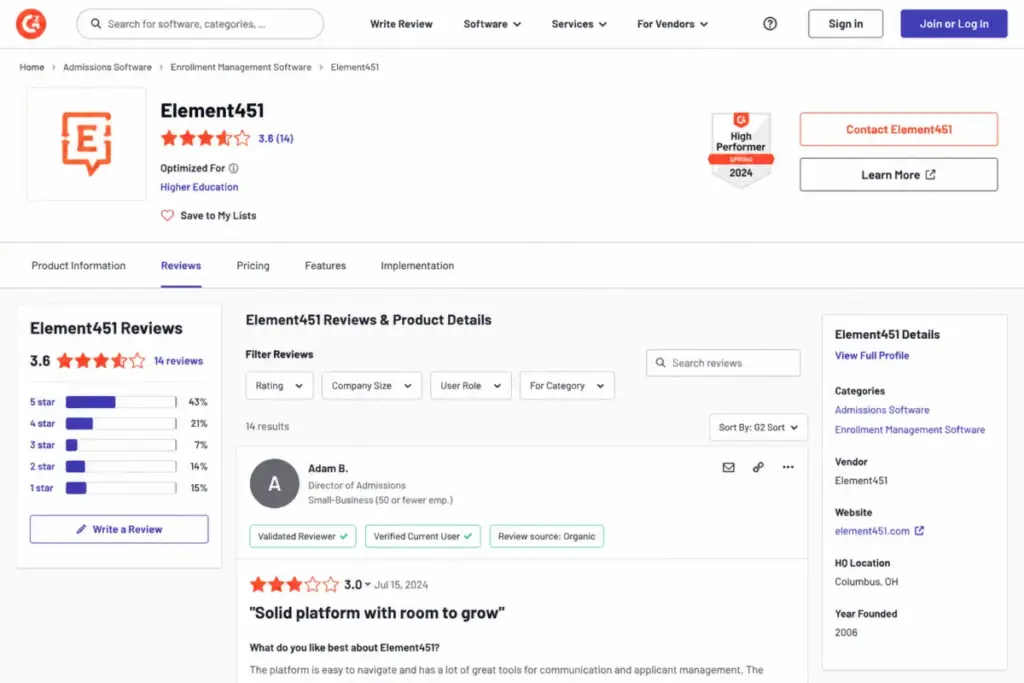
One verified reviewer on G2, Eric R., Director of Enrollment Operations and Information Services in Higher Education (Mid-Market), described Element451 as: “A modern enrollment management platform, solving long-standing admissions CRM challenges.
Software Advice secondary ratings are worth noting: overall 4.6, ease of use 4.6, value for money 4.8, customer support 5.0, functionality 4.4 . The customer support score of 5.0 is notable, though the small review count means it should be treated as a positive signal rather than a statistical certainty.
Element451 Alternatives
Element451 is not the only higher education CRM on the market. The right alternative depends on what your institution prioritizes: application review depth, Salesforce ecosystem fit, legacy SIS integration, or marketing-first workflows. Below are the most relevant comparisons for 2026 buyers evaluating this category of best CRM software.
Element451 vs Slate by Technolutions
Slate is the incumbent in higher-ed admissions, used by over 2,000 institutions. Its strength is deep application review: configurable application reading, SQL-based query logic, committee workflows, and granular data manipulation. Slate uses flat annual pricing rather than per-seat, similar to Element451.
The tradeoffs are real. Niche’s comparison notes that Slate has a steep learning curve, SQL-based logic that requires technical skill, and a dated UI compared to newer platforms. Element451 offers a more modern UX, AI agent teams, and a broader lifecycle scope covering marketing, engagement, and student success in addition to admissions.
For a detailed breakdown, see our Slate by Technolutions review.
Verdict: If your institution runs complex committee-based application review for medical, law, or other specialized programs, Slate is the better pick. If you want a modern platform covering the full student lifecycle with AI agents and you do not need SQL-level query customization, Element451 is the stronger option.
Element451 vs Salesforce Education Cloud
Salesforce Education Cloud brings the full Salesforce ecosystem to higher education: AppExchange integrations, custom objects, advanced reporting, and scalability for very large institutions. The tradeoff is cost and complexity. Salesforce requires licensed admins, often needs implementation partners, and carries higher total cost of ownership when you factor in per-user licensing, add-ons, and consultant fees.
Element451 is simpler to deploy, positions itself as no-code, and bundles AI agents that Salesforce requires separate products or custom builds to match. However, if your campus already runs Salesforce across departments, adding Education Cloud may make more sense than introducing a second CRM platform.
For pricing context, see our Salesforce pricing analysis and Salesforce CRM review.
Verdict: If your campus is already deeply embedded in the Salesforce ecosystem and has admin resources, Salesforce Education Cloud is the better pick. If you want faster implementation, built-in AI agents, and do not need the full Salesforce platform, Element451 wins.
Element451 vs Ellucian CRM Recruit or Advise
Ellucian CRM Recruit and Ellucian CRM Advise integrate tightly with Ellucian’s SIS products, particularly Banner and Colleague. For institutions running these systems, Ellucian offers native data flow that reduces integration complexity.
The downsides are well documented. Niche notes clunky interfaces and slower feature rollout compared to newer platforms. Element451 offers a more modern UI, AI agent workflows, and broader lifecycle coverage. But if your campus runs Banner or Colleague and values tight SIS integration above all else, Ellucian’s native connection is hard to beat.
See our Ellucian CRM Advance review for more detail.
Verdict: If your institution runs Banner or Colleague and SIS integration is the top priority, Ellucian CRM Recruit or Advise is the better pick. If you want modern AI capabilities and a broader platform, Element451 is stronger.
Element451 vs TargetX
TargetX is a Salesforce-native CRM for higher education, which means it inherits both the strengths and costs of the Salesforce platform. TargetX can be a good fit for institutions that want higher-ed workflows without leaving Salesforce, but it adds Salesforce licensing costs on top of the TargetX subscription.
Element451 operates independently of Salesforce, which reduces total cost of ownership for institutions not already on the Salesforce platform. TargetX may offer stronger fit for campuses that need Salesforce reporting and AppExchange integrations alongside admissions workflows.
See our TargetX review for a deeper comparison.
Verdict: If you need a higher-ed CRM that runs natively on Salesforce and your campus already pays for Salesforce licenses, TargetX is the better pick. If you want to avoid Salesforce dependency and prefer built-in AI agents, Element451 is the stronger choice.
Element451 vs LeadSquared
LeadSquared serves both education and general business markets, with strong lead management and workflow automation. For higher-ed institutions, LeadSquared offers multi-channel communication, application tracking, and enrollment analytics. Its alternatives page lists Element451 as a competitor and highlights CRM selection factors including SIS/LMS integration and personalized student journeys.
Element451 is more specialized for higher education, with purpose-built AI agents for admissions, financial aid, advising, and student success. LeadSquared offers broader industry applicability but less higher-ed-specific depth.
Verdict: If you want a CRM that works across education and other business verticals with strong lead management, LeadSquared is the better pick. If you need purpose-built higher-ed AI agents and student lifecycle coverage, Element451 is the better option.
HubSpot CRM note: For graduate schools or continuing education programs that prioritize marketing UX over admissions depth, HubSpot CRM can be a viable alternative. HubSpot offers a free tier, strong marketing automation, and an intuitive interface, but it lacks higher-ed-specific workflows like application review, transcript evaluation, or FERPA-aligned student record management.
Final Verdict: Who Should Use Element451?
Element451 earns an 8.3 out of 10 in this review. It is a strong platform for higher-ed institutions that want AI-driven student engagement across the full lifecycle, but it is not for everyone.
Use Element451 if:
- You are a higher-ed institution, not a general business CRM buyer.
- You want AI agents tied to admissions, marketing, engagement, or student success workflows.
- You need multi-channel student communication across email, SMS, phone, and WhatsApp where supported.
- You want a modern UX compared with legacy higher-ed CRM tools like Slate or Ellucian.
- You can assign a CRM owner and knowledgebase owner to maintain data quality and AI governance.
Do not use Element451 if:
- You need public self-serve pricing before any demo or sales conversation.
- You need highly specialized medical school or complex committee-based application review that requires SQL-level customization.
- You lack internal ownership for CRM data, integrations, and AI governance, with no plan to hire or assign someone.
- You want a general-purpose CRM for sales teams, marketing agencies, or non-education businesses.
- You already have Salesforce deeply embedded across your campus and only need a light enrollment add-on.
Weighted Scoring Table:
| Category | Score | Weight Rationale |
|---|---|---|
| Higher-ed fit | 9.2 | Purpose-built for student lifecycle, not adapted from a general CRM |
| AI agent workflow depth | 8.8 | Over a dozen purpose-built agents, though governance load is real |
| Pricing transparency | 6.8 | Quote-based model limits self-serve evaluation, third-party references conflict |
| Implementation clarity | 7.8 | No-code positioning helps, but SIS/LMS integration and knowledge setup require planning |
| Integrations and security | 8.9 | SOC 2 Type II, FERPA, SSO, MFA, native SIS/LMS connectors, strong documentation |
| Alternative fit boundaries | 8.1 | Clear positioning against Slate, Salesforce, Ellucian, but limited public review evidence |
| Overall | 8.3/10 |
The score reflects a platform that does higher-ed enrollment and student success well, with genuine AI capabilities, but is held back by pricing opacity and limited public review data. If Element451 published transparent pricing tiers and accumulated more verified third-party reviews, the score would likely improve.
FAQ
Is Element451 a CRM?
Element451 is a CRM, but not a general-purpose one. It is a higher education student engagement and lifecycle platform that combines CRM and CDP capabilities with AI agent teams. Element Core includes the CRM + CDP foundation, while modules like Element Admissions, Element Marketing, Element Engagement, and Element Success add workflow-specific features. It is designed for enrollment and student success teams, not for sales organizations.
How much does Element451 cost in 2026?
Element451 pricing is annual and quote-based, depending on institution size, module selection, and support tier. The official pricing calculator showed $26,000/year during May 2026 research. Third-party listings on Capterra and GetApp show a starting price of $20,000/year flat rate. ITQlick references $32,000/year. A formal quote from Element451 is required for exact pricing. Special pricing is available for community colleges.
Does Element451 offer a free trial?
Element451 does not advertise a free trial or self-serve sign-up on its official website as of May 2026. Institutions must request a demo and go through the sales process to evaluate the platform. This is standard for enterprise higher-ed CRM tools, but it means you cannot test the product before committing to a contract.
What is Element Core?
Element Core is the foundation layer included in every Element451 package. It contains the CRM + CDP, shared conversations inbox, task management, forms, automations, integrations, the Bolt Knowledge Hub, admin and security tools, and Bolt Insights analytics. Think of it as the base operating system on which the Admissions, Engagement, Marketing, and Success modules run.
What are Bolt AI Agents?
Bolt AI Agents are purpose-built AI assistants within Element451, each designed for a specific higher-ed workflow. Examples include the Application Reader Agent, Transcript Evaluation Agent, Financial Aid Advisor Agent, Campaign Creator Agent, Copywriter Agent, and Career Counselor Agent. Agents use the Bolt Knowledge Hub as their approved information source and are configured by institutional staff to reflect specific programs, policies, and procedures.
Is Element451 better than Slate?
It depends on your priorities. Element451 offers a more modern UX, built-in AI agents, and broader lifecycle coverage across marketing, engagement, and student success. Slate offers deeper application review customization, SQL-based query logic, and is used by over 2,000 institutions. For complex admissions processes like medical school committee review, Slate is typically the better fit. For AI-driven engagement across the full student lifecycle, Element451 is stronger.
Is Element451 better than Salesforce Education Cloud?
Element451 is simpler to implement, comes with built-in AI agents, and does not require per-user licensing or Salesforce admin expertise. Salesforce Education Cloud offers greater scalability, the AppExchange ecosystem, and advanced custom reporting. If your campus already runs Salesforce, Education Cloud may be the more practical choice. If you want a standalone higher-ed platform with faster time to value, Element451 has the advantage.
Does Element451 integrate with SIS and LMS systems?
Yes. Element451 offers native integrations with SIS platforms including Banner and Colleague, and LMS platforms including Canvas, Blackboard, and Brightspace. Additional integrations are available through APIs, Zapier, flat file import/export, and managed integrations. The official integrations page lists SIS, LMS, CRM, communication, document services, and payment system connections.
Is Element451 FERPA compliant?
Element451’s official security and compliance page states that the platform is FERPA-aligned. It is built on AWS, is SOC 2 Type II certified, supports SSO with SAML v2.0, MFA, role-based permissions, audit logs, and data retention controls. The institution remains responsible for how student data is configured and used within the platform. Element451 does not house HIPAA information.
Who should not use Element451?
Element451 is not a good fit for general business CRM buyers, sales teams, marketing agencies, or organizations outside higher education. It is also a poor fit for institutions that cannot assign a CRM owner and knowledgebase owner, campuses deeply embedded in Salesforce that only need a light add-on, schools requiring public pricing before a demo, or programs needing complex committee-based application review that exceeds Element451’s current depth.