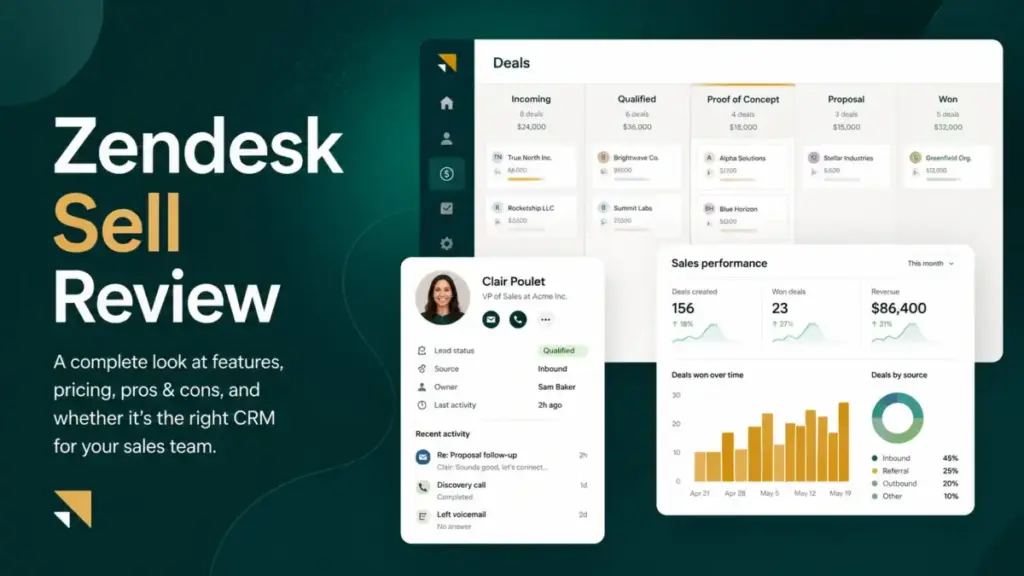
Zendesk Sell is a sales CRM that still works. It tracks leads, manages deals, and connects sales data to Zendesk Support. But here is the fact that changes everything about this Zendesk Sell review: Zendesk has officially scheduled Sell for retirement on August 31, 2027. That single announcement turns every feature evaluation, every pricing comparison, and every buyer recommendation into a different conversation.
Most reviews on the SERP still treat Zendesk Sell like an active, long-term CRM option. It is not. This review evaluates Zendesk Sell through the lens that matters in 2026: short-term usability for existing customers versus long-term migration risk for everyone else. I verified pricing, plan gates, API access, data export limitations, and the official retirement timeline through Zendesk’s own documentation, third-party review platforms, and competitive analysis across top CRM software options.
| Quick Verdict | Details |
|---|---|
| Score | 5.5/10 |
| Best for | Current Zendesk Sell customers operating through the transition period |
| Not for | New CRM buyers, teams planning beyond August 2027, budget-sensitive startups |
| Starting price | $19/user/month (Sell Team, as of May 2026) |
| Free plan | No. 14-day free trial only |
| Retirement date | August 31, 2027 |
| Verdict | Skip for new purchases. Use short-term if already deployed. Start migration planning now. |
The 3 Problems Zendesk Sell Still Solves
Zendesk Sell covers core sales CRM workflows: lead management, contact tracking, deal pipeline visibility, and activity logging. According to Zendesk’s official Sell page, the platform provides lead, contact, and deal management, activity tracking, lead generation, triggers, automation, and a 360-degree customer view. For existing users, three specific problems keep Sell relevant through the transition window.
Sales-Support Visibility for Zendesk Ecosystem Teams
The strongest argument for Zendesk Sell has always been its connection to Zendesk Support. Sales reps see support ticket history. Support agents see deal context. That bidirectional visibility eliminates the “customer said one thing to sales, another to support” problem that plagues disconnected stacks.
Is this integration enough to justify staying on a retiring product? For teams already running Zendesk Support and needing 12 to 18 months of sales-support alignment, yes. But only as a bridge, not a foundation.
Mobile CRM for Field Sales Teams
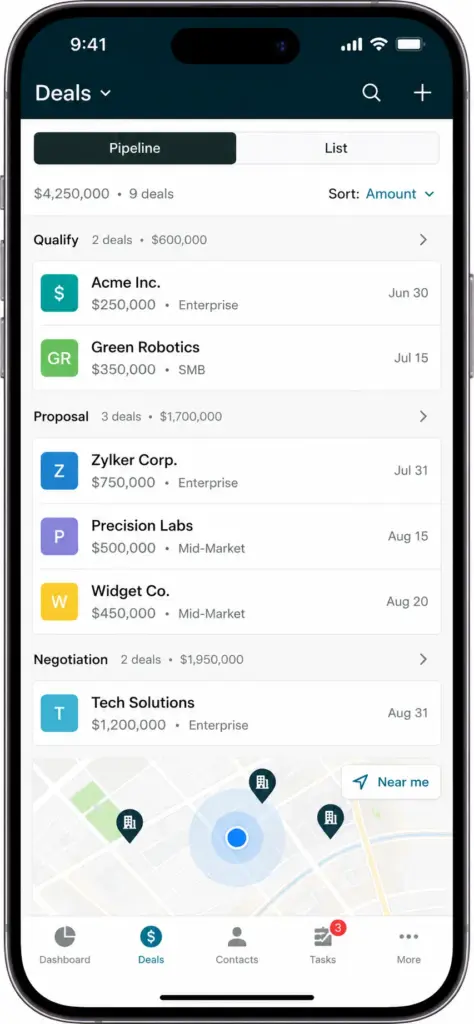
Zendesk states Sell is available on Apple App Store and Google Play, providing mobile access with location information. TechRadar’s 2026 review confirms the mobile apps are well-designed and responsive, providing most desktop functionality. Field reps who live on their phones get a genuinely usable mobile CRM.
That said, mobile app quality does not change the retirement timeline. A field sales team adopting Zendesk Sell today gets a strong mobile experience for roughly 15 months before the product disappears.
Core Pipeline Management Without Complexity
Zendesk Sell’s interface is clean and focused. Paraphrased user sentiment from Capterra (4.3 overall rating across 159 reviews, 84% positive) highlights ease of use and day-to-day sales tracking as consistent strengths. A January 2026 reviewer on Gartner Peer Insights described the platform as intuitive, reliable, and suited for teams wanting efficiency without unnecessary complexity.
One detail most reviews miss: that simplicity is both Sell’s advantage and its ceiling. Teams needing deep customization, advanced reporting, or multi-object workflows hit the limits fast. The product was designed for straightforward sales processes, not complex revenue operations.
The 2 Problems Zendesk Sell Creates
Zendesk Sell’s retirement is not a rumor or speculation. Zendesk’s official announcement confirms the product retires on August 31, 2027. Zendesk will no longer provide a sales CRM after that transition. That creates two problems no feature list can fix.
The Migration Clock Is Already Ticking
Every team currently using Zendesk Sell faces a forced migration. Zendesk says Sell customers retain full access until August 31, 2027, and that the company partnered with Pipedrive to support the transition to another sales CRM. But “full access until retirement” does not mean “full data portability.” Teams planning that forced migration should compare Zendesk Sell alternatives by data portability, pipeline fit, Zendesk Support continuity, implementation effort, and total cost before the 2027 deadline.
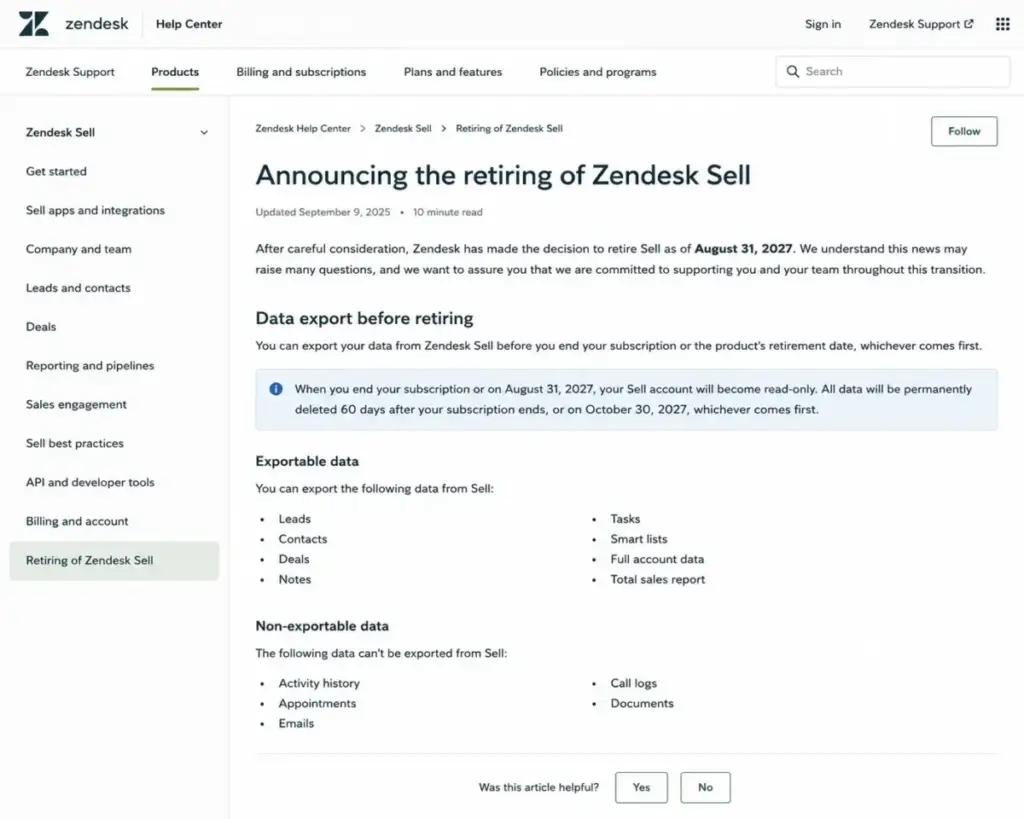
Here is the export limitation that should concern every current user: Zendesk says exported Sell data includes leads, contacts, deals, notes, tasks, smart lists, full account data, and the total sales report. Activity history, appointments, emails, call logs, and documents cannot be exported.
That gap matters. A 10-person sales team with two years of call logs and email threads in Zendesk Sell will lose that context permanently when the subscription ends or at retirement, whichever comes first. Migration planning is not optional. It is urgent.
| Data Category | Exportable | Not Exportable |
|---|---|---|
| Leads, Contacts, Deals | Yes | |
| Notes, Tasks, Smart Lists | Yes | |
| Full Account Data | Yes | |
| Total Sales Report | Yes | |
| Activity History | Not exportable | |
| Appointments | Not exportable | |
| Emails | Not exportable | |
| Call Logs | Not exportable | |
| Documents | Not exportable |
Plan-Gated APIs Complicate Integration Projects
Zendesk Sell has four API groups: Core API, Sync API, Firehose API, and Search API. According to Zendesk’s developer documentation, Core APIs are available on all Sell subscription plans. Sync API, Firehose API, and Search API are available only on Sell Growth and higher plans.
The rate limit caps at 36,000 requests per hour (10 requests per token per second), with excess requests receiving HTTP 429 until reset, per Zendesk’s API rate limit documentation.
| API Group | Sell Team | Sell Growth | Sell Professional | Sell Enterprise |
|---|---|---|---|---|
| Core API | Yes | Yes | Yes | Yes |
| Sync API | No | Yes | Yes | Yes |
| Firehose API | No | Yes | Yes | Yes |
| Search API | No | Yes | Yes | Yes |
| Rate Limit | 36,000 req/hr | 36,000 req/hr | 36,000 req/hr | 36,000 req/hr |
So should a sales ops team build new integrations on a retiring platform? The answer is no, unless the integration serves the migration itself. New complex API projects on Zendesk Sell carry avoidable rework risk because every workflow built today needs rebuilding on a new CRM before August 2027.
Zendesk Sell Pricing in 2026
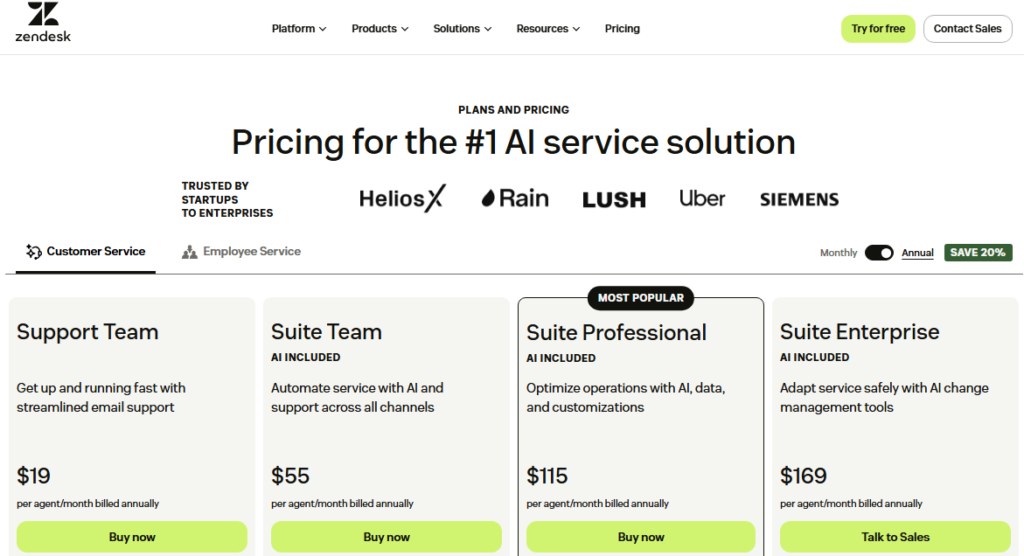
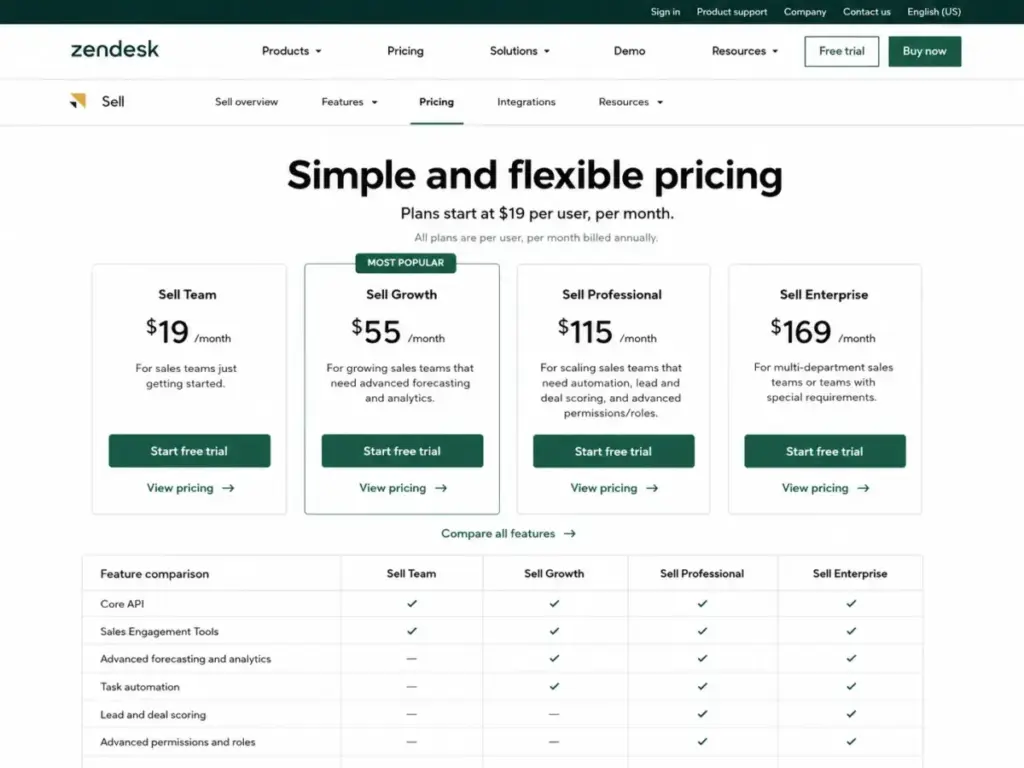
Zendesk Sell offers four plans. All prices shown are from Zendesk’s official Sell page as of May 2026. Exact monthly billing prices (as opposed to annual-equivalent prices) were not confirmed in the accessible official page extraction.
| Plan | Price (per user/month) | Best For | Key Additions | Main Limitation |
|---|---|---|---|---|
| Sell Team | $19 | Entry-level sales tracking | Core lead, contact, deal management; Core API | No Sales Engagement Tools; no Sync/Firehose/Search APIs |
| Sell Growth | $55 | Growing teams needing prospecting | Advanced forecasting; Sales Engagement Tools; all 4 API groups | Price jump from $19 to $55 is steep for the feature delta |
| Sell Professional | $115 | Scaling teams needing automation | Task automation; lead and deal scoring; advanced permissions | Over 2x the Growth price |
| Sell Enterprise | $169 | Multi-department teams | Enterprise-level positioning | Highest cost for a product retiring in 2027 |
No free forever plan exists. Zendesk’s registration page confirms a 14-day free trial that is 100% free and does not require a credit card. The trial includes Sales Engagement Tools (Reach) with four prospecting and four enrichment credits per account. Unused credits expire at the end of each month.
Where Pricing Starts to Pinch
The biggest mistake most buyers make with Zendesk Sell pricing is looking at the per-seat number without reading the billing rules. All users on a Zendesk Sell account need to be on the same plan, according to Zendesk’s billing documentation. That means upgrading one rep to Growth for API access forces every seat to $55/month.
Here is the hidden math for a 10-person team:
- Sell Team: 10 users x $19 = $190/month ($2,280/year)
- Sell Growth: 10 users x $55 = $550/month ($6,600/year)
- Sell Professional: 10 users x $115 = $1,150/month ($13,800/year)
- Sell Enterprise: 10 users x $169 = $1,690/month ($20,280/year)
The jump from Team to Growth is $360/month for a 10-person team. For a product with a published retirement date, that is a hard number to justify to a CFO.
And there is another billing detail most reviews skip: deleting a user and downgrading seats are separate steps. Downgrades take effect after the current billing period. Upgrades take effect immediately with prorated charges. If an admin removes a sales rep but forgets to reduce the seat count, billing continues for that empty seat.
Before you commit to any plan above Team, calculate whether the remaining months before August 2027 justify the total spend. A team paying $550/month for Growth has roughly 15 months left, totaling approximately $8,250 in CRM costs for a platform that will not exist.
Zendesk Sell Pros and Cons
What Zendesk Sell Gets Right
Clean, focused interface for straightforward sales processes. Capterra reviewers consistently highlight ease of use. The learning curve is shallow compared to Salesforce or HubSpot. Small teams start tracking deals within days, not weeks. That low adoption friction matters for teams where reps resist CRM tools.
Strong mobile CRM application. The iOS and Android apps provide genuine field-ready functionality, including geolocation. TechRadar confirms most desktop features translate to mobile. For outside sales reps, the mobile experience is a legitimate selling point.
Native Zendesk Support integration. Sales-support context sharing is Sell’s unique value proposition. No other CRM provides this depth of integration with Zendesk’s support platform. If your support team runs on Zendesk, the sales-support handoff is real.
Prospecting tools on eligible plans. Sales Engagement Tools (formerly Reach) offer prospecting, enrichment, and automated outreach sequences on Growth, Professional, and Enterprise plans. Credit allocation depends on plan; exact paid credit amounts were not publicly extracted.
API access on all plans (Core). Even the $19 Team plan includes Core API access for basic integrations. REST-based CRUD operations cover standard workflow connections.
What Zendesk Sell Gets Wrong
The product is retiring. This is not a soft limitation. Zendesk officially announced August 31, 2027 as the end date. Every other con on this list is temporary; this one is permanent.
Critical data cannot be exported. Activity history, appointments, emails, call logs, and documents are locked inside Zendesk Sell. A team that has built two years of communication history loses that context entirely during migration. That is a problem for growing teams.
Advanced APIs are plan-gated. Sync, Firehose, and Search APIs require Growth ($55/user/month) or higher. A team on the $19 Team plan that needs data synchronization faces a forced upgrade across all seats.
Sales Engagement Tools credits expire monthly. The prospecting and enrichment credit system resets each month. Teams that do not use their allocation lose it. The trial includes only four prospecting and four enrichment credits per account.
No free forever plan. Unlike HubSpot CRM (free for unlimited users) or Zoho CRM (free tier for up to 3 users), Zendesk Sell has no confirmed free plan. The 14-day trial is the only zero-cost option.
All users must share the same plan. Mixed plan assignments are not possible. If one rep needs Growth-tier features, the entire team pays Growth pricing.
Reporting and advanced customization limitations. Paraphrased sentiment from TrustRadius highlights frustrations with support, renewal experience, and product limitations. Value and reporting receive more mixed feedback compared to ease-of-use ratings.
Who Wins and Who Loses With Zendesk Sell in 2026
This is not a product where one generic recommendation fits all readers. The right answer depends entirely on where you sit today.
| Buyer Scenario | Recommendation | Reasoning |
|---|---|---|
| Current Sell customer with active pipelines | Use short-term, start migration now | Full access until Aug 2027, but export limits mean early planning is critical |
| Zendesk Support customer needing sales context | Sell as temporary bridge only | Ecosystem fit exists, but Zendesk is exiting sales CRM entirely |
| New 5-person startup choosing first CRM | Choose a different CRM | No free plan, retirement risk, and $19/user/month entry with no long-term future |
| Sales ops team needing API workflows | Only if already deployed | New integration projects on a retiring platform create avoidable rework |
| Mobile-first field sales team | Short-term only for existing users | Strong mobile app, but retirement date limits the recommendation horizon |
Who Should Use Zendesk Sell
Use Zendesk Sell if you are a current customer with active deal pipelines and need continuity while exporting data, documenting workflows, and preparing a migration before August 31, 2027. Also acceptable if you are an existing Zendesk Support account that needs short-term sales-support visibility while evaluating a replacement CRM.
Who Should NOT Use Zendesk Sell
Avoid Zendesk Sell if you are a new CRM buyer, a team signing a multi-year CRM roadmap, a team dependent on full email, call log, document, and activity export, or a sales operations team that needs a product with a long-term development roadmap. The retirement date removes Zendesk Sell from long-horizon purchasing decisions. If I could give one piece of advice about Zendesk Sell in 2026, it would be this: do not start something you know you will have to abandon.
Security and Compliance Note
Zendesk’s Trust Center lists security and compliance programs including SOC 2 Type II, ISO 27001:2022, ISO 27018:2019, PCI-DSS, and HIPAA program information. Infrastructure runs on AWS. Buyers in regulated industries should verify Sell-specific scope and plan eligibility in the Trust Center before using compliance claims in procurement. Do not assume every certification covers every Sell feature without confirmation.
Better Alternatives for Teams Leaving (or Avoiding) Zendesk Sell
If you are migrating from Zendesk Sell or choosing a new CRM, the right alternative depends on your exit scenario. I did not score Zendesk Sell based on brand popularity alone. I evaluated it against the alternatives that make sense for each buyer profile.
Pipedrive: The Official Transition Partner
Zendesk’s retirement announcement names Pipedrive as its preferred migration partner. According to Zendesk, Pipedrive offers a native Zendesk integration, sales CRM workspace, real-time dashboards, custom reports, AI email features, mobile app, open API, and 500+ integrations. For teams that want the lowest-friction migration path, Pipedrive is the default starting point. See our Pipedrive CRM evaluation for a full breakdown.
HubSpot CRM: Free Starting Point With Growth Runway
HubSpot CRM starts at $0 for unlimited users. For a startup or small team that was considering Zendesk Sell’s $19/month Team plan, HubSpot’s free tier removes the entry cost entirely. The trade-off: HubSpot’s pricing escalates sharply at Professional tier. Review our HubSpot CRM analysis for the full pricing math.
Salesforce Sales Cloud: Enterprise-Grade Replacement
For larger teams or complex revenue operations, Salesforce CRM offers the depth that Zendesk Sell never had. The cost is significantly higher, the implementation timeline is longer, and the learning curve is steeper. But Salesforce is not going anywhere.
Freshsales: Mid-Market Alternative With AI Features
Freshsales offers a free tier, built-in phone and email, and AI-powered lead scoring at lower price points than Salesforce. For teams in the 5 to 25 user range that need more than Pipedrive but less than Salesforce, Freshsales fills the gap.
Streak: Gmail-Native CRM for Small Teams
For teams that live in Gmail and want the simplest possible CRM, Streak runs inside the inbox. It is not a replacement for Zendesk Sell’s Zendesk Support integration, but for solo sellers or tiny teams, it removes the separate-tool friction entirely. If that inbox-first model is the appeal, compare Streak CRM alternatives by small-team cost, Gmail-native workflow, support handoff needs, and whether a standalone CRM creates too much adoption friction.
| Alternative | Best Migration Fit | Starting Price | Free Tier | Zendesk Integration |
|---|---|---|---|---|
| Pipedrive | Official transition path | Varies by plan | No confirmed free forever plan | Native Zendesk integration |
| HubSpot CRM | Budget-conscious new buyers | $0 (free tier) | Yes, unlimited users | Available via marketplace |
| Salesforce | Enterprise and complex ops | Varies by edition | No | Available via AppExchange |
| Freshsales | Mid-market teams (5-25 users) | Free tier available | Yes | Via Zapier or API |
| Streak | Gmail-native small teams | Free tier available | Yes | Limited |
Zendesk Sell FAQ
Is Zendesk Sell being discontinued?
Yes. Zendesk officially announced that Zendesk Sell retires on August 31, 2027. Current customers retain full access until that date. Zendesk has partnered with Pipedrive to support the transition. After retirement, Zendesk will no longer provide a sales CRM product.
How much does Zendesk Sell cost in 2026?
Zendesk Sell starts at $19/user/month for the Team plan, scaling to $55 (Growth), $115 (Professional), and $169 (Enterprise). All prices are from Zendesk’s official Sell page as of May 2026. No free forever plan exists. A 14-day free trial is available without a credit card.
Does Zendesk Sell have a free plan?
No confirmed free forever plan. Zendesk offers a 14-day free trial that does not require a credit card. The trial includes Sales Engagement Tools with four prospecting and four enrichment credits per account.
What data cannot be exported from Zendesk Sell?
Activity history, appointments, emails, call logs, and documents cannot be exported. Leads, contacts, deals, notes, tasks, smart lists, full account data, and the total sales report can be exported. This limitation is critical for migration planning.
Is Zendesk Sell worth it in 2026?
For existing customers who need short-term continuity, Zendesk Sell remains functional. For new buyers, it is not worth adopting a CRM with a public end-of-life date. The migration cost, data export limitations, and platform risk outweigh the short-term benefits.
What are the best Zendesk Sell alternatives?
Pipedrive is Zendesk’s official transition partner. HubSpot CRM offers a free starting tier. Salesforce fits enterprise teams. Freshsales serves mid-market buyers. Streak works for Gmail-native small teams. The best alternative depends on team size, budget, and whether you need Zendesk Support integration. Explore our best CRM for small business guide for ranked options.
Does Zendesk Sell integrate with Zendesk Support?
Yes. The sales-support integration provides bidirectional customer context between sales and support teams. This remains Zendesk Sell’s strongest differentiator. Teams already running Zendesk Support get the most value from this connection.
Does Zendesk Sell have an API?
Yes. Zendesk Sell provides four API groups: Core, Sync, Firehose, and Search. Core API is available on all plans. Sync, Firehose, and Search APIs require Growth ($55/user/month) or higher. The rate limit is 36,000 requests per hour.
Should I migrate from Zendesk Sell now or wait?
Start migration planning now. Zendesk Sell data deletion begins when the subscription ends or at retirement (August 31, 2027), whichever comes first. Since activity history, emails, call logs, and documents cannot be exported, teams should document and preserve critical context before ending their subscriptions.
Can I still buy Zendesk Sell in 2026?
The official retirement announcement confirms current customer access and the retirement date, but does not clearly define new-customer purchase restrictions by market. Regardless of availability, purchasing a CRM with a published end-of-life date is a poor long-term decision.
Final Verdict: Zendesk Sell Earns 5.5/10
Zendesk Sell earns 5.5/10 in this 2026 review. The product still functions. The interface is clean. The mobile app is strong. The Zendesk Support integration provides real value for ecosystem teams.
None of that matters if the platform disappears in 15 months.
Zendesk Sell is best for current customers who need continuity while planning a migration before August 31, 2027. It is not the best fit for new CRM buyers, teams building long-term sales processes, or organizations that need full data portability. Choose Pipedrive if you want the official transition path with native Zendesk integration. Check HubSpot pricing if you want a free starting point with long-term growth runway. Choose Salesforce if you need enterprise-grade depth.
The gap between what Zendesk Sell does today and what it will do after August 2027 is the entire product. Plan accordingly.
Pricing verified as of May 2026. Check the Zendesk Sell official page for current rates.