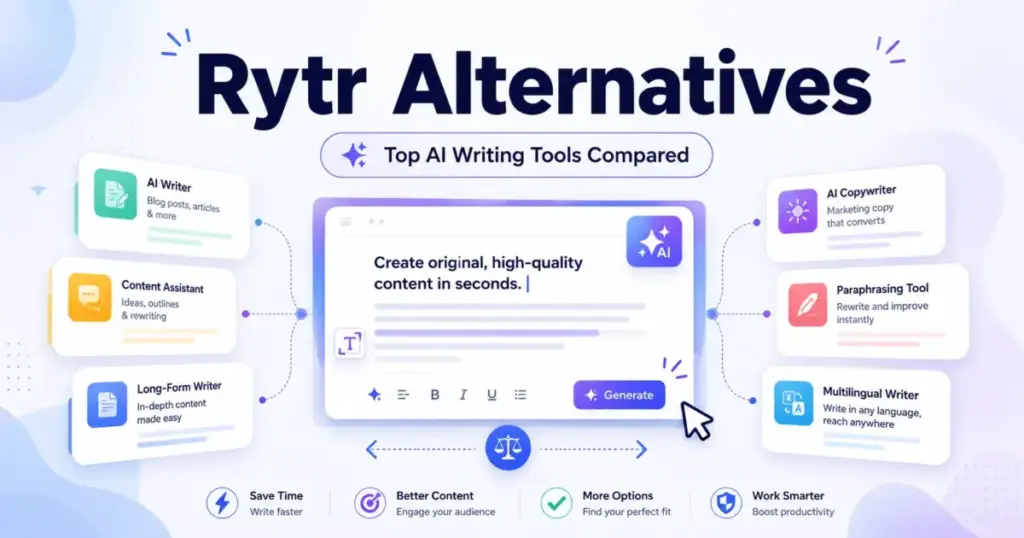
Rytr is one of the most affordable AI writing assistants on the market, and for quick social captions, email drafts, and short rewrites, it does the job. But the reason you are here probably has nothing to do with what Rytr does well. It has to do with what Rytr does not do at all.
Maybe your content team outgrew the 10,000-character free-plan ceiling. Maybe you need structured SEO workflows, not just a prompt box and a list of use cases. Maybe your marketing org needs brand governance, campaign collaboration, or GTM automation that a lightweight writing assistant was never designed to handle. Or maybe you just need a cheaper, more focused rewriting tool without the overhead of a content generator you barely use.
The real problem with most “Rytr alternatives” lists is that they treat every best AI writing tool as the same category. They are not. An SEO content platform, a GTM workflow engine, a grammar-and-tone assistant, and a budget paraphraser all solve completely different switching pains, and pricing them side by side without acknowledging that difference misleads buyers.
This article separates AI writing tools, AI editing tools, SEO/GEO platforms, and GTM workflow systems so you can match the right Rytr replacement to your actual reason for leaving. Every price cited below was verified against official sources on June 10, 2026. All products were evaluated through official pricing pages, documentation, and feature lists.
Quick Verdict by Switching Trigger
Before diving into individual alternatives, here is the decision map. Find your reason for leaving Rytr, then check the recommended pick.
| If you are leaving Rytr because… | Best alternative | Why |
|---|---|---|
| Need stronger long-form SEO workflow | Writesonic, Frase | SERP research, optimization scoring, content audits |
| Need brand-governed marketing output | Jasper | Brand voice profiles, campaign collaboration, enterprise controls |
| Need GTM workflow automation | Copy.ai | Workflow credits, bulk runs, API, multi-step pipelines |
| Need cheaper editing or paraphrasing | QuillBot, Wordtune | Lower price, focused rewrite/grammar tools |
| Need ecommerce catalog copy at scale | Hypotenuse AI | Bulk product descriptions, PIM/ERP integrations, taxonomy |
| Need performance-oriented ad copy | Anyword | Predictive scoring, A/B testing, copy intelligence |
| Need writing quality guardrails | Grammarly | Tone, plagiarism, AI detection, enterprise governance |
The core tension here: Rytr is cheap and simple. The alternatives that solve deeper problems cost more and do more. The alternatives that stay cheap solve narrower problems. There is no single upgrade that gives you everything Rytr does plus everything it lacks.
Why People Leave Rytr
Rytr users typically leave for one of these reasons:
- Need stronger long-form SEO workflow. Rytr handles short-form generation and basic rewriting, but it lacks the SERP competitor analysis, content briefs, optimization scoring, and structured article workflows that dedicated SEO platforms offer.
- Need brand-governed marketing output. Teams that need reusable brand voice profiles, approval flows, collaboration, and enterprise controls outgrow a template-based prompt tool quickly.
- Need GTM automation instead of isolated copy prompts. Revenue and sales teams running bulk campaigns, multi-step workflows, and API-driven copy generation need more than a single-prompt writing assistant.
- Need cheaper editing, rewriting, or paraphrasing. Users who mostly polish and paraphrase sentences do not need to understand what generative AI is to get their job done. A focused editing tool is cheaper and faster.
- Need ecommerce or catalog copy at scale. Retail teams writing thousands of product descriptions need bulk CSV/XLSX workflows, product attribute enrichment, taxonomy support, and PIM/ERP integrations.
- Need performance-oriented ad and landing page copy. Performance marketers want predictive scoring, A/B testing, and data-backed copy intelligence, not generic AI drafts.
Rytr’s Strengths (When Not to Switch)
Stay with Rytr if your workflow is simple: occasional social media captions, short email drafts, or quick rewrites for a solo writer. Rytr’s 40+ use-case templates, built-in tone features (on paid plans), and $7.50/month annual price point are hard to beat for lightweight, individual use. If you are not hitting the free plan’s 10,000-character ceiling and you do not need SEO, brand governance, or team collaboration, switching adds complexity without adding value.
Rytr’s Limitations (When to Switch)
The switching triggers above map to specific Rytr gaps: weak fit for long-form SEO workflows, no real brand voice governance, limited workflow depth compared with GTM platforms, plan-gated tones/languages/plagiarism checks, and no ecommerce-specific content systems. Rytr also has public FTC case history around review-generation allegations (the FTC later reopened and set aside the 2024 final consent order), which may matter for teams sensitive to compliance and review handling.
Quick Pricing Comparison
Pricing was verified on June 10, 2026. “10-user cost” estimates are included where public pricing allows reasonable math; caveated entries mean the vendor does not publish clean 10-seat self-serve pricing.
| Tool | Starting Price | 10-User Estimate | Billing Model |
|---|---|---|---|
| Rytr | $7.50/mo (annual) | ~$75/mo (caveated) | Per account |
| Jasper | $69/mo per seat | ~$690/mo (caveated; Business likely needed) | Per seat / custom |
| Copy.ai | $29/mo | $1,000/mo Growth (5-seat Chat plan below) | Plan-based |
| Writesonic | $199/mo (annual) | Custom / Enterprise | Plan-based |
| Anyword | $39/mo (annual) | Custom / contact sales | Plan / custom |
| Grammarly | $12/mo | ~$120/mo (Pro) | Per user / enterprise |
| QuillBot | $4.17/mo (annual) | ~$41.70/mo (caveated) | Per account / team |
| Wordtune | $4.89/mo (annual) | ~$48.90/mo (annual) | Per account |
| Scalenut | $59/mo | $199/mo Professional (unlimited team) | Plan-based |
| Frase | $49/mo | Custom / add-on | Plan + add-ons |
| Hypotenuse AI | Custom | Custom | Custom / contact sales |
Reading this table: The gap between Rytr’s $7.50/month and an enterprise SEO platform at $199/month is not a bug. It reflects a category difference. Budget editing tools (QuillBot, Wordtune, Grammarly) cluster near Rytr’s price point. SEO and GTM platforms cost more because they replace multiple tools, not just a writing assistant.
#1 Jasper: Best for Brand-Governed Marketing Teams

Starting price: $69/month per seat | Free trial: 7-day | Migration difficulty: Medium
Jasper is what Rytr would look like if it were rebuilt as a marketing platform instead of a writing assistant. Where Rytr gives you 40+ use-case templates and a prompt box, Jasper gives you brand voice memory, campaign collaboration, a browser extension, and Business-tier controls including API access and SSO.
Why Rytr users switch to Jasper: Marketing teams that need reusable brand voice, approval workflows, multi-user collaboration, and integrations outgrow Rytr’s individual-writer focus. Jasper’s Jasper AI pricing structure reflects that platform ambition: Pro starts at $69/month per seat, and teams needing more than one user or advanced governance typically move into Business/custom pricing.
What Jasper does worse than Rytr: It is dramatically more expensive for lightweight individual writing. If you only need occasional blog outlines or social caption rewrites, Jasper is overkill.
Avoid if: You are a solo writer with a sub-$20/month budget. Jasper’s per-seat model makes no sense for individual use.
Key features: Brand voice profiles, marketing content generation, browser extension, campaign collaboration, Business plan with API and SSO options.
Limitations: Higher entry price; some team and enterprise features require Business/custom pricing.
→ Read our full Jasper AI review and analysis
#2 Copy.ai: Best for GTM Workflow Automation
Starting price: $29/month | Free trial: Not verified | Migration difficulty: Medium
Copy.ai has pivoted hard from “AI copywriter” to “GTM workflow platform.” The Chat plan ($29/month, 5 seats) gives you unlimited words and access to multiple LLMs. But the real value is in workflow credits, bulk runs, API access, and integrations on Growth ($1,000/month, 75 seats) and higher plans.
Why Rytr users switch to Copy.ai: Revenue, sales, and marketing teams that need multi-step GTM workflows (prospecting sequences, enrichment flows, bulk personalization) cannot build those inside Rytr’s template interface. Copy.ai treats copy as one output inside a larger automation pipeline.
What Copy.ai does worse than Rytr: It is overkill for solo writers who only need cheap drafts or rewrites. The jump from $29/month Chat to $1,000/month Growth is steep if you only need more than five seats.
Avoid if: You write alone and do not need workflows, API, or integrations. The Chat plan works, but you are paying for infrastructure you will not use.
Key features: Chat plan with unlimited words, multiple LLM access, workflows, workflow credits, API and integrations on higher plans.
Limitations: 10-user public self-serve cost is not visible because the Chat plan includes only 5 seats and higher workflow plans start much higher.
→ Read our full Copy.ai review and evaluation
#3 Writesonic: Best for SEO and AI-Search Content Production

Starting price: $249/month monthly or $199/month billed annually | Free trial: Not verified | Migration difficulty: Medium
Writesonic is no longer just an AI writer. It has evolved into an SEO and GEO content production platform. It combines article generation with SEO audits, GEO brand presence tracking, AI search platform monitoring, and project-based workflows.
Why Rytr users switch to Writesonic: Content teams that need end-to-end SEO workflows (keyword research, SERP-aware article generation, optimization scoring, content auditing, AI visibility tracking) hit Rytr’s ceiling almost immediately. Writesonic replaces both the writing tool and separate SEO tools.
What Writesonic does worse than Rytr: It is far more expensive and may be excessive for basic social, email, or rewrite tasks. The $199/month annual starting price is roughly 26 times Rytr’s entry point.
Avoid if: You only write social posts, email subject lines, or short rewrites. You would be paying for an SEO platform you never touch.
Key features: AI article generation, SEO audits, GEO brand presence, AI platform monitoring, API access, project and user limits by plan.
Limitations: Public lower plans include limited users; 10-user pricing is not fully visible without Enterprise/custom context.
→ Read our full Writesonic review and analysis
#4 Anyword: Best for Performance-Marketing Copy

Starting price: $49/month monthly or $39/month billed yearly | Free trial: 7-day | Migration difficulty: Medium
Anyword is the Rytr alternative for marketers who do not just want AI-generated copy. They want AI-predicted copy performance. Anyword layers predictive scoring, content intelligence, brand voice, and testing-oriented workflows on top of its generative engine.
Why Rytr users switch to Anyword: Performance marketers running paid campaigns need copy prediction, A/B testing insights, and data-backed optimization. Rytr generates drafts; Anyword tells you which draft will perform better before you spend ad budget.
What Anyword does worse than Rytr: It is more specialized and more expensive than Rytr for general-purpose writing. If you just need a cheap all-purpose assistant, Anyword’s prediction features are wasted spend.
Avoid if: You do not run paid campaigns or measure copy performance. The predictive layer adds cost without adding value for casual writing.
Key features: Performance predictions, brand voice, Blog Wizard, plagiarism checker, real-time predictions, content intelligence, A/B testing on higher plans.
Limitations: Exact 10-user pricing is not public because advanced team plans move into custom pricing.
#5 Grammarly: Best for Editing, Guardrails, and Team Writing Quality

Starting price: $12/month | Free trial: Free plan and 7-day Pro trial | Migration difficulty: Low
Grammarly is not a content generator in the same sense as Rytr, and that is exactly why some Rytr users switch to it. Grammarly sits inside your existing workflow (email, docs, browser) and focuses on correctness, tone, fluency, plagiarism detection, AI detection, and enterprise-grade writing governance.
Why Rytr users switch to Grammarly: Writers and teams that need polishing, tone adjustment, plagiarism/AI detection, and consistent writing quality care more about output control than output generation. Grammarly pricing and plan details show Pro at $12/month, with Enterprise available for larger teams needing SAML/SCIM, DLP, BYOK, and admin controls.
What Grammarly does worse than Rytr: It is not a full AI blog or SEO content production platform. If you need to generate 2,000-word articles from scratch, Grammarly is a complement, not a replacement.
Avoid if: You need a content generator, not a content editor. Grammarly polishes; it does not create from zero.
Key features: Grammar suggestions, tone adjustment, sentence rewrites, plagiarism detection, AI detection, AI prompts, enterprise controls.
Limitations: Generative content and prompt allowances differ by plan; advanced admin and security controls are Enterprise-gated.
→ Read our full Grammarly review and evaluation
#6 QuillBot: Best Budget Rewriting and Paraphrasing Alternative

Starting price: $8.33/month billed annually | Free plan: Yes | Migration difficulty: Low
QuillBot is cheaper than Rytr and more focused. If your primary workflow is rewriting, paraphrasing, summarizing, and grammar checking, QuillBot delivers those features without the overhead of an AI content generator.
Why Rytr users switch to QuillBot: Students, freelancers, and budget-conscious writers who mostly use Rytr for its rewriting and grammar features can get a better-focused, cheaper tool. QuillBot also includes a humanizer and AI detector, which Rytr does not emphasize.
What QuillBot does worse than Rytr: It is weaker as a full marketing workflow, brand voice, or long-form SEO production system. If you need to generate original marketing copy from prompts, QuillBot is not the right switch.
Avoid if: You need original content generation, brand voice, SEO workflows, or marketing copy. QuillBot edits; it does not create.
Key features: Paraphraser, grammar checker, summarizer, AI detector, humanizer, plagiarism prevention, team plan controls.
Limitations: Official pricing pages showed conflicting Premium price information between the Premium page and FAQ page; verify pricing at checkout before purchasing.
#7 Wordtune: Best Lightweight Rewrite Assistant

Starting price: $6.99/month monthly or $4.89/month billed annually | Free plan: Yes | Migration difficulty: Low
Wordtune occupies similar budget territory as Rytr but focuses specifically on making your existing writing clearer, more fluent, and more polished. It is a rewrite-first tool rather than a generation-first tool.
Why Rytr users switch to Wordtune: Users who want clearer, more natural-sounding rewrites without adopting a heavier AI content platform prefer Wordtune’s lightweight, sentence-level approach. The free plan and low annual pricing make it a near-zero-risk switch.
What Wordtune does worse than Rytr: It lacks the deep SEO, GTM, and ecommerce workflows that some Rytr switchers need. If you are leaving Rytr to scale up, Wordtune is a lateral move, not an upgrade.
Avoid if: You need long-form content generation, SEO optimization, or team workflow features. Wordtune is for sentence-level polish only.
Key features: Rewrites, AI suggestions, summaries, grammar, vocabulary, clarity, fluency, premium support on Unlimited.
Limitations: Daily rewrite and summary limits apply on lower plans; not designed as a full SEO publishing suite.
#8 Scalenut: Best for SEO/GEO Content Teams

Starting price: $59/month standard monthly | Free trial: 7-day | Migration difficulty: Medium
Scalenut sits closer to an SEO/GEO workflow platform than a simple AI writing assistant. It bundles topic clusters, content audits, optimization scoring, internal linking suggestions, and AI platform visibility tracking into a production workflow that Rytr does not attempt.
Why Rytr users switch to Scalenut: SEO teams that need topic clusters, site audits, content optimization, keyword planning, and GEO prompts need a platform designed around search performance, not a prompt-based copy generator. Scalenut’s Professional plan ($199/month standard) includes unlimited team members, making it more cost-efficient at scale than per-seat models.
What Scalenut does worse than Rytr: It is more complex and more expensive than Rytr for casual writing, social captions, or quick drafts. The learning curve is steeper because the tool assumes SEO workflow context.
Avoid if: You write social posts or short-form copy. Scalenut assumes every piece of content targets a search query.
Key features: GEO prompts, AI platform tracking, SEO articles, content optimization, clusters, site audits, keyword planner, internal linking, team member tiers.
Limitations: Plan limits vary by articles, optimization runs, audit pages, workspaces, and AI prompts; promotional sale prices on the pricing page may be temporary. Use standard pricing for budget planning.
#9 Frase: Best for SERP Research and AI Visibility Workflow
Starting price: $49/month | Free trial: 7-day, no credit card | Migration difficulty: Medium
Frase combines an AI agent with SERP research, content briefs, SEO/GEO optimization, internal linking, site audits, and AI visibility tracking. It is a research-and-optimize platform first, and a writing tool second.
Why Rytr users switch to Frase: Content teams that start with keyword research and SERP competitor analysis before writing need a tool that treats research as the primary workflow. Frase’s brief builder, optimization scoring, and what AI visibility tracking does help teams produce content designed for both traditional search and AI search engines.
What Frase does worse than Rytr: It is less appropriate for simple, cheap short-form copy. Frase assumes you are producing research-backed, SEO-optimized articles, not social captions or email subject lines.
Avoid if: You write quick drafts without keyword research. Frase’s value comes from its SERP analysis layer, which is wasted on casual writing.
Key features: AI Agent, SEO/GEO optimization, SERP competitor analysis, AI visibility tracking, site audits, API/MCP, brand voice, internal linking.
Limitations: Starter is a 1-user plan; exact 10-user public pricing was not fully confirmed in accessible evidence. Annual billing offers 20% discount.
#10 Hypotenuse AI: Best for Ecommerce Product Catalog Content
Starting price: Custom / contact sales | Free trial: Try free, no credit card | Migration difficulty: High
Hypotenuse AI is the most specialized tool on this list. It is purpose-built for ecommerce teams that need to generate, enrich, and manage product catalog content at scale: product descriptions, attributes, taxonomy, tagging, and PIM/ERP integrations.
Why Rytr users switch to Hypotenuse AI: Ecommerce and retail teams writing hundreds or thousands of product descriptions need bulk CSV/XLSX workflows, product attribute enrichment, custom models, and integrations with their existing product information systems. Rytr’s general-purpose templates cannot handle catalog-scale production.
What Hypotenuse AI does worse than Rytr: It is not a transparent, low-cost replacement. Pricing is custom/contact-sales, and the platform is optimized for ecommerce workflow scale rather than casual writing. If you are a solo blogger looking for a cheap Rytr swap, Hypotenuse AI is the wrong category entirely.
Avoid if: You are not an ecommerce team. The pricing, onboarding, and feature set are built for catalog-scale product content, not general writing.
Key features: Product description generator, 20+ ecommerce content types, bulk CSV/XLSX workflows, product attribute enrichment, tagging and taxonomy, PIM/ERP integrations, custom models, SOC 2 context.
Limitations: Exact public pricing and 10-user cost are not disclosed; best fit is ecommerce workflow scale rather than casual writing.
Feature Gate Comparison for Top 6 Rytr Alternatives
Not every feature is available on every plan. This table maps where the critical features sit across the entry-level tiers of each alternative.
| Feature | Jasper (Pro) | Copy.ai (Chat) | Writesonic (Basic) | Anyword (Starter) | Grammarly (Pro) | QuillBot (Premium) |
|---|---|---|---|---|---|---|
| Brand voice | Yes (2 voices) | No | No | Yes | No | No |
| SEO optimization | Limited | No | Yes | No | No | No |
| Workflow automation | No | Limited | No | No | No | No |
| API access | Business only | Growth only | Yes | Business only | Enterprise only | No |
| Plagiarism checker | No | No | No | Yes | Yes | Yes |
| AI detection | No | No | No | No | Yes | Yes |
| Team collaboration | Business only | 5 seats | Limited | Custom | Enterprise only | Team plan |
| Predictive scoring | No | No | No | Yes | No | No |
The cheapest plan rarely includes the feature that triggered your switch. Verify which tier unlocks the specific capability you need before comparing prices.
Migration Difficulty Matrix
| Alternative | Difficulty | Key factors |
|---|---|---|
| Jasper | Medium | Brand voice setup, campaign configuration, team onboarding |
| Copy.ai | Medium | Workflow creation, API integration, credit system learning |
| Writesonic | Medium | SEO workflow setup, project organization, content audit configuration |
| Anyword | Medium | Performance model calibration, data integration, testing workflow |
| Grammarly | Low | Browser extension install, minimal configuration |
| QuillBot | Low | Web tool, no migration needed, paste-and-edit workflow |
| Wordtune | Low | Browser extension or web tool, minimal setup |
| Scalenut | Medium | SEO workflow configuration, cluster setup, audit configuration |
| Frase | Medium | Brief templates, SERP research workflow, domain setup |
| Hypotenuse AI | High | PIM/ERP integration, taxonomy mapping, custom model training, sales process |
How to Pick the Right Rytr Alternative
The best Rytr alternative depends entirely on why you are leaving. Here is a quick decision framework:
| If you need… | Start with… | Avoid… |
|---|---|---|
| Long-form SEO content workflow | Writesonic, Scalenut, Frase | QuillBot, Wordtune |
| Brand voice + marketing governance | Jasper, Anyword, Grammarly | QuillBot, Hypotenuse AI |
| GTM workflow automation | Copy.ai, Jasper | Wordtune, QuillBot |
| Cheaper rewriting/paraphrasing | QuillBot, Wordtune, Grammarly | Writesonic, Scalenut |
| Ecommerce catalog copy at scale | Hypotenuse AI, Writesonic | Grammarly, Frase |
| Performance ad copy with prediction | Anyword, Copy.ai, Jasper | QuillBot, Wordtune |
Budget anchor: If you are switching because Rytr’s free plan is too limited but you do not need SEO or GTM depth, QuillBot ($8.33/month annual), Wordtune ($4.89/month annual), or Grammarly ($12/month) keep you in a similar price range. If you are switching because Rytr is too shallow for serious content production, expect to spend $49 to $249/month for a platform that replaces both your writing tool and your SEO/workflow stack.
When to Stay with Rytr
Not every Rytr user needs to switch. Stay with Rytr if:
- You are a solo writer producing short-form content (social captions, email drafts, ad copy) and the free or Unlimited plan covers your volume.
- You use fewer than 5 of Rytr’s 40+ templates and do not need SEO, brand governance, or team collaboration.
- Your monthly writing budget is under $10/month and you do not need plagiarism checks or AI detection.
- You are comfortable with Rytr’s output quality and do not need performance prediction, SERP research, or ecommerce-specific workflows.
Switch from Rytr if:
- Your content team has more than 2 writers and needs collaboration, approval, or brand voice controls.
- You need long-form SEO content with optimization scoring, SERP analysis, or AI visibility tracking.
- You need GTM workflows, API access, or integration with your CRM/marketing stack.
- You need ecommerce product descriptions at catalog scale with PIM/ERP integrations.
- Compliance, review handling, or enterprise security controls are a requirement for your team.
Final Verdict
Rytr is not a bad tool. It is a limited tool, and the right alternative depends on which limit you hit first.
If your ceiling is SEO depth, Writesonic, Scalenut, or Frase replace both Rytr and a separate SEO tool. If your ceiling is brand governance, Jasper or Anyword add the control layer Rytr lacks. If your ceiling is workflow automation, Copy.ai turns copy generation into one step inside a GTM pipeline. If your ceiling is price, QuillBot and Wordtune are cheaper and more focused for rewriting.
The most common mistake is replacing Rytr with a more expensive tool that solves a problem you do not have. Match the alternative to the switching trigger, verify the plan that unlocks the feature you need, and check the 10-user cost before committing.
Frequently Asked Questions
What is the best Rytr alternative in 2026?
It depends on your switching reason. For SEO workflows, Writesonic or Frase. For brand-governed marketing, Jasper. For budget rewriting, QuillBot or Wordtune. For GTM automation, Copy.ai. For ecommerce catalog copy, Hypotenuse AI. There is no single “best” because these tools solve different problems.
Is there a free alternative to Rytr?
Yes. Grammarly, QuillBot, and Wordtune all offer free plans. Grammarly’s free tier includes grammar, spelling, and basic tone suggestions. QuillBot’s free plan covers paraphrasing and grammar. Wordtune’s free plan includes limited daily rewrites and summaries. Frase and Hypotenuse AI offer free trials without requiring a credit card.
Which Rytr alternative is best for SEO content?
Writesonic ($199/month annual), Scalenut ($59/month), and Frase ($49/month) are built for SEO workflows. They include SERP research, content briefs, optimization scoring, audits, and AI visibility tracking, features Rytr does not offer. Jasper also supports long-form content but emphasizes marketing collaboration over SEO workflow depth.
What is cheaper than Rytr?
QuillBot starts at $8.33/month billed annually, and Wordtune starts at $4.89/month billed annually. Both are cheaper than Rytr’s $7.50/month annual plan. They focus on rewriting and editing rather than full AI content generation.
Is Jasper better than Rytr?
Jasper is more capable than Rytr for marketing teams that need brand voice, collaboration, and enterprise controls. But at $69/month per seat versus Rytr’s $7.50/month, Jasper costs roughly 9 times more. For solo writers who only need quick drafts, Jasper’s additional features may not justify the price difference. See our Jasper vs Copy.ai comparison for more context on how marketing-focused AI tools differ.
Which Rytr alternative is best for ecommerce product descriptions?
Hypotenuse AI is purpose-built for ecommerce catalog content, including bulk product descriptions, attribute enrichment, taxonomy, and PIM/ERP integrations. Writesonic also supports product content workflows. Anyword can add predictive performance scoring to product copy. Rytr’s general-purpose templates are not designed for catalog-scale production.
How much does Rytr cost for 10 users?
Rytr does not publish explicit team or multi-seat pricing. The Unlimited plan is $7.50/month billed annually per account. Buying 10 individual subscriptions would cost approximately $75/month, but there is no public team plan or volume discount structure to reference. If team collaboration and admin controls matter, compare with tools like Jasper (Business/custom), Grammarly (Enterprise), or Scalenut (Professional with unlimited team members).
Which Rytr alternative has the best brand voice features?
Jasper offers dedicated brand voice profiles and campaign-level collaboration. Anyword adds predictive performance scoring layered on top of brand voice. Grammarly provides tone detection and consistency guardrails. Rytr’s custom tone feature exists on paid plans but lacks the depth and governance layer these platforms provide.
Pricing, plans, and feature availability cited in this article were verified against official vendor sources on June 10, 2026. SaaS pricing changes frequently. Confirm current rates on each vendor’s pricing page before purchasing. Where 10-user estimates are provided, they are based on published per-seat or per-plan math and may differ from actual team or enterprise quotes.
Related reading: explore Copy.ai alternatives if you need GTM workflow depth, or compare Writesonic against other SEO content tools for long-form production workflows.