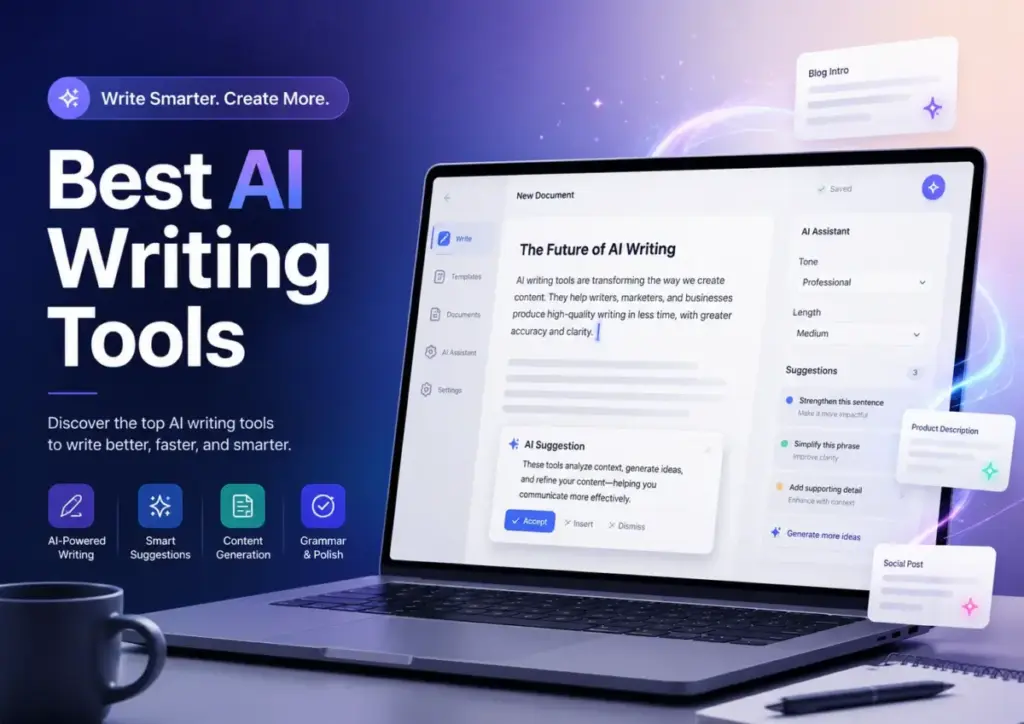
Most AI writing tool lists rank 10 products as if they all solve the same problem. They don’t. The best AI writing tools in 2026 split into five distinct categories: flexible chatbot writers, marketing platforms, SEO and GEO content tools, editing assistants, and fiction writing aids. Picking the wrong type wastes money and adds editing hours.
This ranking separates tools by the real writing job they solve, not by the longest feature list. I evaluated Claude, Jasper, ChatGPT, Frase, Copy.ai, Grammarly, Writesonic, Surfer, Rytr, and Sudowrite across output quality, workflow depth, SEO and GEO support, editing features, pricing, and governance. Each product gets a score, a “best for” label, and a “not for” warning so you can match your actual workflow to the right tool. If you are exploring broader options, see our guide to AI tools for content creation. Understanding what is AI at a foundational level also helps separate real capability from marketing noise.
Quick Verdict: Best AI Writing Tool by Use Case
Before the detailed reviews, here is the short answer for each writing job.
| Use Case | Best Pick | Why |
|---|---|---|
| Best overall writing quality | Claude | Natural long-form prose and editing |
| Best marketing team platform | Jasper | Brand voice and campaign workflows |
| Best flexible assistant | ChatGPT | Works across many writing tasks |
| Best SEO and GEO workflow | Frase | SERP research plus AI content scoring |
| Best GTM workflows | Copy.ai | Workflow credits and sales-marketing automation |
| Best editing layer | Grammarly | Grammar, tone, clarity, plagiarism |
| Best AI search visibility suite | Writesonic | AI search tracking plus article writer |
| Best optimizer | Surfer | Content optimization and AI prompt tracking |
| Best budget option | Rytr | Free plan and low paid entry price |
| Best fiction tool | Sudowrite | Story-aware writing workflow |
What Counts as an AI Writing Tool?
The biggest mistake in choosing an AI writing assistant is comparing unlike tools. A grammar checker and a campaign workflow platform do not solve the same problem, even if both use generative AI under the hood. Here are the five categories that matter.
Flexible chatbot writers. Claude and ChatGPT fall here. They use large language models to generate, rewrite, and edit text across any format. They offer maximum flexibility but zero built-in SEO scoring or campaign automation.
Marketing AI platforms. Jasper and Copy.ai belong in this group. They add brand voice, campaign pipelines, team governance, and repeatable templates on top of AI generation. They cost more per seat but save time for teams publishing across channels.
SEO and GEO content platforms. Frase, Writesonic, and Surfer focus on search-driven content. They provide SERP research, content scoring, AI search visibility tracking, and optimization guidance. Their value is in the workflow around the writing, not just the draft.
Editing and grammar assistants. Grammarly leads this category. It works across many writing surfaces, improving grammar, tone, clarity, and checking for plagiarism. It is not a full article generator, but it is the strongest finishing layer. For the full breakdown of Free versus Pro limits, AI prompts, plagiarism detection, and editing accuracy, read our Grammarly review.
Fiction and creative writing tools. Sudowrite is purpose-built for fiction writers. It supports story ideation, creative expansion, and rewrites. It is not designed for SEO content or business copy.
Understanding these categories prevents the most common buying mistake: paying $69/month for a marketing platform when a $20/month chatbot covers your actual needs.
10 Best AI Writing Tools in 2026
Here is the full comparison table. Prices were verified on May 5, 2026.
| Rank | Tool | Badge | Best For | Starting Price | Main Strength | Main Limitation | Score |
|---|---|---|---|---|---|---|---|
| 1 | Claude | Best Overall | Long-form drafts, editing, ideation | Free; Pro $17/mo (annual) | Natural prose and reasoning | No built-in SEO scoring | 9.4 |
| 2 | Jasper | Best Marketing Platform | Brand-controlled campaigns | $59/mo/seat (annual) | Brand voice and workflows | Expensive for solo writers | 9.2 |
| 3 | ChatGPT | Best Flexible Assistant | Brainstorming, outlines, rewrites | Free; Plus $20/mo | Range of writing tasks | Output needs strong editing | 9.0 |
| 4 | Frase | Best SEO/GEO Workflow | SERP research, AI article drafting | $49/mo | Keyword-to-draft workflow | Drafts need editorial polish | 8.8 |
| 5 | Copy.ai | Best GTM Workflows | Sales and marketing automation | $24/mo (annual) | Workflow automation | Steep jump to Growth tier | 8.6 |
| 6 | Grammarly | Best Editing Layer | Grammar, tone, clarity, plagiarism | Free; Pro $12/mo (annual) | Cross-platform editing | Weak full article generation | 8.5 |
| 7 | Writesonic | Best AI Search Suite | AI article writing, AI visibility | $79/mo (annual) | AI search tracking | Oversized for simple writing | 8.3 |
| 8 | Surfer | Best Optimizer | Content briefs and page optimization | $99/mo (annual) | Optimization scoring | Not a standalone writer | 8.2 |
| 9 | Rytr | Best Budget Option | Quick drafts, captions, basic copy | Free; $7.50/mo (annual) | Low price, usable free plan | Weak long-form quality | 7.8 |
| 10 | Sudowrite | Best Fiction Tool | Story development, creative writing | $10/mo (annual) | Fiction-specific workflow | Poor for business content | 7.6 |
Now, the detailed reviews.
Claude – Best Overall Writing Quality

Score: 9.4/10 – Excellent
Claude produces the strongest natural prose in this ranking. Where most AI writing tools generate text that reads like a template, Claude produces drafts that sound like a competent human writer who took time to think before typing. For writers, marketers, founders, and editors who care about draft quality before workflow automation, Claude is the best AI writing tool in 2026.
For a deeper look at the platform, read the full Claude review.
Best for: Writers, content marketers, founders, editors, and teams that prioritize draft quality and natural tone.
Not for: Teams needing built-in SEO scoring, campaign pipelines, or strict brand workflow controls.
Pricing: Free plan available. Pro costs $17/month with annual billing or $20/month on a monthly plan. Max starts from $100/month. See the full Claude pricing breakdown. Verified May 5, 2026.
What I liked
- Long-form writing and editing quality consistently outperformed other tools in this evaluation. Claude handles 10,000+ word documents without losing coherence.
- Research mode, Projects, and Artifacts give writers a workspace, not just a chat window. Uploading source material and specifying constraints produces drafts closer to publish-ready.
- Google Workspace connectors and Claude for Word, Excel, and PowerPoint (on paid plans) mean you can bring Claude into the tools you already use.
Where it falls short
- No built-in SEO content scoring or SERP analysis. If you need optimization scores, you need a second tool like Frase or Surfer.
- Less structured than Jasper for repeatable marketing workflows. There are no campaign templates, content pipelines, or brand governance rules built into the platform.
Pricing warning: Heavy users can hit usage limits on Pro and may need to upgrade to Max at $100/month or higher. Check current rate limits before committing to high-volume production.
My verdict: Claude is the best overall AI writing tool when your priority is output quality. It works best when you give it a clear brief, target reader, source material, and tone constraints. If you need marketing automation or SEO scoring, pair Claude with a workflow tool rather than switching to a weaker writer.
Jasper – Best for Brand-Controlled Marketing

Score: 9.2/10 – Excellent
Jasper is the most purpose-built AI writing platform for marketing teams in this ranking. It is not the best raw writer (Claude and ChatGPT produce better prose), but Jasper adds brand voice, campaign workflows, content pipelines, and team governance that general chatbots lack. For marketing departments publishing across email, social, ads, and blog channels, Jasper reduces the coordination overhead that slows content production.
Read the full Jasper AI review for a detailed breakdown.
Best for: Marketing departments, agencies, and teams publishing across multiple channels with brand consistency requirements.
Not for: Solo bloggers who only need drafts and light editing.
Pricing: Pro costs $69/month per seat on a monthly plan or $59/month per seat billed yearly. Business plan is custom pricing through sales. See the full Jasper AI pricing guide. Verified May 5, 2026.
What I liked
- Brand Voice and Jasper IQ let teams upload brand assets, tone rules, and knowledge sources. Without that setup, Jasper feels like an expensive chatbot wrapper. With it, outputs are noticeably more on-brand than generic ChatGPT output.
- Content Pipelines and marketing agents create repeatable workflows for campaign content. This is where Jasper separates from chatbot-based writing.
- Campaign workflows handle multi-channel asset creation from a single brief, reducing the time between strategy and published content.
Where it falls short
- Expensive compared with Claude ($17/month) or ChatGPT ($20/month) for writers who only need drafts. At $59/month per seat annually, solo users need to justify the brand and workflow layer.
- Advanced governance and API access sit behind the Business plan with custom pricing, making it hard to evaluate total cost before a sales conversation.
Pricing warning: The per-seat model adds up fast for growing teams. A 5-person team pays $295/month on annual billing for Pro alone. Business plan pricing is not publicly disclosed.
My verdict: Jasper is worth the price for marketing teams that have brand assets ready and need repeatable, multi-channel workflows. It is not the right investment for individual writers who can get better prose from Claude at a third of the cost. If you are comparing, see Jasper vs Copy.ai.
ChatGPT – Best Flexible Writing Assistant

Score: 9.0/10 – Excellent
ChatGPT is the most flexible AI writing assistant in this list. It handles brainstorming, outlines, drafts, rewrites, research summaries, data analysis, and creative writing in one interface. It does not specialize in any single writing job the way Jasper specializes in marketing or Frase specializes in SEO, but its range makes it the tool most people actually open daily.
For the full platform analysis, see the ChatGPT review.
Best for: Founders, freelancers, students, marketers, and generalists who write across many formats.
Not for: Teams needing built-in brand governance or SEO content scoring.
Pricing: Free plan available. Plus costs $20/month. Pro plans at $100/month and $200/month. See the full ChatGPT pricing breakdown. Verified May 5, 2026.
What I liked
- The broadest range of writing support in a single tool: text generation, file uploads, data analysis, voice, image generation, and Custom GPTs on paid plans.
- Projects on paid plans let you organize writing work with persistent context, similar to Claude’s Projects feature.
- Custom GPTs allow teams to create specialized writing assistants without code, which partially closes the gap with dedicated marketing platforms.
Where it falls short
- Output quality depends heavily on prompting and editing. Without clear instructions and a strong editing pass, ChatGPT drafts often sound generic.
- No built-in brand governance, content scoring, or campaign pipeline tools. These require third-party integrations or manual processes.
Pricing warning: API usage is billed separately from the ChatGPT subscription. Teams building custom workflows on the API face different, usage-based costs that can exceed the subscription price.
My verdict: ChatGPT is the right choice for writers who need one tool that works across every writing task. It is not the best at any single job, but it is good enough at most jobs that many writers never need a second tool. For a direct comparison, read ChatGPT vs Claude.
As Reddit user Isokelekl noted in r/content_marketing: “For general AI writing tools the best is still Claude Pro.” That matches my evaluation for pure writing quality, but ChatGPT wins on flexibility and multimodal range.
Frase – Best SEO and GEO Drafting Workflow
Score: 8.8/10 – Very Good
Frase connects the gap between keyword research and published content better than any other tool in this ranking. It combines SERP research, AI article drafting, SEO scoring, GEO optimization, and AI visibility tracking in one workflow. If your writing job starts with a target keyword and ends with a search-optimized article, Frase is the most efficient path from start to finish among SMB-friendly tools.
Best for: SEO teams, content marketers, agencies, and site owners publishing search-driven content.
Not for: Fiction writers, casual users, or people who only need emails and social posts.
Pricing: Starter costs $49/month billed monthly. Rank-Ready documents available from $3.50 per article as a pay-per-article option. Verified May 5, 2026.
What I liked
- The “keyword to optimized draft” workflow is the strongest in this list. SERP analysis, content brief, AI draft, and optimization score happen in the same workspace.
- GEO scoring and AI visibility tracking address the 2026 reality that content now needs to perform in AI answer engines (Google AI Overviews, Perplexity, ChatGPT search), not just traditional search results.
- Brand voice settings, auto internal linking, and API/MCP access give teams workflow control beyond basic drafting.
Where it falls short
- Draft quality still needs editorial polish. Frase is strongest before and during the draft, not as a final-quality writer.
- Add-on costs apply when teams exceed article, audit, or visibility tracking limits.
Pricing warning: The Starter plan covers core features, but teams with high publishing volume should check whether article limits and add-on pricing fit their budget before committing.
My verdict: Frase is the best AI writing tool for SEO and GEO workflows. It does not produce the most natural prose (Claude wins there), but it ensures the draft targets the right topics, covers the right subtopics, and scores well for both traditional and AI-powered search.
Copy.ai – Best GTM Workflow Automation

Score: 8.6/10 – Very Good
Copy.ai is no longer just a copy generator. It has repositioned as a GTM (go-to-market) workflow automation platform that connects AI writing to sales and marketing processes. The Chat plan at $24/month annually offers unlimited words, but the real value sits in workflow credits that automate repeatable GTM tasks across content, email, and sales enablement.
For the complete breakdown, read the Copy.ai review.
Best for: GTM teams, sales enablement, demand generation, and marketing ops teams with repeatable processes.
Not for: Individual bloggers who only want blog drafts.
Pricing: Chat costs $29/month monthly or $24/month annually. Growth starts at $1,000/month. Expansion at $2,000/month. Scale at $3,000/month. Verified May 5, 2026.
What I liked
- Unlimited words on the Chat plan removes per-word anxiety that plagues other tools.
- Access to OpenAI, Anthropic, and Gemini models gives teams flexibility to pick the best model for each task.
- Workflow credits and the Infobase let teams automate processes, not just generate text. This is where Copy.ai separates from basic AI writers.
Where it falls short
- The pricing jump from Chat ($29/month) to Growth ($1,000/month) is one of the steepest in this list. Teams that outgrow Chat face a difficult decision.
- Workflow credits determine automation volume, and running out mid-month can block production.
Pricing warning: Workflow credits are the real currency on Growth and above. Teams should model their actual workflow volume before upgrading, because the $1,000/month jump catches many buyers off guard.
My verdict: Copy.ai is most valuable when the team documents a repeatable process first, then automates it. Without that, it is just another chatbot. With it, Copy.ai saves more time per dollar than Jasper for GTM-specific workflows, though Jasper wins on brand governance and content pipeline depth.
Grammarly – Best Editing Layer
Score: 8.5/10 – Very Good
Grammarly is the strongest everyday editing layer in this ranking. It is not the best tool for generating a full article from scratch, but it is the best tool for making any AI-generated draft actually publishable. Grammar checks, tone adjustment, sentence rewrites, plagiarism detection, and AI text detection work across browser extensions, desktop apps, and integrations with most writing surfaces.
Best for: Business writing, email, editing, student writing, and teams that already draft elsewhere using Claude, ChatGPT, or another generator.
Not for: Users who expect one-click long-form article generation.
Pricing: Free plan available. Pro costs $12/month with annual billing. Enterprise requires custom pricing. Verified May 5, 2026.
What I liked
- Works across more writing surfaces than any other tool in this list. Browser extension, desktop app, mobile keyboard, and integrations with Google Docs, Microsoft Office, Slack, and dozens of other platforms.
- Plagiarism detection and AI text detection on Pro provide a quality control layer that most AI writing tools lack entirely.
- 2,000 AI prompts on Pro for generative tasks like rewrites, drafts, and replies add generation capability on top of the core editing function.
Where it falls short
- Full article generation is weaker than Claude, ChatGPT, Jasper, or even Rytr. Grammarly shines after the first draft, not before it.
- Enterprise-level controls (admin dashboard, style guides, brand tones for teams) require custom pricing through sales.
Pricing warning: Pro at $12/month annually is one of the lowest entry prices in this list. But teams needing governance, advanced analytics, and brand tone rules will need Enterprise, and that price is not public.
My verdict: Grammarly is the editing layer most AI writing workflows are missing. Pair it with Claude, ChatGPT, or Jasper for the strongest draft-to-publish pipeline. It is not a replacement for a dedicated writer or generator, but it makes every other tool’s output better.
Writesonic – Best AI Search Visibility Suite

Score: 8.3/10 – Very Good
Writesonic has moved beyond AI writing into AI search visibility and SEO workflow management. AI Article Writer 6.0, AI search tracking, Prompt Explorer, sentiment analysis, and AI Bot Traffic Monitoring make it more of a content operations suite than a simple writer. For teams tracking visibility across ChatGPT, Gemini, Google AI Overviews, and Perplexity, Writesonic bundles capabilities that otherwise require multiple subscriptions.
For the detailed analysis, see the Writesonic review.
Best for: SEO teams and brands tracking AI search visibility across multiple platforms.
Not for: Budget solo writers who only need basic drafting.
Pricing: Starter costs $99/month monthly or $79/month annually. Basic at $249/month monthly or $199/month annually. Growth at $499/month monthly or $399/month annually. Verified May 5, 2026.
What I liked
- AI search tracking and prompt monitoring give teams visibility into how their content appears in AI answer engines, a feature most AI writing tools ignore entirely.
- Chatsonic provides a flexible chatbot interface alongside the structured article writer, covering both quick writing tasks and long-form production.
- SEO audits and sentiment analysis add workflow depth beyond basic generation.
Where it falls short
- Entry price of $79/month annually is significantly higher than Claude ($17/month), ChatGPT ($20/month), or Rytr ($7.50/month). The pricing makes sense only if you use the SEO and AI visibility features.
- The platform can feel oversized if all you need is a writing assistant.
Pricing warning: Starter includes 2 users and charges additional users at $50/user/month. A 5-person team on Starter pays $229/month annually before any plan upgrade.
My verdict: Writesonic is best evaluated as an AI search visibility suite, not just an AI writer. If your team needs to track how content performs in AI answer engines alongside traditional search, Writesonic bundles features that would otherwise require separate tools. If you only need writing, Claude or ChatGPT delivers better prose for less money. For a direct comparison, see Copy.ai vs Writesonic.
Surfer – Best Content Optimization
Score: 8.2/10 – Very Good
Surfer is not primarily a writer. It is the best content optimization tool in this ranking. Content scoring, AI visibility tracking, AI prompt tracking, brand knowledge integration, plagiarism checking, and rank drop detection make it the strongest “after the draft” platform for SEO teams. Surfer is most valuable when you already have writers (human or AI) and need to ensure their output is optimized for search.
Best for: SEO teams optimizing existing content, content briefs, and page-level search performance.
Not for: Buyers who want a general-purpose drafting assistant.
Pricing: Standard costs $99/month billed yearly. Pro at $182/month billed yearly. Verified May 5, 2026.
What I liked
- Content optimization scoring remains the core strength. The editor shows real-time scores against competitor pages for the target keyword.
- AI visibility tracking and AI prompt tracking address the same 2026 concern as Writesonic: content performance in AI answer engines, not just Google’s traditional results.
- Integrations with Google Docs, Jasper, and other writing tools mean Surfer fits into existing workflows rather than replacing them.
Where it falls short
- Writing generation capability is secondary. Surfer can generate drafts, but the output quality lags behind Claude, ChatGPT, and Jasper.
- Annual billing is emphasized, and users should verify whether AI writing credits fit their publishing volume before committing.
Pricing warning: At $99/month annually for Standard, Surfer costs the same as Writesonic Starter but covers a narrower scope (optimization vs. full writing suite). Check whether you need Surfer’s depth of optimization or Writesonic’s breadth of features.
My verdict: Surfer is the right investment for teams that already have a writing tool and need an optimization layer. It pairs well with Claude or ChatGPT as the writer plus Surfer as the optimizer. It is less complete as a standalone writing workflow than Frase, which bundles research, drafting, and optimization together.
Rytr – Best Budget AI Writer
Score: 7.8/10 – Good
Rytr is the most affordable AI writing tool in this ranking with a usable free plan and paid tiers starting at $7.50/month annually. It covers 40+ use cases and 20+ tones, which makes it functional for quick drafts, social captions, product descriptions, and basic copy. It does not match the output quality of Claude, ChatGPT, or Jasper, but for budget-conscious freelancers and microbusinesses, Rytr handles lightweight writing needs at a fraction of the cost.
For the full evaluation, see the Rytr review.
Best for: Freelancers, students, microbusinesses, and users who need quick copy without a large subscription.
Not for: SEO teams, enterprise content operations, or teams needing brand governance.
Pricing: Free plan with 10,000 characters per month. Unlimited at $7.50/month annually. Premium at $24.16/month annually. Verified May 5, 2026.
What I liked
- The free plan provides a genuine trial, not a demo. 10,000 characters per month is enough to evaluate the tool on real tasks.
- Unlimited generation on paid plans removes per-word anxiety. At $7.50/month, this is the lowest cost for unlimited AI writing in the ranking.
- Chrome extension and personal tone of voice settings add convenience for users who write in browser-based platforms.
Where it falls short
- Long-form output quality and structural control lag behind Claude, ChatGPT, and Jasper. Rytr works well for short-form content but struggles with nuanced 2,000+ word articles.
- No SEO scoring, SERP research, or AI visibility features. SEO teams need a separate tool.
Pricing warning: The free plan’s 10,000 character limit is roughly 1,500 to 2,000 words per month. That is enough for testing but not for regular production.
My verdict: Rytr is the right tool for writers whose primary constraint is budget, not quality. It handles quick drafts and short-form copy well enough for the price. For anything requiring thought leadership, long-form depth, or search optimization, invest in a stronger writer.
Sudowrite – Best for Fiction Writers

Score: 7.6/10 – Good
Sudowrite is the most specialized tool in this ranking. It exists for fiction writers, novelists, and creative projects, not for SEO content, business copy, or marketing workflows. Story ideation, rewrite tools, and creative expansion features are designed around the fiction writing process, which makes Sudowrite more useful for authors than general-purpose AI chatbots that lack story-aware generation.
Best for: Fiction writers, novelists, and creative writing projects.
Not for: Content marketers, SEO teams, business copywriters, or anyone producing non-fiction commercial content.
Pricing: Hobby & Student costs $10/month annually or $19/month monthly. Professional at $22/month annually or $29/month monthly. Max at $44/month annually or $59/month monthly. Verified May 5, 2026.
What I liked
- Fiction-specific workflow tools (story ideation, creative expansion, rewrites) outperform generic chatbot approaches for novel and short story writing.
- Pricing starts lower than most marketing AI platforms, making it accessible for independent authors.
- The Max plan includes credit rollover, which helps authors with irregular writing schedules.
Where it falls short
- Completely unsuited for SEO content, business writing, or structured marketing workflows. This is a fiction tool only.
- Credit-based usage on all plans means output volume is capped. Heavy writers need to track usage carefully.
Pricing warning: Credit rollover applies to the Max plan only ($44/month annually). Hobby & Student and Professional credits expire monthly.
My verdict: Sudowrite is the best AI writing tool for fiction writers in this ranking. Treat it as a creative partner, not an editorial authority. For authors who also write non-fiction or business content, pair Sudowrite with Claude or ChatGPT rather than trying to use it for both jobs.
Score Summary
Here is the full scoring table with the weighted rubric applied across all 10 tools.
| Rank | Tool | Writing Quality (25%) | Use-Case Fit (15%) | Workflow Depth (15%) | SEO/GEO (15%) | Editing/QC (10%) | Pricing (10%) | Governance (10%) | Total |
|---|---|---|---|---|---|---|---|---|---|
| 1 | Claude | 9.8 | 9.2 | 8.5 | 7.0 | 8.5 | 9.0 | 7.5 | 9.4 |
| 2 | Jasper | 8.5 | 9.5 | 9.8 | 8.0 | 8.0 | 7.0 | 9.5 | 9.2 |
| 3 | ChatGPT | 9.0 | 9.0 | 8.0 | 7.0 | 7.5 | 9.5 | 7.0 | 9.0 |
| 4 | Frase | 8.0 | 9.0 | 9.0 | 9.8 | 7.5 | 8.5 | 8.0 | 8.8 |
| 5 | Copy.ai | 8.0 | 8.5 | 9.5 | 7.0 | 7.0 | 7.5 | 8.5 | 8.6 |
| 6 | Grammarly | 7.5 | 9.0 | 7.0 | 6.5 | 9.8 | 9.5 | 8.0 | 8.5 |
| 7 | Writesonic | 8.0 | 8.5 | 8.5 | 9.0 | 7.5 | 7.0 | 7.5 | 8.3 |
| 8 | Surfer | 7.5 | 8.5 | 8.0 | 9.5 | 8.0 | 7.0 | 7.5 | 8.2 |
| 9 | Rytr | 7.0 | 7.5 | 6.5 | 5.5 | 7.0 | 9.5 | 5.5 | 7.8 |
| 10 | Sudowrite | 8.0 | 9.0 | 7.0 | 4.0 | 6.5 | 8.5 | 5.0 | 7.6 |
The top three tools (Claude, Jasper, ChatGPT) all score 9.0 or above, but they excel in different dimensions. Claude leads on raw writing quality. Jasper leads on workflow depth and governance. ChatGPT leads on pricing accessibility and flexibility.
The middle tier (Frase, Copy.ai, Grammarly, Writesonic, Surfer) scores between 8.2 and 8.8. These tools are specialists. Frase and Surfer dominate SEO and GEO. Copy.ai dominates workflow automation. Grammarly dominates editing. Choosing between them depends on your primary writing job, not on which one has the highest total score.
Rytr and Sudowrite score lower overall (7.6 to 7.8) because they serve narrower audiences. For their target buyers, specifically budget-conscious freelancers and fiction writers, they are the right tools despite the lower total.
Why AI Drafts Still Need Human Editing
No tool in this ranking produces consistently publish-ready content without editing. This is not a limitation of any single product. It is a limitation of the current generation of large language models.
AI writing tools generate text that is structurally sound, grammatically correct, and topically relevant. But they frequently produce output that sounds generic, misses nuance, includes filler sentences, and lacks the specific evidence that builds reader trust.
As Reddit user warprez observed in r/WritingWithAI: “Real talk: most AI writing needs heavy editing to not sound generic. The ones worth using are the ones you actually open daily, not the hyped ones.”
Reddit user AdamYamada put it more bluntly in r/DigitalMarketing: “It’s good for outlines. For original writing you can’t use AI.”
I partially disagree with that second take. AI writing tools are genuinely useful for drafting, not just outlines. But the editing burden is real, and the best AI writing software is the one that minimizes that burden rather than eliminating it. Claude and ChatGPT reduce editing time more than most specialized tools because their base output quality is higher. Tools like Grammarly then catch what the writer and the AI both missed.
When choosing an AI writing assistant, factor in the time you will spend editing. A tool that costs $7.50/month but requires 2 hours of editing per article is more expensive than a $20/month tool that requires 30 minutes.
The Best AI Writing Tool Stack by Use Case
Most writers need two tools, not one. Here are the minimum viable stacks for common use cases.
Budget stack ($20 to $32/month):
ChatGPT Plus ($20/month) for drafting and brainstorming, plus Grammarly Free for editing. Total: $20/month. Upgrade to Grammarly Pro ($12/month annually) when editing volume justifies it.
SEO content stack ($66 to $116/month):
Claude Pro ($17/month annually) or ChatGPT Plus ($20/month) for drafting, plus Frase Starter ($49/month) or Surfer Standard ($99/month annually) for optimization. Claude + Frase totals $66/month, which is less than many single-tool subscriptions.
Marketing team stack ($130 to $170/month per seat):
Jasper Pro ($59/month per seat annually) for brand-controlled content production, plus Grammarly Pro ($12/month annually) for editing, plus Surfer Standard ($99/month annually, shared across the team) for optimization.
Agency stack ($83 to $148/month per writer):
Claude Pro ($17/month) or ChatGPT Plus ($20/month) per writer for drafting, plus Frase Starter ($49/month, shared) or Surfer Standard ($99/month, shared) for optimization, plus Grammarly Pro ($12/month per writer) for editing.
Fiction stack ($27 to $37/month):
Claude Pro ($17/month annually) for research, ideation, and prose revision, plus Sudowrite Professional ($22/month annually, or Hobby at $10/month) for story-specific generation and creative expansion. Total: $27 to $39/month.
Enterprise stack (custom pricing):
Jasper Business (custom) for brand governance and content pipelines, plus Grammarly Enterprise (custom) for organization-wide editing standards, plus Surfer Pro ($182/month annually) for SEO optimization. Contact each vendor for bundled pricing.
How to Choose the Right AI Writing Tool
Matching the right AI content writing tool to your workflow depends on six factors.
Writing volume. If you publish fewer than 4 articles per month, a general chatbot (Claude or ChatGPT) plus a free editing layer (Grammarly Free) covers most needs for under $20/month. High-volume teams publishing 20+ articles per month benefit from workflow platforms like Jasper or Frase that reduce per-article production time.
Content type. Blog posts, long-form guides, and thought leadership favor Claude for draft quality. Marketing copy, ads, and multi-channel campaigns favor Jasper. SEO-driven articles favor Frase or Surfer. Fiction favors Sudowrite. Short-form social and email copy works fine with ChatGPT or Rytr.
Editing tolerance. If you want the lowest editing burden, Claude produces the most natural first drafts. If you are comfortable with heavy editing, any tool works, but factor the time cost into your tool budget.
Brand voice needs. Teams with strict brand guidelines need Jasper’s Brand Voice or Grammarly’s tone settings. Solo writers who can enforce voice through prompt engineering can achieve similar results with Claude or ChatGPT at lower cost.
SEO and GEO needs. If content must rank in Google search, AI Overviews, Perplexity, or ChatGPT search, you need either Frase, Surfer, or Writesonic for optimization scoring and AI visibility tracking. General chatbots do not provide this.
Budget. The cheapest functional AI writing stack is ChatGPT Free + Grammarly Free ($0/month). The cheapest paid stack is Rytr Unlimited ($7.50/month). The cheapest professional stack is Claude Pro + Grammarly Free ($17/month). Match your budget to your actual writing job before paying for features you will not use.
How We Tested and Ranked These AI Writing Tools
Every tool in this ranking was evaluated using a weighted rubric totaling 100%.
| Criteria | Weight | What We Measured |
|---|---|---|
| Writing output quality | 25% | Naturalness, clarity, structure, editing usefulness, long-form consistency |
| Use-case fit | 15% | Whether the tool solves a clear writing job better than general alternatives |
| Workflow depth | 15% | Briefs, projects, brand voice, collaboration, approvals, automation |
| SEO and GEO support | 15% | SERP research, content scoring, AI visibility, prompt tracking, optimization guidance |
| Editing and quality control | 10% | Grammar, plagiarism, AI detection, tone, clarity, review workflow |
| Pricing and value | 10% | Entry price, hidden costs, credit limits, annual billing pressure |
| Governance and scalability | 10% | Team controls, security, brand rules, enterprise readiness |
Scoring bands: 9.0 to 10 is Excellent. 8.0 to 8.9 is Very Good. 7.0 to 7.9 is Good. Under 7.0 is Limited or Not Recommended for this intent.
What we penalized: Generic AI output with no editing support. Opaque pricing. Credit systems that are hard to predict. Tools that claim SEO value without content scoring. Weak brand voice controls. Products useful only inside one ecosystem.
Based on this evaluation, each tool was scored, ranked, and assigned a “best for” badge. Read our full review methodology for details on how SaaSZap evaluates software.
Products We Evaluated But Did Not Rank
These tools were considered but did not make the final 10 for specific reasons.
Writer.com. Strong enterprise AI writing and governance platform. Too sales-led and enterprise-heavy for this broad buyer intent. Pricing is not fully exposed publicly.
QuillBot. Useful paraphrasing and grammar assistant. Grammarly is stronger as a broad editing layer for this list.
Notion AI. Useful inside Notion, but not writing-first enough for this comparison.
ProWritingAid. Strong editing tool for authors, but weaker AI drafting coverage than Sudowrite and Grammarly.
Anyword. Strong performance copywriting niche, but narrower than Jasper and Copy.ai for most readers.
Scalenut. Relevant SEO content platform, but overlaps heavily with Frase, Surfer, and Writesonic.
Hemingway Editor. Helpful clarity tool, but not a full AI writing platform.
Canva Magic Write. Useful inside Canva, but design-first rather than writing-first.
HubSpot AI Content Assistant. Useful for HubSpot users, but too ecosystem-bound for a general recommendation.
Semrush SEO Writing Assistant. Strong SEO-adjacent tool, but not a full AI writing platform.
Common Mistakes When Choosing AI Writing Software
Buying a workflow platform when you only need a chatbot. If your team is one or two writers producing blog posts, paying $59/month per seat for Jasper when Claude at $17/month produces better prose is a common mismatch.
Ignoring editing time. A $7.50/month tool that requires 2 hours of editing per article costs more in total than a $20/month tool that cuts editing to 30 minutes. Factor labor cost into every comparison.
Comparing monthly prices without usage limits. Writesonic Starter at $79/month covers 2 users. Adding a third costs $50/month. Copy.ai Chat at $24/month is unlimited words, but Growth at $1,000/month is where workflow automation lives. Always check what the quoted price actually includes.
Choosing SEO scoring over real writing quality. An optimized article that reads like a keyword-stuffed template will not earn links, social shares, or reader trust. SEO scoring matters, but writing quality is the 25% weight in this rubric for a reason.
Assuming AI detection is reliable enough to automate editorial judgment. AI detectors produce false positives frequently. Using them as the sole quality gate instead of human editorial review creates more problems than it solves.
Treating fiction tools as business writing tools. Sudowrite is designed for novels and stories. Using it for blog posts or marketing copy will produce poor results compared with Claude, ChatGPT, or Jasper.
Buying annual plans before testing real output. Most tools offer monthly billing at a premium. Use the monthly plan for 30 to 60 days, test with your real content types, and switch to annual only after you confirm the tool fits your workflow.
FAQ
What is the best AI writing tool in 2026?
Claude is the best overall AI writing tool in 2026 for draft quality, long-form editing, and natural prose. For marketing teams, Jasper is the best platform. For SEO content, Frase offers the strongest keyword-to-draft workflow. The best tool depends on your writing job, team size, and budget.
Which AI writing tool is best for SEO?
Frase is the best AI writing tool for SEO content in 2026. It combines SERP research, AI article drafting, content scoring, and GEO optimization in one workflow. Surfer is the best dedicated optimizer. Writesonic adds AI search visibility tracking. Claude and ChatGPT can draft SEO content but need a separate tool for optimization scoring.
Is Claude better than ChatGPT for writing?
Claude produces more natural, structured, and edit-ready prose than ChatGPT for most long-form writing tasks. ChatGPT is more flexible across different task types (data analysis, images, code, voice). For pure writing quality, Claude wins. For range and multimodal support, ChatGPT wins. Claude Pro costs $17/month annually; ChatGPT Plus costs $20/month.
Is Jasper worth it for marketing teams?
Jasper is worth it for marketing teams that publish across multiple channels and need brand voice consistency, campaign workflows, and content pipelines. At $59/month per seat annually, it is expensive for solo writers. Teams should have brand assets ready before subscribing, because without brand voice setup, Jasper does not justify the premium over Claude or ChatGPT.
What is the best free AI writing tool?
ChatGPT Free offers the broadest free AI writing experience. Grammarly Free is the best free editing layer. Rytr Free provides 10,000 characters per month for quick copy generation. Claude Free provides high-quality drafting with usage limits. For most users, ChatGPT Free + Grammarly Free is the strongest zero-cost stack.
Which AI writing tool is best for long-form content?
Claude is the best AI writing tool for long-form content. It handles documents over 10,000 words without losing coherence, and its editing capabilities make revision faster than restarting. ChatGPT is second for flexibility. Jasper works for teams needing long-form marketing content with brand controls. Frase is best for long-form SEO articles specifically.
Can AI writing tools replace human writers?
No. AI writing tools reduce drafting time and provide structural support, but every tool in this ranking still requires human editing for publish-ready quality. The best AI writing software minimizes editing time rather than eliminating it. Content strategy, voice, expertise, and editorial judgment remain human responsibilities.
Which AI writing tool is best for fiction?
Sudowrite is the best AI writing tool for fiction in 2026. It provides story-aware generation, creative expansion, and rewrite tools designed for novels and short stories. Claude is a strong alternative for fiction writers who also want reasoning and revision capabilities. Marketing-focused tools like Jasper and Copy.ai are poor choices for fiction.
How much do AI writing tools cost?
AI writing tools range from free to over $3,000/month. Rytr starts at $7.50/month. Grammarly Pro costs $12/month annually. Claude Pro costs $17/month annually. ChatGPT Plus costs $20/month. Frase starts at $49/month. Jasper Pro starts at $59/month per seat annually. Writesonic starts at $79/month annually. Copy.ai Growth starts at $1,000/month. All prices verified May 5, 2026.
Do AI writing tools need editing?
Yes. Every AI writing tool produces output that requires human editing before publication. Claude requires the least editing among the tools tested. ChatGPT and Jasper need moderate editing. Budget tools like Rytr and template-heavy outputs from any tool need more editing time. Factor editing cost into every tool comparison.
Are AI writing tools safe for SEO?
AI writing tools are safe for SEO when the output is edited, fact-checked, and optimized. Google does not penalize AI-generated content specifically; it penalizes low-quality content regardless of how it was created. Using tools like Frase or Surfer for content optimization and Grammarly for quality checks reduces SEO risk.
What is the best AI writing tool for small businesses?
For small businesses, the best AI writing tool depends on the writing job. A solo founder writing blog posts should start with Claude Pro ($17/month) or ChatGPT Plus ($20/month). A small marketing team should consider Jasper Pro ($59/month per seat). A budget-constrained business can start with ChatGPT Free + Grammarly Free at $0/month.
Final Thoughts
The best AI writing tools in 2026 are not the ones with the longest feature lists. They are the ones that match your actual writing job, editing tolerance, and budget.
Best overall writing quality: Claude. Score 9.4/10. The strongest natural prose and long-form editing in this ranking. Start here if draft quality is your priority.
Best marketing platform: Jasper. Score 9.2/10. The most complete brand voice and campaign workflow system. Start here if you manage a multi-channel marketing team.
Best flexible assistant: ChatGPT. Score 9.0/10. The broadest range of writing tasks in one tool. Start here if you need flexibility across many content types.
Best SEO/GEO workflow: Frase. Score 8.8/10. The strongest keyword-to-optimized-draft workflow. Start here if search content is your primary output.
Best budget tool: Rytr. Score 7.8/10. The lowest entry price for usable AI writing. Start here if budget is your primary constraint.
Best fiction tool: Sudowrite. Score 7.6/10. The most specialized fiction writing workflow. Start here if you are writing novels or short stories.
For most professional teams, the right answer is a stack of two tools, not one. A writer (Claude or ChatGPT) plus a specialist (Frase for SEO, Grammarly for editing, Jasper for brand workflows) produces better results than any single subscription.
Test monthly before committing to annual billing. Match the tool to the writing job. Edit everything before you publish.