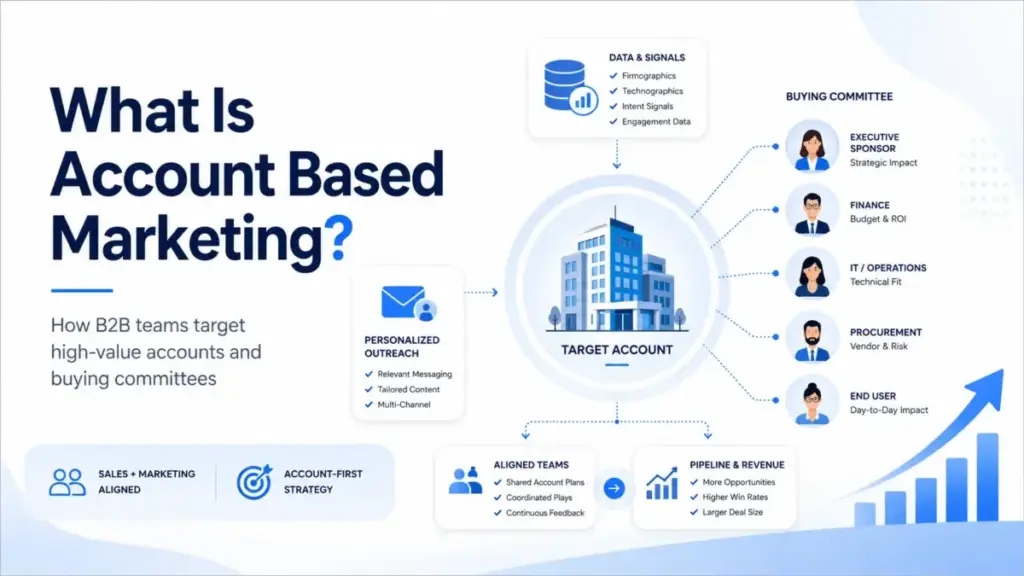
Account based marketing is a B2B strategy where sales and marketing teams select high-value target accounts, map the buying committee inside each account, and coordinate personalized campaigns around those specific companies. The term sounds like a tactic.
It is not. As Forrester’s Matt Senatore put it: “Account-based marketing is not a tactic, it’s not a technology, and it’s not a one-off program.” ABM is a go-to-market operating model, and the difference between running it well and wasting budget comes down to account selection, buying-committee coverage, sales follow-through, and measurement discipline.
This guide covers how ABM works, when to use it, when to avoid it, common mistakes, key metrics, and the platforms that enable ABM workflows. If your team evaluates marketing automation software or CRM-connected campaign tools, ABM changes how you think about pipeline.
Quick Answer: Account based marketing (ABM) is a B2B strategy that treats individual target accounts as focused markets. Sales and marketing align around named accounts, personalize outreach to buying committees, and measure success by account engagement, pipeline, and revenue, not lead volume alone.
The 60-Second Explanation of Account Based Marketing
Layer 1 (Simple): Instead of casting a wide net to capture as many leads as possible, ABM starts with a list of companies your team wants to win. Marketing and sales work together to reach the right people at those companies with messages built for their specific needs.
Layer 2 (Technical): ABM uses firmographic and technographic data, intent signals, and account scoring to identify and prioritize target accounts. Campaigns activate across advertising, email, web personalization, content syndication, events, and direct sales outreach. Progress tracks at the account level through engagement scores, buying-committee coverage, marketing qualified accounts (MQAs), and pipeline attribution.
Layer 3 (Business): ABM matters because B2B buying decisions involve committees of 5 to 12 stakeholders across procurement, operations, IT, and executive roles. A single form fill from one person does not represent a sales-ready account. ABM measures whether marketing reaches enough of the right people at the right companies to generate real pipeline, not just leads. According to a Mordor Intelligence market estimate, the ABM market sits at approximately $1.15 billion in 2026 with projections reaching $2.02 billion by 2031, though these are research estimates, not guaranteed market outcomes.
| Term | Definition | Key Difference from ABM |
|---|---|---|
| Demand generation | Broad audience capture through content, ads, and inbound channels | Starts with audience, not named accounts |
| Lead generation | Collecting individual contact information for sales follow-up | Measures leads, not account engagement |
| Account based advertising | Targeting ads to people at selected companies | A channel within ABM, not the full strategy |
| Inbound marketing | Attracting visitors through content and SEO | Can complement ABM but starts with traffic, not accounts |
How Account Based Marketing Actually Works
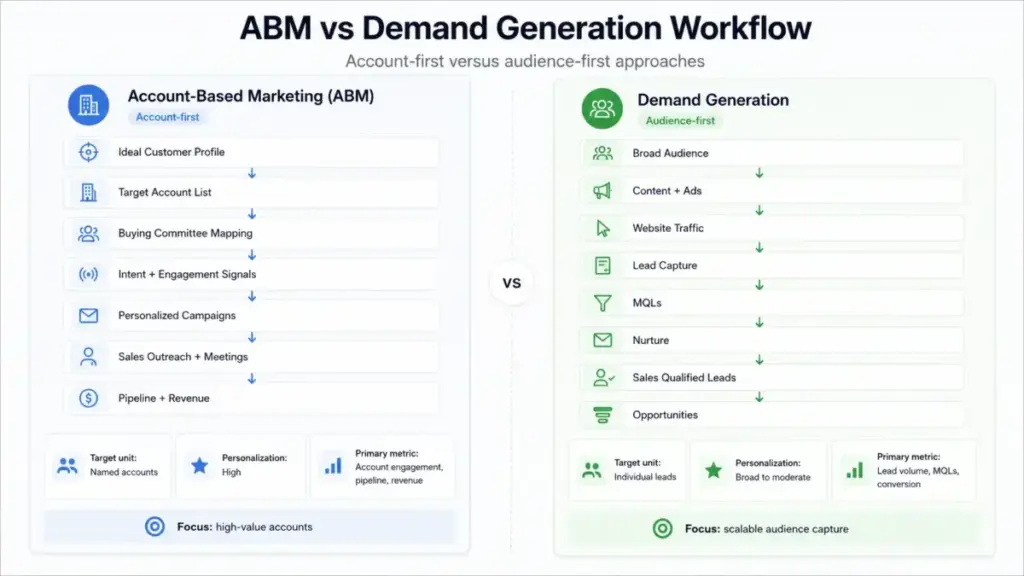
ABM follows an account-first pipeline. According to Demandbase’s ABM 101 guide, ABM flips the traditional funnel: instead of generating leads and qualifying them into accounts, ABM starts with defined target accounts and engages the buying committee within each one.
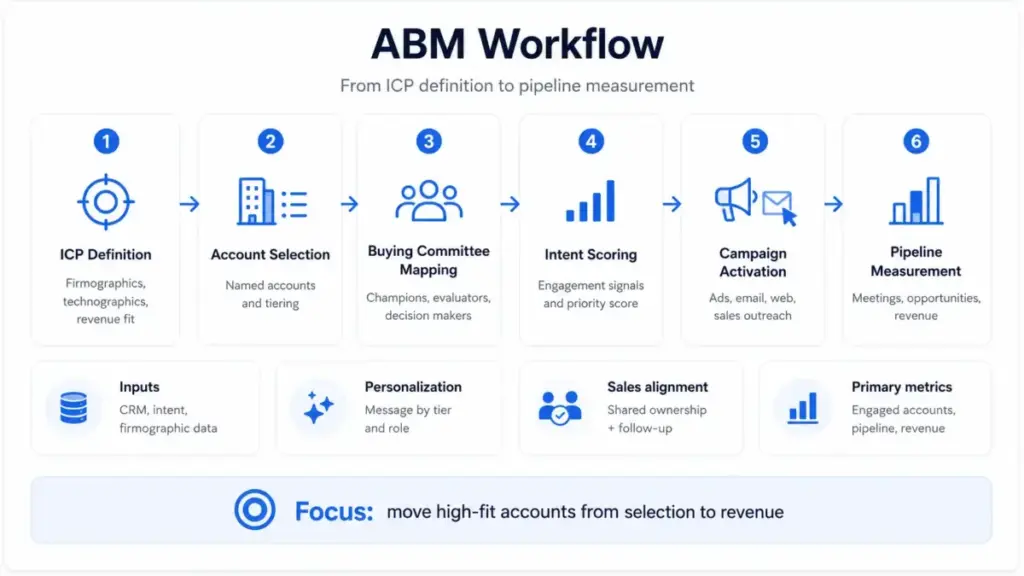
The workflow operates in six stages:
- Define the ideal customer profile (ICP). Use firmographics (industry, revenue, headcount), technographics (current software stack), historical win data, and sales input. The ICP is not a persona. It is a company-level profile.
- Build and tier the account list. Select named accounts and segment them into one-to-one (strategic), one-to-few (clustered), and one-to-many (programmatic) tiers based on deal value and personalization capacity.
- Map the buying committee. Identify 3 to 10 roles per account: economic buyer, technical evaluator, end user, champion, and blocker. A single contact is not a covered account.
- Enrich account data and score intent. Layer in intent signals (topic research surges), website visits, content downloads, event attendance, and CRM activity. Flag accounts showing active buying behavior.
- Activate coordinated campaigns. Run advertising, email sequences, web personalization, sales outreach, events, and content in timed waves. One-to-one accounts get custom assets. One-to-many accounts share modular messaging by segment.
- Measure and iterate. Track account engagement, meetings booked, opportunities created, pipeline influenced, win rate, deal size, and expansion revenue. Feed results back into ICP refinement and account selection.
Where it breaks: ABM fails at step 1 when sales and marketing disagree on the account list. It fails at step 3 when teams track one contact per account instead of mapping the committee. It fails at step 5 when marketing activates campaigns but sales does not follow up within the SLA window.
Account Based Marketing vs Demand Generation
The most common confusion in B2B marketing is treating ABM and demand generation as interchangeable. They are not.
Demand generation starts with broad audience capture. It measures leads, MQLs, and funnel conversion. ABM starts with named accounts. It measures account engagement, committee coverage, and pipeline from target accounts.
The two approaches can coexist. According to HubSpot’s ABM guide, ABM complements inbound marketing rather than replacing it. Inbound captures interest from unknown visitors. ABM concentrates resources on accounts with the highest revenue potential.
The practical difference: a demand generation program that generates 500 MQLs with 2% close rate produces 10 deals. An ABM program that engages 50 accounts with 20% close rate also produces 10 deals, but from higher-value accounts with larger contract sizes and longer customer lifetimes.
Neither approach is universally better. The right model depends on deal value, buyer complexity, and operational capacity.
Types of Account Based Marketing
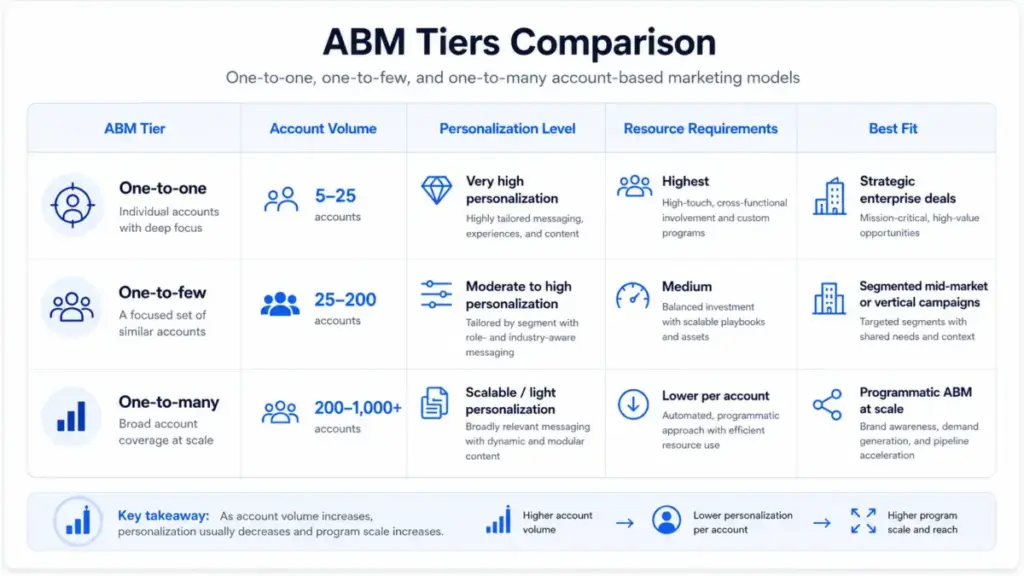
ABM operates across three tiers. Each tier requires different levels of personalization, sales involvement, and budget.
| ABM Type | Account Volume | Personalization Depth | Sales Effort | Content Needs | Best Use Case |
|---|---|---|---|---|---|
| One-to-one | 5-25 accounts | Fully custom per account | Dedicated account owner | Custom decks, microsites, executive outreach | Enterprise deals above $100K ACV |
| One-to-few | 25-200 accounts | Segment-specific by industry, use case, or size | Shared ownership with routing rules | Modular content by vertical or persona | Mid-market accounts with similar buying triggers |
| One-to-many | 200-1,000+ accounts | Dynamic personalization using data signals | Automated routing with manual follow-up | Scalable templates with dynamic fields | Programmatic pipeline generation for known ICPs |
Two additional ABM-adjacent concepts matter:
Account based advertising is a channel-level tactic, not a strategy. It targets ads to people at selected accounts. Advertising alone does not constitute ABM because it lacks sales coordination, buying-committee tracking, and pipeline measurement.
Account based experience (ABX) extends ABM beyond campaigns into website personalization, customer success motions, expansion plays, and renewal programs. ABX treats the full customer lifecycle as an account-level operation.
Step-by-Step: How to Start an ABM Program
Step 1: Define the business case
Clarify the goal: net-new enterprise acquisition, vertical penetration, customer expansion, or retention. ABM without a business case becomes a software purchase without a strategy.
Step 2: Build the ICP using data
Combine firmographics, technographics, revenue potential, existing customer patterns, and historical win rates. Involve both sales and marketing in ICP development. An ICP built by marketing alone generates a list sales will not trust.
Step 3: Select and tier accounts
Start small. A first ABM program with 25 to 50 accounts is more productive than a list of 500 accounts nobody can cover. Tier accounts into one-to-one, one-to-few, and one-to-many segments based on deal value and available resources.
Step 4: Map buying committees
For each account, identify the economic buyer, technical evaluator, end users, internal champion, and potential blockers. The goal is 3 to 5 mapped contacts per account minimum, not one name in a CRM record.
Step 5: Clean your CRM data
Account ownership, company domains, contact roles, lifecycle stages, and opportunity records need to be accurate before ABM campaigns launch. Dirty data creates misrouted leads, duplicate outreach, and unreliable measurement.
Step 6: Define triggers and account journey stages
Map the signals that indicate account readiness: intent surges, repeated website visits, content engagement, event registration, sales activity, and opportunity changes.
Step 7: Create segment-specific messaging
Build proof points, ads, email sequences, landing pages, and sales plays by segment. One-to-one accounts need custom assets. One-to-few and one-to-many accounts use modular templates with dynamic personalization.
Step 8: Activate campaigns in coordinated waves
Sequence advertising, email, web personalization, sales outreach, events, and retargeting. Coordination matters more than channel volume. An ad without a sales follow-up is a wasted impression.
Step 9: Set sales follow-up SLAs
Define rules: how quickly sales responds to engaged accounts, who owns which accounts, meeting booking targets, opportunity creation timelines, and feedback loops to marketing.
Step 10: Measure at the account level
Track engagement, committee coverage, meetings, pipeline, win rate, deal size, and expansion revenue. Do not measure ABM with lead-volume metrics.
The Mistakes That Waste Your First 6 Months
- Choosing accounts because sales likes them, not because data supports them. An account list built on relationships without ICP validation produces low-fit pipeline.
- Measuring leads instead of account engagement. ABM success tracks buying-committee coverage and account-level pipeline, not individual form fills.
- Buying ABM software before defining the process. Software accelerates a working ABM motion. It does not create one from scratch.
- Over-personalizing before proving fit. Custom content for every account is expensive. Start with one-to-few segmentation and invest in one-to-one only for accounts that show strong engagement signals.
- No sales follow-up rules. Marketing generates engaged accounts. Without a defined SLA for sales response, those accounts go cold.
- Ignoring existing customers. ABM applies to expansion, cross-sell, and renewal motions, not only net-new acquisition. According to Optimizely’s ABM glossary, ABM can target existing accounts for upsell and cross-sell opportunities.
- Treating ABM as an ad campaign. Account based advertising is one channel. ABM requires coordinated sales outreach, content, events, and measurement.
Common Misconceptions About Account Based Marketing
Misconception: ABM is the same as demand generation with better targeting.
Reality: Demand generation captures broad audiences and qualifies them into leads. ABM starts with named accounts and measures account-level engagement, not lead volume.
Misconception: ABM means buying an ABM platform.
Reality: Software helps with data enrichment, intent signals, advertising activation, and measurement. ABM depends first on account selection, messaging, sales alignment, and disciplined follow-through.
Misconception: ABM only works for net-new enterprise acquisition.
Reality: ABM supports customer expansion, cross-sell, retention, and renewal motions for existing strategic accounts.
Misconception: ABM requires fully custom creative for every single account.
Reality: One-to-one ABM may need custom assets for a small number of strategic accounts. One-to-few and one-to-many programs use modular messaging by segment, persona, or buying stage.
When to Use ABM and When to Avoid It
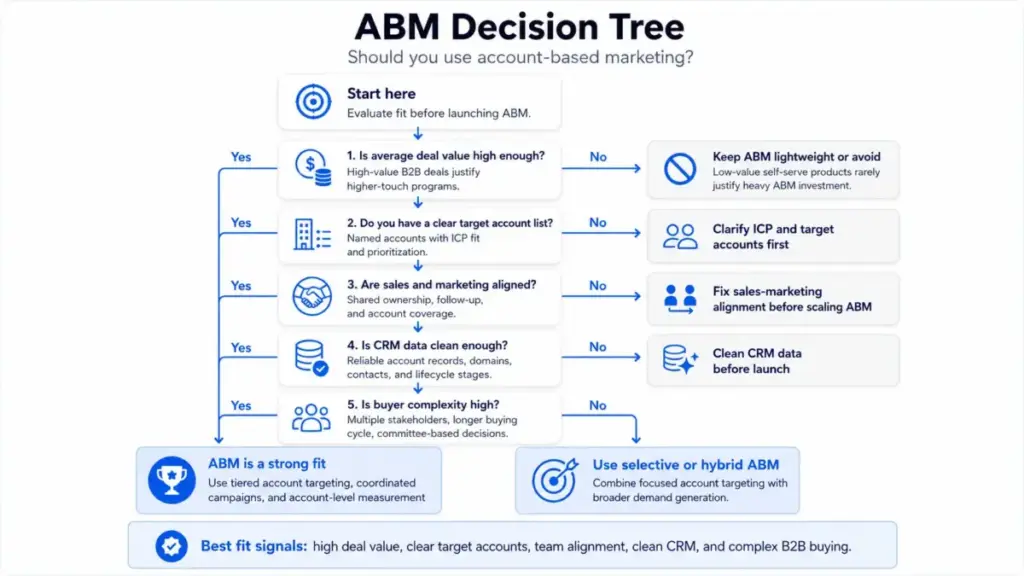
Use ABM when:
- Average deal value exceeds $15K-$25K annually
- The buyer is a company with a multi-person buying committee
- The addressable account list is knowable and finite
- Sales and marketing can coordinate on account ownership and follow-up
- Winning fewer, higher-fit accounts is more valuable than volume lead capture
Avoid ABM when:
- The product is low-price self-serve (under $100/month)
- The audience is too broad to identify named accounts
- Deal value cannot support the cost of personalized campaigns
- CRM data quality is poor and no one will clean it
- Sales will not commit to follow-up SLAs
- The team lacks content production and operational capacity
According to Oracle’s ABM page, strategic accounts should have strong revenue potential because ABM programs cost more per account than broad marketing.
How to Measure ABM Success
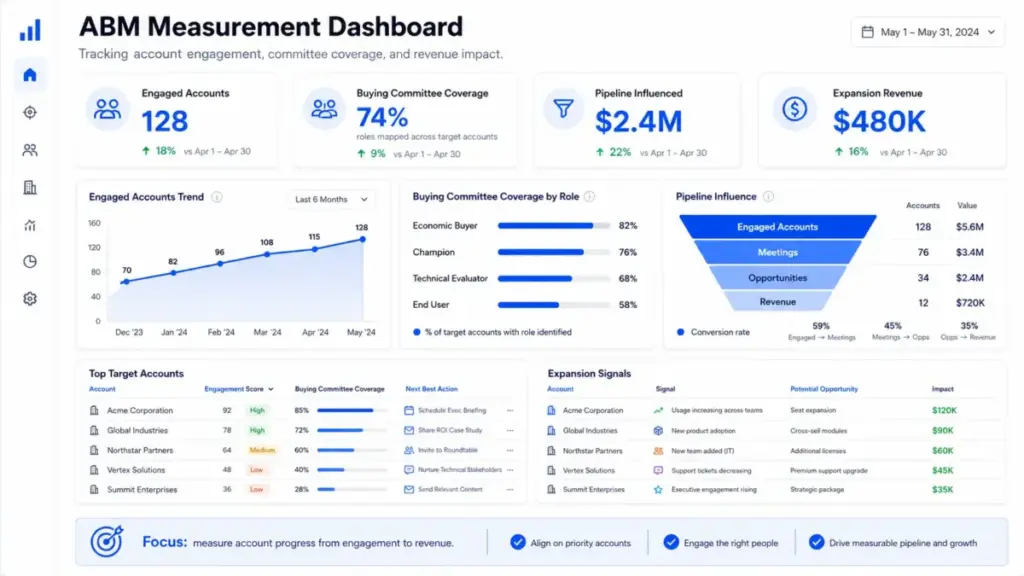
ABM metrics operate across five stages, from early engagement through revenue and expansion.
| Stage | Metric | Why It Matters |
|---|---|---|
| Engagement | Target account website visits, ad impressions, content downloads | Signals awareness and early interest |
| Coverage | Buying committee contacts identified, roles mapped per account | Determines whether marketing reaches the full committee |
| Activation | Meetings booked, sales accepted accounts, account penetration rate | Shows whether engagement converts to sales conversations |
| Pipeline | Opportunities created, pipeline value, deal velocity, win rate | Measures revenue impact from ABM-sourced and ABM-influenced deals |
| Expansion | Cross-sell revenue, upsell pipeline, renewal rate, customer lifetime value | Tracks post-sale ABM impact on existing accounts |
The ABM Leadership Alliance and Momentum ITSMA benchmark report reported improved account engagement, pipeline growth, and revenue among surveyed ABM programs, though these are benchmark findings, not guaranteed outcomes for every team.
What Good ABM Looks Like: Platform Examples
ABM platforms provide the data, automation, advertising, and measurement layers that support ABM at scale. Pricing in this category is often opaque, and separating software cost from media spend matters.
| Platform | Core ABM Function | Pricing Status (as of May 2026) |
|---|---|---|
| Demandbase One | Account selection, intent analysis, ad activation, sales insights, revenue measurement | Custom pricing;pricing page describes platform fee plus flat per-user fee |
| 6sense Revenue AI | Intent signals, predictive modeling, anonymous visitor identification, ABM advertising, workflow automation | Full ABM platform pricing is not clearly listed publicly;Sales Intelligence pricing has separate tiers |
| AdRoll ABM | Account-based advertising, buyer signals, Salesforce-connected workflows, multichannel campaigns | Advertising pricing uses dynamic CPM; Salesforce AppExchange listing shows a package starting at $975/month (listing-based, not universal) |
| HubSpot ABM Software | Target account dashboards, workflows, account prioritization, LinkedIn Sales Navigator integration, ABM reporting | CRM-native ABM inside HubSpot ecosystem;Marketing Hub pricing starts at $10/seat/month (Starter), $890/month (Professional), $3,600/month (Enterprise), with contact tier costs scaling separately |
| Terminus ABM Platform | Target account engagement, campaign orchestration, account insights, sales-marketing coordination | Pricing is not publicly listed;official pages direct buyers to request a demo |
A customer quote on AdRoll’s ABM page from Snowflake notes: “We’re achieving a 50 percent new opportunity rate with existing customers we target with ABM.” This reflects a specific customer result, not a universal ABM benchmark.
Matt Heinz of Heinz Marketing, cited on Demandbase’s ABM 101 page: “Know why you’re doing it and what success looks like before you start.”
The honest caveat: Enterprise ABM platforms (Demandbase, 6sense, Terminus) typically involve custom pricing, media spend budgets, and implementation costs that add up beyond the subscription fee. For teams not ready for enterprise platforms, HubSpot’s CRM-native ABM features or a lightweight approach using CRM, spreadsheets, LinkedIn, and focused sales coordination can deliver results at lower cost and complexity.
When You Need ABM Software
Signals you need dedicated ABM software:
- Your target account list exceeds 100 accounts
- You need intent data to prioritize accounts showing buying signals
- Your team runs advertising campaigns targeted at specific companies
- Sales needs account-level engagement dashboards inside the CRM
- You measure pipeline by account, not just by individual lead
- Your revenue operations team needs attribution data across marketing and sales touchpoints
Signals you do not need ABM software yet:
- Your target list is under 50 accounts and manageable in a spreadsheet plus CRM
- Your average deal value does not justify the platform cost
- Sales and marketing have not agreed on an ICP or account follow-up process
How to Choose the Right ABM Tool
- Start with the workflow, not the software. Define your ICP, account list, and measurement model before evaluating platforms.
- Separate advertising cost from platform cost. ABM tools often bundle media spend with subscription fees.
- Check CRM integration depth. ABM data that does not flow into your CRM system creates a visibility gap for sales.
- Evaluate intent data quality. Not all intent signals are equal. Ask vendors how they source intent data and what coverage looks like for your industry.
- Assess pricing transparency. If a vendor requires a demo before showing any pricing, factor in negotiation time and budget uncertainty.
- Match platform complexity to team maturity. Enterprise platforms require dedicated ABM operators. CRM-native options (HubSpot) work for teams building their first ABM motion.
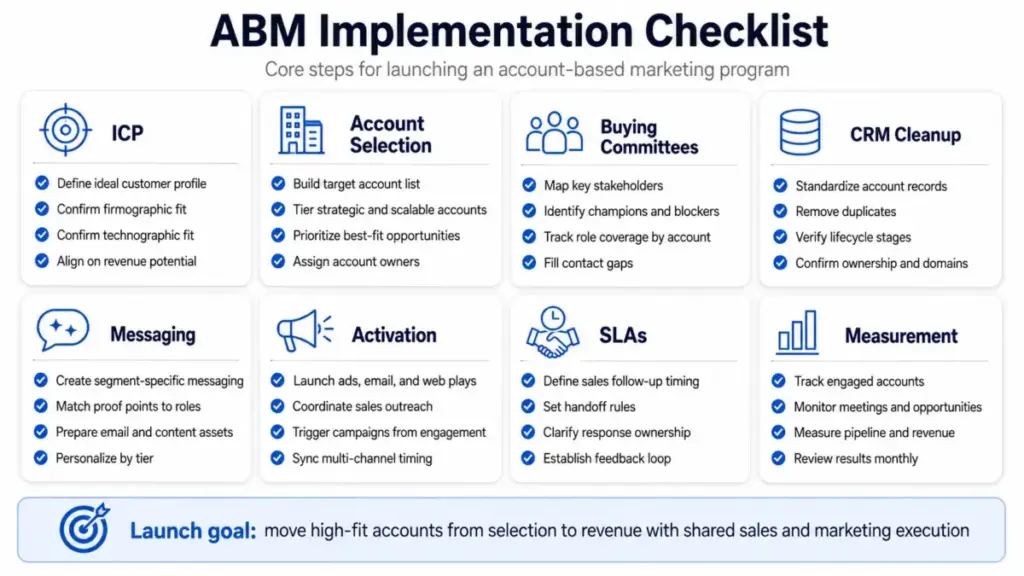
ABM Starter Checklist
- [ ] Define the business case (acquisition, expansion, or retention)
- [ ] Build the ICP with firmographic, technographic, and win-rate data
- [ ] Select 25-50 target accounts and tier them
- [ ] Map 3-5 buying committee roles per account
- [ ] Clean CRM data: account ownership, domains, contacts, and lifecycle stages
- [ ] Create 3 segment-specific message frameworks
- [ ] Set sales follow-up SLAs (response time, meeting targets, feedback loops)
- [ ] Choose measurement metrics: engagement, coverage, pipeline, and revenue
- [ ] Run a 90-day pilot before scaling
- [ ] Review results monthly and refine account list quarterly
Related Resources
- Best CRM software for sales teams
- What is customer segmentation?
- What is customer churn?
- What is lead scoring?
FAQ
What is account based marketing in simple terms?
Account based marketing is a B2B strategy where marketing and sales teams focus on a defined list of high-value companies instead of broad lead generation. Each target account receives personalized outreach coordinated across advertising, email, content, and sales activity.
How does account based marketing differ from demand generation?
Demand generation starts with broad audience capture and qualifies leads into sales opportunities. ABM starts with named accounts and measures account-level engagement, buying-committee coverage, and pipeline. The two can work together, but they use different targeting logic and success metrics.
Can small SaaS companies use ABM?
Yes. A small team can run ABM with 25-50 accounts using CRM, spreadsheets, LinkedIn, email, and focused sales follow-up. Enterprise ABM platforms are not required. The discipline matters more than the tooling.
What are the three types of ABM?
One-to-one ABM targets 5-25 strategic accounts with fully custom campaigns. One-to-few ABM clusters 25-200 similar accounts by industry or use case. One-to-many ABM uses programmatic personalization for 200-1,000+ accounts.
What metrics measure ABM success?
Core ABM metrics include target account engagement, buying-committee coverage, meetings booked, opportunities created, pipeline influenced, win rate, average contract value, and expansion revenue. Lead volume alone does not measure ABM performance.
Do you need ABM software to run ABM?
No. ABM is a strategy, not a software category. Small teams can run effective programs using CRM, manual research, and sales coordination. Dedicated ABM platforms (Demandbase, 6sense, HubSpot ABM, AdRoll ABM, Terminus) add intent data, advertising automation, and measurement at scale.
When should you not use account based marketing?
Avoid ABM when average deal value is low, the audience is too broad to name accounts, CRM data quality is poor, sales will not follow up, or the team lacks operational capacity. Self-serve products under $100/month rarely justify ABM investment.
Is account based advertising the same as ABM?
No. Account based advertising targets ads to people at selected companies. It is one channel within ABM. Full ABM includes sales coordination, buying-committee mapping, content personalization, measurement, and follow-up across multiple channels.
How many accounts should be in an ABM list?
Start with 25-50 for a first program. Mature programs run 200-1,000+ accounts across tiers. The right number depends on deal value, team capacity, and available budget. A list too large to cover with personalized follow-up is not an ABM list.
How long does ABM take to show results?
Most ABM programs need 90 to 180 days to generate measurable pipeline. Early signals (engagement, meetings) appear faster. Revenue results require a full sales cycle. ABM is a sustained operating model, not a short-term campaign.
This guide synthesizes official product documentation, vendor ABM frameworks, analyst perspectives, and practitioner resources verified as of May 2026. ABM platform pricing and features are subject to change. Check official pricing pages for current rates.