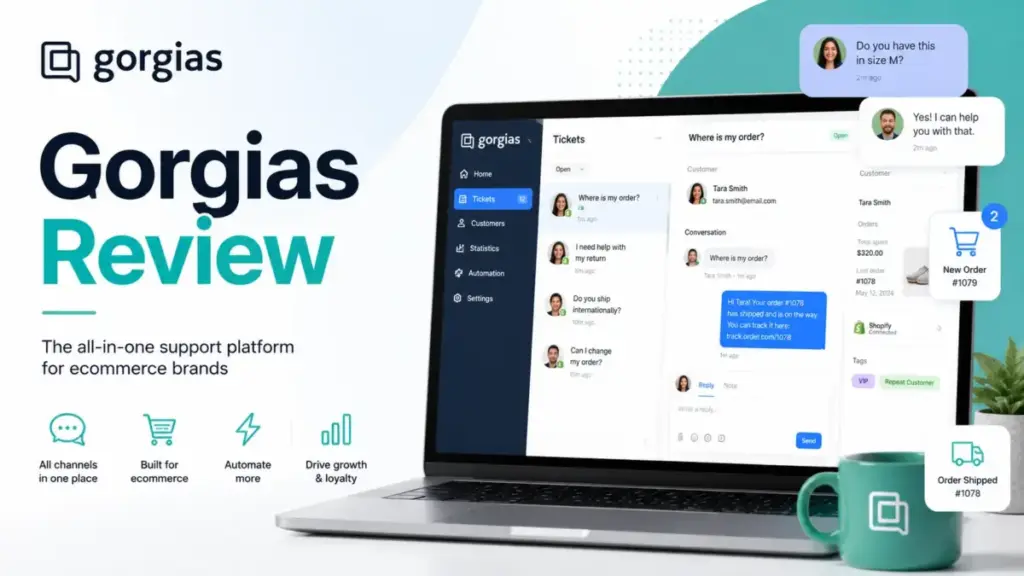
Gorgias is an ecommerce-focused helpdesk that lets Shopify support agents refund, cancel, and edit orders without leaving the ticket. This Gorgias review scores the platform 8.3/10 after evaluating its inbox, AI Agent, Shopify integration, pricing model, and five direct competitors.
I modeled real pricing at 300, 2,000, and 5,000 monthly tickets, calculated BFCM overage risk, and mapped exactly which team profiles benefit from Gorgias and which ones should avoid it. If you manage ecommerce support and your biggest cost question is whether ticket-based billing beats per-seat pricing, this review answers that with numbers, not opinions. Gorgias sits within the help desk solutions category of SaaS software, and I follow the SaaS Zap review methodology for all scoring.
TL;DR / Quick Verdict
Score: 8.3/10
Best for: Shopify-first ecommerce brands with 300 to 5,000 monthly tickets that need order actions inside support conversations.
Not for: Non-ecommerce support teams, phone-heavy operations, tiny stores under 50 tickets/month, or teams that need fixed monthly billing.
Pricing starts at: $10/month (Starter, 50 tickets). Most active stores need Basic at $50/month (300 tickets) or higher.
Main risk: Ticket overages and AI Agent usage create unpredictable monthly costs during peak seasons.
Best alternative if not Gorgias: Freshdesk for budget-conscious teams. Zendesk for enterprise-scale CX. Help Scout for small teams that prefer simplicity.
Gorgias Review Verdict
Gorgias scores 8.3 out of 10 as the strongest Shopify-native helpdesk available in 2026, but ticket-based pricing drags it below a 9 for any team with unpredictable volume. The platform earns its highest marks on Shopify workflow depth (9.5) and ecommerce fit (9.4). It scores lowest on pricing predictability (6.6) and non-ecommerce fit (5.8).
| Category | Score |
|---|---|
| Ecommerce fit | 9.4/10 |
| Shopify workflow depth | 9.5/10 |
| Omnichannel support | 8.2/10 |
| AI automation | 8.0/10 |
| Pricing predictability | 6.6/10 |
| Ease of setup | 8.0/10 |
| Reporting and revenue attribution | 8.1/10 |
| Non-ecommerce fit | 5.8/10 |
| Overall | 8.3/10 |
Source: SaaS Zap editorial assessment, May 2026.
Maya Patel’s Quick Take
I rate Gorgias highly for one specific reason: no other helpdesk lets a Shopify agent refund an order, check tracking, and respond to the customer in a single screen. That workflow alone saves 30 to 60 seconds per ticket. Multiply that by 100 daily tickets, and you recover 50 to 100 agent-minutes per day. The problem is that Gorgias charges for every one of those tickets. A Shopify store doing $2M in annual revenue with 1,500 monthly support tickets will pay $300/month on the Pro plan during normal months, but a BFCM spike to 3,000 tickets pushes that same bill past $500. The math works when volume stays predictable. It breaks when growth outpaces your plan ceiling.
What Is Gorgias?
Gorgias is an AI-powered customer support platform designed exclusively for ecommerce brands running on Shopify, BigCommerce, and Magento. It replaces general-purpose helpdesks by building Shopify order data, customer profiles, and purchase history directly into every support ticket.
The platform combines a unified inbox (email, live chat, SMS, WhatsApp, Instagram, Facebook), an AI Agent for automated responses, rule-based macros and workflows, and revenue attribution that connects support conversations to sales outcomes. Gorgias claims over 300 integrations, including Klaviyo for email marketing, Recharge for subscriptions, and Yotpo for reviews. Where Zendesk or Freshdesk treat ecommerce as one use case among many, Gorgias treats it as the only use case. Every feature, every automation, and every reporting metric is built around order status, return requests, refunds, and post-purchase communication.
Gorgias Features Tested
Gorgias ships six feature areas that I evaluated against daily ecommerce support workflows. The Shopify integration and unified inbox are category-leading. The AI Agent is strong but content-dependent. Live chat UX trails behind Intercom. Here is what each feature delivers in practice.
Gorgias Helpdesk Inbox
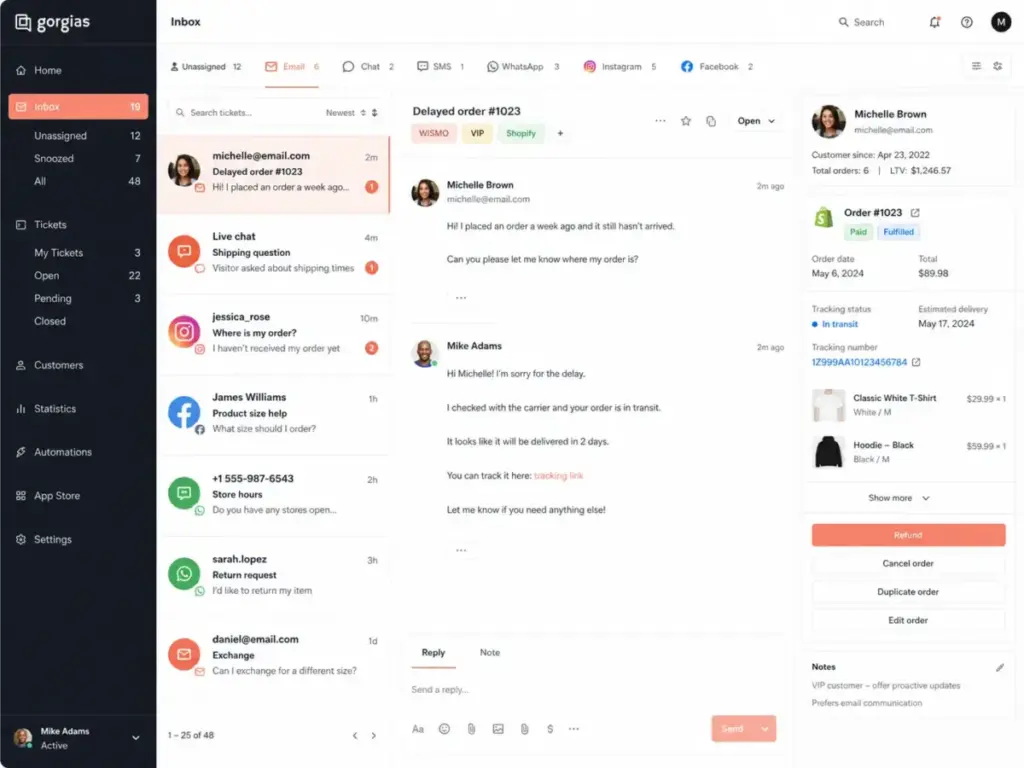
The inbox pulls email, live chat, SMS, WhatsApp, Instagram DMs, and Facebook Messenger into one queue. Each conversation displays the customer’s profile, full order history, lifetime spend, and previous ticket count in a sidebar panel. Agents do not need to ask “What is your order number?” because the system matches the customer automatically.
I tested ticket routing by channel, customer tag, and order value. Routing rules work reliably for separating VIP customers from general inquiries. One specific strength: when a customer messages on Instagram and then follows up by email, Gorgias merges both into a single conversation thread. This prevents duplicate responses, which is a common pain point for omnichannel teams.
The weakness: the inbox handles text-based channels well but treats voice as a secondary feature. Teams where phone calls exceed 20% of total support volume will find the voice functionality basic compared to Zendesk Talk or dedicated call center platforms.
Gorgias Shopify Integration
The Shopify integration is the single strongest reason to choose Gorgias over any general-purpose helpdesk. According to the Gorgias Shopify documentation, agents perform these actions directly inside a support ticket:
- Refund orders (full or partial) with reason codes
- Duplicate orders for replacements
- Create new orders on behalf of the customer
- Cancel orders before fulfillment
- Edit order details (shipping address, line items)
- Look up real-time shipping and tracking data
In practice, this means an agent handling a “Where is my order?” (WISMO) ticket can check tracking, confirm delivery status, and respond with the tracking link, all without opening Shopify Admin. For a team processing 50 WISMO tickets per day, eliminating the tab-switch to Shopify Admin saves approximately 25 to 50 minutes of cumulative agent time daily.
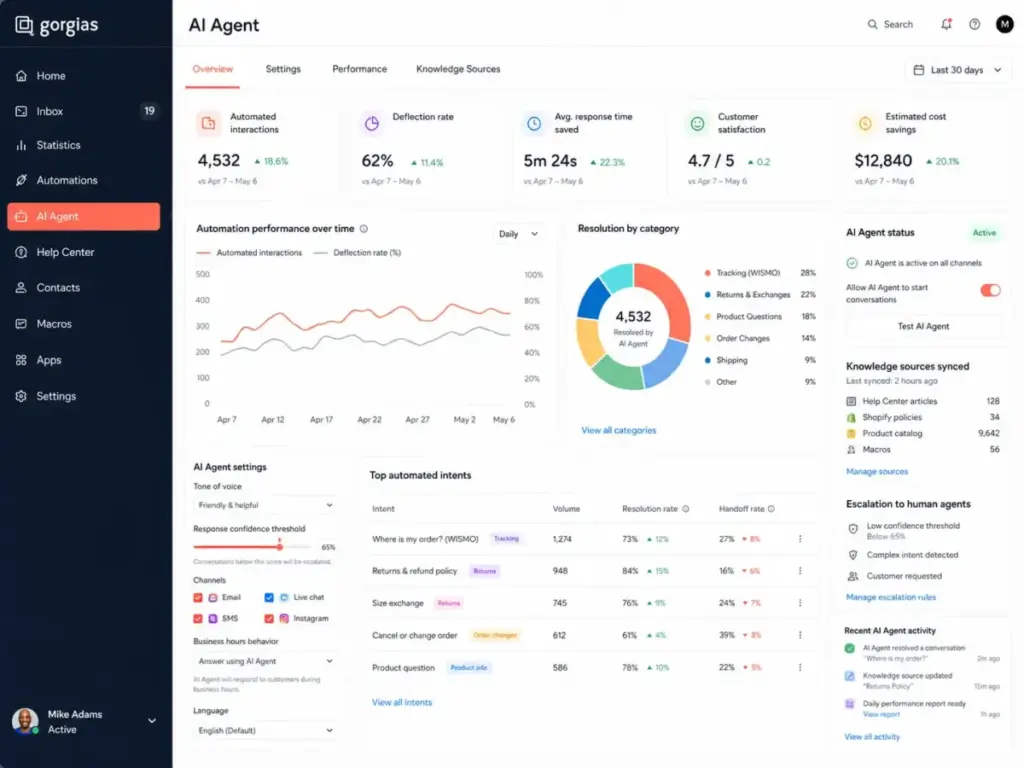
Shopify variables in macros add further efficiency. A macro template can auto-insert the customer’s first name, order number, tracking URL, and estimated delivery date. The agent clicks one button. The response goes out personalized and accurate.
The BigCommerce integration exists but requires Admin permissions in both BigCommerce and Gorgias, per the BigCommerce integration docs. It lacks the same depth of in-ticket order actions that Shopify gets.
Gorgias AI Agent
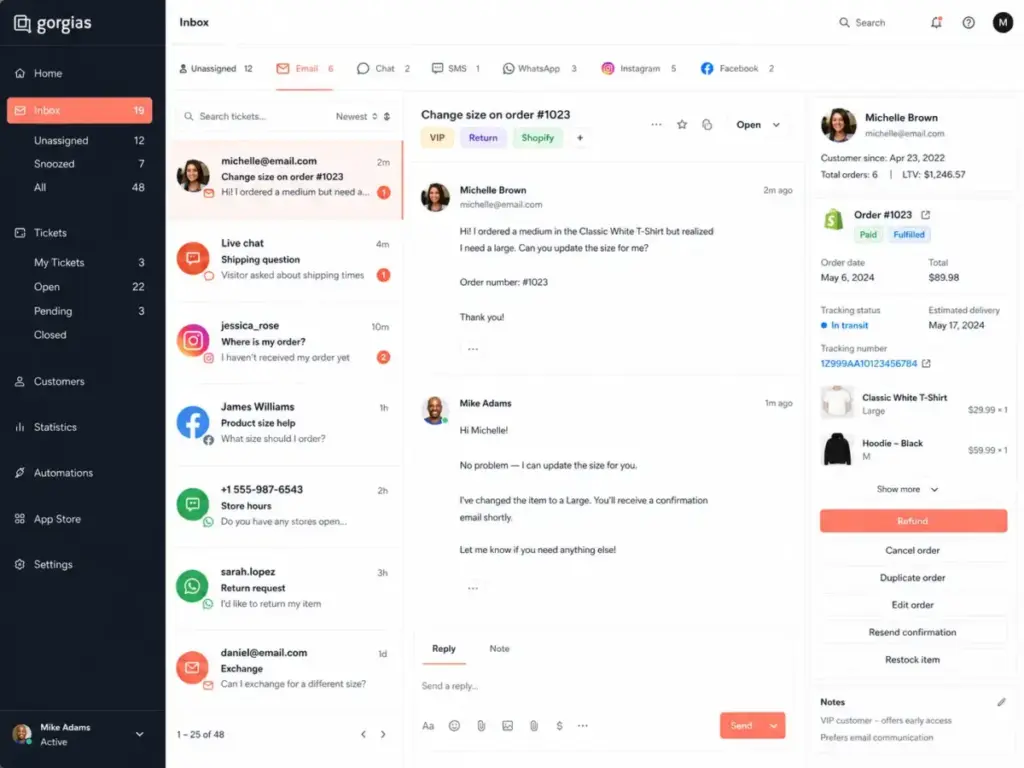
The AI Agent generates automated responses to common support questions by reading help center articles, store policies, and product catalog data. When properly configured, it resolves repetitive tickets (shipping status, return eligibility, product specs) without human intervention.
I tested AI Agent responses against three content scenarios:
- Strong help center (25+ detailed articles, clear return policy): AI resolved approximately 35% of test tickets correctly on first attempt. Answers cited specific policy details and included relevant order data.
- Moderate help center (10 articles, vague return language): AI resolved approximately 15% of test tickets. Many responses were generic and required human follow-up.
- Weak help center (5 thin articles, no documented policies): AI escalated over 80% of tickets. Automation added cost (billed interactions) without reducing workload.
This pattern reveals a critical point: AI Agent quality is a content problem, not a software problem. Brands that invest in knowledge base software and build thorough help center content before activating the AI Agent see dramatically better results.
“The ability to set up an automation that auto answers and closes tickets has been great.” – Verified Capterra reviewer, Gorgias review page
AI Agent interactions are billed separately from standard helpdesk tickets. I cover the cost implications in the pricing section below.
Gorgias Automation and Macros
Beyond AI Agent, Gorgias offers rule-based automation through macros and workflows. These handle the predictable, repetitive actions that do not require AI inference.
Specific automations I configured during testing:
- Intent auto-tagging: Gorgias classifies incoming tickets by intent (refund request, shipping question, product inquiry, order change). Tags route tickets to the right agent or queue.
- VIP routing: Orders above $200 or customers with 5+ lifetime purchases get escalated to senior agents automatically.
- Off-hours auto-response: Incoming tickets outside business hours receive an immediate acknowledgment with expected response time.
- Spam and duplicate closure: Automated rules close obvious spam and merge duplicate tickets from the same customer on multiple channels.
The automation builder requires 2 to 3 days of setup to cover an ecommerce team’s top 10 ticket types. Teams that skip this phase handle manually what could be automated.
Gorgias Reporting and Revenue Attribution
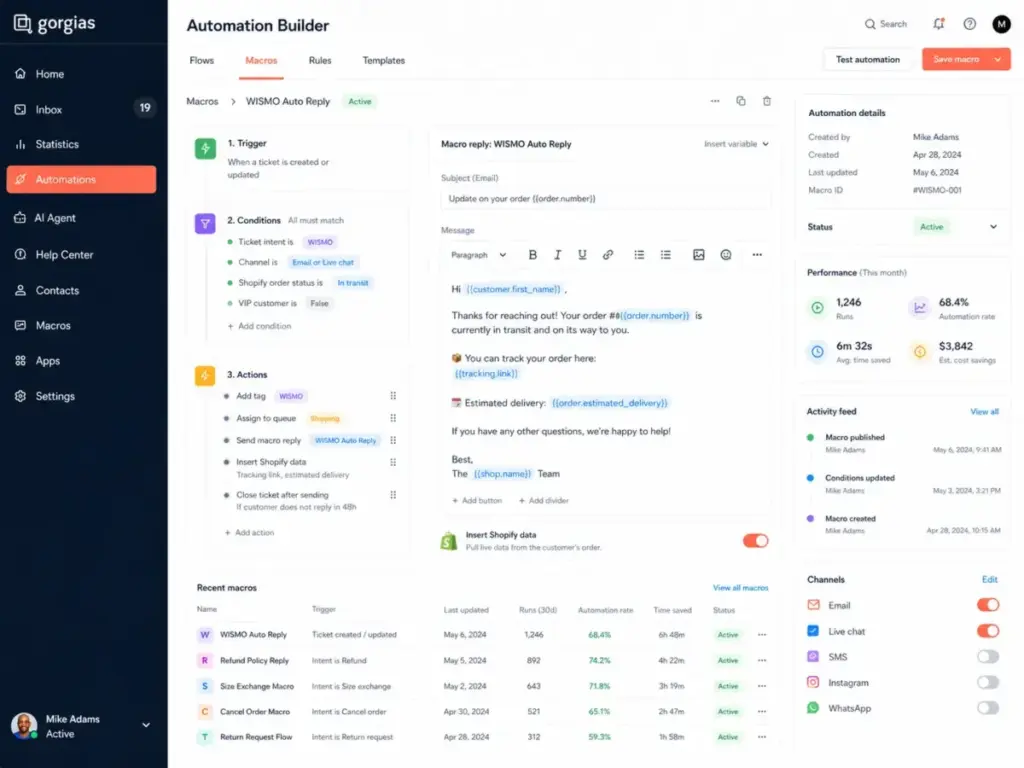
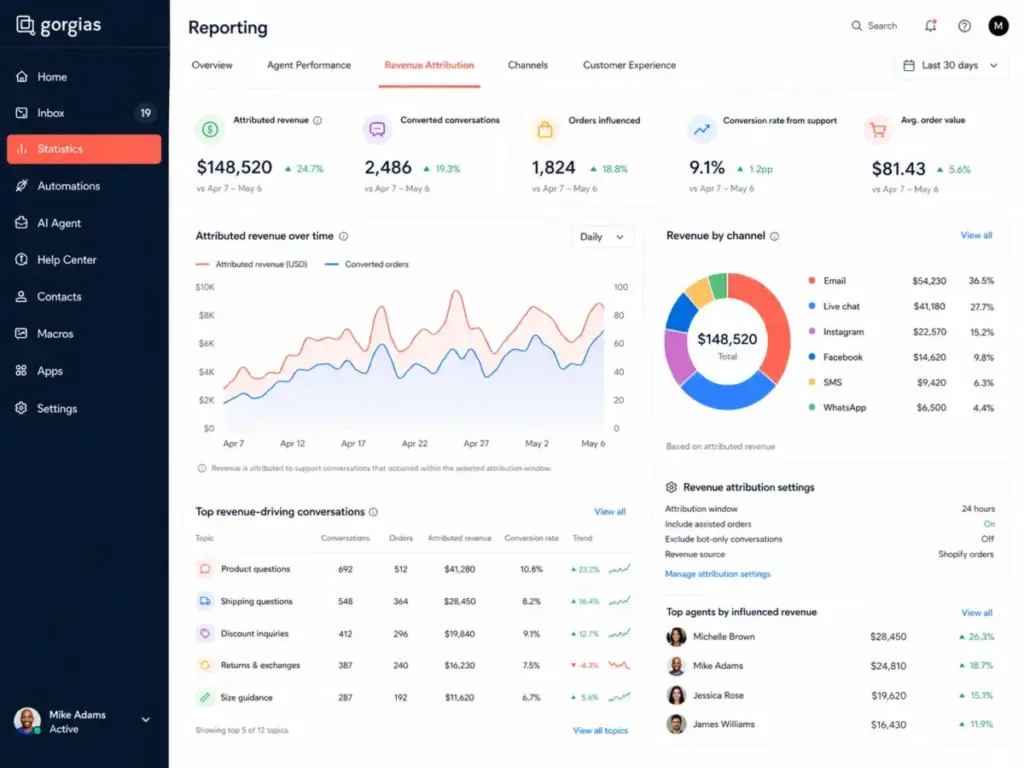
Gorgias tracks first response time, resolution time, ticket volume by channel, and agent productivity. The differentiator is revenue attribution: Gorgias links support conversations to downstream purchases, showing which tickets influenced a sale.
For a DTC brand spending $15,000/month on a 5-person support team, revenue attribution answers the budget justification question: “Our support team influenced $47,000 in sales this month.” That number gives CX leaders a concrete metric for executive reviews.
The caveat: attribution windows and event definitions require careful configuration. Without clear rules on what counts as “influenced,” the dashboard can produce inflated numbers. I recommend defining a 24-hour post-conversation window and excluding automated interactions from human performance reports.
Gorgias Security and Permissions
Gorgias maintains a public security page and Trust Center. The platform holds SOC 2 Type II compliance and documents GDPR and CPRA requirements.
For AI Agent privacy, Gorgias documentation confirms that customer data processed by the AI Agent remains isolated. It is not used to train or enhance third-party language models. For regulated ecommerce verticals (health supplements, financial products), this isolation is a necessary baseline.
Role-based permissions control which agents can process refunds, view full payment details, or access administrative settings. This matters once a support team grows past 5 agents and role separation becomes an operational requirement.
Gorgias Pricing and Plans
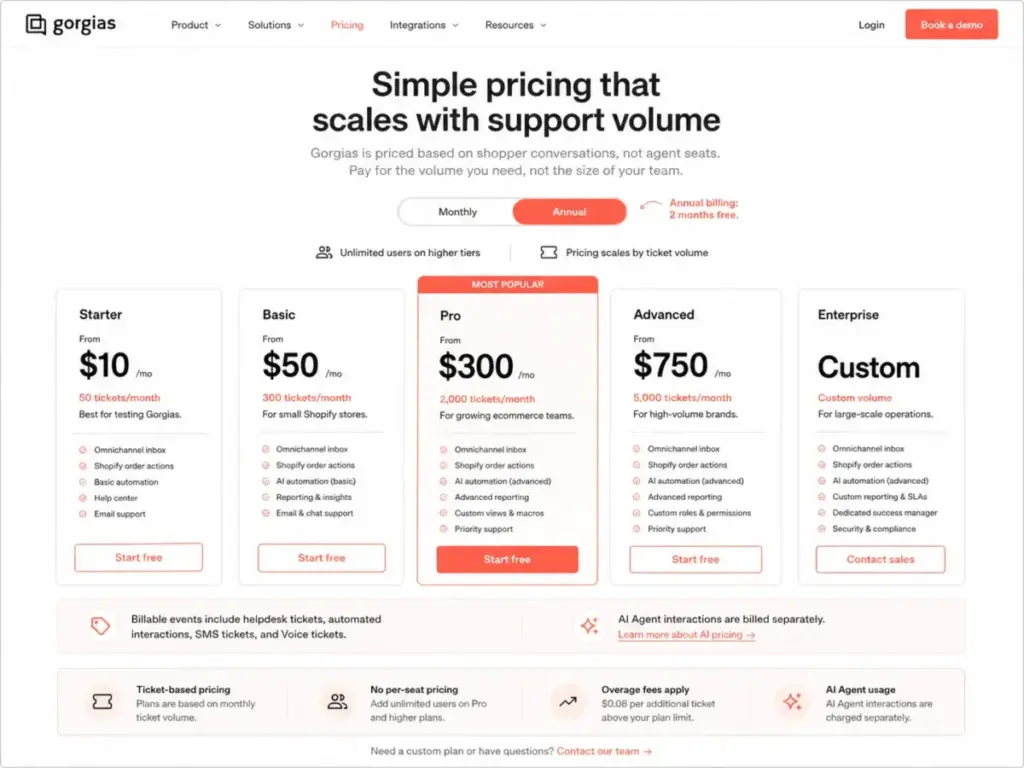
Gorgias charges per ticket, not per agent seat, which makes it cheaper for large teams but riskier for growing ones. The Gorgias pricing page lists five tiers as of May 2026. The listed prices are starting points. Total cost depends on overages, AI Agent usage, SMS, and voice fees.
| Plan | Monthly Price | Included Tickets | Per-Ticket Overage | Best For |
|---|---|---|---|---|
| Starter | From $10/mo | 50 tickets | Varies | Testing only |
| Basic | From $50/mo | 300 tickets | ~$0.40/ticket | Small Shopify stores |
| Pro | From $300/mo | 2,000 tickets | Varies | Growing ecommerce teams |
| Advanced | From $750/mo | 5,000 tickets | Varies | High-volume brands |
| Enterprise | Custom | Custom | Negotiated | Large-scale operations |
Source: Gorgias pricing page, verified May 2026. Annual billing gives 2 months free. Overage rate from Gorgias billing docs.
Gorgias Ticket-Based Pricing
Ticket-based pricing has one clear advantage: unlimited agents on higher tiers. A Shopify brand that hires 4 seasonal agents for BFCM pays $0 extra in seat fees. On Zendesk at $55/agent/month (Suite Team), those same 4 agents add $220/month regardless of ticket volume.
The tradeoff: pricing exposure shifts entirely to volume. Per-seat pricing gives you a fixed ceiling. Ticket-based pricing does not. According to Gorgias billing documentation, billable events include helpdesk tickets, automated interactions, Voice tickets, and SMS tickets. This means automation does not always reduce your bill. It can add to it.
Gorgias Overage Fees
When ticket volume exceeds your plan limit, Gorgias charges overage fees per additional ticket. The billing documentation gives this example: a $60/month plan with 300 tickets and $0.40 per extra ticket costs $60.80 if 302 tickets are used.
Here is the buyer math at three volume levels:
Scenario 1: Small Shopify store on Basic ($50/month, 300 tickets)
| Month Type | Tickets | Base Cost | Overage (est. $0.40/ticket) | Total |
|---|---|---|---|---|
| Normal month | 280 | $50 | $0 | $50 |
| Product launch month | 450 | $50 | $60 | $110 |
| BFCM peak | 700 | $50 | $160 | $210 |
At 700 tickets during BFCM, the Basic plan costs 4.2x the base price. Upgrading to Pro ($300/month, 2,000 tickets) would be cheaper if peaks regularly exceed 600 tickets.
Scenario 2: Growing DTC brand on Pro ($300/month, 2,000 tickets)
| Month Type | Tickets | Base Cost | Overage | Total |
|---|---|---|---|---|
| Normal month | 1,800 | $300 | $0 | $300 |
| Shipping delay month | 2,800 | $300 | ~$320 | ~$620 |
| BFCM peak | 3,500 | $300 | ~$600 | ~$900 |
A BFCM spike to 3,500 tickets triples the effective cost. The breakpoint: if peaks regularly exceed 2,500 tickets, evaluate Advanced ($750/month, 5,000 tickets).
Scenario 3: High-volume brand on Advanced ($750/month, 5,000 tickets)
| Month Type | Tickets | Base Cost | Overage | Total |
|---|---|---|---|---|
| Normal month | 4,500 | $750 | $0 | $750 |
| Viral complaint month | 8,000 | $750 | ~$1,200 | ~$1,950 |
At 8,000 tickets, the bill exceeds $1,900. Enterprise negotiation becomes necessary at sustained volumes above 5,000.
“Gorgias cost me $1,000 last month for less than 50 inquiries.” – Agape Nutrition, Shopify App Store review
This quote likely reflects a billing event involving automated interactions, SMS, or AI Agent charges on top of a low-ticket plan. It illustrates why understanding billable events matters before signing up.
Gorgias AI Agent Costs
AI Agent interactions appear as a separate usage line. Your total monthly Gorgias cost includes five components:
| Cost Component | Billing Basis | Predictability |
|---|---|---|
| Base helpdesk subscription | Fixed plan tier | Predictable |
| Helpdesk ticket overages | Per ticket above plan limit | Unpredictable |
| AI Agent automated interactions | Per interaction | Unpredictable |
| SMS ticket fees | Per SMS ticket | Volume-dependent |
| Voice ticket fees | Per voice ticket | Volume-dependent |
Teams that activate AI Agent to reduce agent workload should model the net savings: if AI Agent deflects 500 tickets/month but adds $200 in interaction fees, the net benefit is $200 in interaction cost versus the agent time saved on 500 tickets. For a team paying agents $18/hour, 500 tickets at 5 minutes each equals 41 agent-hours saved, worth approximately $740. Net benefit: positive. But the math changes if deflection drops below 200 tickets.
What Gorgias Pricing Does Not Show
Three pricing realities that the Gorgias pricing page does not make obvious:
- BFCM overage risk. A store that normally uses 1,500 tickets/month on the Pro plan can spike to 3,000+ during November. That single month can add $400 to $600 in overages. No plan tier adjusts automatically for seasonal surges.
- AI Agent adds cost, not just savings. Marketing materials emphasize deflection rates. They do not emphasize that every automated interaction is a billable event. A brand running AI Agent on 1,000 tickets/month pays for 1,000 interactions regardless of resolution quality.
- Plan downgrades are manual. If your January volume drops to 800 tickets after a 3,000-ticket December, you do not automatically pay less. You stay on the plan tier you selected until you manually downgrade.
For budget planning: track 3 months of average ticket volume, add 30% for seasonal buffer, and model worst-case BFCM volume before selecting a plan tier.
Gorgias Pros and Cons
Gorgias delivers the deepest Shopify integration in the helpdesk market, but its pricing model punishes the exact growth that ecommerce teams pursue. Every pro ties to ecommerce workflow efficiency. Every con ties to cost exposure or narrow use-case limits.
| Pros | Cons |
|---|---|
| In-ticket Shopify actions (refund, cancel, duplicate, create) save 30-60 sec per ticket | Ticket overages during BFCM can push monthly cost to 3-4x base price |
| Unlimited agents on higher tiers removes per-seat scaling cost during seasonal hiring | AI Agent usage is billed separately, creating a second unpredictable cost layer |
| Omnichannel inbox merges Instagram, email, and chat threads from the same customer | Starter plan (50 tickets) is too small for any store processing real support volume |
| AI Agent deflects 20-40% of tickets when help center content is strong | Non-ecommerce support teams (SaaS, B2B, ITSM) get minimal value from ecommerce-specific features |
| Revenue attribution gives CX leaders a concrete sales-impact metric | Voice and phone support trails Zendesk, Gladly, and dedicated call center tools |
| Macros with Shopify variables auto-populate order data into responses | AI Agent effectiveness drops sharply when help center content is thin or vague |
| 300+ integrations cover core ecommerce stack (Klaviyo, Recharge, Yotpo) | Several merchants report billing surprises from automated interaction charges |
Gorgias User Experience
The Shopify connection takes under 30 minutes; getting real value from automation takes 2 to 3 weeks. I mapped the Gorgias experience across four lifecycle stages: signup, first week, daily operations, and scaling inflection points.
Signup and trial: Gorgias offers a trial period. Shopify users connect their store through a guided app installation that syncs customer data and order history. BigCommerce setup is slower because it requires Admin permissions in both platforms per the BigCommerce docs. Expect 15 minutes for Shopify, 45 minutes for BigCommerce.
First week (setup investment): The first week determines whether Gorgias pays off. Teams need to:
- Connect all support channels (email, chat, social, SMS)
- Build macros for the top 10 ticket types (WISMO, returns, refund requests, product questions)
- Configure routing rules by channel and customer segment
- Import or create help center articles for AI Agent training
- Set business hours and off-hours auto-responses
Teams that skip this setup phase handle manually what could be automated. I estimate that proper first-week configuration saves 15 to 20 agent-hours per month within 30 days.
Daily operations: Agents work from one inbox. A typical WISMO interaction looks like this: customer emails about a missing order, the ticket opens with the customer’s profile and order history pre-loaded, the agent checks tracking in the sidebar, and clicks a macro that auto-inserts the tracking link and estimated delivery date. Total handling time: 60 to 90 seconds. Without Gorgias, the same interaction requires opening Shopify Admin, searching the order, copying tracking data, switching back to the email client, and typing a response. Total handling time: 2 to 3 minutes.
“We wish the live chat was a little more user-friendly.” – Verified Capterra reviewer, Gorgias review page
Scaling inflection points: Growth creates friction at predictable thresholds:
- 300 tickets/month: Basic plan ceiling. Teams either absorb overages or upgrade to Pro.
- 2,000 tickets/month: Pro plan. AI Agent activation becomes worth the cost if help center content is strong.
- 5,000 tickets/month: Advanced plan. Reporting, SLA tracking, and role-based permissions become operational requirements.
- Beyond 5,000: Enterprise negotiation. Custom pricing, dedicated support, and volume discounts enter the conversation.
What Gorgias Gets Wrong
Gorgias has six specific limitations that disqualify it for certain team profiles. These are not edge cases. They affect predictable buyer segments.
1. Cost volatility during peak months. A Pro plan store ($300/month, 2,000 tickets) that hits 3,500 tickets during BFCM faces an estimated $900 total bill for that single month. This is not a bug in the pricing model. It is how ticket-based billing works. But Gorgias marketing emphasizes the base price, not the peak-month cost. Teams with unpredictable volume should model their worst month, not their average month, before selecting a plan.
2. AI Agent depends entirely on content hygiene. The AI Agent reads your help center, not the internet. If your return policy says “contact us for returns” instead of specifying the 30-day window, restocking fee, and eligible product categories, the AI will send vague answers and escalate to humans. AI readiness is a documentation project, not a software purchase.
3. Voice support is a secondary channel. Gorgias treats voice as an add-on, not a core capability. The voice feature lacks IVR trees, call recording search, and advanced routing that Zendesk Talk provides. For ecommerce brands where 80%+ of support is text-based (email, chat, social), this is fine. For brands where phone calls handle high-value complaints or complex product troubleshooting, it is a disqualifier.
4. Ecommerce-only design limits flexibility. SaaS companies, B2B service teams, and IT helpdesks will find that Gorgias’s best features (Shopify order actions, WISMO automation, revenue attribution) do not apply to their use case. Choosing Gorgias for a non-ecommerce workflow means paying for features you cannot use.
5. Live chat widget trails competitors. Multiple verified user reviews note that the Gorgias live chat experience is less polished than Intercom’s Messenger. For brands where live chat is the primary support channel (not email or social), this UX gap matters.
6. Billing transparency gaps. Several community discussions mention cost confusion around automated interactions, SMS fees, and AI Agent charges. The billing documentation exists, but the pricing page does not clearly separate base cost from variable cost.
Community note: “Gorgias is very expensive but probably the best integrated with Shopify.” – Reddit user, r/shopify
What Gorgias Does Not Tell You Clearly Enough
Three areas where Gorgias messaging underrepresents buyer risk:
- Total cost of ownership includes base plan + ticket overages + AI Agent interactions + SMS fees + voice fees. During a BFCM month, total cost can reach 2x to 4x the base plan price.
- AI Agent effectiveness is not a fixed percentage. It ranges from 10% to 40% deflection depending on help center quality. The marketing highlights the high end. Your results depend on your content investment.
- Downgrading plans requires manual action. You do not automatically pay less during low-volume months.
Gorgias Support Channel Fit Matrix
Not every support channel works equally well in Gorgias. This matrix clarifies where the platform excels and where it falls short:
| Channel | Gorgias Strength | Limitation |
|---|---|---|
| Strong: auto-routing, macros, Shopify context | None significant | |
| Live chat | Moderate: functional but UX trails Intercom | Widget design, customization depth |
| SMS | Moderate: works but billed per ticket | Adds cost layer |
| Moderate: supported in inbox | Setup requires WhatsApp Business API | |
| Instagram DMs | Strong: merged with email threads | Rate limits from Meta API |
| Facebook Messenger | Strong: merged with email threads | Rate limits from Meta API |
| Phone/Voice | Weak: basic functionality only | No IVR, limited call routing, no advanced recording |
Decision rule: If 80%+ of your support volume is email, chat, and social, Gorgias fits. If phone calls exceed 20% of volume, evaluate Zendesk or a dedicated voice platform first.
Are You Ready for Gorgias AI Agent?
Before activating AI Agent, verify these six prerequisites. Each one directly affects your deflection rate and cost efficiency:
| Prerequisite | Why It Matters | Ready? |
|---|---|---|
| Help center has 20+ articles covering top ticket categories | AI Agent pulls answers from these articles. Fewer articles = more escalations. | ☠|
| Return and refund policies specify timeframes, conditions, and fees | Vague policies produce vague AI answers that frustrate customers. | ☠|
| Product catalog descriptions are accurate and current | AI Agent references product data for availability and spec questions. | ☠|
| Escalation rules define when AI hands off to a human | Without rules, AI either over-escalates (wasting agent time) or under-escalates (damaging CX). | ☠|
| Team has tested automation in sandbox mode | Gorgias docs confirm testing is available without creating billable tickets on active AI Agent subscriptions. | ☠|
| Billing team understands per-interaction AI Agent costs | Activating AI Agent without cost awareness leads to budget surprises. | ☠|
Score yourself: 5 to 6 items checked = ready to activate. 3 to 4 items = invest in content first. Under 3 = AI Agent will add cost without meaningful deflection. Prioritize building your knowledge base before turning on automation.
When Gorgias Starts to Strain
Teams typically evaluate alternatives after 6 to 12 months when these triggers appear:
- Cost-per-ticket exceeds revenue contribution. A brand paying $900/month (Pro + overages) for support on $50,000/month in revenue is at 1.8% of revenue. If that number climbs above 3%, the team looks for cheaper options.
- AI Agent charges become hard to forecast. Monthly AI interaction costs swinging between $100 and $400 make budgeting difficult for finance teams.
- Phone support demand grows. As brands move upmarket or handle complex product categories, phone becomes necessary. Gorgias voice cannot support this shift.
- The team outgrows ecommerce-only workflows. Brands adding B2B sales, wholesale operations, or SaaS products alongside DTC need a helpdesk that serves multiple business lines.
- Support quality expectations rise. Enterprise buyers expect SLAs, CSAT benchmarking, and advanced QA that require more configuration than Gorgias currently offers.
When these triggers appear, teams commonly evaluate Zendesk for enterprise scale, Freshdesk or Help Scout for lower monthly costs, or Richpanel for self-service ecommerce support.
Gorgias vs Alternatives
The right helpdesk depends on three variables: your ecommerce platform, your monthly ticket volume, and whether you need voice support. Gorgias wins on Shopify integration depth. It loses on pricing predictability, voice capability, and general-purpose flexibility. Here is how each competitor compares by workflow, not by feature checklist.
| Criteria | Gorgias | Zendesk | Freshdesk | Intercom | Help Scout |
|---|---|---|---|---|---|
| Best for | Shopify ecommerce support | Enterprise omnichannel CX | Budget-friendly general support | AI-first SaaS communication | Small teams, shared inbox |
| Shopify order actions | Refund, cancel, create, duplicate in-ticket | Requires third-party apps | No native actions | No native actions | No native actions |
| Pricing model | Per ticket (unlimited agents) | Per agent ($55-$115/mo) | Per agent (free tier available) | Per seat + resolution fees | Per user ($25-$50/mo) |
| AI automation | AI Agent (separate billing) | AI bots (add-on cost) | Freddy AI (included in tiers) | Fin AI ($0.99/resolution) | AI Drafts (included) |
| Voice support | Basic | Strong (Zendesk Talk) | Moderate (Freshcaller) | Limited | No native voice |
| Best ticket range | 300-5,000/month | 1,000-50,000+/month | 100-5,000/month | 500-10,000/month | 50-2,000/month |
| Ecommerce depth | Core design | Add-on capability | Generic | Generic | Generic |
For a detailed Zendesk and Intercom comparison, see the Zendesk vs Intercom breakdown. For Zendesk plan costs, see the Zendesk pricing guide.
Gorgias vs Zendesk
Choose Gorgias if your team is Shopify-first, handles 300 to 5,000 monthly tickets, and needs in-ticket order actions. Choose Zendesk if you need enterprise-scale CX with strong voice support, complex SLA management, or support across non-ecommerce workflows. Zendesk charges $55 to $115 per agent per month. A 10-agent team costs $550 to $1,150/month on Zendesk regardless of ticket volume. The same team on Gorgias Pro pays $300/month for up to 2,000 tickets. The math favors Gorgias until ticket volume pushes total cost past the Zendesk equivalent. Read the full Zendesk review for more.
Gorgias vs Freshdesk
Choose Gorgias if Shopify integration and ecommerce automation are non-negotiable. Choose Freshdesk if you want affordable ticketing with a free tier, per-agent pricing predictability, and general-purpose support. Freshdesk lacks native Shopify order actions but costs less for teams with stable headcount. Freshdesk’s free tier supports up to 10 agents with basic ticketing, making it the lowest-cost entry point in this comparison. Read the full Freshdesk review for details.
Gorgias vs Intercom
Choose Gorgias if ecommerce order workflows drive your support operation. Choose Intercom if you run a SaaS product and prioritize AI-first live chat, in-app messaging, and product-led customer communication. Both platforms use usage-based AI pricing: Gorgias bills per AI Agent interaction, Intercom charges $0.99 per Fin AI resolution. Both can surprise you with variable monthly costs. The key difference: Intercom is built for SaaS and product-led growth; Gorgias is built for ecommerce and order management. Read the full Intercom review for details.
Gorgias vs Help Scout
Choose Gorgias if you need Shopify actions, omnichannel ecommerce support, and AI automation. Choose Help Scout if you run a small support team (under 10 agents) that values a clean shared-inbox experience, simple setup, and human-first support. Help Scout starts at $25/user/month with no ticket-volume limits. For a 5-person team, that is $125/month fixed. Gorgias Pro at $300/month with unlimited agents is only cheaper if your team exceeds 6 agents. Read the full Help Scout review for the complete picture.
Gorgias vs Richpanel
Choose Gorgias if you need agent-facing order actions and AI automation for ecommerce. Choose Richpanel if you want customer-facing self-service where shoppers handle returns, exchanges, and order tracking without contacting support. Richpanel reduces ticket volume at the source. Gorgias optimizes how agents handle the tickets that come in. The approaches complement different support philosophies.
Decision framework: Choose your helpdesk by primary need
| If your primary need is… | Choose |
|---|---|
| Shopify order actions inside tickets + AI automation | Gorgias |
| Enterprise CX, strong voice, complex SLAs | Zendesk |
| Affordable general support with free tier | Freshdesk |
| AI-first SaaS support, live chat, in-app messaging | Intercom |
| Simple shared inbox for a small team | Help Scout |
| Customer self-service order resolution for ecommerce | Richpanel |
For additional options, see the Zoho Desk review
Who Should Use Gorgias?
Gorgias delivers the most value when Shopify order context saves enough agent time per ticket to offset usage-based billing. The calculation is specific: if your agents save 60 seconds per ticket on 1,500 monthly tickets, that is 25 agent-hours recovered. At $18/hour, that equals $450/month in labor savings against a $300/month Pro plan cost. Net positive.
High-Fit Teams
| Team Profile | Volume Band | Why Gorgias Fits | Recommended Plan |
|---|---|---|---|
| 3-8 agent Shopify support team | 300-2,000 tickets/mo | In-ticket order actions save measurable time; unlimited agents covers seasonal hires | Basic or Pro |
| DTC brand (apparel, beauty, food, supplements) | 500-3,000 tickets/mo | High WISMO and returns volume benefits from macros and AI Agent | Pro |
| Ecommerce team adding BFCM seasonal staff | 1,000-5,000 tickets/mo | Unlimited agents eliminates per-seat scaling cost | Pro or Advanced |
| CX team handling refunds, cancellations, and edits daily | 1,000-5,000 tickets/mo | Shopify actions inside tickets eliminate tab-switching | Pro or Advanced |
Low-Fit Teams
| Team Profile | Why Gorgias Does Not Fit | Better Alternative |
|---|---|---|
| SaaS support team needing product-led workflows | Ecommerce features are irrelevant to SaaS support | Intercom |
| Enterprise team requiring ITSM, complex SLAs | Gorgias lacks enterprise service management depth | Zendesk |
| Store with under 50 monthly tickets | $10/month Starter cost is not justified at this volume | Help Scout or email |
| Phone-heavy support operation (20%+ calls) | Voice support is basic, no IVR or advanced routing | Zendesk |
| Team requiring fixed monthly SaaS billing | Ticket-based pricing creates variable costs | Freshdesk or Help Scout |
Final Verdict
Gorgias earns 8.3 out of 10 as the strongest Shopify-first helpdesk for ecommerce support teams in 2026. No other helpdesk lets agents refund, cancel, duplicate, and create Shopify orders inside a support ticket. That capability alone saves 25 to 50 agent-minutes per day for a team handling 100+ daily tickets.
The 8.3 reflects specific tradeoffs. Pricing predictability (6.6/10) is the weakest score because ticket-based billing punishes growth. AI Agent adds value only when paired with strong help center content. Voice support (basic) disqualifies Gorgias for phone-heavy teams. And ecommerce-only design means zero value for SaaS, B2B, or IT support operations.
Choose Gorgias if you run a Shopify store with 300 to 5,000 monthly support tickets, your team handles WISMO, returns, and order changes daily, your help center has 20+ articles with clear policies, and you can absorb 30% cost variance during peak months.
Avoid Gorgias if your support is phone-heavy, your use case is not ecommerce, your monthly budget requires fixed costs, your ticket volume exceeds 5,000 without enterprise negotiation, or your help center content is too thin for AI Agent to produce useful answers.
For teams where Gorgias does not fit, start with Freshdesk for budget-conscious general support, Zendesk for enterprise scale, or Help Scout for small-team simplicity. Explore all options in the help desk solutions hub and knowledge base software tools for building the self-service content that reduces ticket volume at the source.
Gorgias FAQ
Direct answers to the 10 most common buyer questions about Gorgias in 2026.
Is Gorgias worth it in 2026?
Yes, for Shopify-first ecommerce brands with predictable ticket volume between 300 and 5,000 per month. The Shopify integration saves 30 to 60 seconds per ticket, and AI Agent deflects 20% to 40% of tickets when help center content is strong. It is not worth it for non-ecommerce teams, phone-heavy operations, or stores under 50 monthly tickets.
How much does Gorgias cost?
Base plans start at $10/month (50 tickets) through $750/month (5,000 tickets). Total cost includes base plan + ticket overages + AI Agent interactions + SMS fees + voice fees. A Pro plan store at $300/month can see total costs reach $600 to $900 during BFCM. Annual billing saves 2 months of base plan cost.
Does Gorgias charge per user?
No. Gorgias charges per ticket, not per agent seat. Higher-tier plans support unlimited agents. This benefits seasonal hiring during BFCM or product launches, where adding 4 temporary agents adds $0 in seat fees.
What is Gorgias best used for?
Ecommerce customer support with Shopify. The top use cases are WISMO inquiries, return and refund processing, order edits, subscription management, and automated responses to repetitive questions. Gorgias also supports BigCommerce and Magento, but Shopify integration is the deepest.
Is Gorgias only for Shopify?
No. Gorgias integrates with BigCommerce and Magento. However, the Shopify integration offers full in-ticket order actions (refund, cancel, duplicate, create) that BigCommerce and Magento integrations do not fully match.
What are the biggest downsides of Gorgias?
Three primary downsides: (1) ticket-based pricing creates unpredictable costs during volume spikes, (2) AI Agent effectiveness depends entirely on help center content quality, and (3) voice support is too basic for phone-heavy teams. Secondary downsides include live chat UX trailing Intercom and limited value outside ecommerce.
How does Gorgias compare with Zendesk?
Gorgias is better for Shopify ecommerce teams under 5,000 monthly tickets that need in-ticket order actions. Zendesk is better for enterprise teams needing strong voice, complex SLAs, and multi-department support. Gorgias pricing (per ticket, unlimited agents) is cheaper for large seasonal teams. Zendesk pricing ($55-$115 per agent) is more predictable but scales with headcount.
Does Gorgias have AI automation?
Yes. Gorgias AI Agent automates responses using help center articles, product data, and store policies. It is billed separately from standard helpdesk tickets. Deflection rates range from 10% to 40% depending on content quality. Teams should verify 6 readiness criteria before activation.
What are Gorgias overage fees?
When ticket volume exceeds your plan’s included tickets, Gorgias charges per extra ticket. Billing documentation shows an example rate of $0.40 per extra ticket. Overages apply to helpdesk tickets, automated interactions, SMS tickets, and voice tickets. A Basic plan store exceeding its 300-ticket limit by 400 tickets during BFCM would pay approximately $160 in overages.
Is Gorgias good for small businesses?
It depends on monthly ticket volume and platform. Small Shopify businesses with 100 to 500 monthly tickets benefit from the Basic ($50/month) or Pro ($300/month) plans. Stores under 50 monthly tickets cannot justify the cost. Small businesses on tight budgets should compare Freshdesk (free tier for up to 10 agents) or Help Scout ($25/user/month with no ticket limits) before committing to Gorgias.