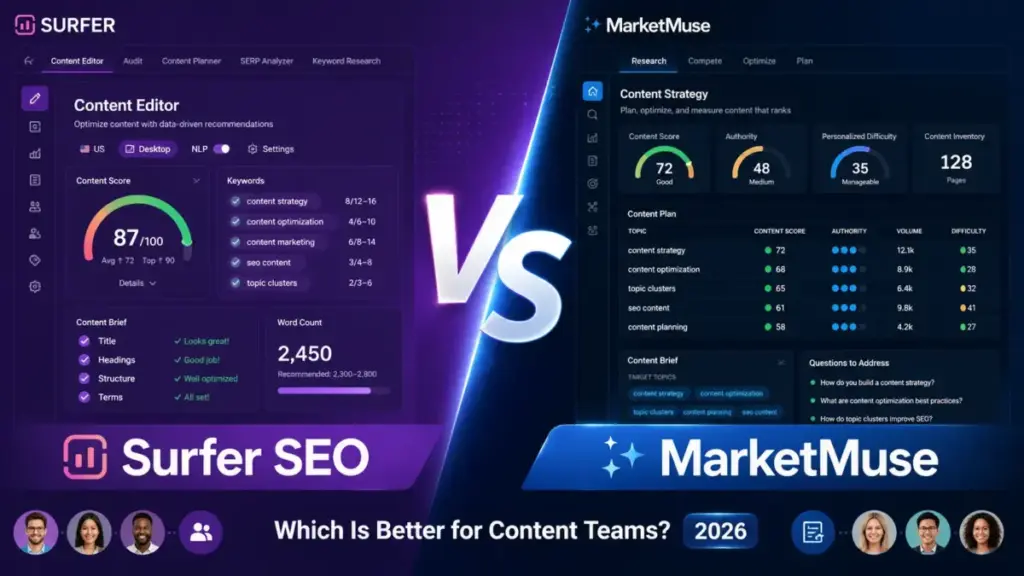
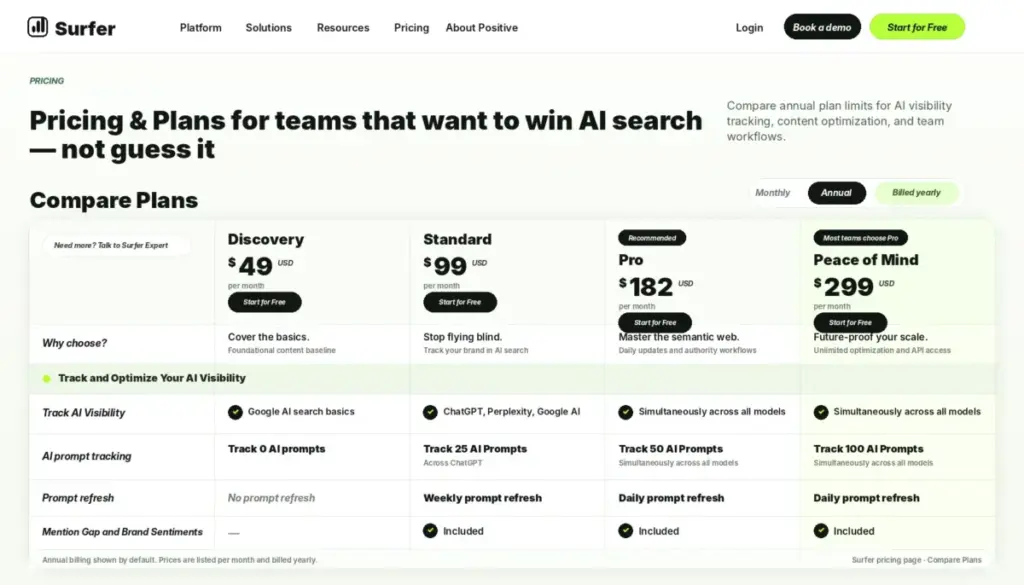
Surfer sells AI visibility tracking as its 2026 headline. On the $49 Discovery plan, you get zero AI prompts to track.
That single line is the honest starting point for Surfer SEO vs MarketMuse, because both products hide their real character behind a plan gate rather than a feature list.
Surfer is a page-level execution tool with an AI search monitor bolted on at higher tiers. MarketMuse is an inventory-first strategy system that decides what deserves to be written at all.
Choose Surfer if your bottleneck is producing and optimizing pages every week, you want writers inside Google Docs or WordPress, and you need public pricing you can forward to finance. Choose MarketMuse if your bottleneck is deciding which of your 800 existing URLs to update first, and you can absorb a slower, planning-heavy workflow.
I built this comparison from official pricing pages and public documentation checked on July 8, 2026, not from a trial account. That distinction matters here, because several ranking comparisons for this query still quote plan data that no longer matches either vendor’s official page.
Quick Verdict: Surfer SEO vs MarketMuse
| Category | Winner | Why |
|---|---|---|
| Pricing transparency | Surfer | Annual USD prices are published for all five tiers; MarketMuse’s paid dollar amounts were not visible in the accessible official pricing text |
| Page-level content optimization | Surfer | Content Editor, Content Score, and 1-click optimization sit inside the writing surface |
| Content inventory and topic authority | MarketMuse | Site inventory, tracked topics, and topic models are the product, not an add-on |
| Content briefs and brief types | MarketMuse | Strategy unlocks all nine brief types and 20 briefs per month |
| Prioritizing existing URLs | MarketMuse | Tracked topics scale to 10,000 and Site Heatmap ranks the library |
| AI search visibility tracking | Surfer | Prompt tracking is a priced, plan-gated line item; no comparable MarketMuse public evidence surfaced |
| Integrations and publishing workflow | Surfer | WordPress, Google Docs, Contentful, Zapier, Jasper, and ChatGPT are named on the official integrations page |
| API and automation | Surfer, with a tier caveat | API exists but only on Peace of Mind and Enterprise, with no sandbox |
| Team seats on published plans | Surfer | Published tiers reach 10 seats; MarketMuse’s published tiers stop at 5 users |
| Ongoing free access | MarketMuse | A permanent Free tier exists, versus Surfer’s 7-day Pro trial |
Six of ten dimensions go to Surfer, which reads lopsided until you notice what the four MarketMuse wins have in common. Every one of them is about deciding what to write, and that is the decision that costs a publisher the most money when it goes wrong.
The tools are not competing for the same hour of your team’s day. Surfer competes for the hour before a draft ships, and MarketMuse competes for the hour before anyone opens a document at all.
Teams shopping the best AI tools for content creation usually discover this split only after they have paid for the wrong one.
Surfer SEO vs MarketMuse at a Glance
| Surfer | MarketMuse | |
|---|---|---|
| Best for | 3 to 10 person SEO and content teams publishing or refreshing pages weekly | Content strategists and publishers prioritizing 300 or more existing URLs |
| Not best for | Teams that must rank a 2,000-URL library before writing anything new | Solo writers who need a cheap in-document optimizer, and developers who need documented API access |
| Starting price | $49 per month, billed yearly (Discovery) | $0 (Free); paid dollar amounts not visible in accessible official pricing text |
| Practical tier | Pro at $182 per month, billed yearly | Research, for teams that need the Research app and 1,000 tracked topics |
| Free plan or trial | 7-day Pro trial for new accounts | Permanent Free tier: 1 user, 10 queries per month |
| Seats on top published plan | 10 (Peace of Mind); custom on Enterprise | 5 (Strategy) |
| Setup difficulty | Low to moderate | Moderate to high |
| Main strength | Optimization and AI visibility tracking inside the writing workflow | Site inventory, topic models, and brief generation at library scale |
| Main weakness | Unused monthly limits do not roll over | Paid pricing requires a quote, and no public API documentation surfaced |
| Pricing checked | July 8, 2026 | July 8, 2026 |
Parent company matters less than buyers assume, but it explains roadmap direction. Surfer joined Positive Group in 2025, and MarketMuse was acquired by Siteimprove in 2024, per each company’s own announcements.
The Siteimprove acquisition is the reason MarketMuse enterprise questions increasingly route through a sales conversation rather than a public page.
How We Compared Surfer and MarketMuse
Testing level for this comparison is official_research_only. Neither product was purchased, trialed, or operated for this article, and no screenshots of a live account exist behind these claims.
Every price, plan limit, seat count, and feature gate below comes from the vendor’s own pricing page or documentation, checked on July 8, 2026. Review-platform sentiment from G2, Capterra, and TrustRadius appears only as user opinion, never as proof that a feature exists.
That separation is the reason this comparison disagrees with several pages currently ranking for Surfer SEO vs MarketMuse. Some of them present third-party reported prices as official, and at least one repeats MarketMuse pricing that predates the current package structure.
Comparison criteria, in the order buyers apply them: pricing transparency, plan gates, page-level optimization, inventory strategy, AI search visibility, integrations and API, seats and scaling, admin and security evidence, and support. Each dimension gets a named winner, because a comparison without winners is a directory listing.
The known limitation of this method: documentation describes intent, not behavior. Official docs can tell you that Surfer’s API consumes real plan limits, but not how the SERP Analyzer feels at 200 tracked pages.
Where the evidence stops, this article stops, and says so. The same source discipline is described in our review methodology.
Workflow 1: Optimizing One Page Before It Ships
Surfer wins this workflow, and the margin is not close.
A writer opens Surfer’s Content Editor, pastes a draft, and works against a live Content Score built from the current SERP. The same guidance surfaces inside Google Docs or WordPress through Surfer’s integrations, so the optimization step never becomes a separate tab.
MarketMuse answers with the Optimize app, which generates a topic model, a content score, and a target word count. It is competent guidance, delivered in a separate application that most writers will not keep open beside their draft.
The gap is workflow location, not model quality. Both products build topic models from SERP analysis, and both rest on the same natural language processing basics that power every content scoring tool in this category.
MarketMuse’s own Optimize documentation is unusually honest about the ceiling here: it states that keyword density alone will not improve rankings. That is a vendor telling you its own score is a prioritization signal, not a ranking lever, and it deserves more credit than it gets.
Treat both content scores the same way. A score of 78 does not rank a page; it tells an editor which draft is furthest from topical coverage and therefore cheapest to fix.
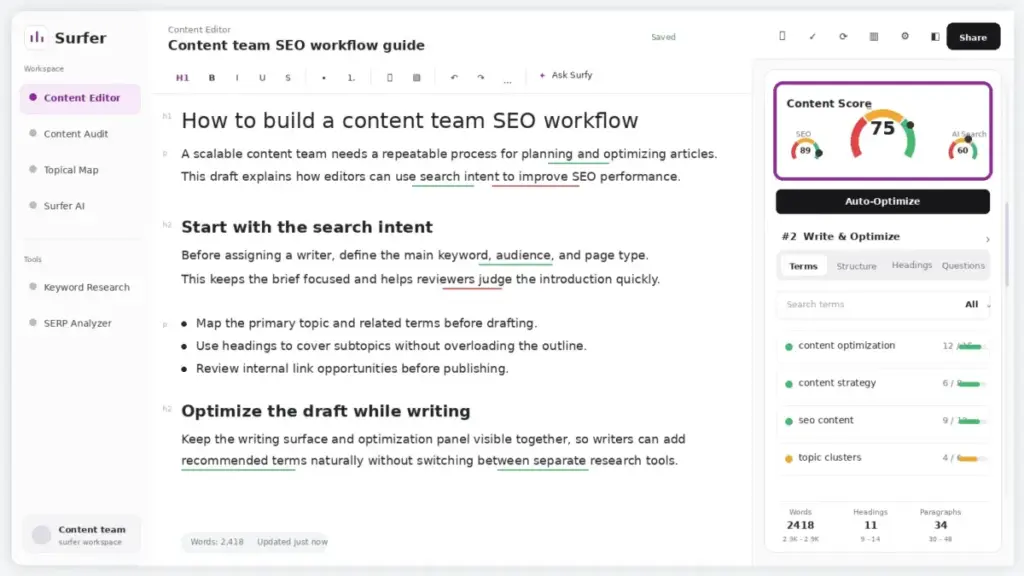
For a 3-person B2B SaaS content team shipping two posts a week, Surfer Standard at $99 per month, billed yearly, covers 3 seats and 360 documents. That is the tier where the optimization workflow stops being a bottleneck.
Workflow 2: Choosing What to Write Across 800 Existing URLs
MarketMuse wins this workflow outright, and it is the reason the product still commands a premium.
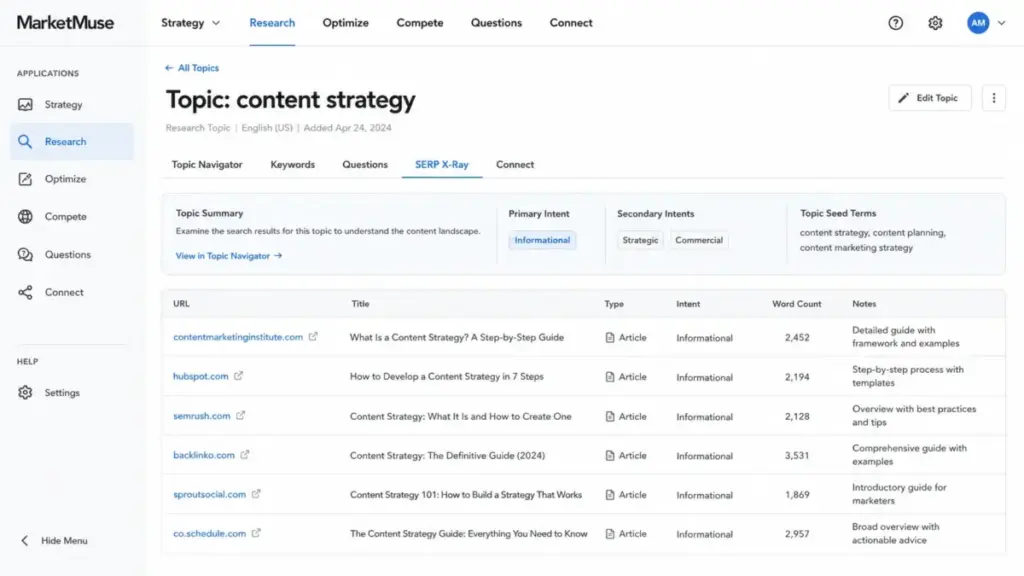
MarketMuse builds a site inventory, applies personalized difficulty and topic authority metrics, and then ranks what to update, consolidate, or create. Tracked topics scale from 100 on Optimize to 1,000 on Research to 10,000 on Strategy, per the official MarketMuse pricing page checked on July 8, 2026.
Surfer answers with Content Audit, Topical Map, and coverage-gap features on Pro and above. Those are real capabilities, and several older comparison pages are wrong to claim Surfer has no planning layer at all.
The difference is what the tool is organized around. Surfer’s unit of work is a document; MarketMuse’s unit of work is the library.
Here is the number nobody in the top ten publishes. MarketMuse scales tracked topics 100x between Optimize and Strategy, from 100 to 10,000, while content briefs scale only 4x, from 5 to 20 per month.
Your topic coverage expands a hundredfold. Your ability to turn coverage into briefs expands fourfold.
The bottleneck moves from software to humans, and it moves there faster than the pricing tiers suggest. A publisher buying Strategy for 10,000 tracked topics is buying visibility into a backlog that its 20 monthly briefs will take decades to clear.
That is not a criticism of the tool. It is a warning about the tier you pick: buy the tracked-topic count your writers can convert, then upgrade when brief output becomes the constraint.
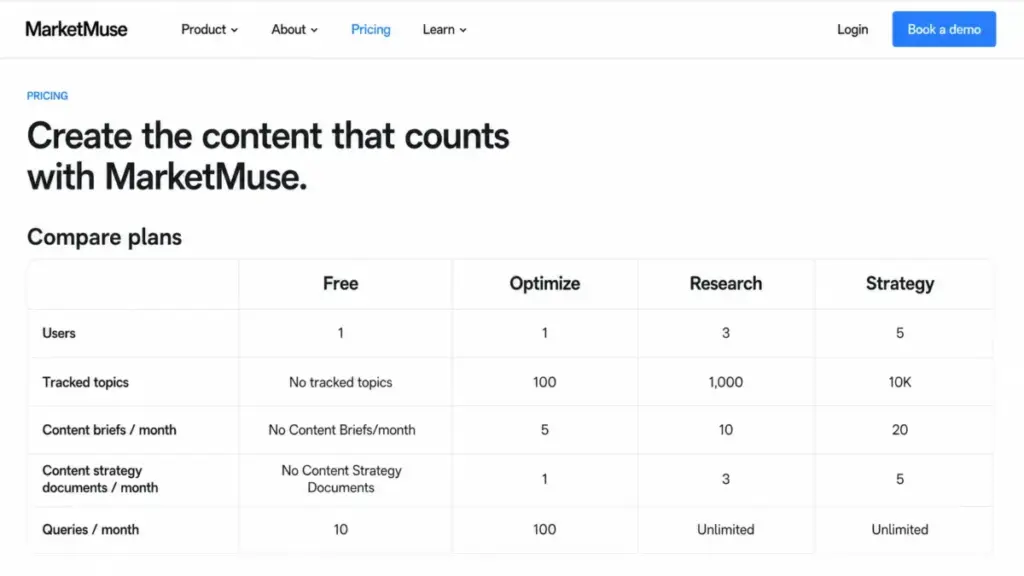
There is a second gate that decides this workflow. MarketMuse’s Research application documentation shows that Research app features require Research or higher, and Site Heatmap requires Strategy or higher.
Optimize, the entry paid package, therefore cannot run the workflow most buyers associate with the MarketMuse name. A team that buys Optimize expecting SERP X-Ray, SERP Heatmap, and Site Heatmap has bought a content editor with a topic model.
Skip Optimize if inventory strategy is the reason you are shopping. Start at Research, or do not start.
Workflow 3: Tracking Visibility in ChatGPT, Perplexity, and Gemini
Surfer wins this workflow on public evidence, and MarketMuse does not currently contest it.
Surfer’s official pricing table treats AI prompt tracking as a metered, plan-gated resource. Discovery includes none, and Standard includes 25 prompts refreshed weekly.
Pro includes 50 prompts refreshed daily, and Peace of Mind includes 100 prompts refreshed daily.
No comparable AI visibility tracking feature surfaced in MarketMuse’s public documentation during this research. That is an evidence statement, not a claim that the capability cannot exist behind a sales conversation.
The refresh cadence is the part that changes the buying decision, and it is missing from every page currently ranking for this query.
| Surfer plan | AI prompts tracked | Refresh cadence | Refreshes per prompt per month | What that buys |
|---|---|---|---|---|
| Discovery ($49/mo, yearly) | 0 | None | 0 | No AI visibility monitoring at all |
| Standard ($99/mo, yearly) | 25 | Weekly | About 4 | Trend detection only; a mid-week answer flip is invisible |
| Pro ($182/mo, yearly) | 50 | Daily | About 30 | Enough resolution to link a visibility change to a publish date |
| Peace of Mind ($299/mo, yearly) | 100 | Daily | About 30 | Prompt coverage for a multi-brand or multi-product portfolio |
Weekly refresh at 25 prompts is roughly four observations per prompt per month. If an AI answer engine swaps your brand out on a Tuesday and back in on a Friday, Standard will never see it.
Pro’s daily refresh raises that to roughly 30 observations, which is the first tier where AI visibility becomes a monitoring product rather than a reporting curiosity. The jump from $99 to $182 buys resolution, not more prompts alone.
Price the feature honestly. At Pro, 50 tracked prompts cost about $3.64 per prompt per month; at Peace of Mind, 100 prompts cost about $2.99 each.
If your brand only cares about a dozen high-intent prompts across ChatGPT, Perplexity, and Gemini, you are paying for 38 you will not use. That is a real argument for Standard, and a real argument against treating AI visibility as the reason to upgrade.
Workflow 4: Automating Briefs, Audits, and Exports
Surfer wins automation, and then immediately taxes the win.
Surfer publishes an API covering content editor management, Surfer AI, audits, SERP Analyzer data, dashboard data, the AI Detector, and the Humanizer. Its official API documentation states three constraints that no ranking competitor spells out.
API access is limited to Peace of Mind and Enterprise, and the key must be generated from the account owner’s login.
There is no sandbox, and requests consume your actual plan limits.
Read that last constraint the way an engineer would. Every integration test, every retry loop, every malformed request during development burns production quota that does not roll over.
A developer prototyping a brief-generation pipeline on Peace of Mind is spending real documents and real audit credits to find out that the payload shape was wrong. Budget the quota cost of building the integration, not just the $299 monthly subscription.
If your team is still weighing whether this matters, the short version of what an API does explains why the missing sandbox is more than a convenience issue.
MarketMuse’s automation story is different in kind. No public MarketMuse API documentation surfaced during this research, so the honest phrasing is that the evidence is absent, not that the API is absent.
What MarketMuse does document is export. Excel exports run from Topic Navigator, SERP X-Ray, Heatmap, Connect, Optimize, and Newsroom, which makes the spreadsheet the integration layer for most teams.
| Integration type | Surfer | MarketMuse |
|---|---|---|
| Native editor integration | Google Docs, WordPress, Contentful | Not verified in public documentation |
| Connector platform | Zapier | Not verified in public documentation |
| AI tool integration | Jasper, ChatGPT | Not verified in public documentation |
| Browser extension | Keyword Surfer | Not verified in public documentation |
| Documented public API | Yes, Peace of Mind and Enterprise only, no sandbox | No public API documentation surfaced |
| Export workflow | Available | Excel export from six named applications |
Surfer’s official integrations page names each of those destinations, including the Jasper AI review subject that many content teams already run alongside their optimizer. MarketMuse’s absence from most rows is an evidence gap, not a verified product hole, and a buyer with an integration requirement should force the question in the sales call.
If your publishing workflow ends in WordPress, Surfer removes a copy-paste step. If it ends in a spreadsheet review with an editor, MarketMuse already speaks your language.
Pricing and Value per Dollar
Surfer wins pricing transparency without winning on price. MarketMuse’s plan limits are public; its paid dollar amounts are not.
Surfer’s Plan-Gate Map
| Plan | Price (billed yearly) | Documents | Tracked pages | AI prompts | Brand workspaces | Seats | API |
|---|---|---|---|---|---|---|---|
| Discovery | $49/mo | 120 | 10 | None | 1 | 1 | No |
| Standard | $99/mo | 360 | 50 | 25, weekly refresh | 1 | 3 | No |
| Pro | $182/mo | 360 | 200 | 50, daily refresh | 5 | 5 | No |
| Peace of Mind | $299/mo | Unlimited | 500 | 100, daily refresh | Unlimited | 10 | Yes |
| Enterprise | From $999/mo | Custom | Custom | Custom | Custom | Custom | Yes |
Look at the documents column across Standard and Pro. Both sit at 360.
The $83 monthly jump from Standard to Pro buys nothing extra to write in. It buys 150 more tracked pages, four more brand workspaces, two more seats, daily prompt refresh, internal linking, and coverage-gap analysis.
That reframes the upgrade. Pro is an agency and multi-brand purchase, not a volume purchase, and a single-brand team that publishes more should stay on Standard until tracked pages break.
The full tier ladder is broken down further in our Surfer SEO pricing breakdown.
Two hidden costs live in Surfer’s official pricing FAQ. Unused limits do not roll over, and annual billing saves up to 17 percent while locking the commitment.
A seasonal publisher that ships 40 documents in November and 4 in February is not buying an average. It is buying November twelve times, then discarding eight months of unused capacity.
Buy for your median month. Handle peak months with the 7-day Pro trial on a new account only if the calendar allows, and otherwise accept the overflow rather than the annual tier above it.
What MarketMuse Publishes and What It Withholds
| Package | Paid price | Users | Site inventory | Tracked topics | Briefs/mo | Brief types | Strategy docs/mo | Queries/mo |
|---|---|---|---|---|---|---|---|---|
| Free | $0 | 1 | None | None | None | None | None | 10 |
| Optimize | Not visible in accessible official text | 1 | 1 | 100 | 5 | Article Briefs | 1 | 100 |
| Research | Not visible in accessible official text | 3 | 1 | 1,000 | 10 | Partial | 3 | Unlimited |
| Strategy | Not visible in accessible official text | 5 | 1 | 10,000 | 20 | All nine | 5 | Unlimited |
Third-party publications report MarketMuse paid pricing, and those figures may well be accurate. They are not official, they were not visible in the accessible pricing page text on July 8, 2026, and a finance team should not approve a budget line from a magazine review.
Ask MarketMuse for a written quote against these exact package limits before shortlisting. Treat any comparison article that states MarketMuse’s paid prices as official, including the ones ranking above this page today, as unverified on that point.
Cost for a 10-Person Content Team
| Requirement | Surfer | MarketMuse |
|---|---|---|
| 10 seats on a published plan | Peace of Mind, $299/mo billed yearly | Not available; Strategy caps at 5 users |
| Annual commitment | $3,588 | Quote required |
| Cost per seat per month | $29.90 | Not calculable from official sources |
| Tracked pages or topics included | 500 tracked pages | 10,000 tracked topics (5 users) |
| API included | Yes | No public documentation |
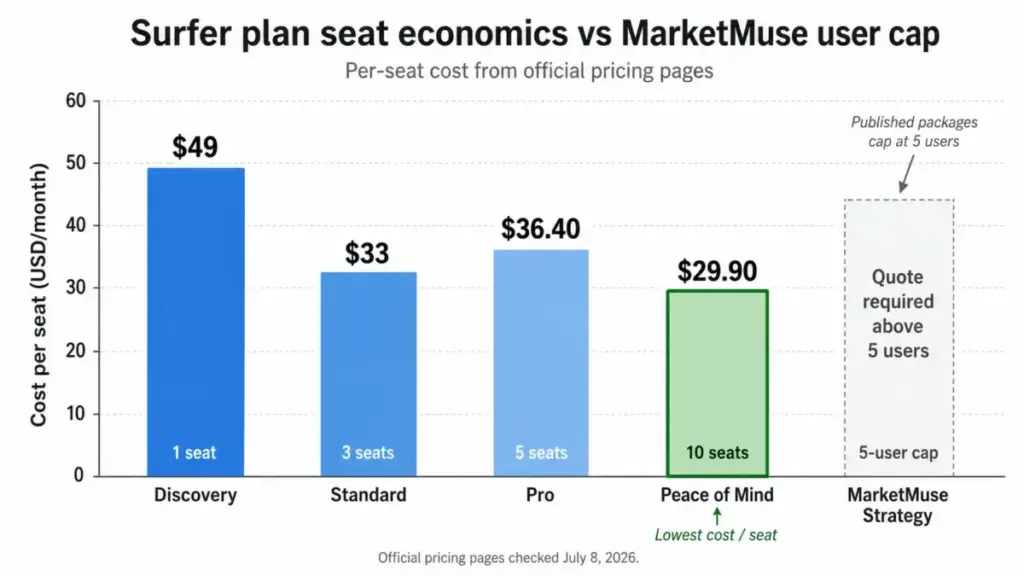
This is the cleanest fact in the entire comparison, and no page in the current top ten states it. MarketMuse’s published tiers stop at 5 users, so a 10-person content team cannot buy MarketMuse from the pricing page at all.
Surfer’s Peace of Mind covers 10 seats at $29.90 per seat per month. That is less per seat than Discovery’s single-seat $49, which is the inverted pricing curve that rewards larger teams and punishes freelancers.
A 10-person team that needs MarketMuse is entering a sales-led purchase whether it planned to or not. Budget for the procurement cycle, not just the license.
Surfer’s per-seat cost falls as the team grows: $49 at Discovery, $33 at Standard, $36.40 at Pro, and $29.90 at Peace of Mind. Pro breaks the curve because those five seats are paying for brand workspaces rather than headcount.
Feature-by-Feature Comparison
| Dimension | Surfer | MarketMuse | Winner |
|---|---|---|---|
| Core workflow unit | The document | The site inventory | Split by bottleneck |
| Ease of use for writers | Guidance inside Google Docs and WordPress | Separate Optimize application | Surfer |
| Automation | API on Peace of Mind and Enterprise, Zapier connector | Excel export from six applications | Surfer |
| Reporting and analytics | Content Audit, rank drop detection, tracked pages by plan | Site Heatmap (Strategy+), topic authority, personalized difficulty | MarketMuse for library reporting |
| AI features | Surfer AI, Surfy, Humanizer, AI Detector, AI prompt tracking | Generative AI inside Optimize; vendor states it does not write content for customers | Surfer |
| Integrations | WordPress, Google Docs, Contentful, Jasper, ChatGPT, Zapier, Keyword Surfer | Export and CMS movement documented; native integrations not verified | Surfer |
| Public API | Yes, high tiers only, no sandbox | No public documentation surfaced | Surfer |
| Briefs and templates | Content briefs inside the editor workflow | Nine brief types, gated to Strategy | MarketMuse |
| Collaboration and seats | 1, 3, 5, then 10 seats by tier | 1, 3, then 5 users by package | Surfer |
| Mobile app | No official native app evidence found | No official native app evidence found | Tie, both browser-first |
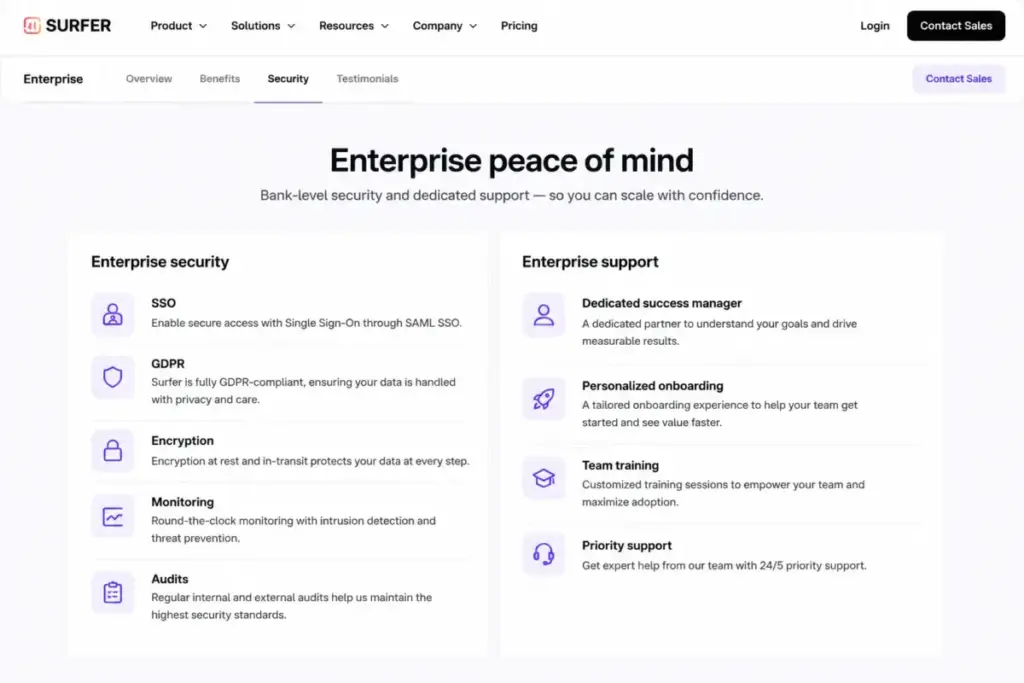
| Admin and security | Enterprise lists SSO, GDPR alignment, encryption, monitoring, audits | Privacy policy and user-management docs; no public SSO or certification evidence | Surfer, on public evidence |
| Support and onboarding | CSM, tailored onboarding, check-ins, 24/5 support on enterprise tiers | Help center and knowledge base; enterprise support likely sales-led | Surfer, on public evidence |
Three of those winner cells carry the phrase “on public evidence” or “not verified,” and that phrasing is doing real work. MarketMuse may well hold certifications and integrations it does not publish.
A procurement team cannot buy what it cannot verify. If your security review requires a trust page before the first call, Surfer clears that bar today and MarketMuse asks you to book a meeting.
Neither vendor showed official evidence of a native mobile app. Treat both as browser-first tools and stop asking whether an editor can approve a brief from a phone.
Reporting, Support, Security, and Admin Controls
Surfer’s enterprise page lists SSO, GDPR alignment, encryption in transit and at rest, real-time security monitoring, and internal and external audits. It also names a dedicated customer success manager, tailored onboarding, regular check-ins, and 24/5 support.
Neither vendor’s public pages verified SOC 2 or ISO certification during this research, so nobody should claim either holds one. Ask for the report, not the marketing line.
MarketMuse’s public trust surface is thinner: a privacy policy, a help center, and user-management documentation. That documentation reveals two admin constraints worth knowing before you roll the tool out to contractors.
A MarketMuse user’s email address cannot be changed after creation, and resending some invitations requires deleting and recreating the user. Consumer email handles are not accepted.
For an in-house team of five with stable emails, that is a footnote. For an agency cycling freelancers through client workspaces every quarter, it is a recurring admin chore, and it is documented in MarketMuse’s own user management documentation.
Reporting splits along the same line as everything else. Surfer reports on pages you track; MarketMuse reports on topics you own.
Migration and Setup Difficulty
| Setup dimension | Surfer | MarketMuse |
|---|---|---|
| Time to first useful output | Low: paste a draft, read the score | Moderate: inventory must build before prioritization means anything |
| Data import | Not required for the editor workflow | Site inventory connection required for the core value |
| Workflow rebuild | Low: guidance layers onto existing drafting | High: planning cadence and brief approval must be redesigned |
| Team training | Low to moderate for writers | Moderate to high for strategists and editors |
| Admin friction | Standard seat management | Email addresses immutable; some invites need delete and recreate |
| Long-term scalability | Seats to 10 on published plans, then Enterprise | Users to 5 on published plans, then a quote |
| Overall difficulty | Low to moderate | Moderate to high |
The MarketMuse setup cost is not technical. It is organizational, because the tool only pays off when someone has authority to say “we are not writing that.”
Teams without a content strategist to own the inventory will let MarketMuse rot into an expensive keyword tool. Buy it with a named owner or do not buy it.
Surfer’s setup risk runs the other direction. It installs so easily that writers adopt the score before an editor decides what the score is for, and the team ends up optimizing pages nobody should have published.
Where Surfer Wins
Best for: 3 to 10 person SEO and content teams that publish or refresh pages weekly and want optimization guidance inside Google Docs, WordPress, or Contentful.
Not best for: strategists whose first job is ranking 2,000 existing URLs by opportunity before a single new draft is commissioned.
Surfer wins the weekly production loop. A writer never leaves the draft, an editor sees the score before approval, and the WordPress integration removes the last copy-paste step.
It wins AI search visibility on evidence. Prompt tracking is a priced, metered, documented line item, and no equivalent MarketMuse public evidence exists.
It wins the finance conversation. Five tiers, published USD prices, a published per-seat structure that improves as the team grows, and an annual discount stated in the official FAQ.
It wins the automation conversation, conditionally. The API exists and is documented, and the condition is a $299 monthly floor plus a no-sandbox constraint that turns development into metered usage.
It wins procurement on public evidence. SSO, GDPR alignment, encryption, and audit language sit on a page your security reviewer can read before the first call.
| Pros | Cons |
|---|---|
| Optimization guidance runs inside Google Docs, WordPress, and Contentful, so writers do not switch tools | API is locked to Peace of Mind at $299/mo and Enterprise, with no sandbox and real-limit consumption |
| Published USD pricing across five tiers, with 10 seats at $29.90 each on Peace of Mind | Unused monthly limits do not roll over, which penalizes seasonal publishers |
| AI prompt tracking with daily refresh from Pro upward, giving roughly 30 observations per prompt per month | Document limits do not increase between Standard and Pro, so pure volume buyers gain nothing from the upgrade |
| Public enterprise security and support detail, including SSO and 24/5 support | Content Audit and Topical Map do not match MarketMuse’s inventory-level prioritization |
| Documented integrations with Zapier, Jasper, ChatGPT, and Keyword Surfer | Review sentiment repeatedly questions scoring quality on mixed-intent SERPs |
Verdict: Choose Surfer if a page ships this week and someone has to make it rank. Skip it if nothing should ship until the library is triaged.
Where MarketMuse Wins
Best for: content strategists and publishers managing 300 or more existing URLs who need topic authority analysis, tracked topics, and structured briefs before commissioning work.
Not best for: a solo freelancer optimizing four posts a month, or a developer who needs a documented public API.
MarketMuse wins inventory strategy. Site inventory, personalized difficulty, and topic models exist to answer a question Surfer never asks: which of these pages deserves another hour of anyone’s time.
It wins briefs. Strategy unlocks all nine brief types and 20 briefs per month, which is a production system rather than an outline generator.
It wins topic scale. Ten thousand tracked topics on Strategy is a number Surfer’s tracked-page model does not attempt to match.
It wins ongoing free access. The Free tier is permanent at 1 user and 10 queries per month, where Surfer offers a 7-day Pro trial and then a bill.
It wins the strategist’s report. Site Heatmap on Strategy and Research-app analysis give an editor a defensible reason to kill a planned article, and killing articles is where content budgets get saved.
| Pros | Cons |
|---|---|
| Site inventory, tracked topics, and topic authority rank an entire library rather than one document | Paid dollar prices were not visible in the accessible official pricing text on July 8, 2026 |
| Strategy includes all nine brief types and 20 monthly briefs, enough to run an editorial calendar | Published packages cap at 5 users, so a 10-person team cannot buy from the pricing page |
| Tracked topics scale to 10,000, far past Surfer’s 500 tracked pages | Research-app features need Research or higher, and Site Heatmap needs Strategy, so Optimize cannot run the flagship workflow |
| Permanent Free tier with 1 user and 10 monthly queries, useful for evaluating topic models | No public API documentation surfaced; Excel export is the practical integration path |
| Excel export from Topic Navigator, SERP X-Ray, Heatmap, Connect, Optimize, and Newsroom | User emails cannot be changed and some invites require delete and recreate, which hurts agencies with contractor churn |
Verdict: Choose MarketMuse if a strategist owns the content inventory and has authority to reprioritize it. Skip it if your team writes first and plans afterward.
Who Should Choose Surfer?
Pick Surfer if a writer touches the tool every day. The value lands in the draft, not in a planning meeting, and adoption follows the writing surface.
Pick Surfer if you need 6 to 10 seats on a published plan. Peace of Mind carries 10 at $29.90 per seat, and MarketMuse has no published answer above 5 users.
Pick Surfer if AI search visibility is a 2026 board metric. Buy Pro, not Standard, because daily refresh is the difference between monitoring and reporting.
Pick Surfer if procurement wants a security page before a sales call. SSO, GDPR alignment, encryption, and audit language are published rather than promised.
Pick Surfer if the publishing stack ends in WordPress or Contentful. The integration removes a step your editors currently do by hand.
Who Should Choose MarketMuse?
Pick MarketMuse if you have more URLs than writers. Its entire value proposition is telling you which of those URLs to abandon.
Pick MarketMuse if briefs are your production bottleneck. Twenty briefs a month across nine brief types on Strategy is an editorial system, and no Surfer tier is organized around brief throughput.
Pick MarketMuse if a named content strategist will own the inventory. Without that owner, the topic models become expensive wallpaper.
Pick MarketMuse if you want to evaluate topic modeling at zero cost for longer than a week. The Free tier persists, and 10 queries a month is enough to judge the output quality.
Start at Research, not Optimize, because Optimize excludes the Research app that defines the product.
Who Should Avoid Both?
Avoid both if your monthly output is four posts and your budget is under $50. Surfer’s cheapest annual tier is $588 a year for a single seat, and MarketMuse’s Free tier does not include a site inventory, tracked topics, or briefs, which means it cannot support a workflow.
Avoid both if you need a documented API on an entry plan. Surfer gates the API at $299 a month, and no MarketMuse public API documentation surfaced during this research.
Avoid both if you expect a content score to guarantee rankings. MarketMuse’s own Optimize documentation states that keyword density alone will not improve rankings, and Surfer’s score is calibrated to the current SERP rather than to future ones.
Avoid both if nobody on the team will change a decision because of the output. A tool that produces a report nobody acts on is a subscription, not a system.
If price is the disqualifier rather than the workflow, the alternatives below cover it, and a wider set of Surfer SEO alternatives exists for teams that want the editor without the tier ladder.
Alternatives to Surfer and MarketMuse
| Alternative | Choose it if | Where it beats this pair | Pricing note |
|---|---|---|---|
| Frase | You want brief generation and optimization in one lower-cost editor | Briefs and SERP research bundled below Surfer’s Pro tier | Verify current pricing on the official page before shortlisting |
| Clearscope | Editorial quality control matters more than planning or AI tracking | Report clarity and writer adoption in newsroom-style teams | Sales-led; confirm the quote |
| Semrush Content Toolkit | You already pay Semrush and want optimization without a second vendor | Consolidates keyword research, tracking, and optimization billing | Bundled inside an existing Semrush subscription |
| seoClarity | You are an enterprise buyer who needs SEO platform depth, not a content editor | Enterprise reporting and site-wide analysis | Enterprise quote required |
Frase is the honest cost answer for a two-person team that wants briefs plus optimization; its Frase pricing plans sit below Surfer Pro. Clearscope is the answer when an editor, not an SEO, owns quality.
None of these four were evaluated hands-on for this article, and none of their prices were verified against an official page on July 8, 2026. Treat the table as a shortlist starting point, cross-check against the broader field of AI writing tools ranked by workflow, then verify pricing yourself.
Final Verdict
Surfer SEO vs MarketMuse is not a fight over who optimizes better. It is a fight over which decision your team keeps getting wrong.
For 3 to 10 person SaaS and agency content teams publishing weekly, Surfer wins. Standard at $99 covers three seats and 360 documents; Pro at $182 adds the daily AI prompt refresh, five brand workspaces, and internal linking that agencies need.
For publishers and strategists sitting on 300 or more URLs, MarketMuse wins, and Research is the entry point rather than Optimize. Its 1,000 tracked topics and Research-app analysis answer the prioritization question that costs the most when it is guessed.
For a 10-person content team, Surfer wins by default. MarketMuse’s published packages stop at 5 users, and the rest is a sales conversation.
For a mature team with budget for both, run MarketMuse upstream to choose the work and Surfer downstream to ship it. That is the only configuration where the $500-plus combined monthly spend earns its keep.
For a solo freelancer at four posts a month, buy neither yet. Surfer Discovery at $49 for one seat and 120 documents is defensible once you are billing clients for optimization; MarketMuse Free is a sampler, not a workflow.
One number should decide this for most readers. If more than half your traffic goal depends on pages that already exist, you have a MarketMuse problem, and no Content Score will fix it.
FAQ
Is Surfer SEO better than MarketMuse?
For weekly page production, yes. Surfer puts optimization inside Google Docs and WordPress, publishes its pricing, and tracks AI visibility prompts from the Standard tier upward.
For deciding which of several hundred existing URLs to update first, MarketMuse is better. Tracked topics, topic authority, and Site Heatmap are built for library-level triage rather than single-document scoring.
What is the actual difference between Surfer SEO and MarketMuse?
Surfer’s unit of work is a document, and MarketMuse’s unit of work is your site inventory. Surfer scores a draft against the live SERP, then pushes it back into your CMS.
MarketMuse models every topic you own, ranks what deserves investment, and generates briefs. One shortens the path to publish, the other shortens the path to a decision.
Which one is cheaper, Surfer or MarketMuse?
Surfer is cheaper to start and cheaper to verify. Discovery is $49 per month billed yearly, and every tier price is published.
MarketMuse’s paid dollar amounts were not visible in the accessible official pricing text on July 8, 2026, so any price you read elsewhere is third-party reporting. Get a written quote before you compare budgets.
Does MarketMuse have a free plan?
Yes. The Free tier gives one user 10 queries per month with limited applications.
It excludes site inventory, tracked topics, content briefs, brief types, and content strategy documents, so it demonstrates the topic model rather than running a workflow. Use it to judge output quality, not to run an editorial calendar.
Does Surfer SEO have a free trial?
Yes, and it is short. Surfer’s official pricing FAQ describes a 7-day Pro trial for new accounts, which grants daily AI prompt refresh, 200 tracked pages, and five brand workspaces for one week.
There is no permanent free tier. Plan the week before you start it, because unused limits never roll over.
Which tool is better for content briefs?
MarketMuse, and it is not close on Strategy. That package includes all nine brief types and 20 briefs per month, so a managing editor can commission a full calendar from one system.
Surfer generates brief-style guidance inside its editor workflow, but it is organized around optimizing a draft rather than producing a brief queue for other writers.
Which tool is better for agencies?
Surfer, for execution across client brands. Pro at $182 per month gives five brand workspaces, 200 tracked pages, and five seats, while Peace of Mind removes the workspace cap.
Choose MarketMuse instead only when the agency sells content strategy as its deliverable, and remember that published packages stop at five users.
Can Surfer SEO track AI search visibility?
Yes, with a plan gate that decides its usefulness. Discovery includes no AI prompts, Standard tracks 25 refreshed weekly, Pro tracks 50 refreshed daily, and Peace of Mind tracks 100 refreshed daily.
Weekly refresh spots trends, while only daily refresh links a visibility change to a publish date. No equivalent MarketMuse public evidence surfaced.
Does Surfer SEO offer API access?
No, unless you are on Peace of Mind at $299 per month or Enterprise. Surfer’s official API documentation also states there is no sandbox, that the key must come from the owner account, and that requests consume your actual plan limits.
Development traffic burns production quota, so budget the credits alongside the subscription.
Should I switch from Surfer to MarketMuse?
No, unless your traffic goal now depends on existing pages rather than new ones. Switching swaps a writer-facing optimizer for a strategist-facing planning system, and it pays off only when someone owns the content inventory and can cancel planned work.
If both problems are real and budget allows, run MarketMuse upstream and keep Surfer downstream.