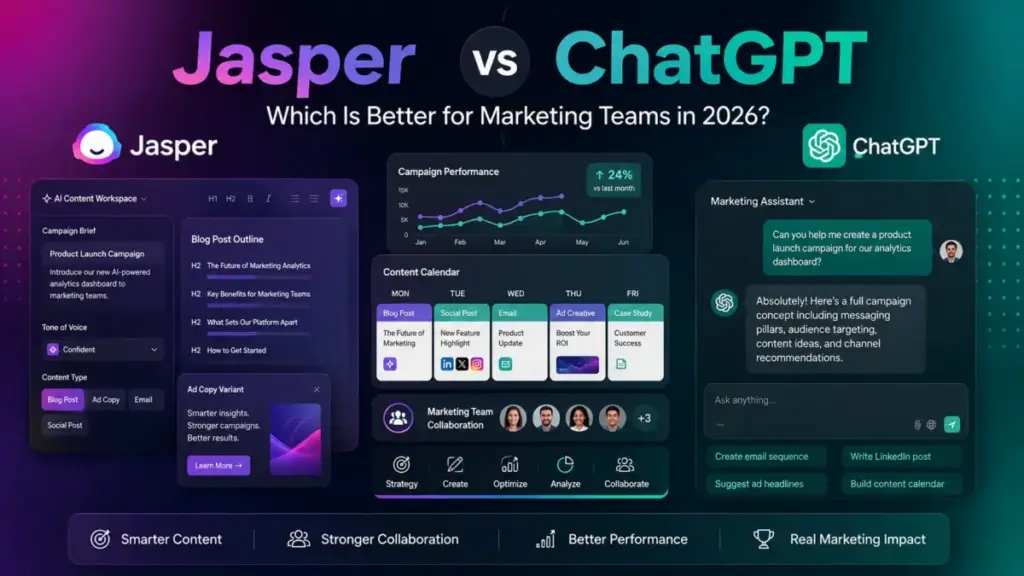
Jasper vs ChatGPT is not a fight over which tool writes a better paragraph. It is a fight over who owns your brand context, your seats, and your governance once more than one person touches the content.
Jasper’s Brand Voice looks like the feature that justifies the subscription. For a solo marketer with one brand, it might. For a 3-person team or an agency juggling client accounts, the seat cap and the asset limits become the actual buying decision, and that is where most comparisons stop paying attention.
Here is the short version. Choose Jasper if governed, on-brand marketing production across a team is your main workflow and you will pay for the controls that keep output consistent. Choose ChatGPT if you need lower-cost, broad AI for writing, research, coding, data, and files, with brand governance handled more manually. This comparison covers pricing, seat gates, brand governance, integrations, security, mobile access, and the scenarios where the answer flips.
For wider context on where each tool sits, our roundup of the best AI writing tools puts both in the same category, but the head-to-head below is where the decision actually gets made.
Quick Verdict: Jasper vs ChatGPT
| Category | Winner | Why |
|---|---|---|
| Entry price | ChatGPT | Free tier plus paid plans from $8/mo; Jasper Pro starts at $59/mo billed yearly |
| Brand governance | Jasper | Brand Voice, Knowledge assets, Audiences, and Jasper IQ are built for marketing consistency |
| General-purpose breadth | ChatGPT | Covers research, reasoning, coding, data analysis, files, images, and voice |
| Smallest-team cost (1 seat) | ChatGPT | Free/Plus start far below Jasper Pro’s single seat |
| Team seats and scaling | Depends | Jasper Pro is 1 seat only; ChatGPT Business needs a 2-seat minimum |
| Marketing workflow depth | Jasper | Agents, Canvas, Grid, and governed pipelines target campaign production |
| API and automation | Depends | Jasper API is Business-only; ChatGPT uses apps plus a separate OpenAI API |
| Enterprise IT controls | ChatGPT Enterprise | SCIM, EKM, RBAC, and data residency exceed Jasper’s published controls |
| Mobile access | ChatGPT | Official iOS and Android apps; Jasper’s help doc points to a web shortcut |
| Fact-sensitive content | Tie | Both need human review; reviewer sentiment flags accuracy gaps on each |
Nine of ten categories resolve to a clear side or a clear condition. The two “Depends” rows are the ones that decide most purchases, so they get full sections below.
Jasper vs ChatGPT at a Glance
| Jasper | ChatGPT | |
|---|---|---|
| Best for | 5-30 person marketing teams needing brand consistency | Solo creators to cross-functional teams needing broad AI |
| Starting price (USD) | $59/mo/seat billed yearly; $69/mo/seat monthly | $0 Free; $8 Go; $20 Plus; Business from $20/user/mo annual |
| Practical paid tier | Jasper Pro (1 seat) or Business (custom) | ChatGPT Plus (solo) or Business (teams) |
| Free plan / trial | 7-day Pro trial; no permanent free plan verified | Permanent Free plan plus low-cost paid tiers |
| Seat model | Pro = 1 seat; Business adds seats | Business = 2-seat minimum |
| Setup difficulty | Moderate (higher for Business governance) | Low for individuals; moderate for Business |
| Main strength | Governed brand voice and marketing workflow | Range across writing, research, coding, and data |
| Main weakness | Custom Business pricing and 1-seat Pro cap | Manual brand governance for marketing teams |
Prices reflect official pages checked on 2026-07-03. Jasper positions itself as marketing infrastructure with chat, not a chatbot, so comparing only chat output undersells its workflow layer and oversells ChatGPT’s brand controls. Read the two products as different shapes, not two versions of the same writer.
How We Compared
This comparison is documentation-based and third-party validated. It draws on official Jasper and OpenAI pricing, product, security, API, and help pages, plus review sentiment from G2, Capterra, and TrustRadius. No hands-on trial, private workspace, or measured output test was run, so nothing here claims tested output quality or measured edit time.
Pricing and plan gates were checked on 2026-07-03 against official sources. Where a directory or competitor page disagreed with an official page, the official page won, and the conflict is flagged in the pricing section. Review platforms were used only for user sentiment, never as a pricing source.
Two caveats matter for trust. Jasper Business pricing is custom, so any team-cost math for Jasper at scale is deliberately left open rather than estimated, and Jasper’s mobile evidence comes from an older help article that may lag current deployment. Both are called out where they appear.
Workflow 1: On-Brand Campaign Content
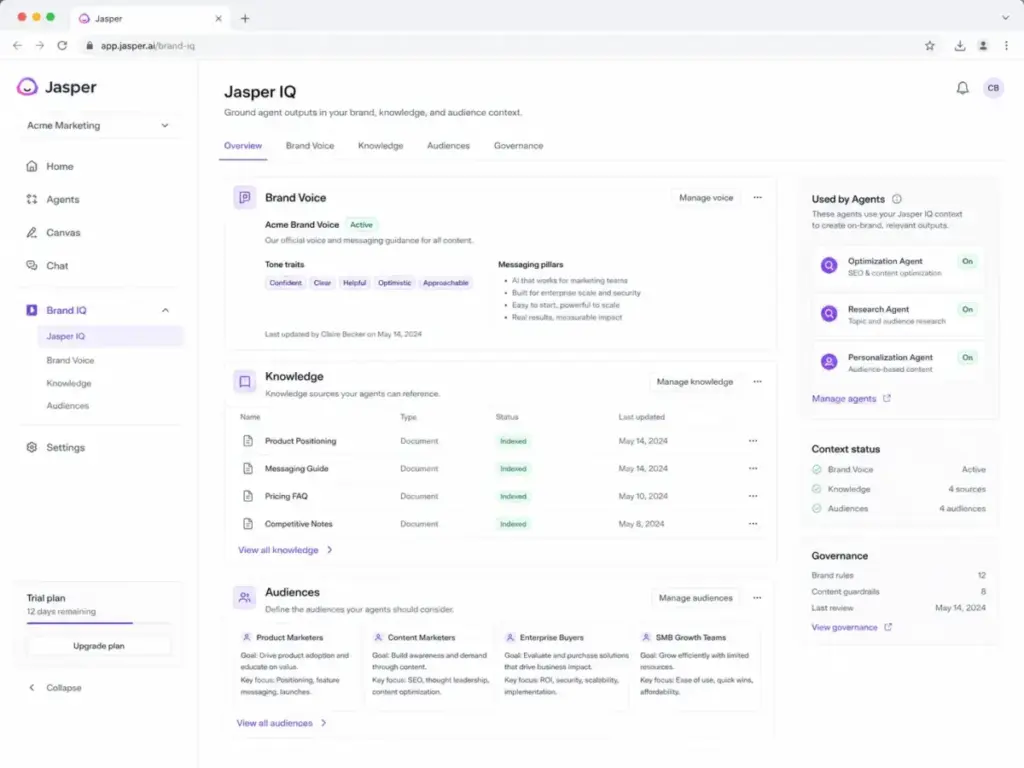
This is Jasper’s home turf. Jasper Pro is built around Brand Voice, Knowledge assets, and Audiences, and its Jasper IQ layer governs how that context is applied across campaigns.
Jasper wins this workflow, and it is not close for a team. The output arrives closer to on-brand because the brand system is a first-class object, not a prompt you paste each time.
ChatGPT can hold brand context through custom instructions, projects, custom GPTs, and, on Business, company knowledge. That is real, but it is a more manual assembly than a governed Brand Voice that every seat inherits by default.
Here is the disambiguation most competitors skip. Brand voice, memory, company knowledge, and custom instructions are not the same thing. Jasper IQ is governed marketing context designed to keep tone and claims consistent across a team. ChatGPT’s company knowledge and memory are general context retrieval, strong for pulling facts into an answer, weaker as an enforced brand standard.
The buyer impact is direct. If your bottleneck is “our five writers produce five slightly different brand voices,” Jasper’s governance solves the actual problem. If your bottleneck is “I need good copy fast and I am the only reviewer,” ChatGPT’s flexibility is enough and cheaper.
For readers new to the underlying idea, marketing automation explains why governed content pipelines matter more as headcount grows.
Workflow 2: Research, Reasoning, Coding, and Data Work
ChatGPT wins this one outright. Its paid plans cover advanced reasoning, deep research, data analysis, file work, image generation, voice, and Codex for coding, none of which is Jasper’s purpose.
Jasper does not position itself as a general assistant, so judging it on coding or spreadsheet analysis is judging it on work it never claimed. That framing matters because a marketer who also needs code, data, or technical research is a different buyer than a pure content team.
Plan gates shape this on the ChatGPT side. Advanced reasoning, projects, tasks, custom GPTs, and expanded deep research and Codex usage sit on Plus and above, while higher usage ceilings and larger input maximums arrive on Pro and Enterprise per OpenAI’s pricing table.
The failure mode to watch is context, not accuracy. On long files and multi-step research, the first thing that constrains a cheaper plan is the input ceiling and usage cap, not the model’s raw capability.
Buyer impact: founders, analysts, growth marketers, and developers who need one tool for copy and technical work should default to ChatGPT. A content-only team gains little from that breadth and may pay for capability it never uses.
Our ChatGPT review digs into how those broader capabilities hold up across non-marketing tasks.
Workflow 3: Team Content Operations and Governance
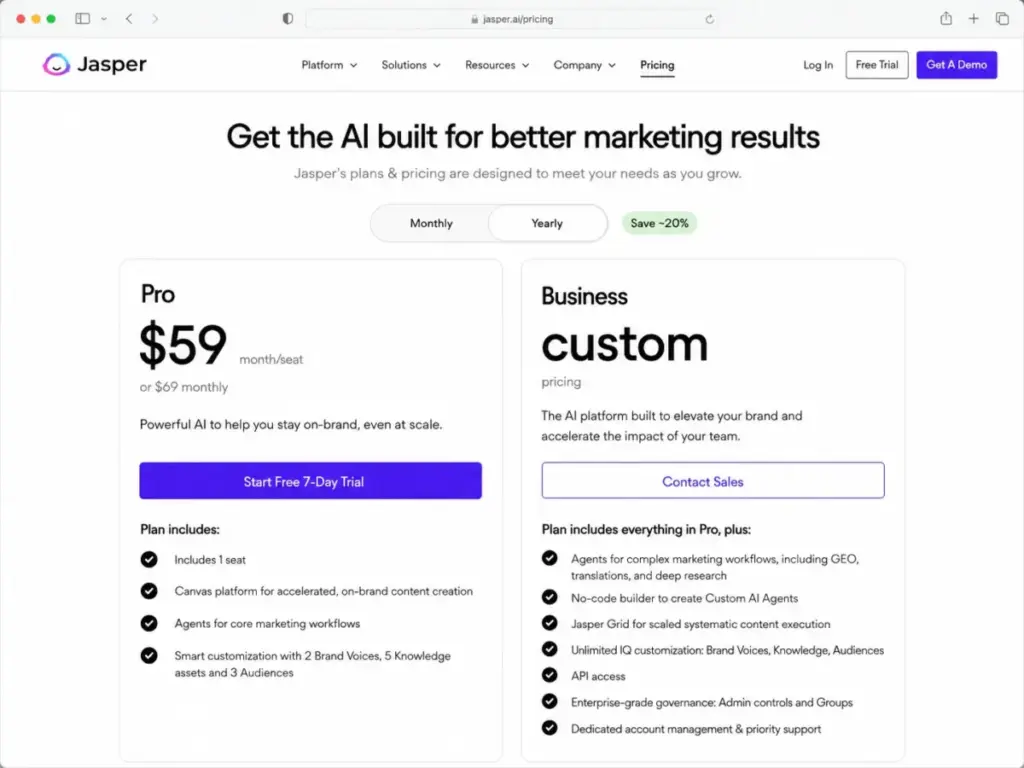
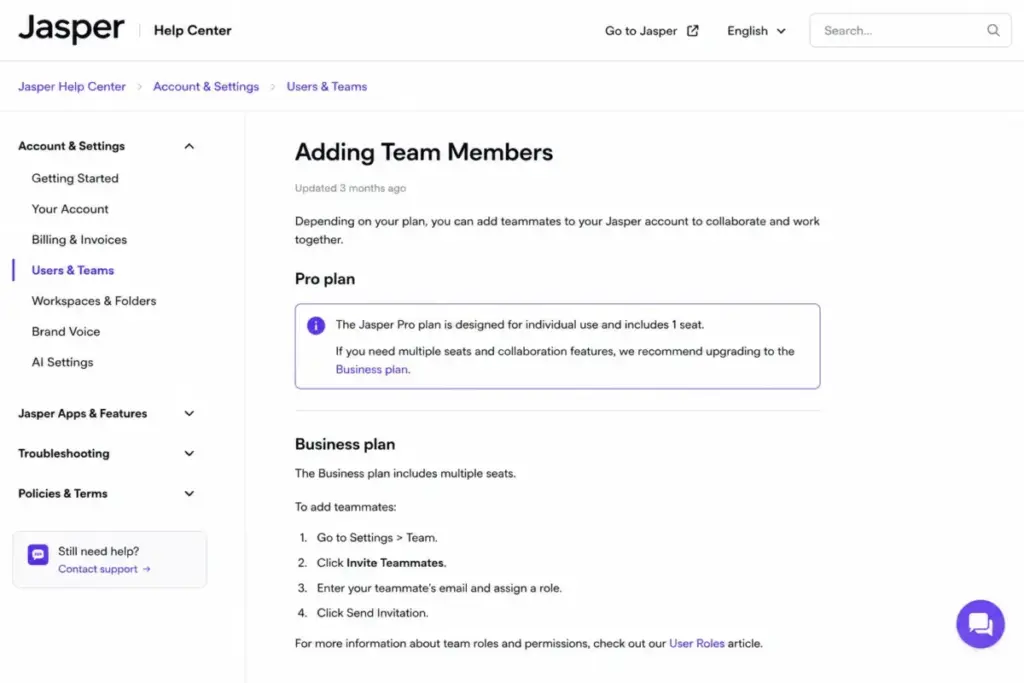
This is where the seat gates decide the purchase. Jasper Pro is limited to 1 seat, so any team past a single person cannot stay on Pro and must price Jasper Business, which is custom.
Jasper Business is the tier that opens the team story. It adds complex marketing agents, no-code custom agents, Jasper Grid, unlimited IQ customization, API access, admin controls and groups, dedicated account management, and priority support.
Here is the Jasper plan-gate map that most SERP results leave vague:
| Capability | Jasper Pro | Jasper Business |
|---|---|---|
| Seats | 1 only | Based on purchased seats |
| Brand Voices | 2 | Unlimited IQ customization |
| Knowledge assets | 5 | Unlimited IQ customization |
| Audiences | 3 | Unlimited IQ customization |
| Custom / complex agents | No | Yes |
| Jasper Grid | No | Yes |
| API access | No | Yes |
| Admin controls, groups | No | Yes |
| Dedicated account manager | No | Yes |
The agency threshold falls out of that table. Jasper Pro’s 2 Brand Voices and 5 Knowledge assets can fit a solo operator with one or two active client brands, but an agency running several client brands hits that cap quickly and is pushed to Business.
ChatGPT’s team gate is different and cheaper to enter. ChatGPT Business starts at a 2-seat minimum with public per-user pricing, and company knowledge, admin, SAML SSO, and MFA come with the workspace.
Buyer impact: a 3-person marketing team cannot use Jasper Pro at all, so the real comparison is Jasper Business (custom quote) against ChatGPT Business (public per-user price). If brand governance is the bottleneck, get the Jasper quote; if predictable cost and broad work matter more, ChatGPT Business is the safer default.
Before committing either way, it is worth reading our Jasper AI review for the deeper single-product breakdown of how the governance layer behaves in practice.
Pricing and Value per Dollar
Start with the official numbers, checked 2026-07-03. Jasper Pro is $69/month/seat monthly or $59/month/seat billed yearly, with a 7-day trial and custom Business pricing.
ChatGPT spans a wider ladder: Free at $0, Go at $8/month, Plus at $20/month, Pro from $100/month, and Business at $25/user/month billed monthly or $20/user/month billed annually. Enterprise is custom.
Two ChatGPT pricing facts get lost in older comparisons. Business carries a 2-seat minimum, so the real entry cost for a business workspace is two seats, and Pro has two tiers, with OpenAI’s help pages describing a $100 tier and a $200 highest-usage tier rather than a single flat Pro price.
Here is the cost-at-entry math that decides small-team buys:
| Team size | Jasper | ChatGPT Business (annual) |
|---|---|---|
| 1 user | Pro: $59-$69/mo | Plus $20/mo, or Free |
| 2 users | Pro cannot cover 2; Business custom | ~$40/mo (2-seat minimum) |
| 3 users | Business custom quote | ~$60/mo |
| 10 users | Business custom quote | ~$200/mo |
The per-seat comparison favors ChatGPT on paper wherever Jasper forces a Business quote. A single Jasper Pro seat at $59/month annual costs roughly three times a ChatGPT Business seat at $20/month annual, so the governance has to be worth that premium for the math to hold.
Now the hidden costs, stated safely. Jasper says some Business usage-based features, such as GEO Hub and Agents, run on credits, and its Fair Use Policy allows throttling, limitations, or additional costs if usage parameters are exceeded.
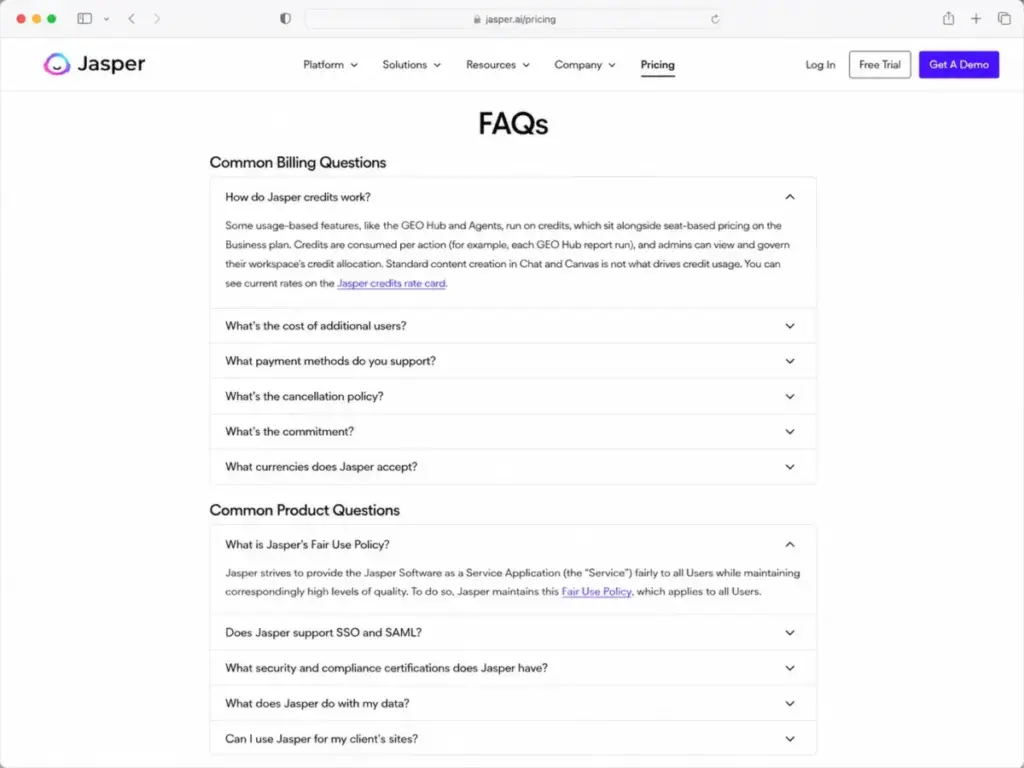
The exact credit rate card and fair-use thresholds were not public in detail in the reviewed sources, so high-volume teams should verify the current rate card before estimating spend. Do not treat Jasper Business as a fixed monthly line until sales confirms both the seat price and the credit model.
A freshness note protects you from stale directory data. Some review directories list Jasper starting near $29 and ChatGPT as “contact vendor,” which conflicts with the official public pricing above. Trust the vendor pricing pages for price claims; directory summaries can lag or show older vendor-supplied figures.
For the full tier-by-tier breakdown on the Jasper side, our Jasper pricing guide carries the plan detail this section summarizes.
The equivalent ChatGPT pricing guide does the same for OpenAI’s ladder, including the Go, Plus, and Pro-tier splits.
Integrations and Automation
Neither tool is a blank logo wall, but they connect in different ways, and the plan gate is the part buyers miss. Jasper API access is available only to Business Plan users and tech partners, so automation on Jasper depends on the Business tier.
ChatGPT connects through apps rather than a single API tier. ChatGPT Apps link tools like Slack, SharePoint, Airtable, Google Drive, GitHub, and HubSpot, and Enterprise or Edu admins must enable apps in workspace settings before users connect them.
Here is the integration matrix that separates marketing claims from implementation reality:
| Path | Jasper | ChatGPT | Plan gate |
|---|---|---|---|
| Native / app connectors | Marketplace (Webflow, Google Docs, Slack) | Apps (Slack, SharePoint, Airtable, Drive, GitHub, HubSpot) | ChatGPT app enablement on Enterprise/Edu |
| Browser extension | Chrome, Edge | Web and app based | None |
| Zapier / Make | Yes | Via ecosystem | None |
| Direct API | Yes | Separate OpenAI API | Jasper API = Business only |
| Custom app / agent | No-code custom agents (Business) | Custom apps via developers | Jasper custom agents = Business |
The OpenAI API is a separate product from a ChatGPT subscription, so budget it apart from seat pricing. The buyer question is simple: if you need to wire either tool into internal systems, confirm which tier enables the connection before you compare sticker prices.
Automation is also where AI agents enter the picture, since Jasper’s custom agents and ChatGPT’s apps solve overlapping problems through different architectures.
Security, Privacy, and Admin Controls
Security is where “which is better” splits by department. Jasper covers marketing-grade governance, while ChatGPT Enterprise covers heavier IT identity controls.
Jasper states SSO and SAML 2.0 on Business, RBAC, an in-app AI audit log, SOC 2 Type II, GDPR, CCPA, PCI, and DPA compliance, annual penetration testing, US data centers, TLS 1.2 or higher in transit, AES-256 at rest, and no training on customer data. That is a strong marketing-governance posture.
OpenAI says Business and Enterprise data is not used to train models by default, with AES-256 at rest and TLS 1.2 or higher in transit, and lists SOC 2 Type 2, ISO 27001, and related certifications. Enterprise adds SCIM, RBAC, user analytics, EKM, and data residency that Business does not include.
Here is the security gate matrix:
| Control | Jasper Business | ChatGPT Business | ChatGPT Enterprise |
|---|---|---|---|
| No training on your data | Yes | Yes (by default) | Yes (by default) |
| SSO / SAML | Yes | Yes | Yes |
| MFA | Via account controls | Yes | Yes |
| RBAC | Yes | Roles | Yes (RBAC) |
| Audit log | In-app AI audit log | Basic analytics | User analytics |
| SCIM provisioning | Not published | No | Yes |
| EKM / data residency | Not published | No | Yes |
| SOC 2 Type II | Yes | Yes | Yes |
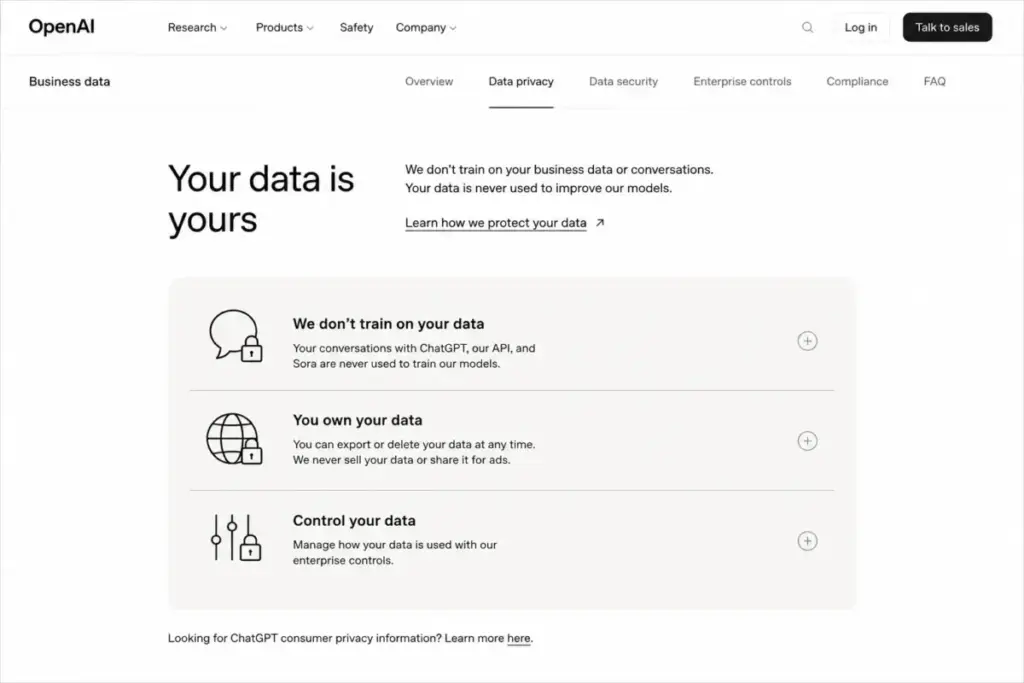
One privacy point deserves care. OpenAI’s no-training-by-default statement applies to Business and Enterprise organization data, not automatically to consumer settings, so do not tell your legal team “ChatGPT never trains on our data” without specifying the plan.
Support tracks the same tier logic. Jasper Business includes dedicated account management and priority support, while OpenAI Enterprise includes 24/7 priority support, SLAs, custom legal terms, and AI advisors for eligible customers, with Business relying more on workspace and admin resources.
Buyer impact: a regulated marketing team whose core need is brand governance, SSO, and audit logs can shortlist Jasper Business. A regulated enterprise whose core need is identity provisioning, EKM, and data residency across many departments should shortlist ChatGPT Enterprise.
Mobile Access and Everyday Use
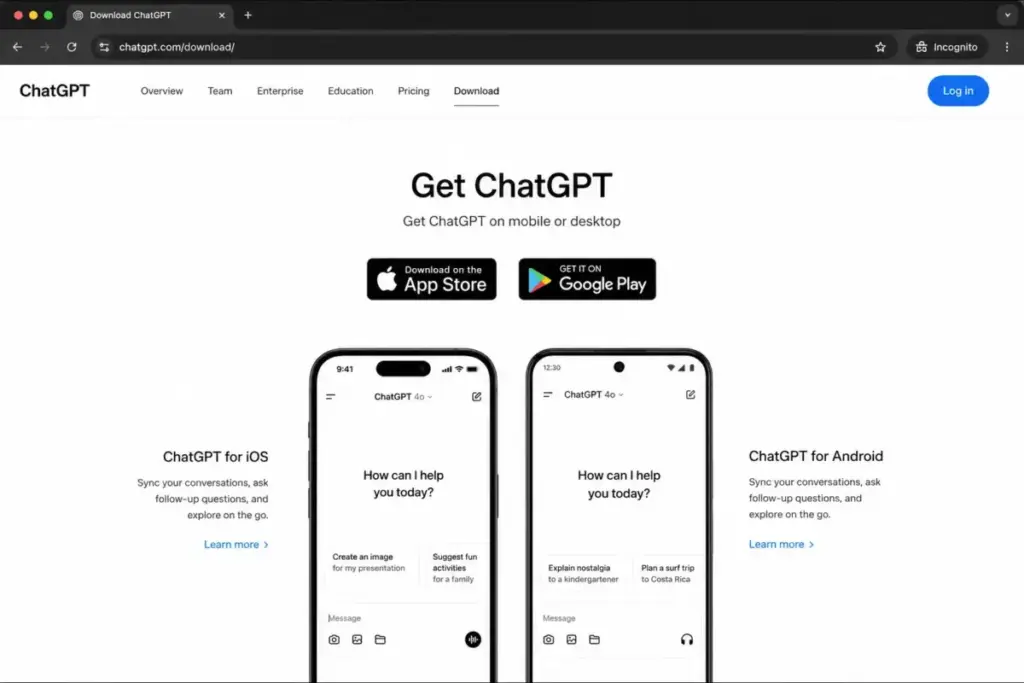
ChatGPT wins mobile cleanly. Its official download page lists iOS and Android apps supporting chat on the go, voice conversations, questions about photos, and Codex management from a phone.
Jasper’s evidence points the other way, with a caveat. An official Jasper Help Center article says Jasper does not have a downloadable app and suggests adding the web app as a home-screen bookmark, though that article is older and may not reflect every current detail.
Buyer impact: executives approving copy between meetings, field and event marketers, and anyone reviewing on a phone will find ChatGPT’s native apps materially smoother. If mobile capture and review is part of your daily loop, verify Jasper’s current mobile state before you commit.
Setup and Migration Difficulty
Setup effort scales with governance, not with logins. For a solo user, both tools are low-effort: sign up, start prompting.
| Scenario | Jasper | ChatGPT |
|---|---|---|
| Solo user | Low | Low |
| Small team workspace | Moderate (Business admin, brand assets) | Low to moderate (workspace, billing) |
| Governed rollout | High (IQ assets, agents, permissions, brand governance) | High for Enterprise (identity, residency, retention) |
Jasper’s real setup cost is the brand system itself. Building Brand Voices, Knowledge assets, Audiences, and agents is the work that makes Jasper worth its price, and skipping it leaves you paying for governance you never configured.
ChatGPT’s heavier setup only appears at Enterprise, where identity, compliance, residency, and retention need IT involvement. For most small teams, ChatGPT’s workspace is faster to stand up than a governed Jasper deployment.
Human Review Still Required
Neither tool removes the reviewer. Reviewer patterns on Capterra and TrustRadius describe Jasper as strong for drafts, marketing copy, outlines, SEO content, and social posts, but weaker on technical or fact-sensitive writing without editing.
ChatGPT draws similar caution. TrustRadius sentiment describes it as useful for brainstorming, writing, and spreadsheet help but unreliable for calculations and cited research, and G2 pros-and-cons notes flag occasionally inaccurate or outdated answers.
For fact-sensitive content, treat both as draft engines, not publishers. A safe review loop for legal, medical, finance, or technical copy runs like this:
- Verify every factual claim against a primary source before publishing.
- Add real citations rather than trusting model-supplied references.
- Route the draft through a subject-matter expert.
- Get brand and legal approval on regulated claims.
This is the human-in-the-loop cost that pricing pages never show. If your content carries compliance or accuracy risk, the reviewer’s time is part of the true cost of either tool, and AI hallucinations explain why that review step is not optional.
Where Jasper Wins
Jasper is the clearer fit in these situations:
- Multi-writer teams that need one enforced brand voice across campaigns rather than five improvised ones.
- Agencies past two active client brands, where Pro’s asset caps push toward Business governance.
- High-volume SEO, GEO, and campaign production that benefits from complex agents, Grid, and pipelines.
- Regulated marketing teams whose core requirement is brand governance, SSO, RBAC, and an audit log.
- Content operations where dedicated account management and priority support reduce rollout risk.
Each of these ties back to governance, not raw writing quality. Jasper earns the premium when consistency and control across people are the problem you are paying to solve.
Where ChatGPT Wins
ChatGPT is the clearer fit here:
- Solo creators and students who want a capable tool at Free or $20/month rather than $59/month.
- Cross-functional roles needing writing plus research, coding, data analysis, and files in one tool.
- Small teams that value predictable public per-seat pricing over a custom quote.
- Mobile-first workflows that need native iOS and Android apps.
- Buyers who want the lowest entry cost to evaluate AI before committing budget.
The common thread is breadth and price. ChatGPT wins whenever the job is varied, the reviewer is one person, or the budget is tight.
Who Should Choose Jasper?
Choose Jasper if three or more of these are true: you run a marketing team of 5 or more, brand consistency across writers is a recurring pain, you manage multiple brands or clients, you need marketing-specific agents and pipelines, or you require governed brand context with audit logging. Jasper’s value is the control layer, and that layer only pays off when several people produce brand content on a schedule.
Do not choose Jasper mainly because it “has AI.” Choose it because the brand governance and workflow depth solve a problem your current stack cannot.
Who Should Choose ChatGPT?
Choose ChatGPT if three or more of these are true: you are a solo user or small team, you need broad AI beyond marketing, your budget favors low entry cost, you want native mobile access, or you need coding, data, and research alongside copy. ChatGPT’s range and price make it the safer default for anyone whose work is not purely governed marketing production.
Do not choose ChatGPT expecting Jasper-grade brand enforcement out of the box. You will assemble that context manually, and for a one-reviewer workflow that is usually fine.
Who Should Avoid Both?
Some teams should shortlist a third type of tool instead:
- Teams whose core need is platform-native social engagement and scheduling may get more from a dedicated social suite.
- Teams that need a full SEO suite with rank tracking and site audits should pair or replace these with an SEO platform.
- Content operations tightly bound to a DAM or CMS may need workflow tooling neither product centers on.
If your bottleneck is distribution or SEO infrastructure rather than drafting, neither Jasper nor ChatGPT is the tool that fixes it. When drafting is not the bottleneck, a specialist tool from our Jasper alternatives list may fit the actual gap better than either option here.
Alternatives to Jasper and ChatGPT
| Alternative | Choose it if |
|---|---|
| Copy.ai | You want marketing-focused generation at a lower entry point than Jasper Business |
| Writesonic | You need SEO-leaning content generation with ad and article templates |
| Claude | You want a general assistant with strong long-form reasoning as a ChatGPT counterpart |
| A dedicated SEO suite | Rank tracking, audits, and keyword research matter more than brand voice |
Our Jasper vs Copy.ai breakdown covers the marketing-tool alternative if Jasper’s price is the sticking point.
For the general-assistant route, ChatGPT vs Claude covers the strongest counterpart if reasoning rather than brand governance is the draw.
Should You Use Both?
Running both can work, but “use both” is not free advice. Two systems mean two places to maintain prompts, brand context, files, approvals, and final QA, and someone has to own that seam.
Use both only if you can answer these clearly:
- Who owns brand context in each tool and keeps them in sync?
- Where does a draft hand off from ChatGPT research to Jasper brand production?
- Who runs final QA once content crosses tools?
- Is the extra subscription cheaper than the copy-paste labor it creates?
If those answers are fuzzy, a dual-tool stack adds manual integration work rather than saving it. A workable split is ChatGPT for research, reasoning, and technical drafts, Jasper for governed on-brand production, with one owner managing the handoff.
Before paying for either or both, run a 30-minute evaluation. Give both tools the same brand guide, the same campaign brief, and the same fact-check step, then compare brand fit, edit time, citation quality, and how much handoff friction each creates.
Final Verdict
There is no single winner, and forcing one would misread the buyer. The decision resolves by scenario:
- Solo creator or student: ChatGPT, for cost and breadth.
- Solo marketer with one brand and recurring campaigns: Jasper Pro, if on-brand output is the decisive need.
- 3-person marketing team: price Jasper Business against ChatGPT Business; pick Jasper for governance, ChatGPT for cost and range.
- Agency with more than two active client brands: Jasper Business, for unlimited IQ customization (get a quote).
- Founder, analyst, developer, or technical marketer: ChatGPT, for coding, data, and research alongside copy.
- Regulated enterprise: ChatGPT Enterprise when identity, EKM, and residency dominate; Jasper Business when marketing governance dominates.
- High-volume SEO and campaign team: Jasper Business, with credit and custom-pricing verification.
The pattern is consistent. Jasper wins when governed marketing production across people is the job; ChatGPT wins when breadth, mobility, or price is the job. Match the tool to your dominant workflow, not to whichever writes a marginally nicer sentence.
For where these two sit against the broader chat and assistant field, our best AI chatbots roundup adds the surrounding options.
FAQ
Is Jasper better than ChatGPT?
Not universally. Jasper is better for governed, on-brand marketing production across a team, with Brand Voice, Knowledge assets, and agents built in. ChatGPT is better for broad AI work, lower entry cost, and mobile access. Pick by your dominant workflow rather than by which tool writes one nicer sentence.
Which is cheaper, Jasper or ChatGPT?
ChatGPT, at the entry point. It offers a Free plan and paid tiers from $8/month, while Jasper Pro starts at $59/month billed yearly for a single seat. At team scale, Jasper Business is custom-priced, so compare a Jasper quote against ChatGPT Business at roughly $20/user/month annual before deciding.
Can ChatGPT replace Jasper?
For a solo reviewer or a small team, often yes, if you build brand context manually with custom instructions, projects, and company knowledge. For a multi-writer team that needs enforced brand voice and audit logging, ChatGPT’s more manual governance is a real gap that Jasper closes.
Does Jasper use OpenAI models?
Jasper positions itself as marketing infrastructure that applies multiple AI models within governed workflows, rather than as a single-model chatbot. The buyer takeaway is that you are paying for the brand and workflow layer, not just raw model access, so a model-by-model comparison misses the point.
Can my 3-person marketing team use Jasper Pro?
No. Jasper Pro is limited to 1 seat, so a 3-person team must move to Jasper Business, which is custom-priced. That is why a small team’s real comparison is Jasper Business against ChatGPT Business, not Jasper Pro against ChatGPT Plus.
Is ChatGPT Business safe for company data?
OpenAI states that Business and Enterprise organization data is not used to train models by default, with encryption in transit and at rest. That protection applies to the business plans specifically, so confirm your plan and settings rather than assuming it covers consumer use as well.
Is Jasper good for agencies?
Yes, if you outgrow Pro’s limits. Jasper Pro includes 2 Brand Voices and 5 Knowledge assets, which suits one or two client brands, while agencies with more client accounts need Business for unlimited IQ customization. Get a Business quote before assuming the cost fits your margins.
Which is better on mobile?
ChatGPT. It offers official iOS and Android apps with voice and photo support, while an older Jasper help article says there is no downloadable app and suggests a home-screen web shortcut. Verify Jasper’s current mobile state if mobile review is a regular part of your workflow.