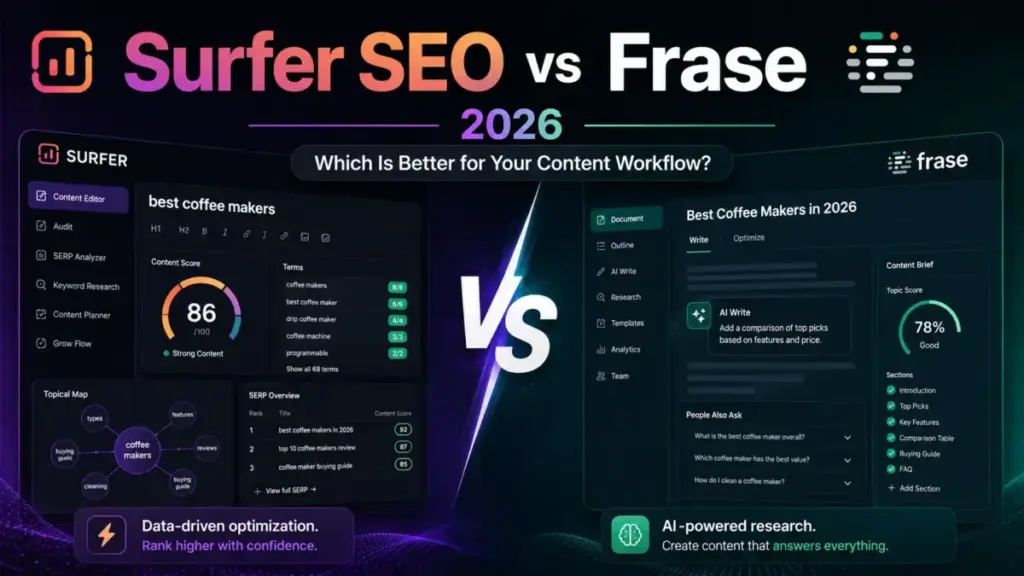
Surfer’s AI visibility prompt tracking looks like the headline feature that justifies the price. On the entry Discovery plan, you get zero of them. Frase includes AI visibility from its cheapest paid tier, but caps you at 10 published articles a month.
That is the real Surfer SEO vs Frase decision in 2026: not which tool is “better,” but which plan gate breaks your workflow first. Both products moved past on-page content scoring this year and now sell a full loop of research, drafting, optimization, publishing, and monitoring across Google and generative AI search.
They compete with the broader field of best AI writing tools, but as optimization platforms rather than pure generators. The loop looks similar in a feature grid; the limits are where they diverge.
I compared both platforms against their official pricing, product, docs, and security pages, checked July 8, 2026. This is official-source research, not a hands-on trial, so every plan cap, price, and feature gate below is mapped to a vendor page rather than a personal test result.
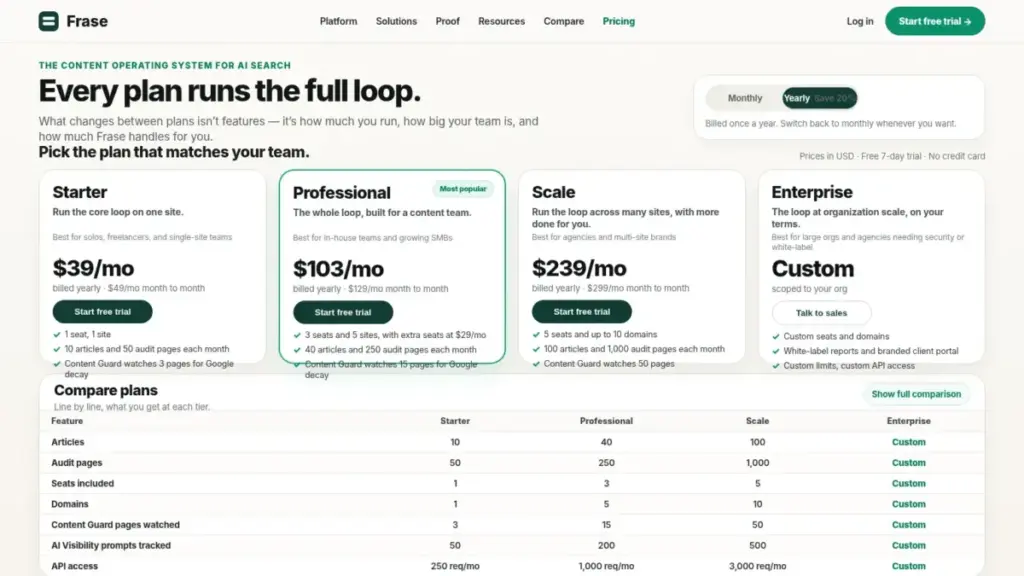
Choose Frase if you are a solo creator or a team of three to five that needs a research-to-publish workflow, direct publishing into WordPress, Webflow, Sanity, or Wix, API access on every plan, and a lower annual entry price. Frase Starter runs $39/month billed yearly with a 7-day no-card trial.
Choose Surfer SEO if your core job is granular on-page optimization inside a mature content editor, you manage a growing library of tracked pages, and you want AI visibility prompt tracking that refreshes daily on higher tiers. Surfer’s confirmed annual prices run from $49 to $299/month before Enterprise.
Avoid both if you expect a content score to guarantee rankings, or if you only publish two or three pieces a quarter and cannot justify a recurring optimization subscription.
Quick Verdict: Surfer SEO vs Frase
Winners here are per category, not overall. No single tool wins every row, which is exactly why the plan you pick matters more than the logo.
| Category | Winner | Why |
|---|---|---|
| Entry annual price | Frase | Starter is $39/mo yearly vs Surfer Discovery at $49/mo yearly |
| Monthly flexibility and trial | Frase | Clear $49 month-to-month and a 7-day no-card trial |
| On-page optimization depth | Surfer | Content Editor, Content Score, 1-click optimize, internal linking |
| Research-to-publish workflow | Frase | Agent researches, drafts, scores, and publishes to your CMS |
| Direct CMS publishing | Frase | WordPress, Webflow, Sanity, Wix, plus FraseCMS hosting |
| Content decay fixing | Frase | Content Guard drafts fixes and republishes after approval |
| AI visibility at entry tier | Frase | AI visibility from Starter; Surfer gates prompts to Standard+ |
| Higher-tier prompt tracking | Surfer | 50 to 100 prompts refreshed daily on Pro and Peace of Mind |
| API access and published quotas | Frase | API on every plan with 250/1,000/3,000 request quotas |
| Verified enterprise compliance | Frase | Public SOC 2 Type II attestation; Surfer SOC 2 unconfirmed |
| 10-seat flat cost | Surfer | Peace of Mind bundles 10 seats at $299/mo yearly |
Surfer SEO vs Frase at a Glance
Two AI SEO and content optimization platforms that now overlap on the loop but split on unit economics and publishing.
| Attribute | Surfer SEO | Frase |
|---|---|---|
| Parent company | Positive | Copysmith |
| Category | AI search visibility and SEO optimization | AI SEO, GEO, and content operating system |
| Entry price (annual) | $49/mo (Discovery) | $39/mo (Starter) |
| Free trial | “Start for Free” CTA; terms not fully confirmed | 7-day trial, no card required |
| Core unit | Documents (120 to unlimited by plan) | Articles (10 to 100/mo by plan) plus audit pages |
| Direct CMS publishing | Not listed; WordPress, Contentful, Zapier connectors | WordPress, Webflow, Sanity, Wix, FraseCMS |
| AI visibility starts at | Standard ($99/mo) | Starter ($39/mo) |
| API access | Upper tiers; quotas not publicly confirmed | Every plan; 250/1,000/3,000 req/mo |
| SOC 2 Type II | Not verified in this research | Publicly stated |
| SSO / SAML | SSO on Enterprise | SSO/SAML on Enterprise |
| Mobile app | None verified (web-first) | None verified (web-first) |
How We Compared
This comparison is built on official documentation and pricing pages, not a hands-on account test. Every plan cap, price, and feature below reflects what the vendor pages show as of July 8, 2026, so the language stays with what the documentation states rather than personal trial results.
Sources include the Surfer and Frase pricing pages, product and feature pages, help and API docs, and each vendor’s security page, all checked July 8, 2026. Third-party review platforms are used only for sentiment patterns, never for product facts.
Two limits are worth flagging up front. Surfer’s official page cleanly exposed annual-billed prices, but the monthly toggle was not fully captured, so treat Surfer month-to-month figures as unconfirmed until you check the page yourself.
Surfer also documents API capabilities without publishing exact per-plan request quotas, and its enterprise page lists GDPR and SSO but did not confirm SOC 2. I flag those as unverified rather than guessing at numbers.
SaaS pricing changes often. Every price here should be re-checked on the vendor page before you buy.
Workflow 1: Research and Briefs
The first real fork is who builds your outline. This is where Frase originally made its name, and the workflow still leans in its favor.
Frase generates SERP-based briefs and drafts in a defined brand voice, then scores the result for both SEO and generative engine optimization. On Starter you get 10 articles and 50 audit pages a month, which is a research budget, not just a word count.
Surfer approaches the same job from the editor outward. Its Topical Map, Content Ideas, and Coverage Gap tools surface what to write, but the deeper planning features sit on Pro at $182/month rather than the entry tier.
Here is the hype test. Both tools market “AI research,” but the useful question is how many briefs you can actually run before a cap stops you. Frase counts articles and audit pages explicitly; Surfer counts documents, and a document in Surfer is closer to an optimization workspace than a finished, published article.
For a solo writer producing eight to ten briefs a month, Frase Starter is the cleaner fit. For an SEO editor who wants topical-gap analysis feeding a strict on-page score, Surfer Pro does more, at roughly triple the entry price.
Winner: Frase, for research volume and brief-to-draft speed at a low entry price.
Workflow 2: Drafting and On-Page Optimization
Once you have a draft, the job flips to scoring and tightening. This is Surfer’s home turf, and it shows.
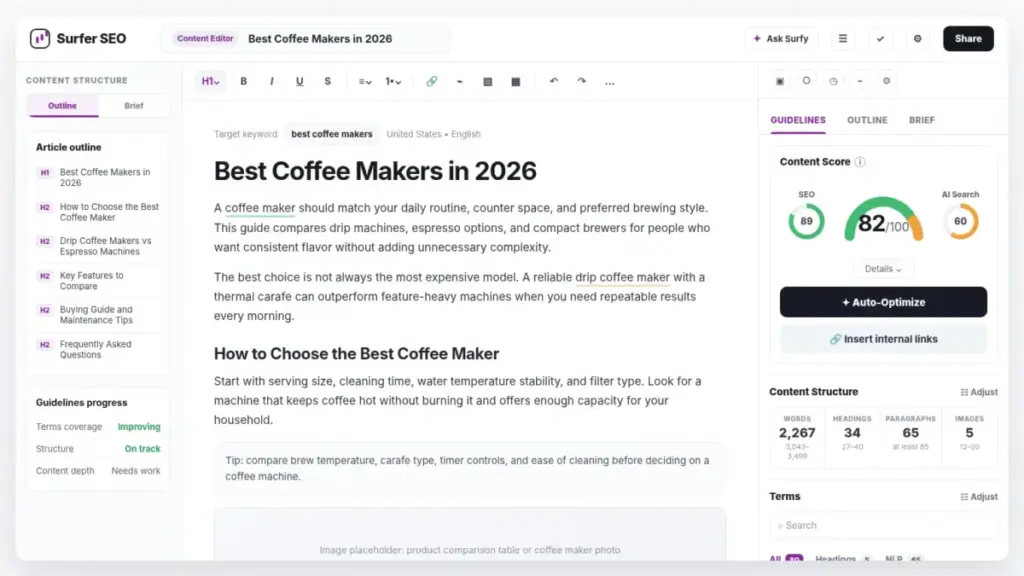
Surfer’s Content Editor pairs a live Content Score with AI SEO guidelines, 1-click content optimization, and an AI Humanizer. Its Surfy assistant and Surfer AI handle generation inside that same scoring loop, so the optimization signal is always in view.
Frase also scores drafts for SEO and GEO, but its optimization sits inside a broader workflow driven by AI agents rather than a dedicated editor built purely for term coverage. If your editors live and die by a content score, Surfer’s editor feels more purpose-built.
The failure mode differs by tool. In Surfer, the first thing that breaks is the document cap: Discovery gives you 120 documents, and heavy optimizers burn through workspaces faster than they expect. In Frase, the constraint is the monthly article count, so a team optimizing many short pieces hits the article ceiling before it runs low on ideas.
Human review is still required in both. Review-pattern signals on G2 note that Frase’s AI output can drift off-topic, and no content score, in either tool, is a substitute for an editor checking intent and accuracy.
Winner: Surfer SEO, for teams whose primary metric is on-page optimization depth.
Workflow 3: Publishing to Your CMS
This is the workflow most feature grids hide, and it is the clearest practical divider between the two tools.
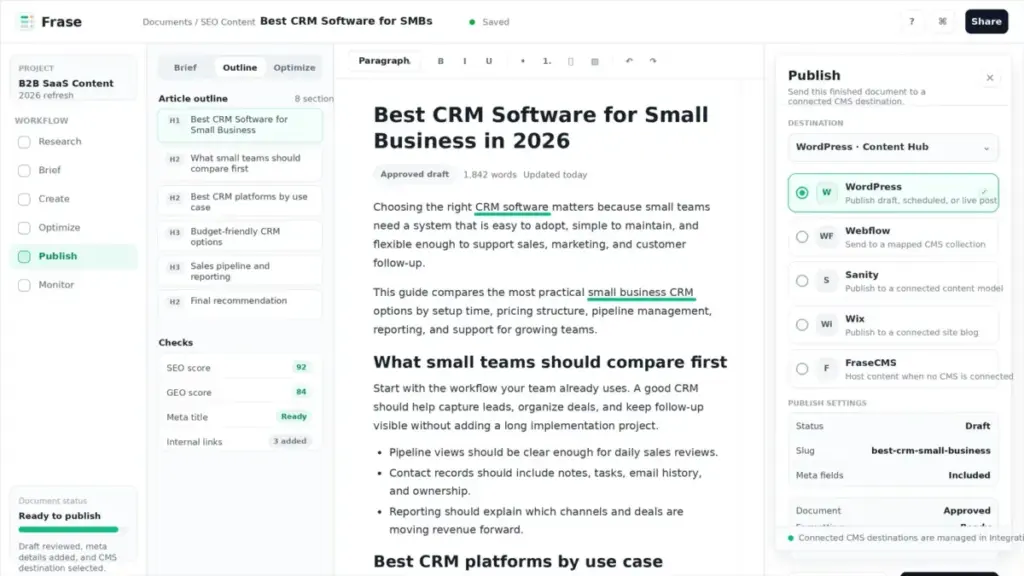
Frase publishes finished content directly to WordPress, Webflow, Sanity, or Wix, and can host on FraseCMS. That turns “draft approved” into “page live” without a copy-paste handoff.
Surfer’s public pricing lists WordPress, Google Docs, Contentful, and Zapier integrations plus data export, and its docs add a Google Docs extension. Those are strong for optimizing and exporting, but the emphasis is the editor and connectors rather than one-click publishing to a CMS you host.
For a content-ops team, that difference is production speed. If your writers finish in the tool and a separate person pastes into WordPress, Frase removes a manual step that Surfer’s stack generally leaves in place.
The caveat: direct publishing is only useful if it lands cleanly in your exact CMS. A team on a headless Contentful setup may value Surfer’s Contentful and Zapier routes more than Frase’s WordPress-first publishing.
Winner: Frase, for teams that want to publish, not just optimize and export.
Workflow 4: Monitoring and Fixing Content Decay
Teams with existing libraries care more about refreshing old pages than drafting new ones. Both tools monitor decay; only one closes the loop for you.
Surfer’s Content Audit tracks content performance, rank changes, quick wins, and refresh recommendations tied to Search Console-style workflows. It tells you what dropped and what to optimize, then hands the fix back to a human editor.
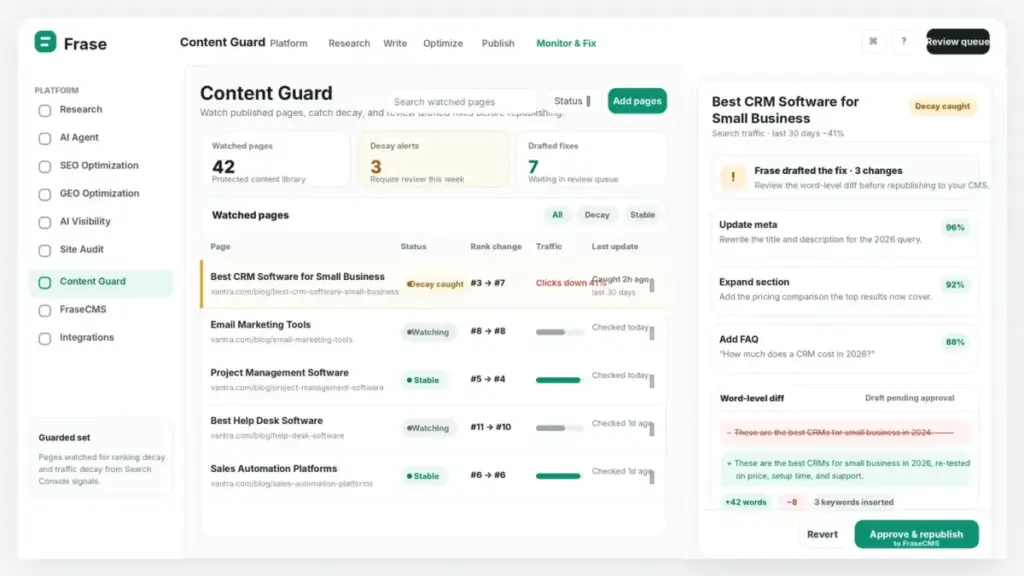
Frase’s Content Guard watches marked pages for ranking and traffic decay, drafts the fix itself, and republishes to your CMS once you approve it. That approval step is the human-in-the-loop check, and it is on by default rather than an afterthought.
The distinction is monitor-and-recommend versus draft-and-republish. Surfer surfaces the opportunity; Frase attempts the repair and waits for your sign-off.
Watch the plan gate on Frase’s side. Content Guard watches only 3 pages on Starter, 15 on Professional, and 50 on Scale, so a 200-page library needs the higher tiers or a rotation strategy. Surfer’s tracked-page counts scale differently, from 10 on Discovery up to 500 on Peace of Mind.
Winner: Frase for a closed-loop republish, Surfer SEO for optimization-led auditing with more tracked pages at the top tier.
Workflow 5: AI Visibility and GEO Tracking
Both tools now track whether AI engines mention your brand. “Has AI visibility” is a checkbox; the useful details are which engines, how many prompts, and how often it refreshes.
Frase includes AI visibility from Starter, tracking ChatGPT and Google AI, adds Perplexity on Professional, and adds Claude and Gemini on Scale. Historical data scales too: current-only on Starter, 3 months on Professional, 12 months on Scale, and 24 months on Enterprise.
Surfer gates AI prompt tracking above its entry plan. Discovery has zero prompts, Standard adds 25 prompts refreshed weekly, Pro moves to 50 refreshed daily, and Peace of Mind reaches 100 daily.
Refresh cadence is the hype test here. Weekly refresh on Surfer Standard is fine for a slow-moving brand-mention check, but daily refresh, which starts at Surfer Pro, matters if you are tracking fast-moving AI answers. Frase’s engine breadth at low tiers competes directly with that.
One misconception to kill: neither tool guarantees an AI citation. Both monitor and alert; the actual fix still comes from your content workflow, authority, and freshness, and it builds over weeks, not during a trial.
Winner: Frase for entry-tier engine coverage and history retention, Surfer SEO for high-frequency daily prompt tracking on Pro and above.
| AI visibility factor | Surfer SEO | Frase |
|---|---|---|
| Starts at | Standard ($99/mo) | Starter ($39/mo) |
| Prompts (by tier) | 0 / 25 / 50 / 100 | 50 / 200 / 500 by tier |
| Refresh cadence | Weekly on Standard, daily on Pro+ | Not tier-split the same way; monitored and alerted |
| Engines added by tier | Tracks Google and AI engines; prompt caps scale | ChatGPT + Google AI, then Perplexity, then Claude + Gemini |
| Historical data | Not clearly tier-split in this research | Current / 3mo / 12mo / 24mo |
| Auto-fix | No; monitor and recommend | No; monitor and alert, fix via workflow |
Pricing and Value per Dollar
Starting price is the wrong number to compare, because Surfer sells documents and Frase sells articles and audit pages. Those units are not interchangeable, so the honest comparison is cost per usable output within each tool, plus a true 10-seat cost.
Here are the confirmed prices, checked July 8, 2026, drawn from Surfer’s pricing plans and Frase’s pricing tiers. Treat Surfer’s monthly-billed figures as unconfirmed until you re-check the toggle.
| Plan | Surfer SEO (annual) | Frase (annual / monthly) |
|---|---|---|
| Entry | Discovery $49/mo | Starter $39/mo / $49 |
| Mid | Standard $99/mo | Professional $103/mo / $129 |
| Upper | Pro $182/mo | Scale $239/mo / $299 |
| Top self-serve | Peace of Mind $299/mo | (Scale is top self-serve) |
| Enterprise | $999/mo, tailored | Custom |
On Frase, cost per included article drops as you scale: about $3.90 per article on Starter, roughly $2.58 on Professional, and about $2.39 on Scale at annual pricing. Cost per audit page falls faster, from about $0.78 on Starter to roughly $0.24 on Scale.
On Surfer, documents run about $0.41 each on Discovery and $0.28 on Standard before Peace of Mind removes the cap entirely. That looks cheaper per unit, but a Surfer document is an optimization workspace, not a published article, so do not read it as a like-for-like article price.
Now the 10-seat question, which the entry price hides. Surfer Peace of Mind bundles 10 seats at $299/month billed yearly, with unlimited documents, 500 tracked pages, 100 daily prompts, and API access.
Frase reaches 10 seats by adding to Scale: 5 included seats plus 5 extra at $29/month each puts a 10-person team near $384/month at annual pricing, before Enterprise. So at 10 seats, Surfer’s flat bundle is cheaper, while Frase gives you 100 articles, 1,000 audit pages, up to 10 domains, and a 3,000-request API quota for the premium.
One hidden-cost note in Frase’s favor: its pay-as-you-go overages are optional and off by default, so you do not get a surprise bill for exceeding a cap. Surfer’s overage behavior was not clearly exposed in this research, so confirm it before you rely on bursting past a limit.
Stale pricing is common in older comparison posts. If you see Frase “Solo” plans or Surfer “Essential” tiers quoted elsewhere, those are outdated plan names; the current tiers are the ones above, checked July 8, 2026.
Plan Limits That Actually Matter
Feature logos tell you a capability exists. This matrix tells you which plan actually gives you enough of it to run a real workflow.
| Limit | Surfer Discovery / Standard / Pro / Peace of Mind | Frase Starter / Professional / Scale |
|---|---|---|
| Price (annual) | $49 / $99 / $182 / $299 per mo | $39 / $103 / $239 per mo |
| Seats | 1 / 3 / 5 / 10 | 1 / 3 / 5 (extra $29/mo) |
| Sites or workspaces | 1 / 1 / 5 / unlimited | 1 site / 5 sites / up to 10 domains |
| Documents or articles | 120 / 360 / 360 / unlimited docs | 10 / 40 / 100 articles per mo |
| Tracked / audit pages | Tracked pages: 10 / 50 / 200 / 500 | Audit pages: 50 / 250 / 1,000 per mo |
| AI prompts | 0 / 25 wk / 50 daily / 100 daily | 50 / 200 / 500 |
| Content decay watch | Tracked pages above | Content Guard: 3 / 15 / 50 pages |
| API access | Upper tiers; quota not confirmed | 250 / 1,000 / 3,000 req per mo |
| Historical AI data | Not tier-confirmed | Current / 3mo / 12mo |
The reading is straightforward. Surfer’s entry Discovery plan is an optimization seat for one person with no AI prompt tracking. Frase’s entry Starter plan is a full loop for one person, capped at 10 published articles.
API and Automation
For product-led and technical content teams, the API is a buying decision, not a nice-to-have. If you are newer to how an API works, it is the connection that lets one system trigger another automatically, and here it is a clear Frase advantage on paper.
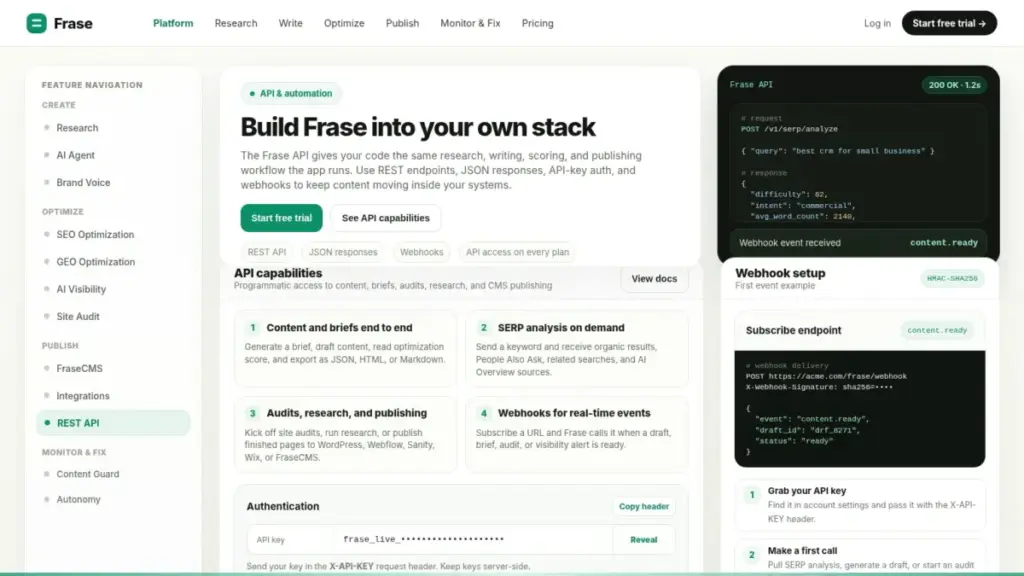
Frase publishes API access on every plan with named quotas: 250 requests a month on Starter, 1,000 on Professional, 3,000 on Scale, and custom on Enterprise. The REST API exposes content, briefs, SERP analysis, AI visibility tracking, site audits, research, and CMS publishing, with API-key authentication and signed webhooks.
Frase also lists an MCP server integration for AI assistants such as Claude and Cursor-style tools, which matters if you are wiring content ops into an agent stack.
Surfer documents solid API capabilities, including auditing, content creation, managing content editors, generating outlines, and triggering AI writing. The gap is transparency: exact per-plan request quotas were not publicly confirmed in this research, and API access appears gated to the upper tiers.
The usage-math takeaway: if you need to automate at a known cost, Frase lets you size the plan to a request budget today. With Surfer, you get the capability but have to confirm the quota with sales or docs before you build against it.
Winner: Frase, for published quotas and API access on every plan.
Integrations and Publishing
Integrations only matter in the shape of a workflow: does the tool optimize and export, or does it publish? Here is the split by type.
| Integration type | Surfer SEO | Frase |
|---|---|---|
| CMS publishing | Not listed as direct publish | WordPress, Webflow, Sanity, Wix, FraseCMS |
| Writing surface | Google Docs extension | Google Docs, Notion |
| Headless / other CMS | Contentful | Any URL extraction |
| Automation | Zapier | Webhooks, MCP server |
| Dev tooling | API | API, GitHub, Linear |
| Export | Data export | Exportable reports (Scale+) |
The pattern: Surfer is built to optimize inside your writing surface and export, with Contentful and Zapier for the plumbing. Frase is built to publish, with WordPress-first CMS support and a webhook/MCP layer for automation.
Which stack wins depends on where you publish. A WordPress-centric blog team leans Frase, while a headless, Zapier-heavy stack may prefer Surfer’s Contentful and Zapier route.
Support, Security, and Admin Controls
Procurement can disqualify a tool before anyone evaluates features. This is where the two diverge on paper.
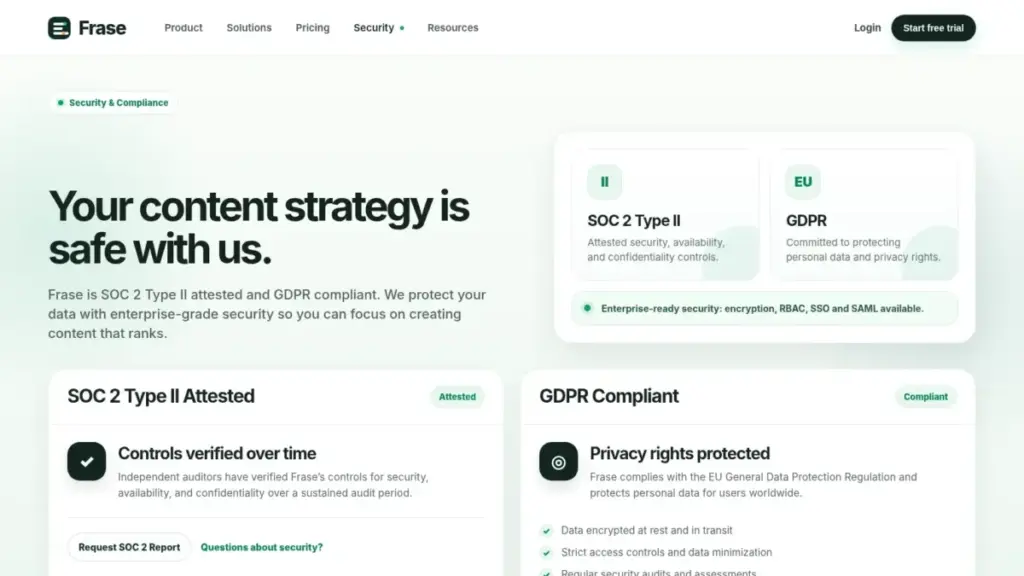
Frase’s security page states SOC 2 Type II attestation and GDPR compliance, with encryption at rest and in transit, role-based access control, SSO/SAML for enterprise, regular audits, code review, and vulnerability scanning. It also offers to share its SOC 2 report.
Surfer’s enterprise page states GDPR compliance, SSO, encryption in transit and at rest, real-time security monitoring, and regular internal and external audits, plus tailored onboarding, a dedicated CSM, and 24/5 support. Its public pages did not confirm SOC 2 in this research.
For a security-conscious buyer, that is the deciding line. Frase gives you a public SOC 2 Type II claim you can hand to a security reviewer today; Surfer gives you strong controls but leaves the SOC 2 question to confirm with sales.
SSO/SAML and white-label sit on the top tiers for both. Frase Enterprise adds a branded client portal and custom domain; Surfer Enterprise adds white-label, an advisory program, and legal onboarding assistance.
Winner: Frase, for verified SOC 2 Type II, with Surfer competitive on hands-on onboarding and support.
Team Collaboration and Reporting
Editorial teams care about who can recover a change and who can show a trend to leadership. The tools split on collaboration governance and reporting history.
Surfer’s pricing table exposes version history, an activity log, live collaboration, comments, folders, and external links that scale by plan, alongside seats. Those are the operational controls an editor cares about when several people touch one document.
Frase’s reporting edge is history retention on AI visibility: current-only on Starter, then 3, 12, and 24 months as you climb. Exportable reports arrive on Scale, and white-label reports plus a branded client portal arrive on Enterprise.
For an agency that presents trends to clients, Frase’s retention and exportable, white-label reporting is the stronger reporting story. For an in-house editorial team focused on document governance, Surfer’s version history and activity log are more directly useful.
What Real Users Say
Review scores drift, so treat these as sentiment patterns from G2, Capterra, and Trustpilot, not fixed facts. Recheck ratings before you cite a number anywhere.
| Theme | Surfer SEO pattern | Frase pattern |
|---|---|---|
| Ease of use | Praised for the content editor and actionable insights | Praised for ease and time savings |
| Research / editor speed | Strong on-page optimization workflow | Fast research-to-brief, some off-topic AI output |
| Pricing / value | Some call pricing a barrier for small teams | Often called affordable, some flag add-on costs |
| AI output quality | Generally positive | Mixed; occasional irrelevant generations |
| Support / reliability | Described as fast and helpful | Trustpilot skews critical, with a representativeness caveat |
The consistent signal: buyers like Surfer’s editor and Frase’s speed, and both sets of reviewers remind you that AI output needs a human pass.
Setup and Migration Difficulty
Neither tool is hard to open, but both get more involved as you connect data sources and governance. Here is the honest read.
| Setup factor | Surfer SEO | Frase |
|---|---|---|
| Time to first value | Moderate | Low to moderate |
| Free entry | “Start for Free” CTA | 7-day trial, no card |
| Learning curve | Content scoring, tracked pages, audits, prompts | Agent, CMS connect, Content Guard, API |
| Deeper setup | GSC-style monitoring, team roles | CMS auth, Search Console, webhooks, MCP |
| Enterprise onboarding | Tailored onboarding, CSM | Dedicated account manager, SLA |
Surfer’s curve is about learning the scoring and audit model. Frase’s is about wiring the loop: connect a CMS, connect Search Console, set Content Guard, and, if you automate, configure the API and webhooks.
Migration between them is low-risk because neither holds your published content hostage; your pages live in your CMS. The switching cost is retraining editors on a different scoring model, not moving data.
Where Surfer SEO Wins
Four scenarios where Surfer is the clearer pick.
Deep on-page optimization: the Content Editor, Content Score, 1-click optimize, and internal linking are purpose-built for editors who optimize term-by-term.
High-frequency AI prompt tracking: daily-refresh prompt tracking starts at Pro and reaches 100 prompts on Peace of Mind, ahead of a weekly cadence.
Flat-cost 10-seat teams: Peace of Mind bundles 10 seats, unlimited documents, and 500 tracked pages at $299/month billed yearly.
Large tracked-page libraries: 500 tracked pages at the top self-serve tier suits teams monitoring a big existing library for rank drops.
Where Frase Wins
Five scenarios where Frase pulls ahead.
Research-to-publish in one tool: the agent researches, drafts, scores, and publishes to your CMS after approval, removing the copy-paste handoff.
Direct CMS publishing: WordPress, Webflow, Sanity, and Wix support, plus FraseCMS hosting, beats optimize-and-export for publishing teams.
Lower entry and clear trial: $39/month annual, $49 month-to-month, and a 7-day no-card trial lower the barrier to start.
API on every plan: 250, 1,000, and 3,000 request quotas by tier give technical teams a known automation budget from day one.
Verified compliance: a public SOC 2 Type II attestation clears a procurement step Surfer leaves open.
Who Should Choose Surfer SEO?
Pick Surfer if your primary metric is on-page optimization and your editors work term-by-term inside a content score. That is what its editor is built for.
Pick Surfer if you manage a large existing library and want tracked-page monitoring with daily AI prompt refresh on Pro or above.
Pick Surfer if you are a 10-seat team that wants a flat, predictable bundle at $299/month rather than per-seat math.
Who Should Choose Frase?
Pick Frase if you want one tool to research, draft, optimize, and publish, especially into WordPress, Webflow, Sanity, or Wix.
Pick Frase if you are a solo creator or a team of three to five who values a low annual entry price, a real trial, and API access on every plan.
Pick Frase if you need a closed-loop content-decay fix with Content Guard, or a public SOC 2 Type II attestation for procurement.
Who Should Avoid Both?
Skip both if you publish only a handful of pieces a quarter. A per-unit or ad hoc freelance workflow rarely justifies a recurring optimization subscription at these prices.
Skip both if you expect a high content score to guarantee rankings or AI citations. Both vendors are explicit that visibility builds over weeks through intent, authority, links, and freshness, not a single score.
If you want raw AI drafting more than SEO scoring, a general AI writing tool may fit better, and you can compare the field of AI content creation tools before committing to an optimization platform.
Should You Use Both?
“Use both” is common advice and usually overkill. It only pays off under specific conditions.
Run both when you publish at real volume, separate researcher, writer, and editor roles, and need to both refresh an existing library and ship net-new briefs. In that setup, Frase can own research, drafting, and publishing while Surfer owns final on-page optimization and scoring.
Below that volume, paying two subscriptions duplicates cost for a workflow one tool can handle. If a single editor does everything, pick one and go deep.
Alternatives to Surfer SEO and Frase
If neither fits, three directions cover most reasons buyers look elsewhere.
| Alternative | Best for | Why consider it |
|---|---|---|
| Clearscope | Enterprise editorial teams | Simple, high-trust content grading with a premium price |
| MarketMuse | Topic-model planning | Content inventory and topical authority planning at scale |
| Jasper | AI-first drafting | Generation and brand voice when scoring is secondary |
Clearscope suits teams that want clean content grading and will pay for it. MarketMuse suits planners who think in topic models and inventories. Jasper suits teams that want AI drafting first and treat SEO scoring as secondary, and it is worth weighing against the wider set of Surfer SEO alternatives and Frase alternatives before you decide.
Final Verdict
The Surfer SEO vs Frase choice has no universal winner, and picking one by brand is the mistake. The decision is a plan-gate decision, so here it is by buyer type.
Solo creator publishing 5 to 10 pieces a month: choose Frase Starter. The lower entry price, real trial, CMS publishing, and API access beat an optimization-only seat.
SEO specialist optimizing pages one at a time: choose Surfer. Its editor and content score are the sharper instrument for term-level optimization.
Three-person in-house team running the full loop: choose Frase Professional for seats, sites, internal linking, and Perplexity in AI visibility.
Agency across many client sites: choose Frase Scale or Enterprise for domains, exportable and white-label reporting, and the 3,000-request API.
Security-first enterprise: choose Frase for the public SOC 2 Type II, unless Surfer’s optimization workflow is itself the business requirement.
Ten-seat team wanting flat cost: choose Surfer Peace of Mind at $299/month for 10 seats and unlimited documents.
The one-line rule: Frase wins the workflow and the entry price; Surfer wins the on-page editor and flat-cost seats. Match the plan gate to your volume, not the marketing to your mood.
FAQ
Is Frase better than Surfer SEO?
Neither is better across the board. Frase is the stronger research-to-publish tool with a lower entry price, CMS publishing, and API on every plan. Surfer is stronger for deep on-page optimization inside its content editor and for flat-cost 10-seat teams. Match the tool to your workflow and volume rather than picking an overall winner.
What is the difference between Surfer SEO and Frase?
Surfer centers on a content editor with a live content score, tracked pages, and audits, so it optimizes and exports. Frase centers on an agent loop that researches, drafts, scores, and publishes directly to WordPress, Webflow, Sanity, or Wix. The practical divider is that Frase publishes to your CMS while Surfer mainly optimizes and hands off.
Which is cheaper, Surfer SEO or Frase?
At the entry tier, Frase is cheaper: Starter is $39/month billed yearly versus Surfer Discovery at $49/month, checked July 8, 2026. At 10 seats the order flips, because Surfer Peace of Mind bundles 10 seats at $299/month while a 10-person Frase Scale setup lands near $384/month with extra seats. Re-check both pages before buying.
Does Frase publish to WordPress?
Yes. Frase’s pricing and product pages state it publishes directly to WordPress, Webflow, Sanity, and Wix, and it can also host content on FraseCMS. That direct-publish path removes a copy-paste step. Surfer, by contrast, lists WordPress, Google Docs, Contentful, and Zapier connectors rather than the same one-click CMS publishing.
Does Surfer SEO have AI visibility tracking?
Yes, but it is gated by plan. Surfer’s AI prompt tracking is absent on Discovery, starts at 25 weekly-refreshed prompts on Standard, moves to 50 daily on Pro, and reaches 100 daily on Peace of Mind. If entry-tier AI visibility matters, Frase includes it from Starter, which is the cheaper on-ramp for that specific feature.
Does Frase have API access?
Yes, on every plan. Frase publishes request quotas of 250 per month on Starter, 1,000 on Professional, 3,000 on Scale, and custom on Enterprise, with content, brief, audit, and CMS-publishing endpoints plus webhooks. Surfer documents API capabilities too, but exact per-plan quotas were not publicly confirmed in this research, so verify them before you build.
Can I use Surfer SEO and Frase together?
You can, and some high-volume teams do, letting Frase own research, drafting, and publishing while Surfer handles final on-page optimization. It only pays off if you publish at volume and separate writer and editor roles. For most single-editor workflows, two subscriptions duplicate cost, so pick one.
Do Surfer SEO and Frase guarantee rankings?
No. Both vendors are clear that a high content or GEO score does not guarantee rankings or AI citations. Visibility builds over weeks through search intent, authority, links, freshness, and human editing. Treat the score as a directional optimization aid, not a promise, and do not expect ranking proof during a 7-day trial.
Which tool is better for agencies?
Frase generally fits agencies better at the top tiers, with up to 10 domains on Scale, exportable reports, and white-label reporting plus a branded client portal on Enterprise. Surfer’s Enterprise adds white-label and advisory onboarding but is less reporting-forward in its public pricing. If client-facing reporting is central, Frase is the safer agency pick.
Which tool is easier for beginners?
Frase is a gentler start for most beginners because of the 7-day no-card trial and the guided research-to-publish loop. Surfer has a moderate learning curve tied to its scoring, tracked-page, and audit model. Neither is difficult to open, but Frase reaches a finished, published article with fewer manual handoffs for a first-time user.