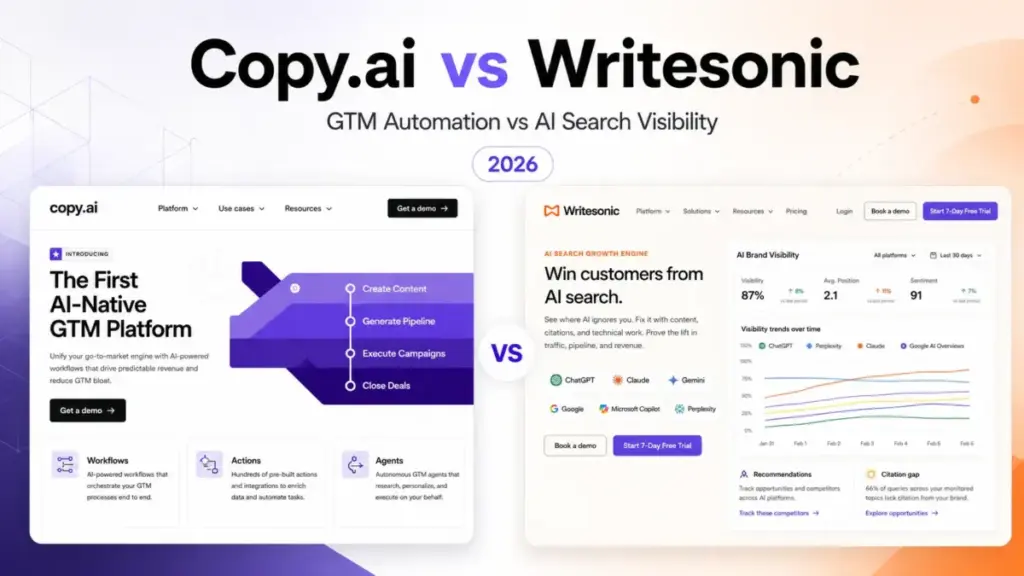
Copy.ai is a GTM automation platform. Writesonic is an AI-search visibility platform. In 2026, they are not the same product category anymore, and most comparison articles on the first page of Google still treat them like interchangeable AI writers.
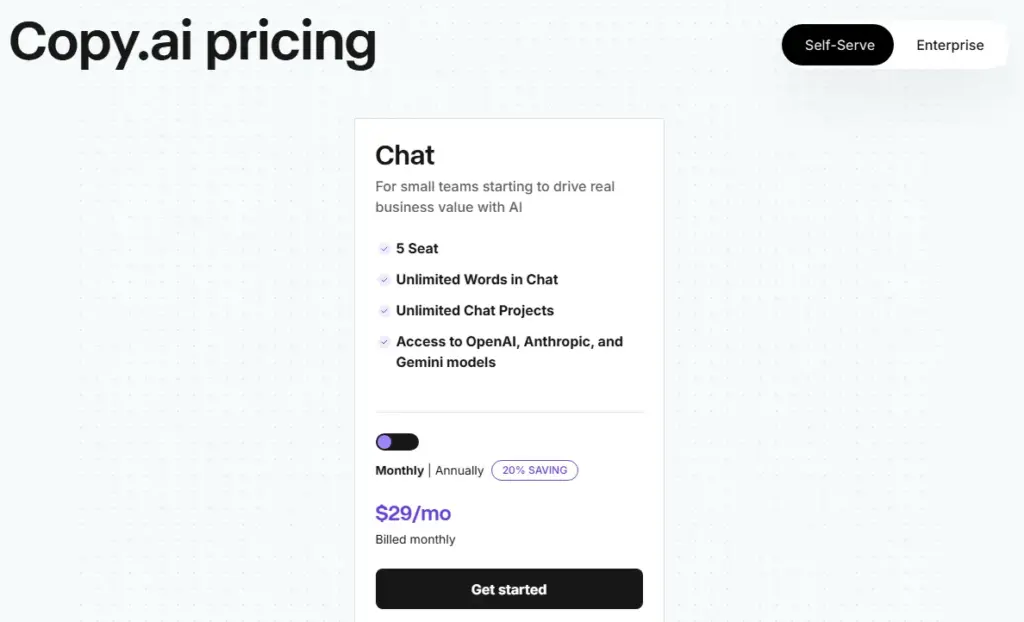
Choose Copy.ai if your team needs to codify repeatable go-to-market workflows: prospecting, CRM enrichment, outbound sequences, and sales enablement. The Chat plan starts at $29/month for 5 seats, and the real workflow automation begins at $1,000/month on Growth (as of June 2026).
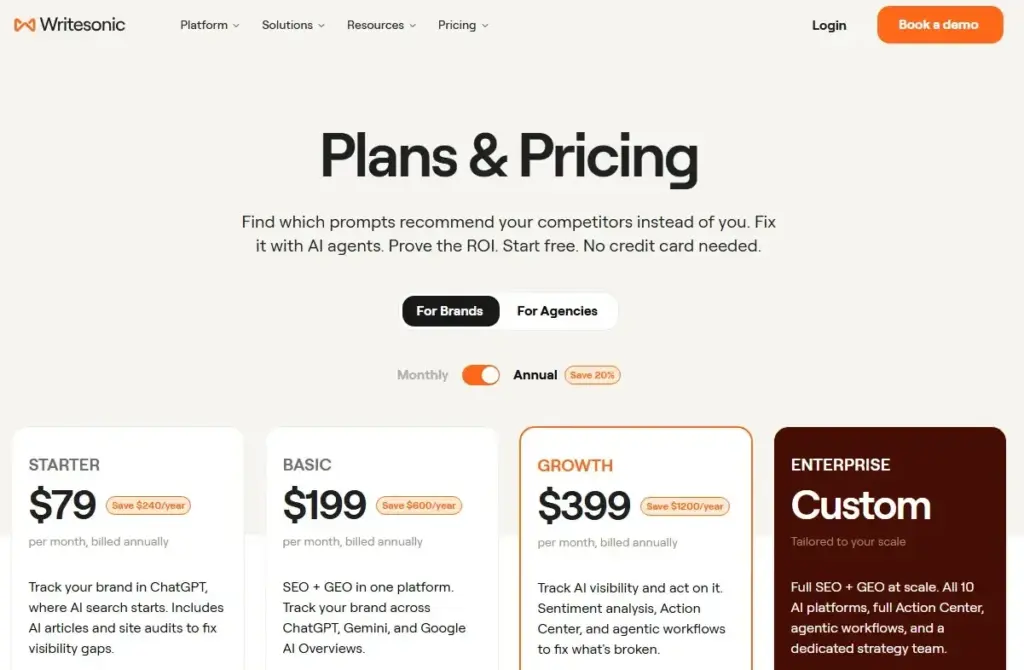
Choose Writesonic if your team needs to track how your brand appears in ChatGPT, Gemini, Google AI Overviews, and other AI-search surfaces. Starter begins at $79/month for 1 user, with GEO monitoring, prompt tracking, and AI article generation baked into every tier (as of June 2026).
The real decision is not which tool writes better copy. It is whether you need GTM process automation or AI-search visibility monitoring. Both platforms have moved far beyond the best AI writing tools category they started in, and that shift changes everything about how you should evaluate them.
Quick Verdict: Copy.ai vs Writesonic
| Category | Winner | Why |
|---|---|---|
| Pricing transparency and team scaling | Copy.ai | Fixed annual tiers cover 75 to 200 seats. Writesonic public plans cap at 5 users. |
| GTM workflow automation | Copy.ai | Built around Workflows, Actions, Agents, Tables, and CRM integrations. Writesonic does not offer this. |
| AI-search visibility and GEO | Writesonic | Tracks visibility across AI platforms, prompt/answer monitoring, Action Center, and site audits. |
| SEO content operations | Writesonic | Includes AI articles, site audits, Google Search Console, WordPress, and keyword tools by plan. |
| Security and compliance | Tie | Both offer SOC 2 Type II and GDPR. Writesonic adds HIPAA. Copy.ai adds SSO readiness. |
| Integrations and API | Tie | Copy.ai emphasizes CRM/GTM integrations and Zapier. Writesonic emphasizes SEO data sources and GEO API. |
| Ease of adoption | Depends | Copy.ai is easier for Chat, harder for workflow buildout. Writesonic is straightforward for monitoring, complex for Enterprise GEO. |
What this means: Copy.ai wins 2 categories outright, Writesonic wins 2, and the remaining 3 are ties or context-dependent. This is not a case where one tool dominates. The winner depends entirely on whether your primary job is automating GTM operations or monitoring AI-search brand visibility.
Copy.ai vs Writesonic at a Glance
| Detail | Copy.ai | Writesonic |
|---|---|---|
| Best for | Revenue teams codifying GTM workflows: prospecting, CRM enrichment, outbound, content ops | SEO, content, and growth teams tracking AI-search visibility, GEO, and content execution |
| Not best for | Teams whose primary need is AI-search tracking, prompt monitoring, or GEO action planning | Sales teams needing CRM enrichment, prospecting workflows, or GTM process automation |
| Starting price | $29/mo (Chat, 5 seats) | $79/mo (Starter, 1 user) |
| Practical team plan | $1,000/mo (Growth, 75 seats, 20K workflow credits) | $199/mo (Basic, 2 users) or $399/mo (Growth, 3 users) |
| Free plan | Not listed on current pricing page | Not listed on current pricing page |
| Setup difficulty | Low for Chat; Medium-High for workflow automation | Medium for self-serve GEO; High for Enterprise multi-brand |
| Key strength | Codified GTM workflows with multi-model AI access | AI visibility monitoring across 10 AI platforms |
| Key limitation | Workflow credits vary by complexity; no simple per-run cost | Public tiers cap users, projects, prompts, articles, and audits |
| Security | SOC 2 Type II, GDPR, SSO ready | SOC 2 Type II, GDPR, HIPAA, SSO/SAML (Enterprise) |
| Official pricing | copy.ai/prices | writesonic.com/pricing |
How We Compared Copy.ai and Writesonic
This comparison is based on official product pages, pricing pages, documentation, and published third-party review data from Capterra and GetApp. Both products were evaluated at the official_research_only level. Neither product was hands-on tested for this article.
Our evaluation framework covers seven dimensions: GTM workflow automation, AI-search visibility and GEO, SEO content operations, pricing transparency and team scaling, integrations and API, security and compliance, and ease of adoption.
Pricing was verified on June 9, 2026 from official pricing pages at copy.ai/prices and writesonic.com/pricing. Both platforms have evolved significantly from their original generative AI copywriting positioning, so older SERP comparisons that frame this as “which AI writer is cheaper” are working from outdated assumptions.
Review limitation: This evaluation relies on official documentation and public review sentiment, not hands-on workflow testing. Feature behavior, credit consumption patterns, and actual AI-search monitoring accuracy may differ from what official pages describe.
Workflow 1: GTM Automation and Sales Operations
This is where Copy.ai pulls ahead decisively. Writesonic does not compete in this category.
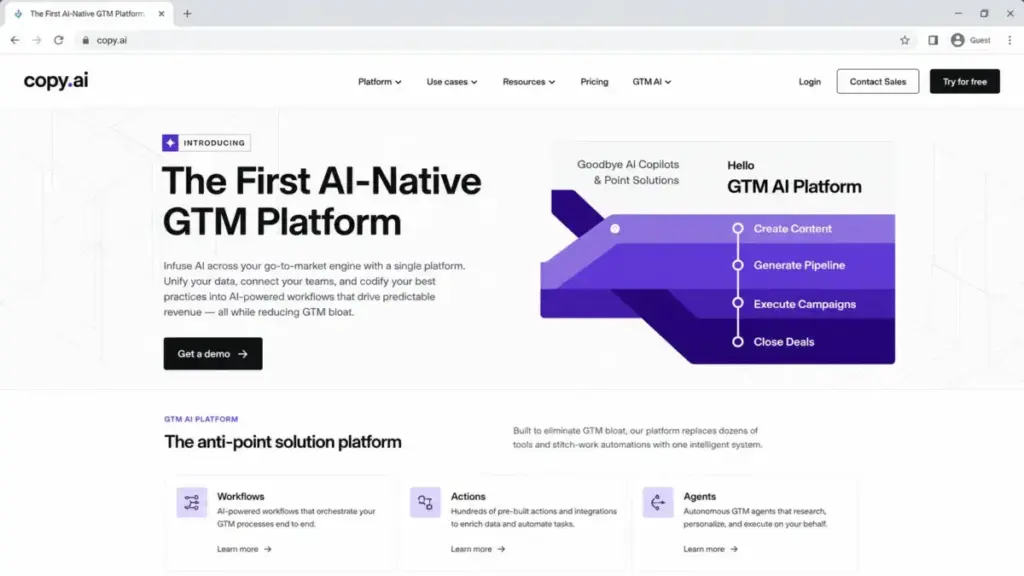
Copy.ai’s platform is built around Workflows, Actions, Agents, and Tables, all designed to codify repeatable go-to-market processes. The official product page lists use cases including prospecting, account research, lead enrichment, outbound content, CRM enrichment, and sales enablement. These are not add-on features. They are the core product.
The platform connects to business CRMs and GTM technology directly, with Salesforce, HubSpot, Gong, Zapier, Outreach, and Salesloft shown as integration examples. According to the official platform page, Copy.ai also offers 2,000+ additional app connections through Zapier and a standalone API. For teams that need AI agents handling repetitive GTM tasks, this is the relevant capability set.
The Plan-Gate Reality for GTM Workflows
Here is the problem most comparisons miss: Copy.ai’s Chat plan ($29/month for 5 seats) gives you unlimited words in Chat, unlimited Chat projects, and access to OpenAI, Anthropic, and Gemini models. That is genuinely useful for drafting and brainstorming. But the GTM workflow automation that defines Copy.ai’s current positioning requires the Growth plan at $1,000/month billed annually, which includes 20,000 workflow credits per month.
Each workflow run consumes a different number of credits depending on complexity. Copy.ai’s official page confirms this, but does not provide a simple per-run dollar cost. If your team runs complex multi-step workflows, you could burn through 20,000 credits faster than expected and need to purchase additional credits.
For a deeper look at Copy.ai’s feature set and limitations, see our Copy.ai evaluation.
Writesonic’s position: Writesonic is not designed for sales workflow automation, CRM enrichment, or outbound prospecting. If GTM automation is your primary need, Writesonic is not a relevant option.
Winner: Copy.ai (not close)
Workflow 2: AI-Search Visibility and GEO Monitoring
This is where Writesonic wins outright. Copy.ai does not offer a comparable monitoring stack.
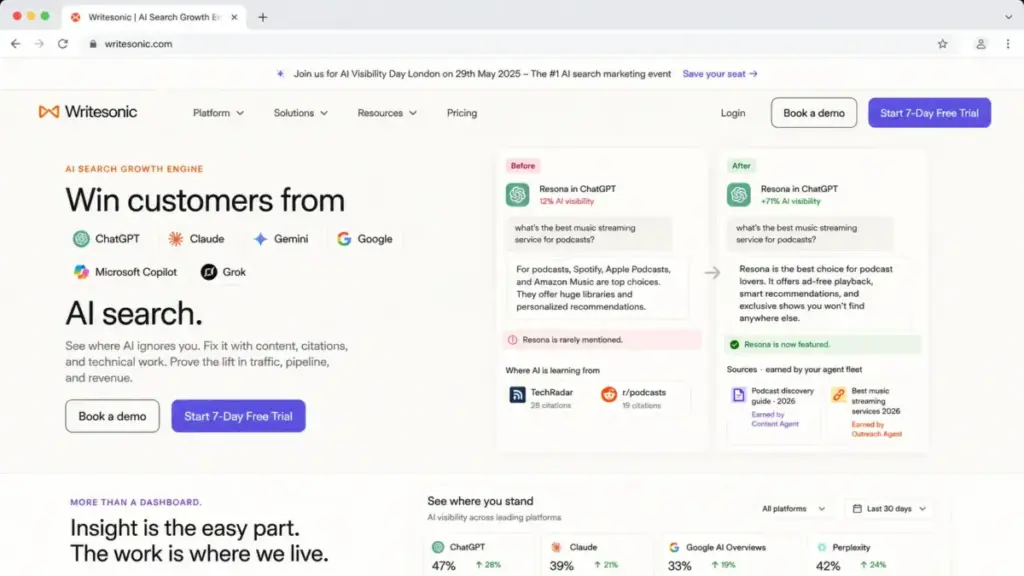
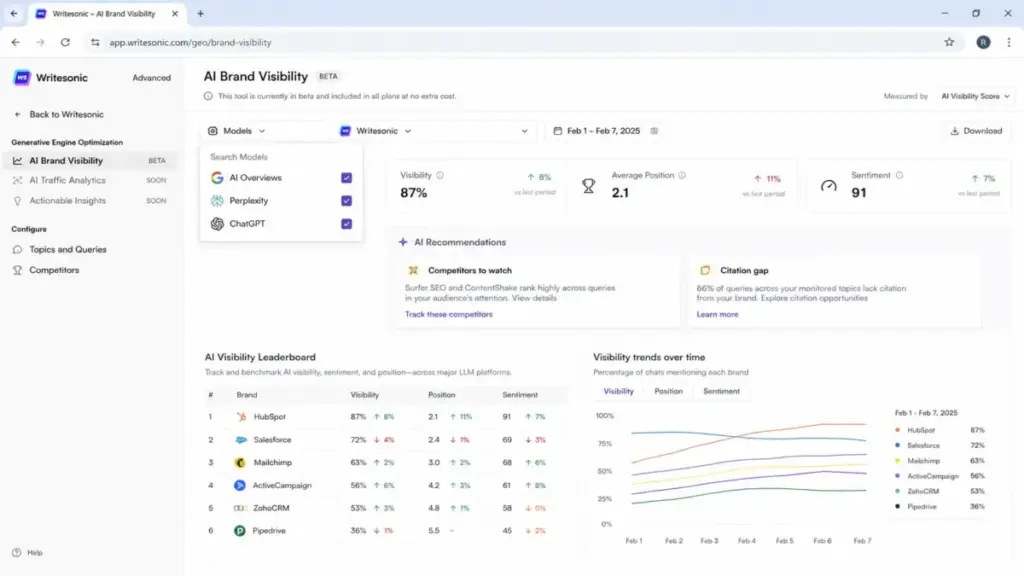
Writesonic positions itself as an “AI Search Growth Engine” and GEO/AEO platform. The product tracks how brands appear across AI-search surfaces, including ChatGPT, Gemini, Google AI Overviews, and up to 10 AI platforms on Enterprise. Core features include AI Visibility Monitoring, AI Agent Analytics, Action Center, AI Search Volume, AI Brand Explorer, AI Shopping Tracker, and AI Ads Tracker.
The practical workflow looks like this: Writesonic monitors how AI platforms reference your brand, tracks daily prompt answers, identifies visibility gaps, and provides an Action Center to prioritize fixes. It then offers AI Article Writer and AI Content Agent tools to create or refresh content based on those findings.
The Plan-Gate Reality for GEO Monitoring
Writesonic gates these features aggressively by tier:
| Feature | Starter ($79/mo) | Basic ($199/mo) | Growth ($399/mo) | Enterprise (Custom) |
|---|---|---|---|---|
| AI platforms tracked | ChatGPT only | ChatGPT, Gemini, Google AI Overviews | ChatGPT, Gemini, Google AI Overviews | All 10 AI platforms |
| Prompts tracked | 50 | 100 | 200 | Custom |
| Answers tracked daily | 50 | 300 | 600 | Custom |
| AI articles/month | 15 | 25 | 50 | Custom |
| Site audits | 10 (100 pages each) | 20 (1,200 pages each) | 50 (2,500 pages each) | Custom |
| Users | 1 | 2 (+3 at $50/user) | 3 (+2 at $50/user) | Custom |
| Projects | 1 | 1 | 2 | Custom |
| Action Center | No | No | Limited | Full |
| Sentiment analysis | No | No | Yes | Yes |
The Starter plan at $79/month gives you exactly 1 user, 1 project, 50 prompts, and ChatGPT-only tracking. That is a research-grade starting point, not a production monitoring setup. Most teams doing serious GEO work will need Basic ($199/month) at minimum, and teams tracking multiple brands or markets will need Enterprise.
For more on Writesonic’s capabilities, see our Writesonic evaluation.
Copy.ai’s position: Copy.ai does not offer AI-search visibility tracking, prompt monitoring, Google AI Overviews tracking, or GEO-specific action planning. If monitoring how your brand appears in AI-search results is the primary need, Copy.ai is not a relevant option.
Winner: Writesonic (not close)
Workflow 3: Content Creation and SEO Operations
Both platforms create content, but they approach it from fundamentally different directions.
Copy.ai’s content workflow is rooted in GTM output. The platform generates outbound emails, prospecting messages, ad copy, social posts, and sales enablement materials. It offers Brand Voice and Infobase features to maintain consistency across outputs. The Chat interface supports multi-model access (OpenAI, Anthropic, Gemini) for drafting and iteration. Content is a byproduct of GTM workflows, not the primary product.
Writesonic’s content workflow is rooted in SEO and GEO execution. The platform includes an AI Article Writer, AI Content Agent, site audits, and integrations with Google Search Console, WordPress, GA4, Looker Studio, Google Keyword Planner, Google SERPs, and Reddit. Content creation is directly tied to the visibility monitoring pipeline: find the gap, create the content, measure the lift.
For SEO teams specifically, Writesonic’s integration with Google Search Console and WordPress means content goes from insight to published page without leaving the platform. Copy.ai does not offer native SEO data source integrations at the same depth.
A Capterra reviewer noted about Copy.ai: “It is not easy to prompt Copy.ai on the length of the content you want or words to include” (source). Another reviewer, Allison C. (Founder), described it as “Great for first drafts and some idea generation” (source).
Writesonic reviewers on GetApp appreciate the platform for fast articles and workflow efficiency, but note that costs can add up for frequent use (paraphrased from GetApp reviewer patterns). Capterra reviewers highlight the intuitive platform and versatile idea development as strengths, while flagging restrictive credit-based usage and word count limits as drawbacks (paraphrased from Capterra reviewer patterns).
Winner: Writesonic for SEO/GEO content operations. Copy.ai for GTM-focused content (outbound, sales enablement, ad copy).
Pricing and Value at Scale
This is where the comparison gets interesting, because these two platforms use completely different pricing models and buyer motions.
Copy.ai Pricing (as of June 2026)
| Plan | Monthly Price | Annual Price | Seats | Workflow Credits | Key Limits |
|---|---|---|---|---|---|
| Chat | $29/mo | $24/mo ($288/yr) | 5 | None (Chat only) | Unlimited words in Chat, multi-model access |
| Growth | $1,000/mo | $1,000/mo ($12,000/yr) | 75 | 20,000/mo | Unlimited Chat + workflow automation |
| Expansion | $2,000/mo | $2,000/mo ($24,000/yr) | 150 | 45,000/mo | Higher credit volume |
| Scale | $3,000/mo | $3,000/mo ($36,000/yr) | 200 | 75,000/mo | Highest public credit tier |
| Enterprise | Custom | Custom | Custom | Custom | API access, bulk runs, guided implementation, 20+ integrations |
Writesonic Pricing (as of June 2026)
| Plan | Annual Price | Users | Prompts | Articles/mo | Audits | Key Limits |
|---|---|---|---|---|---|---|
| Starter | $79/mo | 1 | 50 | 15 | 10 (100 pages) | ChatGPT only, 1 project |
| Basic | $199/mo | 2 (+3 at $50/user) | 100 | 25 | 20 (1,200 pages) | ChatGPT, Gemini, Google AI Overviews |
| Growth | $399/mo | 3 (+2 at $50/user) | 200 | 50 | 50 (2,500 pages) | Limited Action Center, sentiment analysis |
| Enterprise | Custom | Custom | Custom | Custom | Custom | All 10 AI platforms, full Action Center, SSO/SAML |
Cost at Scale: What Your Team Actually Pays
| Team Size | Copy.ai Cost | Writesonic Cost | Winner | Caveat |
|---|---|---|---|---|
| 5 users | $29/mo (Chat) or $1,000/mo (Growth) | $349/mo (Basic + 3 extra users) or $499/mo (Growth + 2 extra users) | Copy.ai for Chat; Writesonic if GEO features needed | Copy.ai Chat has no workflow credits |
| 10 users | $1,000/mo (Growth, up to 75 seats) | Custom/Enterprise required | Copy.ai on public pricing transparency | Writesonic public tiers do not support 10 users |
| 25 users | $1,000/mo (Growth, up to 75 seats) | Custom/Enterprise required | Copy.ai on public pricing transparency | Depends on Enterprise quote and use case |
| 50 users | $1,000/mo (Growth, up to 75 seats) | Custom/Enterprise required | Copy.ai on public pricing transparency | Depends on Enterprise quote and use case |
What this means: Copy.ai has a clear pricing advantage for teams larger than 5 users because its Growth plan covers up to 75 seats for $1,000/month. Writesonic’s public plans cap at 5 users with add-ons, and any team beyond that size needs an Enterprise conversation. If you are comparing Jasper vs Copy.ai or other AI tools at scale, this seat-limit difference matters more than starting price.
Hidden Costs to Watch
Copy.ai: Workflow credit consumption varies by workflow complexity. You cannot predict a simple per-run dollar cost from the pricing page alone. Extra credits may be needed. API access and bulk workflow runs require Enterprise. Implementation effort for custom GTM workflows can be significant.
Writesonic: Public plans cap users, projects, prompts, daily answers, articles, audits, markets, and Action Center access. Additional users cost $50/user/month where available, but public tiers max out at 5 users total. Enterprise is required for SSO/SAML, custom users, full Action Center, all 10 AI platforms, and a dedicated AI Search Strategist.
Setup and Migration Difficulty
| Dimension | Copy.ai | Writesonic |
|---|---|---|
| Initial setup | Low for Chat (sign up, start prompting). Medium-High for workflow automation (requires mapping GTM processes, configuring integrations, building workflows). | Medium for self-serve monitoring (connect data sources, configure prompts). High for Enterprise multi-brand tracking. |
| Onboarding | Enterprise includes guided Jumpstart implementation. Chat plan is self-serve. | Enterprise includes dedicated AI Search Strategist. Self-serve plans have email support. |
| Switching from Copy.ai to Writesonic | Medium. You lose GTM workflows entirely. You gain AI-search monitoring. Requires rebuilding content workflows around GEO pipeline. | N/A |
| Switching from Writesonic to Copy.ai | N/A | Medium. You lose AI-search tracking. You gain GTM automation. Requires building sales/marketing workflows from scratch. |
| Data portability | Neither vendor offers a direct migration tool between the two. Treat migration as manual export/import plus workflow redesign. | Same as Copy.ai. |
What this means: Switching between these platforms is less about moving content and more about rebuilding your operational approach. They serve different jobs. A migration is effectively adopting a new platform for a different purpose.
Where Copy.ai Wins
GTM workflow codification. If your team runs repeatable prospecting, account research, or outbound sequences, Copy.ai’s Workflows, Actions, and Tables are purpose-built for this.
Team scaling on public pricing. Growth at $1,000/month covers 75 seats. Expansion covers 150. Scale covers 200. You know the price before you call sales.
Multi-model AI access on the entry plan. The $29/month Chat plan includes OpenAI, Anthropic, and Gemini models. For a 5-person team that needs a shared AI workspace, this is hard to beat on cost.
CRM and GTM integrations. Salesforce, HubSpot, Gong, Outreach, Salesloft, and 2,000+ Zapier connections. If your workflows need to push data into and pull data from business systems, Copy.ai has deeper GTM integration support.
Budget-conscious teams needing a shared AI chat workspace. At $29/month for 5 seats (or $24/month billed annually), Copy.ai Chat is the lowest-cost option for a small team that needs collaborative AI access without GEO monitoring.
Where Writesonic Wins
AI-search visibility monitoring. If you need to know how ChatGPT, Gemini, or Google AI Overviews reference your brand, Writesonic is purpose-built for this. Copy.ai does not offer comparable monitoring.
GEO action planning. The Action Center (Growth and Enterprise) prioritizes fixes based on visibility gaps. This workflow, from monitoring to action to content creation, is Writesonic’s core value proposition.
SEO content operations with native data sources. Google Search Console, WordPress, GA4, Looker Studio, Google Keyword Planner, and Google SERPs are integrated directly. Content goes from data insight to published page within one platform.
Enterprise GEO programs. All 10 AI platforms, custom prompts/regions/languages, full Action Center, SSO/SAML, HIPAA, and a dedicated AI Search Strategist. For brands running multi-market AI-search visibility programs, Writesonic Enterprise is the specialized option.
Site audits and content refresh workflows. Even the Starter plan includes 10 audits of 100 pages each. Growth includes 50 audits of 2,500 pages each. If your team audits site health as part of content operations, this is built in.
Who Should Choose Copy.ai
Sales and RevOps teams automating GTM processes. If your primary workflow involves prospect research, CRM enrichment, outbound content generation, and account-based marketing, Copy.ai is built for this. Writesonic is not.
Teams needing 10+ users on transparent public pricing. Copy.ai Growth covers 75 seats for $1,000/month. Writesonic requires Enterprise/custom pricing for anything beyond 5 users.
Startups needing a low-cost shared AI workspace. The Chat plan at $29/month for 5 seats with multi-model access is the cheapest entry point in this comparison.
Organizations already using Salesforce, HubSpot, or Gong. Copy.ai’s GTM integration depth makes it the natural choice if your workflows center on these platforms.
Who Should Choose Writesonic
SEO and content teams tracking AI-search visibility. If you need to monitor how your brand appears in ChatGPT, Gemini, Google AI Overviews, and other AI-search surfaces, Writesonic is the specialized platform.
Agencies managing client GEO programs. Multiple projects, prompt tracking across AI platforms, content audits, and the Action Center make Writesonic suited for agency workflows where AI-search visibility reporting is a deliverable.
E-commerce brands monitoring AI Shopping Tracker and AI Ads Tracker. These features are specific to Writesonic and have no Copy.ai equivalent.
Enterprise brands needing SOC 2 Type II, HIPAA, and SSO/SAML for GEO programs. Writesonic Enterprise includes all four compliance and access control requirements. Copy.ai offers SOC 2 Type II and GDPR but does not publicly list HIPAA.
Who Should Avoid Both
Solo creators who only need general writing assistance. Neither platform is optimized for individual content creators who want a simple AI writing assistant. ChatGPT or Claude offers more flexibility at a lower cost for general-purpose writing without GTM or GEO overhead.
WordPress bloggers needing deep on-page SEO scoring. While Writesonic integrates with WordPress and offers site audits, dedicated SEO tools like Surfer SEO provide more granular on-page optimization scoring. Copy.ai is not an SEO tool at all.
Teams that want one low-cost AI assistant rather than a specialized platform. Both Copy.ai and Writesonic have evolved beyond simple AI writing. If you do not need GTM workflow automation or AI-search monitoring, you are paying for capabilities you will not use.
Who Should Choose Which: Buyer Scenario Matrix
| Buyer Scenario | Choose Copy.ai | Choose Writesonic |
|---|---|---|
| 5-person startup needing shared AI workspace | $29/mo Chat covers 5 seats at far lower cost | Only if AI-search monitoring is the primary need |
| SEO agency tracking clients across AI search | Not built for visibility monitoring | Purpose-built for AI visibility, prompt tracking, audits |
| Sales team automating prospect research | Official use cases include prospecting, CRM enrichment, outbound | Not designed for sales workflow automation |
| Enterprise brand needing AI-search share-of-voice | Does not offer comparable monitoring | Enterprise includes all 10 AI platforms, dedicated strategist |
| RevOps team codifying GTM workflows | Workflows, Actions, Tables, and API connections for GTM | Not positioned for GTM process codification |
Alternatives to Copy.ai and Writesonic
If neither platform fits, consider these alternatives:
Jasper AI: Best for brand-focused marketing teams that want AI writing and campaign content without GTM automation or GEO monitoring as the core need. Jasper commonly appears in review comparisons as a premium AI writing option for teams focused on brand voice consistency and marketing content production.
Surfer SEO: Best for SEO teams that want on-page optimization and content scoring rather than AI writing or GTM automation. Several SERP competitors note that either Copy.ai or Writesonic may need separate SEO optimization tooling depending on the workflow.
ChatGPT: Best for individuals who want flexible prompting and general AI assistance without platform-specific workflow gates. Useful when the buyer does not need Copy.ai’s GTM automation or Writesonic’s GEO monitoring, and just needs a capable AI content creation tool for general use.
Final Verdict: Copy.ai vs Writesonic in 2026
There is no single winner. These are two different platforms solving two different problems.
Choose Copy.ai if your team’s primary job is automating go-to-market operations. Prospecting, CRM enrichment, outbound content, sales enablement, and workflow codification are Copy.ai’s core strengths. The pricing is transparent at scale (75 to 200 seats on public plans), and the GTM integration depth with Salesforce, HubSpot, and Gong makes it the natural choice for revenue teams.
Choose Writesonic if your team’s primary job is monitoring and improving how your brand appears in AI-search results. GEO monitoring, prompt tracking, AI visibility analytics, content execution, and site audits are Writesonic’s core strengths. The platform is purpose-built for SEO, content, and growth teams operating in a world where AI-search surfaces matter as much as traditional SERPs.
Avoid both if you only need general AI writing assistance. A general-purpose model like ChatGPT or Claude will cost less and do the job without forcing you into a GTM or GEO platform you do not need.
The SERP competitors that still frame this as “which AI writer is cheaper” are working from outdated product positioning. In 2026, the question is not Copy.ai vs Writesonic for writing. It is Copy.ai for GTM automation vs Writesonic for AI-search visibility. Match the tool to the job, and the decision becomes straightforward. For teams weighing broader options in this space, understanding marketing automation workflows can help clarify which platform aligns with your operational priorities.
FAQ
Is Copy.ai better than Writesonic?
Copy.ai is better for GTM workflow automation, CRM enrichment, and sales-focused operations. Writesonic is better for AI-search visibility monitoring, GEO, and SEO content operations. Neither is universally better. The right choice depends on whether your team’s primary job is automating go-to-market processes or tracking brand visibility in AI-search platforms.
Which is cheaper, Copy.ai or Writesonic?
For a 5-seat team needing only AI chat, Copy.ai is cheaper at $29/month versus Writesonic’s $79/month Starter (which covers 1 user). For teams needing 10+ users, Copy.ai’s Growth plan at $1,000/month for 75 seats is publicly priced, while Writesonic requires a custom Enterprise quote. Cost comparisons depend on team size and feature requirements.
Does Copy.ai integrate with Salesforce?
Yes. Copy.ai’s official platform page shows Salesforce as a direct integration, alongside HubSpot, Gong, Outreach, Salesloft, and Zapier. The platform emphasizes CRM and GTM technology connections as part of its core workflow automation capability.
Can Writesonic track Google AI Overviews?
Yes, starting from the Basic plan at $199/month. Writesonic’s Basic tier includes ChatGPT, Gemini, and Google AI Overviews tracking. Enterprise covers all 10 AI platforms. The Starter plan at $79/month is limited to ChatGPT-only tracking.
Which tool is better for a small marketing team?
It depends on the team’s primary function. A marketing team focused on content, SEO, and AI-search visibility should choose Writesonic. A marketing team focused on outbound campaigns, lead generation, and CRM-driven operations should choose Copy.ai. For a 5-person team with budget constraints, Copy.ai Chat at $29/month is the lowest entry cost.
What happens if I run out of Copy.ai workflow credits?
Copy.ai’s official documentation states that each workflow run may consume different credits depending on complexity. If your team exhausts the monthly credit allocation (20,000 on Growth, 45,000 on Expansion, 75,000 on Scale), you may need to purchase additional credits or upgrade your plan. The per-run cost is not publicly simplified, so monitoring credit usage is essential.
Is Writesonic worth it for GEO?
Yes, if your team needs structured AI-search visibility monitoring. Writesonic’s GEO capabilities, including prompt tracking, answer monitoring, Action Center, site audits, and AI article generation, are purpose-built for this use case. However, the Starter plan is limited (ChatGPT only, 50 prompts, 1 user). Most teams doing production GEO work will need Basic at minimum and likely Growth or Enterprise for full Action Center access.
Which is better for agencies, Copy.ai or Writesonic?
Writesonic is better for agencies delivering AI-search visibility reporting, GEO audits, and content execution as client services. Copy.ai is better for agencies running GTM operations, outbound campaigns, and CRM workflows on behalf of clients. The deciding factor is which service the agency delivers, not which tool has more features overall.