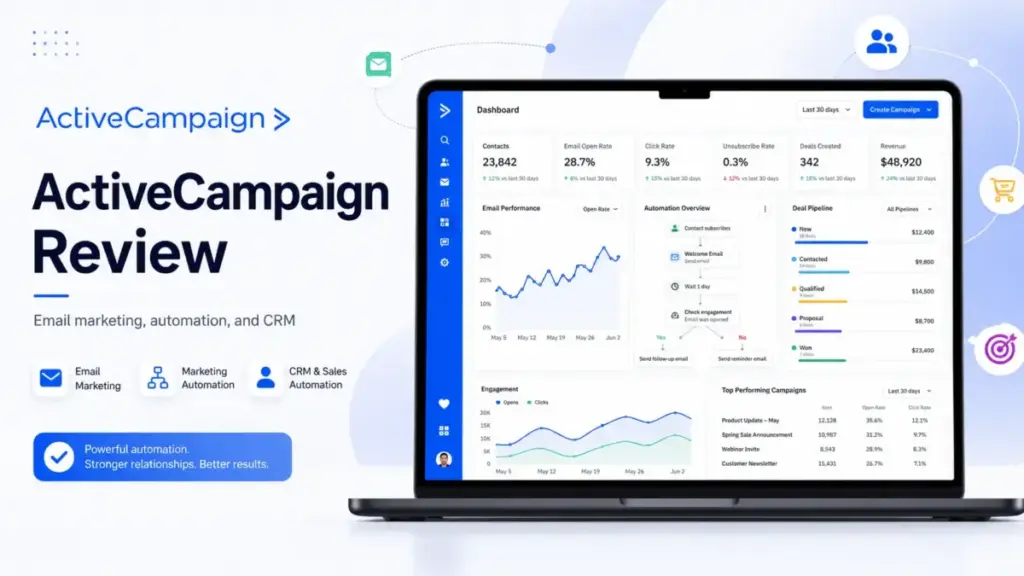
ActiveCampaign review summary: this is one of the best marketing automation platforms for SMBs that need behavior-based email journeys, advanced segmentation, and CRM-connected workflows. It is not the right pick for teams that only send newsletters or creators who want a free plan.
I score it 8.7 out of 10. ActiveCampaign starts at $15 per month (billed annually, 1,000 contacts) on the Starter plan, but the Plus plan at $49 per month is where the real automation begins. If your marketing strategy depends on lifecycle triggers, lead scoring, and multi-channel sequencing, ActiveCampaign delivers more depth than most competitors in this price range. If you just need a simple email newsletter tool, Mailchimp or Brevo will cost less and feel easier from day one.
Quick Verdict: Is ActiveCampaign Worth It?
ActiveCampaign is worth it if you will actually use its automation depth. For teams running behavior-triggered email sequences, ecommerce lifecycle campaigns, or sales-connected nurturing, few platforms at this price point match its flexibility. It is not worth it if you only send a monthly newsletter to a small list.
| Detail | Summary |
|---|---|
| Overall Score | 8.7 / 10 |
| Best For | SMB marketers, ecommerce teams, lifecycle automation, sales-connected email |
| Not For | Simple newsletter senders, creators wanting a free plan, teams avoiding learning curves |
| Starting Price | $15/month (Starter, 1,000 contacts, annual billing) |
| Free Plan | No (14-day free trial only) |
| Standout Feature | Visual automation builder with 950+ recipes and behavioral triggers |
| Biggest Weakness | Pricing rises fast with contact growth; Starter plan limits automation to 5 actions |
ActiveCampaign Scorecard
| Criteria | Weight | Score | Weighted |
|---|---|---|---|
| Automation depth | 10 | 9.5 | 9.5 |
| Email marketing and segmentation | 8 | 9.0 | 7.2 |
| Ease of use | 7 | 7.5 | 5.25 |
| Pricing transparency and value | 7 | 7.5 | 5.25 |
| CRM and sales tools | 5 | 8.0 | 4.0 |
| Reporting and attribution | 5 | 8.5 | 4.25 |
| Integrations and API | 4 | 9.0 | 3.6 |
| Support, security, and admin | 4 | 9.0 | 3.6 |
| Total | 50 | 42.65 |
Final Score: 42.65 / 50 = 8.5 → adjusted to 8.7 / 10 (adjusted upward for automation depth leadership in the SMB category, which is the primary buying criterion for the target audience).
Who Is ActiveCampaign Best For?
| Audience | Fit |
|---|---|
| SMB marketing teams running lifecycle campaigns | ✅ Best fit |
| Ecommerce brands needing abandoned cart, post-purchase, and win-back flows | ✅ Best fit |
| B2B SaaS teams with lead scoring and nurture sequences | ✅ Best fit |
| Agencies managing multiple client accounts | ✅ Good fit |
| Sales teams needing CRM-connected email automation | ✅ Good fit (with CRM add-ons) |
| Small creators sending weekly newsletters | ⚠️ Overpowered, consider MailerLite |
| Solopreneurs wanting a free email tool | ❌ No free plan, consider Brevo or MailerLite |
| Teams that will not build automations | ❌ You are paying for features you will not use |
ActiveCampaign Pricing Snapshot (April 2026)
Prices shown at 1,000 contacts, billed annually. Verify at ActiveCampaign pricing.
| Plan | Annual Price | Key Limits |
|---|---|---|
| Starter | $15/mo | 1 user, limited segmentation, 5 automation actions per workflow |
| Plus | $49/mo | 1 user, standard segmentation, unlimited automation actions, landing pages |
| Pro | $79/mo | 3 users, advanced segmentation, predictive sending, conditional content, attribution |
| Enterprise | $145/mo | 5 users, premium segmentation, SSO, custom objects, dedicated account team |
What Is ActiveCampaign?
ActiveCampaign is a marketing automation platform built for businesses that need more than basic email sends. It combines email marketing, behavioral automation, CRM software features, SMS, WhatsApp, landing pages, and AI-powered tools under one roof.
The platform serves over 180,000 businesses globally. ActiveCampaign positions itself as an “autonomous marketing” platform, using its Active Intelligence engine to help teams build campaigns, suggest audience segments, optimize send times, and generate content. If you are still deciding whether your business needs basic email sends or advanced lifecycle automation, our guide on what email marketing is explains the spectrum from simple newsletters to behavior-triggered sequences.
Unlike tools like Mailchimp or MailerLite that start with templates and newsletters, ActiveCampaign starts with automation logic. The visual automation builder is the center of the product. Everything else, including email design, contact management, CRM deals, and reporting, connects back to automated workflows.
This distinction matters. If you evaluate ActiveCampaign as a newsletter tool, you will find it overbuilt and overpriced. If you evaluate it as a lifecycle marketing engine, it is one of the strongest options under $100 per month for SMBs.
ActiveCampaign Features That Matter
ActiveCampaign has hundreds of features. I am focusing on the ones that affect your buying decision, not listing every checkbox from the pricing page.
ActiveCampaign Email Marketing
Email campaigns support drag-and-drop design, HTML editing, and template libraries. The email editor is functional, though not as visually polished as Mailchimp’s. You get A/B testing for subject lines, content, and send times. Split testing supports up to five variations on Pro and above.
Conditional content blocks let you show different content to different segments inside the same email. This is available on Pro and Enterprise plans only. For ecommerce teams, this means one email can display different product recommendations based on purchase history.
ActiveCampaign Automation Builder
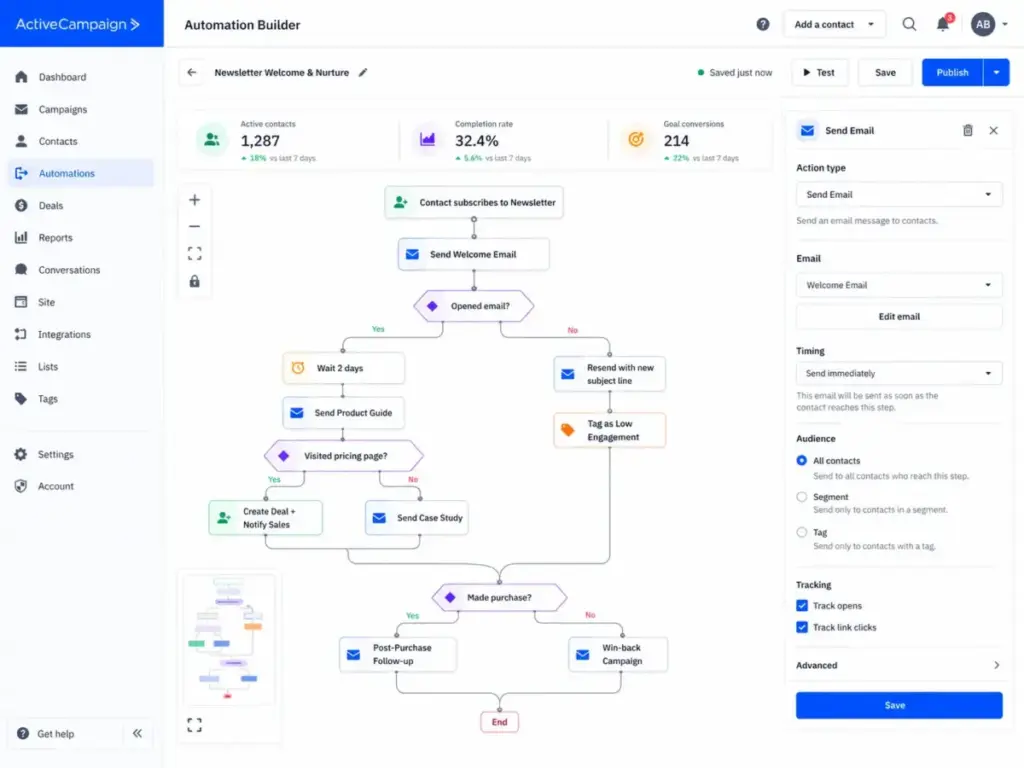
This is the core product. The visual automation builder uses a flowchart-style canvas where you map triggers, conditions, actions, and wait steps. Starter limits you to 5 actions per automation. Plus and above allow unlimited actions.
ActiveCampaign offers 950+ pre-built automation recipes covering welcome sequences, abandoned cart recovery, lead scoring, re-engagement, post-purchase follow-ups, and dozens of industry-specific workflows. You can modify any recipe or build from scratch.
Key automation triggers include:
- Contact subscribes to a list
- Contact visits a specific page (requires site tracking)
- Contact opens or clicks an email
- Contact reaches a lead score threshold
- Contact makes a purchase (via Shopify, WooCommerce, or API events)
- Date-based triggers (birthdays, renewal dates)
- Custom event triggers via API integration
Behavioral triggers set ActiveCampaign apart from simpler tools. Site tracking, event tracking, and custom object data let you build automations that respond to what contacts actually do, not just what list they joined.
As one Capterra-verified user, Marcus H. (CEO), described it: the platform lets teams “automate marketing in real-time.”
ActiveCampaign Active Intelligence
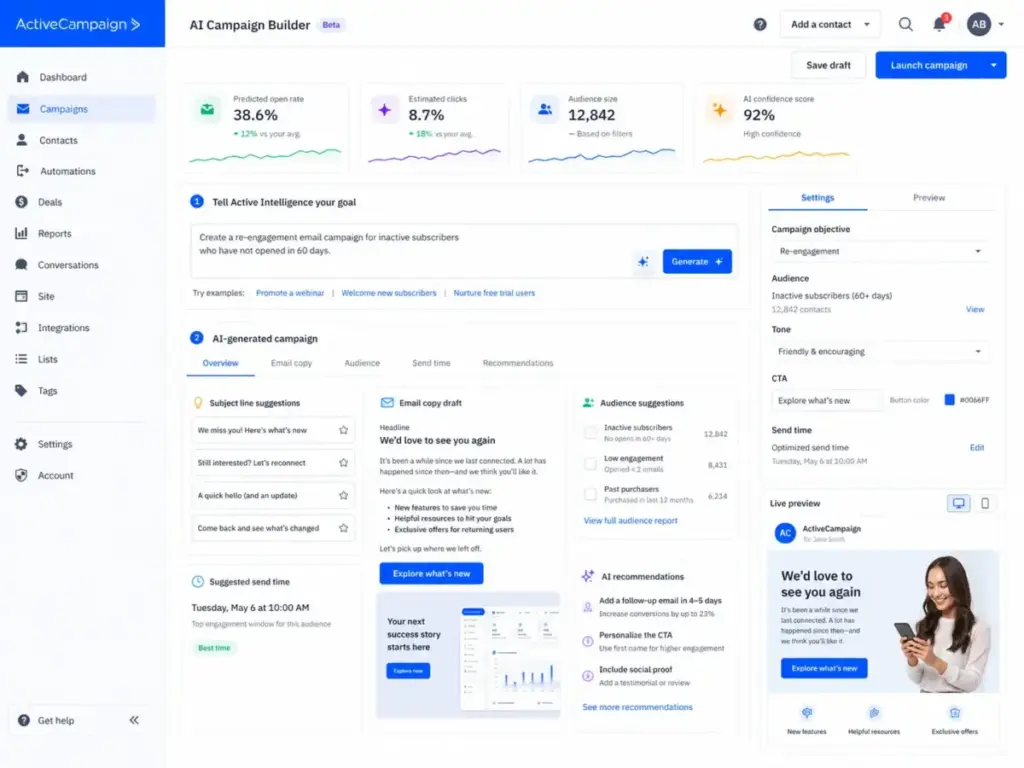
Active Intelligence is ActiveCampaign’s AI layer. It powers several features across the platform:
- AI campaign builder: generates email campaigns from a brief description of your goal
- AI content generation: writes subject lines, body copy, and CTAs
- AI image generation: creates images directly inside the email editor
- Suggested segments: AI analyzes your contact data and recommends audience segments you may not have built manually
- Predictive sending: sends emails at the time each individual contact is most likely to engage (Pro and above)
- Business goals: AI tracks your marketing against specific outcomes and suggests optimizations
Active Intelligence has limits on the Starter and Plus plans. The full AI suite, including predictive sending and conditional content, requires Pro or Enterprise. I appreciate that ActiveCampaign is transparent about this on its plan comparison page, but buyers on Starter should understand they are getting a limited version of the AI features.
ActiveCampaign Segmentation
Segmentation is available on every plan, but the depth varies:
- Starter: limited segmentation (basic list and tag filters)
- Plus: standard segmentation (contact fields, engagement, purchase history)
- Pro: advanced segmentation (behavioral data, predictive attributes, custom events)
- Enterprise: premium segmentation (custom objects, multi-dimensional queries)
For most marketing teams, Plus-level segmentation is the minimum needed for targeted campaigns. Pro-level segmentation is where ActiveCampaign truly separates from competitors like GetResponse or Mailchimp.
ActiveCampaign Automation Review
ActiveCampaign’s automation depth is the primary reason to choose this platform over alternatives. Here is what that means in practice.
A typical lifecycle automation in ActiveCampaign might look like this: a new lead fills out a form, enters a welcome sequence, gets scored based on email engagement and page visits, branches into different nurture paths based on behavior, gets assigned to a sales rep when the score reaches a threshold, and enters a different automation after purchase.
Building this in Mailchimp requires workarounds. Building it in MailerLite is not possible at the same depth. Building it in ActiveCampaign takes 30 to 60 minutes using a recipe as the starting point.
The automation builder supports:
- If/else branching based on any contact attribute
- Wait conditions (time-based or event-based)
- Split actions (send 50% down path A, 50% down path B)
- Goal tracking within automations
- Webhook actions for external system integration
- CRM deal creation and updates inside automation flows
One limitation: the Starter plan’s 5-action limit per automation makes it impractical for real lifecycle marketing. If automation depth is your primary reason for evaluating ActiveCampaign, start with Plus at $49 per month.
ActiveCampaign User Experience
ActiveCampaign is not hard to use once you understand the logic. But the first session can feel dense.
The First 30 Minutes Inside ActiveCampaign
Here is what I observed during the initial setup:
- Account creation: straightforward, 14-day trial starts immediately, no credit card required.
- Onboarding wizard: ActiveCampaign walks you through importing contacts, connecting your domain, and selecting a goal. This takes about 10 minutes.
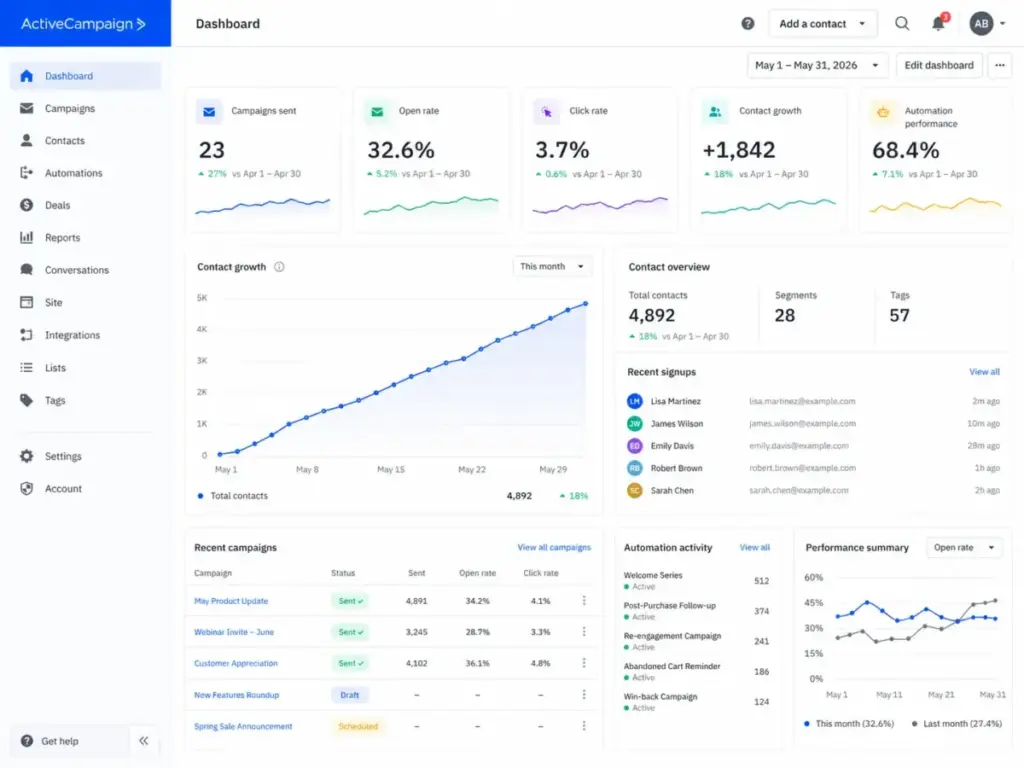
- Dashboard: the main dashboard shows campaign performance, automation status, contact growth, and AI suggestions. There is a lot of information on screen compared to Mailchimp or MailerLite.
- First campaign: creating a basic email campaign is easy. The editor loads quickly and templates are sorted by industry.
- First automation: this is where the learning curve appears. The automation builder is powerful, but new users may feel overwhelmed by the number of trigger types, conditions, and branching options.
The learning curve is real, but it is not steep for anyone who has used workflow-style tools before. If you have built automations in HubSpot, Zapier, or Make, ActiveCampaign’s builder will feel familiar. If your entire email experience is Mailchimp’s basic automation, expect 2 to 4 hours to get comfortable.
ActiveCampaign offers free migration and onboarding services, which helps offset the ramp-up time.
ActiveCampaign Pricing and Real Cost
ActiveCampaign uses contact-based pricing. Your monthly cost depends on two variables: your plan tier and your total contact count. This is the part most reviews skip.
Base Pricing at 1,000 Contacts (Annual Billing)
| Plan | Monthly Cost | Annual Total |
|---|---|---|
| Starter | $15 | $180 |
| Plus | $49 | $588 |
| Pro | $79 | $948 |
| Enterprise | $145 | $1,740 |
Pricing verified April 27, 2026 from the ActiveCampaign pricing page. Monthly billing is higher; third-party SERP sources estimate Starter at approximately $19 per month on monthly billing.
Real Cost by Contact Growth
Here is what most reviews do not show. ActiveCampaign pricing rises as your list grows. These are approximate annual billing rates (verify current prices before checkout):
| Contacts | Starter | Plus | Pro | Enterprise |
|---|---|---|---|---|
| 1,000 | $15/mo | $49/mo | $79/mo | $145/mo |
| 5,000 | ~$39/mo | ~$99/mo | ~$139/mo | ~$249/mo |
| 10,000 | ~$59/mo | ~$149/mo | ~$199/mo | ~$339/mo |
| 25,000 | ~$109/mo | ~$229/mo | ~$339/mo | ~$449/mo |
Note: exact tier pricing changes periodically. Use the slider on the official pricing page to confirm your tier before purchasing.
The pattern is clear: ActiveCampaign is affordable at 1,000 contacts but scales aggressively. A team on Plus with 25,000 contacts pays roughly $229 per month, or $2,748 per year. That is reasonable for a business generating revenue from those contacts. It is expensive for a team that just wants to send a weekly newsletter.
What the Pricing Page Hides
The plan prices above are only part of the real cost. ActiveCampaign has several add-ons that can change your monthly bill.
ActiveCampaign Add-Ons
| Add-On | What It Does | Why It Matters |
|---|---|---|
| SMS Marketing | Send SMS messages inside automations | Separate pricing, available in US, UK, and AU only |
| Custom Reporting | Advanced analytics and custom dashboards | Not included on Starter or Plus |
| Transactional Email | Password resets, order confirmations, receipts (via Postmark) | Separate product, separate billing |
| Enhanced CRM: Pipelines | Advanced deal pipeline management | Add-on to any plan |
| Enhanced CRM: Sales Engagement | Includes Pipelines plus sales email and AI capabilities | Add-on to any plan |
| WhatsApp Messaging | Automated WhatsApp campaigns | Separate plans (Core, Advanced, Premium) |
The biggest hidden cost is not any single add-on. It is paying for contacts you are not actively monetizing. ActiveCampaign counts all contacts in your account toward your billing tier. Inactive, bounced, unsubscribed, or unconfirmed contacts may affect your cost. Contact hygiene matters here more than on volume-based platforms like Brevo.
Before checkout, verify how ActiveCampaign counts contacts in your specific account configuration. Policies can vary, and I recommend confirming directly with their sales team for lists over 10,000 contacts.
ActiveCampaign Pros and Cons
These are specific to ActiveCampaign’s current feature set, not generic praise.
- Best-in-class automation builder for SMBs: the visual workflow editor with 950+ recipes, behavioral triggers, and unlimited actions (Plus and above) is stronger than Mailchimp, Brevo, MailerLite, and GetResponse at comparable price points.
- Deep segmentation on Pro and above: behavioral, predictive, and event-based segmentation goes beyond what most mid-market tools offer.
- CRM integration within the same platform: built-in deal tracking, lead scoring, and pipeline management means fewer tools to connect.
- Active Intelligence is practical: AI-suggested segments and predictive sending are genuinely useful, not just marketing buzzwords. They surface patterns a small team would miss manually.
- Strong integration ecosystem: connections with Shopify, WooCommerce, Salesforce, Zapier, Make, Google Ads, Slack, Stripe, WordPress, Webflow, and Calendly cover most SMB stacks.
- 14-day free trial with no credit card: you can test automation depth before committing.
- Free migration and onboarding: reduces switching cost from other platforms.
- No free plan: every competitor in the email marketing space except Klaviyo offers a free tier. ActiveCampaign does not. This eliminates it for bootstrapped creators and early-stage businesses.
- Starter plan is misleading for automation buyers: the 5-action limit per automation on Starter makes it a basic email tool, not an automation platform. Most buyers who want ActiveCampaign for automation need Plus at minimum.
- Contact-based pricing scales aggressively: a 25,000-contact list on Plus costs roughly $229 per month. Brevo’s volume-based model can be significantly cheaper for large lists with lower send frequency.
- Learning curve for non-technical users: the automation builder, segmentation options, and multi-channel setup require 2 to 4 hours of onboarding for users coming from simpler tools.
- Advanced features are heavily gated: predictive sending, conditional content, attribution, and custom objects require Pro ($79/mo) or Enterprise ($145/mo).
- CRM depth requires add-ons: the built-in CRM covers basic pipeline tracking. For advanced sales workflows, you need Enhanced CRM add-ons at extra cost.
ActiveCampaign CRM and Sales Tools
ActiveCampaign includes CRM features on all plans. You can create deals, track pipeline stages, assign contacts to sales reps, and trigger automations based on deal changes.
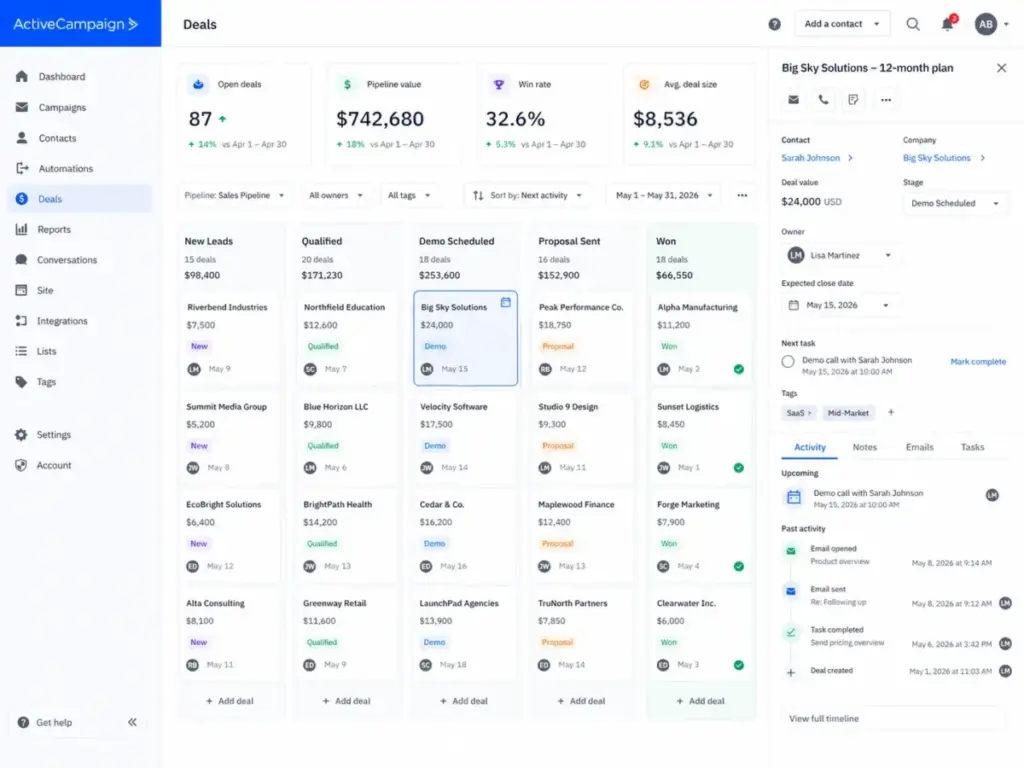
The built-in CRM is adequate for small sales teams that need visibility into deal stages and want marketing-to-sales handoff automation. It is not a replacement for dedicated CRM platforms like Salesforce or HubSpot CRM if your sales team needs advanced forecasting, territory management, or complex approval workflows.
ActiveCampaign Enhanced CRM Add-Ons
Two CRM add-ons extend the built-in features:
- Pipelines Enhanced CRM: adds advanced pipeline management and sales automation
- Sales Engagement Enhanced CRM: includes everything in Pipelines plus additional email and AI capabilities for sales outreach
These add-ons are available on any plan. Pricing is separate from your base plan cost. If your team needs both marketing automation and sales CRM, calculate the total cost of ActiveCampaign base plan plus Enhanced CRM add-ons, then compare against best CRM for marketing automation options like HubSpot.
ActiveCampaign Lead Scoring
Lead scoring is available on Plus and above. You can assign points based on email engagement, page visits, form submissions, and custom events. Scores can trigger automations, such as notifying a sales rep when a lead reaches a threshold.
This is one of the features that makes ActiveCampaign more than an email tool. Connecting marketing behavior to sales action inside a single platform, without Zapier or manual exports, is a real advantage for B2B teams.
Security, Integrations, and API
Security, Compliance, and Admin Controls
ActiveCampaign takes security seriously, especially on Enterprise:
- MFA (multi-factor authentication): available on all plans
- SSO (single sign-on): Enterprise only
- Session management: admin controls for session duration and forced logout
- Trust Center: public-facing portal with security documentation
- SOC 2 report: available through the Trust Center for enterprise buyers
- GDPR compliance: data processing agreements, consent management, and EU data hosting options
For teams in regulated industries, Enterprise is the minimum viable plan due to SSO, custom objects, and dedicated account support.
ActiveCampaign Integrations
ActiveCampaign connects with over 900 apps. Key integrations include:
- Ecommerce: Shopify, WooCommerce, BigCommerce, Magento, Square
- CRM: Salesforce, Microsoft Dynamics, Pipedrive, Zoho
- Ads: Google Ads, Facebook, LinkedIn
- Productivity: Slack, Calendly, Stripe
- CMS: WordPress, Webflow, Squarespace, Wix
- Automation: Zapier, Make
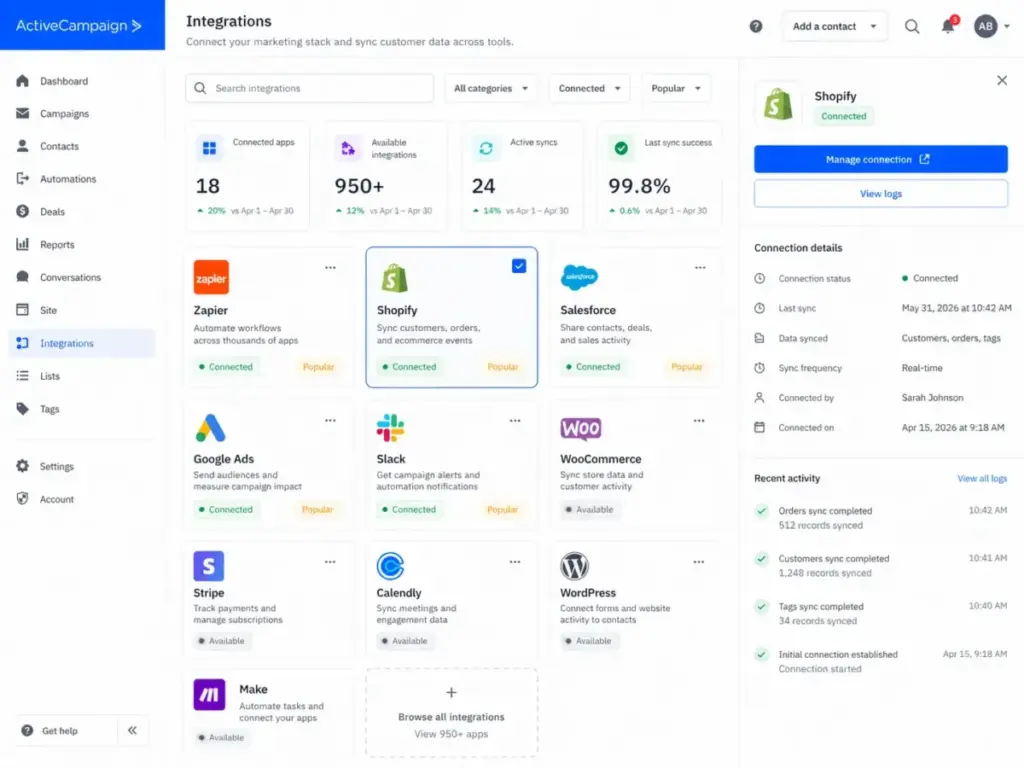
Premium ecommerce integrations (BigCommerce, Magento, Shopify Plus) require Pro or Enterprise. Standard integrations are available on all plans.
ActiveCampaign API and Developer Tools
The API and developer portal supports REST-based access to contacts, deals, automations, campaigns, and custom objects. Documentation is well-maintained and includes code examples.
For teams with developers, the API enables custom event tracking, webhook-driven automations, and deep integration with proprietary systems. ActiveCampaign also supports MCP (Model Context Protocol) connections for AI tools like Claude and ChatGPT, which is a newer capability for AI-assisted marketing operations.
ActiveCampaign Reporting
Reporting includes campaign performance, automation reports, contact trends, and revenue attribution (Pro and above). Custom reports are available as an add-on.
Attribution tracking on Pro lets you see which campaigns and automations drive conversions. This is valuable for teams that need to justify marketing spend to leadership. If reporting is a primary buying criterion, verify whether built-in reports meet your needs before paying for the Custom Reporting add-on.
ActiveCampaign vs Alternatives
I am naming a winner for each comparison. “Both are great options” is not helpful when you are choosing a platform.
ActiveCampaign vs Mailchimp
Mailchimp is better for simple newsletters, polished email templates, and beginners who want an intuitive editor. ActiveCampaign is better for behavioral automation, lifecycle marketing, and sales-connected email workflows.
If your primary need is sending a well-designed monthly newsletter to under 5,000 contacts, choose Mailchimp. If you need branching automations triggered by website behavior or purchase history, choose ActiveCampaign. Mailchimp pricing is also more transparent at lower tiers.
Winner for automation: ActiveCampaign. Winner for newsletters: Mailchimp.
ActiveCampaign vs Brevo
Brevo uses email-volume pricing instead of contact-based pricing. This means Brevo can be significantly cheaper for large lists with low send frequency. Brevo also offers a free plan for up to 300 emails per day.
ActiveCampaign’s automation builder is deeper than Brevo’s. If you need advanced behavioral triggers, lead scoring, and CRM-connected workflows, ActiveCampaign wins. If your priority is sending transactional and marketing emails to a large list without paying per contact, Brevo wins.
Winner for automation depth: ActiveCampaign. Winner for budget list growth: Brevo.
ActiveCampaign vs MailerLite
MailerLite is cleaner, simpler, and cheaper for basic email marketing. It offers a free plan for up to 1,000 subscribers. For creators, bloggers, and small businesses that need a straightforward newsletter tool, MailerLite is the better choice.
ActiveCampaign is the better choice for teams that need advanced segmentation, multi-step automations, CRM integration, and behavioral targeting. The gap in automation depth between the two platforms is significant.
Winner for simple newsletters: MailerLite. Winner for lifecycle marketing: ActiveCampaign.
ActiveCampaign vs Klaviyo
Klaviyo is purpose-built for ecommerce, especially Shopify and direct-to-consumer brands. Klaviyo’s customer data platform, revenue attribution, and ecommerce-specific automations (browse abandonment, predicted customer lifetime value) are stronger than ActiveCampaign’s ecommerce features.
ActiveCampaign is more versatile. It serves B2B SaaS, service businesses, agencies, and ecommerce teams. Klaviyo is more expensive and narrower if you are not running a DTC ecommerce operation.
Winner for ecommerce revenue workflows: Klaviyo. Winner for multi-industry automation: ActiveCampaign.
ActiveCampaign vs GetResponse
GetResponse is better for teams that need built-in webinars, sales funnels, and landing page builders as primary features. GetResponse’s webinar integration is a unique differentiator that ActiveCampaign does not match.
ActiveCampaign’s automation builder and CRM depth are stronger than GetResponse. If webinars and funnels are central to your marketing, choose GetResponse. If behavioral automation and CRM-connected email are central, choose ActiveCampaign.
Winner for webinars and funnels: GetResponse. Winner for CRM-connected automation: ActiveCampaign.
ActiveCampaign vs HubSpot
HubSpot Marketing Hub is part of a full customer platform covering CRM, sales, marketing, service, and operations. If your organization needs all of these under one roof with deep alignment between teams, HubSpot is the better choice.
ActiveCampaign is more affordable for marketing-focused teams. HubSpot’s Marketing Hub Professional starts at $800 per month (3 seats, 2,000 contacts). ActiveCampaign Pro starts at $79 per month. The feature gap narrows as HubSpot’s price increases, but for SMBs that primarily need marketing automation, ActiveCampaign delivers better value.
Winner for full customer platform: HubSpot. Winner for marketing automation value: ActiveCampaign.
Competitor Comparison Table
| Feature | ActiveCampaign | Mailchimp | Brevo | MailerLite | Klaviyo | GetResponse | HubSpot |
|---|---|---|---|---|---|---|---|
| Free plan | ❌ | ✅ | ✅ | ✅ | ❌ | ✅ | ✅ |
| Starting paid price | $15/mo | $13/mo | $9/mo | $10/mo | $20/mo | $19/mo | $20/mo |
| Automation depth | ★★★★★ | ★★★ | ★★★ | ★★ | ★★★★ | ★★★ | ★★★★ |
| Email design | ★★★★ | ★★★★★ | ★★★ | ★★★★ | ★★★★ | ★★★ | ★★★★ |
| Built-in CRM | ✅ | ❌ | ✅ | ❌ | ❌ | ❌ | ✅ |
| SMS automation | Add-on | Add-on | ✅ | ❌ | ✅ | ✅ | Add-on |
| Ecommerce focus | Good | Good | Basic | Basic | Excellent | Basic | Good |
| Best for | Lifecycle automation | Newsletters | Budget lists | Simple email | DTC ecommerce | Webinars | Full platform |
Who Should Use ActiveCampaign?
This is the decision that matters. ActiveCampaign is not for everyone, and pretending otherwise wastes your time and money.
Persona Decision Matrix
| Persona | Recommendation | Why |
|---|---|---|
| SMB marketing team (5-50 employees) | ✅ Strong yes | Automation depth, segmentation, and CRM at a fraction of HubSpot’s cost |
| Ecommerce brand (Shopify/WooCommerce) | ✅ Yes, unless DTC-heavy | Good ecommerce automations; choose Klaviyo if revenue attribution is the #1 priority |
| B2B SaaS lifecycle marketer | ✅ Strong yes | Lead scoring, behavioral triggers, and API integration fit SaaS GTM workflows |
| Agency managing multiple clients | ✅ Yes | Multi-account management and automation recipes speed up client onboarding |
| Solo creator or blogger | ⚠️ Probably not | No free plan, complex for simple needs; use ConvertKit or MailerLite instead |
| Small business sending monthly newsletters | ⚠️ Overpowered | You will pay for automation you do not use; Mailchimp or Brevo is cheaper and simpler |
| Enterprise with SSO and compliance needs | ✅ Yes (Enterprise plan) | SSO, SOC 2, custom objects, and dedicated support meet enterprise requirements |
| Budget-conscious team with 50,000+ contacts | ❌ Not ideal | Contact-based pricing makes ActiveCampaign expensive at scale; evaluate Brevo |
When Not to Use ActiveCampaign
Be honest about your needs. ActiveCampaign is not the right choice if:
- You will not build automations. The platform’s value is in automation depth. If you only send one-off campaigns, you are overpaying.
- You need a free plan. There is no permanent free tier. Brevo, MailerLite, and Mailchimp all offer free plans.
- Your list exceeds 50,000 contacts and you send infrequently. Contact-based pricing hurts large, low-frequency senders. Brevo’s volume model is better here.
- You want an all-in-one CRM, sales, and service platform. ActiveCampaign’s CRM is a complement to marketing automation, not a full sales platform. HubSpot or Salesforce serve this need better. If your needs are simpler – a weekly newsletter, a welcome sequence, and basic segmentation – a lighter tool may be the better fit. Our guide to email marketing basics helps you map your actual workflow before choosing a platform.
Final Verdict
ActiveCampaign earns an 8.7 out of 10 in this review. It is one of the strongest marketing automation platforms for SMBs that need behavior-based journeys, advanced segmentation, and sales-connected email automation.
The automation builder is the best in the mid-market category. 950+ recipes, behavioral triggers, site tracking, event tracking, and branching logic give marketing teams real power without enterprise pricing. Active Intelligence adds practical AI features that improve campaign creation and audience targeting.
The trade-offs are real. No free plan, contact-based pricing that scales aggressively, a Starter plan that limits automation to 5 actions, and advanced features gated behind Pro and Enterprise. Teams that will not use automation depth should look elsewhere.
My recommendation: start with the 14-day free trial on the Plus plan ($49/mo at 1,000 contacts). Build one multi-step automation. If the builder feels natural and your marketing strategy needs behavioral triggers, ActiveCampaign is likely worth the investment. If you spend the trial building one-off email campaigns, you are better served by a simpler, cheaper tool.
For more context on how I evaluate SaaS tools, see our review methodology.
Score: 8.7 / 10
FAQ
Is ActiveCampaign worth it in 2026?
Yes, for teams that use its automation depth. ActiveCampaign delivers strong value for SMBs running behavior-triggered email sequences, lead scoring, and multi-channel campaigns. It is not worth it if you only send basic newsletters; simpler tools like Mailchimp or MailerLite cost less.
How much does ActiveCampaign cost?
ActiveCampaign starts at $15 per month (Starter, 1,000 contacts, annual billing). Plus is $49 per month, Pro is $79 per month, and Enterprise is $145 per month. Prices increase with contact count. Add-ons for SMS, custom reporting, transactional email, and Enhanced CRM add to the base cost. Pricing verified April 2026.
Does ActiveCampaign have a free plan?
No. ActiveCampaign does not offer a permanent free plan. It provides a 14-day free trial with no credit card required. If you need a free email marketing tool, consider Brevo (300 emails/day free), MailerLite (1,000 subscribers free), or Mailchimp (500 contacts free).
What is ActiveCampaign best for?
ActiveCampaign is best for marketing automation, lifecycle email campaigns, behavioral segmentation, and CRM-connected email workflows. It serves SMB marketing teams, ecommerce brands, B2B SaaS companies, and agencies that need advanced automation at a mid-market price point.
Is ActiveCampaign good for small businesses?
Yes, if the small business needs automation. ActiveCampaign’s Plus plan ($49/mo) is well-suited for growing SMBs with 1,000 to 10,000 contacts that run automated welcome sequences, nurture campaigns, and sales handoff workflows. It is overpowered for small businesses that only send a monthly newsletter.
Is ActiveCampaign better than Mailchimp?
For automation, yes. ActiveCampaign’s automation builder, behavioral triggers, and CRM integration are significantly stronger than Mailchimp’s. For simple newsletters, template design, and beginners, Mailchimp is easier and more affordable. Choose based on whether automation or simplicity is your priority.
Is ActiveCampaign better than Brevo?
For automation depth and segmentation, yes. For cost efficiency with large contact lists, no. Brevo’s volume-based pricing can save significant money for teams with 25,000+ contacts and lower send frequency. ActiveCampaign’s behavioral automation and CRM features are more advanced.
Does ActiveCampaign include CRM?
Yes, ActiveCampaign includes basic CRM features (deals, pipelines, contact management) on all plans. For advanced sales workflows, two Enhanced CRM add-ons (Pipelines and Sales Engagement) are available at additional cost. It is not a full CRM replacement for complex sales organizations.
Does ActiveCampaign support SMS and WhatsApp?
Yes. SMS marketing is available as an add-on in the US, UK, and Australia. WhatsApp messaging has separate plans (Core, Advanced, Premium). Both channels can be integrated into automation workflows for multi-channel campaigns.
What are the best ActiveCampaign alternatives?
The best alternatives depend on your priority: Mailchimp for simple newsletters, Brevo for budget-friendly large lists, MailerLite for creators, Klaviyo for ecommerce, GetResponse for webinars and funnels, and HubSpot Marketing Hub for full CRM and sales alignment.
Is ActiveCampaign hard to learn?
The basic email campaign editor is easy. The automation builder has a learning curve of 2 to 4 hours for users coming from simpler tools. ActiveCampaign offers free onboarding, migration services, and 950+ pre-built automation recipes to accelerate setup. Users familiar with workflow-based tools adapt quickly.
What is the biggest downside of ActiveCampaign?
The biggest downside is contact-based pricing combined with no free plan. As your list grows, costs increase regardless of how many emails you send. Teams with large, low-engagement lists pay for every contact. The Starter plan’s 5-action automation limit also forces most automation-focused buyers to the $49/mo Plus plan.