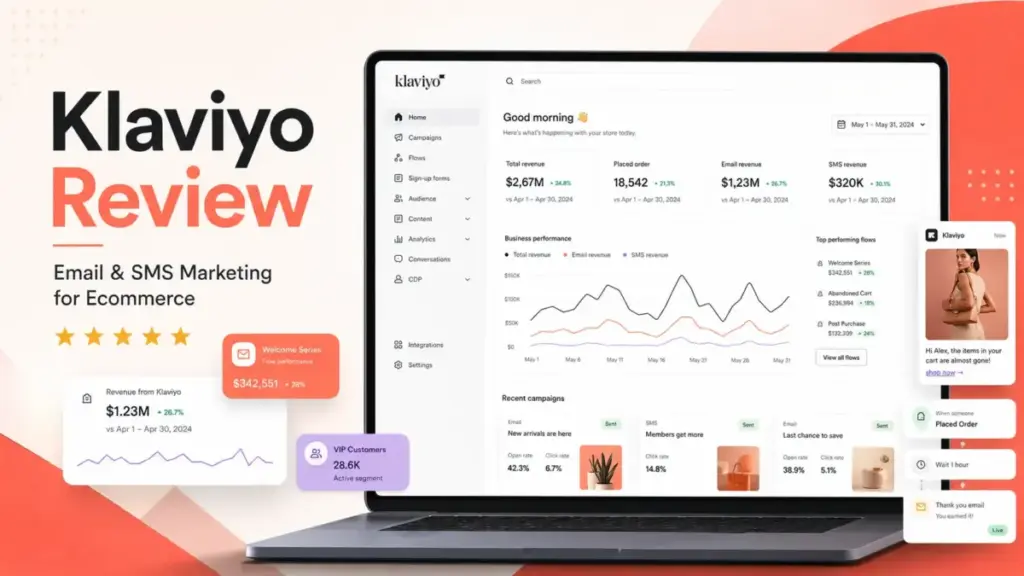
Klaviyo review verdict: Klaviyo is worth it for ecommerce brands that can turn customer data into repeat purchases, but it is too expensive for stores that only send basic newsletters. The platform combines email, SMS, WhatsApp, and customer profiles into one SaaS marketing system built for Shopify and DTC retention.
Pricing starts at $0 for up to 250 active profiles and 500 emails per month. Beyond that, costs scale with every profile you collect, every SMS credit you burn, and every add-on module you activate. This Klaviyo review breaks down the real cost structure, explains who benefits most, and identifies when Omnisend, Mailchimp, or Brevo is the smarter pick. For a side-by-side ranking of Klaviyo against 19 other platforms, see our best email marketing platforms guide.
Quick Verdict
| Score | 8.6 / 10 |
| Best for | Shopify and DTC brands with repeat-purchase products, clean customer data, and enough margin to justify list-based pricing |
| Not for | Solo founders under 250 active profiles, newsletter-only senders, low-margin catalogs, and teams that will not build segments |
| Free plan | $0: 250 active profiles, 500 emails/month, 150 mobile credits/month |
| Main limitation | Cost compounds across active profiles, SMS credits, and add-on modules; forecasting total spend requires a calculator |
| Best alternative (budget ecommerce) | Omnisend |
| Best alternative (newsletters) | Mailchimp |
| Best alternative (lowest cost) | Brevo |
Klaviyo Review Verdict
Klaviyo earns an 8.6 out of 10 in this review because it delivers the deepest ecommerce customer data layer available in a self-serve email and SMS platform. The automation flows, behavioral segmentation, and revenue attribution tools outperform most competitors for Shopify-native stores. But the score loses points on pricing transparency, SMS credit complexity, and add-on creep that catches growing brands off guard.
The platform is worth the cost only when your store can convert segmentation depth into incremental revenue. If you send one newsletter a month to your entire list, Klaviyo’s per-profile billing model works against you.
I scored Klaviyo using weighted criteria aligned with ecommerce buyer priorities. Full scoring details follow the review methodology used across all SaaSZap evaluations.
| Criterion | Weight | Score | Notes |
|---|---|---|---|
| Ecommerce data depth | 20% | 9.5 | Shopify and customer profile foundation is best in class |
| Automation and segmentation | 20% | 9.2 | Lifecycle flows and behavior-based campaigns lead the category |
| Email + SMS execution | 15% | 8.6 | Strong delivery, but SMS credit math complicates forecasting |
| Pricing transparency | 15% | 7.2 | Free plan is clear; real cost needs calculator and add-on review |
| Ease of setup | 10% | 8.0 | Fast Shopify sync, but learning curve for flow logic and segments |
| Reporting and attribution | 10% | 8.8 | Revenue attribution tied to campaigns, flows, and segments |
| Support and scalability | 10% | 8.0 | Paid support is strong; free plan support ends after 60 days |
| Final Score | 100% | 8.6 |
What Is Klaviyo?
Klaviyo is an ecommerce marketing automation platform that unifies email, SMS, WhatsApp, RCS, and mobile push into a single customer data system. The company positions itself as a B2C CRM, meaning it stores customer profiles, purchase history, browsing behavior, and engagement signals in one place, then lets you act on that data through automated flows and campaigns.
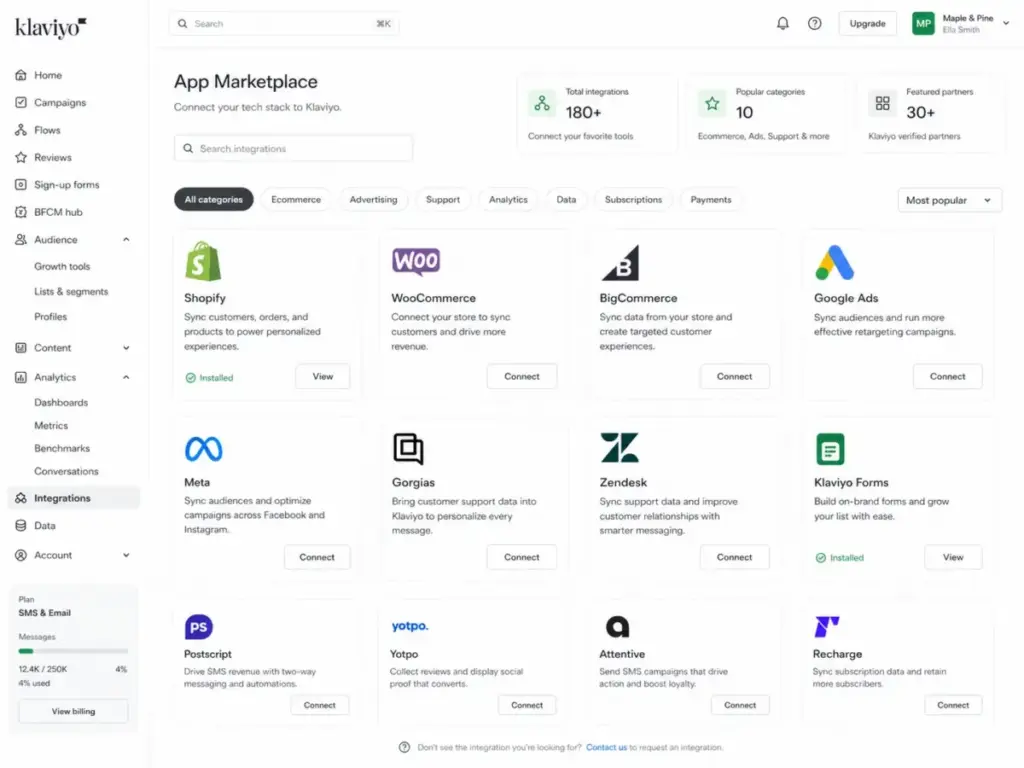
The platform connects natively to Shopify, WooCommerce, BigCommerce, Magento 2, Wix, Square Online, Salesforce Commerce Cloud, and 350+ apps in the Klaviyo App Marketplace. Its core value proposition is not the email builder or the SMS tool. It is the customer data layer that sits behind both.
For store owners, that data layer means you can trigger an abandoned-cart email based on a specific product viewed, suppress buyers who already purchased, and segment by predicted lifetime value, all without exporting data to a spreadsheet.
The tradeoff: you pay for every active profile in your account, whether or not you email them. Before evaluating Klaviyo’s ecommerce-specific features, it helps to understand the broader email marketing framework — including how consent, segmentation, and lifecycle campaigns form the foundation that platforms like Klaviyo build on.
What Changed in Klaviyo in 2026?
Klaviyo’s spring 2026 updates signal a shift from email-and-SMS tool to a broader B2C CRM platform. The changes matter because they affect what you are actually buying, and what you will pay for as add-ons.
The biggest additions include Customer Agent, an AI-powered support tool that handles shopper conversations across email and WhatsApp. WhatsApp marketing campaigns are now a full channel alongside SMS, not just a beta. RCS messaging setup is available for brands that want richer mobile messages beyond plain text. Marketing Agent can now draft campaigns, and Segments AI helps build audience filters using natural language.
The platform also expanded its add-on modules: Customer Hub (a self-service portal for shoppers), Helpdesk (ticket management), Marketing Analytics (deeper reporting), and Advanced Klaviyo Data Platform (formerly CDP, billed on total profiles including suppressions). Each add-on carries its own billing tier. This means Klaviyo’s real product footprint in 2026 is significantly larger than what most “Klaviyo review” articles describe, and so is the potential bill.
Klaviyo Features That Matter
Klaviyo’s feature set is broad, but not every feature carries equal weight for ecommerce buyers. Below, I focus on the six areas that determine whether the platform justifies its cost for your store.
Klaviyo Email Marketing
Klaviyo’s email editor is a drag-and-drop builder with product blocks that pull live catalog data from your ecommerce platform. You can insert dynamic product recommendations, countdown timers, and conditional content blocks that change based on subscriber attributes. Templates are available, and the AI subject line generator suggests variants for A/B testing.
The email system supports campaign sends (one-time blasts to a segment) and flow emails (triggered messages inside automated sequences). Campaigns count toward your monthly email send limit. Flows also count, but since they fire based on behavior triggers, volume depends on how many customers trigger each sequence. At 500 emails per month on the free plan, a store with 250 profiles and two flows active will approach that cap quickly.
Klaviyo SMS and Mobile Messaging
Klaviyo SMS works inside the same platform as email, using the same customer profiles and segments. You can build flows that combine email and SMS steps, with conditional splits based on whether a subscriber has an SMS consent. WhatsApp messaging follows a similar pattern, and RCS is available for supported carriers.
The critical detail: SMS billing runs on credits, not flat-rate pricing. One SMS message in the United States costs a different number of credits than one in the United Kingdom or Australia. MMS messages cost more than SMS. Messages with emojis or special characters reduce the per-segment character limit from 160 to 70, which means a single message can consume multiple segments and multiple credits. WhatsApp messages have a 168-character limit per credit. The free plan includes 150 mobile message credits per month, which may cover only a handful of SMS sends depending on message length and recipient country.
Klaviyo Automation Flows
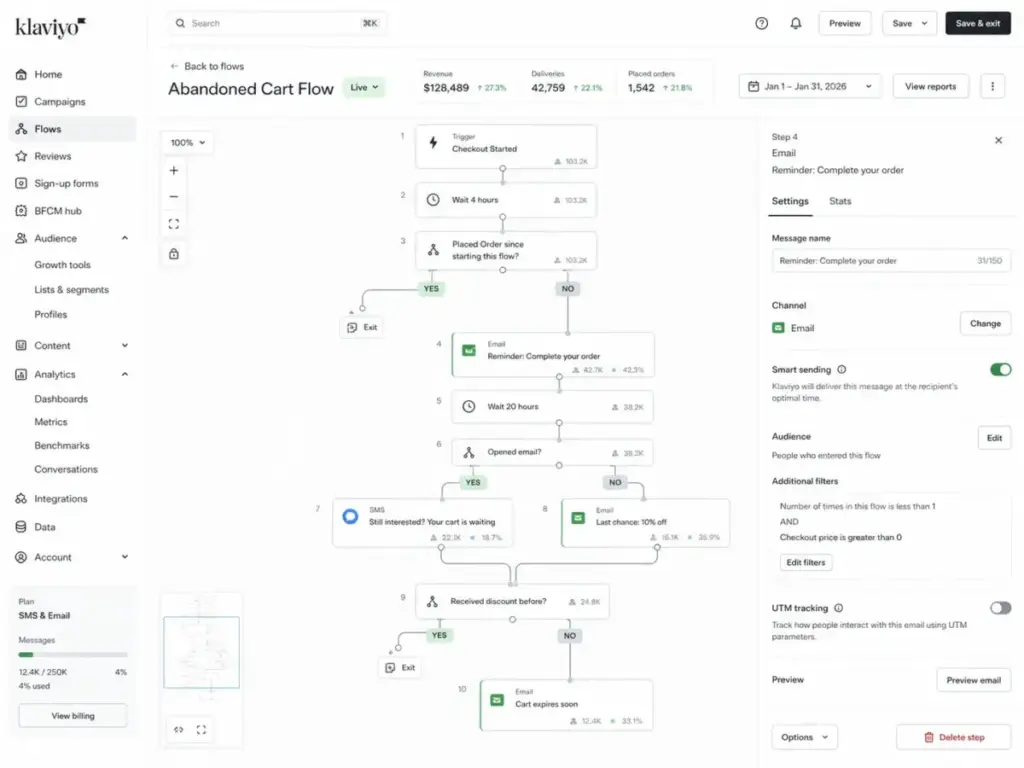
Flows are Klaviyo’s strongest feature for ecommerce. A flow is a sequence of actions triggered by a customer event: abandoned cart, browse abandonment, post-purchase, winback, price drop, back-in-stock, or a custom event you define. Each flow has a visual builder with conditional splits, time delays, A/B test branches, and channel selection (email, SMS, or both).
The pre-built flow library includes templates for the most common ecommerce sequences. A Shopify-connected account can activate an abandoned-cart flow in under 10 minutes, pulling in the abandoned product image, price, and a direct link back to the cart. The flow builder also supports profile property filters, so you can suppress VIP customers from discount sequences or route high-AOV buyers into a different follow-up track.
Klaviyo Segmentation and Profiles
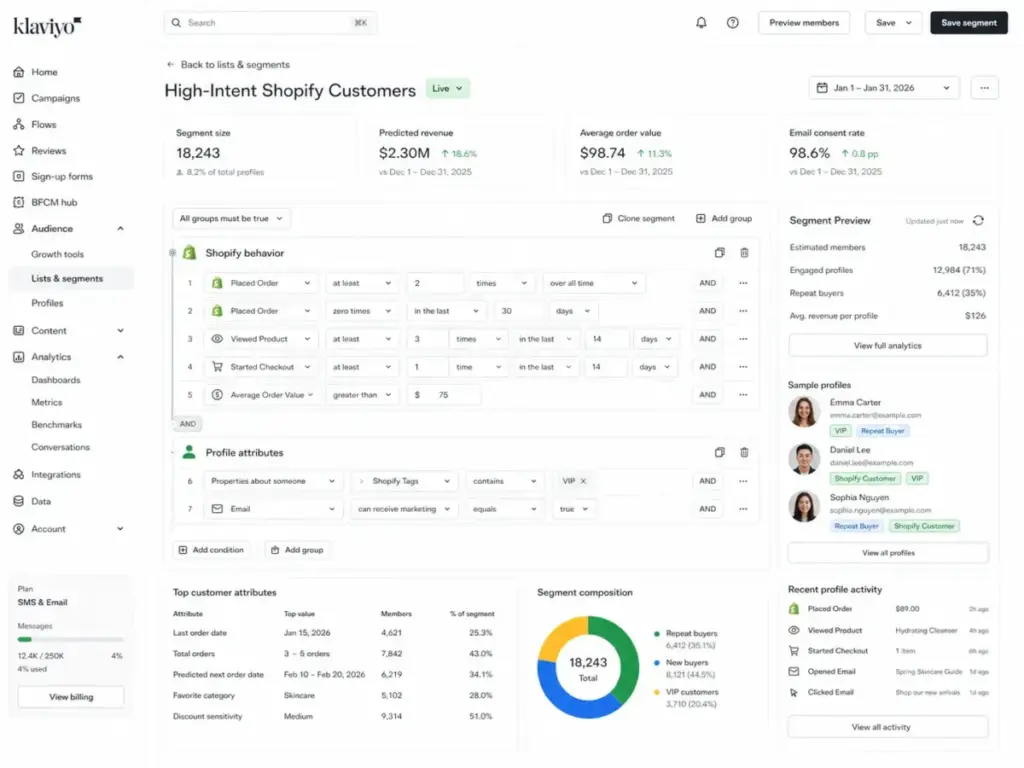
Segmentation in Klaviyo operates on real-time customer data, not static lists. You can build segments based on purchase frequency, average order value, predicted next order date, product category affinity, email engagement (opens, clicks, active on site), and custom properties synced from your ecommerce platform.
Segments update dynamically. A customer who made their second purchase yesterday moves into your “repeat buyer” segment automatically without a manual import or CSV update. This matters for lifecycle marketing because your flows and campaigns always target current behavior, not stale data. The Segments AI feature (new in 2026) lets you describe a segment in natural language, and Klaviyo translates it into filter logic.
The limitation: every profile in your Klaviyo account counts toward billing, whether you email them or not. An active profile is any profile that can be emailed, regardless of consent status. This includes checkout-captured emails from shoppers who never opted in to marketing. If you do not regularly clean suppressed and unengaged profiles, your billing tier rises without a matching increase in reachable audience.
Klaviyo Analytics and Attribution
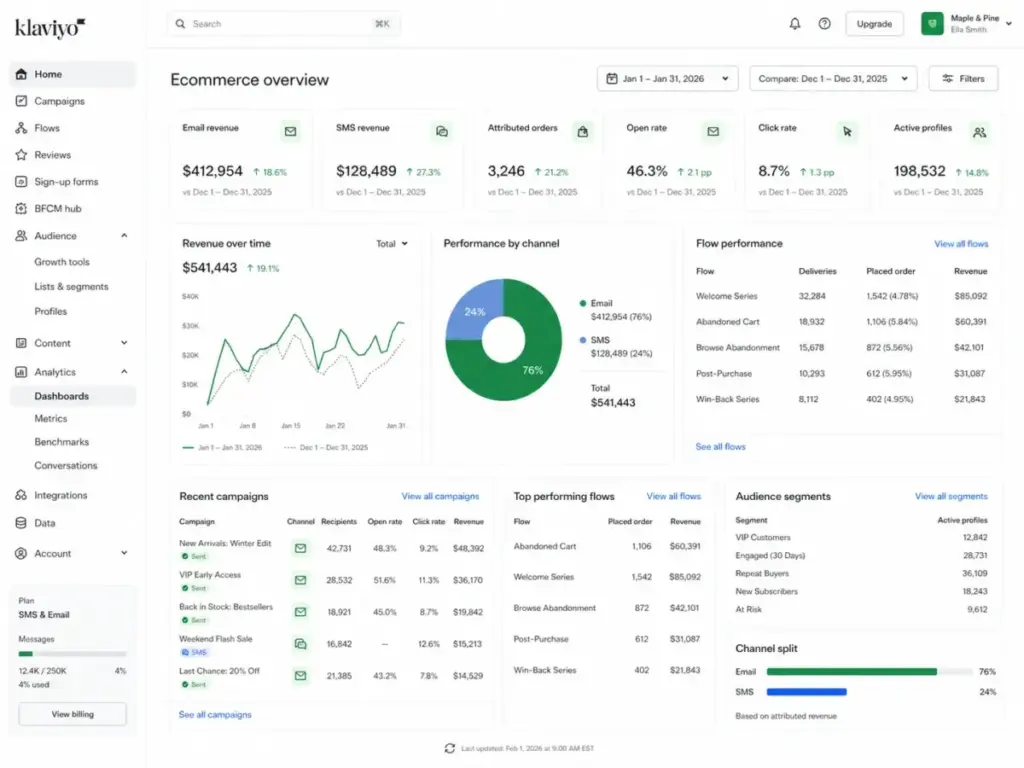
Klaviyo’s reporting ties directly to ecommerce revenue. Each campaign and flow shows attributed revenue, conversion rate, and click-through rate. You can filter by time window, segment, and channel. The dashboard shows a running total of revenue attributed to Klaviyo, which helps justify the platform cost, at least on paper.
Marketing Analytics, available as a paid add-on starting at $100/month for up to 13,500 active profiles, adds deeper reporting layers including cohort analysis and cross-channel performance. For stores under 10,000 profiles, the built-in reporting covers most needs. The add-on becomes relevant for brands running complex multi-flow, multi-channel strategies where granular attribution matters for budget allocation.
Klaviyo AI and Customer Agent
Klaviyo’s AI features in 2026 span marketing and support. Marketing Agent can draft campaigns based on prompts. Subject line AI generates A/B test variants. Segments AI translates plain-English audience descriptions into segment filters.
Customer Agent is a separate product: an AI-powered support agent that handles shopper conversations across email and WhatsApp. It starts at $50/month for up to 75 resolved conversations. For stores receiving more than 75 support inquiries per month, the per-resolution cost adds up. Customer Agent is most relevant for brands with high post-purchase inquiry volume (sizing questions, shipping status, return requests) where automating responses reduces support team load.
Klaviyo User Experience
Klaviyo’s setup workflow for a Shopify store follows a predictable path. I am framing this as the standard lifecycle a new user encounters, based on Klaviyo’s documentation and onboarding flow.
1. Signup. Account creation requires an email, store URL, and basic business info. The free plan activates immediately with no credit card required.
2. Connect Shopify. The Klaviyo Shopify app installs from the Shopify App Store. In a standard setup, the sync imports customer profiles, order history, and product catalog data. Historical data backfill depends on store size.
3. Import and sync profiles. Profiles from Shopify populate automatically. If you have external lists (from a previous ESP, event signups, or manual collection), you upload them as CSV files. Every imported profile counts toward your active profile limit.
4. Build first abandoned-cart flow. Klaviyo’s pre-built abandoned-cart template connects to Shopify checkout events. The flow includes product image blocks, a return-to-cart link, and recommended timing delays. Customizing the template (adding a discount code, changing the delay from 4 hours to 1 hour, adding an SMS step) is where the learning curve starts.
5. Create first segment. A segment like “Purchased in last 90 days AND opened email in last 30 days” requires selecting conditions from dropdown menus. The interface is logical, but the number of available conditions and nested logic can overwhelm first-time users.
6. Launch first campaign. Building and sending a campaign follows a standard ESP workflow: select segment, choose template, write content, preview, schedule or send. The email editor is functional, not minimalist, with product blocks, dynamic sections, and conditional content.
7. Check billing and profile growth. This is where surprises happen. After the Shopify sync, your active profile count may include checkout-captured emails, old customer records, and suppressed profiles that still count toward your tier. Reviewing your active profile count within the first week is critical to avoid an unexpected plan upgrade.
As one Shopify App Store reviewer noted:
“The app works well with Shopify and allows for the most complete view of our customer experience.”
, Degree 33 Surfboards, Shopify App Store review, United States, almost 7 years using the app.
The experience is strongest for users with Shopify ecommerce data flowing in. For WooCommerce or BigCommerce stores, the initial setup requires more manual configuration, and some behavioral triggers depend on API event tracking that Shopify handles natively.
Klaviyo Pricing and Real Cost
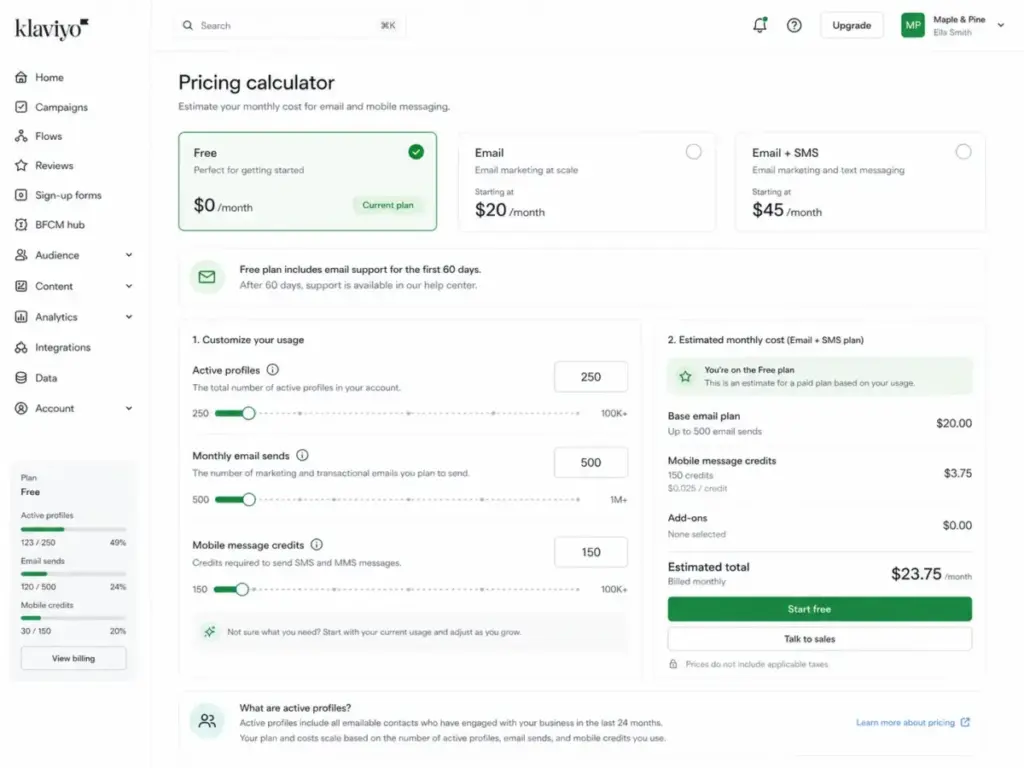
Klaviyo’s pricing appears simple on the surface: a free plan, then paid tiers based on active profiles. The reality involves at least four cost variables that interact with each other.
Free Plan
Klaviyo’s free plan includes:
- Up to 250 active profiles
- 500 emails per month
- 150 mobile message credits per month
- Customer Hub access
- Built-in reporting
- Email support for the first 60 days
- Marketing Agent and AI subject line generator
After 60 days on the free plan, email support ends. If your profile count exceeds 250, Klaviyo may block email sending and flow activation until you reduce profiles or upgrade.
Paid Plans: What Drives the Bill
Paid plans are priced by active profile count and email send volume. The exact pricing for each tier must be confirmed in Klaviyo’s pricing calculator, as rates shift based on profile bands. Before publishing this article for your own pricing decisions, verify the current tier pricing directly.
| Cost Component | How It Scales | What to Watch |
|---|---|---|
| Active profiles | Per-profile tiers (250, 500, 1,000, 1,500 … 150,000+) | Profiles include any emailable contact, even those who did not opt in to marketing |
| Email sends | Included volume per tier, overages available | Bounced and received emails count; skipped emails do not |
| Mobile credits (SMS/MMS/WhatsApp) | Credits vary by country, message type, segment count | One long SMS with emojis can consume 3+ credits |
| Add-on modules | Each billed separately | Customer Hub $20/mo, Helpdesk $10/mo, Customer Agent $50/mo, Marketing Analytics $100/mo |
| Advanced KDP | Based on total profiles (including suppressions) | This is not active profiles; it counts every record in the system |
Source: Klaviyo billing documentation, verified April 2026.
What the Pricing Page Does Not Make Obvious
Active profiles are not opt-in subscribers. An active profile is any profile that can be emailed through Klaviyo, regardless of consent status. A shopper who entered their email at checkout but never checked an opt-in box still counts as an active profile. Stores running aggressive email capture at checkout can accumulate thousands of emailable-but-never-opted-in profiles that inflate billing without delivering marketing value.
SMS credits are not the same as SMS messages. A single SMS message in the US might cost 1 credit, but an MMS costs more. A message with emojis drops the character limit from 160 to 70, turning a single message into a 2- or 3-segment send. WhatsApp messages consume credits at their own rate. Predicting monthly SMS cost requires knowing your subscriber geography, message type mix, and average message length.
Add-on costs stack. A store using email ($X/month for profiles), SMS credits ($Y/month), Customer Hub ($20/month), Helpdesk ($10/month), and Marketing Analytics ($100/month) pays five separate line items. The total Klaviyo bill for a 10,000-profile store with these add-ons active can exceed expectations if the buyer only compared the base email tier.
Downgrades do not refund mid-cycle. If you downgrade mid-billing-cycle, the change takes effect at the next billing cycle. Klaviyo does not issue refunds for the remaining days on the higher tier.
As one verified founder noted on Capterra:
“Because pricing is by number of contacts, it can get pretty expensive.”
, Verified Reviewer, Founder, Capterra.
And from a small Shopify store owner on Reddit:
“it costs as much as my entire Shopify bill per month!”
, Easy-Ads, Reddit r/shopify.
Profile Hygiene Tax
This is the hidden cost most Klaviyo reviews ignore. If you do not regularly suppress or delete unengaged profiles, your active profile count grows with every checkout interaction, every form submission, and every list import. A store with 10,000 active profiles but only 4,000 engaged subscribers is paying for 6,000 profiles that generate zero revenue. Cleaning your list quarterly is not optional hygiene; it is direct cost control.
Klaviyo Pros and Cons
Every ecommerce marketing platform has tradeoffs. Klaviyo’s strengths cluster around data depth and automation; its weaknesses cluster around cost complexity and learning curve.
- Ecommerce customer data depth is best in class for self-serve platforms
- Shopify integration syncs profiles, orders, products, and events natively
- Segmentation updates dynamically based on real-time behavior
- Automation flows support multi-channel sequences with conditional logic
- Revenue attribution ties campaigns and flows directly to orders
- Omnichannel expansion (email, SMS, WhatsApp, RCS, push) is in one platform
- AI features (Marketing Agent, Segments AI, Customer Agent) add workflow efficiency
- Price scales with active profiles, not just subscribers or emails sent
- SMS and WhatsApp credits create unpredictable monthly costs
- Add-on modules (Customer Hub, Helpdesk, Customer Agent, Marketing Analytics) add separate billing tiers
- Learning curve is steep for first-time users building flows and segments
- Free plan email support ends after 60 days
- Advanced KDP bills on total profiles, including suppressions
- Overkill for stores that only send newsletters without segmentation or automation
Klaviyo vs Alternatives
Choosing between Klaviyo and its competitors depends on your store size, margin structure, team skill level, and which channels you actually plan to use. Below, I compare Klaviyo against the five alternatives that appear most often in buyer research.
| Platform | Best For | Ecommerce Data | SMS | Starting Price | Winner By Scenario |
|---|---|---|---|---|---|
| Klaviyo | Shopify DTC brands with repeat-purchase revenue | Deep (native Shopify sync, predicted LTV, behavioral segments) | Credits, multi-channel | $0 (250 profiles) | Best when segmentation drives revenue |
| Omnisend | Ecommerce brands wanting simpler multichannel | Good (ecommerce-focused, less granular than Klaviyo) | Included in plans | $0 (250 contacts) | Best budget ecommerce email + SMS + push |
| Mailchimp | Newsletter-heavy brands and small businesses | Basic (Shopify integration exists, not as deep) | Add-on | $0 (500 contacts) | Best for template-first email and brand design |
| ActiveCampaign | Automation-heavy teams beyond pure ecommerce | Moderate (CRM + automation, less ecommerce-native) | Add-on | $15/mo | Best for complex non-ecommerce automation |
| Brevo | Budget-conscious stores with large lists | Basic (contact management, less behavioral depth) | Included at higher tiers | $0 (300 emails/day) | Best for lowest-cost email + SMS + transactional |
Klaviyo vs Omnisend
Omnisend is the closest direct competitor for ecommerce email and SMS. Both platforms target Shopify stores, both offer automation flows, and both include SMS. Omnisend wins on simplicity: its pricing is more predictable, the interface is less complex, and web push notifications are included. Klaviyo wins on data depth: its segmentation engine, predicted analytics, and profile-level behavioral data go deeper than Omnisend’s. If your store runs 3+ lifecycle flows and segments by purchase frequency, product category, and predicted LTV, Klaviyo pulls ahead. If you want ecommerce multichannel basics without the learning curve, Omnisend is the better fit.
Klaviyo vs Mailchimp
Mailchimp is a general-purpose email platform, not an ecommerce-first tool. Its templates are polished, its brand is recognizable, and its free plan supports 500 contacts. But Mailchimp’s Shopify integration is not as deep as Klaviyo’s native sync, and its behavioral segmentation lacks the ecommerce-specific triggers (browse abandonment by product category, predicted next order date) that Klaviyo offers. Choose Mailchimp for newsletter-driven businesses, local shops, and content brands. Choose Klaviyo when repeat-purchase lifecycle marketing is the primary revenue driver.
Klaviyo vs ActiveCampaign
ActiveCampaign offers deeper automation logic than most ESPs, with branching, scoring, and CRM features that extend beyond ecommerce. It is a strong choice for SaaS companies, agencies, and service businesses that need lifecycle automation across multiple business models. Klaviyo wins for ecommerce-specific data: Shopify order sync, product recommendations, and revenue attribution are more mature. ActiveCampaign wins when your automation needs span beyond online store transactions.
Klaviyo vs Brevo
Brevo (formerly Sendinblue) is the budget pick. Its pricing is based on emails sent, not contacts stored, which means you can maintain a large list without paying per profile. Brevo also handles transactional email natively. The tradeoff: Brevo’s ecommerce segmentation and behavioral automation are less granular than Klaviyo’s. For stores that need affordable email + SMS + transactional email and do not require deep ecommerce data modeling, Brevo saves significant cost.
Klaviyo vs Drip
Drip targets ecommerce brands with a simpler automation-focused approach. It is a viable option for stores that want email automation without Klaviyo’s broader platform complexity. The ecosystem is smaller, the add-on module selection is narrower, and the community is less active. Drip works for smaller ecommerce brands that value simplicity over platform breadth.
Decision tree:
- Need Shopify-native data depth and can afford scaling cost? Choose Klaviyo.
- Need cheaper ecommerce email + SMS + push? Choose Omnisend.
- Need polished newsletter templates for a general audience? Choose Mailchimp.
- Need budget email, SMS, and transactional basics? Choose Brevo.
- Need complex non-ecommerce automation with CRM? Choose ActiveCampaign.
For more options across the best sales and marketing software category, the decision often comes down to whether your primary revenue driver is ecommerce lifecycle marketing or broader business automation.
Who Should Use Klaviyo?
Klaviyo delivers the highest return for stores where customer data directly translates into revenue through automated lifecycle sequences. The platform rewards businesses that invest in segmentation, flow optimization, and profile hygiene.
Shopify apparel store doing $50k to $250k per month with repeat purchases. This is Klaviyo’s core buyer. You have enough order data to build meaningful segments (first-time vs repeat, high-AOV vs low-AOV, seasonal vs year-round). Automated flows for abandoned cart, post-purchase cross-sell, winback, and browse abandonment can generate 20-40% of total email revenue. The per-profile cost is justified by the incremental revenue each flow produces.
DTC brand with a 3-person retention team. If your team runs abandoned-cart, browse abandonment, winback, post-purchase, and VIP flows, Klaviyo’s conditional logic and channel mixing (email + SMS in the same flow) reduces tool fragmentation. A single platform for customer data, messaging, and attribution eliminates the need for Zapier or Make workarounds between separate email and SMS tools.
Ecommerce agency managing 5 to 20 clients. Klaviyo’s multi-account structure and template library let agencies standardize onboarding and flow architecture across clients. The reporting dashboard gives clients a clear revenue-attributed view of what email and SMS are producing.
Subscription brand needing post-purchase and winback flows. Brands selling consumables, supplements, or subscription boxes benefit from Klaviyo’s predicted next order date and churn risk signals. These data points power flows that re-engage lapsing subscribers before they cancel.
Store with enough margin to test SMS and WhatsApp. If your product margins support the cost of mobile messaging credits, Klaviyo’s unified email + SMS flows let you test mobile touchpoints without adding a separate SMS vendor. Brands with an average order value above $60 and a repeat-purchase cycle under 90 days see the strongest SMS ROI.
Who Should Not Use Klaviyo?
Klaviyo is not universally the right choice. For the following micro-cohorts, the platform is either overpriced, overbuilt, or misaligned with how you actually send messages.
Solo founder under $15k per month still validating product-market fit. At this stage, your priority is product validation and traffic acquisition, not lifecycle segmentation. Shopify Email or a free Mailchimp plan covers basic email needs without adding a $20-to-$100+ monthly tool. You can migrate to Klaviyo later when your list and order volume justify the cost.
Store that sends only one newsletter per month. Klaviyo’s per-profile pricing model penalizes low-frequency senders. If you pay for 5,000 active profiles but only send one campaign per month, your cost-per-email-sent is significantly higher than on a platform like Brevo, which bills by email volume rather than contact count. If your sending pattern is closer to basic email marketing – a weekly newsletter and a welcome sequence – a simpler, cheaper tool is the better starting point.
Low-margin catalog with weak repeat-purchase behavior. A store selling low-margin commodity products with no natural repurchase cycle (e.g., furniture, single-purchase electronics) will struggle to generate enough incremental revenue from Klaviyo’s automation to cover the platform cost. The segmentation depth adds limited value when each customer buys once and does not return.
Team that will not clean lists or build segments. Klaviyo’s value comes from using its data layer. If your team imports contacts, sends broadcast campaigns to the full list, never suppresses unengaged profiles, and does not build segments, you are paying premium pricing for commodity email sending. A simpler tool like ConvertKit or Brevo handles that workflow at lower cost.
Brand that needs the lowest possible SMS cost. If your primary channel is SMS (not email), and you need high-volume messaging at the lowest credit cost, dedicated SMS platforms may offer better per-message economics than Klaviyo’s credit system. Klaviyo’s SMS strength is integration with email flows and customer data, not raw SMS volume pricing. Compare dedicated options in our best SMS marketing platforms ranking.
Final Verdict
Klaviyo earns 8.6 out of 10 as an ecommerce email and SMS platform. The score reflects best-in-class ecommerce data depth, automation flow logic, and Shopify integration, balanced against real pricing complexity, SMS credit unpredictability, and add-on cost stacking.
This Klaviyo review comes down to one question: does your store generate enough incremental revenue from segmentation and lifecycle automation to cover the per-profile cost plus add-ons? If yes, Klaviyo is the strongest self-serve option in the category. If no, you are overpaying for features you will not use.
Recommended alternatives by scenario:
- Budget ecommerce email + SMS + push: Omnisend
- Newsletter and template-first email: Mailchimp
- Lowest-cost email and transactional: Brevo
- Automation-heavy non-ecommerce: ActiveCampaign
For ecommerce brands with repeat-purchase products, clean data, and retention-focused marketing teams, Klaviyo remains the platform to beat in 2026.
Klaviyo FAQ
Below are answers to the most common questions about Klaviyo in 2026.
Is Klaviyo worth it in 2026?
Yes, Klaviyo is worth it for ecommerce brands that actively use segmentation, automation flows, and lifecycle marketing to drive repeat purchases. It is not worth it for stores that only send occasional newsletters or have fewer than 250 active profiles, where the free plan caps out quickly and the paid tiers add cost without matching revenue gain.
How much does Klaviyo cost?
Klaviyo’s free plan covers up to 250 active profiles, 500 emails per month, and 150 mobile credits per month. Paid plans scale based on active profile count, email send volume, and mobile message credits. Add-on modules (Customer Hub at $20/month, Helpdesk at $10/month, Customer Agent at $50/month, Marketing Analytics at $100/month) are billed separately. Verify exact pricing in the Klaviyo pricing calculator before committing.
Is Klaviyo better than Mailchimp?
Klaviyo is better for ecommerce stores that need deep Shopify integration, behavioral segmentation, and multi-channel automation flows. Mailchimp is better for newsletter-heavy brands, local businesses, and teams that prioritize template design and simplicity over ecommerce data depth. The choice depends on whether your primary use case is lifecycle ecommerce marketing or general email communication.
Is Klaviyo better than Omnisend?
Klaviyo offers deeper segmentation, more granular customer data modeling, and broader AI features. Omnisend offers simpler pricing, an easier learning curve, and built-in web push notifications alongside email and SMS. For stores under $50k per month in revenue that want multichannel ecommerce marketing without complexity, Omnisend is often the better starting point.
Does Klaviyo include SMS marketing?
Yes, Klaviyo includes SMS, MMS, WhatsApp, and RCS messaging within the same platform. Mobile messaging uses a credit system where cost varies by recipient country, message type, character count, and whether the message includes emojis or media. Credits are not unlimited; they must be purchased or included in your plan tier.
What is Klaviyo best used for?
Klaviyo is best used for ecommerce lifecycle marketing: abandoned-cart recovery, post-purchase follow-up, browse abandonment, winback campaigns, VIP segmentation, and multi-channel (email + SMS) automation flows tied to Shopify or WooCommerce customer data.
Is Klaviyo good for small businesses?
Klaviyo’s free plan works for small stores with up to 250 active profiles. Beyond that, the per-profile pricing model can become expensive relative to revenue for stores under $15k per month. Small businesses that send infrequently or do not use segmentation and automation will find better value in Mailchimp, Brevo, or Shopify Email.
What happens when you exceed Klaviyo's free plan?
When your active profile count exceeds 250, Klaviyo may block email sending and prevent you from setting flow emails live until you upgrade to a paid plan or reduce your profile count below the limit. On paid plans, exceeding profile limits triggers a notification and an automatic move to a compliant tier at the next billing cycle.
Why is Klaviyo so expensive?
Klaviyo’s cost compounds across three vectors: active profile count (including non-opted-in contacts), mobile message credits (which vary by country and message type), and add-on modules (Customer Hub, Helpdesk, Customer Agent, Marketing Analytics, Advanced KDP). Most buyers focus on the base email tier and underestimate the total platform cost when SMS, add-ons, and profile growth are factored in.
What are the best Klaviyo alternatives?
The best Klaviyo alternatives depend on your priority: Omnisend for budget ecommerce multichannel, Mailchimp for newsletter-first email, Brevo for the lowest-cost email and SMS, ActiveCampaign for non-ecommerce automation, and Drip for simpler ecommerce email automation. Each alternative sacrifices some degree of Klaviyo’s ecommerce data depth in exchange for lower cost or simpler operation.
Does Klaviyo work well with Shopify?
Klaviyo’s Shopify integration is among the deepest in the email marketing category. The native app syncs customer profiles, order history, product catalog, and behavioral events (browse, add-to-cart, checkout) in real time. Shopify users can activate pre-built flows, build segments based on purchase data, and attribute revenue to campaigns and flows without additional configuration. As one long-term user noted: “The app works well with Shopify and allows for the most complete view of our customer experience.”
Should I use Klaviyo or Shopify Email?
Start with Shopify Email if you are under 250 contacts, send fewer than 2 campaigns per month, and do not need automation flows. Switch to Klaviyo when you need abandoned-cart flows, browse abandonment, behavioral segmentation, SMS, or revenue attribution. The migration path from Shopify Email to Klaviyo is well-documented and can be completed in one session.