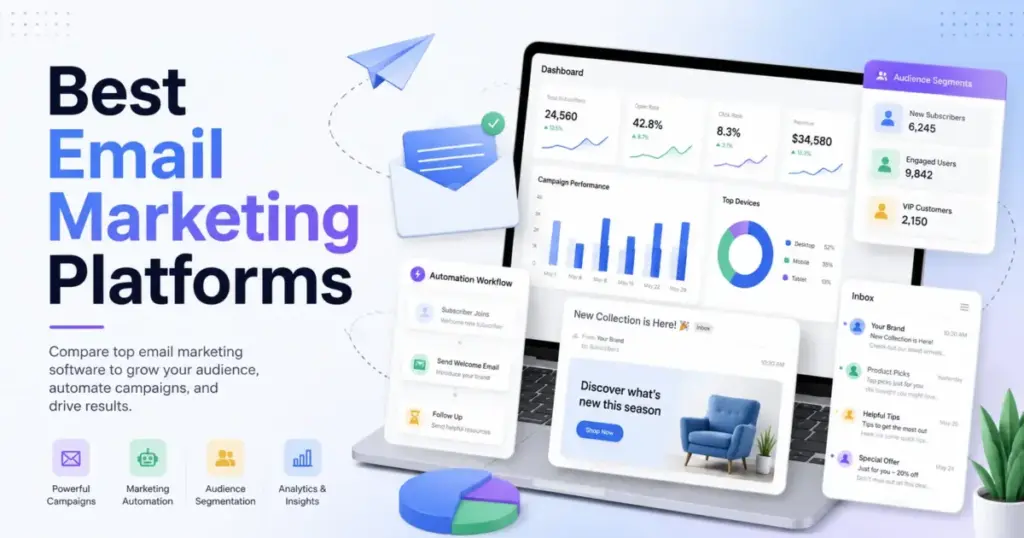
The best email marketing platform in 2026 is not the tool with the lowest starting price. It is the platform that matches your list size, automation needs, sending volume, and customer data model without forcing a painful migration six months later.
If you are new to the channel and want to understand the fundamentals before comparing tools, our guide on what email marketing is covers how permission-based sending works, the main campaign types, and the metrics that matter.
Most comparison articles rank 6 to 12 tools and call it done, but the real market has split into full-service ESPs, ecommerce-native platforms, creator newsletter tools, and developer-first senders.
In this review and comparison, I ranked 20 email marketing platforms across pricing, automation depth, ecommerce fit, deliverability, support, and long-term scalability. If your business depends on CRM software feeding your campaigns, this guide covers that too.
Quick Verdict: Best Email Marketing Platforms
Here are the top picks from my full evaluation of 20 platforms.
- Best overall: Brevo
- Best automation: ActiveCampaign
- Best budget SMB pick: MailerLite
- Best ecommerce segmentation: Klaviyo
- Best mainstream starter: Mailchimp
- Best Shopify alternative: Omnisend
- Best funnel builder: GetResponse
- Best creator platform: Kit
- Best CRM-powered email: HubSpot Marketing Hub
- Best low-cost automation: Moosend
- Best phone support: Constant Contact
- Best free plan: Sender
- Best Design-First Email: Flodesk
- Best Legacy ESP for Small Business: AWeber
Email Marketing Platforms Compared: The Full Table
This table covers all 20 ranked platforms so you can scan pricing, free plans, and fit before reading full reviews. The pricing model column matters more than the starting price.
| Product | Best For | Starting Price | Free Plan | Pricing Model | Main Weakness |
|---|---|---|---|---|---|
| Brevo | SMBs, multi-channel | $9/mo (5,000 emails) | Yes | Send-volume | Advanced features require upgrades |
| ActiveCampaign | Lifecycle automation | ~$15–$19/mo | No (trial) | Contact-based | Learning curve, add-on CRM |
| MailerLite | Budget SMBs, creators | $10/mo | Yes (500 subs) | Contact-based | Limited advanced automation |
| Klaviyo | Ecommerce segmentation | $60/mo (est.) | Yes | Profile-based | Expensive at scale |
| Mailchimp | Mainstream starter | Scales by contacts | Yes (250 contacts) | Contact-based | Automation lags newer tools |
| Omnisend | Shopify stores | $16/mo | Yes | Contact-based | Reporting trails Klaviyo |
| GetResponse | Funnels, webinars | $19/mo ($15.58 annual) | No (14-day trial) | Contact-based | Breadth can feel unnecessary |
| Kit | Creators, coaches | $39/mo (1,000 subs) | Yes (10,000 subs newsletter) | Contact-based | Weak for ecommerce catalogs |
| HubSpot Marketing Hub | CRM-powered email | Varies by tier | Yes (limited) | Seat/contact hybrid | Expensive at Professional tier |
| Moosend | Low-cost automation | $9/mo ($7 annual) | No (30-day trial) | Contact-based | Fewer integrations |
| Constant Contact | Local businesses, nonprofits | ~$12/mo | No (trial) | Contact-based | Weak automation |
| Zoho Campaigns | Zoho ecosystem users | ~$4/mo | Yes (2,000 contacts) | Contact-based | Less attractive outside Zoho |
| Sender | Free plan volume | Paid plans scale | Yes (2,500 subs, 15,000 emails) | Contact/send hybrid | Less established brand |
| Drip | Ecommerce simplicity | $39/mo | No (14-day trial) | List/send-based | Higher entry, narrow focus |
| Campaign Monitor | Agencies, newsletters | ~$13/mo (Lite) | No | Contact-based | Aging automation |
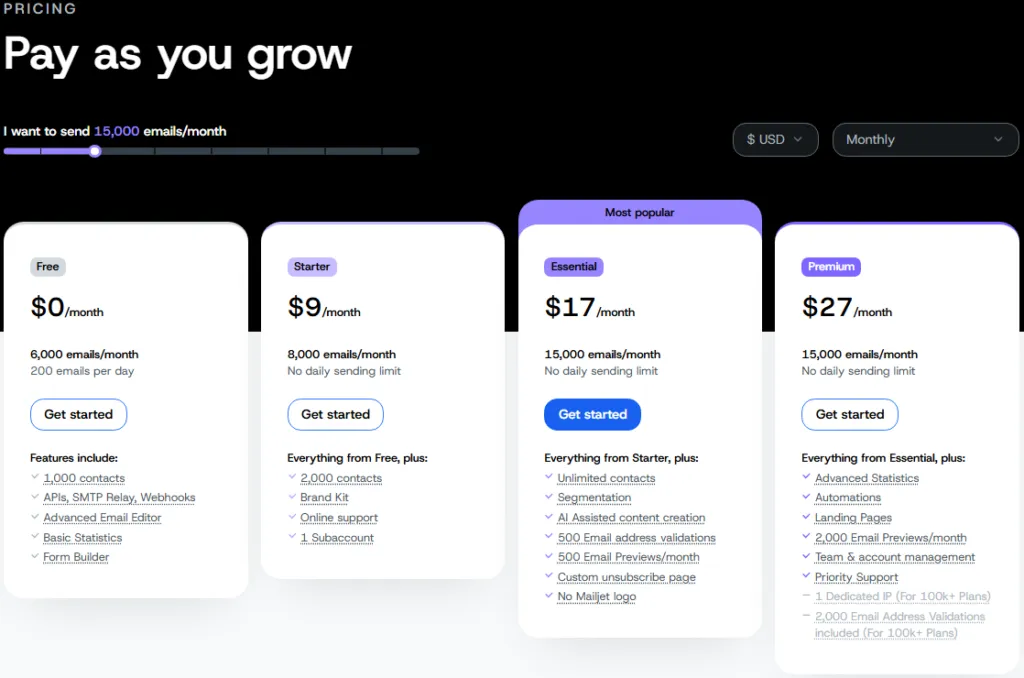
| Mailjet | Dev-marketer collab | $9/mo (8,000 emails) | Yes (6,000/mo, 200/day) | Send-volume | Basic automation |
| Benchmark Email | Basic broadcasts | $15/mo (Pro) | Yes (500 contacts) | Contact-based | Limited A/B testing |
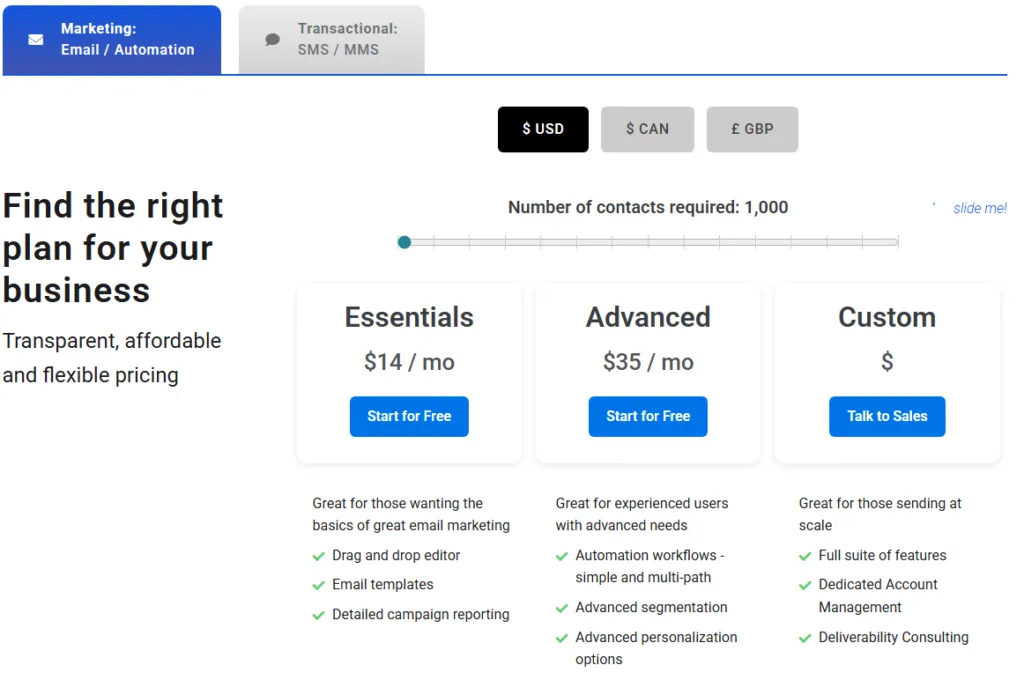
| Campaigner | High-volume automation | ~$14/mo (Essentials) | No | Contact-based | Dated interface |
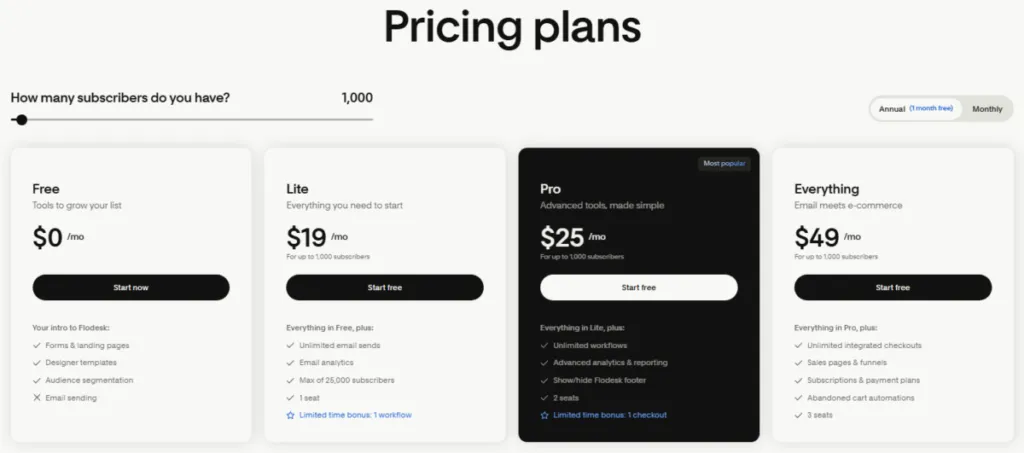
| Flodesk | Design-first email | $25/mo ($19 annual) | Yes (forms only, no sends) | Subscriber-based | Weak automation and segmentation |
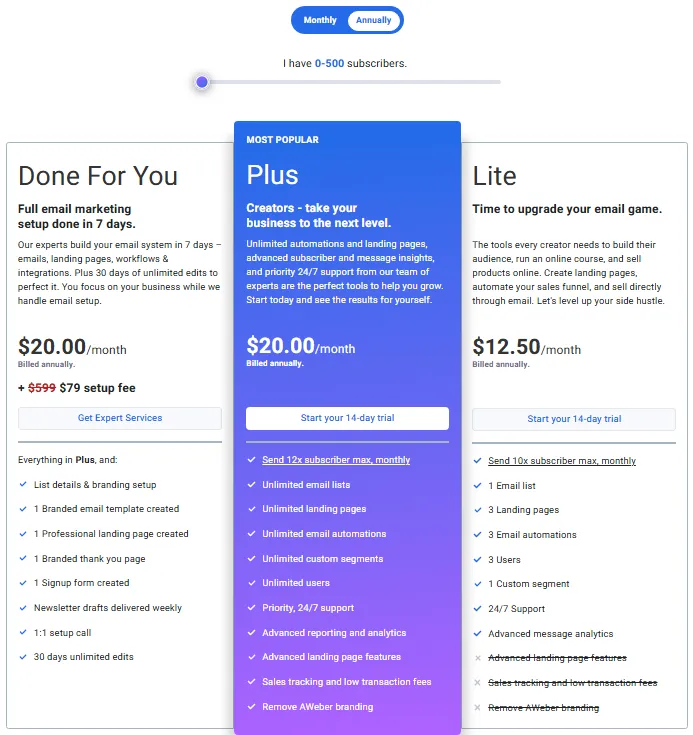
| AWeber | Legacy ESP, small business | $15/mo ($12.50 annual) | Yes (500 subs, 3,000 emails) | Contact-based | Dated interface, limited Lite plan |
How Email Marketing Pricing Works in 2026
Most buyers compare starting prices and miss the real cost driver: the pricing model. Understanding how each platform charges is more important than comparing $9 versus $15 entry points. The wrong model can triple your costs within a year.
Contact-Based vs Send-Volume Pricing
| Pricing Model | How It Works | Best For | Risk | Example Platforms |
|---|---|---|---|---|
| Contact-based | You pay per subscriber count, regardless of sends | Teams emailing most contacts regularly | Cost spikes as list grows, even if engagement drops | Mailchimp, Klaviyo, Omnisend, MailerLite, Kit, AWeber, Flodesk |
| Send-volume | You pay per email sent, unlimited contacts | Large lists with infrequent sends | Overage if campaign frequency increases | Brevo, Mailjet |
| Seat + contact hybrid | Per-user fees plus contact tiers | CRM-driven marketing teams | Onboarding fees and tier jumps | HubSpot |
| Newsletter monetization | Subscriber tiers plus creator commerce revenue | Creators, publishers | Revenue share and paid feature gates | Kit |
Pricing Traps to Watch
- Mailchimp caps the free plan at 250 contacts. Paid plans scale by contacts and impose send limits with overage rules.
- Klaviyo charges by active profiles. Brands with large but unevenly engaged lists pay for contacts they rarely email.
- Brevo starts at $9/month for 5,000 emails, which sounds affordable. But removing Brevo branding and unlocking advanced features can push costs higher.
- Mailjet offers 6,000 free emails per month, but caps daily sends at 200, limiting real campaign use.
- Drip starts at $39/month with no free plan. Early-stage stores pay from day one.
- HubSpot Professional-tier costs and mandatory onboarding fees can dwarf the starting price.
- Kit has a generous free newsletter tier (10,000 subscribers), but advanced automation and commerce features require Creator or Pro plans starting at $39/month.
The pattern is consistent: the starting price tells you the floor, not the ceiling. Always check what happens at 5,000, 25,000, and 100,000 contacts.
Email Marketing Suite vs Newsletter Platform vs Email API
Email marketing software has split into three distinct subcategories. Choosing the wrong category wastes money and creates migration headaches. Here is how the categories break down.
| Category | What It Does | Best For | Examples |
|---|---|---|---|
| Email marketing suite | Full campaigns, automation, segmentation, CRM-lite, multi-channel | SMBs, ecommerce, B2B teams | Brevo, Mailchimp, ActiveCampaign, MailerLite, AWeber |
| Ecommerce ESP | Deep product/purchase data, cart flows, revenue attribution | Online stores, D2C brands | Klaviyo, Omnisend, Drip |
| Design-first and newsletter platform | Audience growth, visual branding, monetization, publishing | Creators, writers, personal brands | Kit, Flodesk, Campaign Monitor |
| Developer-friendly sender | API/SMTP, transactional email, collaborative editing | Dev teams, mixed marketing/dev workflows | Mailjet |
| Enterprise engagement cloud | Journey orchestration, CDP, custom pricing | Large enterprises (not covered here) | Salesforce Marketing Cloud, Braze, Attentive |
Why this matters: If you are a Shopify store owner evaluating Flodesk, you are looking at the wrong category. If you are a local service business comparing Klaviyo, you are paying for ecommerce features you will never use.
Best Email Marketing Platform Reviews
Each platform below was evaluated using official pricing pages, product documentation, current third-party testing, and public user feedback. I spent more words on the top 10 because those tools serve the broadest range of buyers.
Brevo — Best Overall

Score: 9.3/10 — Excellent
Brevo is the best overall email marketing platform for SMBs in this ranking because it combines email, SMS, automation, and volume-based pricing from $9/month. It handles large contact databases without punishing you for list size the way contact-based platforms do. The trade-off is that advanced landing pages, higher-volume campaigns, and team features push you into pricier tiers.
Best for: SMBs, local service businesses, and lean marketing teams with mixed email and SMS needs.
Not for: Ecommerce brands needing Klaviyo-level product analytics or enterprise journey orchestration.
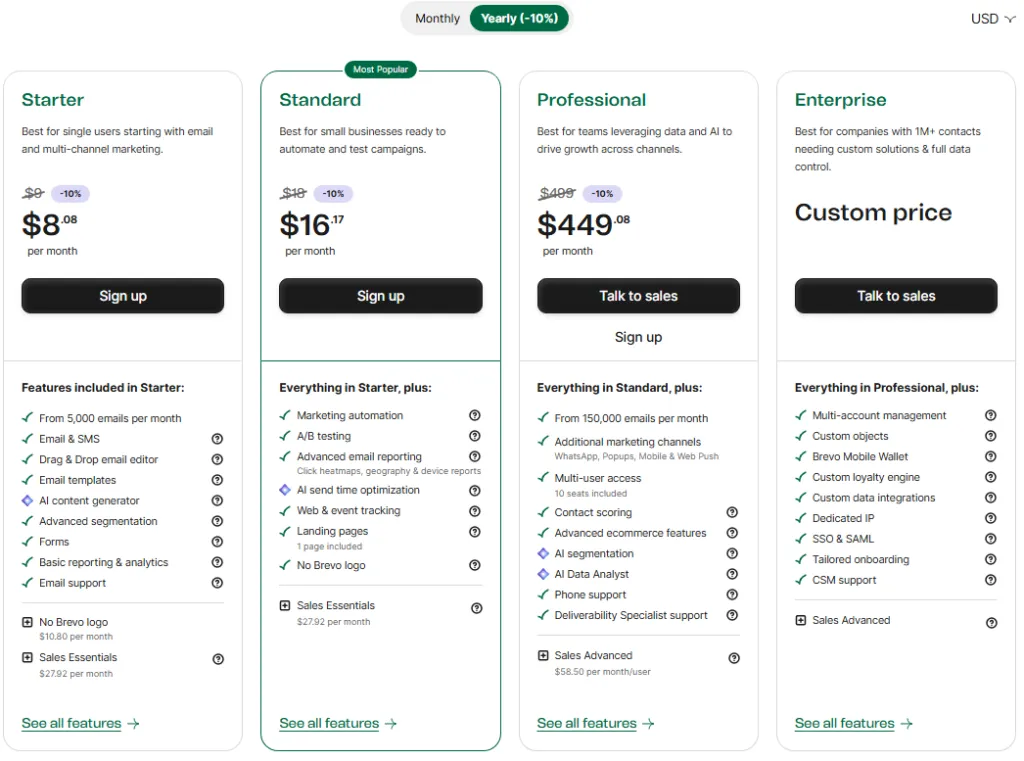
Starting price: Free plan available; Starter from $9/month for 5,000 emails; Business from $18/month. Pricing verified May 2026.
Why I ranked it here: Brevo balances affordability, multi-channel capability, generous contact handling, and practical automation better than most SMB tools. Read our full Brevo review for a deeper breakdown.
Standout features:
- Volume-based pricing suits large lists that do not email every contact constantly
- Built-in SMS and transactional messaging alongside marketing campaigns
- AI content generator and drag-and-drop editor with email templates
Where it falls short:
- Interface feels less polished than Mailchimp
- Removing Brevo branding requires an upgrade
Pricing warning: The $9 Starter plan includes Brevo branding. Unlocking branding removal and more advanced capabilities requires higher tiers or add-ons.
Bottom line: Brevo is the safest starting point for SMBs that want room to grow without contact-based billing pressure.
ActiveCampaign — Best Automation Depth

Score: 9.2/10 — Excellent
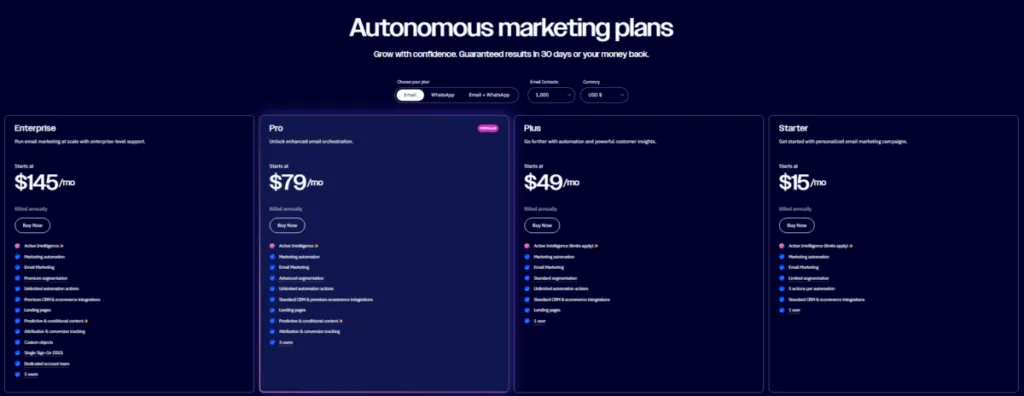
ActiveCampaign is the strongest automation platform here, but its learning curve makes it a poor choice for simple newsletters. Its visual automation builder, lifecycle branching, and 1,000+ integrations make it the go-to for B2B teams and service businesses running complex nurture sequences. Read our full ActiveCampaign review for workflow examples.
Best for: B2B marketers, service businesses, SaaS teams, and experienced lifecycle marketers.
Not for: Beginners who only need a monthly newsletter.
Starting price: Plans start around $15 to $19/month depending on billing and contact tier. No setup fees; free migration offered. Pricing approximate due to calculator-based tiers.
Why I ranked it here: No SMB-tier platform matches its automation depth. Teams usually choose ActiveCampaign after outgrowing Mailchimp-style automations.
Standout features:
- Visual automation workflows with conditional branching, wait steps, and goal tracking
- Active Intelligence with 34 AI agents for predictive actions
- CRM add-ons and 1,000+ app connections via native and Zapier integrations
Where it falls short:
- CRM features have moved toward add-ons, increasing total cost
- Learning curve is steeper than MailerLite, Brevo, or Mailchimp
Pricing warning: Contact billing and add-ons can make the cheap starting tier misleading for growing databases. Check what happens at 10,000 and 25,000 contacts.
Bottom line: If automation logic matters more than newsletter simplicity, ActiveCampaign is the right pick.
MailerLite — Best Budget SMB Pick

Score: 9.0/10 — Excellent
MailerLite is the best budget SMB pick for teams that need simple newsletters, landing pages, and basic automation without paying for features they will not use. It feels like the least intimidating “real” ESP for first-time email marketers.
Best for: Freelancers, creators, small nonprofits, and bootstrapped SMBs.
Not for: Teams needing complex branching, ecommerce event data, or advanced deliverability tooling.
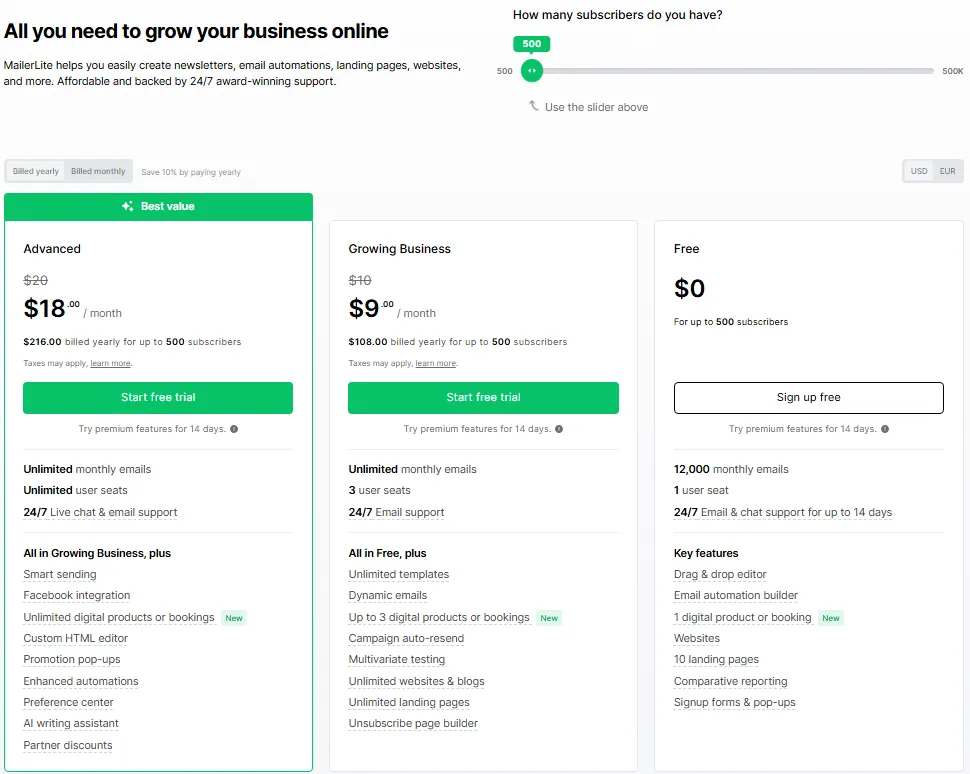
Starting price: Free plan up to 500 subscribers; Growing Business from $10/month; Advanced from $20/month. Pricing verified.
Why I ranked it here: MailerLite gives small teams a clean path from free newsletters to paid automation without forcing a complex marketing suite.
Standout features:
- Clean drag-and-drop editor and publishing flow for non-specialists
- Landing pages, popups, and digital-product selling built in
- AI writing assistant on paid plans
Where it falls short:
- Advanced automation, spam testing, and deep analytics are limited compared with ActiveCampaign and Klaviyo
- The free subscriber cap is now 500, not the older 1,000 cap many buyers remember
Pricing warning: The free plan cap dropped from 1,000 to 500 subscribers. Factor that into early-stage projections.
Bottom line: Start here if you want a clean editor, fair pricing, and room to grow without overwhelm.
Klaviyo — Best Ecommerce Segmentation

Score: 8.9/10 — Very Good
Klaviyo is the best ecommerce email platform when product and purchase data drive segmentation. Its flows, customer profiles, and revenue attribution make it the default choice for Shopify and WooCommerce stores with repeat-purchase models. But the pricing punishes large lists. See our Klaviyo review for a full cost analysis.
Best for: Shopify, WooCommerce, and ecommerce brands with repeat-purchase flows.
Not for: Newsletters, local services, and businesses without ecommerce event data.
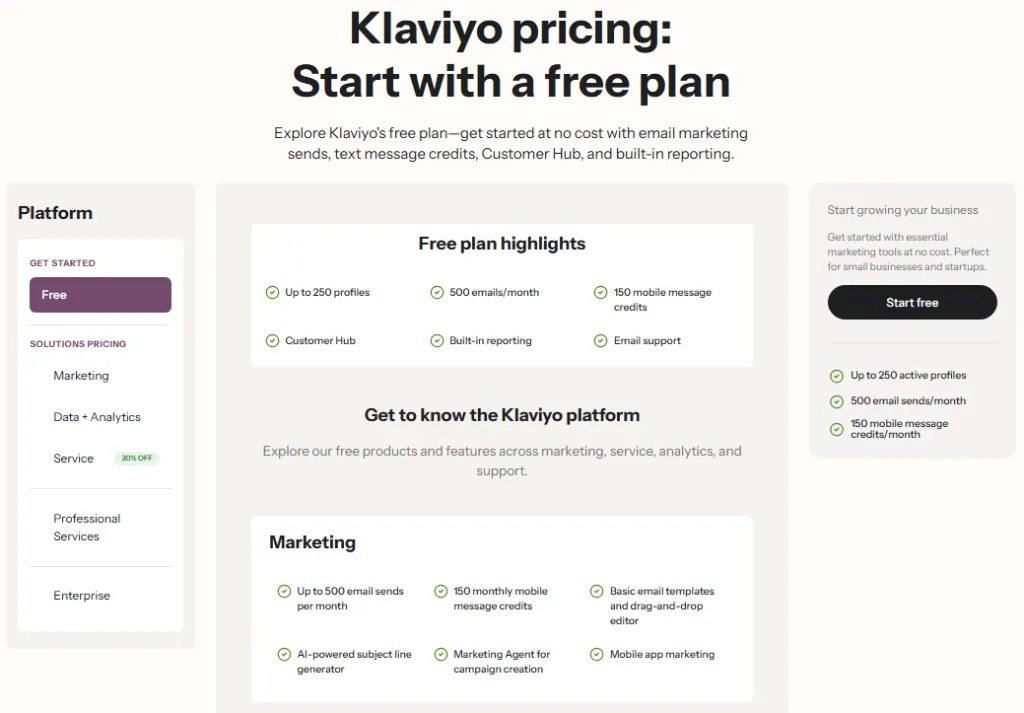
Starting price: Free plan available; email marketing pricing starts at approximately $60/month based on active profiles. Pricing approximate due to calculator-based scaling.
Why I ranked it here: No other platform here matches its ecommerce segmentation depth. Reddit users repeatedly frame Klaviyo as powerful but expensive once lists scale.
Standout features:
- Product and behavior-based segmentation tied to real purchase data
- Pre-built ecommerce flows (abandoned cart, post-purchase, win-back)
- Customer Hub for post-purchase self-service
Where it falls short:
- Profile-based billing punishes brands with large but unevenly engaged lists
- Overkill for businesses without ecommerce event data
Pricing warning: Klaviyo charges by active profiles. A 50,000-profile list costs significantly more than Brevo or Omnisend at the same size. Clean your list aggressively.
Bottom line: If ecommerce data drives your email revenue, Klaviyo earns its price. If it does not, you are overpaying.
Mailchimp — Best Mainstream Starter

Score: 8.7/10 — Very Good
Mailchimp remains a safe default for teams that want familiarity, integrations, and polished campaign creation. But it is no longer the automatic first choice. Automation depth and pricing are not as compelling as newer alternatives. Our Mailchimp review covers the full feature set, and our Mailchimp pricing breakdown explains the scaling math.
Best for: Small teams wanting a familiar interface and broad app support.
Not for: Automation-heavy teams or fast-growing lists that care about long-term cost.
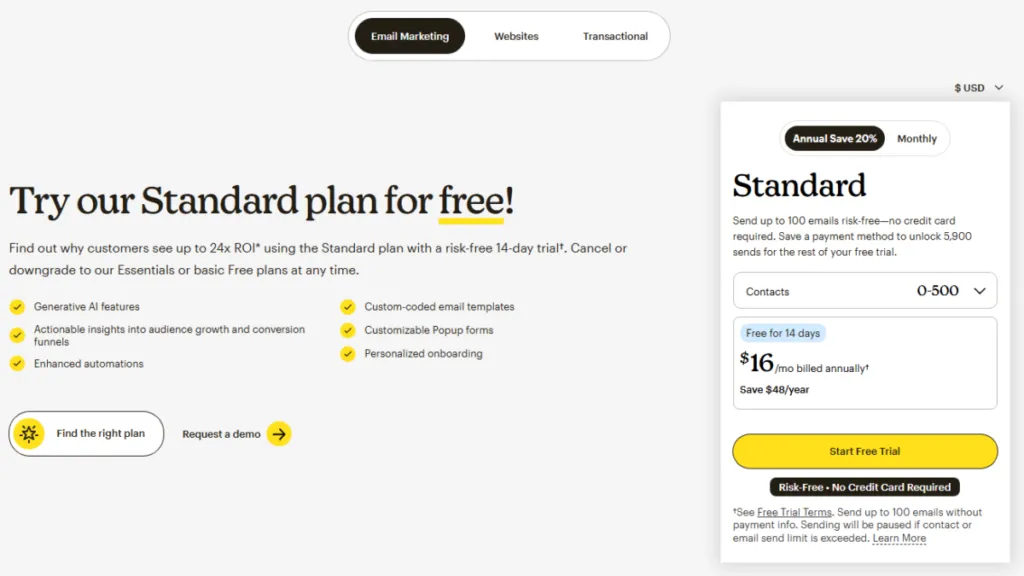
Starting price: Free plan up to 250 contacts; paid plans (Essentials, Standard, Premium) scale by contact count and send limits. Pricing verified.
Why I ranked it here: Mailchimp feels comfortable early, then expensive when segmentation and automation become central.
Standout features:
- Brand recognition and the broadest integration ecosystem in this list
- Polished campaign builder with generative AI features
- Predictive analytics and content optimization on higher tiers
Where it falls short:
- Free plan capped at 250 contacts (down from previous limits)
- Limited free-tier support and no phone support even on paid tiers
- Automation depth lags ActiveCampaign and Klaviyo
Pricing warning: Paid plans have send and contact limits with overage rules.
Bottom line: Mailchimp is fine for starting. Just plan your exit strategy before your list hits 10,000.
Omnisend — Best Shopify Alternative

Score: 8.6/10 — Very Good
Omnisend gives ecommerce stores most core lifecycle campaigns without Klaviyo’s steeper learning curve or price tag. Community discussions often frame Omnisend as the practical middle ground: cheaper and easier than Klaviyo but less deep.
Best for: Shopify stores and small ecommerce brands under heavy automation pressure.
Not for: Enterprise ecommerce brands needing deep predictive analytics.
Starting price: Free plan available; Standard from $16/month; Pro from $59/month. Pricing verified.
Why I ranked it here: Omnisend delivers email, SMS, and push in one ecommerce-focused platform at a lower price point than Klaviyo.
Standout features:
- Ecommerce-first automations with email, SMS, and push notifications combined
- Pre-built templates for abandoned cart, welcome series, and browse abandonment
- Product recommendations and AI-assisted content
Where it falls short:
- Reporting and segmentation depth trail Klaviyo
- SMS pricing and contact scaling still matter even when the entry plan looks affordable
Pricing warning: SMS credits are separate. Factor those into your total monthly cost, especially for stores running cart recovery via text.
Bottom line: If you want ecommerce automation without Klaviyo’s complexity or cost, Omnisend is the strongest alternative.
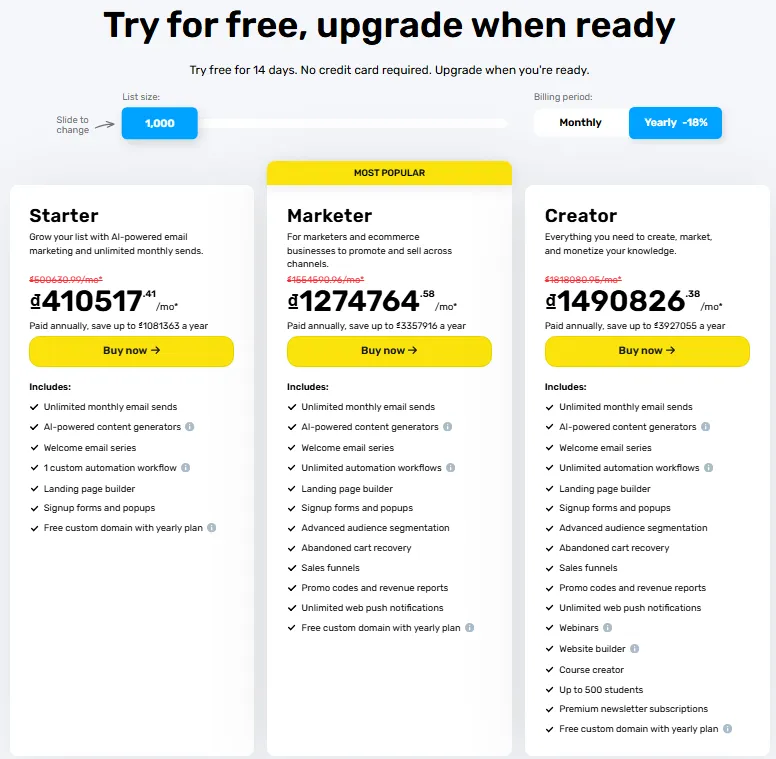
GetResponse — Best Funnel Builder

Score: 8.5/10 — Very Good
GetResponse review is broader than a newsletter tool and stronger when landing pages, webinars, and conversion funnels matter. The platform is most compelling when email is part of a bigger conversion path.
Best for: Creators, educators, webinar marketers, and small teams selling digital products.
Not for: Brands that already have dedicated landing page and webinar tools.
Starting price: Starter from $19/month ($15.58 annually); 14-day free trial. Pricing verified.
Why I ranked it here: Built-in webinar and funnel features reduce tool sprawl for digital product sellers.
Standout features:
- Webinars, funnels, and landing pages included (not add-ons)
- Unlimited emails on all paid plans
- AI email generator and ecommerce integrations
Where it falls short:
- The breadth can feel unnecessary for simple email campaigns
- Advanced automation and creator features sit beyond the entry-level plan
Pricing warning: Webinar attendee limits and advanced automation require higher tiers. Check which plan includes the features you actually need.
Bottom line: GetResponse earns its spot when your workflow combines email, webinars, and funnels in one tool.
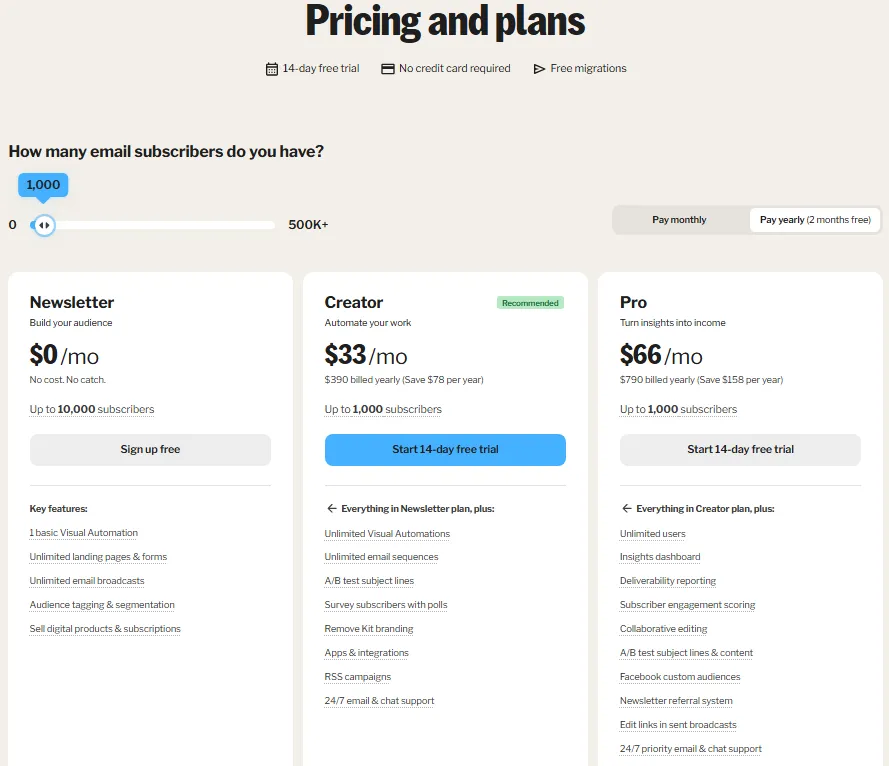
Kit — Best for Creators

Score: 8.4/10 — Very Good
Kit (formerly ConvertKit) is purpose-built for creators who sell content, courses, newsletters, or memberships. Its value depends on whether your email list is an audience, not just a customer database. See our ConvertKit review for the full creator workflow analysis.
Best for: Creators, writers, coaches, podcasters, and solo educators.
Not for: Ecommerce stores needing product recommendations or enterprise teams needing governance.
Starting price: Free Newsletter plan up to 10,000 subscribers; Creator paid plans start around $39/month for 1,000 subscribers. Pricing approximate.
Why I ranked it here: Kit’s creator-first subscriber model and monetization tools (paid newsletters, digital products, tips) set it apart from general-purpose ESPs.
Standout features:
- Free newsletter plan supporting up to 10,000 subscribers
- Creator commerce: sell digital products, paid subscriptions, and tips
- Tag-based subscriber management with visual automation sequences
Where it falls short:
- Not the strongest fit for ecommerce product catalogs or B2B sales teams
- Advanced automation and scaling features require Creator or Pro plans
Pricing warning: The free plan is generous for newsletters, but the moment you need automation sequences or commerce features, you jump to $39/month or higher.
Bottom line: If you are building an audience-driven business, Kit is designed for how creators actually work.
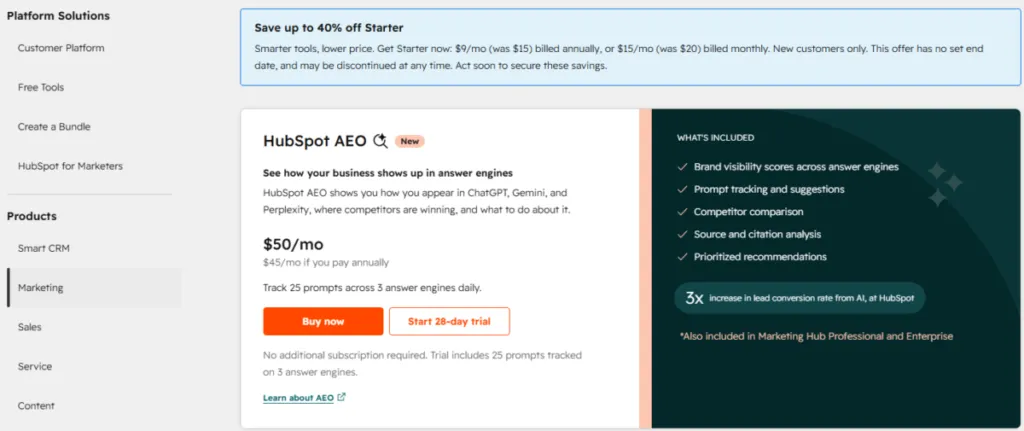
HubSpot Marketing Hub — Best CRM-Powered Email

Score: 8.3/10 — Very Good
HubSpot is excellent when email is part of a CRM-centered inbound marketing system. Contact records, forms, landing pages, sales context, and email live in one ecosystem. But it is too expensive and heavy for simple newsletters. See our HubSpot CRM review and HubSpot pricing breakdown for the full picture.
Best for: B2B companies using CRM, forms, landing pages, and sales follow-up together.
Not for: Creators, small shops, and teams that only send broadcasts.
Starting price: Free email tools available; Marketing Hub Starter and higher tiers scale by seats and contacts. Professional tier includes onboarding fees. Pricing approximate due to complex tiering.
Why I ranked it here: No other platform here matches HubSpot’s CRM-to-email integration depth for B2B teams.
Standout features:
- CRM-driven personalization with full contact lifecycle tracking
- Forms, landing pages, and sales handoff in one system
- AI content tools and smart content for dynamic personalization
Where it falls short:
- Professional-tier costs and onboarding can dwarf the starting price
- Too heavy for teams that only need email campaigns
Pricing warning: HubSpot’s free tools are attractive, but the serious marketing suite is a different budget conversation entirely. Professional plans with onboarding can cost thousands per year.
Bottom line: Choose HubSpot when email, CRM, sales, and forms need to share a single source of truth. Skip it for standalone newsletters.
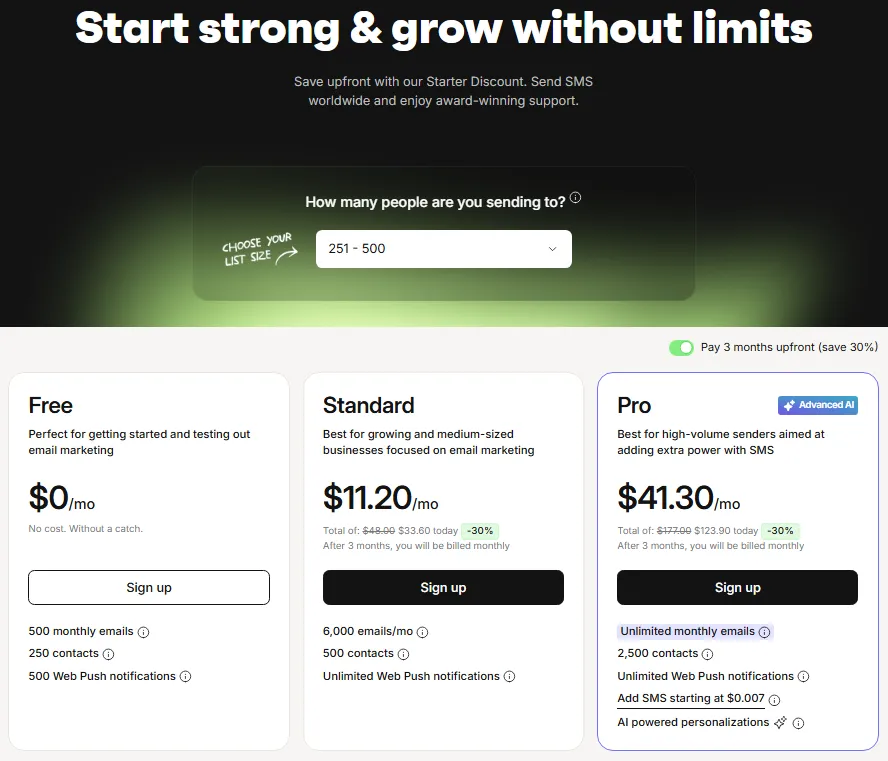
Moosend — Best Low-Cost Automation

Score: 8.2/10 — Very Good
Moosend offers automation and unlimited sends at a price many SMBs can justify. It is often overlooked because it lacks the brand visibility of Mailchimp, but the value proposition holds up.
Best for: Budget-focused SMBs that still need automations and landing pages.
Not for: Teams needing a large native integration ecosystem.
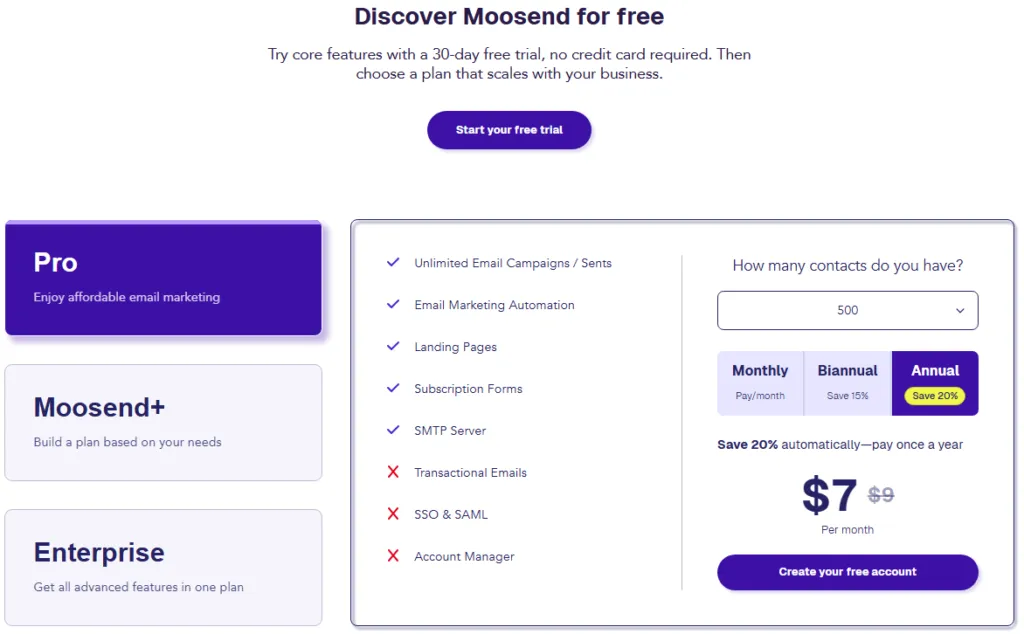
Starting price: 30-day free trial; Pro from $9/month ($7/month annually) for 500 contacts. Pricing verified.
Why I ranked it here: Moosend delivers stronger automation than expected at its price point, with unlimited campaigns on all paid plans.
Standout features:
- Unlimited email campaigns on paid plans
- Visual automation builder with pre-built workflow templates
- Landing pages and subscription forms included
Where it falls short:
- Integrations and interface polish trail larger competitors
- Transactional emails and advanced enterprise capabilities may require higher plans
Pricing warning: The 30-day trial is not a permanent free plan. Budget for paid from month two.
Bottom line: If budget matters and you still need real automation, Moosend punches above its weight.
Constant Contact — Best Phone Support

Score: 8.0/10 — Very Good
Constant Contact is a stable option for small organizations that need help, events, and simple campaigns. It wins when human support matters more than feature density.
Best for: Local businesses, nonprofits, associations, and event-heavy teams.
Not for: Advanced automation, ecommerce segmentation, or creator monetization.
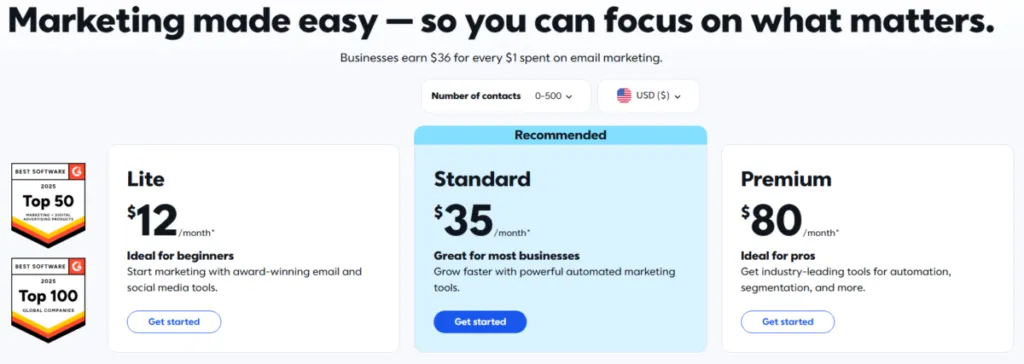
Starting price: Lite from approximately $12/month, Standard from $35/month, Premium from $80/month for 500 contacts. Pricing approximate.
Why I ranked it here: Phone, live chat, and email support are available on paid plans, which is rare in this price range.
Standout features:
- Phone and live chat support on paid plans
- Event marketing and social posting integrations
- AI writing assistant and template library
Where it falls short:
- Automation depth and free-plan appeal lag many competitors
- Pricing scales with contacts, and advanced features require higher tiers
Pricing warning: No permanent free plan. The trial converts to paid, so budget accordingly.
Bottom line: Choose Constant Contact if responsive human support is a priority over automation power.
Zoho Campaigns — Best Zoho Ecosystem

Score: 7.9/10 — Good
Zoho Campaigns is a practical choice when email data already lives in Zoho CRM or Zoho Books. Its value improves sharply when multiple Zoho apps are already in use.
Best for: Zoho CRM users and budget-sensitive SMBs.
Not for: Teams committed to HubSpot, Salesforce, or Shopify ecosystems.
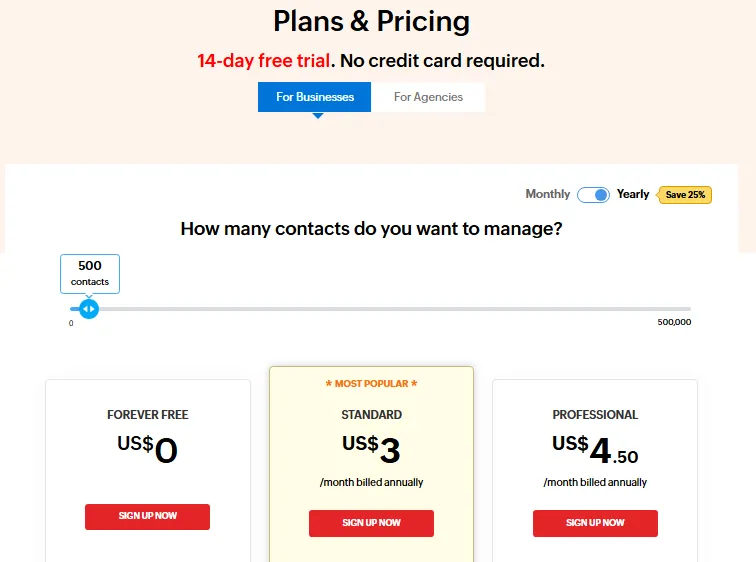
Starting price: Free plan up to 2,000 contacts and 6,000 emails/month; Standard from approximately $4/month for 500 contacts. Pricing verified.
Why I ranked it here: Tight native Zoho integration gives existing Zoho users a cost-effective email layer without third-party connectors.
Standout features:
- Deep integration with Zoho CRM, Zoho Desk, and Zoho Books
- Dynamic content and segmentation at budget-tier pricing
- SMS add-on available for multi-channel campaigns
Where it falls short:
- Less attractive and less polished for teams outside the Zoho ecosystem
- SMS costs extra; some advanced features sit in higher tiers
Bottom line: A strong pick if you are already in Zoho. Otherwise, Brevo and MailerLite offer better standalone value.
Sender — Best Free Plan
Score: 7.8/10 — Good
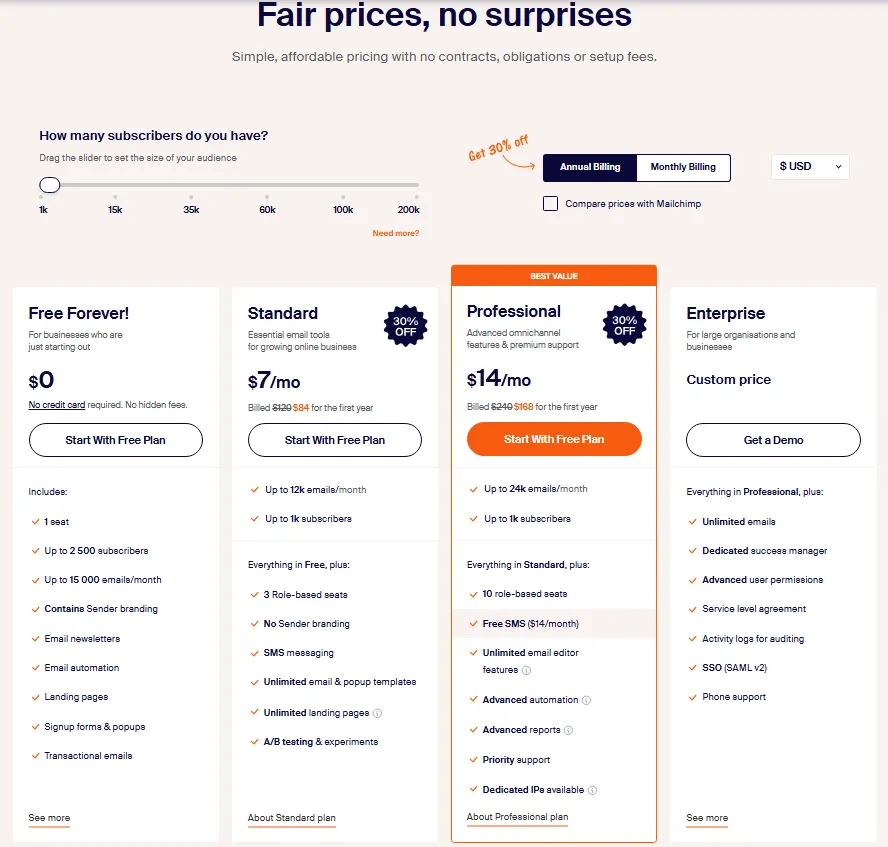
A free email marketing plan is only useful if it lets you test automation, segmentation, and sender setup. Sender’s free tier offers 2,500 subscribers and 15,000 emails per month, which is more usable than most free plans on this list.
Best for: New SMBs, budget-focused teams, and list-building projects.
Not for: Enterprise marketers or ecommerce teams needing deep behavioral data.
Starting price: Free Forever plan (2,500 subscribers, 15,000 emails/month with Sender branding); paid plans scale by volume. Pricing verified.
Standout features:
- 15,000 monthly emails on the free plan (higher than Mailchimp, MailerLite, and Omnisend free tiers)
- Automation, popups, landing pages, and transactional emails included
- Segmentation available on free tier
Where it falls short:
- Free plan includes Sender branding
- Brand visibility and ecosystem depth are weaker than larger competitors
Bottom line: Sender is strongest when “send enough emails for free” is the deciding factor.
Drip — Best Ecommerce Simplicity
Score: 7.7/10 — Good
Drip provides a simpler ecommerce alternative when Klaviyo feels too heavy. Fewer feature gates than many tiered ESPs make it attractive for mid-size online stores.
Best for: Ecommerce teams that want automation without Klaviyo complexity.
Not for: Non-ecommerce newsletters or budget-first creators.
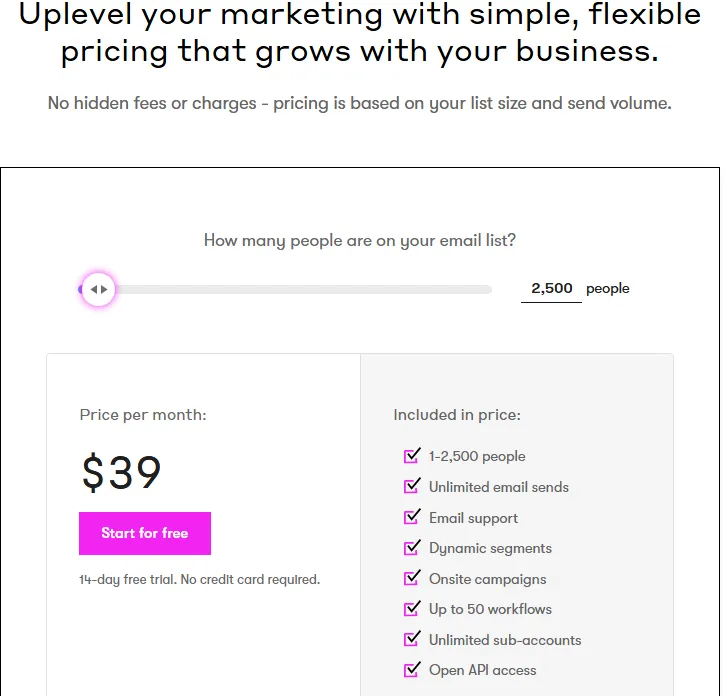
Starting price: $39/month; 14-day free trial. Pricing verified.
Standout features:
- All features unlocked from the start (no tier-gating)
- Ecommerce automations, segmentation, and revenue reporting
- Onsite messaging and forms for conversion
Where it falls short:
- Higher starting price and no permanent free plan
- Narrower ecosystem and integration set than Klaviyo or Omnisend
Bottom line: Drip works best when ecommerce email is the main revenue engine and you want simplicity over Klaviyo’s depth.
Campaign Monitor — Best Agency Newsletters

Score: 7.6/10 — Good
Campaign Monitor remains relevant for agencies and design-driven newsletter workflows where template quality and client management matter more than automation depth.
Best for: Agencies, publishers, and teams managing polished newsletters.
Not for: Ecommerce analytics or advanced lifecycle automations.
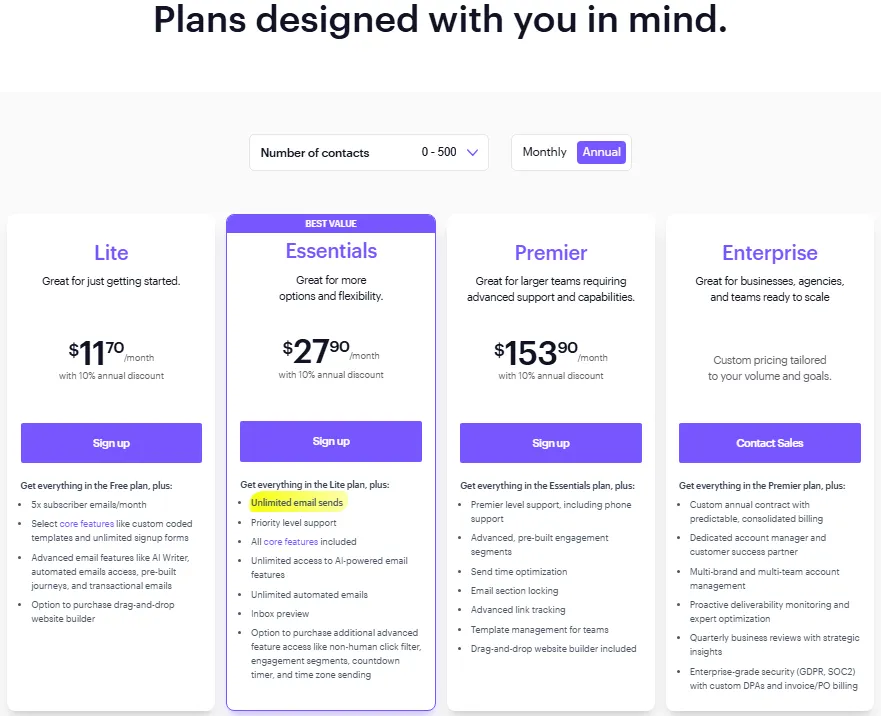
Starting price: Lite from approximately $13/month, Essentials from $31/month, Premier from $171/month for up to 500 contacts. Pricing approximate.
Standout features:
- Template and client-campaign management heritage
- Journey management for multi-step sequences
- Transactional email support alongside marketing campaigns
Where it falls short:
- Pricing and feature depth are less compelling against newer automation tools
- Automation lags ActiveCampaign, Brevo, and even Moosend
Bottom line: Campaign Monitor earns its place when email design and client management matter more than automation power.
Mailjet — Best Developer-Marketer Collaboration

Score: 7.5/10 — Good
Mailjet bridges marketer-friendly campaigns and developer-friendly sending infrastructure. It is not glamorous, but the send-volume pricing can be rational for certain databases.
Best for: Mixed marketing and dev teams, and companies with large lists but moderate sends.
Not for: Automation-heavy ecommerce brands.
Starting price: Free plan (6,000 emails/month with 200/day cap); Starter $9/month for 8,000 emails; Essential $17/month for 15,000 emails. Pricing verified.
Standout features:
- Real-time collaborative email editing for teams
- Combined marketing and transactional email in one platform
- GDPR-positioned with strong deliverability tooling
Where it falls short:
- Automation is basic compared with Brevo and ActiveCampaign
- Free daily cap of 200 emails limits real campaign use
Bottom line: Choose Mailjet when marketing and dev teams both need to touch the same email system.
Benchmark Email — Best Basic Broadcasts

Score: 7.4/10 — Good
Benchmark Email is useful for teams that want a simple campaign builder without deep automation needs. It is better for “send this campaign well” than “orchestrate a customer journey.”
Best for: Small businesses sending simple newsletters and announcements.
Not for: Lifecycle marketers and ecommerce automations.
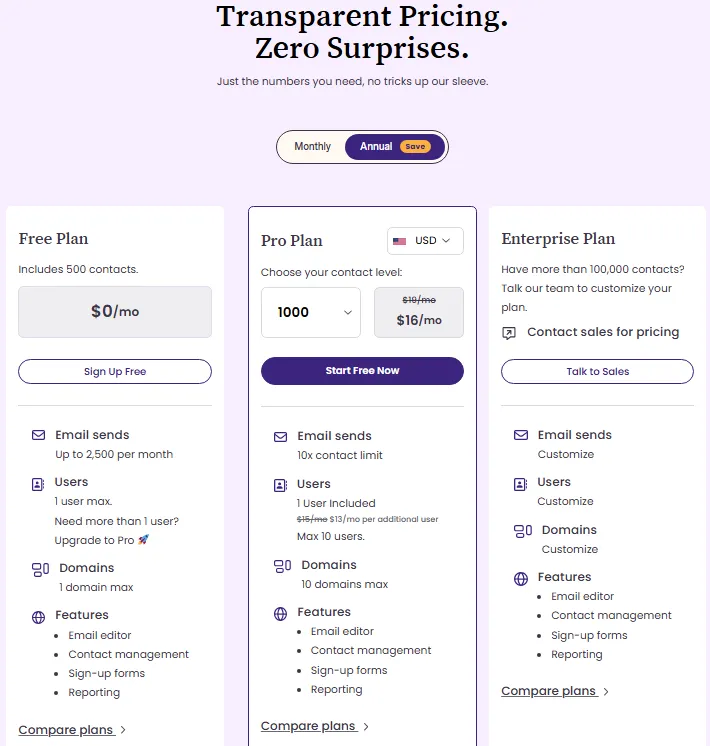
Starting price: Free plan up to 500 contacts and 2,500 monthly sends; Pro at $15/month. Pricing verified.
Standout features:
- Accessible drag-and-drop builder with AI text and image assistance
- Practical free plan for basic broadcasting
- Reporting and segmentation on paid plans
Where it falls short:
- Automation and A/B testing are limited or absent in key tiers
- Additional users cost $15/month each
Bottom line: A decent pick for straightforward broadcast emails, but outclassed by Moosend and Sender for automation value.
Campaigner — Best High-Volume Automation

Score: 7.3/10 — Good
Campaigner deserves a spot for automation-heavy marketers who are past the basic-newsletter stage. It is more functional than fashionable.
Best for: Growing businesses with frequent campaigns and segmentation needs.
Not for: Design-sensitive teams or beginners wanting modern UX.
Starting price: Essentials from approximately $14/month; Advanced from approximately $35/month for 1,000 contacts. Pricing approximate.
Standout features:
- Advanced automation workflows and segmentation on higher plans
- A/B testing, dynamic content, and ecommerce integrations
- Email and SMS capabilities in one platform
Where it falls short:
- Interface feels dated compared with MailerLite, Brevo, and Mailchimp
- No dedicated mobile app
Pricing warning: The Reputation Defender add-on can add 20% to your monthly subscription cost.
Bottom line: Consider Campaigner when automation volume matters more than interface polish.
Flodesk — Best Design-First Email
Score: 7.2/10 — Good
Flodesk is the strongest option for creators and small businesses that prioritize email design over automation depth. Its patented layout technology, custom font uploads, and brand color controls let non-designers produce polished campaigns that look like they came from a design agency. Flodesk claims its emails get seen 17% more than the industry average, and its opt-in forms convert at 2x industry benchmarks.
Best for: Creators, personal brands, coaches, and small businesses where visual branding matters more than automation logic. Not for: Ecommerce teams needing deep segmentation, B2B lifecycle marketers, or data-heavy SaaS teams. Starting price: Free plan (forms and landing pages only, no email sending); Lite from $25/month ($19/month annually); Pro from $28/month ($25/month annually); Everything from $54/month ($49/month annually). Pricing verified May 2026.
Why I ranked it here: Flodesk fills a gap that most ESPs ignore: design quality without design skills. But it trades automation depth and segmentation power for that visual polish.
Standout features:
- Patented layout editor with custom fonts, brand colors, countdown timers, and embedded polls
- Unlimited email sends on all paid plans
- Sales pages, checkout flows, and payment processing on the Everything plan
Where it falls short:
- Workflow automations are limited on Lite (1 workflow only); unlimited workflows require Pro
- Segmentation and analytics are basic compared with ActiveCampaign, Brevo, or Klaviyo
- Lite plan caps subscribers at 25,000; Pro and Everything cap at 255,000
Pricing warning: Flodesk moved away from its original flat-rate unlimited pricing model. Plans now scale by subscriber count. The Lite plan is affordable at 1,000 subscribers ($25/month), but Pro at 50,000 subscribers jumps to $449/month annually. Check the pricing calculator at your projected list size before committing.
Bottom line: Choose Flodesk when email design quality is your competitive advantage and your automation needs are simple. Skip it if you need conditional branching, ecommerce event triggers, or CRM-driven segmentation.
AWeber — Best Legacy ESP for Small Business

Score: 7.1/10 — Good
AWeber is one of the oldest email marketing platforms still actively serving small businesses. It has been operating since 1998 and offers a straightforward combination of newsletters, automation, landing pages, and ecommerce selling. It will not win on feature depth against ActiveCampaign or Brevo, but its 24/7 support (including phone), free migration service, and simple setup make it a dependable option for non-technical teams.
Best for: Small businesses, bloggers, coaches, and solo entrepreneurs who want a reliable ESP with phone support and simple automation. Not for: Advanced lifecycle marketers, ecommerce brands needing deep segmentation, or teams that need unlimited automations on a budget plan. Starting price: Free plan up to 500 subscribers (3,000 emails/month); Lite from $15/month ($12.50 annually); Plus from $30/month ($20 annually) for up to 500 subscribers. Pricing verified May 2026.
Why I ranked it here: AWeber’s longevity, 24/7 phone support, and free migration service give it a specific edge for small businesses switching from another ESP without technical help.
Standout features:
- 24/7 support via phone, email, and chat on all plans (priority support on Plus)
- Free account migration service from other ESPs
- AI subject line assistant, drag-and-drop builder, AMP emails, and pre-written campaign templates
Where it falls short:
- Lite plan is limited to 1 list, 3 landing pages, 3 automations, and 1 custom segment
- Interface and template designs feel dated compared with MailerLite, Flodesk, and Brevo
- Send limit is 10x subscriber count on Lite (12x on Plus), not unlimited
Pricing warning: AWeber’s Lite plan restricts automations to 3 and segments to 1. If you need more, you jump to Plus at $30/month ($20 annually), which doubles the cost. Also, ecommerce transactions carry a 1.0% fee on Lite (0.6% on Plus) on top of payment processor fees.
Bottom line: AWeber is a safe, low-risk pick for small businesses that value phone support and guided migration over cutting-edge features. If you need more than 3 automations, budget for the Plus plan from the start.
How to Choose Email Marketing Software
The right email marketing platform depends on your team type, not on which tool has the most features. Picking the wrong category costs more than picking the wrong product within the right category. Here is a decision framework by team.
Decision Matrix by Team Type
| Team Type | Primary Need | Best Fit | Avoid |
|---|---|---|---|
| Solo creator | Audience building, monetization | Kit, Flodesk | Klaviyo, HubSpot |
| Local business | Simple campaigns, phone support | Constant Contact, Brevo, AWeber | Drip, Campaigner |
| Ecommerce store (under 500 contacts) | Abandoned cart, welcome flows | Omnisend (free), Sender | HubSpot, Flodesk |
| Ecommerce store (5,000+ contacts) | Deep segmentation, SMS | Klaviyo, Omnisend | MailerLite, Benchmark |
| SaaS startup | Product lifecycle, transactional | ActiveCampaign, Brevo | Flodesk, Constant Contact |
| B2B service business | CRM nurture, automation | ActiveCampaign, HubSpot | Flodesk, Drip |
| Agency managing clients | Multi-brand, templates | Campaign Monitor, Brevo | AWeber, Kit |
| Budget-first SMB | Affordable automation | Brevo, MailerLite, Moosend | HubSpot, Klaviyo |
| Mid-market team | Full lifecycle, reporting | ActiveCampaign, Brevo | Benchmark, Sender |
What to Check Before You Commit
- Pricing model: Contact-based or send-volume? Check costs at your projected 12-month list size.
- Automation gates: Does the free or entry plan let you test automation, or is it locked behind upgrades?
- Sender authentication: Does the platform guide you through SPF, DKIM, and DMARC setup? These directly affect inbox placement.
- List hygiene tools: Can you suppress, clean, and segment inactive contacts without manual exports?
- Support access: Is support email-only, or do you get live chat and phone? Check by tier.
- Migration difficulty: Moving to a new ESP means re-permissioning, rebuilding automations, and re-warming your sender reputation. Choose carefully the first time.
If you need email marketing tied to a broader sales and marketing stack, explore our guide to best sales and marketing software. For CRM-heavy teams, see our marketing automation CRM software recommendations.
How We Ranked These Email Marketing Platforms
I evaluated more than 30 candidate email marketing products and ranked the top 20. Evidence sources included official pricing pages, product documentation, current third-party testing, public user feedback, and category-fit analysis. The scoring rubric below shows how each platform earned its position.
| Criteria | Weight | What I Measured |
|---|---|---|
| Automation and lifecycle depth | 20% | Workflow branching, triggers, autoresponders, lifecycle coverage |
| Email campaign builder | 15% | Template quality, editing speed, personalization fields |
| Segmentation and customer data | 15% | Tags, lists, events, ecommerce/CRM sync, dynamic content |
| Pricing and value | 15% | Starting price, free plan, upgrade cliffs, scaling model |
| Deliverability and compliance | 10% | Sender setup, authentication guidance, deliverability tooling |
| Integrations | 10% | CRM, ecommerce, API, Zapier, native ecosystem |
| Reporting, testing, and AI | 10% | A/B testing, dashboards, attribution, useful AI features |
| Support and usability | 5% | Onboarding, support access, learning curve |
Scoring Bands
- 9.0 to 10: Excellent
- 8.0 to 8.9: Very Good
- 7.0 to 7.9: Good
- 6.0 to 6.9: Fair
- Below 6.0: Niche or limited fit
What I Penalized
- Opaque pricing that requires a sales call for basic tier information
- Weak automation gates that lock basic workflows behind expensive plans
- Free plans that block real testing of segmentation, automation, or sender setup
- Pricing that punishes normal list growth with steep per-contact jumps
- Unsupported deliverability claims without authentication guidance
What I Did Not Test
- Enterprise SSO provisioning
- Custom migration projects
- Dedicated IP warming services
- Full API implementation for every tool
I scored AI features only when they change actual workflow: subject line generation, send-time optimization, segmentation assistance, or content production at scale. A checkbox AI feature with no measurable impact on campaign production did not earn points. According to a Litmus report, advanced AI adopters are 75% more likely to achieve ROIs above 45:1, but only when AI is embedded in real workflows, not bolted on.
Full details: our review methodology.
Products I Evaluated But Did Not Rank
These platforms were considered but excluded because they serve different buyer intents or pricing models. Including them would mislead mainstream email marketing buyers.
- Salesforce Marketing Cloud: Enterprise-grade journey orchestration with custom pricing. Too heavy and expensive for SMB email marketing.
- Braze: Customer engagement platform for mobile-first enterprises. Custom-priced and overbuilt for this audience.
- Attentive: SMS-first retail platform, not a general email marketing platform.
- Listrak: Retail and ecommerce enterprise orientation with custom pricing.
- Wunderkind: Performance and identity platform, not a general ESP.
- SendGrid (Twilio): Excellent email infrastructure, but more API and deliverability focused than marketer-friendly ESP.
- Mailtrap: Strong for deliverability testing, Email API, and SMTP. Better suited for a developer email tools article.
- beehiiv: Newsletter publishing and growth platform with monetization features, but not a full-service ESP for automation or ecommerce.
- Loops: SaaS lifecycle and transactional email tool. Strong for product-led teams, but too narrow for mainstream email marketing buyers.
- Substack: Newsletter publishing and monetization platform, not a full email marketing suite.
- Customer.io: Strong lifecycle messaging for product-led and technical teams, but narrower than broad SMB email marketing.
Common Mistakes When Choosing Email Marketing Software
The most expensive email marketing mistake is not overpaying on month one. It is choosing a platform you will outgrow in six months. Here are the patterns I see most often.
- Choosing by starting price alone. A $9/month plan that costs $200/month at 10,000 contacts is not cheaper than a $15/month plan that costs $120/month at the same size. Always check the 12-month projection.
- Ignoring the pricing model. Contact-based billing punishes list growth. Send-volume billing punishes high frequency. Know which model fits your sending pattern.
- Skipping sender authentication. SPF, DKIM, and DMARC setup directly affect whether your emails reach inboxes. Any platform that does not guide you through this process is setting you up for deliverability problems.
- Overvaluing free plans. A free plan that blocks automation, adds third-party branding, and limits support is a demo, not a real starting point. Test whether the free plan lets you trial the features that actually matter to your business.
- Treating AI as a tiebreaker. AI email features matter only when they change workflow speed or quality. A subject line generator saves minutes. A checkbox “AI” label saves nothing.
- Ignoring switching costs. Migrating ESPs means rebuilding automations, re-permissioning contacts, re-warming your sender domain, and losing historical reporting. Choose for the 18-month horizon, not the first month.
- Confusing categories. An ecommerce ESP, a newsletter platform, and a developer email API serve different jobs. Picking the wrong category is worse than picking the wrong product within the right category. Before comparing individual tools, make sure you understand how email marketing works as a channel — including the difference between newsletters, lifecycle campaigns, and transactional messages.
Frequently Asked Questions
Here are the most common questions I see from buyers evaluating email marketing platforms in 2026.
What is the best email marketing platform in 2026?
Brevo is the best overall email marketing platform for most SMBs in 2026. It combines email, SMS, automation, CRM-lite, and volume-based pricing from $9/month. For ecommerce, Klaviyo is stronger. For automation depth, ActiveCampaign leads. The best platform depends on your team type, list size, and primary use case.
What is the best free email marketing software?
Sender offers the most usable free plan with 2,500 subscribers and 15,000 emails per month. MailerLite (500 subscribers), Mailchimp (250 contacts), and Omnisend also have free plans, but with lower limits. Evaluate whether the free plan lets you test automation and segmentation, not just send broadcasts.
Is Brevo better than Mailchimp?
Brevo is better for teams with large lists and moderate send frequency because its volume-based pricing avoids per-contact penalties. Mailchimp is better for teams that need broad integrations and a familiar interface. Neither is universally better; the choice depends on pricing model preference and feature needs.
Is ActiveCampaign better than Mailchimp?
ActiveCampaign is better for automation-heavy workflows. Its visual automation builder, lifecycle branching, and CRM add-ons exceed what Mailchimp offers. Mailchimp is simpler to start with and has broader brand integrations. Choose ActiveCampaign when automation logic drives revenue. Choose Mailchimp when simplicity and ecosystem breadth matter more.
Should Shopify stores use Klaviyo or Omnisend?
Klaviyo is stronger for deep segmentation and advanced ecommerce analytics. Omnisend is more affordable and easier to set up for stores that need standard abandoned-cart, welcome, and post-purchase flows without deep predictive modeling. As one Reddit user put it, Omnisend is “the most well-rounded for ecommerce” while Klaviyo keeps “adding features” alongside rising prices.
Which email marketing platform is best for creators?
Kit is the best email marketing platform for creators who sell courses, memberships, newsletters, or digital products. Its free plan supports up to 10,000 subscribers for newsletters. Flodesk is worth considering if visual email design is a priority over automation depth.
How much does email marketing software cost?
Email marketing software costs range from free to $500+ per month depending on list size, features, and platform. Budget SMB options like MailerLite and Moosend start under $10/month. Mid-range tools like ActiveCampaign and GetResponse run $15 to $50/month. Enterprise-adjacent tools like HubSpot Professional can cost hundreds per month plus onboarding fees.
What is the difference between newsletter software and email marketing software?
Newsletter software focuses on publishing, audience growth, and monetization (Kit, Substack). Email marketing software includes automation, segmentation, CRM integration, ecommerce flows, and transactional messages (Brevo, ActiveCampaign, Mailchimp). Design-first tools like Flodesk sit between the two categories. Some tools overlap, but the core job is different.
Which email marketing tool has the best automation?
ActiveCampaign has the deepest automation capabilities in this ranking. Its visual workflow builder supports conditional branching, wait steps, goal tracking, and CRM-triggered actions. Brevo and Moosend offer solid automation at lower price points. Klaviyo leads for ecommerce-specific automation flows.
What should small businesses avoid when choosing email marketing software?
Avoid choosing by starting price alone, ignoring switching costs, and skipping sender authentication setup. Also avoid enterprise-grade tools (HubSpot Professional, Salesforce Marketing Cloud) if you only need campaigns and basic automation. A platform that costs $9/month today but $300/month at 25,000 contacts is not a budget pick.
Final Thoughts
Email marketing platforms in 2026 have split into distinct categories, and choosing the right one starts with understanding which category fits your business. A Shopify store evaluating Flodesk, a local service business comparing Klaviyo, and a solo creator paying for HubSpot Professional are all solving the wrong problem.
Start with the decision matrix above. Match your team type to the right category. Then compare pricing at your projected 12-month list size, not the starting price. Set up SPF, DKIM, and DMARC from day one. Test automation on any free plan before committing. And plan for the platform you will need in 18 months, not just the one that looks cheapest today.
The best email marketing platform is the one that scales with your business without forcing a painful migration later. For most SMBs, that platform is Brevo. For ecommerce, it is Klaviyo or Omnisend. For creators, it is Kit or Flodesk. For automation-first teams, it is ActiveCampaign.