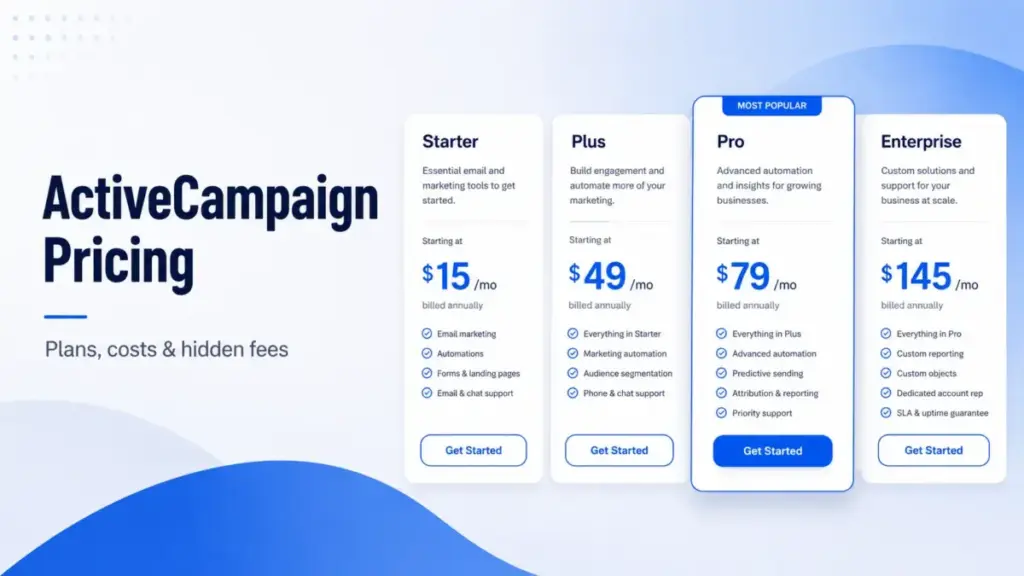
ActiveCampaign advertises a $15 per month starting price. That number is real, and it is also one of the most misleading figures in email marketing pricing. It is the annual-billing rate on the Starter plan at 1,000 contacts, with one user, capped automations, and no landing pages.
The price most growing teams actually pay sits a tier or two higher, plus add-ons that never appear on the headline cards.
ActiveCampaign charges by the number of contacts you store, not the emails you send. That single billing decision shapes everything about who saves money here and who slowly overpays.
A clean 800-contact list on Starter is genuinely cheap. A messy 12,000-contact database stuffed with people who never open anything is a recurring tax you pay every month.
I am Sarah Chen, and I cover email and marketing automation pricing at SaaSZap. If you are still weighing platforms, our guide to the best email marketing software maps the category first.
This guide separates ActiveCampaign’s sticker price from the real bill: every plan, the contact-based billing math, the add-ons it keeps off the comparison cards, and the exact point where Starter stops being a deal.
There is one billing rule, introduced in late 2025, that quietly raised costs for new accounts. Most ranking pages still skip it. I do not.
Key Takeaways
- ActiveCampaign starts at $15 per month on Starter, billed annually for 1,000 contacts (as of June 2026). Monthly billing raises that to $19 per month.
- There is no permanent free plan. You get a 14-day free trial with no credit card required, plus a 30-day results guarantee.
- Plus at $49 per month (annual) is the realistic starting plan for most teams, because Starter caps automations at 5 actions and excludes landing pages.
- Pricing is contact-based. Accounts created on or after November 3, 2025 count every contact toward the limit, regardless of list status.
- The headline price excludes CRM pipelines, SMS, transactional email, custom reporting, and extra users, several of which carry undisclosed or third-party-reported prices.
Quick Pricing Verdict
| Question | Answer |
|---|---|
| Starting price | $15/mo Starter (annual, 1,000 contacts); $19/mo monthly |
| Free plan | None. 14-day free trial, no credit card |
| Best plan for most teams | Plus ($49/mo annual) |
| Plan to avoid | Starter, for anyone past simple newsletters |
| Biggest hidden cost | Contact-based billing as your list grows |
| Best alternative if too expensive | Brevo (sends-based) or Mailchimp free tier |
| Pricing verified | June 2026 |
What this means: if you only send a newsletter to a small, engaged list, ActiveCampaign is affordable and the verdict is simple. If you run real lifecycle automation, the buying decision moves up to Plus or Pro, and the math changes. The rest of this guide is built for that second group.
ActiveCampaign Pricing: Advertised Price vs Real Cost
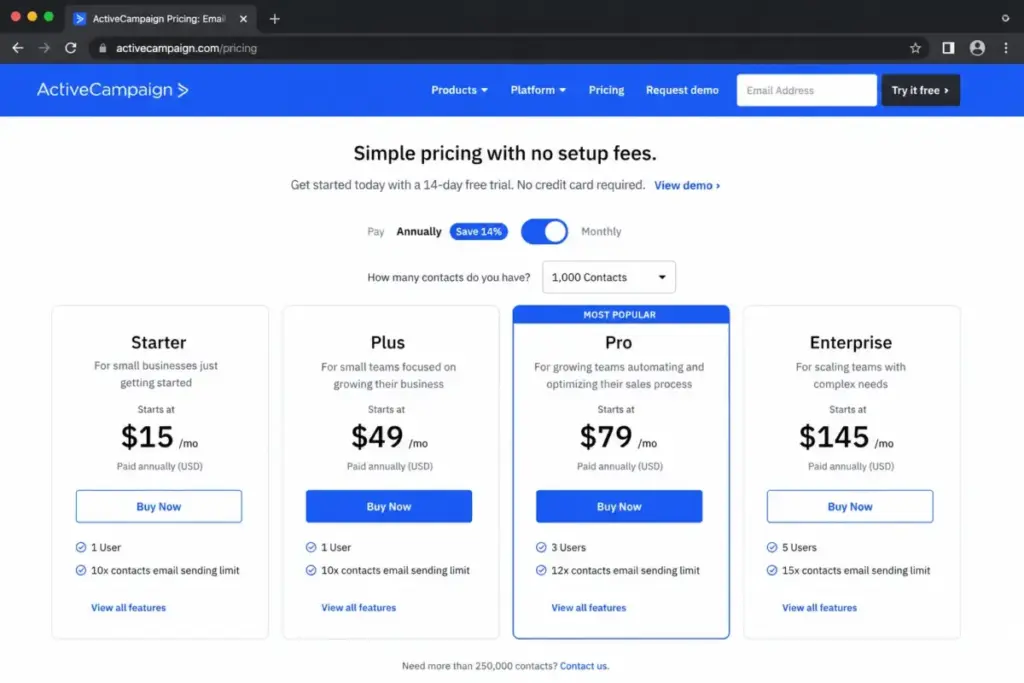
The four headline prices are accurate, but they describe an empty account. Here is the gap between what ActiveCampaign advertises and what shapes your actual spend.
| Plan | Annual (per mo) | Monthly | Included users | Email send limit | Automation actions |
|---|---|---|---|---|---|
| Starter | $15 | $19 | 1 | 10x contacts | 5 per automation |
| Plus | $49 | $59 | 1 | 10x contacts | Unlimited |
| Pro | $79 | $99 | 3 | 12x contacts | Unlimited |
| Enterprise | $145 | $179 | 5 | 15x contacts | Unlimited |
Starting prices reflect 1,000 contacts (as of June 2026). Source: ActiveCampaign official pricing page. Monthly rates cross-checked against TechRadar’s published review.
What this means: the advertised price answers “what is the cheapest way in.” It does not answer “what will this cost my team.” Three variables push the real number up: how many contacts you store, how many people need logins, and which capabilities sit behind add-ons. The Starter line at $15 includes a single user and automations capped at five actions, which most real workflows blow past immediately. The honest starting point for a team that automates anything is Plus.
ActiveCampaign’s pricing model rewards a specific kind of buyer: someone with a tidy, engaged list who uses deep automation. It punishes the opposite, the team hoarding inactive contacts and barely sending. Knowing which one you are tells you more than any plan comparison.
The Hidden Costs Nobody Mentions
The base plan is only the floor. These are the costs that turn a $49 plan into a meaningfully larger monthly bill, and the ones competing pricing pages tend to gloss over.
Contact-Based Billing After November 2025
This is the change most articles miss. Accounts created on or after November 3, 2025 count all contacts toward the contact limit, regardless of list status, per ActiveCampaign’s help documentation. The rule matters most for anyone signing up now, so confirm how your account counts contacts before importing a large list.
Pricing is based on unique contacts, not how many lists each contact sits on. A person on five lists counts once. That part is fair. The catch is that unengaged, dormant contacts still count, and they quietly inflate your tier as your database grows. Starter also has a hard ceiling of 25,000 contacts, so high-volume lists force a plan change before you even consider features.
Additional Users Beyond the Included Seats
ActiveCampaign includes 1 user on Starter, 1 on Plus, 3 on Pro, and 5 on Enterprise. Beyond that, you buy a Users Add-on. The official pricing page lists this add-on but does not expose a public per-seat price in the retrieved pricing text, so you confirm it in-app or with sales.
For a marketing team of two, that means Plus technically needs an extra seat on day one. For a 10-person team, the seat cost becomes a real line item that you cannot calculate from the public page. Treat any “10 users for $X” estimate you see elsewhere with suspicion.
CRM Pipelines and Sales Engagement Add-ons
ActiveCampaign has contact records, but a true sales CRM, pipelines, deal records, lead scoring, and sales engagement, is sold as an Enhanced CRM add-on. The official pricing page confirms two tiers: Pipelines and Sales Engagement. It does not publish their prices.
EmailToolTester, a long-running review site, reports third-party figures: the Pipelines add-on ranging from $49 to $107 base depending on plan, and Sales Engagement from $85 to $179 base, each with additional-user charges. Read those as reported third-party numbers, not official ActiveCampaign pricing. The point stands either way: if you assumed deal pipelines were included, budget for a second subscription.
SMS Credits That Do Not Roll Over
SMS is a paid add-on requiring Plus, Professional, or Enterprise. ActiveCampaign’s help center spells out the operational traps. Unused SMS credits do not roll over month to month. Annual accounts pay annually, but credits still renew each month. Sending to US recipients requires A2P 10DLC registration, which has its own carrier setup costs and timeline.
A third-party source reports SMS pricing around $16.83 per month for 1,000 sends, which I flag as reported rather than official. The bigger risk is not the sticker price. It is buying credits you forfeit each month because usage is lumpy.
Transactional Email Through Postmark
ActiveCampaign handles marketing email. Transactional email, password resets, receipts, order confirmations, and app-triggered messages, runs through Postmark. Postmark Basic starts at $15 per month for 10,000 emails, with Pro at $16.50 and Platform at $18 for the same volume, plus overages from $1.80 per extra 1,000 emails on Basic (as of June 2026). See the Postmark pricing page for current rates.
If your product sends transactional email, this is a separate bill you should plan for, not an afterthought.
Custom Reporting and Email Send-Limit Increases
Custom Reporting is an add-on for eligible Plus and Pro accounts and is included on Enterprise. AI Activities, covering AI translations and actions, is also an add-on whose price ActiveCampaign does not publicly disclose.
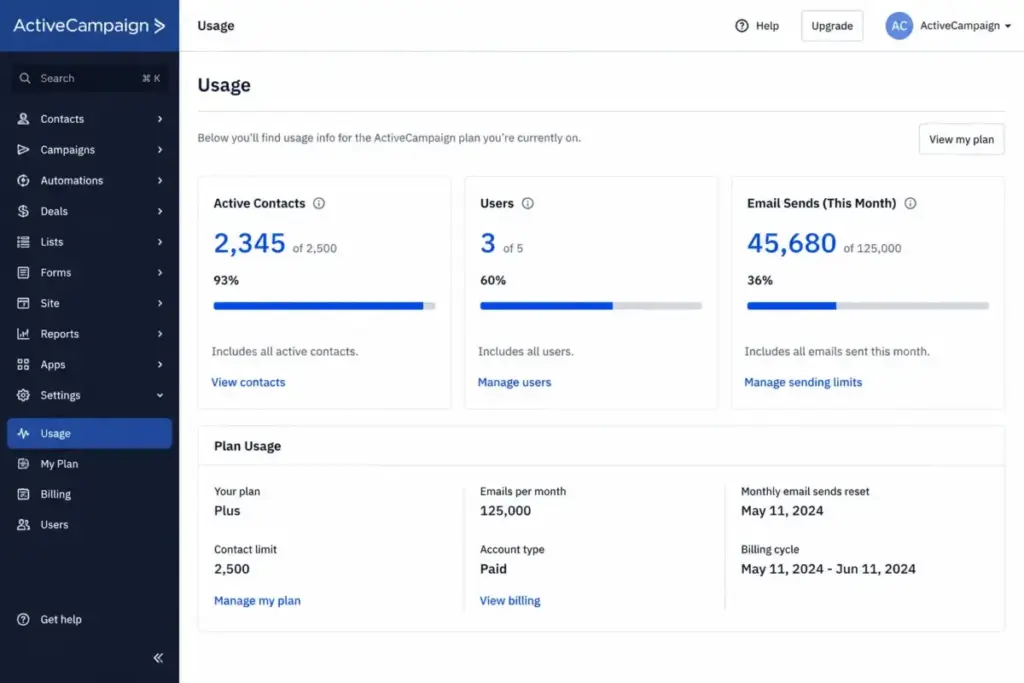
Email sends are gated by a multiplier on your contact limit: 10x on Starter and Plus, 12x on Pro, 15x on Enterprise. High-frequency senders can hit that ceiling. You can monitor active contacts, users, and monthly sends from the Usage page and manage limit increases through billing, though the increase cost is not publicly listed.
Plan-by-Plan Breakdown
Each plan unlocks a different layer of capability. Here is what you get, what stays locked, and when each plan stops making sense.
Starter ($15/mo annual, $19/mo monthly)
Starter is the newsletter and light-automation plan. It includes 1 user, sends up to 10x your contact limit, and allows segmentation in a limited form with 15 active goals. The defining constraint is 5 actions per automation. A welcome series that tags a subscriber, waits, branches on a click, scores them, and notifies your team already exceeds that. No landing pages, no advanced segmentation, no predictive features. See the official pricing page for the full feature grid.
Avoid if: you automate anything beyond a two-step welcome message.
Plus ($49/mo annual, $59/mo monthly)
Plus removes the automation ceiling. You get unlimited automation actions, standard segmentation, landing pages, and 25 active goals, still on 1 included user. This is the first plan where ActiveCampaign behaves like the automation platform it markets itself as. Predictive sending, conditional content, and attribution remain gated above it.
Avoid if: you need revenue attribution or AI send-time optimization out of the box.
Pro ($79/mo annual, $99/mo monthly)
Pro adds advanced segmentation, predictive sending, conditional content, attribution and conversion tracking, and 200 active goals, with 3 included users and a 12x send multiplier. This is the optimization tier for teams measuring revenue per campaign. SSO, custom objects, and dedicated support still require Enterprise.
Avoid if: three users is plenty and you do not need predictive or attribution features. Plus is cheaper.
Enterprise ($145/mo annual, $179/mo monthly)
Enterprise adds premium segmentation, custom objects, single sign-on, a dedicated account team, an uptime SLA, included custom reporting, 5 users, and a 15x send multiplier. This tier is about governance and support, not raw features.
Avoid if: you are buying it for features rather than security, SSO, or a dedicated team. Higher contact volumes and extra users may still need a sales quote.
Feature Gates: What You Actually Get by Plan
| Feature | Starter | Plus | Pro | Enterprise |
|---|---|---|---|---|
| Automation actions | 5 per automation | Unlimited | Unlimited | Unlimited |
| Segmentation | Limited | Standard | Advanced | Premium |
| Landing pages | No | Yes | Yes | Yes |
| Active goals | 15 | 25 | 200 | 200 |
| Predictive sending | No | No | Yes | Yes |
| Conditional content | No | No | Yes | Yes |
| Attribution tracking | No | No | Yes | Yes |
| Custom reporting | No | Add-on | Add-on | Included |
| Custom objects | No | No | No | Yes |
| Single sign-on | No | No | No | Yes |
| Dedicated team and SLA | No | No | No | Yes |
Source: ActiveCampaign official pricing page (as of June 2026).
What this means: the meaningful jump is Starter to Plus, where automation goes from capped to unlimited and landing pages appear. The second jump, Plus to Pro, is about measurement: predictive sending and attribution. Enterprise is a governance purchase. If you understand your business by these three gates, automation, measurement, governance, you can pick a plan in two minutes.
When the Free Trial Stops Working
ActiveCampaign has no permanent free marketing plan. You get a 14-day free trial with broad feature access and no credit card required, plus a 30-day results guarantee. TechRadar’s review notes the trial is based on the Pro plan, so what you test is more capable than what Starter delivers.
That gap matters. You trial Pro-level automation, then production use on Starter caps you at 5 actions per automation. The trial can feel more powerful than the plan you buy. Plan your evaluation around the tier you actually intend to pay for, not the trial sandbox.
After the trial, any real use requires payment. There is no free fallback to drop into, unlike Mailchimp, Brevo, Klaviyo, and Omnisend, all of which keep a free tier. If a free plan is a hard requirement, ActiveCampaign is not your tool.
Real Cost Scenarios: 5, 10, and 20 Users
This is where public pricing runs out. Because additional-user pricing is not disclosed, only one of these scenarios can be quoted with a real number. I will not invent the others.
| Team size | Plan | Real monthly cost | Notes |
|---|---|---|---|
| 5 users | Enterprise | $179/mo ($145/mo annual) | Enterprise includes 5 users at 1,000 contacts |
| 10 users | Enterprise + Users Add-on | $179/mo base plus undisclosed seat cost | Extra-user price not public; confirm in-app or with sales |
| 20 users | Enterprise / custom | Custom | Requires sales or in-app seat pricing for accurate total |
Costs exclude contact growth, CRM add-ons, SMS, transactional email, and reporting beyond included features (as of June 2026).
What this means: ActiveCampaign is contact-priced, not seat-priced, so its cost curve is sideways for users and steep for contacts. At five users you can land on Enterprise at the included seat count. Past that, anyone quoting you a precise 10- or 20-user total is guessing, because ActiveCampaign does not publish the seat add-on. The honest answer is “base plan plus a quote.” That uncertainty is itself a planning cost.
Monthly vs Annual Billing
Annual billing saves roughly 17% to 21% depending on the plan, based on verified monthly versus annual starting prices at 1,000 contacts (as of June 2026).
| Plan | Monthly | Annual (per mo) | Annual savings/year |
|---|---|---|---|
| Starter | $19 | $15 | ~$48 |
| Plus | $59 | $49 | ~$120 |
| Pro | $99 | $79 | ~$240 |
| Enterprise | $179 | $145 | ~$408 |
What this means: annual billing is worth it once you are confident in the platform, but commit deliberately. Pay monthly during your first 60 to 90 days while you confirm deliverability, contact counting, and whether you need add-ons. Lock in annual only after your real bill, base plus add-ons, stabilizes. The savings are real, but so is the cost of prepaying for a tier you outgrow or abandon.
Which Plan to Avoid, and Which to Choose
Avoid Starter if your work involves more than basic newsletters. The 5-action automation cap is the dealbreaker. The moment you want a tagged, branched, time-delayed welcome flow with internal notifications, you are already past it, and you also lose landing pages and advanced segmentation. Starter is poor value for teams that bought ActiveCampaign for automation. The narrow exception: a tiny list sending simple broadcasts.
Choose Plus if you run real automation, lifecycle sequences, segmentation, and landing pages, but do not yet need attribution or predictive sending. It is the most realistic value plan for most growing teams because it removes the Starter ceiling at a reasonable jump. Choose Pro when you are optimizing for revenue and need attribution, predictive sending, and conditional content. Choose Enterprise only when SSO, custom objects, a dedicated team, or an uptime SLA are genuine requirements.
ActiveCampaign Pricing vs Competitors
Comparing email platforms on starting price alone is misleading, because each uses a different billing model. Here is the context, with the caveat that these are not perfectly apples-to-apples.
| Tool | Starting price | Free plan | Billing model | Notable cost note |
|---|---|---|---|---|
| ActiveCampaign | $15/mo (annual) | No | Contact-based | Add-ons for CRM, SMS, reporting |
| Mailchimp | $13/mo Essentials | Yes | Contact-based | Premium $350/mo, unlimited seats |
| Klaviyo | $0 free; ~$30/mo at 1,000 profiles | Yes | Profile-based | Email plus SMS add-ons |
| Brevo | $9/mo Starter | Yes | Sends-based | Professional $499/mo, 10 seats |
| HubSpot Marketing Hub | $20/mo/seat Starter | Yes | Seat plus contacts | Professional $890/mo, $3,000 onboarding |
| Omnisend | $16/mo Standard | Yes | Contact-based | Built for ecommerce |
Prices as of June 2026. Sources: official Mailchimp pricing documentation, HubSpot Marketing Hub pricing, and each vendor’s pricing page, plus TechRadar cross-checks. Competitor figures are approximate starting points; the Klaviyo profile-based rate in particular reflects third-party context rather than a fixed published card. You can read our full Mailchimp pricing breakdown and HubSpot pricing for plan-level detail.
What this means: the billing model is the real comparison, not the entry price. Brevo charges by emails sent, so a large but lightly mailed list is cheap there and expensive on ActiveCampaign. Mailchimp and Omnisend, like ActiveCampaign, charge by contacts, so the same dormant-contact tax applies. HubSpot layers seats on top of contacts, which gets expensive fast for larger teams. If your list is big but your send frequency is low, a sends-based tool can beat ActiveCampaign on pure cost. For automation depth at a clean list, ActiveCampaign earns its price. For a closer look at the platforms, see our reviews of Mailchimp’s email features, Klaviyo for ecommerce, Brevo’s sends model, and Omnisend for online stores.
Is ActiveCampaign Worth the Price?
It depends entirely on your list quality and how much automation you actually run.
Pros of the pricing model: strong automation per dollar on Plus and Pro, transparent core plan prices, annual discounts up to 21%, and ActiveCampaign’s stated policy of no setup fees plus free contact migration, support, and training. Note that “no setup fees” refers to onboarding, not the add-ons covered above. The platform does what it charges for.
Cons of the pricing model: contact-based billing taxes inactive contacts, several capabilities sit behind undisclosed-price add-ons, additional-user pricing is not public, there is no free fallback, and transactional email is a separate Postmark bill. The headline price understates the real one.
Worth it if: you actively use visual automation, lifecycle segmentation, ecommerce or CRM integrations, multi-step nurture campaigns, and revenue workflows, and you keep your list reasonably clean. Not worth it if: you are a newsletter-only sender, run a very small list, need many cheap user seats, carry a database full of dormant contacts, or expect CRM pipelines included without add-ons. For those buyers, a sends-based tool like Brevo or a free tier like Mailchimp’s is the better financial fit.
This is the honest boundary: ActiveCampaign is excellent within its niche of serious lifecycle automation and a poor financial choice outside it. If your use case sits near that edge, review what email marketing involves to scope your needs before committing.
How to Avoid Overpaying for ActiveCampaign
- Clean your list before importing. Because billing counts all contacts on newer accounts, dormant subscribers raise your tier for nothing. Prune non-openers first.
- Start on Plus, not Starter, if you automate at all. Buying Starter then upgrading within a month wastes the gap. Skip straight to the plan your workflows need.
- Pay monthly for the first 60 to 90 days. Confirm your real all-in bill, including add-ons, before locking annual.
- Audit add-ons before you assume they are included. CRM pipelines, SMS, custom reporting, and AI Activities are separate. Price them deliberately.
- Budget SMS credits to your real usage. Credits do not roll over, so over-buying is pure waste. Start small and scale up.
- Plan transactional email separately. If you send receipts or resets, factor in Postmark from the start, not as a surprise.
- Get a written seat quote before scaling past included users. Additional-user pricing is not public. Confirm it before you commit to growth.
Frequently Asked Questions
How much does ActiveCampaign cost per month?
ActiveCampaign starts at $15 per month on Starter, billed annually for 1,000 contacts, or $19 per month on monthly billing (as of June 2026). Plus is $49, Pro is $79, and Enterprise is $145 per month annually. Prices rise as your contact count grows, and add-ons for CRM, SMS, and reporting can increase the total well beyond these starting figures.
Does ActiveCampaign have a free plan?
No. ActiveCampaign does not offer a permanent free marketing plan. You can use a 14-day free trial with broad feature access and no credit card required, plus a 30-day results guarantee. After the trial ends, any production use requires a paid plan. If a permanent free tier is essential, Mailchimp, Brevo, Klaviyo, and Omnisend all keep free plans worth comparing.
Do I have to pay for unsubscribed or inactive contacts?
On accounts created on or after November 3, 2025, all contacts count toward your contact limit regardless of list status, per ActiveCampaign’s help documentation. Pricing is based on unique contacts, not how many lists each is on, so a person on several lists counts once. Inactive and dormant contacts still count, which is why cleaning your list before importing directly lowers your bill.
Which ActiveCampaign plan has landing pages?
Landing pages are included on Plus, Pro, and Enterprise, but not on Starter. This is one reason Plus is the realistic starting plan for teams that need more than email sends. If landing pages are part of your campaign workflow, Starter will not work, and you should budget for Plus at $49 per month annually or $59 monthly (as of June 2026).
Do ActiveCampaign CRM pipelines cost extra?
Yes. Sales CRM features, pipelines, deal records, lead scoring, and sales engagement, are sold as an Enhanced CRM add-on with Pipelines and Sales Engagement tiers, separate from your base plan. ActiveCampaign does not publish these add-on prices. Third-party site EmailToolTester reports Pipelines from $49 to $107 base and Sales Engagement from $85 to $179 base, each with extra-user charges. Treat those as reported, not official.
Is Plus really the starting plan for most teams?
For anyone running automation, yes. Starter caps automations at 5 actions and excludes landing pages and advanced segmentation, which most real lifecycle workflows exceed immediately. Plus removes the automation ceiling and adds landing pages and standard segmentation at $49 per month annually. Unless you are sending simple newsletters to a small list, Plus is the honest entry point, not Starter.
Is ActiveCampaign cheaper than Mailchimp?
It depends on list size and engagement. Both bill by contacts, so a dormant-heavy list costs similarly on each. Mailchimp’s Essentials starts at $13 per month and it offers a free tier; ActiveCampaign starts at $15 with no free plan but stronger automation. At higher contact counts and deeper automation, ActiveCampaign often delivers more per dollar, while Mailchimp’s free plan wins for very small or budget-first senders.
Conclusion
ActiveCampaign pricing is honest at the headline and incomplete in the fine print. The $15 Starter rate is real, but it describes a one-user account with capped automation that most buyers outgrow before their first full campaign. The plan that matches what ActiveCampaign actually markets, unlimited automation, segmentation, landing pages, is Plus at $49 per month annually, and that is the number to anchor your budget to.
The deciding factor is not the plan. It is your list. Contact-based billing rewards a clean, engaged database and penalizes a bloated one, and the late-2025 all-contact rule sharpened that edge for new accounts. Add CRM, SMS, transactional email, and extra seats, and the real bill can sit well above the card you clicked. Price it with the add-ons included, keep your list lean, and ActiveCampaign is a strong automation buy. Skip that math, and the gap between the sticker and the bill is exactly where teams overpay.