Two things get confused under the phrase “drip pricing.” One is a legal term for hidden fees added at checkout. The other is the price of Drip, the ecommerce email marketing platform at drip.com. This guide is about the second one.
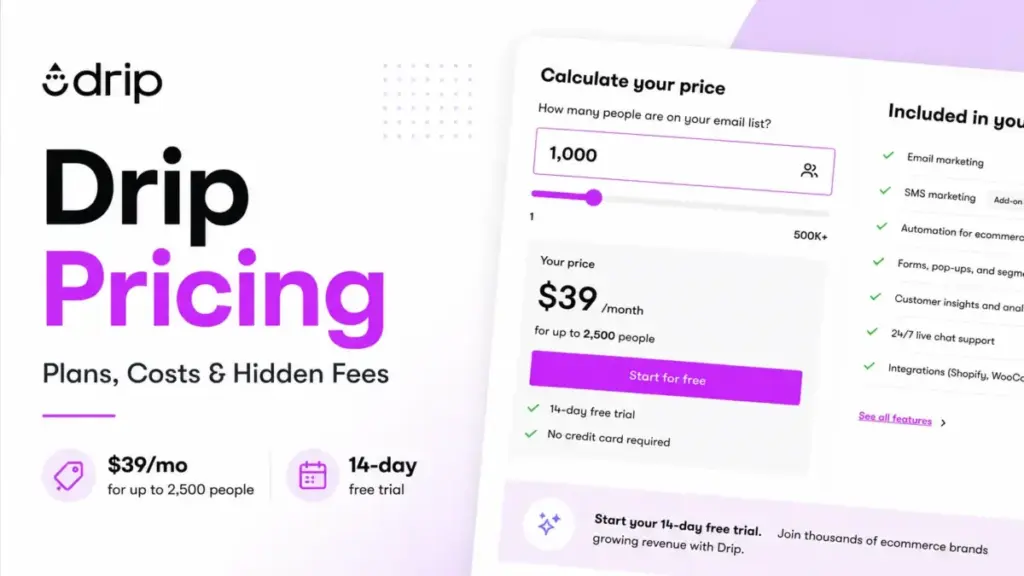
Here is the fast version. Drip starts at $39/month for 1 to 2,500 active people, with a 14-day free trial and no credit card required, verified on Drip’s official pricing page on July 1, 2026. There is one plan, not a Starter/Pro/Enterprise ladder, and the bill climbs with your active people count and email send volume rather than with seats. That “simple” single-plan model is not the same thing as cheap.
The real cost depends on how big your list is, whether you add SMS, and whether Drip’s ecommerce features match the drip campaign motion you actually run. If you send two newsletters a month to a small list, Drip is probably the wrong tool, and I will tell you which cheaper options fit better.
I evaluate email platforms by the sending habit they reward, not the feature list. So this guide separates what Drip officially confirms from what only third-party price trackers report, models cost as your list grows, exposes the add-ons that change the monthly bill, and compares Drip against the alternatives that show up on the same shortlist. For more platforms in this category, see our roundup of the best email marketing software.
Quick Pricing Verdict
| Question | Answer (checked July 1, 2026) |
|---|---|
| Starting price | $39/month for 1–2,500 active people (official) |
| Free plan | No permanent free plan; 14-day free trial, no credit card |
| Billing basis | Active people + monthly email send volume, not per seat |
| Best plan for most teams | The single plan, sized to your active people count |
| Biggest hidden cost | SMS add-on, starts at $39/month on top of your email bill |
| Plan to avoid | Paying for Drip at all if you are not an ecommerce store |
| Best alternative if too expensive | Omnisend or Brevo for small or lightly mailed lists |
| Pricing source | drip.com/pricing and Drip help center |
The one-line verdict: Drip is fairly priced for revenue-focused ecommerce brands that use purchase behavior, and overpriced for anyone treating it as a plain newsletter tool.
The Advertised Price vs The Real Price
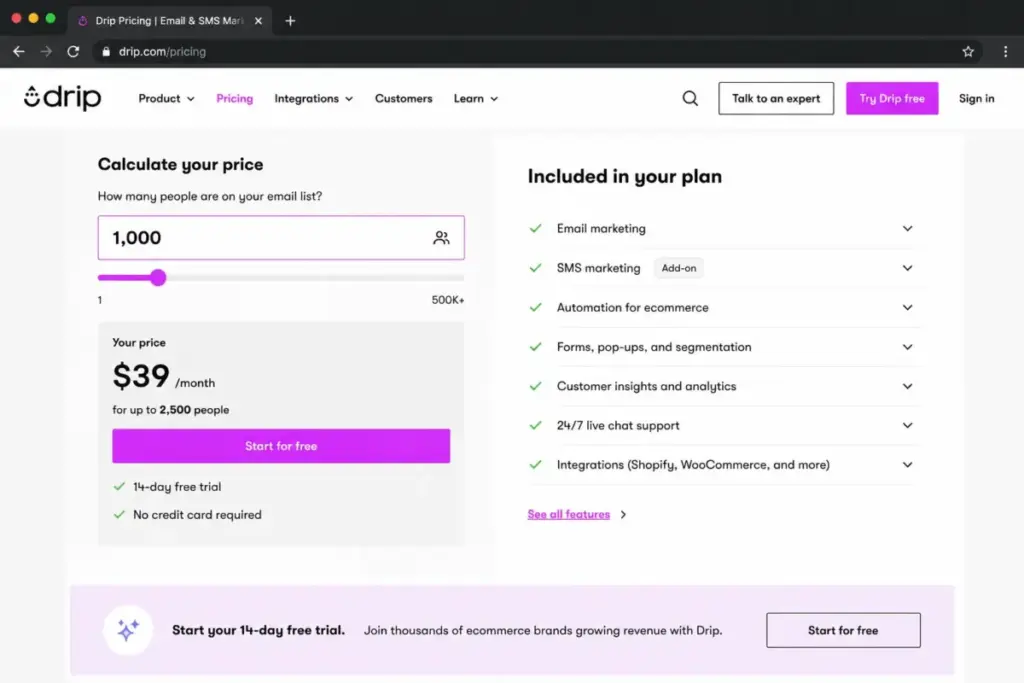
Most pricing pages quote “$39/month” and move on. That number is real, but it is the floor for the smallest list. The gap between the advertised entry price and what a growing store actually pays comes from three places: list-size tier jumps, the SMS add-on, and the fact that Drip’s public pricing page only exposes the base tier in plain text.
The interactive calculator handles everything above 2,500 people, so the higher numbers you see quoted around the web come from third-party trackers, not from a static official price list.
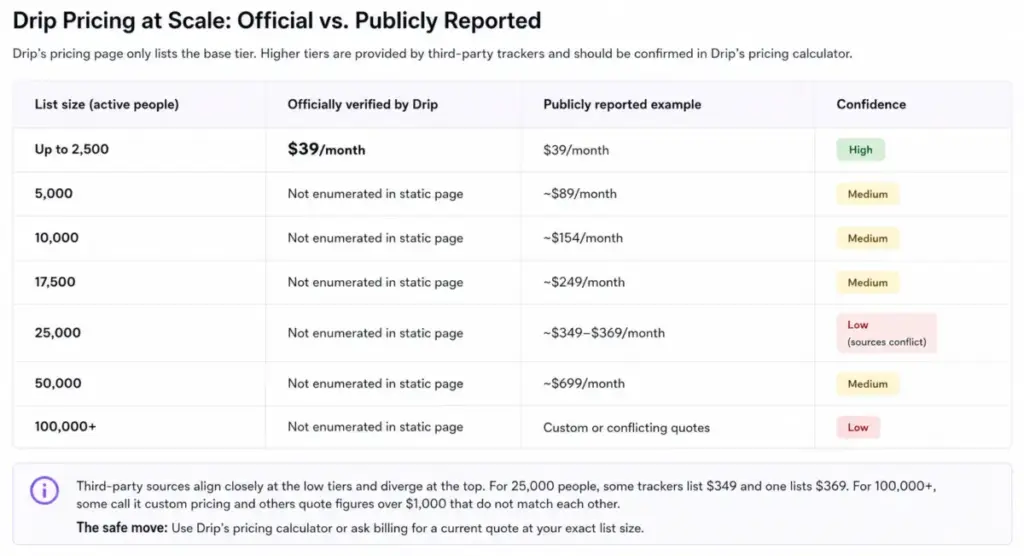
That distinction matters, so I am going to be strict about it. Below, the $39 base tier is officially verified. Everything above it is a publicly reported example that you should confirm in Drip’s own calculator before you budget around it.
| List size (active people) | Officially verified by Drip | Publicly reported example | Confidence |
|---|---|---|---|
| Up to 2,500 | $39/month | $39/month | High |
| 5,000 | Not enumerated in static page | ~$89/month | Medium |
| 10,000 | Not enumerated in static page | ~$154/month | Medium |
| 17,500 | Not enumerated in static page | ~$249/month | Medium |
| 25,000 | Not enumerated in static page | ~$349–$369/month | Low (sources conflict) |
| 50,000 | Not enumerated in static page | ~$699/month | Medium |
| 100,000+ | Not enumerated in static page | Custom or conflicting quotes | Low |
Third-party sources agree closely at the low tiers and diverge at the top. For 25,000 people, some trackers list $349 and one lists $369. For 100,000-plus, some call it custom pricing and others quote figures over $1,000 that do not match each other. Treat the base price as fact and the rest as a planning estimate. The safe move: use Drip’s pricing calculator or ask billing for a current quote at your exact list size.
Drip Hidden Costs: SMS, List Growth, and Annual Billing
Drip markets itself on transparent, single-plan pricing. That is mostly true for email. The surprises come from the pieces that sit outside the email base rate.
1. SMS is a separate add-on starting at $39/month
SMS is not bundled into your email price. Drip’s help center says SMS is enabled by contacting support, tiered SMS pricing starts at $39/month, and billing tiers adjust as your SMS list and message volume grow. If you run SMS marketing alongside email, your real monthly floor is closer to $78 than $39.
Two useful details from the same billing doc. Carrier and hidden fees are not passed through to you separately, which is friendlier than platforms that itemize per-message carrier surcharges. But a single text over 160 characters splits into multiple billable segments, and adding an emoji changes the encoding and lowers the character limit per segment, so a chatty message with emojis can quietly cost more per send than you expect.
2. List growth pushes you into higher tiers
Because you are billed on active people, the number that moves your bill is list size, not team size. A store that grows from 2,500 to 10,000 subscribers is looking at roughly four times the monthly email cost based on publicly reported tiers. There is no per-seat penalty and no charge for extra sub-accounts, but a bloated list of unengaged contacts costs the same as an engaged one. Clean your list before you scale, not after.
3. The “active people” definition is not fully spelled out
Drip’s public pricing copy says you pay for active people and send volume, but it does not fully define the edge cases in plain text. Before you migrate a large or messy list, ask Drip support directly how unsubscribed, inactive, or dormant contacts affect your count. This is the single biggest question I would want answered in writing before committing a big list, because it changes your bill on day one.
4. Annual discount is not publicly confirmed
I did not find a clear public annual discount on Drip’s official pricing page checked July 1, 2026. Some SaaS tools cut 15 to 20 percent for annual commitments; Drip’s crawlable pricing text does not state one either way. Do not assume yearly savings. If annual billing matters to your budget, ask sales or billing before you commit.
| Add-on or cost | Price | When it hits |
|---|---|---|
| SMS | Starts at $39/month | When you add SMS to email |
| SMS message segments | Varies by segment count | Long texts and emojis split into more billable segments |
| List-size tier jump | Varies by active people | When your list crosses a pricing threshold |
| Annual billing | Not publicly verified | Confirm with Drip before committing |
Plan-by-Plan Breakdown (There Is Really Just One)
Drip does not gate features behind a Starter/Pro/Enterprise ladder the way Mailchimp or ActiveCampaign do. There is one plan, and what changes as you pay more is your allowed list size, not your feature access. That is the core of Drip’s pitch, and it is a genuine advantage if you would otherwise be forced up a tier just to get automation.
Here is what the single plan includes, based on Drip’s official pricing and product pages checked July 1, 2026.
| What you get | Status on the paid plan |
|---|---|
| Unlimited email sends (after upgrading from trial) | Included |
| Dynamic segmentation using store, visitor, and behavioral data | Included |
| Onsite campaigns | Included |
| Workflows | Up to 50 workflows listed on the pricing page |
| Email builder with dynamic product blocks and abandoned-cart content | Included |
| Revenue and order attribution dashboards | Included |
| Open API (JSON over HTTPS) | Included |
| MCP connector for Claude, ChatGPT, and other AI clients | Included at no extra cost |
| Email support (Mon–Fri) | All paying customers |
| Live chat support (Mon–Fri) | Plans at $99/month and above |
| Free migration and 90-day onboarding support | Accounts with more than 17,500 people |
Includes: the full ecommerce automation stack, including welcome flows, abandoned cart, browse abandonment, post-purchase, and win-back, plus segmentation and revenue reporting.
Missing: a permanent free plan, unlimited email sends during the trial, and clearly published pricing above the 2,500-person tier.
Avoid if: you are not an ecommerce store. The dynamic product blocks, cart URLs, and order attribution are the reasons Drip costs more than a newsletter tool. Skip all of that and you are paying ecommerce prices for a plain broadcast tool.
A note on integrations. Drip’s own pages quote different numbers in different places, from 50-plus on the homepage to 90-plus on the pricing FAQ to 200-plus on the automation page. Rather than pick one, the honest statement is that Drip supports the major ecommerce integrations most stores need, including Shopify, WooCommerce, and BigCommerce, plus a broader integration ecosystem. If a specific integration is a dealbreaker, confirm it on Drip’s integrations directory before signing up.
The 2026 addition worth flagging: Drip’s MCP connector lets you link your account data to AI clients like Claude and ChatGPT at no extra cost, read-only by default, with write actions requiring approval. It is a nice-to-have, not a reason to buy, unless you already run AI-assisted marketing workflows.
Drip Free Trial: What You Can and Can’t Test
Drip does not have a free-forever plan. It has a 14-day free trial that does not require a credit card. That is generous on friction and thin on one specific thing: unlimited email sends are not available during the trial. Drip confirms this on its own pricing FAQ.
So plan your trial around what you can actually test. In 14 days you can build workflows, connect your store, set up segments, and design emails with dynamic product blocks. What you cannot do is validate high-volume deliverability at your real sending rate, because the trial caps sends. After 14 days, Drip prompts you to upgrade and enter payment details, and the account goes inactive if you let the trial lapse without upgrading.
My trial checklist for an ecommerce store: connect your store first, rebuild your two most important flows (abandoned cart and a welcome series), test how segments populate from real order data, and confirm the integrations you depend on. Judge Drip on how well it models your customer behavior, not on send volume you cannot test yet. For a deeper feature walkthrough beyond pricing, see our full Drip review.
Real Cost Scenarios by List Size
Drip is not per-seat, so the standard “5, 10, 20 users” math does not apply. The number that drives your bill is active people. These scenarios use the officially verified base tier plus publicly reported examples for higher tiers. Treat the higher rows as estimates to confirm in Drip’s calculator.
| List size | Email cost | With SMS added | Notes |
|---|---|---|---|
| 2,500 people | $39/month (verified) | ~$78/month | Best confirmed entry point |
| 5,000 people | ~$89/month (reported) | ~$128/month | Confirm exact price in calculator |
| 10,000 people | ~$154/month (reported) | ~$193/month | Common comparison point vs Klaviyo |
| 17,500 people | ~$249/month (reported) | ~$288/month | Free migration and 90-day onboarding begin above this size |
| 25,000 people | ~$349–$369/month (reported range) | ~$388–$408/month | Sources conflict; get a quote |
| 50,000 people | ~$699/month (reported) | ~$738/month | Confirm current quote for a list this size |
The SMS column assumes you add the entry SMS tier at $39/month; your actual SMS cost rises with message volume. The practical read: below 10,000 people, Drip is a mid-market email cost. Above 17,500, the free migration and onboarding support start to offset the switching cost of moving from Klaviyo or Mailchimp, which is exactly when larger stores tend to shop around.
Who Should Pay for Drip?
The pricing model is the review here. Drip charges like an ecommerce platform, so the value only lands if you use ecommerce data.
- Shopify, WooCommerce, or BigCommerce stores: yes. Abandoned cart, browse abandonment, post-purchase, and revenue attribution are the whole point, and they are all included in the single plan.
- DTC brands scaling past 10,000 subscribers: yes, especially if you are migrating a large list, because free migration and 90-day onboarding kick in above 17,500 people.
- Stores that also want SMS: yes, but budget the extra $39/month and up. Drip’s combined email and SMS flows are a real strength for lifecycle marketing.
- B2B lead-gen teams: usually no. Drip’s data model is built around purchase behavior, not sales-cycle lead nurture. A CRM-adjacent tool fits better.
- Creators and newsletter senders: no. You are paying for ecommerce machinery you will not touch.
Which Plan Should You Avoid?
There is only one plan, so the real “avoid” decision is whether to buy Drip at all. Avoid Drip if you are a local-service business, a nonprofit, a creator, or any team whose main job is sending a regular newsletter to a list that does not generate order data. In those cases you are paying a premium for dynamic product blocks and revenue attribution that never get used.
The exception: if you are a service business that genuinely runs behavior-triggered lifecycle campaigns tied to a storefront or booking system, Drip’s automation can still earn its price. The disqualifier is not your industry label, it is whether purchase behavior drives your emails.
Drip Pricing vs Competitors
Starting price is the least useful number in this category, because these tools bill on completely different meters. Klaviyo charges on active profiles, Brevo charges on email sends, Shopify Email charges on sends inside Shopify, and Drip charges on active people plus send volume. Two lists of the same size can cost wildly different amounts depending on how often you mail them.
| Tool | Starting price | Billing meter | Free plan | Best for |
|---|---|---|---|---|
| Drip | $39/mo up to 2,500 people | Active people + send volume | No (14-day trial) | Revenue-focused ecommerce lifecycle |
| Klaviyo | $0 free plan | Active profiles + usage | Yes, up to 250 profiles / 500 sends | Data-heavy ecommerce teams |
| Omnisend | $0 free; paid from ~$16/mo | Contacts + sends | Yes, all features, 500 emails to 250 contacts | Budget ecommerce needing email + SMS |
| Mailchimp | Free; Essentials ~$13–$19/mo | Contacts, feature-gated plans | Yes, 250 contacts / 500 emails | General small-business email |
| ActiveCampaign | ~$15/mo annual (1,000 contacts) | Contacts + plan tier | No (14-day trial) | Complex B2B automation and CRM journeys |
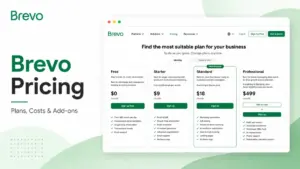
| Brevo | Free; Starter ~$9/mo | Email send volume | Yes, 300 emails/day | Large stored lists with low send frequency |
| Shopify Email | 10,000 free emails/mo | Sends inside Shopify | Included for merchants | Basic Shopify sends, no advanced automation |
A few reads that the raw table hides. Klaviyo’s free plan looks cheaper than Drip’s paid trial, but it caps at 250 active profiles and 500 monthly sends and drops full email support after the first 60 days, so an ecommerce list outgrows it fast. Compare the exact tiers in our Klaviyo pricing breakdown before assuming free means free. Omnisend’s free plan includes every feature, including SMS, but only for up to 250 contacts and 500 emails a month, which makes it a strong low-budget testing ground.
For a large list that you mail infrequently, a send-volume tool is often cheaper than Drip. Brevo’s send-based billing and Shopify Email’s 10,000 free monthly emails can undercut a contact-based bill by a lot, at the cost of weaker lifecycle automation. See the Brevo pricing structure if that describes your list.
On the other side, if you want deep automation with CRM-style journeys, ActiveCampaign pricing gates those features across Starter, Plus, and Pro tiers, so the real cost of the features you need can exceed the sticker price. And if you want a generalist tool with a real free plan, Mailchimp pricing is the usual default, though its automation and send limits are plan-gated in ways Drip’s single plan is not.
Is Drip Worth the Price?
Worth it if you run a Shopify, WooCommerce, or BigCommerce store, your emails are driven by purchase behavior, and you want abandoned cart, post-purchase, and revenue attribution in one plan without climbing a feature ladder. At that point $39/month for a small list is fair, and the single-plan model saves you from paying for a “Pro” tier just to get automation.
Not worth it if you mainly send newsletters, run cold outreach, sell B2B on a long sales cycle, or need a permanent free plan. The ecommerce features you are paying for will sit unused.
If Drip is too expensive for where you are today, the honest downgrade path is Omnisend for a feature-rich free start with email and SMS, or Brevo if you have a big list you rarely mail. If you are a creator or service business rather than a store, a lighter tool such as MailerLite fits the customer segmentation and newsletter workflow better than Drip does. You can compare the omnichannel option in our Omnisend review.
How to Avoid Overpaying for Drip
- Clean your list before you migrate. You pay for active people, so scrubbing unengaged contacts directly lowers your tier.
- Ask support in writing how unsubscribed and dormant contacts are counted before you commit a large list.
- Only add SMS when you will actually use it. It starts at $39/month on top of email.
- Keep SMS messages under 160 characters and skip decorative emojis to avoid extra billable segments.
- Time a large migration to land above 17,500 people if you qualify for free migration and 90-day onboarding, so you are not paying an agency to move your data.
- Confirm your exact tier price in Drip’s calculator rather than trusting third-party numbers, which conflict above 25,000 people.
- Ask about annual billing directly, since no public annual discount is stated on the pricing page.
Pricing verified against drip.com/pricing and the Drip help center on July 1, 2026. Pricing and plans change; confirm current figures with Drip before purchasing. I did not have hands-on account access for this guide; all figures are based on official pricing pages and public documentation.
FAQ
How much does Drip cost?
Drip starts at $39/month for 1 to 2,500 active people, based on its official pricing page checked July 1, 2026. Above that, cost scales by active people and email send volume, so check Drip’s calculator for your list size.
Does Drip have a free plan?
No. Drip offers a 14-day free trial with no credit card required, but there is no permanent free plan. After the trial you are prompted to upgrade.
Can I test unlimited email sends during the trial?
No. Drip’s pricing FAQ states that unlimited email sends are not available during the free trial. Use the 14 days to build workflows, connect your store, and test segmentation.
Does Drip charge extra for SMS?
Yes. SMS is a separate add-on starting at $39/month, enabled by contacting Drip support. Carrier fees are not passed through separately, but long messages and emojis can split into more billable segments.
Does Drip charge by subscribers or by emails?
Drip bills on active people plus monthly email send volume, not per seat. Team size does not change your price; list size and how much you send do.
When do I get live chat support?
All paying customers get email support Monday to Friday. Live chat support is available on plans at $99/month and above.
Is Drip cheaper than Klaviyo?
It depends on your list and sending pattern. Klaviyo has a free plan, but it caps at 250 profiles and 500 monthly sends and limits full support to 60 days. For a growing ecommerce list, both move to paid pricing quickly, so compare your exact tier rather than the entry price.
Why do some sites show different Drip prices?
Some marketplace and directory listings show outdated ranges, such as an old $49–$122/month figure, that no longer match Drip’s current pricing. When numbers conflict, trust Drip’s official pricing page and calculator over third-party trackers.
Is Drip worth it for a Shopify store?
For a revenue-focused Shopify store that uses abandoned cart, post-purchase, and segmentation, yes. For a Shopify store that only sends occasional broadcasts, Shopify Email or a cheaper tool is a better fit.