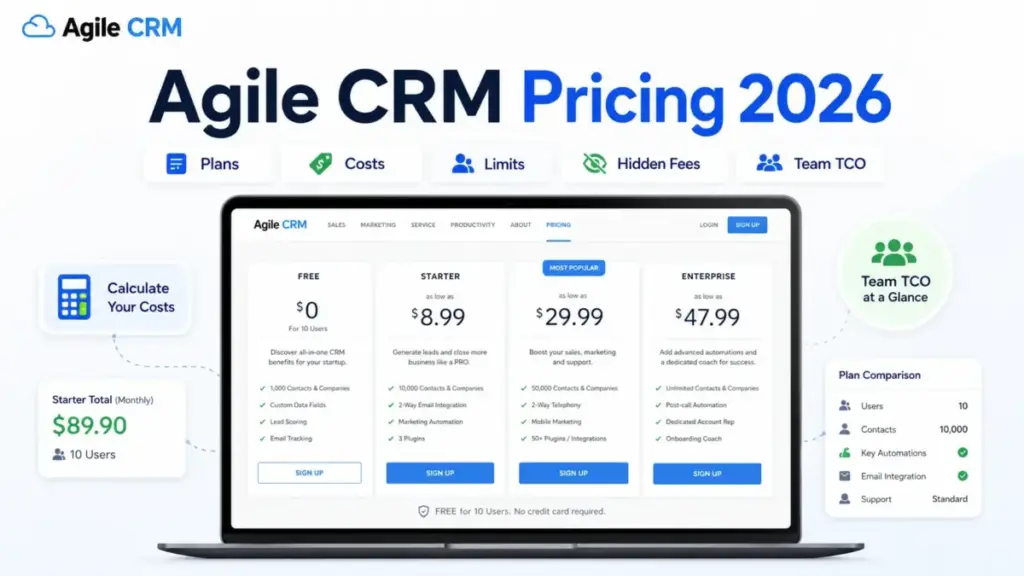
Agile CRM pricing looks like the cheapest all-in-one CRM on the market until you read the two words the official page puts in front of every paid number: “as low as.” Those numbers hold only at the longest commitment, and independent pricing sources map the same tiers to higher monthly and annual rates.
The practical entry tier for most revenue teams is Regular, not Starter, because three integrations and no two-way telephony stop a real sales stack fast. The biggest budget surprise is the email add-on: Agile CRM confirms extra email packages exist and confirms they expire one month after purchase, but publishes no price for them.
This Agile CRM pricing guide separates the verified official numbers from the corroborated billing-term rates, quantifies every plan ceiling, and calculates total cost at 5, 10, 20, and 50 seats. Prices checked July 24, 2026, against the official page, with the wider field covered in our best CRM software picks.
Quick Pricing Verdict
| Question | Answer |
|---|---|
| Official starting price | $0 Free for up to 10 users; paid plans listed “as low as” $8.99 per user/month |
| What the low price requires | The official page does not name the term; independent sources map $8.99, $29.99, and $47.99 to two-year billing |
| Free plan or trial | Free plan confirmed for up to 10 users, no credit card; a paid-plan trial is not confirmed on the official pricing page |
| Best plan for most revenue teams | Regular, once you need more than three integrations, two-way telephony, or 10,000+ contacts |
| Plan to avoid | Starter, if your stack already uses four or more connected apps on day one |
| Biggest hidden cost | Email add-on packages with no published price and a one-month expiry |
| Second biggest hidden cost | Telephony and SMS usage billed by an outside provider, not by Agile CRM |
| Best alternative if the term scares you | Less Annoying CRM at a flat $15 per user/month with no contract |
| Pricing verified | July 24, 2026, against the official Agile CRM pricing page |
The verdict table answers the search, but it hides the part that changes a budget. A five-person team that assumes $8.99 and then picks flexible monthly billing pays 67% more per seat than the advertised figure.
That gap, not the feature list, is the reason this guide exists.
It is also the reason I would never approve an Agile CRM purchase order using the headline price alone. Every number below is labeled by source type so a finance reviewer can see which figures are first-party and which are corroborated.
Executive Summary: Agile CRM TCO at 5, 10, 20, and 50 Users
Agile CRM charges per user per month across three paid tiers, with a genuinely free tier capped at 10 users. There is no usage-based pricing model and no published seat minimum.
Here is the cash exposure at the tier each team size realistically lands on, using the corroborated term rates.
| Team size | Realistic plan | Flexible monthly spend | Annual-plan cost per year | Two-year commitment total |
|---|---|---|---|---|
| 5 users | Starter | $74.95/mo | $599.40 | $1,078.80 |
| 10 users | Regular | $499.90/mo | $4,798.80 | $7,197.60 |
| 20 users | Regular | $999.80/mo | $9,597.60 | $14,395.20 |
| 25 users | Enterprise | $1,999.75/mo | $19,497.00 | $28,794.00 |
| 50 users | Enterprise | $3,999.50/mo | $38,994.00 | $57,588.00 |
Every figure above excludes taxes, email add-ons, telephony usage, and third-party app subscriptions, because none of those are published on the pricing page. No volume discount is applied, since no discount schedule appears publicly.
The jump that matters sits between 10 and 25 users. A 10-person team on Regular commits $7,197.60 over two years, while a 25-person team on Enterprise commits $28,794.00, and the extra money buys access controls, call recording, and an onboarding coach rather than more contacts.
I would treat the 25-seat Enterprise number as the real decision point. Below it, Agile CRM competes on price; at it, the product has to win on governance features instead.
Agile CRM Pricing Plans Compared
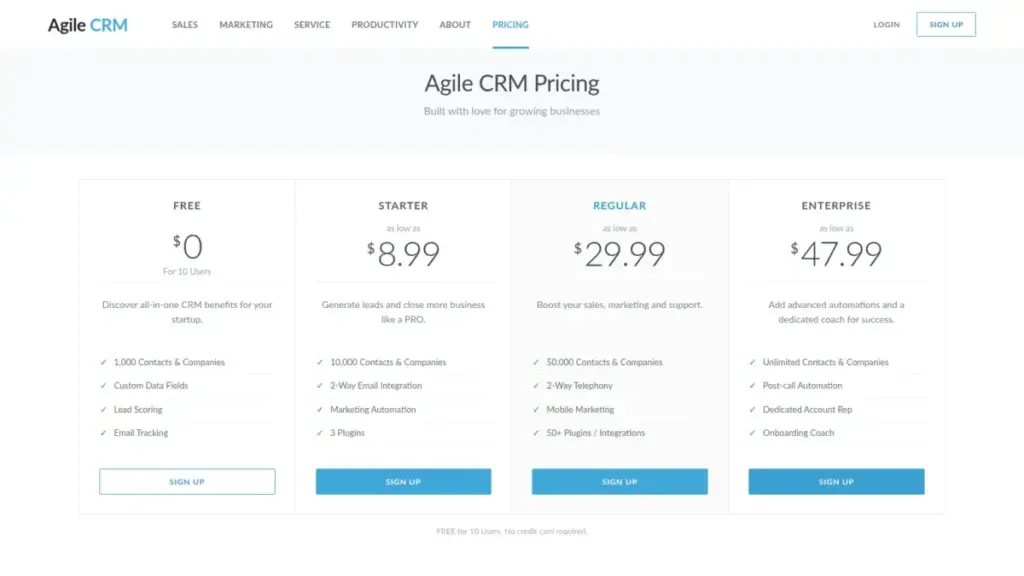
Agile CRM pricing is built on four tiers. The official page confirms plan names, headline prices, and every ceiling in the comparison grid, but it never labels which billing term produces the “as low as” figure.
| Plan | Official headline | Corroborated monthly | Corroborated annual | Corroborated two-year | Billing basis | Best for |
|---|---|---|---|---|---|---|
| Free | $0 for up to 10 users | $0 | $0 | $0 | Flat, up to 10 users | Pilots under 1,000 contacts |
| Starter | As low as $8.99/user/mo | $14.99 | $9.99 | $8.99 | Per user, per month | 3 to 8 person teams with a two-app stack |
| Regular | As low as $29.99/user/mo | $49.99 | $39.99 | $29.99 | Per user, per month | 10 to 25 person sales plus support teams |
| Enterprise | As low as $47.99/user/mo | $79.99 | $64.99 | $47.99 | Per user, per month | 25+ user teams needing access controls |
Only the headline column is first-party evidence from the official pricing page. The monthly, annual, and two-year columns come from independent pricing sources that consistently map the lowest published figures to a two-year commitment, so confirm your term in checkout before you sign anything.
Verify every figure above against the official Agile CRM pricing page before you build a budget around it. Agile CRM pricing is published in USD for the US market and can change without notice.
One directory adds noise here. A current Capterra listing extract shows a $10.99 starting price, which conflicts with the official $8.99 figure, and the official page wins that disagreement.
Buyers new to the category should also separate CRM cost from CRM capability. Our explainer on what CRM software does day to day covers the modules these tiers are gating.
Line-Item Cost Breakdown: Every Billable Item
Agile CRM’s bill has fewer moving parts than HubSpot’s, but the parts it does have are poorly documented. Sorting them into published, provider-billed, and undisclosed is the fastest way to build a defensible budget.
| Line item | Who bills it | Published price? | Budget treatment |
|---|---|---|---|
| Per-seat subscription | Agile CRM | Yes, as “as low as” figures | Model at the monthly rate until your term is confirmed |
| Email add-on packages | Agile CRM | No | Request a written quote before committing |
| Telephony minutes, numbers, recording | Outside provider such as Twilio or RingCentral | Not by Agile CRM | Budget separately per rep |
| SMS and mobile marketing sends | Outside provider | Not by Agile CRM | Budget separately per campaign |
| Connected app subscriptions | Each vendor | Not by Agile CRM | Count every paid connector in your stack |
| 500apps suite | Promoted separately at $14.99/user | Yes, but it is a different product | Exclude unless you deliberately buy it |
| Taxes, refunds, seat reductions | Agile CRM | Not published | Get the terms in writing before prepaying |
Three of those seven lines carry no public number. That is a higher share of unpriced items than I see on most CRM pricing pages, and it is the single strongest argument for asking sales to put a full quote in writing.
The 500apps line deserves a specific warning. Agile CRM’s own site promotes a separate 30-plus app bundle at $14.99 per user, and buyers who see that figure near the CRM cards sometimes add it to their Agile CRM math by mistake.
It is an adjacent suite, not an Agile CRM tier. Leave it out of your total unless someone on your team has explicitly chosen it.
What Each Agile CRM Plan Includes
Each tier changes two things at once: how much data and automation you get, and which workflow becomes possible. Reading them as a capacity ladder rather than a feature ladder produces better decisions.
Free: $0 for up to 10 users
Includes core contact and deal management, email campaigns, web engagement, helpdesk ticketing, Google sync, basic reports, and email support. Ten free seats is genuinely generous for a CRM.
Missing: two-way email, marketing automation, telephony, and phone support. The plan holds 1,000 contacts and companies, one campaign workflow, five nodes per campaign, one automation trigger, one integration, and 500 API calls per day.
My verdict: a real 30-day pilot tool, not a permanent home for a sales team. Seats will not be your constraint; a single list import will be.
Avoid if you need to import more than 1,000 records or connect a second app during evaluation.
Starter: as low as $8.99 per user/month
Includes everything in Free plus two-way email, marketing automation, social monitoring, phone support, and Shopify and Stripe sync. Capacity rises to 10,000 contacts, five workflows, 10 nodes per campaign, five triggers, three integrations, and 5,000 API calls per day.
Missing: custom deal tracks, two-way telephony, mobile marketing, and anything past the third integration.
My verdict: strong value for a 3 to 8 person team running email plus one commerce or payments connector. It is the tier where the advertised price and the useful feature set finally overlap.
Avoid if your day-one stack already includes four connected apps, or if reps need click-to-call inside the CRM.
Regular: as low as $29.99 per user/month
Includes custom deal tracks, two-way telephony, mobile marketing, and access to 50-plus integrations. Capacity rises to 50,000 contacts, 10 workflows, 25 nodes per campaign, 10 triggers, and 10,000 API calls per day.
Missing: access control lists, call recording, post-call automation, team reports, dedicated rep, and onboarding coach.
My verdict: this is the practical floor for a multichannel revenue team, and the price gap from Starter is where Agile CRM stops looking unusually cheap. At $39.99 annual per seat, a 10-person team pays $4,798.80 a year.
Avoid if you only need a contact database and email, because you are paying a 4x premium over Starter for integration headroom you will not use.
Enterprise: as low as $47.99 per user/month
Includes unlimited contacts, unlimited campaign workflows, unlimited automation triggers, 25,000 API calls per day, call recording, automated voicemails, post-call automation, SES, Mandrill and SendGrid options, team reports, access control lists, a dedicated account representative, and an onboarding coach.
Missing: a documented response-time SLA, published storage quotas, and a current certification package. None of those appear on the pricing page.
My verdict: the governance tier. You buy it for access controls and onboarding support, not for capacity, and the word “unlimited” still stops at 50 nodes per campaign.
Avoid if your reason for upgrading is only contact volume, since Regular already holds 50,000 records.
Interface quality and daily workflow sit outside a pricing analysis, and both matter at these tiers. Our full Agile CRM review covers that side of the decision.
Feature Gates by Plan
Feature gates decide the upgrade more often than seat count does, which is why reading Agile CRM pricing as a capability ladder beats reading it as a price list. This grid maps the gates that change day-to-day work.
| Capability | Free | Starter | Regular | Enterprise |
|---|---|---|---|---|
| Two-way email sync | No | Yes | Yes | Yes |
| Marketing automation | No | Yes | Yes | Yes |
| Custom deal tracks | No | No | Yes | Yes |
| Two-way telephony | No | No | Yes | Yes |
| Mobile marketing | No | No | Yes | Yes |
| Call recording and post-call automation | No | No | No | Yes |
| Access control lists | No | No | No | Yes |
| Team reports | No | No | No | Yes |
| Dedicated rep and onboarding coach | No | No | No | Yes |
| Support channels listed | Email and phone | Email and phone | Email, phone, dedicated rep | |
| Native integrations | 1 | 3 | 50+ | 50+ |
| API calls per day | 500 | 5,000 | 10,000 | 25,000 |
Two gates carry most of the buying weight. Two-way telephony sits at Regular, which pushes any call-heavy team past the $29.99 line immediately, and access control lists sit at Enterprise, which pushes any team with a permissions requirement to the top tier regardless of headcount.
If your security review requires role-based restrictions, your Agile CRM price is $47.99 per seat at best, not $8.99. That single fact reprices the product for regulated buyers before the feature comparison even starts.
The Plan Limits That Force an Upgrade
Contacts get the attention, but they are rarely the first ceiling a team hits. Nodes, triggers, and integration slots run out sooner.
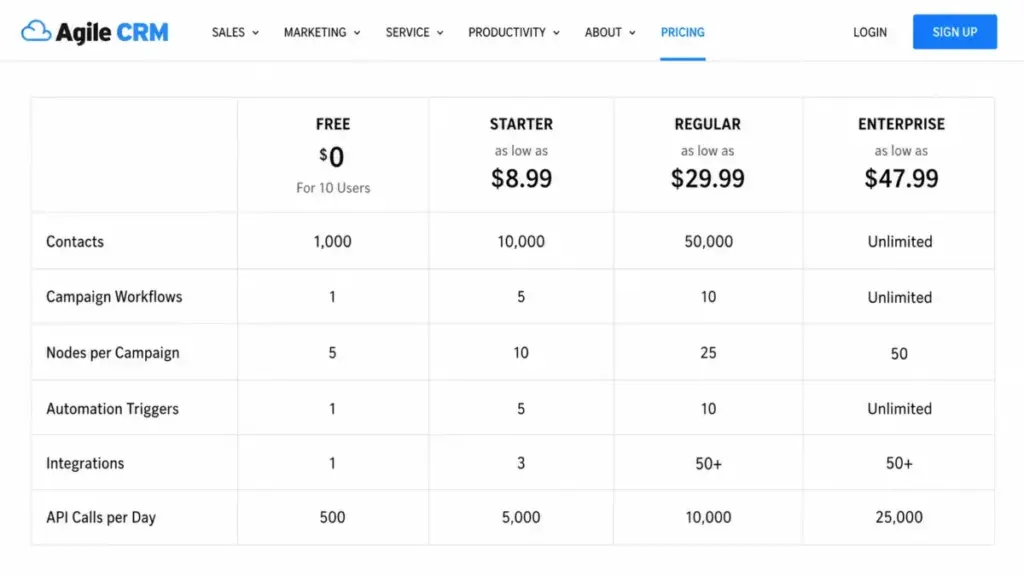
| Limit | Free | Starter | Regular | Enterprise | Typical first bottleneck |
|---|---|---|---|---|---|
| Contacts and companies | 1,000 | 10,000 | 50,000 | Unlimited | One imported list on Free |
| Campaign workflows | 1 | 5 | 10 | Unlimited | A second nurture sequence on Free |
| Nodes per campaign | 5 | 10 | 25 | 50 | Branching logic on Starter |
| Automation triggers | 1 | 5 | 10 | Unlimited | Form plus tag plus deal-stage triggers on Free |
| Native integrations | 1 | 3 | 50+ | 50+ | A fourth connected app on Starter |
| API calls per day | 500 | 5,000 | 10,000 | 25,000 | A nightly two-way sync on Starter |
The node cap is the row people miss. Workflow count and trigger count both become unlimited on Enterprise, but each individual campaign still stops at 50 nodes, so “unlimited automation” describes quantity rather than complexity.
The three-integration problem on Starter
Take an ecommerce team running Gmail, Shopify, and Stripe. Those three connectors consume the entire Starter allowance on the first afternoon of setup.
Add an accounting tool, a support inbox, or a telephony provider and there is no fourth slot. The upgrade to Regular is not driven by contacts or seats, it is driven by connector number four.
That is a $9.99 to $39.99 per-seat jump on annual billing, or roughly $3,600 more per year for a 10-person team. Connector number four, not headcount, is the line item that reprices this CRM.
Calculating whether the API cap fits
The daily API allowance is the ceiling technical buyers should check before anything else. Use records synced, times calls per record, times runs per day.
A nightly enrichment job touching 2,000 contacts at two calls each consumes 4,000 calls in one run. On Starter’s 5,000-call daily allowance, that leaves 1,000 calls for everything else, and Agile CRM does not publish what happens when you exceed the cap.
Run that formula against your real sync schedule before you pick a tier. If the result lands within 20% of the cap, buy the tier above it.
Annual vs Monthly: The Real Savings Math
The official page publishes only the lowest figure per tier, so the discount structure has to be reconstructed from the corroborated term rates. Treat this section as budgeting math to verify at checkout, not as confirmed contract terms.
| Plan | Monthly rate | Annual rate | Yearly saving per seat | Break-even point |
|---|---|---|---|---|
| Starter | $14.99 | $9.99 | $60.00 | 8.0 months |
| Regular | $49.99 | $39.99 | $120.00 | 9.6 months |
| Enterprise | $79.99 | $64.99 | $180.00 | 9.75 months |
Annual billing pays for itself between month eight and month ten depending on tier. If you are confident the tool survives a full year of use, annual is the rational choice; if you are still evaluating, the monthly premium is cheap insurance.
The two-year term is a different question. On Starter, 24 months costs $215.76 per seat at the lowest rate versus $359.76 on flexible monthly, a 40% saving that requires you to be right about a vendor decision two years out.
Agile CRM’s own FAQ confirms you can upgrade, downgrade, or cancel from the dashboard at any time. What it does not state is whether unused prepaid months are refunded, which is the actual financial question behind a two-year commitment.
Get the refund rule, the renewal rate, and the seat-reduction policy in writing before prepaying. Cancellation control is not the same thing as getting your money back.
Add-Ons, Overages, and Surprise Costs
Agile CRM’s headline price is low partly because several real costs sit outside it. Ranked by how much damage each one does to a budget, this is the list.
| Hidden cost | What triggers it | Published price | Risk level |
|---|---|---|---|
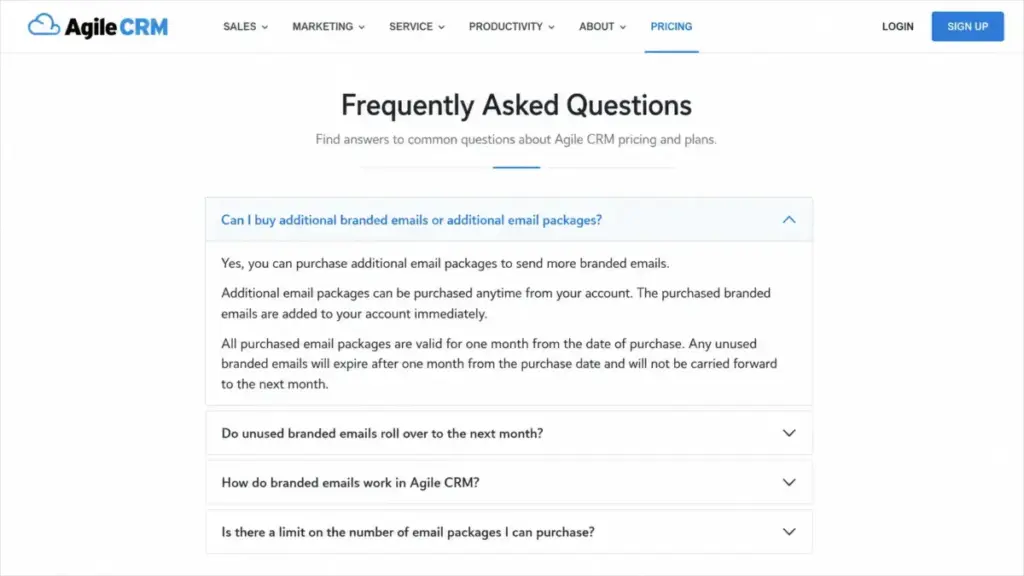
| Email add-on packages | Sending beyond the included 5,000 branded emails | None published | High |
| Telephony usage | Numbers, minutes, recording through an outside provider | Not disclosed by Agile CRM | High for call teams |
| SMS and mobile marketing | Text campaigns through an external service | Not disclosed by Agile CRM | Medium |
| Two-year commitment exposure | Choosing the lowest advertised rate | 24 months of seat cost | Medium |
| Third-party app subscriptions | Connecting paid ecommerce, accounting, or support tools | Varies by vendor | Medium |
| 500apps suite | Separately choosing the promoted bundle | $14.99 per user | Low if excluded correctly |
The email allowance nobody can price
The plan grid lists 5,000 branded emails, but the pricing page does not define whether that number resets monthly, applies account-wide, or applies per user. For a product sold partly on marketing automation, that is a significant documentation gap.
The add-on situation is stranger. Agile CRM confirms you can buy extra email packages and confirms those purchased emails last one month, but publishes no price at all.
A one-month expiry means unused capacity is lost, so a team with uneven campaign volume pays for peaks it cannot bank. Ask for the package tiers, the per-package price, and the reset rule in writing, and treat any answer you cannot get on paper as a reason to model a competitor.
Telephony is capability, not inclusion
Regular and Enterprise open up telephony features, and Agile CRM names Twilio and RingCentral among its integrations. The seat price covers the connection, not the calling.
Numbers, minutes, recording storage, and SMS sends land on the provider’s invoice. For a 10-rep outbound team, that provider bill can rival the CRM subscription, and no part of it appears in the Agile CRM pricing table.
Real Cost Scenarios: 5, 10, 20, and 50 Users
Per-seat pricing hides its own scale. These scenarios use the corroborated term rates, exclude add-ons and taxes, and assume no volume discount because no schedule is published.
| Scenario | Plan and reason | Monthly billing | Annual billing per year | Two-year total |
|---|---|---|---|---|
| Solo founder, under 1,000 contacts | Free, capacity is enough for evaluation | $0 | $0 | $0 |
| 5-person startup, one commerce connector | Starter, three integrations still fit | $74.95 | $599.40 | $1,078.80 |
| 10-person agency, four connectors plus calling | Regular, telephony and 50+ integrations required | $499.90 | $4,798.80 | $7,197.60 |
| 20-person sales and support team | Regular, 50,000 contacts still sufficient | $999.80 | $9,597.60 | $14,395.20 |
| 50-person team with permissions requirement | Enterprise, access control lists required | $3,999.50 | $38,994.00 | $57,588.00 |
The 5-person Starter line is the one that matches the marketing. Everything below it is a different product economically, because the tier that carries a real revenue stack costs four to eight times the advertised entry rate.
A 10-person agency choosing Regular on flexible monthly billing spends $5,998.80 in year one. The same team on the two-year rate spends $3,598.80 per year, and the $2,400 difference is the price of not being locked in.
I would run the free plan for 30 days before choosing between those two numbers. Import a real list, build one workflow with five nodes, connect one app, and see which ceiling you hit first.
Which Agile CRM Plan Should You Choose?
Plan selection under Agile CRM pricing follows requirements, not headcount. Two 10-person companies can legitimately need different tiers.
Solo founders and freelancers under 1,000 contacts: stay on Free. Ten seats and full core CRM cost nothing, and the contact ceiling is the only thing to watch.
3 to 8 person teams moving off spreadsheets: Starter at $9.99 annual per seat, provided your stack is two or three apps. Two-way email and marketing automation both appear at this tier, which is what makes it usable rather than just cheap.
5 to 10 person ecommerce teams: Starter only if Gmail, Shopify, and Stripe are your complete connector list. Add a fourth tool and Regular becomes mandatory, which changes a 10-seat annual bill from $1,198.80 to $4,798.80.
10 to 25 person sales plus support teams: Regular. Custom deal tracks, two-way telephony, and 50,000 contacts cover the multichannel workflow, and the 25-node campaign limit is generous enough for most nurture logic.
Integration-heavy revenue operations teams: check the API math first, then pick Regular or Enterprise on the daily cap rather than the feature list. A 10,000-call ceiling disappears faster than a 10-person operations team expects.
Teams with a permissions or audit requirement: Enterprise, because access control lists and team reports appear nowhere else. Budget $64.99 annual per seat and confirm the certification position separately.
Regulated buyers needing current compliance documentation: pause the purchase. Current SOC 2, ISO 27001, or HIPAA evidence was not found during this research, and the visible GDPR page is written around the May 2018 readiness deadline.
For teams that decide the free tier is the real product they want, our comparison of free CRM software options puts the 1,000-contact ceiling in context against rivals.
Which Agile CRM Plan Should You Avoid?
Starter is the plan most likely to be bought for the wrong reason. It carries the price people quote, and it fails on the constraint people forget to check.
Three integrations is the failure point. A team that connects email, an ecommerce platform, and a payment processor has already spent its entire allowance, and connector four forces an immediate upgrade at four times the per-seat rate.
The 5,000-call daily API ceiling compounds it. Any nightly two-way sync of a mid-sized contact database can approach that number without a single manual action.
Starter still fits one profile well: a small team with a light stack, under 10,000 contacts, no calling requirement, and no plan to add tools within the year. If that describes you, it is the best value in the lineup.
The second plan to question is Enterprise bought purely for capacity. Regular already holds 50,000 contacts, so unless access controls, call recording, or team reports are genuine requirements, the extra $25 per seat per month buys governance you may not need.
If the three-integration ceiling is your blocker and Regular looks overpriced, price the field first. Our list of Agile CRM alternatives covers tools that include a wider connector set at the entry tier.
Security, Uptime, and Procurement Evidence
Procurement teams need the distinction between what a vendor claims and what a vendor documents. Agile CRM makes claims on the pricing page; the documentation trail behind some of them is thin.
| Claim area | What the official pages state | Evidence date and context | Not verified |
|---|---|---|---|
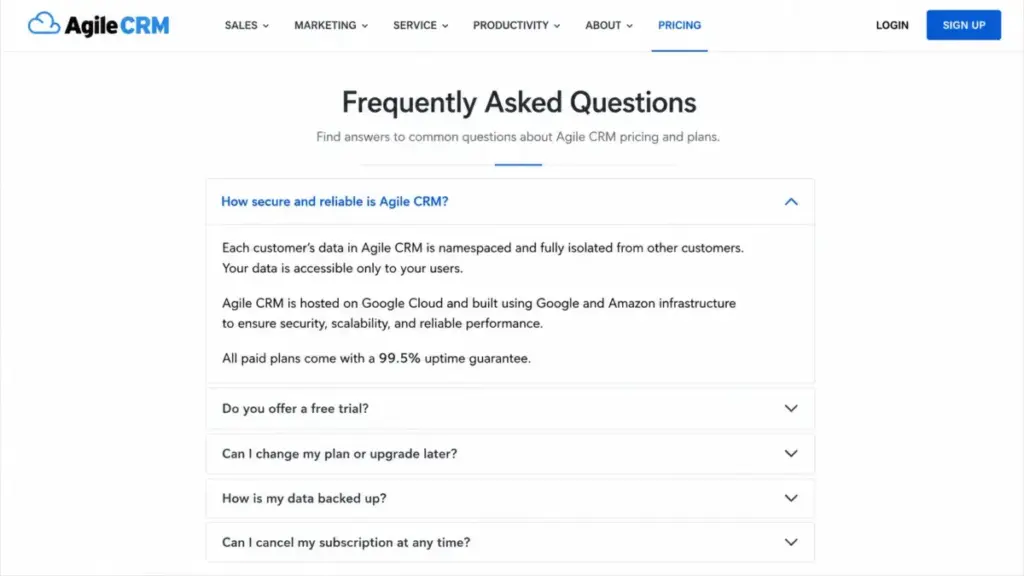
| Data isolation | Namespaced customer data on Google Cloud | Pricing page FAQ, checked July 24, 2026 | Independent audit of the isolation model |
| Hosting | Google and Amazon infrastructure | Pricing page FAQ, checked July 24, 2026 | Region choice, residency options |
| Uptime | 99.5% guarantee on paid plans | Pricing page FAQ, checked July 24, 2026 | Historical uptime record, credit terms |
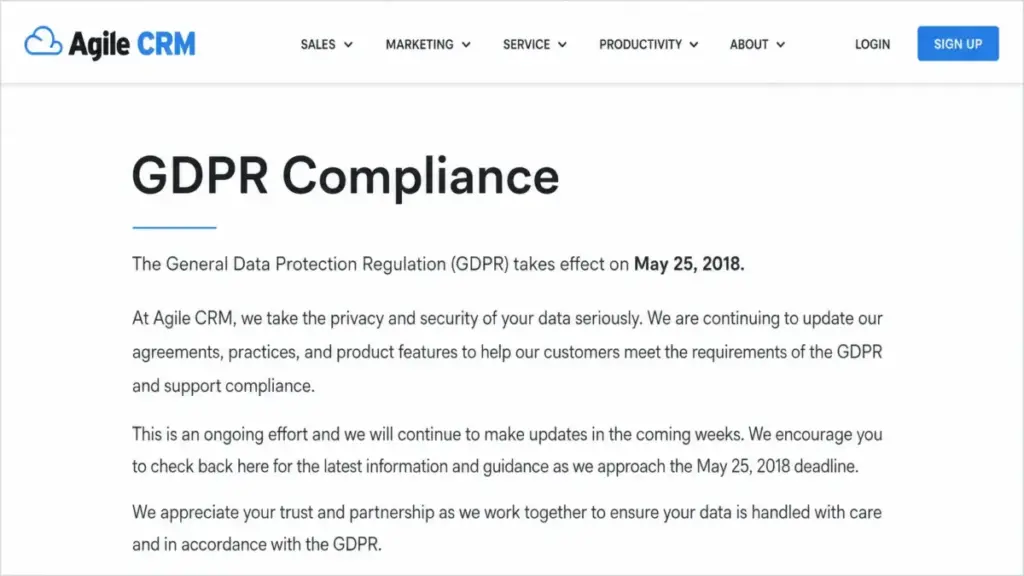
| GDPR | A readiness page framed around the May 25, 2018 deadline | GDPR page, checked July 24, 2026 | Current data processing agreement status |
| SOC 2, ISO 27001, HIPAA | No current certification evidence found | Official-source search, July 24, 2026 | Whether certifications exist but are unpublished |
| Support SLA | Email, phone, and dedicated rep entitlements by tier | Pricing page, checked July 24, 2026 | Any response-time commitment |
The official GDPR page is the clearest example of the evidence-age problem, since it is written around preparing for the May 2018 deadline rather than confirming a current position.
Not finding published certification evidence is not the same as a product being non-compliant. It does mean a regulated buyer has to request documents directly rather than downloading them, and that adds weeks to a procurement cycle.
What 99.5% uptime allows in practice
A 99.5% guarantee sounds close to perfect until you convert it into time. The arithmetic gives 43.8 hours of allowed downtime across a 365-day year, or 216 minutes inside a 30-day month.
That is a mathematical translation of the published guarantee, not a record of observed outages. For a sales team that lives in the CRM during business hours, 43.8 hours is a number worth comparing against whatever your current system delivers.
Risks to Settle Before You Commit
The two-year rate is the cheapest way to buy Agile CRM and the riskiest way to buy any CRM. Four open questions decide whether that trade is sensible for your team.
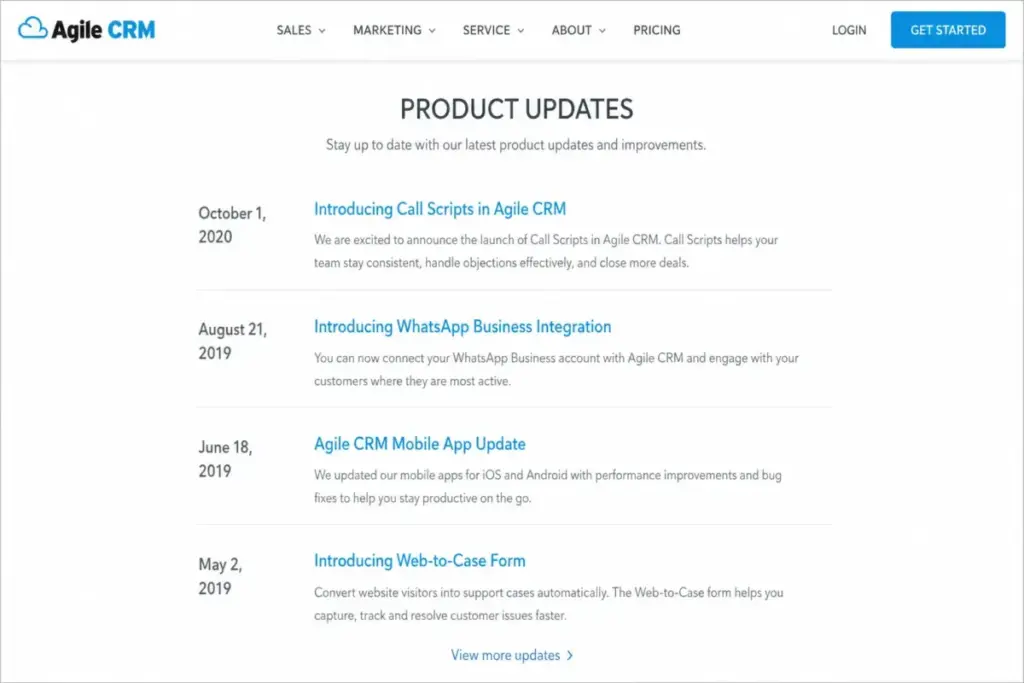
Roadmap visibility. The most recent product update displayed on Agile CRM’s public homepage is dated October 1, 2020, with 2019 entries below it. That is a visible-feed observation, not proof of abandonment, and the site footer carries a 2026 date while the product remains purchasable.
Ask sales for release notes from the past 12 months before signing a 24-month term. A vendor that ships regularly can produce them quickly.
Mobile app maintenance. The official mobile page lists Android and iOS apps covering contacts, deals, tasks, campaigns, calls, and support. Check the current store listing, last update date, and device compatibility during your free-plan pilot, and have a rep log in on a real phone.
Browser extension status. The plan grid lists a Chrome extension on every tier while recent reviewers raise maintenance concerns. Open the official listing, check the last update, and test contact capture before you build a prospecting workflow on it.
Support reality. One official page describes 24×5 live chat, email, and phone support, while the newer tier grid gates phone support to paid plans. No response-time SLA was found on any official page, and recent third-party reviews describe inconsistent live help.
None of those four items disqualifies the product. All four are cheaper to resolve before a purchase order than after one, which is exactly why the free plan exists.
A structured CRM migration checklist makes the pilot phase produce answers instead of impressions.
Agile CRM Pricing vs Competitors
Comparing entry prices across CRMs only works when the billing basis matches. Agile CRM’s lowest figures require the longest term, so lining them up against a competitor’s monthly rate produces a false conclusion.
| CRM | Entry price and basis | Practical tier for a 10-person team | 10-user annual cost | Best for |
|---|---|---|---|---|
| Agile CRM | $8.99/user/mo at the lowest advertised rate | Regular at $39.99 annual | $4,798.80 | Sales, marketing, and helpdesk in one record |
| Freshsales | $9/user/mo billed annually, free up to 3 users | Growth at $9 annual | $1,080.00 | Teams wanting a modern sales UI at a low annual rate |
| Less Annoying CRM | $15/user/mo, one tier, no contract | The single tier | $1,800.00 | Small teams that want zero plan decisions |
| HubSpot Sales Hub | Free for up to 2 users; Starter shown at $7/seat annual and $20/seat monthly | Starter | $840.00 at the annual rate | Teams that expect to grow into a larger platform |
On a matched annual basis, Agile CRM Regular is the most expensive option in that table for a 10-person team. It is only the cheapest when you compare its two-year Starter rate against a rival’s monthly rate, which is not a fair comparison.
Freshsales is the closer competitor on both price and category breadth, and its official Freshsales pricing page names the billing basis beside every rate. That single labeling difference is what makes its $9 figure comparable and Agile CRM pricing figures harder to place.
Where Agile CRM still wins is scope per dollar at the Starter tier. Getting two-way email, marketing automation, and helpdesk ticketing at $9.99 annual per seat is difficult to match, provided the three-integration ceiling fits your stack.
Teams that shortlist on sales workflow rather than price should read our Freshsales review next.
Buyers weighing the two largest rivals against each other can compare them directly in our Freshsales vs HubSpot comparison.
Is Agile CRM Worth the Price?
Worth it if you are a 3 to 10 person team with under 10,000 contacts, a stack of three or fewer connected apps, and no requirement for role-based permissions or current compliance documentation. At $9.99 annual per seat, the feature scope is hard to beat.
Worth it if you need sales, marketing automation, and helpdesk ticketing against one contact record and will not pay HubSpot-level prices for that consolidation. Regular at $39.99 per seat delivers that combination.
Not worth it if your finance or RevOps function needs deep recurring-revenue forecasting and advanced visualization. Recent third-party reviews describe reporting depth and dated interface as recurring complaints, so require a demo that produces your exact reports before you commit.
Not worth it if you are a regulated buyer, because current certification evidence was not found and the visible GDPR page dates to 2018. Not worth it either if a two-year prepayment is your only route to the advertised price and nobody will confirm the refund terms.
Teams that want a single price with no tier decisions should price Less Annoying CRM’s flat rate at $15 per user per month plus tax. One tier removes every feature-gate decision mapped in this guide.
The tradeoff is depth, since a flat-rate CRM will not match Agile CRM on marketing automation or helpdesk. Our Less Annoying CRM review covers where that ceiling sits.
Teams that expect to outgrow a small CRM inside two years should look at our HubSpot CRM review instead, since migration cost usually exceeds the seat saving.
How to Avoid Overpaying for Agile CRM
Seven habits keep an Agile CRM pricing decision honest, and the first one alone protects most of the budget.
- Confirm the billing term before you accept the headline price. The official page says “as low as,” and independent sources map those figures to two years. Ask checkout or sales which term produces $8.99, $29.99, or $47.99.
- Count your connectors before choosing a tier. Three integrations on Starter disappear fast. If your stack has four paid tools today, price Regular from the start rather than paying a mid-term upgrade.
- Get the email add-on quoted in writing. No price is published, purchased emails expire after one month, and the 5,000 branded email allowance has no stated reset period. That combination belongs in a written quote, not an assumption.
- Run the API formula before committing. Records times calls per record times daily runs, compared against 5,000, 10,000, or 25,000. Buying one tier up costs less than discovering the ceiling in production.
- Budget telephony and SMS separately. Provider charges for numbers, minutes, recording, and texts sit entirely outside the seat price, and for call-heavy teams they can exceed it.
- Pilot on Free for 30 days with real data. Import a real list, build one workflow with five nodes, connect one app, and log in on mobile. The ceiling you hit first tells you which tier to buy.
- Request refund and renewal terms before prepaying. Cancelling from the dashboard is confirmed; what happens to unused prepaid months is not. Two years of seat cost is too much exposure to leave undocumented.
The deciding number in Agile CRM pricing is not $8.99. It is the $4,798.80 a 10-person team pays each year on Regular, which is the tier a real multichannel stack requires.
How This Guide Was Researched
This pricing analysis is documentation-based. SaaSZap did not open a paid Agile CRM account or reach checkout, so no hands-on testing or checkout verification is claimed anywhere in this guide.
Plan names, headline prices, contact and workflow limits, feature gates, support entitlements, cancellation terms, uptime claims, and the email add-on policy come from Agile CRM’s official pricing page, checked July 24, 2026.
Technical claims about API allowances, wrappers, webhooks, and SSO come from the Agile CRM developer resources, checked the same day.
Mobile availability comes from the official mobile CRM page, and company identity comes from the published privacy policy.
Monthly, annual, and two-year rates are corroborated by two independent pricing sources rather than confirmed at checkout, and every table above labels them as such. Review sentiment comes from G2, Capterra, TrustRadius, and a June 2026 TechRadar hands-on review, used only for patterns and never as a price source.
Alex Morrison covers CRM pricing and sales operations for SaaSZap. Prices change without notice; verify the current figure and billing term on the official page before purchase.
FAQ
How much does Agile CRM cost per user?
Agile CRM lists Free at $0 for up to 10 users, and paid plans “as low as” $8.99, $29.99, and $47.99 per user per month. Independent sources map those to a two-year term, with annual rates of $9.99, $39.99, and $64.99 and monthly rates of $14.99, $49.99, and $79.99. Confirm your term at checkout.
Is the Agile CRM free plan genuinely free?
Yes, for up to 10 users with no credit card required. The free plan includes core CRM, email campaigns, web engagement, helpdesk, and email support. The limits are what constrain it: 1,000 contacts and companies, one campaign workflow, five nodes per campaign, one automation trigger, one integration, and 500 API calls per day. Capacity runs out long before seats do.
Does Agile CRM have a free trial for paid plans?
A free plan is confirmed on the official pricing page checked July 24, 2026. A paid-plan trial and its length are not confirmed there. Third-party sources disagree, with one recent review citing 14 days and two competitor-authored reviews stating no paid trial exists. Ask sales directly rather than relying on any of those claims.
What is the difference between the Starter and Regular plans?
Starter adds two-way email, marketing automation, and social monitoring, with 10,000 contacts and three integrations. Regular adds custom deal tracks, two-way telephony, mobile marketing, 50-plus integrations, 50,000 contacts, and 10,000 API calls per day. The practical trigger for upgrading is usually a fourth connected app or a click-to-call requirement, not contact volume.
How many contacts can Agile CRM store?
Contact and company limits are 1,000 on Free, 10,000 on Starter, 50,000 on Regular, and unlimited on Enterprise, according to the official plan grid checked July 24, 2026. Storage quotas and file-upload limits are not published on the pricing page, so request those separately if you plan to attach documents to records at scale.
Does Agile CRM limit integrations and API calls?
Yes, and both caps matter more than a buyer would expect. Native integrations run 1 on Free, 3 on Starter, and 50-plus on Regular and Enterprise. API allowances are 500, 5,000, 10,000, and 25,000 calls per day across the four tiers. Agile CRM does not publish what happens when you exceed the daily API ceiling.
What are the hidden costs in Agile CRM pricing?
The largest is the email add-on, which Agile CRM confirms exists and confirms expires one month after purchase without publishing a price. Telephony minutes, numbers, recording, and SMS sends are billed by an outside provider. Third-party app subscriptions and the separately promoted 500apps bundle at $14.99 per user also sit outside the seat price.
Can I cancel Agile CRM at any time?
The official FAQ confirms you can upgrade, downgrade, or cancel from the dashboard at any time. It does not state how unused prepaid months are treated on annual or two-year terms. Cancellation control is not the same as a refund, so request the refund policy, renewal rate, and seat-reduction rules in writing before prepaying.
Is Agile CRM cheaper than Freshsales or HubSpot?
On matched annual billing for 10 users, no. Agile CRM Regular runs $4,798.80 per year, Freshsales Growth runs $1,080, and HubSpot Sales Hub Starter runs $840 at its displayed annual rate. Agile CRM only looks cheapest when its two-year Starter rate is compared against a rival’s monthly price, which is not an equivalent comparison.
Does Agile CRM offer a nonprofit discount?
The official pricing FAQ does not confirm a specific nonprofit discount or program. It points resource-limited nonprofits toward the free plan and notes that standard prices are low. If your organization needs documented nonprofit pricing, request written confirmation from sales before budgeting for a discount that is not published.