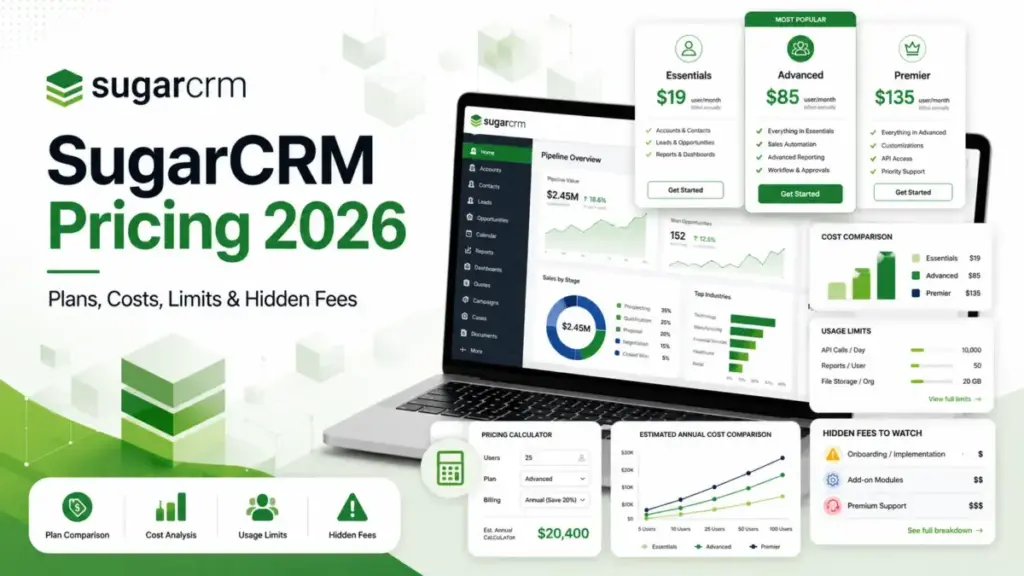
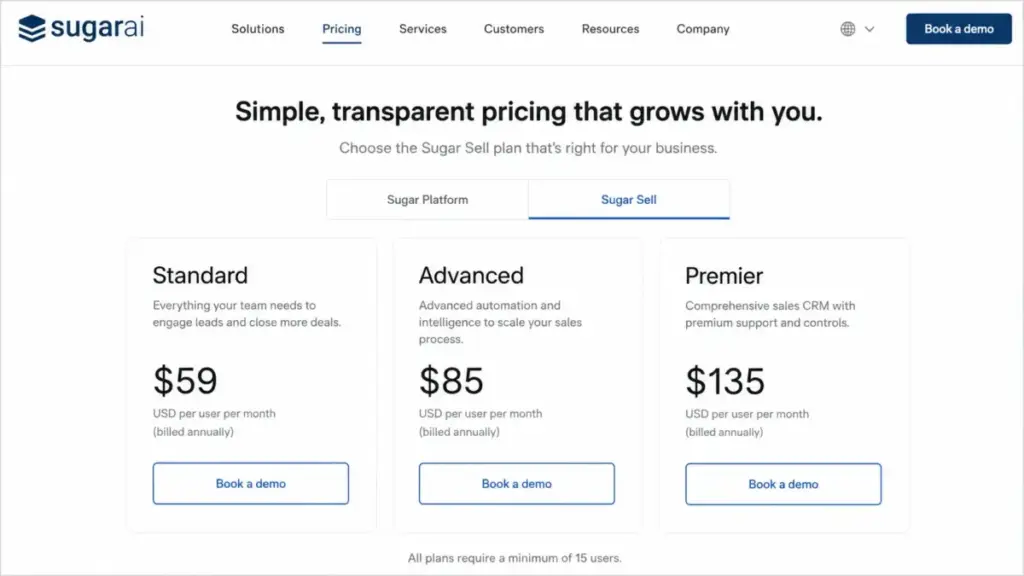
The advertised entry price for SugarCRM is $59 per user per month. The number your finance team signs off on is $10,620 for the first year.
Sugar enforces a 15-user minimum on every public cloud plan.
That gap between sticker price and contract floor is the whole story of SugarCRM pricing in 2026. A five-person sales team pays for ten seats nobody logs into.
This guide costs out all three public Sugar Sell plans: contract math, upgrade-forcing feature gates, unpriced add-ons, and total cost at five to fifty users. Every figure comes from official pricing, legal, support, and documentation sources checked on July 29, 2026.
We also cross-checked it against the best CRM software options we track.
One more thing before the tables. The company rebranded, and roughly half the pricing pages ranking today are quoting plans that no longer exist.
SugarCRM Pricing at a Glance (Verified July 29, 2026)
| Question | Answer |
|---|---|
| Starting price | $59 per user/month, billed annually (Sugar Sell Standard) |
| Real entry cost | $10,620 per year, because 15 seats are the minimum |
| Free plan | None published |
| Free trial | No current self-service trial duration published; a demo is offered |
| Billing options | Annual only on the public page. No month-to-month tier is advertised |
| Best plan for most buying teams | Advanced at $85 per user/month, because email and calendar sync are included |
| Plan to avoid | Standard, if your reps live in Outlook or Gmail |
| Biggest hidden cost | The 15-seat floor, worth $7,080 per year in unused licenses for a 5-person team |
| Second biggest | Annual renewal uplifts of 8%, 6%, or 4% depending on contract term |
| Best alternative if too expensive | Zoho CRM Standard at $14 per user/month with no comparable seat floor |
| Pricing verified | July 29, 2026, against the official US pricing page |
The verdict table above is where most buyers stop reading and start negotiating. The rows that change budgets are the seat floor and the renewal uplift.
Neither appears on the pricing page in a form a CFO can model.
I would treat $10,620 as the true starting line for SugarCRM, not $59.
SugarCRM Is Now SugarAI: What You Are Paying For
SugarCRM announced a new brand identity as SugarAI in an April 2026 announcement, and the site footer now names SugarAI Software Inc. The legacy search term still points at the same company.
The priced product for sales teams is Sugar Sell. That is the line with public per-user pricing, and it is what this guide costs out.
Sugar Serve, Sugar Market, and the on-premises Enterprise editions are separate products with separate commercial terms. Mixing them into one price table is the single most common error on the current results page.
Sugar positions itself for complex, account-based selling in manufacturing, wholesale, and distribution, with heavy ERP connectivity. The company reports more than 4,000 customers and over 180 ERP integrations, and those are vendor-reported figures rather than audited ones.
Still mapping the category before shortlisting? Our explainer on what CRM software does covers the data model behind Sugar’s per-seat licensing.
Stale Claims Circulating in 2026 Search Results
| Claim you will see elsewhere | Status on July 29, 2026 | Source of truth |
|---|---|---|
| Plans cost $79 / $115 / $180 | Outdated | Live pricing page shows $59 / $85 / $135 |
| Sugar Essentials is available | Not shown as a current public Sugar Sell tier | Live pricing page lists only Standard, Advanced, Premier |
| Minimum is 10 users | Outdated for cloud Sell | Pricing policy sets 15, effective September 15, 2025 |
| Sugar caps you at 15 users | Reversed | 15 is a floor, not a ceiling |
| Monthly billing is available | Not published | Every public tier reads “billed annually” |
| A standard free trial is offered | Unverified | The live page promotes a demo, not a published trial length |
Three of those six errors appear in results currently ranking in the top ten for SugarCRM pricing. Any of them can move a budget by five figures.
Essentials is the trickiest one. It is not visible as a purchasable Sugar Sell tier today.
I would ask sales whether any legacy offer still applies rather than planning around it.
SugarCRM Pricing Plans Compared for 2026
Three public Sugar Sell cloud plans exist. All three are per user per month, billed annually, with the same 15-user minimum.
| Plan | Monthly equivalent | Per seat per year | 15-seat annual floor | Billing basis | Best for | Key limits |
|---|---|---|---|---|---|---|
| Standard | $59 | $708 | $10,620 | Per user, annual commitment | 15-plus rep teams that only need core pipeline and quoting | Mail and calendar sync sold separately; Basic support only |
| Advanced | $85 | $1,020 | $15,300 | Per user, annual commitment | Teams that need email sync, case handling, and faster support | Sugar Intelligence, sales-i, and Smart Guides are separately licensed |
| Premier | $135 | $1,620 | $24,300 | Per user, annual commitment | Field and territory sales teams needing mapping and analytics | LinkedIn Sales Navigator licenses are your cost, not Sugar’s |
Prices come from SugarAI’s official pricing page, checked July 29, 2026. Prices change, so confirm the figure on your order form before signing.
The jump from Standard to Advanced is $26 per user per month. At the 15-seat floor that is $4,680 per year, which is the real price of putting Outlook and Gmail sync into your CRM.
The jump from Advanced to Premier is $50 per user per month, or $9,000 per year at 15 seats. Premier buys mapping, Discover analytics, double the managed storage, and a faster support tier.
Our full SugarCRM review covers how the modules behave once configured; this guide stays on the money.
Is There a SugarCRM Free Trial or Free Plan?
No free plan is published for Sugar Sell. The official pricing page routes buyers to a demo request rather than a self-service signup.
No current official free-trial duration was verified on July 29, 2026. Third-party review platforms disagree with each other on this point, and none of them is the vendor.
That matters for evaluation cost. Without a self-service trial, your proof-of-concept runs through a sales cycle, a scoped demo, and possibly a paid sandbox exercise.
I would budget two to four weeks of evaluation before signature. If hands-on validation is a requirement, get a written trial or pilot term into the order form.
Executive Summary: SugarCRM TCO at 5, 10, 15, 25, and 50 Users
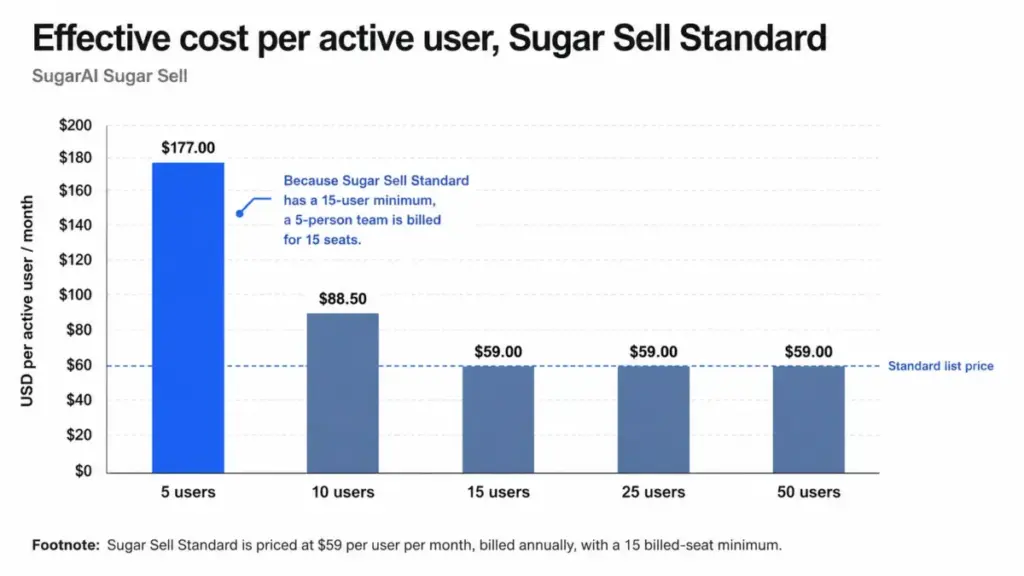
The 15-seat minimum applies to a combination of Sugar Sell and Sugar Serve subscriptions, effective September 15, 2025. Below 15 active users, you still pay for 15.
| Active users | Recommended plan | Billed seats | Monthly equivalent | Annual subscription | Effective cost per active user |
|---|---|---|---|---|---|
| 5 | Standard | 15 | $885 | $10,620 | $177.00 |
| 10 | Standard | 15 | $885 | $10,620 | $88.50 |
| 15 | Standard | 15 | $885 | $10,620 | $59.00 |
| 15 | Advanced | 15 | $1,275 | $15,300 | $85.00 |
| 25 | Advanced | 25 | $2,125 | $25,500 | $85.00 |
| 50 | Premier | 50 | $6,750 | $81,000 | $135.00 |
These figures are derived by multiplying the official per-user price by billed seats and by twelve months. They cover subscription fees only, and exclude tax, negotiated discounts, implementation, add-ons, storage overages, support upgrades, and renewal uplifts.
A five-person team pays three times the headline rate per person who logs in. That is the single most useful number in this guide, and no competing pricing page publishes it.
The economics only normalize at 15 active users. From seat 15 upward, SugarCRM pricing behaves like ordinary per-seat CRM pricing.
Below 15, you are buying a platform commitment rather than a per-seat tool.
Line-Item Cost Breakdown: Every Billable Sugar Sell Item
Sugar publishes three prices and keeps the rest behind a quote. Here is the full billable inventory, with an honest label on what is public and what is not.
| Line item | Public price | When it applies |
|---|---|---|
| Sugar Sell Standard seat | $59 per user/month, annual | Base subscription, 15-seat minimum |
| Sugar Sell Advanced seat | $85 per user/month, annual | Base subscription, 15-seat minimum |
| Sugar Sell Premier seat | $135 per user/month, annual | Base subscription, 15-seat minimum |
| Mail and calendar integration on Standard | Not publicly disclosed | Standard buyers who need Outlook or Gmail sync |
| Sugar Intelligence and sales-i | Not publicly disclosed | Advanced buyers wanting account intelligence |
| Sugar Automate and Smart Guides | Not publicly disclosed | Advanced buyers wanting guided selling; included on Premier |
| LinkedIn Sales Navigator | Third-party subscription, not Sugar’s price | Premier buyers using the LinkedIn connector |
| Managed storage overage | Not publicly disclosed | File or database usage above the plan allocation |
| Pre-purchased extra storage | Not publicly disclosed | Buyers avoiding overage invoices |
| Additional sandboxes | Not publicly disclosed | Implementation and QA beyond included environments |
| Enhanced or Premium support upgrade | Not publicly disclosed | Teams needing faster or 24×7 response |
| Implementation, migration, training | Custom quote | Data migration, integrations, custom workflows |
| Sugar Serve licence for dual-role users | Verify separately | One person doing both sales and service work |
| Sugar Market contact expansion | $150 per month per additional 10,000 contacts | Sugar Market subscriptions above the 10,000-contact base |
Only four of those fourteen lines carry a public number. That ratio is the real reason SugarCRM pricing is hard to compare against Zoho or HubSpot.
Do not accept a verbal figure for any undisclosed line. I would ask for a written price schedule covering storage, sandboxes, support upgrades, and every starred feature before the contract is drafted.
What Each Sugar Sell Plan Includes
Sugar Sell Standard: $59 per User per Month
Standard covers accounts, contacts, leads, opportunities, quotes, activities, pipeline management, business process management, reporting, and mobile access. Basic support is included.
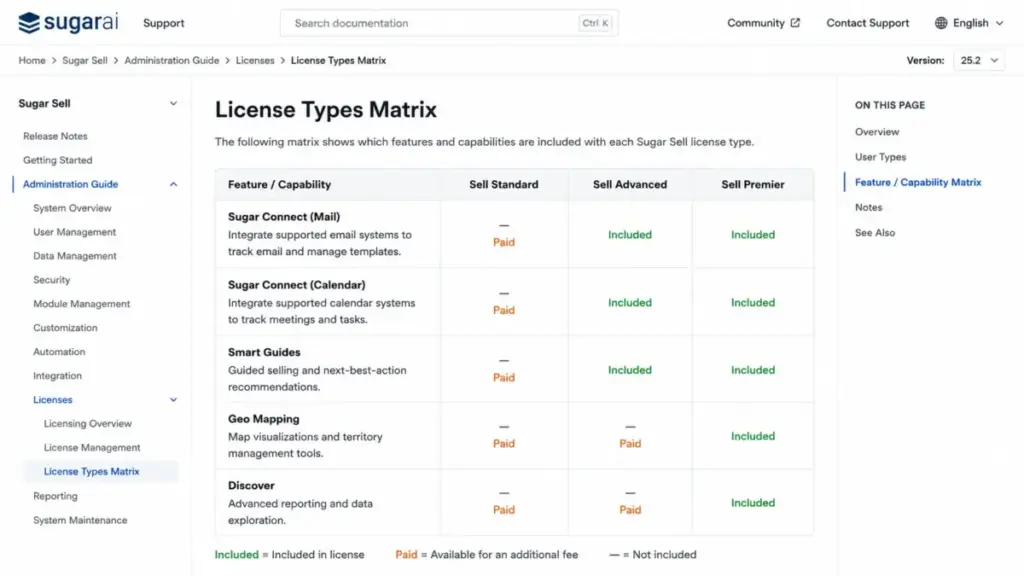
What is missing matters more. Mail and calendar integration is an optional purchase rather than an included feature, and the license matrix confirms that gate.
Cases and bug tracking are not part of Standard either. Support response targets sit at four business hours for a priority-one issue, which is the slowest tier Sugar publishes.
Mini verdict: Standard works for a 15-rep team that keeps email in Outlook and never expects the CRM to log it.
Avoid Standard if: your reps expect calendar and email activity to appear on the contact record automatically. The workaround is manual logging, and manual logging is where CRM adoption dies.
Sugar Sell Advanced: $85 per User per Month
Advanced adds mail and calendar integration, cases, bug tracking, and a faster support tier with a two-business-hour priority-one target. Managed storage rises from a 10 GB base to a 15 GB base per pool.
The asterisks are the catch. Sugar Intelligence, sales-i, and Smart Guides appear alongside Advanced but are optional or separately licensed.
No public unit price exists for any of them.
Read the Advanced feature list as a menu, not an inventory.
Mini verdict: Advanced is the plan I would default to for a 15-to-40-rep B2B team, because email sync and case handling are usually non-negotiable.
Avoid Advanced if: you are buying it specifically for account intelligence or guided selling. Those need separate licenses, and Premier may cost less than Advanced plus two add-on quotes.
Sugar Sell Premier: $135 per User per Month
Premier adds geo mapping, Discover analytics, the LinkedIn connector, and Enhanced support with a one-business-hour priority-one target. Managed storage doubles to a 30 GB base plus 0.5 GB per user in each pool.
Smart Guides is included at this tier rather than licensed separately. For teams that want guided selling, that inclusion is a large part of the price gap.
The LinkedIn connector does not include LinkedIn. Sugar’s product terms require each applicable user to hold an active LinkedIn Sales Navigator license, which is a separate bill from a separate vendor.
Mini verdict: Premier earns its price for territory-based field sales teams that need mapping, faster support, and Smart Guides without add-on negotiations.
Avoid Premier if: your sellers are inside sales who never plan routes and your support risk tolerance is normal. At 50 seats, Premier costs $81,000 per year against $51,000 for the same headcount on Advanced.
Feature Gates: What Each Plan Includes and What It Does Not
The live pricing page marks several features with asterisks. It does not explain whether an asterisk means included, purchasable, or dependent on a third party.
Use this legend when reading any Sugar Sell feature list.
| Capability | Standard | Advanced | Premier | Purchase status |
|---|---|---|---|---|
| Core CRM records and pipeline | Included | Included | Included | Included in plan |
| Business process management | Included | Included | Included | Included in plan |
| Reporting and dashboards | Included | Included | Included | Included in plan |
| Mobile access | Included | Included | Included | Included in plan |
| Mail and calendar integration | Add-on | Included | Included | Paid add-on on Standard, price not disclosed |
| Cases and bug tracking | Not included | Included | Included | Included from Advanced |
| Smart Guides (Sugar Automate) | Not included | Separately licensed | Included | Separate license below Premier |
| Sugar Intelligence and sales-i | Not included | Optional | Optional | Separate license, price not disclosed |
| Geo mapping | Not included | Not included | Included | Included at Premier |
| Discover analytics | Not included | Not included | Included | Included at Premier |
| LinkedIn connector | Not included | Not included | Included | Connector included, Sales Navigator licensed separately |
| Support tier | Basic | Standard | Enhanced | Premium available, price not disclosed |
| Storage base per pool | 10 GB | 15 GB | 30 GB | Overage billed, rate not disclosed |
| Storage per user per pool | 0.25 GB | 0.25 GB | 0.5 GB | Overage billed, rate not disclosed |
Feature gates are documented in the official Sugar license types matrix, which is more precise than the marketing page.
Four categories exist here, not two: included, paid add-on, separately licensed, and third-party dependency. Treating all four as “included in the plan” is how a $15,300 budget becomes a $22,000 invoice.
Sugar’s plan ladder is not a smooth progression of more features. It is a set of discrete gates.
Only three of them (email sync, Smart Guides, and support speed) drive most upgrade decisions.
Annual Billing, Renewal Uplifts, and Seat Locks
There is no monthly-billing comparison to run for Sugar Sell, because no month-to-month option is published. Every public price is a monthly equivalent on an annual commitment.
That removes the usual “save 20% with annual billing” calculation. It also removes your ability to walk away mid-year.
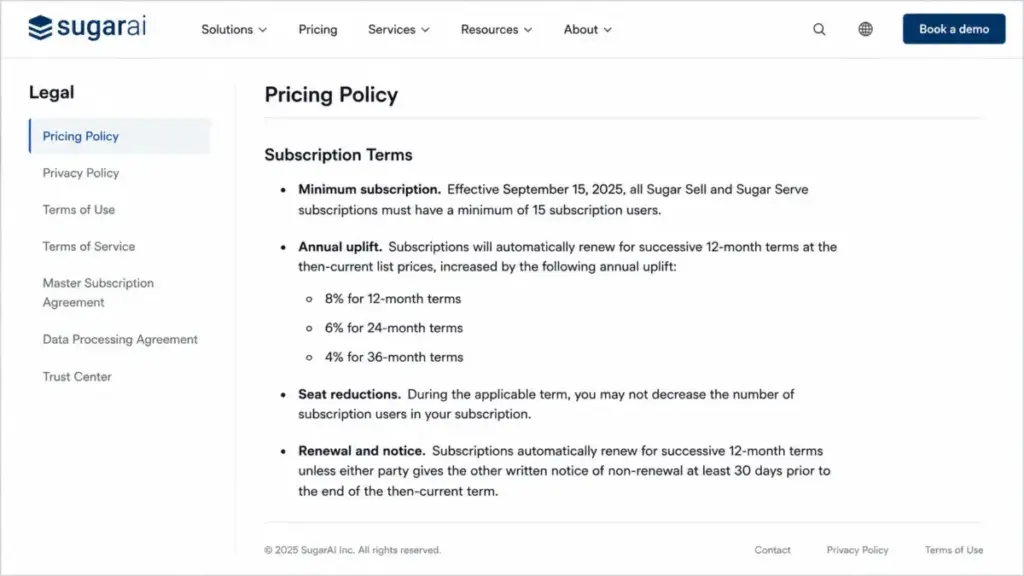
Three clauses in the official pricing policy shape multi-year cost more than the plan choice does.
Annual uplifts. Subscriptions carry an annual increase of 8% on one-year terms, 6% on two-year terms, and 4% on three-year-or-longer terms. Those increases are subject to policy and capped at then-current list price.
No in-term seat reductions. Subscription user seats cannot be decreased during an active term. If headcount drops in month four, you carry those seats to renewal.
Automatic renewal. Subscriptions renew automatically for a term equal to the initial term unless notice is given at least 30 days before expiration.
Here is what the uplift policy does to a 15-seat Standard contract over three years, holding list price constant.
| Contract term | Annual uplift | Year 1 | Year 2 | Year 3 | Three-year total |
|---|---|---|---|---|---|
| 1-year, renewed annually | 8% | $10,620 | $11,470 | $12,387 | $34,477 |
| 2-year | 6% | $10,620 | $11,257 | $11,933 | $33,810 |
| 3-year or longer | 4% | $10,620 | $11,045 | $11,487 | $33,151 |
These are modeled from the published uplift percentages, not a quoted invoice. Future list price is unknown, and order-form exceptions can override the default, so treat the table as policy context rather than a forecast.
The spread across terms is $1,326 over three years on a 15-seat Standard contract, or about 3.8%. Longer terms buy a smaller uplift, and they cost you the flexibility to shrink.
Combine the uplift with the no-reduction clause and the picture sharpens: a three-year term protects your rate and locks your seat count. I would only sign a three-year deal when headcount is stable or growing.
Put the 30-day renewal notice in your contract calendar the week you sign. Missing it is how teams end up renewing a seat count they meant to cut.
Hidden Costs and Add-Ons Nobody Quotes Upfront
The subscription line is the part of SugarCRM pricing you can plan. These are the parts that arrive later.
| Hidden cost | What triggers it | Public price |
|---|---|---|
| 15-seat minimum | Fewer than 15 licensable users | $7,080 per year wasted at 5 active users on Standard |
| Annual renewal uplift | Every renewal or anniversary | 8% / 6% / 4% by term length |
| Mail and calendar sync on Standard | Reps need Outlook or Gmail logging | Not disclosed; Advanced upgrade costs $4,680 per year at 15 seats |
| Smart Guides below Premier | Advanced team wants guided selling | Not disclosed |
| Sugar Intelligence and sales-i | Advanced team wants account intelligence | Not disclosed |
| LinkedIn Sales Navigator | Premier team uses the LinkedIn connector | Third-party subscription, billed by LinkedIn |
| Storage overage | File or database usage above allocation | Not disclosed; invoiced quarterly in arrears |
| Extra sandboxes | Implementation or QA beyond included environments | Not disclosed |
| Support upgrade | Faster or 24×7 response needed | Not disclosed |
| Implementation and migration | Data, integrations, training, cutover | Custom quote |
| Dual Sell and Serve licensing | One person sells and handles service cases | Serve priced separately |
| Sugar Market contacts | Sugar Market list above 10,000 contacts | $150 per month per extra 10,000, or $1,800 per year per block |
Nine of those twelve carry no public number. Each one is a negotiation item, and each one is easier to price before signature than after.
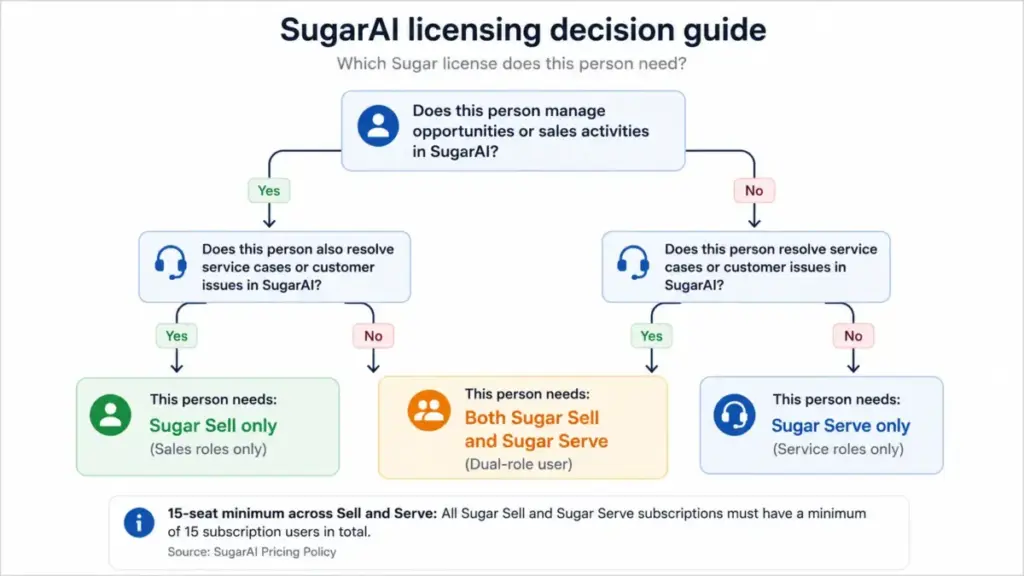
The dual-license item catches cross-functional teams off guard. Sugar’s policy applies the 15-user minimum across a combination of Sell and Serve.
Migration documentation points to evaluating license needs per user role.
If a rep also resolves service cases, plan for two licenses on one human, not one. Sugar’s product terms also confirm the LinkedIn dependency, so the connector at Premier does not remove the Sales Navigator bill.
I would build the quote request around roles first: sales-only, service-only, and dual-role. That single exercise usually changes the seat count before it changes the plan.
Storage, API, and Backup Limits That Become Costs
SugarCloud allocates storage by formula, not by a flat allowance. Each plan gets a base amount plus a per-user amount, applied to both file-system storage and database storage.
| Seats | Standard per pool | Advanced per pool | Premier per pool |
|---|---|---|---|
| 15 | 13.75 GB | 18.75 GB | 37.5 GB |
| 25 | 16.25 GB | 21.25 GB | 42.5 GB |
| 50 | 22.5 GB | 27.5 GB | 55 GB |
Figures are calculated from the base-plus-per-user formulas published in the SugarCloud offerings documentation. Each plan receives that allocation twice, once for files and once for the database.
A 25-seat Advanced tenant gets 21.25 GB of file storage. Attachment-heavy sales teams sending proposals and signed contracts will reach that faster than the number suggests.
Overages do not block work, which is precisely the problem. Sugar’s policy describes overage notification with invoicing quarterly in arrears.
Extra storage can be pre-purchased instead, though no public unit rate exists for either path.
Sandboxes make it worse before they make it better. Sandbox storage counts against the same subscription pool, and included sandboxes may need to be provisioned on request.
Additional sandboxes are purchasable at an undisclosed rate.
The Backup Caveat Nobody Ranks For
Uploaded files are not included in standard backups by default unless requested. Database backups and uploaded-file retention are not the same thing.
If your quotes, contracts, and signed proposals live as CRM attachments, that is a disaster-recovery gap rather than a pricing detail. Get the file-backup scope and the restoration process confirmed in writing before go-live.
API Throughput Constraints
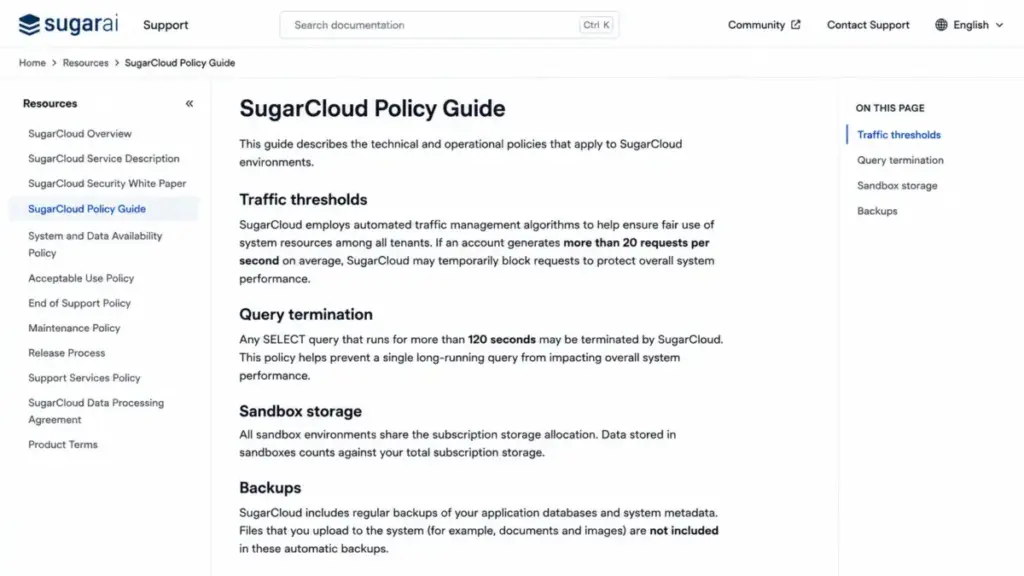
The SugarCloud policy guide sets operational thresholds that affect integration architecture.
- Traffic above 20 requests per second may be blocked.
- SELECT queries running longer than 120 seconds are terminated.
- Planned high-volume traffic requires a support case roughly seven days in advance.
- Direct production database access, custom triggers, and stored procedures are not permitted; use supported APIs and extension mechanisms.
- REST is the current integration path, and SOAP is legacy from the Sugar 7 era.
Those five lines decide whether a nightly ERP sync is a configuration task or a redesign. Teams migrating from a self-hosted Sugar instance are the ones most likely to be surprised.
Direct database work is off the table in SugarCloud.
Model your peak request rate before signing, not during implementation. If your integration bursts past 20 requests per second, raise it with Sugar during procurement while you still have negotiating room.
Support Tiers and Response Times by Plan
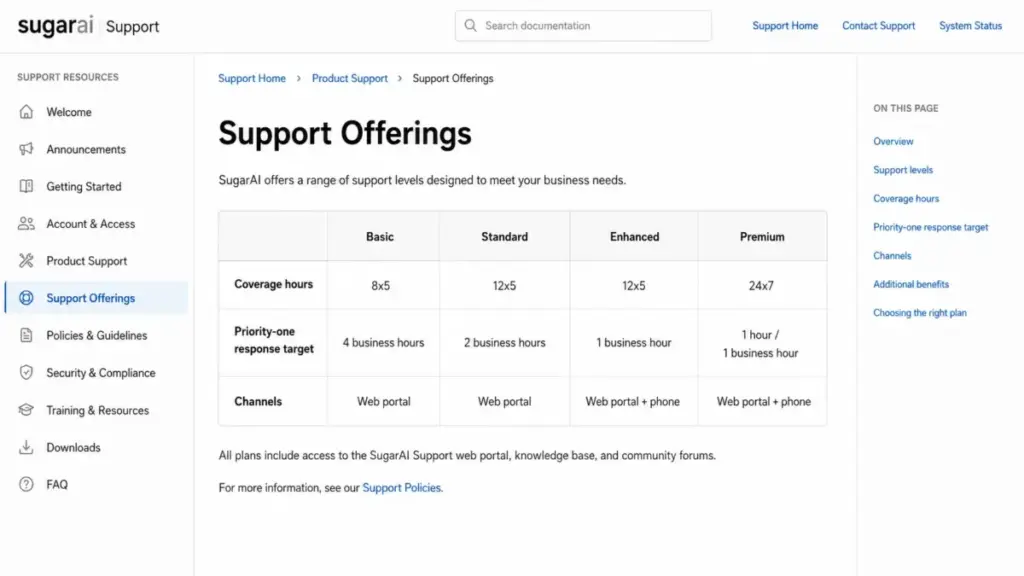
Support is a plan-gated product at Sugar, and the response targets differ enough to change which plan a revenue-critical team should buy.
| Support level | Coverage | Priority-one target | Included with |
|---|---|---|---|
| Basic | 8×5 | 4 business hours | Sugar Sell Standard |
| Standard | 12×5 | 2 business hours | Sugar Sell Advanced |
| Enhanced | 12×5 | 1 business hour | Sugar Sell Premier |
| Premium | 24×7 | 1 hour | Paid upgrade, price not disclosed |
Coverage and response targets are published in the Sugar support offerings matrix.
The gap between Standard and Premier is four business hours versus one on a priority-one incident. For a team whose pipeline stalls when the CRM stalls, that difference can justify the price jump on its own.
Premium is the only tier with 24×7 coverage, and it is the only tier whose price Sugar does not publish at all. If your sales operation runs across time zones, request that quote early, because it changes the plan comparison.
The naming is a genuine trap. Sugar Sell Standard includes Basic support, while Standard support belongs to Sugar Sell Advanced.
Read every support clause against the support-level name, not the plan name.
Implementation and Migration: What to Budget
No universal implementation price is published, and I am not going to invent a range. Secondary guides that quote confident implementation figures are estimating, not sourcing.
What is documented is the work itself. Sugar’s migration guidance calls for evaluating user license needs by role and reviewing configurations in a sandbox.
It also calls for planning a maintenance window for cutover.
These are the cost drivers that shape any quote you receive.
- Record volume and data quality in the source system.
- Number of custom modules and custom fields.
- Integration count, especially ERP and quoting systems.
- Workflow and business-process rebuilds.
- Reporting and dashboard configuration.
- Sandbox provisioning and test-data sizing.
- Admin and end-user training.
- Cutover window and post-launch support.
Ask every implementation bidder to price those eight items separately. Comparable line items are the only way to compare two quotes that differ by 40%.
Sandbox sizing belongs on that list for a reason. Test data consumes the same storage pool as production.
A full-copy sandbox during migration can push you into overage before a single rep logs in.
Our CRM implementation guide covers the sequencing, and the CRM migration checklist covers data mapping in more depth than a pricing article can.
SugarCloud vs On-Premises Enterprise Pricing
Cloud Sell tiers and on-premises Enterprise editions are separate commercial models. Merging them produces the wrong budget.
Official 2025 Enterprise editions material lists Enterprise On-Premises at $85 per user per month and Enterprise+ at $120, each with a 10-user minimum. That document carries a 2025 revision.
Verify both the price and the availability with sales before planning around it.
| Factor | SugarCloud Sell | On-premises Enterprise (2025 material) |
|---|---|---|
| Minimum users | 15 | 10 |
| Published prices | $59 / $85 / $135 | $85 and $120 |
| Hosting responsibility | Sugar | You |
| Direct database access | Not permitted | Your environment, your rules |
| Storage overage billing | Quarterly in arrears | Your infrastructure cost |
| Support tiers | Basic to Enhanced by plan | Verify separately |
The 10-user minimum on the on-premises line is the detail worth noticing. A 10-person team that genuinely wants Sugar may find the deployment question answers the seat-floor problem.
That trade is real but not free. You take on hosting, patching, and infrastructure cost, and you lose the managed-service posture that most 10-person sales teams want.
Security and Compliance Scope
Official security materials support SOC 2 Type II, ISO 27001, CSA STAR Level 1, and controls aligned to GDPR and CCPA. That is a solid baseline for standard B2B sales data.
It is not a blanket regulatory clearance. Nothing in the reviewed evidence establishes HIPAA, PCI DSS, or FedRAMP suitability, and I would not assume any of them.
Request the current reports directly and confirm the exact service, region, and scope they cover. Procurement teams in regulated industries will ask for the scope statement, not the badge.
Which SugarCRM Plan Should You Choose?
Plan choice at Sugar comes down to three gates: email sync, guided selling, and support speed. Team size decides whether you should be buying at all.
| Buyer type | Recommended plan | Annual subscription | Why |
|---|---|---|---|
| Solo or 2-3 person team | None; choose another CRM | N/A | The 15-seat floor makes effective cost $295 or more per active user |
| 5-10 person sales team | Standard, only if you can live without email sync | $10,620 | You still pay 15 seats; effective cost is $88.50 at 10 users |
| 15-40 rep B2B team | Advanced | $15,300 at 15 seats | Email sync, cases, and 2-hour priority-one support |
| Field or territory sales team | Premier | $24,300 at 15 seats | Geo mapping, Discover, Smart Guides, 1-hour support |
| 50-plus seat operation with ERP integration | Premier | $81,000 at 50 seats | Storage headroom, faster support, included guided selling |
| Cross-functional sales and service reps | Advanced or Premier plus Serve | Quote required | Dual-role users may need two licenses |
Advanced is the plan I would recommend for most 15-plus B2B teams evaluating SugarCRM pricing in 2026. Email and calendar sync is not a luxury feature, and buying Standard then adding it usually costs more than starting at Advanced.
Premier makes sense on two triggers, not one: field-based selling and a low tolerance for slow support. If only one of those is true, Advanced plus a support-upgrade quote is worth pricing first.
Which SugarCRM Plan Should You Avoid?
Sugar Sell Standard is the plan I would avoid for most buyers. The reason is a single feature gate.
Mail and calendar integration is an add-on on Standard and included from Advanced upward. A CRM that does not automatically log rep email is a CRM your reps will update manually, which means they will not update it.
The upgrade path is expensive after the fact. Moving 15 seats from Standard to Advanced costs $4,680 per year.
The Sugar Connect add-on quote is not public, so you cannot compare the two options without contacting sales.
Standard still fits one profile. A 15-plus rep team running structured outbound through a separate sales-engagement platform, with email logged there instead, gets real value from the $10,620 entry point.
Outside that scenario, Standard is a plan you upgrade out of within a year. Teams that need a lighter architecture should look at Microsoft Dynamics 365 Sales or a mid-market CRM without a seat floor.
SugarCRM Pricing vs Salesforce, Zoho CRM, and HubSpot
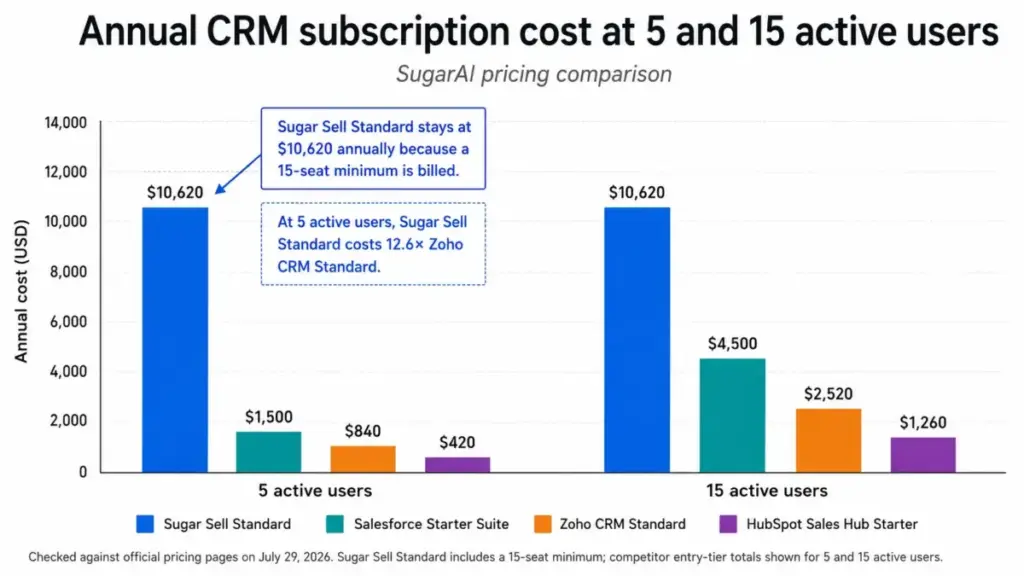
Comparing entry prices per seat makes Sugar look competitive. Normalizing for the 15-seat minimum changes the answer completely.
| Product | Entry price | Cost at 5 active users/year | Cost at 15 active users/year | Best for |
|---|---|---|---|---|
| Sugar Sell Standard | $59 per user/month, annual | $10,620 (15 seats billed) | $10,620 | 15-plus rep B2B teams with ERP-connected selling |
| Salesforce Starter Suite | $25 per user/month | $1,500 | $4,500 | Small teams wanting a mainstream ecosystem |
| Zoho CRM Standard | $14 per user/month, annual | $840 | $2,520 | Cost-sensitive teams that will configure it themselves |
| HubSpot Sales Hub Starter | From $7 per seat/month annual, $20 monthly | $420 | $1,260 | Teams starting free and scaling into paid tiers |
Competitor prices were checked July 29, 2026 on each vendor’s official pricing page. HubSpot’s displayed annual rate may reflect a promotion, and none of these tiers is feature-equivalent to Sugar Sell.
At five active users, Sugar Sell Standard costs 12.6 times Zoho CRM Standard and 7.1 times Salesforce Starter Suite. At fifteen users the gap narrows to 4.2 times Zoho, which is still a wide spread.
Feature scope explains part of that spread and not all of it. Sugar is priced as a configurable B2B platform with business process management and ERP orientation.
Starter tiers from Salesforce and HubSpot are deliberately limited entry products.
Compare Salesforce pricing at its Sales Professional tier rather than Starter Suite if you want a fair fight. The same applies to Zoho CRM pricing plans at Professional or Enterprise.
Treat this table as a price anchor, not a value verdict. It answers “what will I spend” rather than “what will I get”.
Is SugarCRM Worth the Price in 2026?
Sugar Sell earns its price when the CRM has to model a complicated sales motion, not just store contacts. Business process management, configurable data structures, and ERP-connected account context are the capabilities you are paying a premium for.
Worth it if: you have 15 or more licensable sellers, a long B2B sales cycle, and ERP data that belongs on the account record. You also need an admin or partner who can configure it properly.
Worth it if: you need guided selling and territory mapping in one platform and you would otherwise stitch three tools together.
Not worth it if: you have fewer than 15 sellers. The floor turns a $59 product into a $177 product per person who uses it.
Not worth it if: you need transparent all-in pricing before talking to sales. Nine of twelve add-on lines carry no public price, and that is a procurement problem for lean finance teams.
Not worth it if: nobody on your team owns CRM administration. Sugar’s configurability is the reason to buy it and the reason implementations stall.
Teams that like the architecture but not the seat floor should read the HubSpot vs SugarCRM comparison before committing. Teams that want the same B2B depth from a different vendor will find better-matched options among these SugarCRM alternatives.
My verdict: Sugar Sell Advanced at 15-plus seats is a defensible purchase for ERP-connected B2B sales teams. Below 15 seats, Sugar Sell is a budgeting mistake.
How to Avoid Overpaying for SugarCRM
Seven moves that change the invoice, in the order I would make them.
1. Count licensable users before you count plans. Under 15, the seat floor is your dominant cost and the plan comparison barely matters.
2. Separate roles before requesting a quote. Sales-only, service-only, and dual-role users have different licensing outcomes, and dual-role users may need both Sell and Serve.
3. Price Advanced against Standard plus the Sugar Connect add-on. The upgrade costs $4,680 per year at 15 seats, and the add-on quote is private, so make Sugar produce both numbers.
4. Get a written price schedule for every undisclosed line. Storage overage, sandboxes, support upgrades, Smart Guides, and Sugar Intelligence all belong there.
5. Model storage before signing. Calculate base plus per-user allocation for both pools, add sandbox copies, and compare it to your current attachment volume.
6. Negotiate the uplift, not just the discount. Published rates are 8%, 6%, and 4% by term. Longer terms trade flexibility for a lower increase.
7. Diary the 30-day renewal notice on signature day. Automatic renewal repeats the initial term, and the no-reduction clause blocks a mid-term seat trim.
The first two moves save more money than the other five combined. Everything else is margin management once the seat count is right.
FAQ
How much does SugarCRM cost per month?
Sugar Sell Standard is $59 per user per month, Advanced is $85, and Premier is $135, all billed annually. The 15-user minimum makes the smallest real contracts $885, $1,275, and $2,025 in monthly-equivalent terms.
Annual totals are $10,620, $15,300, and $24,300. Prices were checked on the official US pricing page on July 29, 2026.
Does SugarCRM have a free plan or a free trial?
No free plan is published for Sugar Sell. No current official self-service trial duration was verified on July 29, 2026, and the live pricing page promotes a demo request instead.
Third-party sites contradict each other on trial availability. Ask Sugar directly and get any pilot term written into the order form before signing.
What is the minimum number of SugarCRM users?
Fifteen. The official pricing policy sets a 15-subscription minimum effective September 15, 2025, applied across a combination of Sugar Sell and Sugar Serve.
Older articles citing a 10-user minimum describe the previous policy, and one widely read review presents 15 as a maximum. On-premises Enterprise material lists a separate 10-user minimum.
Is SugarCRM billed monthly or annually?
Annually. Every public Sugar Sell price is a monthly equivalent on an annual commitment, and no month-to-month tier is advertised.
There is no monthly-versus-annual discount to calculate and no way to exit mid-term. Subscriptions renew automatically for a term equal to the initial term unless you give 30 days notice.
How much does SugarCRM cost for 15 users?
At 15 users the annual subscription is $10,620 on Standard, $15,300 on Advanced, and $24,300 on Premier. Those figures cover licenses only.
They exclude tax, implementation, migration, training, paid add-ons, storage overages, support upgrades, and the annual renewal uplift of 8%, 6%, or 4% by contract term.
Does SugarCRM charge extra for email and calendar integration?
On Sugar Sell Standard, yes. Mail and calendar integration is an optional purchase there and is included on Advanced and Premier, and Sugar does not publish the add-on price.
Upgrading 15 seats from Standard to Advanced costs $4,680 per year. Request both the add-on quote and the upgrade figure before choosing.
What are SugarCRM's biggest hidden costs?
The 15-seat minimum is the largest, costing a five-person team $7,080 per year in unused licenses. Annual renewal uplifts of 8%, 6%, or 4% come second.
Then come storage overages billed quarterly, add-on licenses for Smart Guides and Sugar Intelligence, extra sandboxes, support upgrades, and implementation services. Most carry no public price.
Is SugarCRM cheaper than Salesforce?
Not at small team sizes. At five active users, Sugar Sell Standard costs $10,620 per year against $1,500 for Salesforce Starter Suite, because Sugar bills 15 seats regardless.
At 15 users the gap narrows to $10,620 versus $4,500. Feature scope differs sharply, so treat this as a price anchor rather than a like-for-like verdict.
Is SugarCRM now called SugarAI?
Yes. SugarCRM announced a new brand identity as SugarAI in April 2026, and the site footer names SugarAI Software Inc.
The priced sales product is still Sugar Sell, with Standard, Advanced, and Premier tiers. Search results and review platforms still use the SugarCRM name, so expect both terms during procurement and in contracts.
Does SugarCRM include implementation?
No universal implementation price or package is published. Sugar’s documentation calls for evaluating license needs by role, reviewing configurations in a sandbox, and planning a maintenance window for cutover.
Costs depend on data volume, custom modules, integrations, workflow rebuilds, and training. Request an itemized quote rather than a single figure.