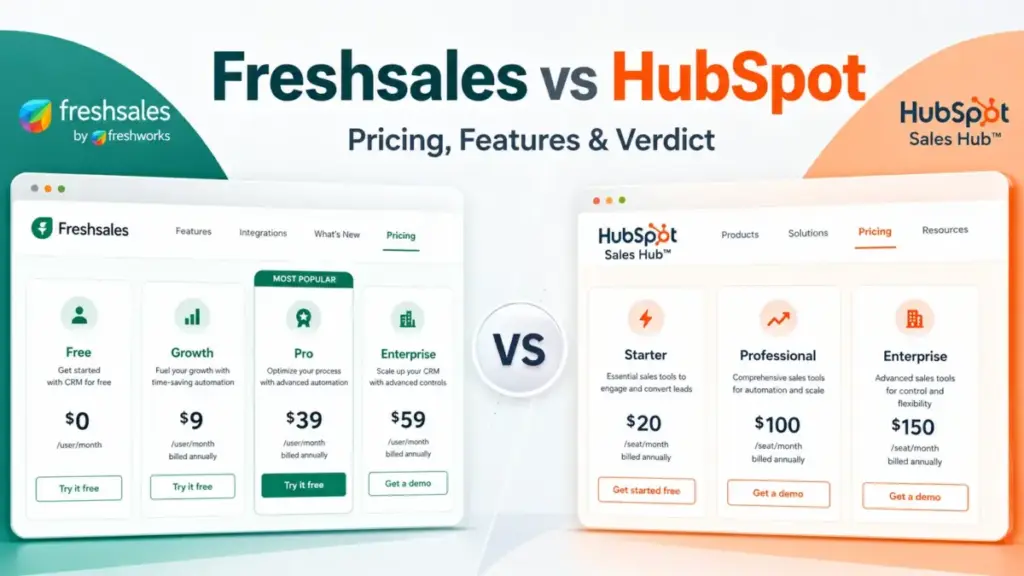
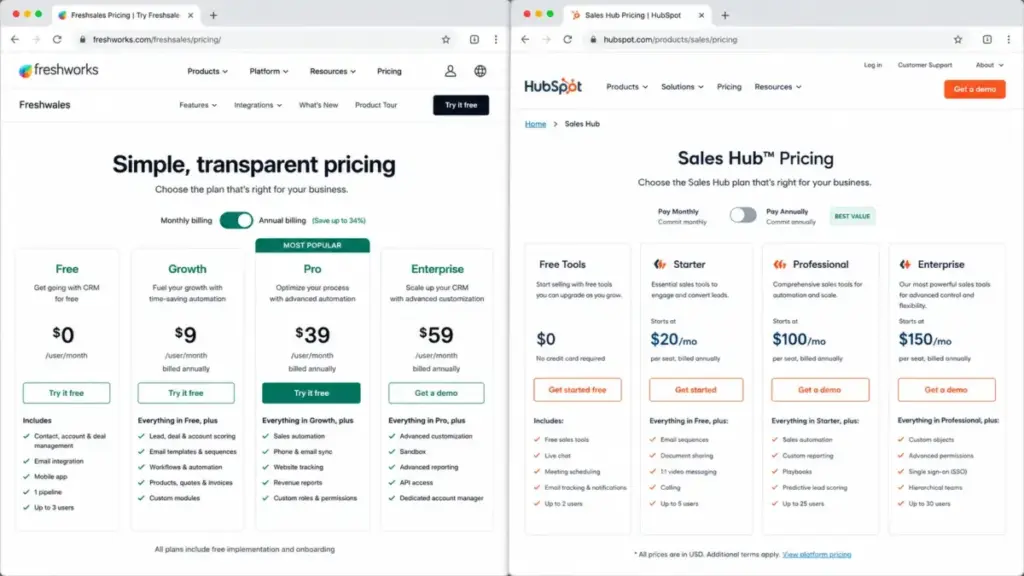
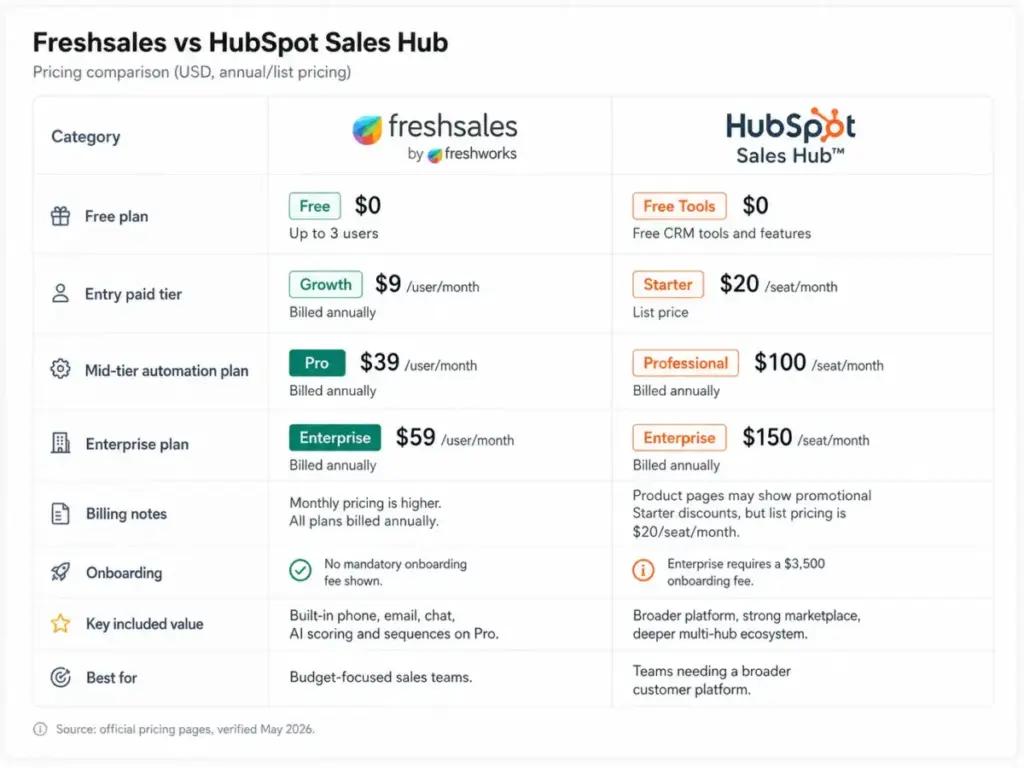
Freshsales Pro costs $39/user/month billed annually. HubSpot Sales Hub Professional costs $100/month per seat. For a 10-person sales team, that is $390/month versus $1,000/month. For buyers comparing mid-tier sales automation, Freshsales Pro is the closest practical comparison to HubSpot Sales Hub Professional, but the two plans do not map feature-for-feature. That price gap is real, and it shapes the entire Freshsales vs HubSpot decision.
But price alone does not tell you which CRM to buy. HubSpot is not just a sales tool. It is a customer platform connecting sales, marketing, service, content, and commerce under one login. Freshsales is a focused sales CRM with built-in phone, email, chat, and AI. The right choice depends on whether your team needs platform breadth or sales execution speed, and how much you are willing to pay for each.
I mapped both CRMs against seven real buying dimensions: pricing at scale, sales execution, platform breadth, automation, integrations, governance, and support. Every winner is declared. Every cost is sourced from official pricing pages verified as of May 2026. If you are comparing best CRM software options for a US sales team, this is the breakdown that matters.
Quick Verdict: Freshsales vs HubSpot
| Category | Winner | Why |
|---|---|---|
| Pricing and total cost at scale | Freshsales | $39/user/month Pro vs $100/seat/month Professional. Freshsales is 2.5x cheaper at every team size. |
| Sales execution speed | Freshsales | Built-in phone, email, chat, Kanban views, and Freddy AI in a single sales-focused CRM. |
| Platform breadth and ecosystem | HubSpot | Sales, marketing, service, content, data, and Commerce Hub under one customer platform. |
| Automation and AI depth | Tie | Freshsales exposes Freddy AI at Pro ($39). HubSpot gates serious automation at Professional ($100). |
| Integrations | HubSpot | HubSpot Marketplace is broader: Gmail, Outlook, WordPress, Zapier, Meta Ads, Jira, and more. |
| Security and governance | HubSpot | Deeper Enterprise governance, custom objects, sandbox, and compliance documentation. |
| Support and implementation | HubSpot | Clear support tiers: Community (free), email/chat (Starter), phone (Professional/Enterprise). |
What this means: Freshsales wins on two dimensions that matter most to budget-focused sales teams. HubSpot wins on five dimensions that matter when your CRM decision is really a platform decision. Choose based on which dimensions your team actually needs.
How We Compared Freshsales and HubSpot
This comparison uses official product pages, pricing documentation, and third-party review platforms as of May 2026. Testing level: third-party validated. I did not run live trials for this article. All feature claims, pricing tiers, and plan gates are sourced from Freshworks and HubSpot official pages, plus Capterra reviewer sentiment for user experience signals.
Pricing for Freshsales comes from the Freshworks CRM pricing page and the Freshworks price-list PDF. Pricing for HubSpot Sales Hub comes from the HubSpot product and services catalog and the HubSpot Sales Hub product page. I used annual billing for Freshsales and list pricing for HubSpot unless stated otherwise.
One limitation: HubSpot promotional Starter pricing changes by campaign. I used the legal catalog list price of $20/month per seat for Starter, not promotional pricing. Freshsales monthly prices were cross-checked against the Freshworks price-list PDF.
To understand how CRM software fits into your sales stack, the core question is whether you need a sales-only CRM or a full customer platform.
Workflow 1: Pipeline Management and Daily Sales Execution
Freshsales wins here. Not by a small margin.
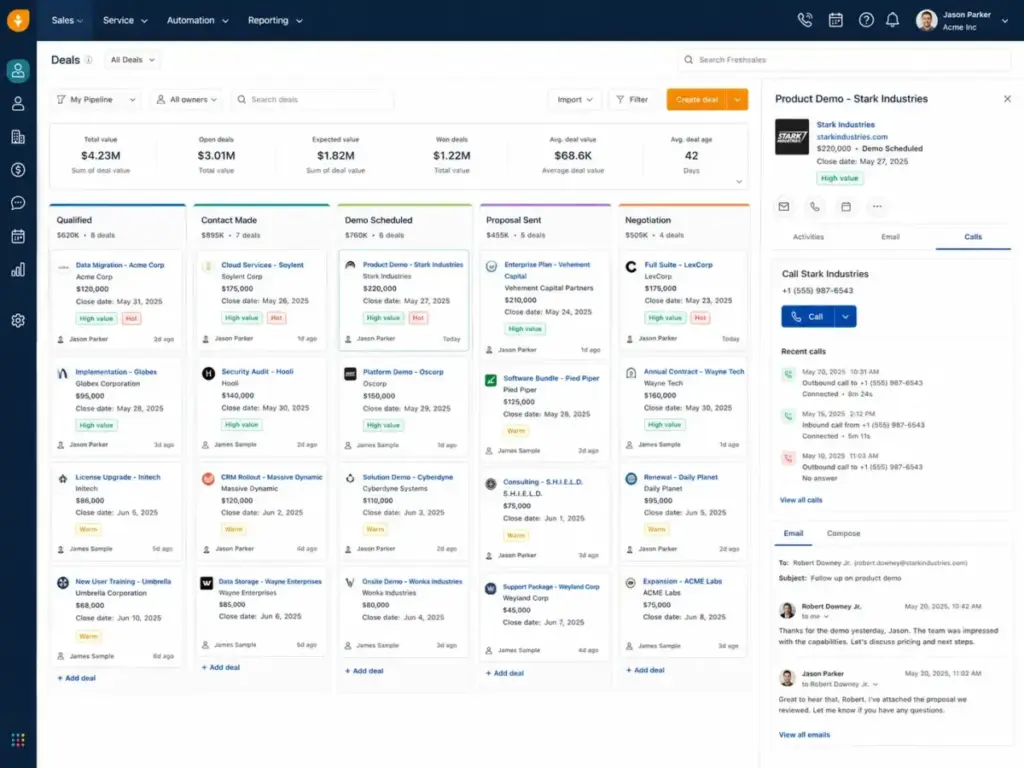
Freshsales bundles contact management, account management, deal pipelines, Kanban views, built-in phone, email, chat, email templates, and a mobile app into a single sales-focused interface. On the Growth plan at $9/user/month billed annually, a 5-person team gets core CRM, custom fields, basic workflows, curated reports, and one CPQ license for $45/month.
HubSpot Sales Hub Free includes deal tracking, live chat, and meetings. That is a solid starting point. But once a team needs sequences, custom reporting, or forecasting, they jump to Professional at $100/month per seat. A 5-person team on HubSpot Professional pays $500/month for capabilities that Freshsales delivers at Pro for $195/month.
The daily workflow difference: Freshsales reps log calls, send emails, and move deals through the pipeline without leaving the CRM. The built-in phone and chat remove the need for separate communication tools. Capterra reviewer patterns generally praise HubSpot’s clean interface and straightforward core CRM tasks, but reaching the same automation depth costs more per seat.
For a 10-person SDR team that needs sales pipeline management with sequences and AI scoring, Freshsales Pro at $390/month delivers the same workflow at less than half the cost of HubSpot Professional at $1,000/month.
Winner: Freshsales. The built-in communication stack and lower cost-per-seat make it the faster path to sales execution.
Workflow 2: Marketing-Sales Alignment and Platform Operations
HubSpot wins here, and the gap is structural.
Freshsales is a sales CRM. It connects to Freshdesk for support and uses the Freshworks Marketplace for integrations (Mailchimp, PandaDoc, QuickBooks, Xero, Stripe, Google Sheets). But it does not include a native marketing hub, content management system, or commerce module.
HubSpot is a customer platform. Sales Hub sits alongside Marketing Hub, Service Hub, Content Hub, Operations Hub, and Commerce Hub. A marketing-led revenue team can run inbound campaigns, capture leads, score them with AI, nurture with sequences, close with CRM, and process payments through Commerce Hub, all under one login.
That platform breadth comes with a cost. Commerce Hub adds platform and processing fees for payment workflows. Marketing Hub Professional starts at a separate pricing tier. Each additional hub multiplies the subscription cost. But for teams that would otherwise cobble together Freshsales plus Mailchimp plus a separate content tool plus a separate payment processor, HubSpot consolidates the stack.
Capterra reviewers commonly like HubSpot’s integrated CRM, sales, marketing, and support capabilities, but mention high pricing for advanced features and complexity. That is the tradeoff in one sentence.
I reviewed how Freshsales handles marketing automation compared to HubSpot’s native approach. Freshsales supports basic workflows and connects to third-party marketing tools. HubSpot makes marketing a first-class module. If your revenue team spans sales, marketing, and service, HubSpot is the platform pick.
Winner: HubSpot. Platform breadth is HubSpot’s real product, not just sales CRM.
Workflow 3: Scaling from 5 to 50 Users with Cost Control
This is where the comparison gets interesting, because the math changes at scale.
Cost at Scale: Freshsales Pro vs HubSpot Sales Hub Professional
| Team Size | Freshsales Pro (annual) | HubSpot Sales Hub Professional | Difference |
|---|---|---|---|
| 5 users | $195/month | $500/month | Freshsales saves $305/month |
| 10 users | $390/month | $1,000/month | Freshsales saves $610/month |
| 25 users | $975/month | $2,500/month | Freshsales saves $1,525/month |
| 50 users | $1,950/month | $5,000/month | Freshsales saves $3,050/month |
Source: Freshworks pricing page and price-list PDF; HubSpot Product & Services Catalog. Verified May 25, 2026. HubSpot Sales Hub product page may display promotional Starter pricing ($10/month per seat) that differs from the catalog list price ($20/month per seat).
What this means: At 50 users on the Pro/Professional tier, Freshsales saves $36,600 per year compared to HubSpot. That is not a rounding error. That is a headcount.
But the cost story has layers. Freshsales Pro includes Freddy AI contact scoring, sales sequences, AI sales emails, territory management, multiple pipelines, account hierarchy, advanced workflows, and custom reports. HubSpot Professional includes deeper sales automation, forecasting, sequences, reporting depth, and sales workspace features.
The real question at scale is whether your team needs HubSpot’s broader platform, or whether Freshsales Pro handles the sales workflow while other tools handle marketing and support. If HubSpot replaces two or three separate subscriptions, the per-seat premium starts to make more sense. If your team only needs sales automation and pipeline control, Freshsales is the cheaper path.
Hidden Costs and Caveats Both Vendors Minimize
| Cost Factor | Freshsales Caveat | HubSpot Caveat | Why It Matters |
|---|---|---|---|
| Monthly vs annual billing | Monthly prices are higher ($11 Growth, $47 Pro, $71 Enterprise) | Starter list price is $20/seat; promos may show $10 | Budget with list pricing, not promotional pricing |
| Feature plan gates | AI scoring, sequences, multiple pipelines, advanced workflows require Pro ($39). Custom modules, sandbox, audit logs require Enterprise ($59). | Forecasting, sequences, advanced reporting require Professional ($100). Custom objects, AI lead scoring require Enterprise ($150). | Starting price is misleading for both. Budget for the tier your team needs. |
| Onboarding fees | No mandatory onboarding fee listed | Enterprise requires a one-time$3,500 onboarding fee | HubSpot Enterprise has a hard cost before you log in |
| Add-on costs | AI agent session packs and phone credits cost extra beyond included allocations | Commerce Hub adds platform and processing fees for payment workflows | Both products have variable costs above subscription |
| Support tiers | 24×5 support listed; exact channels by plan not fully detailed | Community (Free), email/chat (Starter), phone (Professional/Enterprise) | HubSpot’s support tiers are more transparent |
What this means: Both CRMs look cheaper than they are. Freshsales Growth at $9/user/month gets you in the door, but a sales team that needs sequences and AI scoring pays $39/user/month. HubSpot Free is genuinely useful, but a team that needs automation pays $100/seat/month. Build your budget around the tier your team will actually use within 6 months, not the tier you start on.
Feature Gates: What Each Plan Actually Includes
| Feature | Freshsales Plan Gate | HubSpot Sales Hub Plan Gate | Buyer Note |
|---|---|---|---|
| Basic CRM and pipeline | Growth ($9/user/month) | Free ($0) | HubSpot’s free CRM is more generous for basic needs |
| Custom fields and basic workflows | Growth | Starter ($20/seat/month) | Freshsales Growth is cheaper for basic customization |
| Sales sequences | Pro ($39/user/month) | Professional ($100/seat/month) | Freshsales Pro is 2.5x cheaper for sequences |
| AI contact/lead scoring | Pro (Freddy AI) | Enterprise ($150/seat/month) | Freshsales offers AI scoring two tiers lower than HubSpot |
| Multiple pipelines | Pro | Professional | Both gate this behind mid-tier plans |
| Territory management | Pro | Professional | Comparable gating |
| Custom reports | Pro | Professional | Both require mid-tier for custom reporting |
| Advanced forecasting | Enterprise (AI forecasting insights) | Professional | HubSpot offers forecasting one tier lower |
| Custom objects/modules | Enterprise ($59/user/month) | Enterprise ($150/seat/month) | Freshsales Enterprise is $91/seat cheaper |
| Sandbox environment | Enterprise | Enterprise | Both gate sandbox behind top tier |
| Audit logs | Enterprise | Enterprise | Comparable governance gating |
| Field-level permissions | Enterprise | Enterprise | Both require top tier for field-level control |
What this means: Freshsales gates its most important sales features (sequences, AI scoring, multiple pipelines) at Pro ($39). HubSpot gates comparable features at Professional ($100) or Enterprise ($150). The practical impact is that Freshsales delivers mid-market sales automation at SMB pricing. HubSpot delivers broader platform value, but the sales forecasting and governance tools that justify the premium sit at higher tiers.
Pricing and Value per Dollar
Freshsales Plans (as of May 2026)
| Plan | Annual Price | Monthly Price | Key Inclusions |
|---|---|---|---|
| Free | $0 | $0 | Up to 3 users, basic CRM, Kanban, email templates, built-in phone/chat, 24×5 support |
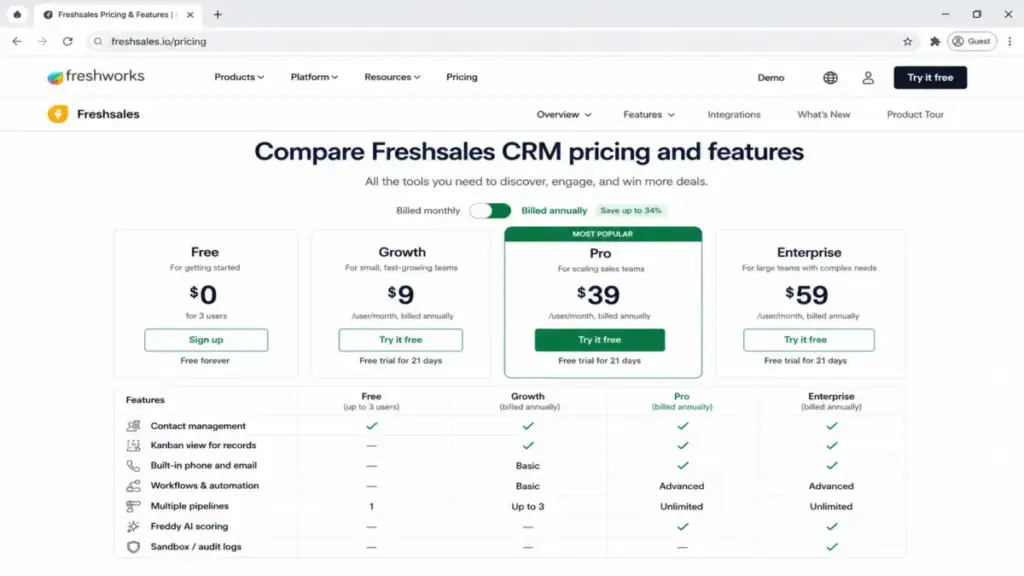
| Growth | $9/user/month | $11/user/month | Custom fields, basic workflows, curated reports, product catalog, marketplace, 1 CPQ license |
| Pro | $39/user/month | $47/user/month | Freddy AI scoring, sales sequences, AI sales emails, territory management, multiple pipelines, custom reports |
| Enterprise | $59/user/month | $71/user/month | Field-level permissions, custom modules, AI forecasting, sandbox, audit logs |
Source: Freshworks pricing page and price-list PDF. Verified May 25, 2026.
HubSpot Sales Hub Plans (as of May 2026)
| Plan | List Price | Key Inclusions |
|---|---|---|
| Free | $0 | Deal tracking, live chat, meetings, no credit card required |
| Starter | $20/month per seat | Paid starter sales tools, additional core seats at $20/month each |
| Professional | $100/month per seat | Sales automation, forecasting, sequences, reporting, sales workspace |
| Enterprise | $150/month per seat (billed annually) | Custom objects, AI lead scoring, conversation intelligence, governance. One-time $3,500 onboarding required. |
Source: HubSpot Product & Services Catalog. Verified May 25, 2026. HubSpot Sales Hub product page may display promotional Starter pricing ($10/month per seat) that differs from the catalog list price ($20/month per seat).
What this means: Freshsales is cheaper at every comparable tier. The value-per-dollar question is whether HubSpot’s platform breadth justifies the premium. For a Freshsales pricing breakdown, the annual billing saves 15-20% versus monthly. For HubSpot pricing details, Enterprise requires annual commitment plus onboarding fees.
Setup and Migration Difficulty
| Dimension | Freshsales | HubSpot Sales Hub |
|---|---|---|
| Initial setup complexity | Low to Medium | Medium to High |
| Time to first pipeline | Hours | Hours to days |
| Complexity ceiling | Rises with AI, CPQ, chatbots, custom modules, API integrations | Rises with multiple hubs, workflow design, reporting, Commerce Hub, governance |
| Migration from Freshsales to HubSpot | N/A | Medium. Map contacts, accounts, deals, stages, sequences, phone data, and Freshworks-specific fields into HubSpot objects. |
| Migration from HubSpot to Freshsales | Medium to High. Harder when buyer uses multiple hubs, marketing contacts, Commerce Hub, custom properties, and reporting dashboards. | N/A |
| Data portability | API access with fair-usage caps. Bulk-upsert limits: 10 concurrent calls, 100 entities per request. | API access with app and account limits. Up to 20 legacy private apps per account, 1,000 webhook subscriptions per app. |
What this means: Freshsales is faster to set up for sales-only CRM use. HubSpot setup gets complex when you activate multiple hubs. The CRM migration from HubSpot to Freshsales is harder than the reverse because HubSpot’s multi-hub data model creates dependencies that a sales-only CRM does not replicate.
Where Freshsales Wins
Choose Freshsales if your team fits these profiles:
- 5-person startup choosing a first CRM. Freshsales Free covers up to 3 users. Growth at $9/user/month scales affordably. HubSpot Free is attractive, but paid sales automation gets expensive faster.
- 10-person SDR team needing sequences and AI scoring. Freshsales Pro includes sales sequences and Freddy AI scoring at $39/user/month. HubSpot Professional charges $100/seat for comparable capabilities.
- Sales team prioritizing built-in communication tools. Freshsales bundles phone, email, and chat into the CRM. No need for separate calling or messaging subscriptions.
- Budget-constrained team that needs Pro-level automation. At 25 users, Freshsales Pro costs $975/month versus $2,500/month for HubSpot Professional. That is $18,300/year in savings.
The Freshsales advantage is clear when the buying decision is about a sales-focused CRM for small teams and the team does not need marketing, content, or commerce modules.
Where HubSpot Wins
Choose HubSpot Sales Hub if your team fits these profiles:
- Marketing-led revenue team. HubSpot’s advantage is the broader customer platform. Sales, marketing, service, content, and Commerce Hub under one login. Freshsales does not match this breadth.
- Enterprise team needing governance. HubSpot Enterprise offers custom objects, AI lead scoring, conversation intelligence, sandbox, and a larger implementation ecosystem. The $3,500 onboarding fee buys structured deployment.
- Team that values integration marketplace depth. HubSpot Marketplace connects Gmail, Google Calendar, Outlook, WordPress, Zapier, Meta Ads, SurveyMonkey, GoToWebinar, Jira, and Eventbrite. Freshworks Marketplace covers key integrations but is narrower.
- Teams needing transparent support tiers. HubSpot documents Community (free), email/chat (Starter), and phone (Professional/Enterprise). Freshsales lists 24×5 support but channel-by-plan detail is less explicit.
If your CRM decision is really a platform decision across marketing, service, and commerce teams, the HubSpot CRM review covers the full platform architecture.
Who Should Avoid Both
Neither Freshsales nor HubSpot is the right CRM for every team. Consider alternatives if:
- You need Salesforce-level enterprise customization. Both Freshsales and HubSpot offer governance at Enterprise tiers, but Salesforce Sales Cloud provides deeper data-model customization, AppExchange ecosystem maturity, and industry-specific solutions. See the Salesforce CRM review for details.
- You want a simpler pipeline-only CRM. If your team just needs a visual deal pipeline without platform complexity, Pipedrive CRM review covers a lighter and often faster option.
- You want low-cost suite bundling across CRM, marketing, and support. The Zoho CRM review covers broader suite coverage at lower cost than HubSpot, with more customization than Freshsales.
- You are a solo founder or freelancer. Both tools have free tiers, but neither is optimized for one-person businesses. A lighter CRM built for individuals will serve solo founders better.
Alternatives to Freshsales and HubSpot
| Alternative | Best For | Starting Price | Why Consider |
|---|---|---|---|
| Pipedrive | Pipeline-first sales teams that want visual simplicity | $14/user/month (Essential) | Simpler pipeline CRM than both Freshsales and HubSpot. Useful when you do not need platform breadth or AI/telephony bundling. |
| Zoho CRM | Budget-sensitive teams needing broad suite coverage | $14/user/month (Standard) | Broader suite at lower cost. Useful when cost matters but you still need CRM + marketing + support. |
| Salesforce Sales Cloud | Large enterprise teams needing deep customization | $25/user/month (Starter Suite) | Deepest enterprise customization and ecosystem. Useful when neither Freshsales nor HubSpot offers enough data-model depth. |
What this means: Pipedrive is the simpler alternative. Zoho CRM is the cheaper suite alternative. Salesforce is the enterprise alternative. If none of these fit, explore Freshsales alternatives or HubSpot CRM alternatives for a broader selection.
Final Verdict: Freshsales vs HubSpot in 2026
There is no universal winner. The right CRM depends on what your team is buying.
Choose Freshsales if your sales team wants lower-cost CRM with built-in sales communication, AI scoring, sequences, and pipeline workflows. Freshsales Pro at $39/user/month delivers mid-market sales automation at SMB pricing. At 10 users, you save $610/month versus HubSpot Professional. That is $7,320/year.
Choose HubSpot if your team needs sales CRM tightly connected to marketing automation, content, service, data, and commerce workflows. HubSpot’s value is the platform, not just the sales seat. The per-seat premium pays for ecosystem breadth, marketplace depth, and multi-hub integration.
Avoid both if you need extreme enterprise customization (Salesforce), simpler pipeline-only CRM (Pipedrive), or low-cost suite bundling (Zoho CRM).
The honest answer: most 5-15 person sales teams will get more value from Freshsales. Most 20+ person revenue teams that span sales, marketing, and service will get more value from HubSpot. The crossover point is not a team size. It is a workflow complexity threshold. If your team needs more than sales CRM, HubSpot justifies the cost. If your team needs sales CRM and nothing else, Freshsales is the better deal.
For a broader view, the Pipedrive vs Freshsales comparison covers how Freshsales stacks up against another sales-focused CRM, and the HubSpot vs Pipedrive comparison shows how HubSpot’s platform approach compares to pipeline-first tools.
FAQ
Is Freshsales cheaper than HubSpot?
Yes. Freshsales is cheaper at every comparable plan tier. Freshsales Pro costs $39/user/month billed annually versus HubSpot Sales Hub Professional at $100/month per seat. At 10 users, Freshsales Pro costs $390/month versus $1,000/month for HubSpot Professional.
Does Freshsales have a free plan?
Yes. Freshsales Free supports up to 3 users and includes basic contact management, Kanban views, email templates, built-in phone and chat, and a mobile app. It is limited to 3 users and does not include custom fields or workflows.
Does HubSpot Sales Hub have a free plan?
Yes. HubSpot Sales Hub Free includes deal tracking, live chat, and meetings with no credit card required. The free tier is generous for basic CRM use, but sales sequences, forecasting, and custom reporting require Professional at $100/month per seat.
Which CRM has better AI features, Freshsales or HubSpot?
Freshsales offers Freddy AI contact scoring and AI sales emails on the Pro plan at $39/user/month. HubSpot offers AI lead scoring on Enterprise at $150/seat/month. For AI scoring at lower cost, Freshsales has the advantage. HubSpot’s broader AI capabilities span multiple hubs but cost more to access.
Can I migrate from HubSpot to Freshsales?
Yes, but the difficulty is medium to high. Migration involves mapping leads, contacts, accounts, deals, stages, activities, email history, sequences, reporting, and custom properties. It is harder when the team uses multiple HubSpot hubs, marketing contacts, Commerce Hub, or custom workflows. Both CRMs support data import/export and API access.
Does HubSpot charge onboarding fees?
HubSpot Enterprise requires a one-time $3,500 onboarding fee and annual billing. Starter and Professional do not have mandatory onboarding fees, but complex implementations often involve partner or consulting spend.
Which is better for small businesses, Freshsales or HubSpot?
For small sales teams (under 15 people) focused on pipeline and outbound, Freshsales offers better value. Freshsales Pro includes sequences, AI scoring, and multiple pipelines at $39/user/month. HubSpot is better for small teams that need CRM plus marketing plus service under one platform, but the cost scales faster.
Should I use Freshsales or HubSpot for a 10-person sales team?
If the team’s primary need is sales automation with built-in phone, email, and AI scoring, Freshsales Pro at $390/month is the stronger value. If the team also runs inbound marketing campaigns, content workflows, and needs marketplace integrations, HubSpot Professional at $1,000/month provides broader platform coverage.
Which CRM is better for inbound marketing and sales?
HubSpot. Inbound marketing is HubSpot’s core DNA. Marketing Hub, Content Hub, and Sales Hub work together for lead capture, nurturing, scoring, and closing. Freshsales can integrate with marketing tools like Mailchimp, but it does not have a native marketing hub.
When should I upgrade from Freshsales to HubSpot?
Consider switching when your team’s CRM needs expand beyond sales to include marketing automation, content management, commerce workflows, or multi-department governance. The migration cost and complexity increase with the amount of Freshsales data, sequences, and customizations you need to move.