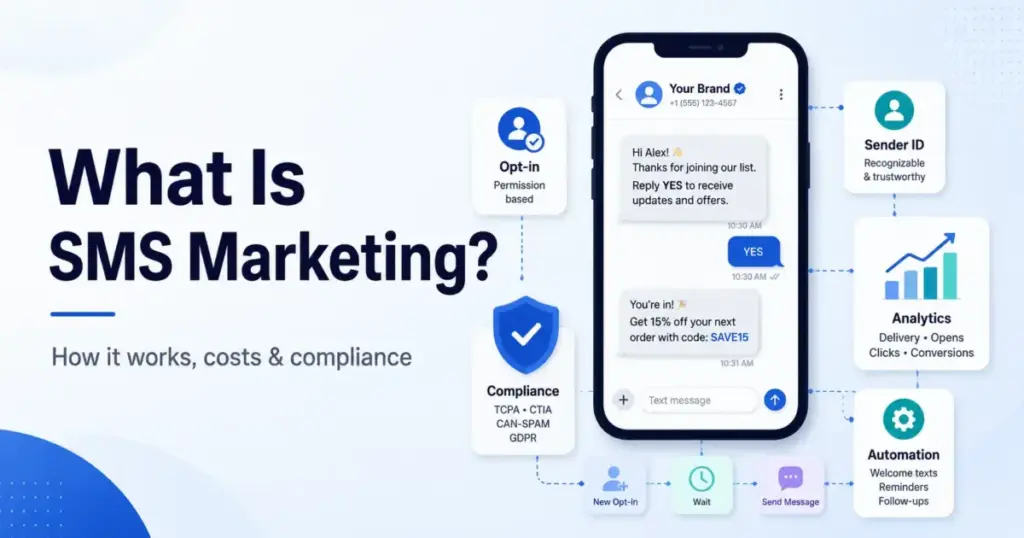
SMS marketing is not just sending promotional texts. It is building a permission-based, measurable, compliant direct messaging system that connects to your CRM, ecommerce data, and lifecycle workflows without exhausting subscriber trust. Most definitions stop at “texting your customers.” The operational reality includes consent capture, sender registration, carrier filtering, opt-out sync, message segment pricing, and revenue attribution.
This guide explains how SMS marketing works as a system, where it fits alongside email marketing platforms, what US compliance requires in 2026, which tools enable it, what it costs, and the mistakes that get programs blocked or unsubscribed.
Review limitation: This guide is based on official product documentation, verified pricing pages, compliance resources, and published user feedback. I did not deploy a live SMS program across all five platforms discussed. Carrier-specific filtering behavior, exact credit consumption, and legal interpretations should be confirmed with your vendor and counsel directly.
Quick Answer: What is SMS marketing? SMS marketing is a permission-based channel where businesses send short text messages to customers who have opted in, typically for promotions, reminders, alerts, or automated lifecycle nudges. It works through registered sender identities (10DLC, toll-free, or short code in the US), requires explicit written consent for promotional messages, and performs best when connected to segmentation, email, and ecommerce data rather than used as a standalone blast tool.
The 60-Second Explanation of SMS Marketing
SMS marketing is a direct marketing channel where a business sends short text messages to customers or prospects who have given explicit consent. According to Mailchimp’s marketing glossary, SMS marketing uses SMS to promote products, services, and brands to mobile device users with their consent. Klaviyo’s SMS guide frames it similarly: sending promotions, coupons, announcements, reminders, and more via text message.
That is the simple layer. Here is where it gets more useful.
The Technical Layer
SMS marketing operates through application-to-person (A2P) messaging infrastructure. A platform or API connects your web application to carrier networks through an SMS gateway. In the US, senders must register through A2P 10DLC (for long codes), toll-free verification, or short codes before sending at scale. Messages are charged per segment (160 characters for standard SMS), and carrier fees apply on top of platform costs.
The Business Layer
SMS matters in 2026 because customer attention is fragmented, email inboxes are crowded, and ecommerce teams need timely lifecycle nudges. The best programs treat SMS as an owned, high-trust channel connected to CRM data, email workflows, ecommerce behavior, opt-in records, suppression lists, and revenue attribution. It is not a replacement for email. It is a complement that works for short, time-sensitive, high-intent messages.
How SMS Marketing Actually Works
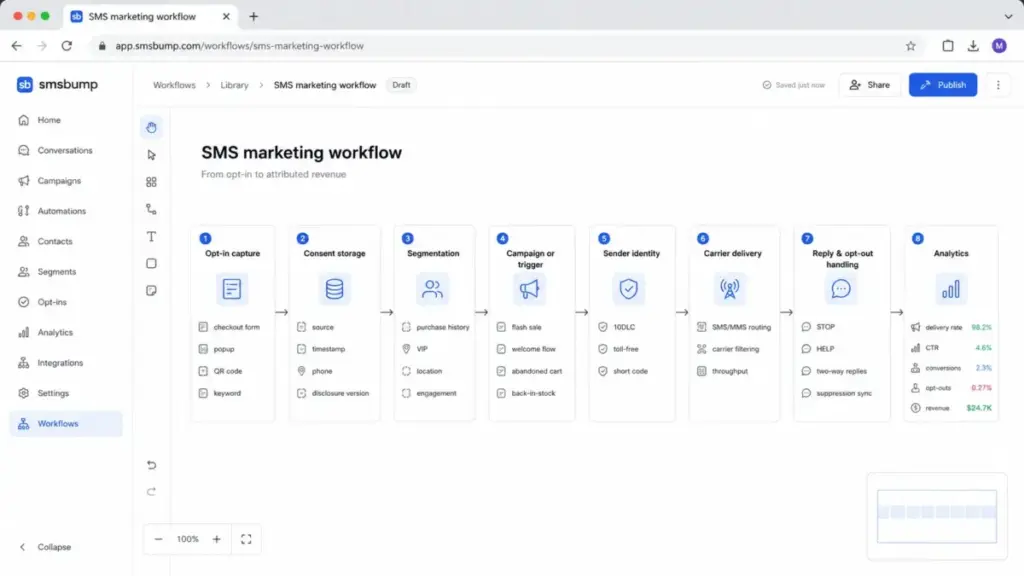
SMS marketing is a seven-part operating system, not a single feature. Each part affects deliverability, compliance, and performance.
- Consent capture. Collect opt-in through checkout forms, pop-ups, QR codes, keyword replies, or account preferences. The disclosure must state the brand name, message type, expected frequency, possible message and data rates, opt-out method, and links to terms and privacy policy.
- Subscriber storage. Store each consent record separately from email consent. Record the source, timestamp, phone number, form or keyword used, disclosure version, and opt-in status.
- Segmentation. Segment subscribers using purchase history, lifecycle stage, engagement, location, VIP status, browse behavior, and SMS-specific engagement data.
- Message creation. Write short copy with one clear call to action. Identify the brand, state the value, keep it concise, use a clean tracked link, and avoid stuffing SMS with email-length copy.
- Sender identity. Choose the right sender type for the US market. This decision affects throughput, verification timelines, and cost.
- Carrier delivery. The SMS provider or API routes messages through carrier networks. Registered senders with clean content and proper consent signals have better deliverability.
- Measurement. Track delivery rate, click rate, reply rate, conversion rate, opt-out rate, attributed revenue, revenue per recipient, and cost per conversion.
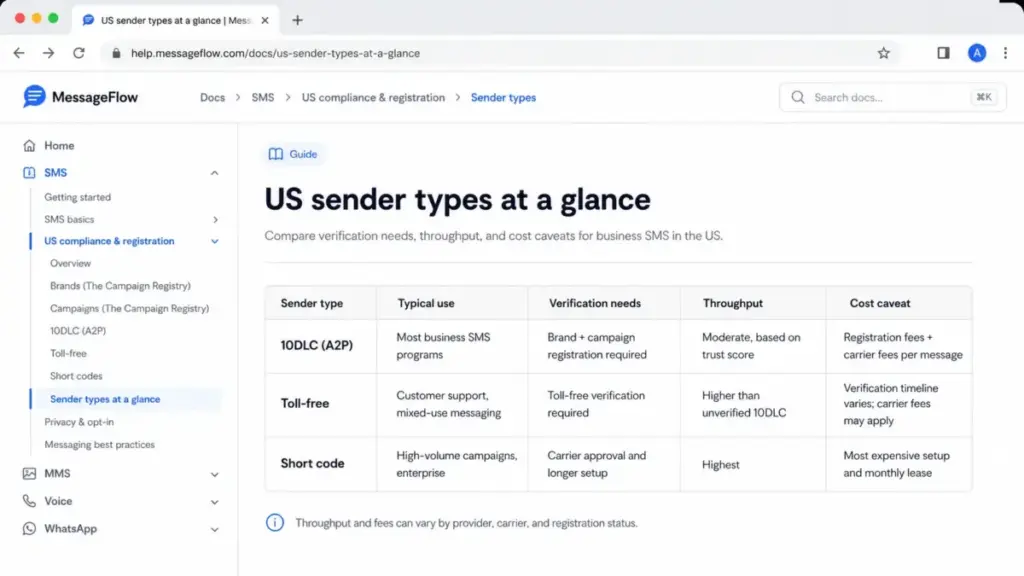
US Sender Types at a Glance
| Sender Type | Typical Use | Verification | Throughput | Cost Caveat |
|---|---|---|---|---|
| 10DLC (A2P) | Most business SMS programs | Brand + campaign registration required | Moderate, depends on trust score | Registration fees + carrier fees per message |
| Toll-Free | Customer support, mixed use | Toll-free verification required | Higher than unverified 10DLC | Verification timeline varies |
| Short Code | High-volume campaigns, enterprise | Carrier approval, longer setup | Highest | Most expensive setup and monthly lease |
According to Twilio’s A2P 10DLC documentation, anyone sending SMS or MMS over a 10DLC number from an application to US recipients must register. This is a carrier standard, not optional.
SMS vs MMS vs RCS
These three message types are related but not interchangeable for cost, content, and customer experience.
| Feature | SMS | MMS | RCS |
|---|---|---|---|
| Content | Text only, 160 characters per segment | Text + images, video, audio, GIFs | Branded, interactive, rich cards |
| Best Use | Short alerts, reminders, codes, CTAs | Product images, coupons with visuals | Branded experiences where supported |
| Cost | Lowest per message | Higher per message | Varies by carrier and provider |
| Deliverability | Widest reach | Wide but slightly lower | Limited to supported devices and carriers |
| When NOT to Use | Long-form content, detailed comparisons | Budget-constrained high-volume sends | When broad reach matters more than format |
Postscript’s pricing page lists separate SMS and MMS rates, with average US carrier fees of $0.0040 for SMS and $0.0083 for MMS (as of May 2026). Twilio’s US SMS pricing starts at $0.0083 per outbound message for long codes, toll-free, and short codes, with carrier fees and segment charges on top.
The cost difference between SMS and MMS adds up at scale. A 10,000-subscriber campaign using MMS instead of SMS can cost significantly more when you factor in per-message rates plus carrier surcharges.
Types of SMS Marketing Messages
Not all text messages serve the same purpose, and the purpose changes the consent and compliance expectations.
| Type | Purpose | Example | Compliance Note |
|---|---|---|---|
| Promotional | Sales, coupons, launches, flash sales, back-in-stock | “20% off ends tonight. Shop now: [link]” | Requires explicit written consent |
| Transactional | Order confirmations, shipping, appointment reminders | “Your order #1234 shipped. Track: [link]” | Generally does not require marketing consent, but do not add promotional copy |
| Conversational | Two-way support, appointment confirmations, replies | “Reply YES to confirm your appointment” | Consent and opt-out rules still apply |
| Automated lifecycle | Abandoned cart, welcome, win-back, birthday | “You left items in your cart. Complete checkout: [link]” | Triggered by behavior, requires consent for marketing messages |
| Bulk broadcast | Announcements to full list or large segment | “Store closed tomorrow due to weather” | Risk of opt-outs if targeting and frequency are weak |
The boundary between transactional and promotional messages matters. Do not casually mix promotional copy into transactional texts without reviewing the compliance implications with counsel.
Is SMS Marketing Legal in the US?
SMS marketing is legal in the US when it follows consent, registration, and content rules. It is not legal just because someone gave you a phone number.
What US Programs Generally Need
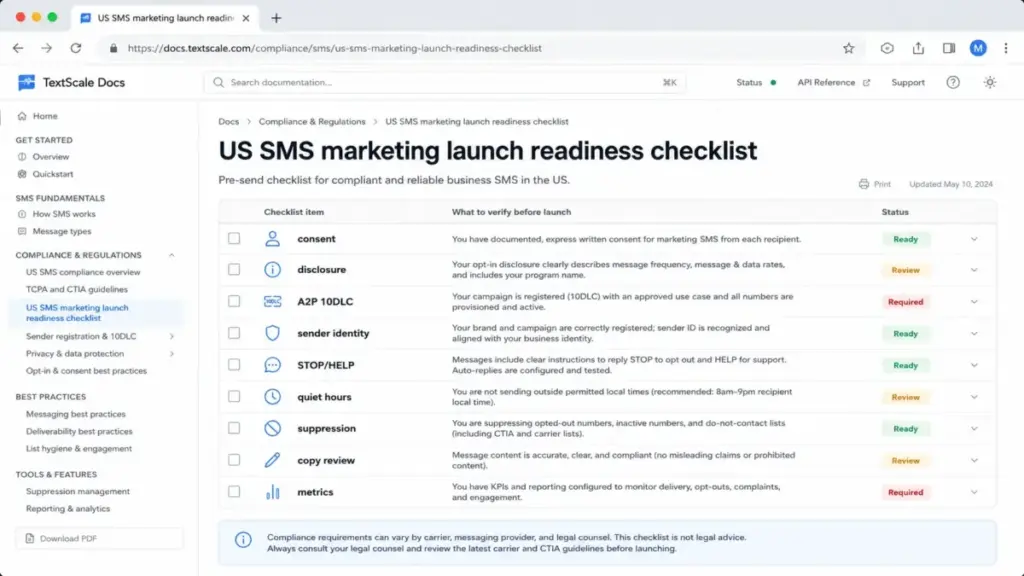
- Explicit written consent for promotional texts (not just email opt-in)
- Clear opt-in disclosure stating brand, message type, frequency, message and data rates, opt-out method, and privacy/terms links
- Consent records stored with source, timestamp, phone number, and disclosure version
- STOP and HELP handling configured and tested before first send
- A2P 10DLC or toll-free verification for application-to-person messaging
- Quiet hours honored (many platforms default to no sends between 9 PM and 9 AM recipient local time)
- Suppression and opt-out sync across all tools that touch the same subscriber
According to Twilio’s TCPA glossary, the TCPA restricts telemarketing communications via voice calls, SMS texts, and fax, and emphasizes consumer consent.
A Note on the 2025 TCPA One-to-One Consent Update
The FCC’s one-to-one consent rule, which would have required consent specific to a single seller, was vacated by the Eleventh Circuit in January 2025. According to a Justia summary of Insurance Marketing Coalition Limited v. FCC and a Womble Bond Dickinson analysis, the FCC subsequently deleted the vacated language and reinstated prior rules.
Do not describe the one-to-one consent requirement as currently implemented federal law. TCPA litigation and interpretation remain active. Discuss your consent strategy with legal counsel before launching.
This article is not legal advice. SaaSZap is not a law firm. Verify all compliance requirements with qualified counsel.
The Mistakes That Waste Your First Month
These are the errors I see most often in SMS programs that stall or get filtered.
- Assuming email consent covers SMS. Email permission and SMS permission should be collected and stored separately. A phone number alone does not equal consent to send marketing texts.
- Sending before A2P or toll-free verification. Unverified senders face lower throughput and higher filtering risk. Build registration time into your launch timeline.
- Overusing SMS for low-value content. Subscriber tolerance for texts is lower than email. Sending the same generic offer to every subscriber drives opt-outs fast.
- Quoting the 98% open-rate claim without context. That number is widely repeated by vendors, but performance depends on list quality, offer relevance, timing, frequency, sender trust, deliverability, and measurement method. Measure delivery, clicks, conversions, opt-outs, and revenue instead.
- Ignoring carrier fees and message segment costs. Platform subscription is not the full cost. Message segments, MMS pricing, carrier surcharges, credits, and registration fees affect your true cost per send.
- Not syncing opt-outs across tools. If a subscriber texts STOP in your SMS platform and your CRM does not reflect that, you risk sending to someone who revoked consent.
- Treating transactional texts as a promotional loophole. Mixing marketing copy into order confirmations creates compliance risk.
Common Misconceptions About SMS Marketing
Misconception: SMS marketing means buying a phone-number list and sending promotions. Reality: SMS marketing should be permission-based. US promotional texts generally require explicit written consent. Purchased lists create legal, deliverability, and brand risk.
Misconception: SMS is better than email, so it should replace email. Reality: SMS is better for timely, short, high-intent nudges. Email is usually better for longer education, rich visuals, product storytelling, newsletters, and multi-message sequences.
Misconception: Consent for email automatically covers SMS. Reality: Email permission and SMS permission should be collected and stored separately.
Misconception: Reply STOP is the whole compliance strategy. Reality: STOP handling is only one part. Programs also need clear opt-in language, consent records, sender registration, suppression, quiet hours, content review, help language, and counsel-approved policies.
When to Use SMS Marketing (and When to Avoid It)
Use SMS when:
- The message is time-sensitive (flash sale ends in 2 hours, appointment in 30 minutes)
- The content is short and has one clear action
- The subscriber has given explicit consent for marketing texts
- The message is tied to a clear event or customer behavior (abandoned cart, back-in-stock, delivery update)
- You can attribute revenue or conversions to the send
Avoid SMS when:
- You need long-form education, rich visual comparisons, or detailed product storytelling
- You are sending low-urgency newsletters or generic weekly updates
- You do not have explicit SMS consent
- Your compliance footing is unclear or unreviewed by counsel
- Your frequency plan involves daily or near-daily promotional texts to the full list
How to Measure SMS Marketing
| Metric | What It Measures | Why It Matters |
|---|---|---|
| Delivery rate | Messages successfully delivered / total sent | Catches sender identity or content issues |
| Click-through rate | Clicks on tracked links / delivered messages | Shows whether the offer and CTA work |
| Conversion rate | Conversions / delivered messages | Ties SMS to actual business outcomes |
| Opt-out rate | STOP requests / delivered messages | Signals fatigue, frequency, or relevance problems |
| Revenue per recipient | Revenue attributed / total recipients | Compares SMS value across campaigns |
| Revenue per SMS subscriber | Revenue attributed / total SMS subscribers | Tracks list-level ROI over time |
| Cost per conversion | Total SMS spend / conversions | Ensures the channel stays cost-effective |
| List growth rate | New subscribers / total subscribers per period | Measures opt-in acquisition health |
As ActiveCampaign’s SMS marketing page suggests, track delivery, click-through, response, conversion, attributed revenue, ROI, cost per acquisition, opt-in, and opt-out rates to understand performance.
Do not rely on open-rate claims alone. SMS open rates are widely cited by vendors, but the original methodology is rarely disclosed. Focus on delivery, clicks, conversions, and revenue.
Tools That Make SMS Marketing Easier
SMS tools solve different problems. Matching the tool to your architecture matters more than picking the one with the longest feature list.
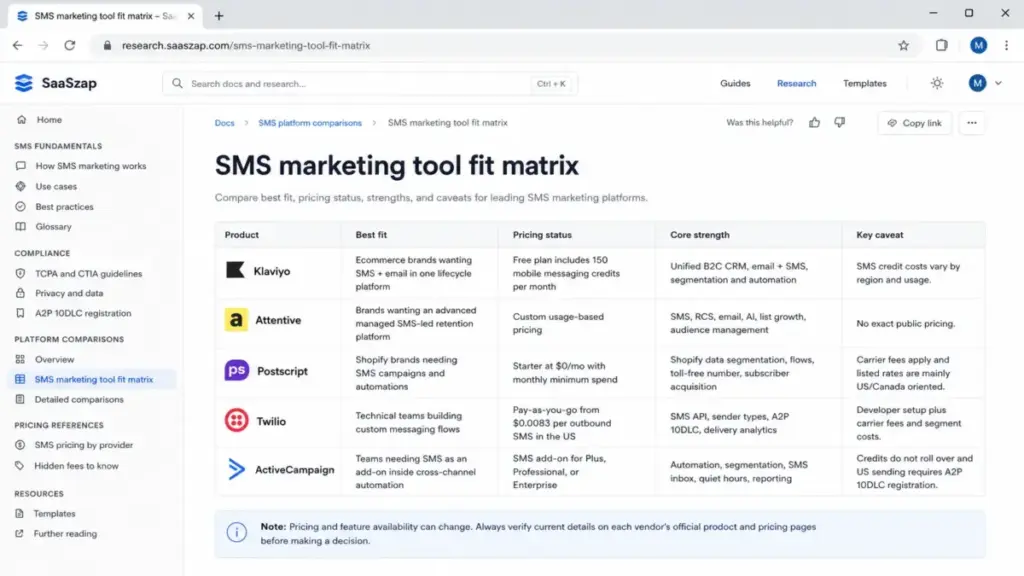
| Tool | Best Fit | Pricing Status | Core Strength | Key Caveat |
|---|---|---|---|---|
| Klaviyo | Ecommerce brands wanting SMS + email in one lifecycle platform | Free plan includes 150 mobile messaging credits/month; paid plans scale by profiles and credits | Unified B2C CRM with email, SMS, RCS, segmentation, automation | SMS credit costs and availability vary by region; verify current credit pricing before budgeting |
| Attentive | Brands wanting a managed, advanced SMS-led retention platform | Custom, usage-based pricing; contact sales | SMS, RCS, email, push, list growth, AI, compliance, audience management | No public pricing; usage-based, not credit-based |
| Postscript | Shopify brands needing SMS campaigns and automations | Starter at $0/month with $49 monthly minimum spend; Growth at $100/month | Shopify data segmentation, toll-free numbers, subscriber acquisition, analytics | Listed rates for US 50 states and Canada only; carrier fees additional |
| Twilio | Technical teams building custom messaging flows | Pay-as-you-go starting at $0.0083 per outbound SMS (US) | SMS API, sender types, A2P 10DLC registration, delivery analytics | Prices may change; carrier fees, segment costs, registration fees apply |
| ActiveCampaign | Teams needing SMS as add-on inside cross-channel automation | SMS add-on requires Plus, Professional, or Enterprise; credits do not roll over | AI campaign planning, segmentation, two-way messaging, quiet hours, automations | US recipients require A2P 10DLC registration; check account billing for current credit cost |
Klaviyo pricing verified via Klaviyo’s pricing page as of May 2026. Postscript pricing verified via Postscript pricing as of May 2026. Twilio pricing per Twilio US SMS pricing, checked May 2026. Attentive pricing status per Attentive pricing page as of May 2026. ActiveCampaign SMS add-on details per ActiveCampaign help center as of May 2026.
“SMS has become a critical part of our marketing strategy because it cuts through the noise.” — Sydney Lynch, Director of Customer Experiences, L2/Prospect2, quoted by ActiveCampaign
For a deeper look at Klaviyo’s email and SMS capabilities, or how ActiveCampaign handles marketing automation, see our individual reviews.
SMS Marketing Launch Checklist
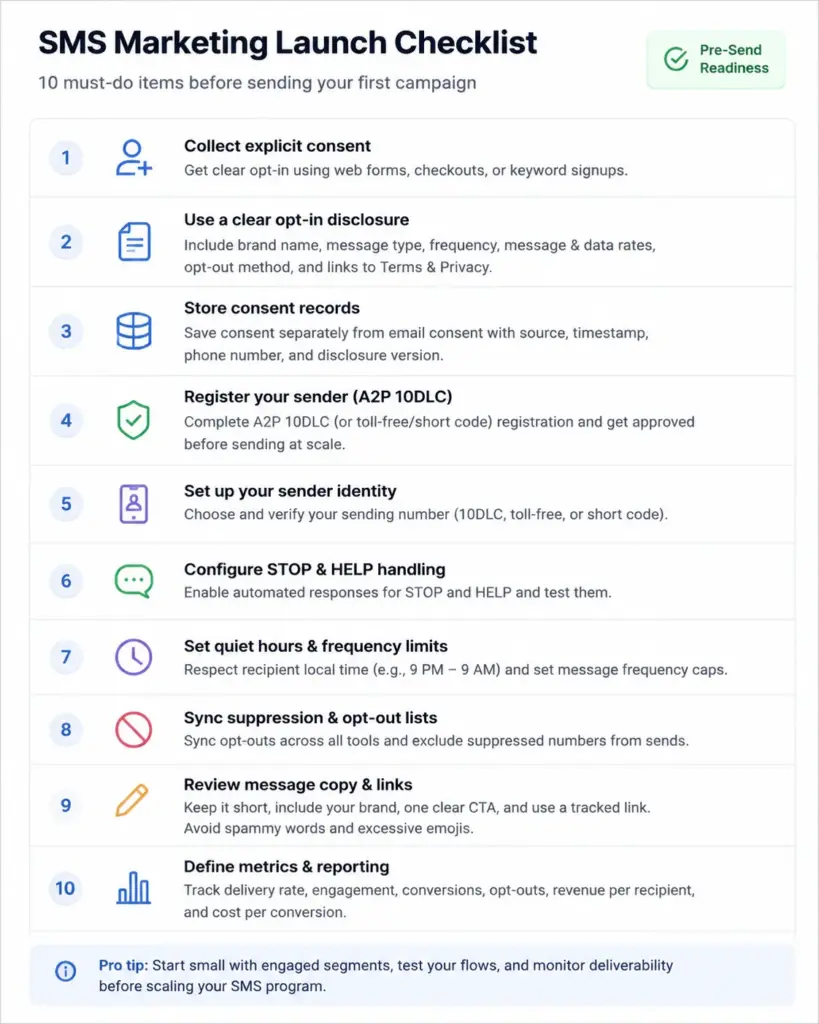
Use this before sending your first campaign.
- Define the job SMS will do: abandoned cart, flash sale, appointment reminder, back-in-stock, welcome, or support
- Choose a sender identity (10DLC, toll-free, or short code) and begin registration
- Create opt-in disclosure with brand name, message type, frequency, rates, opt-out, and privacy/terms links
- Store consent records separately from email consent with source, timestamp, and disclosure version
- Start with 2-4 high-intent flows: welcome, abandoned cart, shipping reminder, and back-in-stock
- Segment from day one using purchase history, lifecycle stage, engagement, and location
- Write SMS copy for one action only: identify brand, state value, include clean link
- Configure STOP, HELP, quiet hours, frequency caps, and opt-out sync before the first send
- Measure delivery, clicks, conversions, opt-outs, revenue per recipient, and cost per conversion
- Review every campaign for compliance, deliverability, and fatigue risk before increasing volume
FAQ
What is SMS marketing in simple terms?
SMS marketing sends short promotional or transactional text messages to people who have opted in. It works best for time-sensitive offers, reminders, and alerts. The key requirement is consent: subscribers must agree to receive texts before you send them.
Do customers need to opt in for SMS marketing?
Yes. US promotional SMS generally requires explicit written consent. Collecting a phone number at checkout does not automatically mean you have permission to send marketing texts. Store consent records with the source, timestamp, and disclosure version.
Is SMS marketing better than email marketing?
SMS is faster and more immediate for short, urgent messages. Email handles long-form education, rich visuals, product storytelling, and newsletters better. Most ecommerce teams use both: email for depth, SMS for timely nudges.
What is A2P 10DLC?
A2P 10DLC is a US carrier standard for verified application-to-person SMS traffic sent through long-code numbers. Businesses sending SMS or MMS from an application to US recipients must register their brand and campaigns through their SMS provider. Registration affects throughput and deliverability.
How much does SMS marketing cost?
Total cost includes platform subscription, per-message rates, MMS surcharges, carrier fees, sender registration fees, and credit consumption. Twilio lists US SMS starting at $0.0083 per outbound message. Postscript starts at $0/month with a $49 minimum spend. Klaviyo includes 150 free credits on the free plan. Attentive uses custom pricing.
How often should businesses send SMS marketing messages?
Start conservatively: 2-4 messages per month for promotional sends. Increase only if engagement stays strong and opt-out rates remain low. Frequency caps and segmentation prevent fatigue. Monitor opt-out spikes after every campaign.
What metrics should I track for SMS marketing?
Track delivery rate, click-through rate, conversion rate, opt-out rate, revenue per recipient, cost per conversion, and list growth rate. Do not rely on open-rate claims alone. Clicks, conversions, and revenue are more actionable.
Can I use the same platform for SMS and email?
Yes. Klaviyo, ActiveCampaign, Brevo, and Mailchimp offer SMS alongside email in one platform. The advantage is unified subscriber data, shared segmentation, and coordinated lifecycle flows. The tradeoff is that dedicated SMS platforms (Attentive, Postscript) may offer deeper SMS-specific features.
Why are my business text messages getting blocked?
Common causes include unverified sender identity, weak A2P 10DLC trust score, content flagged by carrier filters, missing consent signals, suspicious links, or high complaint volume. Register your sender identity, verify your number, and review message content before sending at scale.
What should the first SMS welcome message say?
Identify your brand name. Thank the subscriber for opting in. Set expectations for message frequency and content type. Include the opt-out keyword (STOP). Keep it under 160 characters to avoid multi-segment charges.