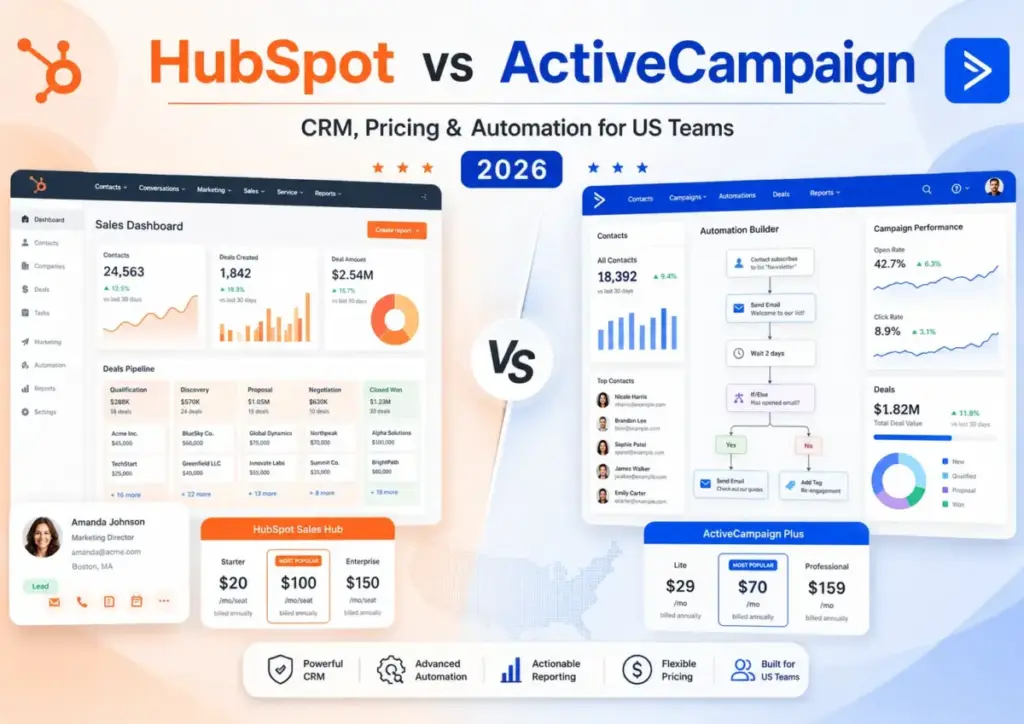
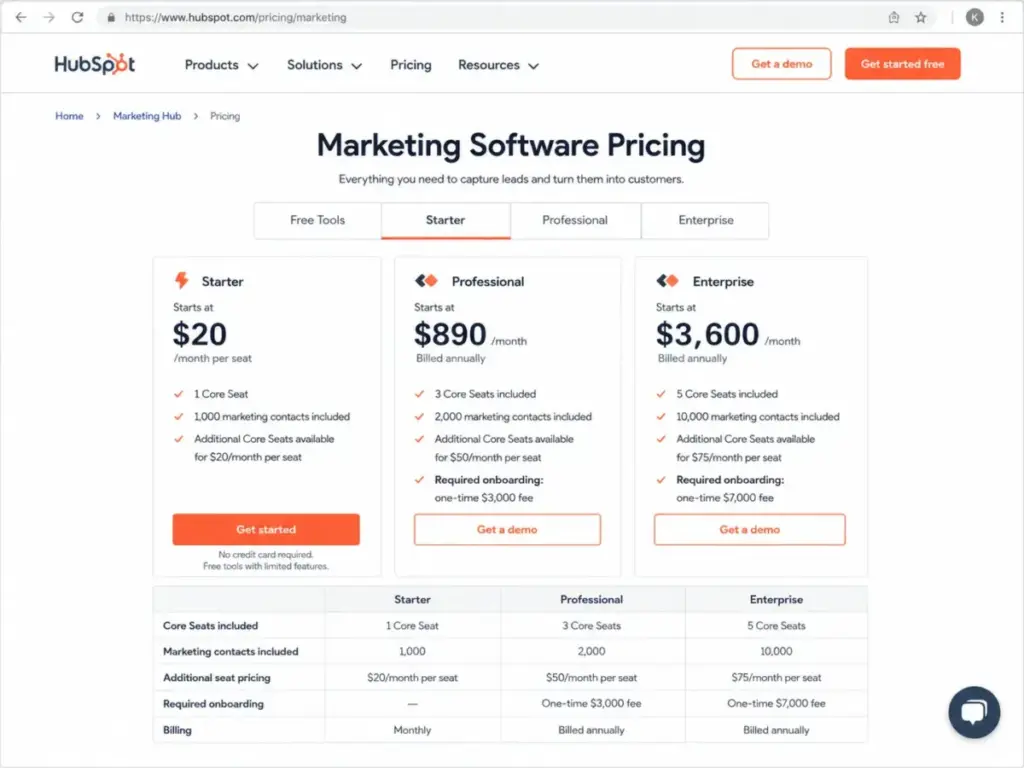
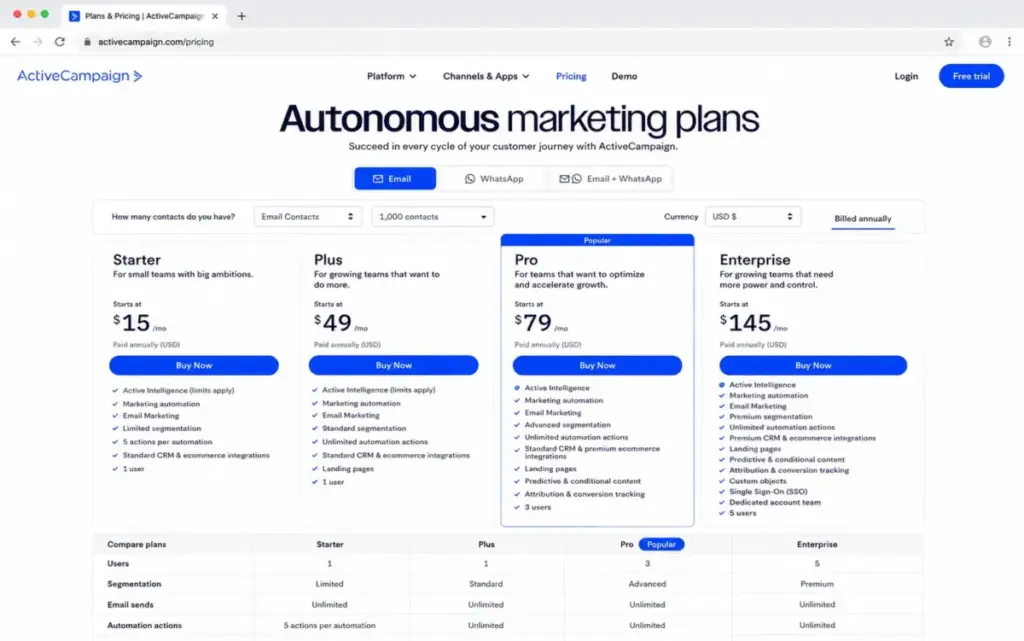
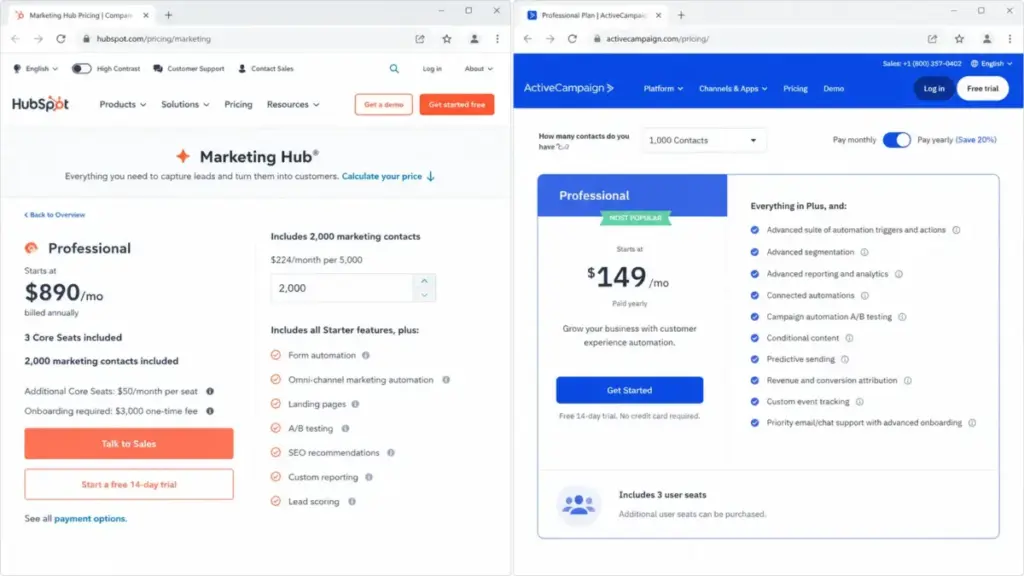
HubSpot Marketing Hub Professional costs $890/month before you add a single extra seat (as of June 2026). ActiveCampaign Enterprise, with 5 users included, starts at $145/month on annual billing. That price gap is real, but the platforms are not solving the same problem.
Choose HubSpot if your team needs a CRM-first revenue system that connects marketing, sales, service, content, and reporting under one login. Choose ActiveCampaign if your team runs on email automation, lifecycle campaigns, and behavioral triggers, and does not need a full CRM operating system. Both rank among the best CRM tools for marketing automation in 2026, but they serve different buyer profiles.
The cost difference is obvious. What is less obvious: HubSpot requires $3,000 onboarding on Marketing Hub Professional and $7,000 on Enterprise, ActiveCampaign charges $0 setup fees, and both platforms bill contacts differently. This comparison breaks down the workflows, the pricing math, and the hidden costs that most top-ranking articles skip entirely.
Quick Verdict: HubSpot vs ActiveCampaign
| Category | Winner | Why |
|---|---|---|
| Pricing and first-year cost | ActiveCampaign | Entry starts at $15/month annual; HubSpot Pro starts at $890/month plus $3,000 onboarding |
| CRM depth and revenue operations | HubSpot | Smart CRM, Sales Hub, Service Hub, and cross-team reporting built natively |
| Marketing automation value | ActiveCampaign | Unlimited automation actions at Pro ($79/month) vs HubSpot requiring Professional tier |
| Reporting and attribution | HubSpot | Multi-touch revenue attribution and customer journey analytics on Enterprise |
| Integrations and ecosystem | HubSpot | 2,000+ marketplace apps vs ActiveCampaign 1,000+ integrations |
| Security and compliance | Tie | Both publish SOC 2, GDPR evidence; ActiveCampaign adds HIPAA and Trust Center |
| Developer and API constraints | HubSpot | Documented API limits with paid increases; ActiveCampaign webhooks have no retry and no incoming webhooks |
What this means: ActiveCampaign wins on price and automation depth. HubSpot wins on CRM architecture, reporting, and ecosystem. The right pick depends on whether your team needs a revenue operating system or an automation engine. For a deeper look at what marketing automation software does, see our knowledge hub.
HubSpot vs ActiveCampaign at a Glance
| Dimension | HubSpot | ActiveCampaign |
|---|---|---|
| Best for | 10+ person sales and marketing teams needing CRM, reporting, and pipeline visibility | Email-first SMBs, ecommerce teams, and lifecycle marketers needing automation at lower cost |
| Starting price | $20/month per seat (Marketing Hub Starter) | $15/month annual (Starter, 1,000 contacts) |
| Practical tier | Marketing Hub Professional, $890/month (3 seats included) | Pro, $79/month annual (3 users, 1,000 contacts) |
| Free plan | Yes (limited free CRM tools with branding) | No (14-day free trial) |
| Setup difficulty | Medium to high (mandatory paid onboarding on Pro/Enterprise) | Medium (no setup fees, free migration and onboarding assistance) |
| Main strength | CRM-centered platform connecting marketing, sales, service, content, AI | Automation depth, segmentation, and ecommerce triggers at lower price |
| Main limitation | Required onboarding fees, contact-tier billing overages, and cost at scale with seats | CRM pipelines, sales engagement, SMS, custom reporting, and lead scoring are add-ons |
What this means: HubSpot is an all-in-one customer platform. ActiveCampaign is a focused automation engine. If you need both CRM and marketing, HubSpot consolidates. If you need automation without the CRM overhead, ActiveCampaign costs less.
How We Compared HubSpot and ActiveCampaign
Alex Morrison reviewed HubSpot and ActiveCampaign by analyzing official pricing catalogs, feature documentation, plan gates, API documentation, security compliance statements, and user sentiment patterns on G2 and Trustpilot. After evaluating 40+ CRM platforms for SaaSZap, I treat CRM-versus-automation comparisons as pricing architecture questions, not feature checklists. For the full individual evaluation, see our HubSpot CRM review.
Testing level: HubSpot was evaluated through official research. ActiveCampaign data was validated through official documentation and third-party sources. Neither product was hands-on tested for this comparison.
Data sources: HubSpot Product and Services Catalog, ActiveCampaign official pricing page, HubSpot API documentation, ActiveCampaign webhook and API documentation, G2 review patterns, and Trustpilot sentiment signals.
Pricing verified: June 2026.
Limitations: ActiveCampaign exact dollar pricing renders dynamically on some crawls. Additional-user pricing for ActiveCampaign is not publicly visible and should be confirmed directly. HubSpot marketing contact overage billing mechanics require careful contract review.
Workflow 1: Marketing Automation, HubSpot vs ActiveCampaign
ActiveCampaign wins marketing automation for most teams under 20 people.
ActiveCampaign Pro at $79/month (annual, 1,000 contacts) includes unlimited automation actions, predictive content, conditional content, landing pages, and 3 users. HubSpot Marketing Hub Starter at $20/month per seat caps automation actions. Unlimited automation, omni-channel workflows, A/B testing, and lead scoring require Marketing Hub Professional at $890/month.
The math is direct. A 5-person team needing multi-step automations pays roughly $79/month on ActiveCampaign Pro versus $990/month on HubSpot Marketing Hub Professional (base plus 2 extra Core Seats at $50/month each). That is a 12x price difference before adding HubSpot’s required $3,000 onboarding fee.
ActiveCampaign Starter, at $15/month annual for 1,000 contacts, caps automations at 5 actions. That plan works for basic welcome sequences, not complex lifecycle campaigns. Any team running multi-branch automations should budget for Plus or Pro from day one.
Paraphrased G2 sentiment: ActiveCampaign users consistently praise automation depth and personalization, while recurring limitations include learning curve, performance issues on large lists, and contact-based cost growth.
Here is the thing. HubSpot workflows on Professional are strong. They connect to CRM records, sales stages, tickets, and content actions in ways ActiveCampaign cannot replicate natively. But you are paying CRM-platform pricing for that integration. If your automations live within email, SMS, and behavioral triggers, ActiveCampaign delivers more for less. Our ActiveCampaign review covers the automation builder in more depth.
Workflow 2: CRM and Pipeline Management
HubSpot wins CRM and pipeline management without contest.
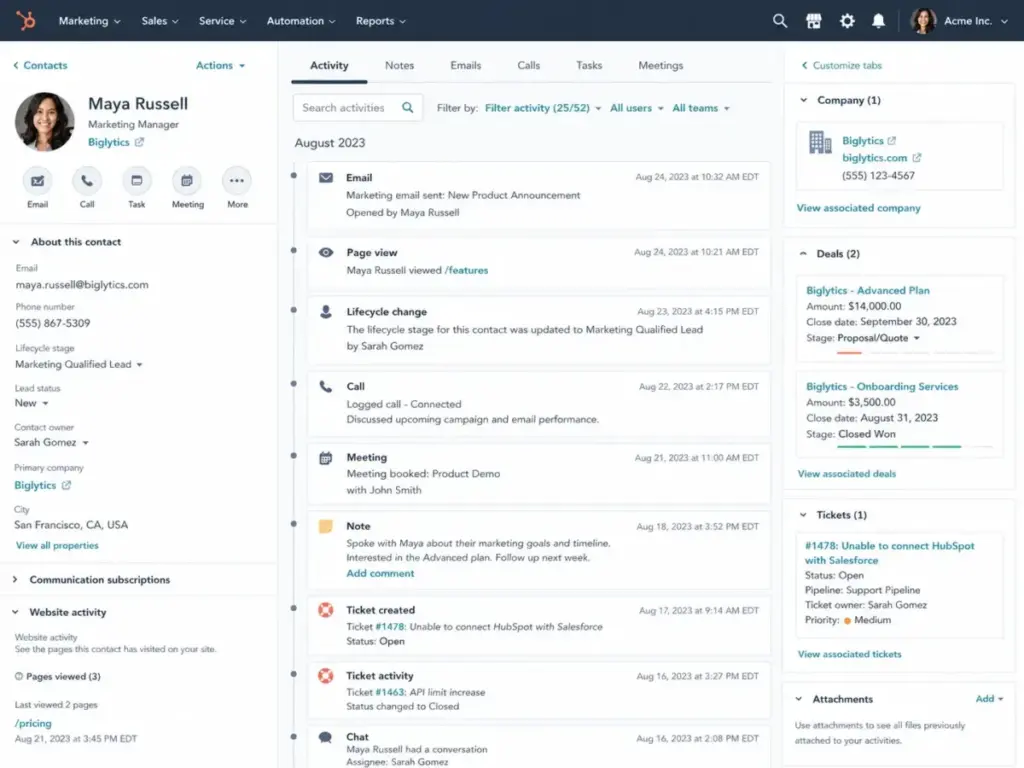
HubSpot Smart CRM is the product’s foundation. Marketing, sales, service, content, and reporting all share one contact record, one timeline, one set of properties. Pipeline management, deal tracking, lifecycle stages, lead scoring, custom objects, and governance tools are built into the platform across Marketing Hub, Sales Hub, and Service Hub.
ActiveCampaign approaches CRM differently. Pipeline management, deal records, account records, lead scoring, automated one-to-one email, and win probability are either add-ons (Enhanced CRM, Sales Engagement) or gated behind higher plans. The CRM in ActiveCampaign is a bolt-on to the automation engine, not the engine itself.
For a 10-person sales and marketing team sharing a pipeline, HubSpot consolidates contact records, deal stages, attribution, and marketing data into one system. ActiveCampaign would require the Enhanced CRM add-on plus the Sales Engagement add-on, and even then the pipeline depth does not match HubSpot’s native architecture.
I keep coming back to this point when evaluating CRM-plus-automation platforms: the question is not which tool has more features, but whether your sales process lives inside a pipeline or inside an email sequence. If it is the pipeline, HubSpot is the architecture you need.
Workflow 3: Reporting and Revenue Attribution
HubSpot wins reporting for any team measuring marketing-to-sales impact.
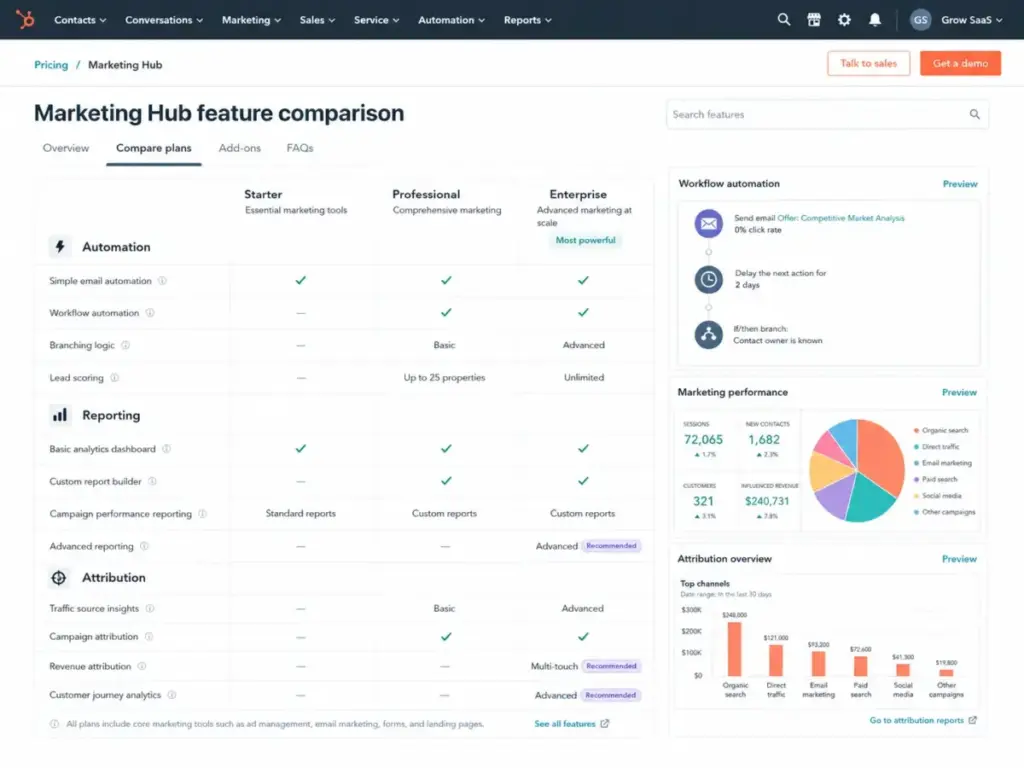
HubSpot Marketing Hub Enterprise includes customer journey analytics and multi-touch revenue attribution. Professional offers dashboards, custom reports, and attribution reporting that connect marketing activities to deals, pipeline stages, and revenue. Cross-hub reporting pulls data from Marketing, Sales, Service, and Content Hubs into unified dashboards.
ActiveCampaign reporting covers campaign performance, automation metrics, and contact activity. Custom reporting, however, is an add-on. The reporting layer is designed for email and campaign analysis, not for pipeline-connected revenue attribution.
For a B2B SaaS marketing team that needs to trace a lead from first touch through closed deal, HubSpot’s reporting architecture is built for that journey. ActiveCampaign reporting answers “which email performed best,” not “which marketing channel generated the most pipeline revenue.”
HubSpot vs ActiveCampaign Pricing and Value per Dollar
ActiveCampaign costs less at every team size in the data I can verify publicly.
| Users | HubSpot Cost (Marketing Hub Pro) | ActiveCampaign Cost (Enterprise, Annual) | Winner | Caveat |
|---|---|---|---|---|
| 5 | $990/month (base + 2 extra seats) + $3,000 onboarding year one | $145/month (5 users included, 1,000 contacts) | ActiveCampaign | AC add-ons and contact scaling extra |
| 10 | $1,240/month (base + 7 extra seats) + $3,000 onboarding year one | $145+/month | ActiveCampaign (caveated) | AC additional-user pricing not publicly visible |
| 25 | $1,990/month (base + 22 extra seats) + $3,000 onboarding year one | $145+/month | ActiveCampaign (caveated) | AC likely requires sales quote for 25 users |
| 50 | $3,240/month (base + 47 extra seats) + $3,000 onboarding year one | $145+/month | ActiveCampaign (caveated) | AC likely requires sales quote for 50 users |
What this means: HubSpot Marketing Hub Professional first-year cost for a 5-person team is approximately $14,880 ($990 x 12 months plus $3,000 onboarding). ActiveCampaign Enterprise at $145/month annual is roughly $1,740/year for 5 users at 1,000 contacts. That is an 8.5x difference in year one, before add-ons on either side.
But here is the catch. ActiveCampaign’s additional-user pricing beyond included seats is not publicly visible. At 10+ users, you need a sales quote. And ActiveCampaign’s CRM, SMS, WhatsApp, and custom reporting are separately priced add-ons. The headline price gap narrows once you layer those on. For a detailed breakdown of HubSpot’s pricing tiers across all hubs, see our HubSpot pricing analysis.
HubSpot’s first-year cost includes required onboarding ($3,000 on Professional, $7,000 on Enterprise), extra Core Seats ($50/month on Professional, $75/month on Enterprise), and marketing contact blocks for contacts above the included tier.
Hidden Cost Checklist: HubSpot vs ActiveCampaign
| Cost Item | HubSpot | ActiveCampaign | Ask Before Buying |
|---|---|---|---|
| Onboarding fee | $3,000 (Pro), $7,000 (Enterprise), mandatory | $0 (free onboarding and migration) | HubSpot: confirm if waivable |
| Extra user seats | $50/month per Core Seat (Pro) | Not publicly visible; confirm per-user add-on pricing | ActiveCampaign: get a quote for 10+ users |
| Contact tier overage | Immediate billing if marketing contacts exceed tier | Contact-based scaling; pricing varies by volume | Both: model costs at 5K, 10K, 25K contacts |
| CRM pipeline management | Included in Smart CRM | Add-on (Enhanced CRM) | ActiveCampaign: confirm Enhanced CRM add-on cost |
| SMS and WhatsApp | Add-on (long code or short code) | Add-on (SMS add-on, WhatsApp Messaging add-on) | Both: get channel-specific pricing |
| Custom reporting | Included on Pro and Enterprise | Add-on | ActiveCampaign: confirm custom reporting add-on cost |
| AI features | Breeze AI credits may apply | AI Activities add-on | Both: confirm credit or add-on pricing |
| API limit increases | Paid add-on ($500/month per increase, max 2) | Not applicable (no documented paid increase option) | HubSpot: calculate API needs before buying |
| Dedicated IP | Add-on | Not publicly documented | Both: ask if needed for deliverability |
| Transactional email | Add-on | Via Postmark (separate product) | Both: budget separately |
What this means: Neither platform’s starting price is the final bill. HubSpot’s hidden costs are front-loaded (onboarding, seats, contact blocks). ActiveCampaign’s hidden costs are modular (CRM add-on, SMS add-on, custom reporting add-on). Budget for both columns before signing.
Feature Gates by Plan: HubSpot vs ActiveCampaign
| Feature | HubSpot Plan Gate | ActiveCampaign Plan Gate | Buyer Implication |
|---|---|---|---|
| Multi-step automation | Professional ($890/month) | Starter ($15/month), capped at 5 actions | AC cheaper for basic automations; HubSpot unlocks unlimited at Pro |
| Unlimited automation actions | Professional | Pro ($79/month) | AC hits unlimited at 11x lower price |
| Lead scoring | Professional | Add-on (Enhanced CRM) | HubSpot includes natively; AC requires separate purchase |
| Landing pages | Starter (limited), Professional (full) | Plus ($49/month) | AC offers landing pages at lower tier |
| A/B testing (email) | Professional | Pro | Both require mid-tier plans |
| Custom reporting dashboards | Professional | Add-on | HubSpot includes; AC charges extra |
| Multi-touch revenue attribution | Enterprise ($3,600/month) | Not available | HubSpot only, at Enterprise pricing |
| Customer journey analytics | Enterprise | Not available | HubSpot only |
| SSO | Enterprise | Enterprise ($145/month) | Both require top-tier plans |
| CRM pipelines and deals | Included (Smart CRM) | Add-on (Enhanced CRM) | HubSpot advantage for sales-driven teams |
What this means: ActiveCampaign makes automation affordable early. HubSpot gates serious automation, reporting, and attribution behind Professional and Enterprise tiers. If your team runs on email triggers, ActiveCampaign’s plan structure is more efficient. If your team needs CRM-connected reporting and attribution, HubSpot’s gating makes sense because those features require CRM data.
Setup and Migration Difficulty
| Dimension | HubSpot | ActiveCampaign |
|---|---|---|
| Setup difficulty | Medium to high | Medium |
| Onboarding requirement | Mandatory paid onboarding on Professional and Enterprise | No setup fees; free migration and onboarding assistance |
| Time to first campaign | Days to weeks (depends on CRM, pipeline, and permission design) | Days (campaign creation is fast; complex automations take longer) |
| Data migration | Migration services, large partner ecosystem, import/export tools | Onboarding specialists help migrate automations and contact lists |
| Workflow rebuild risk | Medium (CRM properties, lifecycle stages, custom objects, and automations need redesign) | Medium (nested segmentation, ecommerce events, and cross-channel orchestration require planning) |
| Switching from A to B | Medium difficulty | N/A |
| Switching from B to A | N/A | High difficulty (CRM redesign, lifecycle stages, attribution, permissions, and dashboards) |
What this means: ActiveCampaign is faster to set up for email-first teams. HubSpot takes longer because you are building a CRM system, not just launching a campaign. Moving from HubSpot to ActiveCampaign is medium effort. Moving from ActiveCampaign to HubSpot is harder because teams must redesign CRM objects, lifecycle stages, and reporting.
Where HubSpot Wins
HubSpot is the better choice in these scenarios:
- 10+ person sales and marketing team sharing a pipeline. HubSpot’s Smart CRM connects marketing contacts to deals, sales stages, and service tickets. ActiveCampaign requires separate add-ons and still does not match this depth.
- B2B team needing multi-touch revenue attribution. HubSpot Enterprise tracks which marketing channels drive pipeline revenue. ActiveCampaign has no equivalent feature.
- Teams needing content, email, and CRM under one login. HubSpot Content Hub, Marketing Hub, Sales Hub, and Service Hub share one data layer. ActiveCampaign requires integrating with third-party CRM and content tools.
- Enterprise teams needing governance, custom objects, and role-based permissions. HubSpot Enterprise provides advanced governance, partition controls, and custom object modeling. ActiveCampaign Enterprise offers SSO and dedicated accounts but less CRM governance depth.
- Teams that value ecosystem breadth. HubSpot Marketplace has 2,000+ apps. ActiveCampaign has 1,000+ integrations. Both cover mainstream stacks, but HubSpot has deeper native sync options.
Where ActiveCampaign Wins
ActiveCampaign is the better choice in these scenarios:
- 5-person email-first startup with limited budget. ActiveCampaign Enterprise includes 5 users at $145/month annual. HubSpot Professional at the same user count costs roughly $990/month plus $3,000 onboarding in year one.
- Ecommerce team running behavioral automations. ActiveCampaign’s segmentation, ecommerce triggers, SMS add-on, and WhatsApp add-on are built for cross-channel lifecycle campaigns. HubSpot can do this but at much higher cost.
- Teams that need automation depth without CRM overhead. ActiveCampaign Pro includes unlimited automations, predictive content, conditional content, and landing pages at $79/month. HubSpot requires $890/month for comparable automation features.
- Budget-sensitive agencies managing client campaigns. ActiveCampaign’s lower per-campaign cost and automation-first design fits agencies that run campaigns without needing full CRM infrastructure per client.
- Teams that want zero setup fees. ActiveCampaign charges no onboarding fee. HubSpot Professional requires $3,000. For a small team testing a new platform, that matters.
Who Should Choose HubSpot
Choose HubSpot if:
- Your sales process requires a shared pipeline with marketing attribution, deal tracking, and lifecycle stage management across a team of 10 or more.
- You need one platform for marketing, sales, service, content, reporting, and AI instead of stitching together 3-4 separate tools.
- Your CFO or VP of Marketing needs multi-touch revenue attribution and customer journey analytics to justify marketing spend.
- You are growing past 20 users and need CRM governance, custom objects, advanced permissions, and enterprise reporting.
- Your tech stack already includes HubSpot Sales Hub or Service Hub, and consolidating marketing into the same ecosystem reduces integration overhead.
Who Should Choose ActiveCampaign
Choose ActiveCampaign if:
- Your team is under 10 people, runs primarily on email and SMS campaigns, and does not need a full CRM operating system.
- Your first-year budget for marketing automation is under $5,000, making HubSpot Professional financially impractical.
- You run an ecommerce brand that needs behavioral triggers, segmentation, and cross-channel lifecycle campaigns without CRM complexity.
- You want to launch automations this week, not next quarter. ActiveCampaign’s onboarding is faster and cheaper.
- Your CRM needs are basic (contacts, simple pipelines) and can be handled by the Enhanced CRM add-on without needing HubSpot’s full platform.
Who Should Avoid Both HubSpot and ActiveCampaign
Neither HubSpot nor ActiveCampaign is the right pick if:
- You only need a simple sales pipeline. A 3-person sales team tracking deals and activities does not need HubSpot Marketing Hub or ActiveCampaign automations. Consider Pipedrive for a focused pipeline CRM at lower cost. See our Pipedrive CRM review for a detailed evaluation.
- You need ecommerce-first SMS and email at scale with deep Shopify integration. Klaviyo is built for Shopify lifecycle marketing with revenue attribution. Both HubSpot and ActiveCampaign can connect to Shopify, but Klaviyo’s native integration is deeper for pure ecommerce teams. Our Klaviyo review covers this in detail.
- Your budget is under $200/year and you need simple email newsletters. Brevo offers lower-cost email marketing with basic CRM. ActiveCampaign’s Starter caps automations at 5 actions. HubSpot’s free tools come with branding limits. Our Brevo review covers it as a simpler starting point.
- You need enterprise CRM depth without HubSpot pricing. If you need Salesforce-level customization, CPQ, and AppExchange ecosystem but cannot afford HubSpot Enterprise’s $3,600/month plus $7,000 onboarding, evaluate Salesforce directly.
Alternatives to HubSpot and ActiveCampaign
| Alternative | Choose If | Starting Price |
|---|---|---|
| Pipedrive | You need a simple, fast sales pipeline CRM without a large marketing suite | $14/user/month |
| Brevo | You need lower-cost email marketing with simple CRM and do not need advanced automation | $9/month (Starter) |
| Klaviyo | You run Shopify ecommerce and need lifecycle email, SMS, and revenue tracking natively | Free up to 250 contacts; paid plans from $20/month |
What this means: Not every team needs a CRM platform or an automation engine. Match the tool to the workflow. Pipeline-first teams should look at Pipedrive. Newsletter-first teams should look at Brevo. Shopify ecommerce teams should look at Klaviyo. If you are comparing HubSpot to other CRM tools, see our HubSpot vs Pipedrive comparison for a head-to-head.
Final Verdict: HubSpot vs ActiveCampaign in 2026
The HubSpot vs ActiveCampaign decision is a CRM architecture question, not a feature comparison.
Choose HubSpot if your team needs marketing, sales, service, content, and reporting in one CRM-centered platform. The price is higher because you are buying an operating system, not a single tool. A 10-person sales and marketing team with shared pipeline, attribution needs, and growth plans toward 25+ users will get more long-term value from HubSpot, despite the $890/month Professional base and $3,000 onboarding fee.
Choose ActiveCampaign if your team is email-first, automation-heavy, and under 10 people. ActiveCampaign Pro at $79/month gives you unlimited automations, predictive content, and 3 users. For a 5-person startup spending under $5,000/year on marketing tools, ActiveCampaign is the more practical pick. Add the Enhanced CRM add-on only if you outgrow basic pipeline tracking. Teams weighing broader options should also explore our roundup of best email marketing platforms.
My bottom line: I recommend HubSpot for teams building a revenue operations system and ActiveCampaign for teams building an automation engine. If you pick HubSpot, budget for the actual bill (seats, onboarding, contact tiers), not the starting price. If you pick ActiveCampaign, verify add-on costs for CRM, SMS, and custom reporting before committing.
FAQ
Is ActiveCampaign cheaper than HubSpot?
Yes, at publicly listed prices. ActiveCampaign Pro starts at $79/month annual for 1,000 contacts with 3 users. HubSpot Marketing Hub Professional starts at $890/month with 3 included seats. ActiveCampaign also charges no setup fee, while HubSpot requires $3,000 onboarding on Professional. The gap narrows if you add ActiveCampaign’s CRM, SMS, and custom reporting add-ons, but ActiveCampaign remains cheaper for most team sizes.
Does ActiveCampaign have a real CRM?
ActiveCampaign includes basic contact management. Pipeline management, deal records, lead scoring, and sales engagement are available as add-ons (Enhanced CRM, Sales Engagement). These add-ons provide functional CRM capabilities, but the pipeline depth and cross-team governance do not match HubSpot Smart CRM or Salesforce-level systems. For teams with simple pipeline needs, the add-on works. For 15+ person sales teams, a dedicated CRM is likely a better fit.
Does HubSpot charge onboarding fees?
Yes. HubSpot Marketing Hub Professional requires a $3,000 one-time onboarding fee. Marketing Hub Enterprise requires $7,000. These fees are mandatory per HubSpot’s official Product and Services Catalog. Marketing Hub Starter can be self-serve without a required onboarding fee.
Which is better for email automation, HubSpot or ActiveCampaign?
ActiveCampaign is better for most email-first teams. Unlimited automation actions start at Pro ($79/month annual). HubSpot locks unlimited actions behind Professional ($890/month). Both platforms handle multi-step workflows, but ActiveCampaign reaches that depth at roughly one-ninth the monthly cost.
Can ActiveCampaign replace HubSpot Marketing Hub?
It depends on what you use. ActiveCampaign can replace HubSpot’s email marketing, automation, and basic CRM functions at lower cost. It cannot replace HubSpot’s native Sales Hub, Service Hub, Content Hub, customer journey analytics, multi-touch revenue attribution, or enterprise governance features. If your HubSpot usage is mostly email and workflows, ActiveCampaign is a viable replacement. If you depend on cross-hub reporting and pipeline management, it is not.
Should I switch from ActiveCampaign to HubSpot?
Switch if your team has outgrown basic automation and now needs a CRM-centered system for pipeline management, sales handoff, revenue attribution, and cross-team reporting. Moving from ActiveCampaign to HubSpot is high-difficulty: you will need to redesign CRM objects, lifecycle stages, permissions, dashboards, and forms. Budget for HubSpot onboarding fees and rebuild time.
Is HubSpot worth the price over ActiveCampaign?
HubSpot is worth the premium for teams that will use multiple hubs (Marketing, Sales, Service) and need unified reporting. For a 5-person email-first team, HubSpot Professional is hard to justify at $890/month when ActiveCampaign Pro handles the same automation at $79/month. The premium pays off when your team crosses 10+ people with shared pipeline and attribution requirements.
Which is better for small business, HubSpot or ActiveCampaign?
For small businesses under 10 people focused on email marketing and automation, ActiveCampaign offers better value. For small businesses with a sales team that needs pipeline management, CRM records, and marketing attribution in one tool, HubSpot Starter ($20/seat/month) or Professional provides more long-term coverage. Define “small business” by team size and sales process complexity, not revenue.
What ActiveCampaign features are add-ons?
CRM pipelines (Enhanced CRM), sales engagement, SMS messaging, WhatsApp messaging, AI Activities, and custom reporting are add-ons on ActiveCampaign. Exact add-on pricing requires direct confirmation. These costs can add up, especially for teams that need pipeline management and multi-channel messaging alongside email automation.
How hard is it to migrate from ActiveCampaign to HubSpot?
High difficulty. Migration requires mapping contacts, segments, automations, email templates, landing pages, and consent fields from ActiveCampaign to HubSpot’s CRM structure. Teams also need to redesign lifecycle stages, deal pipelines, reporting dashboards, and permission settings. ActiveCampaign states onboarding specialists can help migrate outbound. HubSpot offers migration services and a large partner ecosystem. Complex workflow logic and attribution history cannot be assumed portable without manual rebuild.