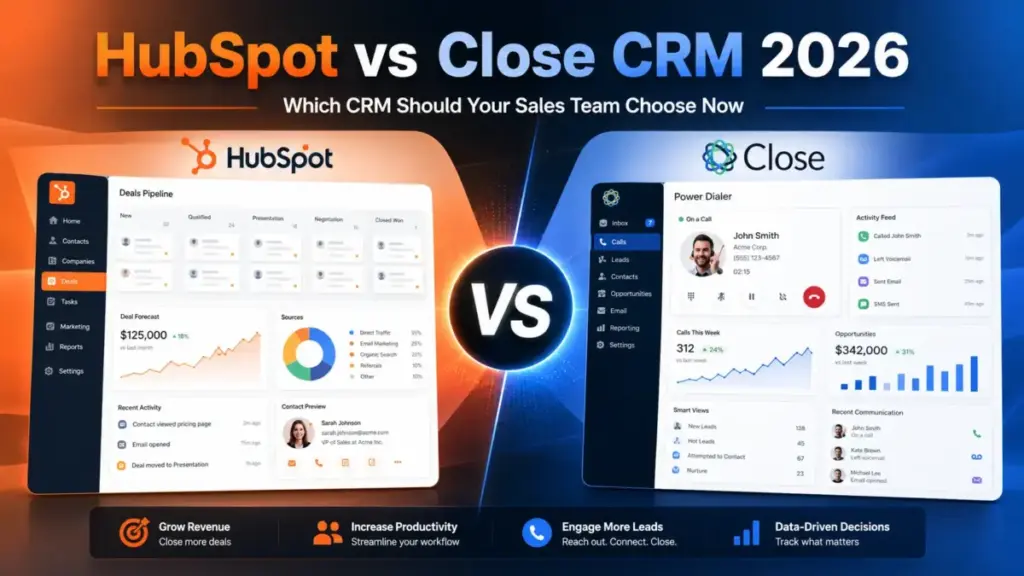
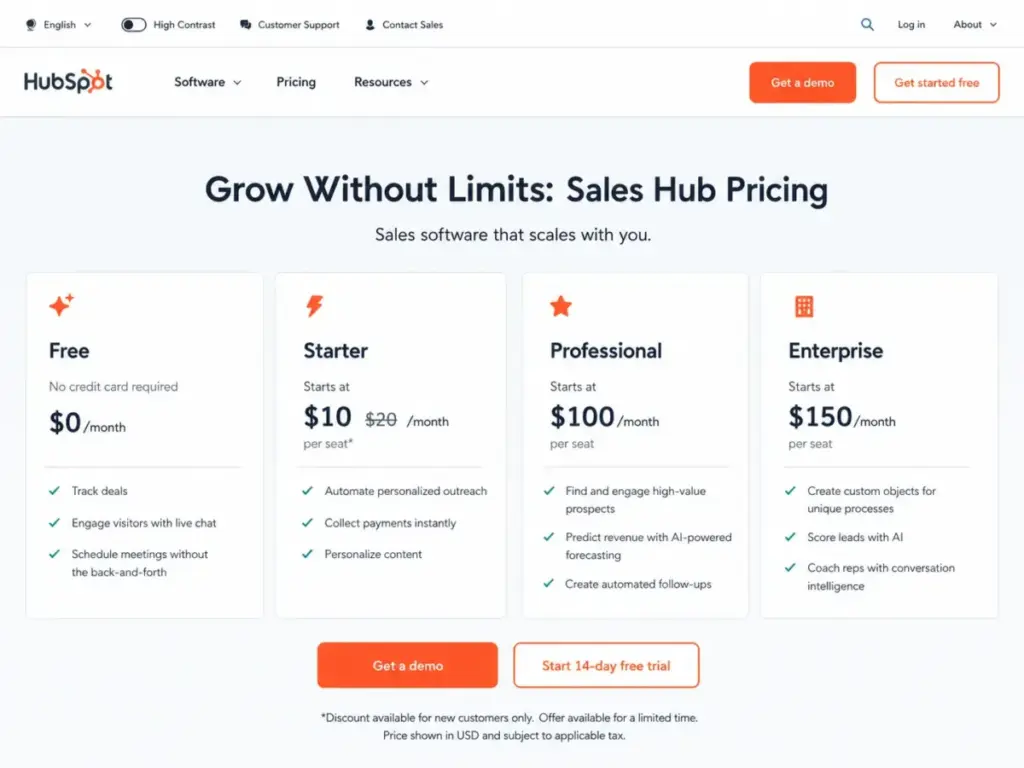
HubSpot Sales Hub Professional costs $100 per user per month. Close Growth annual costs $99 per user per month. Almost identical at the automation tier. But a 10-person sales team on HubSpot gets a full go-to-market platform with sequences, forecasting, custom reports, and more than 2,000 integrations. The same team on Close gets built-in calling, SMS, Power Dialer, centralized inbox, and a CRM that was designed around the daily outbound workflow.
Choose HubSpot if your team needs CRM plus marketing handoff, reporting depth, governance, and ecosystem scale. Choose Close if your team lives in calls, SMS, email, and fast pipeline execution. The right pick depends on your sales motion, not on which CRM has a longer feature list.
For teams evaluating best sales CRM software options, this is one of the most common head-to-head decisions in 2026. I built pricing models, mapped feature gates, and compared real workflow differences to help you pick the right one.
Understanding what CRM software actually does matters here because these two products define “CRM” very differently. HubSpot treats CRM as the data layer for an entire customer platform. Close treats CRM as the command center for outbound sales execution.
Quick Verdict: HubSpot vs Close CRM
| Category | Winner | Why |
|---|---|---|
| Pricing and total cost | Depends | Close Growth annual is $1 cheaper per seat than HubSpot Professional, but HubSpot includes more platform breadth at that price. Hidden costs differ: HubSpot has onboarding fees; Close has calling and SMS usage fees. |
| Ease of setup and adoption | Close | Narrower product focused on daily outbound workflow. Less admin configuration needed for a small sales team. |
| CRM platform breadth | HubSpot | Sales, marketing, service, CPQ, custom objects, reporting, and 2,000+ integrations under one platform. |
| Outbound calling and SMS | Close | Built-in calling, SMS, centralized inbox, Power Dialer on Growth, Predictive Dialer and live call coaching on Scale. |
| Automation and workflows | HubSpot | Deeper workflow, sequence, and reporting automation. Close offers workflows starting at Growth, but scope is narrower. |
| Integrations and ecosystem | HubSpot | More than 2,000 marketplace apps versus Close’s focused API and sales workflow integrations. |
| AI features | Depends | HubSpot has Breeze for prospecting and selling. Close has Chloe AI across all plans with per-plan credit limits. Different strengths. |
| Security and compliance | Tie | Both provide SOC 2 Type 2 and GDPR compliance. |
| Support options | HubSpot | Free tier gets community; Starter adds email and chat; Professional and Enterprise add phone. Close offers email support plus paid Premium Support starting at $750 per month. |
What this means: HubSpot wins on breadth and ecosystem. Close wins on outbound execution speed and built-in communication. If your CRM decision is driven by calling volume and SMS, Close is the shorter path. If your decision is driven by reporting, marketing alignment, and scaling past 50 users, HubSpot is the stronger foundation.
How We Compared HubSpot and Close CRM
This comparison uses official pricing pages, product documentation, feature-gate analysis, and third-party review sentiment from G2 and SoftwareAdvice. Pricing was verified on June 4, 2026 from HubSpot Sales Hub and Close pricing.
After evaluating 40+ CRM platforms for SaaSZap, I can tell you the pricing page rarely reflects what a 10-person team pays. Both HubSpot and Close have hidden costs that change the math once you factor in onboarding, calling fees, and plan-gated features.
Testing level: third-party validated. This comparison uses official vendor documentation, public pricing data, and aggregated third-party review signals. We did not conduct hands-on product testing for this article.
Limitation: HubSpot Starter displayed a limited-time promotional $10 per seat per month price on the product page, while the official catalog lists Starter from $20 per month per seat. Close’s base plan prices do not fully include calling, SMS, phone line, and A2P 10DLC compliance costs.
Workflow 1: Outbound Calling and Follow-ups, HubSpot vs Close
Close wins this workflow.
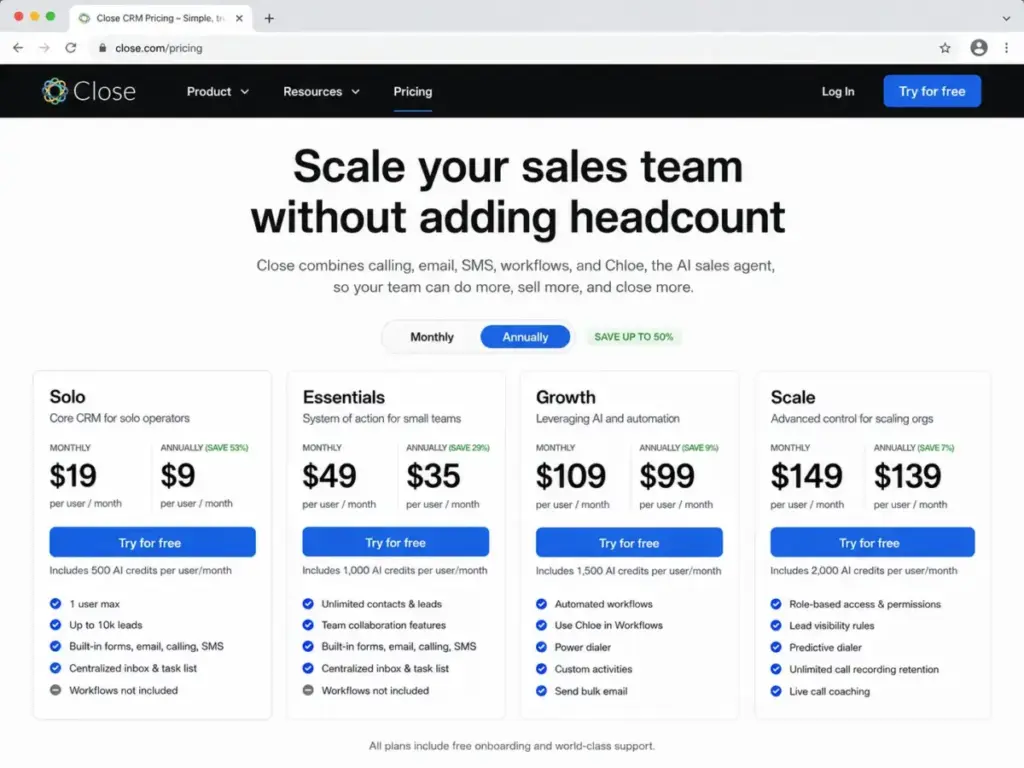
A 10-person SDR team making 50+ calls per day needs calling, SMS, and follow-up tools inside the CRM. Close was built for this. Calling, SMS, and centralized inbox are included starting on Essentials at $49 per user per month (monthly) or $35 per user per month (annual). Growth adds Power Dialer at $99 per user per month (annual). Scale adds Predictive Dialer and live call coaching at $139 per user per month (annual).
HubSpot includes call tracking and calling features, but calling minutes and HubSpot-provided phone numbers are limited by plan. Extra calling minutes can require paid limit increases. For a call-heavy team, HubSpot’s calling constraints create friction that Close simply does not have.
There is a caveat, though. Close’s calling is usage-based. Phone lines start at $1 per line per month. SMS costs and A2P 10DLC compliance add operational and cost overhead. A team making 500+ calls per day needs to model those usage fees before assuming Close is cheaper.
Workflow winner: Close. The product was designed around this exact motion. HubSpot can do it, but calling-heavy teams will hit plan limits faster.
For teams that rely on Close CRM’s detailed capabilities, the calling and SMS infrastructure is the primary reason they choose Close over broader platforms.
Workflow 2: Marketing-to-Sales Pipeline and Reporting, HubSpot vs Close
HubSpot wins this workflow.
A scaling SaaS company with inbound leads from marketing, multi-stage deal pipelines, cross-team reporting, and sales forecasting needs a platform that connects sales to marketing data. HubSpot Sales Hub is part of a broader customer platform that includes Marketing Hub, Service Hub, and Operations Hub. The modules share a single CRM database and reporting layer.
HubSpot Professional at $100 per user per month gives you advanced workflows, sequences, reporting, forecasting, and cross-functional data visibility. Enterprise at $150 per user per month adds custom objects, team hierarchy forecasting, advanced governance, and larger reporting limits.
Close is a sales execution CRM. It does not include marketing automation, service operations, CMS, or the kind of cross-functional reporting that a RevOps team needs. If your team runs marketing campaigns that generate MQLs, routes those MQLs to SDRs, and tracks conversion through a multi-stage pipeline with forecasting, HubSpot is the platform that connects those dots.
Workflow winner: HubSpot. The architecture difference is structural. HubSpot is a platform of interconnected modules that share a data layer. Close is a focused sales tool. For marketing-to-sales handoff, HubSpot removes the integration gap.
Teams evaluating HubSpot’s full CRM ecosystem should read our HubSpot CRM detailed analysis for a deeper look at feature gates across tiers.
Workflow 3: AI-Assisted Sales Execution, HubSpot vs Close
This one depends on what “AI” means for your team.
HubSpot offers Breeze capabilities for AI prospecting, lead management, and guided selling across Sales Hub tiers. The AI features strengthen as you move from Starter to Professional to Enterprise, but the exact availability depends on your plan and seat configuration.
Close includes Chloe AI across all plans with per-plan credit limits: 500 credits per user per month on Solo, 1,000 on Essentials, 1,500 on Growth, and 2,000 on Scale. Chloe AI is available in workflows starting at Growth. Close’s AI approach is narrower but directly integrated into the daily sales workflow.
Here is the thing. Both platforms treat AI differently. HubSpot’s AI is broader (prospecting, content, forecasting, guided selling). Close’s AI is focused on the sales rep workflow (call coaching on Scale, AI-assisted workflows on Growth). If your team needs AI for sales execution inside a focused CRM, Close’s per-plan credit model is straightforward. If your team needs AI across marketing, sales, and service, HubSpot’s platform-wide approach covers more ground.
Workflow winner: Depends. Close for AI inside the daily calling and workflow motion. HubSpot for AI across the full go-to-market platform.
Pricing and Value per Dollar
HubSpot Sales Hub Pricing (verified June 4, 2026)
| Plan | Price | Billing | Key Limits |
|---|---|---|---|
| Free | $0/month | Monthly | Basic CRM tools; advanced automation, reporting, and governance excluded |
| Starter | $20/seat/month (catalog baseline; promotional $10/seat may apply) | Monthly or annual | Starter-level sales tools; fewer automation and reporting features |
| Professional | $100/seat/month | Monthly or annual | Advanced workflows, sequences, reporting, forecasting |
| Enterprise | $150/seat/month | Annual | Custom objects, governance, larger reporting limits; $3,500 one-time onboarding fee |
Close CRM Pricing (verified June 4, 2026)
| Plan | Monthly Price | Annual Price | Key Limits |
|---|---|---|---|
| Solo | $19/user/month | $9/user/month | 1 user, 10,000 leads, 500 AI credits, no workflows |
| Essentials | $49/user/month | $35/user/month | Unlimited leads and contacts, email, calling, SMS, no workflows |
| Growth | $109/user/month | $99/user/month | Automated workflows, Power Dialer, bulk email, 1,500 AI credits |
| Scale | $149/user/month | $139/user/month | Predictive Dialer, call coaching, custom objects, unlimited call recording |
| Custom | Contact sales | Contact sales | High-volume or custom commercial needs |
What this means: At the automation tier (HubSpot Professional vs Close Growth annual), the per-seat price is nearly identical. The real cost difference shows up in hidden costs and what each dollar buys.
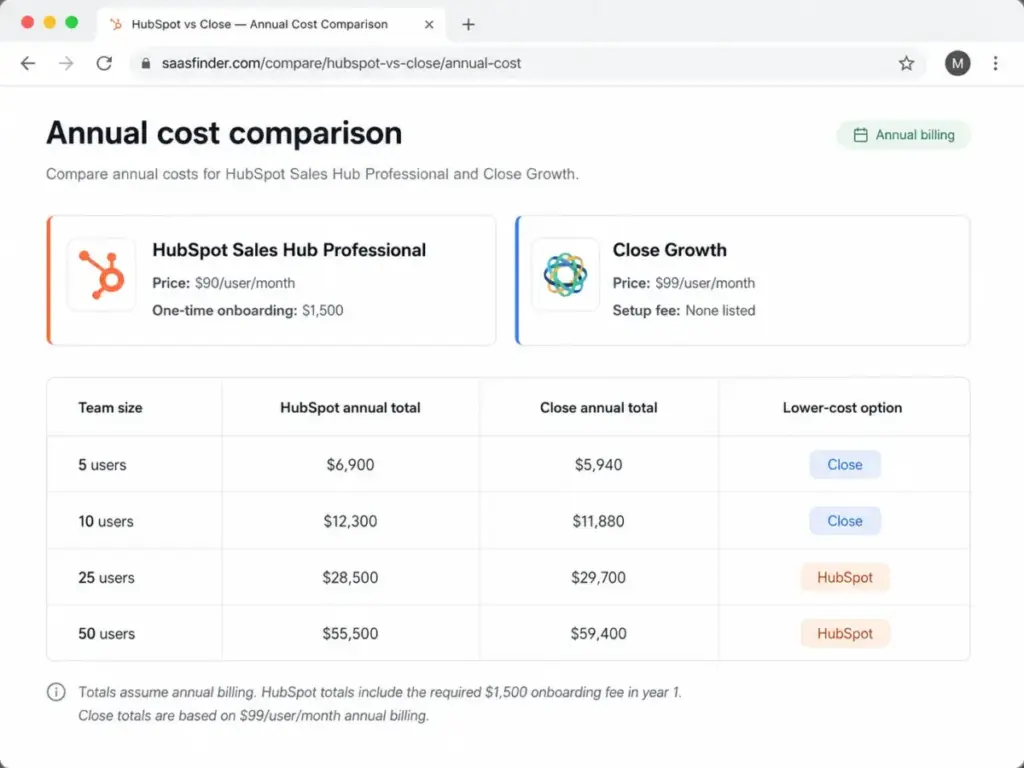
Cost at Scale: HubSpot Professional vs Close Growth Annual
| Team Size | HubSpot Professional | Close Growth Annual | Difference | Caveat |
|---|---|---|---|---|
| 5 users | $500/month | $495/month | $5 | Excludes HubSpot onboarding and Close calling/SMS usage fees |
| 10 users | $1,000/month | $990/month | $10 | Same exclusions |
| 25 users | $2,500/month | $2,475/month | $25 | Same exclusions |
| 50 users | $5,000/month | $4,950/month | $50 | Same exclusions |
What this means: Close Growth annual is marginally cheaper per seat, but the gap is negligible at scale. The real decision is not the per-seat difference. It is whether your team needs HubSpot’s platform breadth or Close’s communication-first approach. At $500 per month for 5 users, HubSpot gives you a platform. Close gives you a calling machine.
Hidden Costs You Need to Model
HubSpot hidden costs:
- Enterprise onboarding fee: $3,500 one-time
- Calling minutes and phone numbers have plan-level limits
- Advanced automation, reporting, and custom objects require Professional or Enterprise
- Starter pricing may vary between promotional and catalog baseline
Close hidden costs:
- Calling is usage-based
- Phone lines start at $1 per line per month
- SMS usage and A2P 10DLC compliance create cost and operational overhead
- Premium Support starts at $750 per month
- Workflows, Power Dialer, Predictive Dialer, call coaching, and custom objects require Growth or Scale
For a deeper look at HubSpot’s pricing model and plan gates, check our HubSpot pricing breakdown.
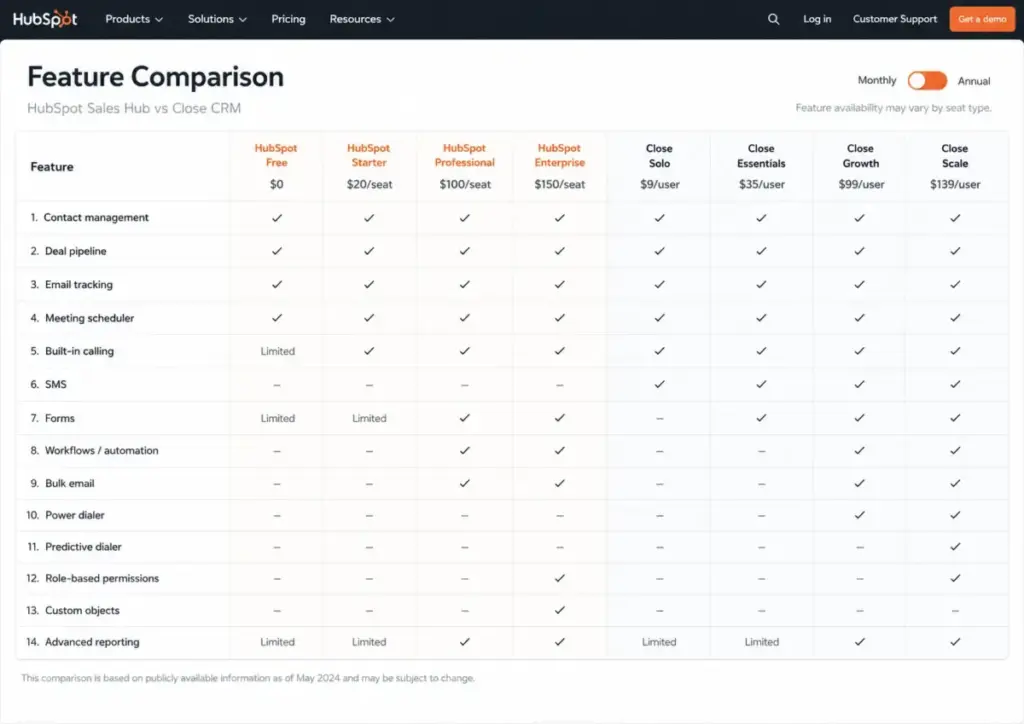
Feature Gate Comparison: What You Get by Plan
| Feature | HubSpot Plan Gate | Close Plan Gate | Buyer Impact |
|---|---|---|---|
| Basic CRM and pipeline | Free | Solo ($9/user/month annual) | HubSpot’s free tier covers basic CRM; Close Solo is limited to 1 user and 10,000 leads |
| Email sequences | Starter ($20/seat/month) | Essentials ($35/user/month annual) | HubSpot is cheaper for basic email sequences |
| Sales automation and workflows | Professional ($100/seat/month) | Growth ($99/user/month annual) | Nearly identical tier gate and price for automation |
| Forecasting and advanced reporting | Professional ($100/seat/month) | Not a primary Close feature | HubSpot wins for forecasting-dependent teams |
| Power Dialer | Not native to HubSpot | Growth ($99/user/month annual) | Close-only feature for call-heavy teams |
| Predictive Dialer and call coaching | Not native to HubSpot | Scale ($139/user/month annual) | Close-only feature for high-volume calling |
| Custom objects | Enterprise ($150/seat/month) | Scale ($139/user/month annual) | Close is cheaper for custom objects by $11/seat |
| AI capabilities | Breeze (varies by plan) | Chloe AI (all plans, credit-limited) | Close includes AI on all plans; HubSpot AI depends on tier |
| 2,000+ marketplace integrations | All plans (depth varies) | Not available | HubSpot only |
What this means: If your team’s daily workflow centers on calling, SMS, and dialer-assisted outbound, Close unlocks those features at Growth and Scale. If your team needs forecasting, deep reporting, cross-functional automation, and ecosystem integrations, HubSpot unlocks those at Professional and Enterprise.
Setup and Migration Difficulty
| Factor | HubSpot Sales Hub | Close CRM |
|---|---|---|
| Setup difficulty | Medium to High | Low to Medium |
| Time to first pipeline | 1-3 days (basic); weeks for Professional/Enterprise | Hours to 1-2 days |
| Onboarding requirement | Enterprise requires $3,500 one-time onboarding | No mandatory onboarding fee |
| Admin overhead | Higher as team scales (governance, permissions, workflows) | Lower, but calling/SMS compliance requires configuration |
| Migration complexity (to) | Medium to High (re-map sales history, workflows, custom objects) | Medium (import contacts, configure calling, rebuild workflows) |
| Migration complexity (from) | Medium (HubSpot supports record export and import tools) | Medium (Close supports CSV/XLS import, API exports, email/SMS export) |
| Data portability | Record export, CRM import tools, API access | CSV/XLS import, Smart View exports, API-based async exports |
What this means: Close is faster to set up for a team that just needs calling, pipeline, and email. HubSpot takes longer but gives you a more complete platform once configured. If your team has fewer than 15 people and needs to be making calls within a week, Close gets you there faster.
Where HubSpot Sales Hub Wins
- Marketing-to-sales handoff. HubSpot connects sales, marketing, and service under one data layer. Close does not do marketing automation.
- Reporting and forecasting depth. Professional and Enterprise tiers provide custom reports, forecasting, and team hierarchy analytics that Close does not match.
- Integration ecosystem. More than 2,000 marketplace apps versus Close’s narrower integration footprint.
- Enterprise governance. Custom objects, role-based permissions, and advanced admin controls on Enterprise exceed Close Scale’s governance options.
- Free tier as a starting point. HubSpot’s free CRM gives small teams a real entry point. Close Solo is limited to 1 user.
Where Close CRM Wins
- Built-in calling and SMS. Calling, SMS, and centralized inbox are native to Close starting at Essentials. HubSpot’s calling has plan-level minute and phone-number limits.
- Dialer tools. Power Dialer on Growth and Predictive Dialer on Scale are features HubSpot does not natively offer.
- Setup speed. A 5-person outbound team can be making calls within hours. HubSpot’s broader platform takes longer to configure.
- AI across all plans. Chloe AI is included on every Close plan with per-plan credit limits. HubSpot’s AI availability depends on tier.
- Lower admin friction. Close’s narrower scope means less CRM administration for teams that only need outbound execution.
Who Should Choose HubSpot Sales Hub
- Scaling SaaS companies that need CRM plus marketing handoff, cross-functional reporting, and integrations under one ecosystem.
- RevOps-managed teams that need advanced workflows, forecasting, custom objects, and team hierarchy analytics.
- Companies planning to grow past 50 reps where platform governance, reporting depth, and ecosystem breadth matter more than daily calling speed.
If your team fits any of these profiles, start with our HubSpot vs Pipedrive comparison to see how HubSpot compares against another common alternative.
Who Should Choose Close CRM
- Founder-led sales teams under 10 people that mainly sell through calls, SMS, and email follow-ups.
- SDR teams doing 50+ outbound calls per day that need Power Dialer, call recording, and pipeline tracking in one workspace.
- Outbound-heavy agencies that want a focused CRM without marketing, service, or CMS overhead.
Teams exploring alternatives should also review our Close CRM alternatives analysis for more options in this space.
Who Should Avoid Both
- Teams that need a very low-cost pipeline CRM with minimal monthly spend. Both HubSpot Professional and Close Growth cost $99-$100 per user per month at the automation tier. If your budget is under $30 per user per month, consider Pipedrive CRM’s feature set or Zoho CRM.
- Large enterprises needing deep customization beyond HubSpot. If HubSpot Enterprise’s custom objects and governance are not flexible enough, Salesforce Sales Cloud offers deeper enterprise architecture.
- Teams that need a pipeline-first CRM without communication usage fees or platform complexity. Neither HubSpot’s breadth nor Close’s usage-based calling model fits a team that wants a simple, flat-cost pipeline tool.
Alternatives to HubSpot and Close CRM
| Alternative | Best For | Why Consider |
|---|---|---|
| Pipedrive | Teams wanting visual pipeline management with less platform complexity than HubSpot and less communication-tool depth than Close | Good middle option when sales process tracking matters more than full GTM automation or dialer-heavy outbound |
| Salesforce Sales Cloud | Enterprise organizations needing deep customization, complex governance, and large CRM architecture | Useful when HubSpot is not customizable enough and Close is too narrow |
| Zoho CRM | Budget-conscious teams that want a broad business software suite at lower entry cost | Useful when neither HubSpot’s platform cost nor Close’s sales communication focus fits the buying criteria |
What this means: Pipedrive is the middle ground for teams that want pipeline management without HubSpot’s complexity or Close’s communication model. Salesforce is the escalation path for enterprises that outgrow both. Zoho is the budget option when platform cost is the primary concern.
For a broader view of CRM options, our best CRM for small business guide covers more alternatives across different budget tiers.
Final Verdict: HubSpot vs Close CRM in 2026
The HubSpot vs Close CRM decision comes down to your sales motion, not your feature checklist.
Choose HubSpot Sales Hub if your team needs a platform that connects marketing, sales, service, and reporting under one data layer. Start at Professional ($100 per user per month) if you need automation, sequences, and forecasting. Budget for Enterprise ($150 per user per month plus $3,500 onboarding) if you need custom objects and governance.
Choose Close CRM if your team’s daily workflow is outbound calls, SMS, email, and pipeline execution. Start at Growth ($99 per user per month annual) if you need workflows and Power Dialer. Budget for Scale ($139 per user per month annual) if you need Predictive Dialer, call coaching, and custom objects.
My honest take, after building pricing models for 15+ CRM tools: at the automation tier, these two products cost almost the same per seat. The cost difference is a rounding error. The real difference is what you get for that dollar. HubSpot gives you a platform. Close gives you a weapon. Pick based on what your team actually does every day, not on what the marketing page promises.
If you need a broader view of how HubSpot compares against another major CRM, our HubSpot vs Salesforce CRM comparison covers the enterprise side of that decision.
FAQ
Is Close CRM better than HubSpot?
Close is the better fit for outbound-heavy sales teams that make 50+ calls per day and need built-in calling, SMS, and dialer tools inside their CRM. HubSpot is the better fit for teams that need CRM plus marketing automation, reporting, and ecosystem integrations. The winner depends on your sales motion, not the feature count.
Is Close CRM cheaper than HubSpot?
At the automation tier, Close Growth annual ($99 per user per month) is $1 cheaper per seat than HubSpot Professional ($100 per user per month). But Close has usage-based calling and SMS fees, and HubSpot has onboarding fees and feature tiering. Total cost depends on call volume and platform needs.
Which CRM is better for cold calling?
Close CRM. Built-in calling, SMS, Power Dialer on Growth, and Predictive Dialer on Scale are designed for call-heavy workflows. HubSpot includes call tracking but has plan-level calling minute limits that constrain high-volume teams.
Should a small outbound team use HubSpot or Close?
A team under 10 people doing outbound calls and follow-ups will get more value from Close. The product is focused on the daily outbound workflow, and setup takes hours instead of days. HubSpot is the better pick if the same team also needs marketing handoff and reporting depth.
Can Close replace HubSpot Sales Hub?
Yes, if your team only needs outbound sales execution (calling, SMS, email, pipeline). No, if your team relies on HubSpot’s marketing automation, service tools, cross-functional reporting, CPQ, or ecosystem integrations.
Does Close CRM have marketing automation?
No. Close is a sales execution CRM. It does not include marketing automation, CMS, or service operations. Teams that need marketing-to-sales alignment should evaluate HubSpot or a separate marketing platform.
What hidden costs should I expect with HubSpot Sales Hub?
Enterprise onboarding fee ($3,500 one-time), calling minute limits, phone number limits, and feature gates that push teams from Starter to Professional or Enterprise. The practical starting point for most sales teams is Professional at $100 per seat per month, not Starter.
What hidden costs should I expect with Close CRM?
Usage-based calling fees, phone lines starting at $1 per line per month, SMS costs, A2P 10DLC compliance overhead, and Premium Support at $750 per month. Workflows, Power Dialer, and Predictive Dialer require Growth or Scale.
Is HubSpot too much CRM for a startup sales team?
Yes, if the team only needs calling, SMS, and pipeline tracking. HubSpot’s broader platform creates setup and admin overhead that a 5-person outbound team does not need. Close is the faster path for founder-led sales.
Which CRM is better for RevOps teams?
HubSpot Sales Hub. Professional and Enterprise tiers provide advanced workflows, custom reports, forecasting, custom objects, and team hierarchy analytics that RevOps teams need. Close does not position itself as a RevOps platform.