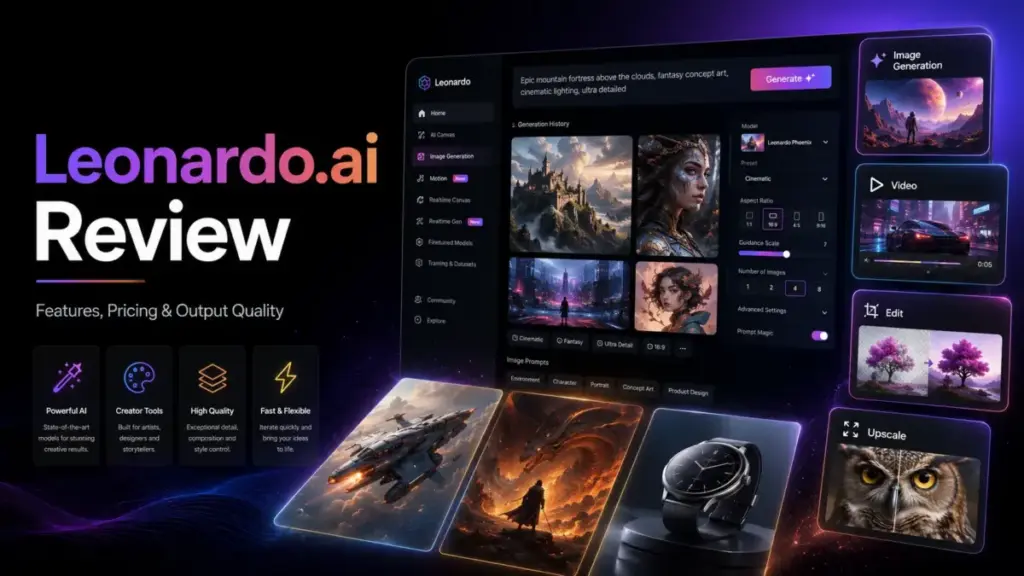
Most generative AI image tools promise studio-quality output for pocket change, but the real cost only becomes clear after you hit token limits, discover your free creations are public, or realize the API runs on a completely separate billing system. This Leonardo.ai review breaks down what the platform actually delivers in 2026, who benefits most from it, and where it falls short.
Leonardo.Ai is worth considering if you need a production-oriented image generation workspace with model selection, custom training, and team collaboration at a lower entry price than Midjourney. It is not worth it if you need guaranteed prompt consistency, absolute privacy on a free plan, or a single subscription that covers both web and API usage. Among the current crop of AI image generators, Leonardo.Ai occupies an unusual middle ground: more workflow tooling than DALL-E, more accessible than Stable Diffusion, and cheaper than Adobe Firefly at comparable tiers.
Quick Verdict: Is Leonardo.Ai Worth It?
Leonardo.Ai earns a 7.4 out of 10 in this review. It is a capable generative AI creative platform with genuine strengths in model variety, editing tools, and price-to-feature ratio, but token complexity, public free outputs, and API billing separation create friction that most competing reviews ignore.
| Category | Score (out of 10) | Notes |
|---|---|---|
| Image Generation Quality | 8.0 | Strong across multiple models; prompt drift still requires human review |
| Editing and Workflow Tools | 7.5 | Realtime Canvas, Omni editing, and Flow State add real production value |
| Pricing Transparency | 6.5 | Token math, relaxed generation caveats, and API separation reduce clarity |
| Team and Collaboration | 7.0 | Team Starter and Growth plans exist, but Canva entitlement has limits |
| Privacy and Commercial Rights | 7.0 | Paid private mode is solid; free plan ownership and visibility are weak |
| Support and Reliability | 6.5 | Trustpilot shows 4.6/5 overall, but 11% 1-star reviews and billing complaints |
| Overall | 7.4 | Best for solo creators and small teams needing volume at mid-range pricing |
Best for: Solo commercial creators producing 50 to 300 assets per month, small marketing teams, and game-art teams prototyping characters and environments.
Not for: Users who need absolute privacy on a free plan, developers expecting API access bundled with a web subscription, or teams that require pixel-perfect prompt consistency without manual review.
What Is Leonardo.Ai?
Leonardo.Ai is a generative AI creative platform built for image generation, image editing, video generation, and custom model training. It operates as a web application with a separate API product, and it is owned by Canva following an acquisition announced in 2024.
The platform positions itself between consumer-friendly tools like DALL-E and professional pipelines like Stable Diffusion. It offers multiple foundation models (including Phoenix 1.0 and Lucid Origin), a Realtime Canvas for interactive editing, Blueprints for repeatable workflows, and team workspace features. Unlike Midjourney, which focuses primarily on generation quality, Leonardo.Ai builds outward into editing, consistency, and production workflow tools.
Leonardo.Ai Pricing and Plans
Leonardo.Ai uses a token-based pricing system across six individual and team tiers, plus separate API billing. All prices below were verified on the official Leonardo.Ai pricing page on May 4, 2026. If you have seen references to plans named Apprentice, Artisan, or Maestro, those are outdated names that many third-party articles still use. The current official plan labels are Free, Essential, Premium, and Ultimate.
| Plan | Starting Price | Token Allowance | Best For | Key Limits | Verified Date |
|---|---|---|---|---|---|
| Free | $0/month | 150 fast tokens/day | Learning, casual exploration | Public creations only, basic quality, 1 collection | May 4, 2026 |
| Essential | $12/month | 8,500 fast tokens/month (25,500 bank) | Solo creators, light commercial use | 2 concurrent generations, 5 queue limit, 10 model trainings/month | May 4, 2026 |
| Premium | $30/month | 25,000 fast tokens/month (75,000 bank) | Active creators, small teams | 3 concurrent, 10 queue, 20 trainings/month, unlimited relaxed images (selected models) | May 4, 2026 |
| Ultimate | $60/month | 60,000 fast tokens/month (180,000 bank) | High-volume creators, studios | 6 concurrent, 20 queue, 50 trainings/month, unlimited relaxed image and video (selected models) | May 4, 2026 |
| Team Starter | $72/month ($24/seat, 3 seats) | 75,000 shared + 25,000/seat | Small design teams (3-5 people) | 6 concurrent, 20 queue, private team generations | May 4, 2026 |
| Team Growth | $144/month ($48/seat, 3 seats) | 180,000 shared + 60,000/seat | Marketing and game-art teams (5-20 people) | 6 concurrent, 20 queue, team token model training | May 4, 2026 |
What Leonardo.Ai pricing does not make obvious
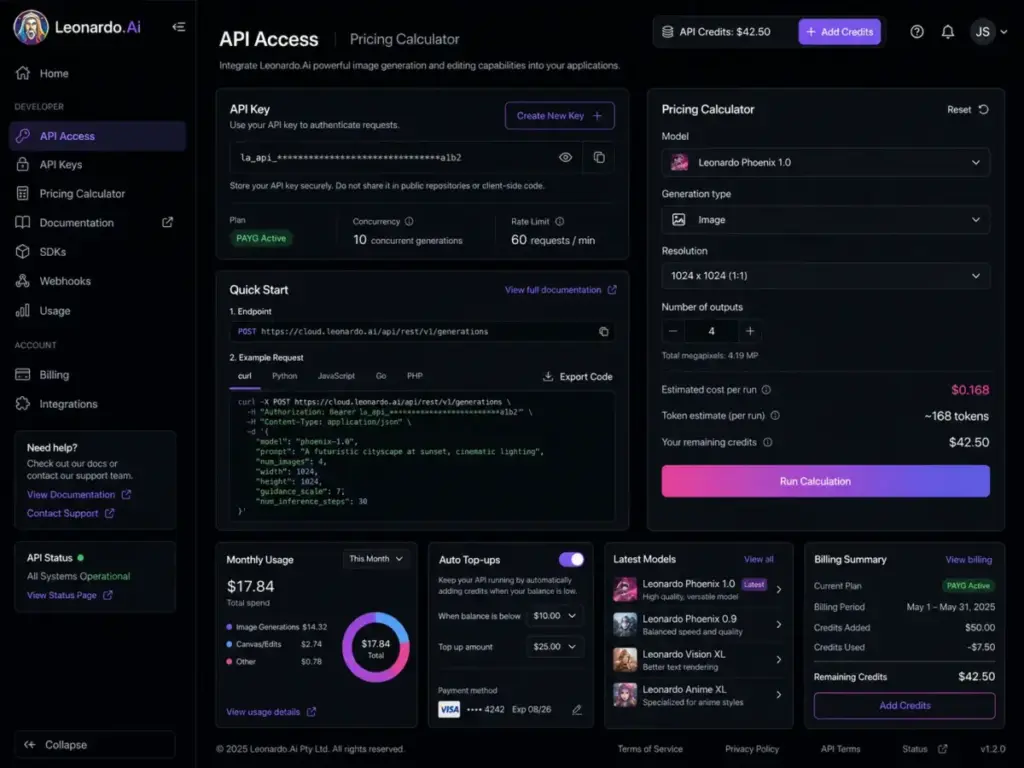
1. The API is a separate product with separate billing. Subscribing to Essential, Premium, or Ultimate does not give you API access. The API uses its own credit system starting at $5, with automatic top-ups and up to 10 concurrent generations. This is a common point of confusion: the web app subscription and the API Pay as You Go plan are entirely distinct purchases.
2. Free commercial use exists, but free outputs are public and non-exclusive. Free users can use generated images commercially. However, as stated in Leonardo.Ai’s commercial usage guide, free-plan generations are public, visible to other users, and can be remixed through platform features. Between you and Leonardo.Ai, Leonardo.Ai owns assets generated on the free plan. Paid subscribers using private mode have full ownership as between the user and Leonardo.Ai.
3. Relaxed unlimited generation applies only to selected models. The “unlimited relaxed generation” on Premium and Ultimate plans does not cover every model. It is restricted to selected models, and during high-demand periods, relaxed queue times can increase. This is not the same as unlimited fast generation.
4. Canva Business can be a shortcut to Essential access, but not to pooled team credits. Canva Business and Enterprise users can receive Leonardo Essential access at no extra cost, provided they do not already have a paid Leonardo subscription. Each Canva team member gets individual Leonardo Essential access, but tokens are not pooled or shared across the Canva team. Canva-managed Leonardo accounts cannot upgrade to Premium or Ultimate through Canva. If Canva Business lapses, the Leonardo account reverts to Free.
5. Video generation and advanced model use burn tokens faster than image-only workflows. Token costs vary by model, resolution, and generation type. A user generating 100 images per month on a basic model will consume far fewer tokens than a user generating 20 videos. The pricing calculator guide in Leonardo’s docs can help estimate real usage.
6. Team plans are priced per seat but presented as monthly team totals. The official pricing page lists Team Starter at $72/month and Team Growth at $144/month, but these are totals for a minimum of 3 seats. The per-seat cost is $24 and $48 respectively.
Leonardo.Ai Key Features
Leonardo.Ai is not a single-purpose image generator. It bundles generation, editing, model training, video, and API access into one platform, with feature gates that vary by plan tier. Here is what each major capability actually does and where it fits in a production workflow.
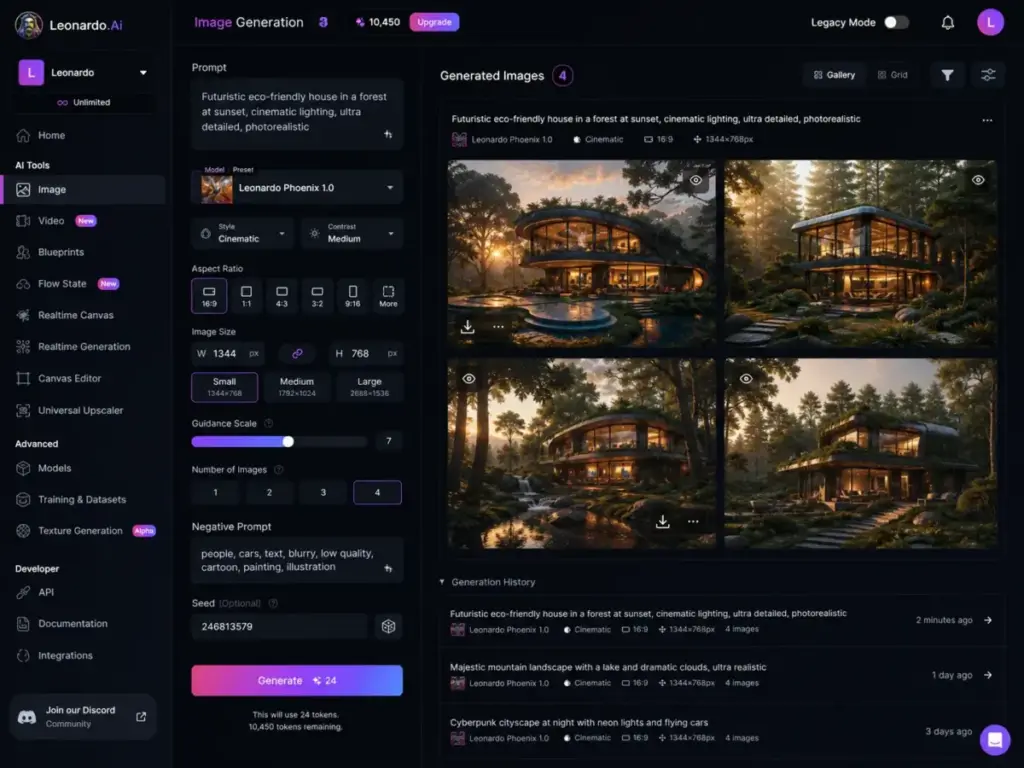
Leonardo.Ai Image Generation
The core image generation engine supports multiple foundation models including Phoenix 1.0, Lucid Origin, and Lucid Realism. Users can select models based on the output style they need: photorealistic, illustrated, stylized, or concept-art oriented. The model selection page lists available options with sample outputs.
Prompt controls include negative prompts, guidance scale, image dimensions, and seed values. For users familiar with prompt engineering, Leonardo provides enough knobs to fine-tune results without requiring a local Stable Diffusion setup. Prompt enhancement is available to help less experienced users get better outputs from simple descriptions.
One real user on Capterra highlighted the appeal of the free tier: “The versatility of the image creation and the 150 daily credits” (Patrice M., Creator, Capterra). That said, 150 daily fast tokens on the free plan will produce a limited number of images depending on model and resolution. Users planning to generate more than 10 to 20 images per day will exhaust free tokens quickly.
Leonardo.Ai Realtime Canvas and Editing
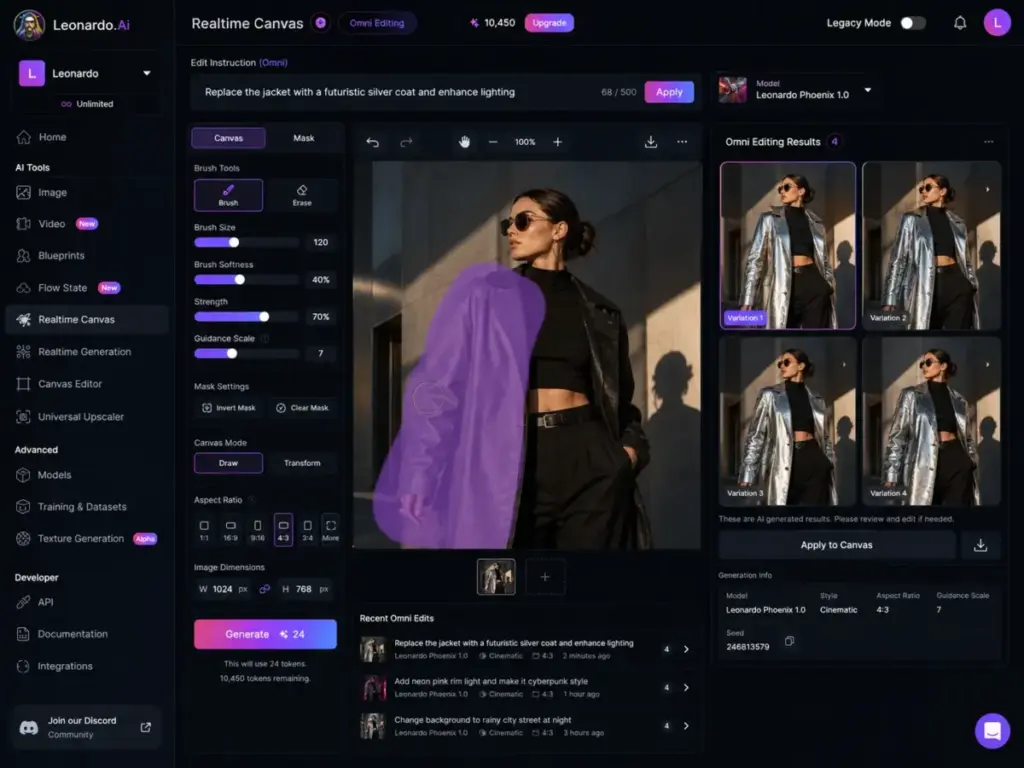
Realtime Canvas allows users to sketch or upload rough compositions and watch the AI interpret them in near real-time. This is more interactive than a standard text-to-image flow: you draw, and the model responds with a styled interpretation of your sketch. For concept artists and game designers, this creates a rapid ideation loop.
Omni editing provides inpainting, outpainting, and element-level editing within generated images. You can mask a region, describe what you want, and let the model fill or replace that area. Background removal and image upscaling are also available as part of the AI image editor tools, making Leonardo.Ai one of the more complete AI photo editors in the generative space.
However, canvas editing does not always produce clean results on the first attempt. As one CAD technician noted: “Sometimes the canvas editor does not always produce the results you want” (Jeffrey W., CAD Technician, Capterra). Expect retries, especially with detailed inpainting tasks.
Leonardo.Ai Custom Models and Consistency
Leonardo.Ai allows users to train custom models on their own image sets, which is a feature most competitors either lack or restrict to enterprise tiers. The training limit varies by plan: 10 models per month on Essential, 20 on Premium, and 50 on Ultimate. Team Growth plans include team-level model training.
Custom model training is useful for maintaining brand consistency, generating product variations from a reference set, or creating a character that appears consistently across multiple outputs. This is one area where Leonardo.Ai has a practical edge over Midjourney (which offers no equivalent custom training) and DALL-E (which lacks user-trained models entirely).
That said, prompt consistency across generations, even with the same model and similar prompts, still requires human review. Minor prompt wording changes can shift composition, color palette, and character details. For teams producing assets that must look consistent across a campaign or game, manual curation remains necessary.
Leonardo.Ai Video Generation
Leonardo.Ai offers AI video generation through Motion 2.0 and supports VEO 3 integration. Video generation consumes tokens at a higher rate than image generation, and quality varies by model and prompt complexity. The platform is part of the growing list of AI video generators, but video output quality is still an evolving area.
User complaints about video distortion, particularly in character motion and scene transitions, appear in community discussions. For short-form social media clips or concept animations, the video tools are usable. For polished commercial video, the output will likely need post-production work.
Ultimate plan subscribers get unlimited relaxed video generation on selected models, which reduces the per-video cost for high-volume video experiments. Lower-tier plans must use fast tokens for video, which can drain allocations rapidly.
Leonardo.Ai API and Team Workflows
The Leonardo.Ai API is a separate product from the web application. Developers can access the latest models, generate images and video programmatically, and run up to 10 concurrent generations on the Pay as You Go plan. The API starts with a $5 credit purchase, with automatic top-ups and non-expiring credits. Official SDKs are available, and the API quick-start guide covers authentication and basic generation calls.
For teams, the Team Starter and Growth plans add shared token pools, private team generations, and unlimited collections. The team plans page outlines collaboration features. Custom team plans are available for organizations needing tailored workflows and higher concurrency.
Leonardo.Ai states that it holds SOC 2 Type I and Type II certification, which is relevant for teams evaluating compliance requirements. That said, the platform does not maintain a public security portal with detailed audit reports, so enterprise buyers should request documentation directly.
User Experience and Learning Curve
Leonardo.Ai is dense. The workspace packs model selection, prompt controls, generation history, editing tools, and collection management into a single interface. For users coming from simpler tools like DALL-E (where you type a prompt and get an image), the number of options can slow down first sessions.
The learning curve is not about the interface being poorly designed. It is about the number of decisions you need to make before generating: which model, what resolution, how many tokens this will cost, whether to use prompt enhancement, and whether to adjust guidance scale. Experienced users benefit from this control. Casual users may find it overwhelming compared to ChatGPT’s “just describe what you want” approach.
Model selection alone requires some learning. Different models produce different output styles, and choosing the wrong model for a given prompt leads to outputs that are technically generated but stylistically wrong. Leonardo does not provide a strong recommendation engine for model selection, so users learn by experimenting.
Retry behavior is another area where expectations need calibration. Inpainting and canvas editing sometimes produce results that miss the intended edit, requiring 2 to 5 retries for precision tasks. This is a limitation of the underlying models, not just the interface, but it does affect the practical cost of editing-heavy workflows.
What Most Leonardo.Ai Reviews Get Wrong
Several patterns repeat across competing reviews, and they create real confusion for buyers evaluating Leonardo.Ai in 2026. Here are the most common errors.
Outdated plan names. Many third-party articles still reference Apprentice ($12), Artisan ($30), and Maestro ($60) as current plan names. As of May 2026, the official plans are Essential, Premium, and Ultimate. If you are reading a review that uses the old names, its pricing data may also be outdated. Always verify on the official pricing page.
Free commercial use without context. Competing reviews often state that Leonardo.Ai allows commercial use on the free plan without mentioning that free outputs are public. This is technically accurate but misleading. Free-plan images can be viewed, copied, and remixed by other users through platform features. Between you and Leonardo.Ai, Leonardo.Ai owns the generated assets on the free plan. For confidential brand work, free-plan commercial use carries real risk.
API bundled with web subscription. Some reviews describe the API as a feature of Leonardo.Ai without clarifying that API credits are purchased separately from web subscriptions. A $30/month Premium subscriber does not automatically get API access. The API Pay as You Go guide makes this explicit.
Canva entitlement as full access. The Canva Business integration gives users Essential-tier access, not Premium or Ultimate. Tokens are per user, not pooled. And Canva-managed accounts cannot upgrade tiers through Canva. Some reviews present this as “Leonardo.Ai is included with Canva” without noting these restrictions.
Token economics as simple math. Token costs vary by model, resolution, and generation type (image vs. video vs. upscale). A review that says “8,500 tokens = roughly X images” without specifying the model and settings is guessing. Real token consumption depends on the specific workflow.
What Are Leonardo.Ai’s Biggest Limitations?
Every tool has constraints. Leonardo.Ai has several that directly affect purchasing decisions and daily workflows. Here are the ones that matter most.
1. Free-plan outputs are public. There is no private mode on the free plan. Every image you generate is visible to other Leonardo.Ai users and can be viewed, remixed, or used through platform features. For brand assets, client work, or anything confidential, the free plan is unsuitable.
2. Private mode requires a paid subscription. Private generation, where outputs are visible only to you and authorized users, is exclusive to Essential, Premium, Ultimate, and Team plans. This is the only way to get ownership of outputs as between you and Leonardo.Ai. The privacy policy and terms of service detail how public and private content is treated differently.
3. API credits are completely separate from web subscriptions. This bears repeating because it affects budgeting. If you need both the web workspace and programmatic generation, you are paying for two products. The API pricing FAQ confirms this separation.
4. Prompt consistency still requires human curation. Even with the same model, seed, and similar prompts, output variation can drift across generations. For teams producing asset sets that must look cohesive (game character sheets, product mockup series, campaign visuals), expect to generate multiple batches and select the best outputs manually.
5. Canvas and inpainting editing may need multiple retries. Precision inpainting, especially on small regions or detailed compositions, does not always land on the first attempt. This means additional token consumption and longer editing sessions for detail-oriented work.
6. Video generation quality can distort. Motion 2.0 and related video models produce usable short clips for social media and concept animations, but motion artifacts, character distortion, and scene-transition issues are reported in community feedback. Video generation is functional but not production-polished for most use cases.
7. Support and billing complaints exist in user reviews. Trustpilot shows Leonardo.Ai at 4.6 out of 5 from 1,218 reviews, with 84% 5-star and 11% 1-star ratings. Leonardo.Ai responds to 67% of negative reviews, typically within 1 week. One enterprise customer reported: “unable to pause or cancel our enterprise subscription” (Connor, enterprise customer, Trustpilot). This is one complaint, not universal proof of billing issues, but it signals a risk area for enterprise buyers who should confirm cancellation terms before committing.
8. Free users face stricter content moderation filtering. Free-tier users can encounter more aggressive content filtering that blocks prompts containing terms that paid users can use. If a prompt is blocked, the user must modify it. This is noted in Leonardo’s FAQ documentation.
Leonardo.Ai Pros and Cons
Here is a balanced summary based on official documentation, user reviews, and competitive positioning. This is not vendor marketing language.
- Multiple foundation models with distinct output styles (Phoenix, Lucid Origin, Lucid Realism) give real creative range
- Custom model training available starting at Essential ($12/month), a feature most competitors gate to enterprise tiers or do not offer
- Realtime Canvas and Omni editing provide a production workflow beyond basic text-to-image
- Free plan with 150 daily fast tokens is more generous than Midjourney (no free tier) and competitive with DALL-E’s free allocation
- Team plans with shared token pools and private generations start at $72/month for 3 seats
- Canva Business users get Essential access at no additional cost (with caveats)
- SOC 2 Type I and Type II certification stated for compliance-conscious teams
- Token cost math is opaque: different models, resolutions, and generation types consume tokens at different rates
- Free outputs are public and owned by Leonardo.Ai (not by the user)
- API billing is entirely separate from web subscriptions
- Prompt consistency drifts across generations, requiring manual curation for cohesive asset sets
- Canvas editing retries add friction and token cost to detailed workflows
- Video generation quality is inconsistent, with motion distortion reported
- Billing and cancellation complaints in 11% of Trustpilot reviews
- Relaxed unlimited generation is limited to selected models, not all models
Leonardo.Ai vs Alternatives
Choosing an AI image generator depends on your workflow, budget, privacy needs, and ecosystem preferences. Here is how Leonardo.Ai compares to five direct competitors, with specific scenarios where each tool is the better pick.
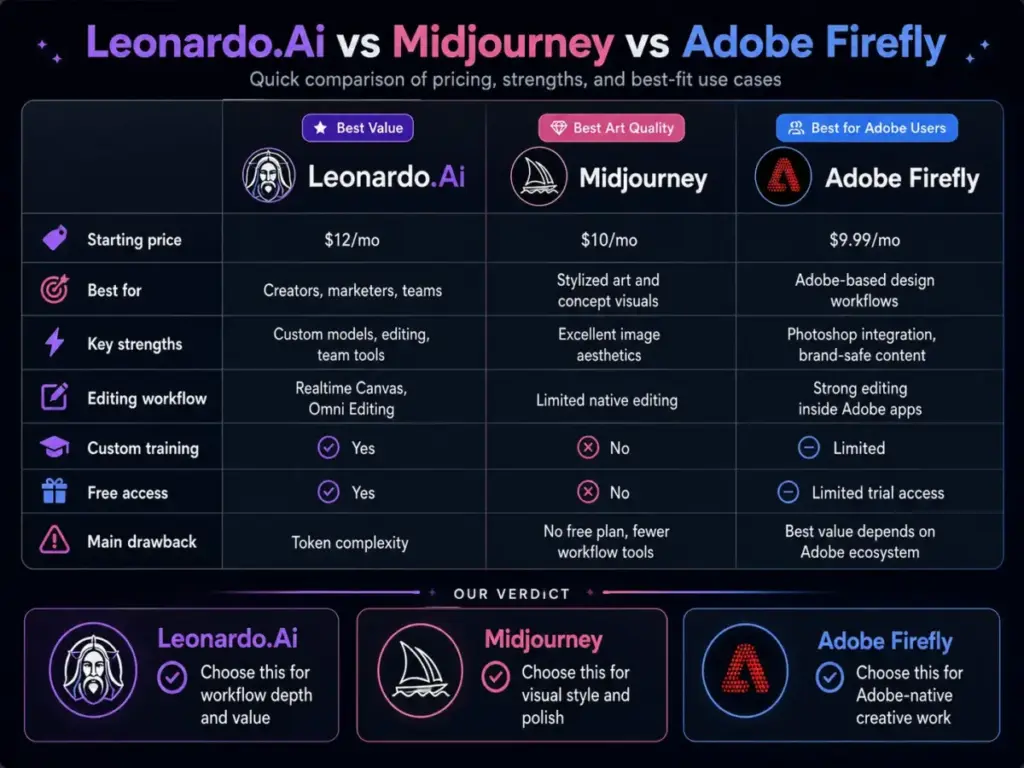
Leonardo.Ai vs Midjourney
Midjourney produces some of the most aesthetically polished AI images available, with a strong lean toward cinematic, stylized, and high-art outputs. Midjourney Basic starts at $10/month, Standard at $30/month, and Pro at $60/month, with a 20% annual discount. Relax Mode (unlimited generation) starts at Standard, and Stealth Mode (private) requires Pro or Mega ($120/month). For a full breakdown, see our Midjourney review.
Pick Leonardo.Ai when: You need custom model training, Realtime Canvas editing, team collaboration tools, or a free tier for experimentation. Leonardo.Ai offers more workflow tooling at comparable price points.
Pick Midjourney when: Raw output aesthetics are the priority, you work primarily in stylized or cinematic imagery, and you do not need editing, custom training, or team features. Midjourney’s visual quality ceiling on default models is higher for art-directed work.
Leonardo.Ai vs Adobe Firefly
Adobe Firefly integrates directly into Photoshop, Illustrator, and Adobe Express, making it the default choice for teams already in the Adobe ecosystem. Firefly Standard starts at $9.99/month with 2,000 generative credits, and Firefly Pro at $19.99/month with 4,000 credits. See the Adobe Firefly review and Adobe Firefly pricing for details.
Pick Leonardo.Ai when: You need standalone generation and editing outside Adobe apps, custom model training, or a free plan. Leonardo.Ai is more self-contained and does not require an Adobe subscription.
Pick Adobe Firefly when: Your team already uses Photoshop or Illustrator, brand safety is a top requirement (Firefly trains on licensed content), or you need generation embedded in existing design workflows.
Leonardo.Ai vs ChatGPT Images
ChatGPT (with DALL-E and GPT Image generation) excels at natural-language iteration, where you describe, refine, and adjust images through conversation. ChatGPT Free includes limited image generation, Plus offers more, and Pro includes unlimited faster generation. See our DALL-E review for a deeper analysis.
Pick Leonardo.Ai when: You need a dedicated image production workspace with collections, model selection, custom training, and team features. Leonardo.Ai is built for volume production, not conversational iteration.
Pick ChatGPT Images when: You want image generation embedded in a text/reasoning workflow, you prefer conversational refinement over parameter controls, or you are already paying for ChatGPT Plus.
Leonardo.Ai vs Stable Diffusion
Stable Diffusion is an open-source model ecosystem that runs locally or on cloud GPUs. It offers maximum control through LoRA training, ControlNet, and custom pipelines. The Stability AI Community License covers individuals and organizations under $1M annual revenue. See our Stable Diffusion review for setup and cost details.
Pick Leonardo.Ai when: You want cloud-hosted generation without managing GPUs, installing software, or writing Python scripts. Leonardo.Ai provides Stable Diffusion-class capabilities with a browser interface.
Pick Stable Diffusion when: You need absolute privacy (local generation), full model control via LoRA and ControlNet, or you want to avoid per-token costs entirely by running on your own hardware.
Leonardo.Ai vs Canva AI
Canva AI (including Dream Lab) is integrated into the Canva design platform, which Canva owns alongside Leonardo.Ai. Canva Business and Enterprise users can access Leonardo Essential features. See our Canva AI review for the full breakdown.
Pick Leonardo.Ai when: You need advanced generation capabilities beyond Essential tier, custom model training, or a dedicated image production workspace. Leonardo.Ai’s standalone platform offers more depth than Canva’s embedded AI tools.
Pick Canva AI when: Your primary workflow is template-based marketing assets (social posts, presentations, brand kits), your team is already on Canva Business, and Essential-level Leonardo access is sufficient. The Canva integration eliminates a separate subscription.
Who Should Use Leonardo.Ai?
Leonardo.Ai works best for specific user types with specific volume and privacy needs. Here is a decision matrix based on plan capabilities, pricing, and competitive alternatives.
| Buyer Scenario | Monthly Output Need | Privacy Need | Best Leonardo Plan | Better Alternative If |
|---|---|---|---|---|
| Casual creator | 10 to 50 images | Low | Free | Use Canva AI if templates matter more |
| Solo commercial creator | 50 to 300 assets | Medium to High | Essential or Premium | Use Adobe Firefly if Adobe apps matter |
| Marketing team (3-8 people) | 300 to 1,000 assets | High | Team Starter or Growth | Use Canva AI if templates and approvals dominate |
| Game concept team (5-20 people) | 500+ concept assets | High | Premium, Ultimate, or Team Growth | Use Stable Diffusion if LoRA control matters more |
| Developer (API integration) | API-based usage | High | API PAYG or API Custom | Use Stability API if open model control matters more |
Solo Etsy or print-on-demand creators producing 30 to 100 product mockups per month: Essential ($12/month) provides enough fast tokens for image-only workflows with private mode. Premium ($30/month) adds relaxed unlimited generation on selected models, which is valuable if you frequently iterate.
3 to 8 person marketing teams creating weekly campaign visuals: Team Starter ($72/month for 3 seats) gives each member private generation and a shared token pool. If your team already uses Canva Business, the Leonardo Essential entitlement may be sufficient for light generation needs.
5 to 20 person game-art teams prototyping characters, props, and backgrounds: Team Growth ($144/month for 3 seats) with additional seats provides the highest token allocation and team model training. Custom model training is the key differentiator here, letting teams maintain character consistency across concept batches.
Developers building image-generation workflows through API: Start with the API Pay as You Go plan at $5 to test integration, then move to API Custom for volume discounts and dedicated support.
Who Should Not Use Leonardo.Ai?
Leonardo.Ai is the wrong tool in several specific scenarios. Rather than forcing it to fit, consider these alternatives.
If you need privacy on a free plan, Leonardo.Ai is the wrong choice. Every free generation is public. For confidential client briefs, unreleased product designs, or sensitive brand assets, even experimental exploration on the free plan creates exposure. Stable Diffusion running locally gives you complete privacy at zero per-image cost.
If you expect API access included in your web subscription, adjust your budget. The web app and API are separate billing systems. A team budgeting $60/month for Ultimate and expecting to embed generation into their app will need an additional API budget starting at $5 plus ongoing usage.
If you need pixel-perfect prompt consistency across dozens of outputs without manual review, no current AI image generator fully solves this, but Stable Diffusion with LoRA and ControlNet gives the most deterministic control.
If you are a large enterprise needing detailed compliance documentation, SOC 2 audit reports, and a dedicated security portal, verify what Leonardo.Ai provides before committing. The stated SOC 2 certification is a positive signal, but enterprise procurement teams typically expect more documentation than is publicly available.
Final Verdict
Leonardo.Ai scores 7.4 out of 10 in this review. It delivers more production workflow tooling than most competitors at its price point, with real strengths in model variety, custom training, Realtime Canvas, and team features. The token-based pricing is competitive, especially against Midjourney’s lack of a free tier and Adobe Firefly’s credit math.
The main friction points are token complexity, public free-plan outputs, API billing separation, and the need for manual curation to maintain consistency across generation batches. These are not dealbreakers, but they are real costs that affect daily use.
For solo creators and small teams producing 50 to 1,000 images per month with private-mode requirements, Leonardo.Ai is one of the strongest options in 2026. For enterprise teams, the platform is promising but requires direct engagement with Leonardo.Ai on compliance, cancellation terms, and support SLAs.
This review was evaluated using the SaaS Zap review methodology, which prioritizes evidence-based analysis over vendor claims.
FAQ
These are the most common questions about Leonardo.Ai, answered directly.
Is Leonardo.Ai worth it in 2026?
Yes, for users who need a production-oriented AI image generation workspace at mid-range pricing. The Essential plan at $12/month offers private generation and custom model training, which most competitors either lack or gate to higher tiers. It is not worth it if you only need occasional image generation (ChatGPT may be sufficient) or if you need absolute control over models (Stable Diffusion is better).
How much does Leonardo.Ai cost?
Leonardo.Ai offers a free plan with 150 daily fast tokens, Essential at $12/month, Premium at $30/month, and Ultimate at $60/month. Team plans start at $72/month (Team Starter, 3 seats) and $144/month (Team Growth, 3 seats). API access starts with a separate $5 credit purchase. All prices verified on Leonardo.Ai pricing on May 4, 2026.
Is Leonardo.Ai free?
Leonardo.Ai has a free plan with 150 fast tokens per day, basic quality settings, and 1 personal collection. Free-plan generations are public (visible to all users) and, between you and Leonardo.Ai, Leonardo.Ai owns the outputs. Private generation and full user ownership require a paid plan starting at $12/month.
Can I use Leonardo.Ai images commercially?
Yes. Both free and paid users can use generated images commercially, according to Leonardo’s commercial usage guide. The critical difference: free outputs are public and not exclusively owned by the user, while paid private outputs give the user ownership as between the user and Leonardo.Ai. For confidential commercial assets, a paid plan with private mode is necessary.
Are Leonardo.Ai free generations private?
No. All free-plan generations are public. They can be viewed, copied, and remixed by other Leonardo.Ai users through platform features. Private generation is exclusive to paid plans (Essential, Premium, Ultimate, and Team plans). If you mark paid content as public, you still own it but grant Leonardo.Ai a license to use, copy, display, and distribute that content.
What are Leonardo.Ai tokens?
Tokens are the usage currency for Leonardo.Ai. Each generation, whether image, video, upscale, or edit, consumes a certain number of tokens based on the model used, resolution, and generation type. Fast tokens generate outputs quickly, while relaxed generation (available on Premium and Ultimate for selected models) runs at lower priority but does not consume fast tokens. The token bank stores unused tokens up to a cap (e.g., 25,500 for Essential, 75,000 for Premium).
Does Leonardo.Ai have an API?
Yes. The Leonardo.Ai API provides programmatic access to image and video generation with the latest models, up to 10 concurrent generations, and non-expiring credits. The API uses a separate billing system from the web app. It starts with a $5 credit purchase on the Pay as You Go plan, with custom plans available for higher concurrency and volume discounts.
Is Leonardo.Ai better than Midjourney?
It depends on the use case. Leonardo.Ai offers more workflow tooling (Realtime Canvas, custom model training, team features, free plan) at comparable pricing. Midjourney produces higher-aesthetic output by default for stylized and cinematic images. For production workflows with editing, training, and team collaboration, Leonardo.Ai has advantages. For pure visual quality in art-directed work, Midjourney currently has the edge.
What is the best Leonardo.Ai alternative?
The best alternative depends on your priority. Midjourney for aesthetic quality and art direction. Adobe Firefly for Adobe ecosystem integration and brand-safe commercial use. Stable Diffusion for local control, privacy, and LoRA training. ChatGPT Images for conversational iteration. Canva AI for template-first marketing workflows. Each addresses a different workflow need.
Is Leonardo.Ai included with Canva?
Partially. Canva Business and Canva Enterprise users can receive Leonardo Essential access (equivalent to the $12/month plan) at no extra cost, provided they do not already have a paid Leonardo subscription. However, tokens are per user (not pooled), accounts cannot upgrade beyond Essential through Canva, and if Canva Business lapses, the Leonardo account reverts to Free. This is documented in the Canva Business Leonardo access FAQ.