Moonshot AI markets Kimi as three products at once: a consumer AI assistant, a coding tool called Kimi Code, and a developer API platform. Most pages ranking for this keyword treat it like a simpler ChatGPT alternative. That framing costs you money if you pick the wrong plan or confuse membership pricing with API billing.
Kimi’s Adagio free plan caps agent tasks at 6 per refresh cycle (as of May 2026), and the features that technical teams actually want, like Agent Swarm and Kimi Claw, do not appear until you reach the $39/month Allegretto tier.
Daniel Rivera has tracked AI pricing changes across 12 tools monthly for 18 months, and the gap between what Kimi advertises and what each plan unlocks is one of the widest I have mapped this year. Before comparing best AI chatbot options, you need to know which Kimi product you are buying.
Disambiguation: This review covers Moonshot AI’s Kimi assistant and API ecosystem (moonshot.ai / kimi.com). Other products using the “Moonshot” brand for ecommerce optimization or visual collaboration are unrelated.
| Category | Verdict |
|---|---|
| Best for | Developers, AI app builders, and cost-sensitive teams needing long-context analysis, coding support, or agentic API workflows |
| Not ideal for | Regulated US teams needing public SOC 2/HIPAA attestation, nontechnical users wanting fixed-price simplicity |
| Starting price | Free (Adagio); paid from $19/month (Moderato) |
| Best practical plan | Allegretto at $39/month for Agent Swarm + Kimi Code 5x quota |
| Free plan/trial | Yes, Adagio: limited agent quota (6), 1 concurrent task, no Agent Swarm, no Kimi Code, no Kimi Claw |
| Setup difficulty | Low for chat; Medium for Kimi Code (CLI/VS Code); Medium-High for API |
| Main strength | Long-context K2.6 model with competitive API token pricing and built-in tool ecosystem |
| Main limitation | Consumer membership and API billing are separate systems; quota does not carry over; no public SOC 2/HIPAA attestation |
| Best alternative | Claude for coding reliability; ChatGPT for ecosystem maturity; Perplexity for research |
What this means: Kimi scores high on capability-per-dollar for technical users. The plan-gate complexity and compliance gaps are the real decision filters.
Moonshot AI Pros and Cons
| Pros | Cons |
|---|---|
| K2.6 offers a 262,144-token context window, one of the longest available at consumer pricing | Consumer membership and API billing are completely separate systems with no shared credits |
| API token pricing ($0.95/M input, $0.16/M cache-hit) is competitive with frontier models | Agent Swarm, Kimi Code, and Kimi Claw are all locked behind the $39/month Allegretto tier |
| Agent Swarm enables parallelized research with up to 300 sub-agents at $39/month | No public SOC 2, HIPAA, or US data residency attestation for enterprise procurement |
| Built-in API tool ecosystem (Web Search, Code Runner, Memory) reduces external dependencies | Kimi Code and agent quotas do not carry over between refresh cycles |
| Kimi Code offers Anthropic-compatible endpoint for VS Code and CLI integration | Minimal third-party review coverage on G2, Capterra, and TrustRadius as of May 2026 |
What this means: Kimi’s technical capabilities are strong for the price. The dealbreakers are structural: billing complexity, compliance gaps, and quota mechanics that punish inconsistent usage patterns.
How Daniel Rivera Reviewed Moonshot AI
This review is based on official Moonshot AI and Kimi documentation, Kimi API developer platform, API documentation, Moonshot AI privacy policy, terms of service materials, and third-party signals from Google Play, Reddit’s LocalLLaMA community, and TrustRadius’s Enterprise Generative AI category.
Pricing was verified in May 2026. Testing level: third-party validated. I did not run hands-on API calls or Kimi Code sessions for this review. Claims about features, quotas, and plan gates come from official published sources only. Understanding what an AI chatbot does at the product level matters here because Kimi blurs the line between consumer chat and developer infrastructure.
Review limitation: Moonshot AI’s product surface changes fast. Some features described here may have been updated after the verification date. Enterprise pricing, SLA terms, and rate-limit customization are not public and could not be independently confirmed.
The 3 Problems Kimi Solves
Kimi is not a ChatGPT clone with cheaper pricing. It is a platform that addresses three specific pain points that technical buyers hit with incumbent AI tools.
Long-Context Document Processing Without Per-Page Fees
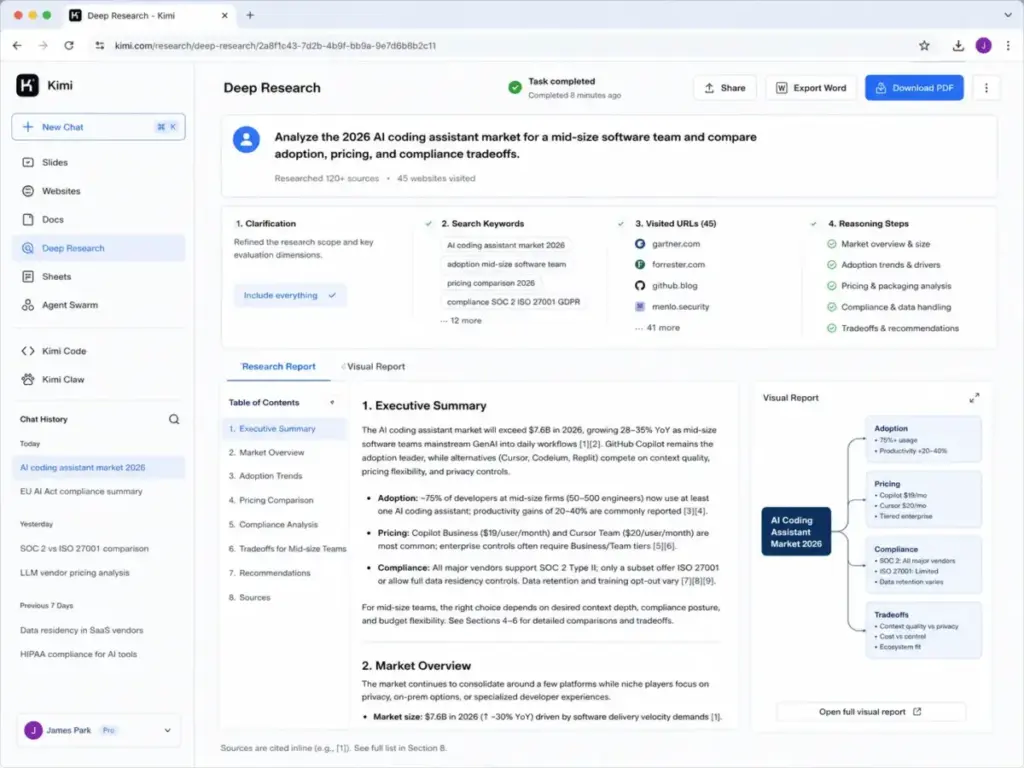
Kimi K2.6 supports a 262,144-token context window on the official API. For teams processing legal documents, research papers, or codebases, that context length eliminates the chunk-and-stitch workarounds required by models with shorter windows. The consumer Kimi assistant layers Deep Research, Docs, Sheets, Slides, and Websites workflows on top. A 3-person research team processing 50-page regulatory filings gets document-level reasoning without splitting the input across multiple prompts.
The catch: document content passed through the API is billed as input tokens. A 50-page PDF could burn through $0.95 per million input tokens at K2.6 rates before you add output costs. Token math matters more than feature marketing here.
Coding Assistance Through a Dedicated Membership Feature
Kimi Code gives paid members a CLI and VS Code integration for AI-assisted coding. It uses an endpoint compatible with Anthropic-style API calls, which means developers familiar with that ecosystem can plug it in without rewriting their toolchain. The quota scales by tier: 1x on Moderato ($19/month), 5x on Allegretto ($39/month), and 30x on Vivace ($199/month).
Here is the part most reviews skip: Kimi Code quota is shared across your membership and does not carry over between refresh cycles. If you burn through your allocation mid-week, you wait. For a solo developer experimenting with AI-assisted refactoring, the Moderato allocation may last. A 5-person engineering team sharing one account will hit the ceiling fast.
Agentic Task Execution at Consumer Pricing
Agent Swarm is Kimi’s parallelized agent feature. It dispatches sub-agents to handle broad research, batch downloads, multi-file processing, and multi-angle analysis simultaneously. Official materials describe up to 300 sub-agents and 4,000 steps for supported workloads. At $39/month (Allegretto), you get 50 Agent Swarm uses with 4 concurrent subtasks. At $199/month (Vivace), that scales to 240 uses with 8 concurrent subtasks.
I see Agent Swarm as best suited for parallelizable work: scanning multiple data sources, comparing documents side by side, or generating multi-section reports. It is not a universal autopilot. App store sentiment across both iOS and Android suggests that users value Kimi’s reasoning depth, but report inconsistent results on complex multi-step instructions. That matches the pattern I see across agentic AI tools in 2026: impressive demos, inconsistent production reliability.
The 2 Problems Kimi Creates
Every AI product introduces friction. Kimi’s friction is structural, not cosmetic. Two issues will shape your buying decision more than any benchmark score.
Membership Pricing and API Pricing Are Separate Systems
This is the gap that costs buyers the most confusion. Kimi consumer membership (Adagio through Vivace) covers the chat assistant, Kimi Code, Agent Swarm, and Kimi Claw. Kimi API is a completely separate billing system with token-based pricing, a minimum recharge requirement, and rate limits tied to your cumulative spending.
A developer who buys Allegretto at $39/month for Kimi Code access does not get production API calls included. If that same developer wants to integrate K2.6 into an application, they need to separately fund the API account: $0.95 per million input tokens, $4.00 per million output tokens for K2.6. Add $0.005 per triggered web search call if you enable that tool. Output tokens dominate API cost for long-form generation workflows.
I have tracked AI pricing across 12 tools monthly for 18 months, and this consumer-versus-API split is one of the least transparent billing structures I have documented. The ChatGPT vs Claude head-to-head that most buyers reference does not cover this billing architecture at all.
No Public Compliance Attestations for US Procurement
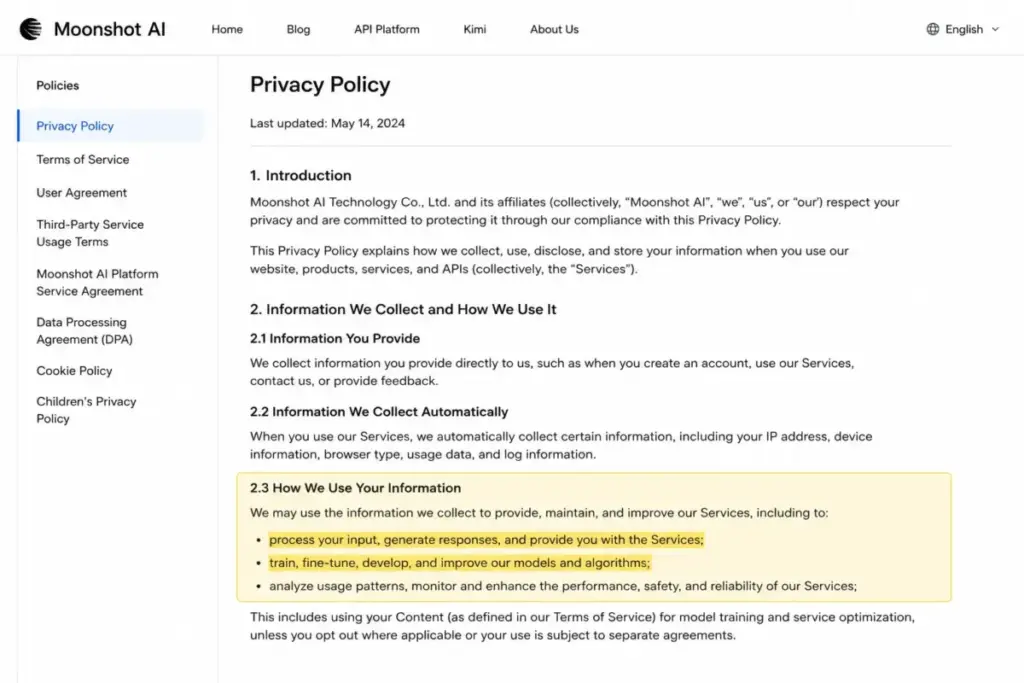
Moonshot AI’s official privacy materials describe encryption, data transmission security, limited employee access, backups, and breach alerts. The terms state that user content “may be used to operate, maintain, improve, and develop” the services, with an opt-out available by contacting support. That phrasing is standard for consumer AI tools, but it puts the burden on the user to proactively request exclusion.
What I did not find in any reviewed official source: public SOC 2 attestation, HIPAA compliance certification, or US data residency commitments. For a solo developer or a 3-person startup, this may not block adoption. For a 20-person healthcare team, a regulated financial services firm, or a government contractor, the absence of these attestations is a procurement blocker. Your compliance team will flag it.
Enterprise/custom SLA arrangements are described as available through the API platform, but the details are not public. If you need compliance evidence before trial, you will need to contact Moonshot AI directly and validate their response against your requirements.
Moonshot AI Pricing Reality
Kimi pricing splits into two tracks. Here is the consumer membership structure first, then API costs.
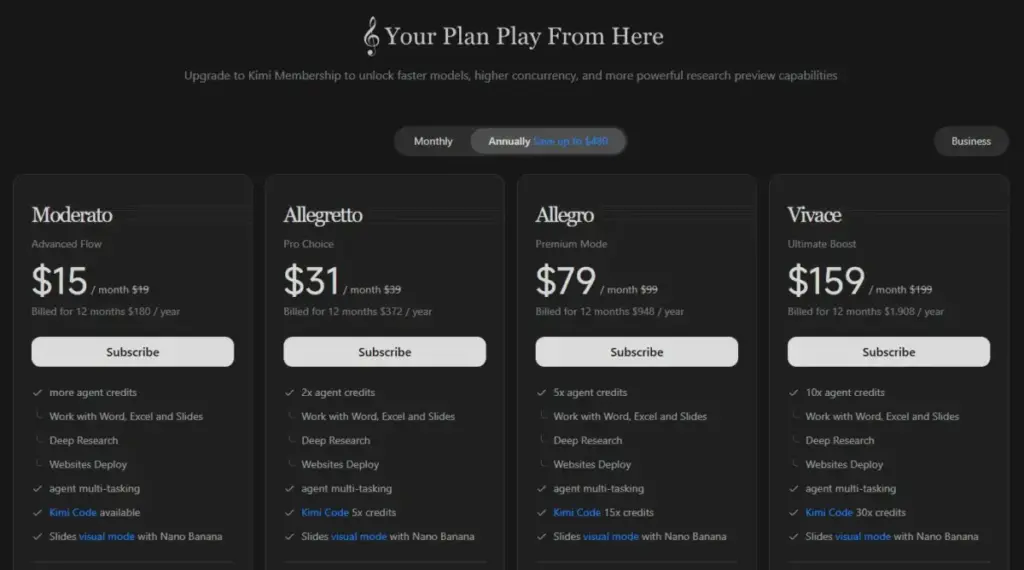
Kimi Membership Plans (as of May 2026)
| Plan | Monthly | Annual (effective/mo) | Agent Quota | Concurrent Tasks | Agent Swarm | Kimi Code | Kimi Claw | Pro Database |
|---|---|---|---|---|---|---|---|---|
| Adagio | Free | Free | 6 | 1 | No | No | No | 200 calls |
| Moderato | $19 | $15 | 60 | 2 | No | 1x | No | 2,000 calls |
| Allegretto | $39 | $31 | 150 | 2 | 50 uses (4 subtasks) | 5x | Yes | 5,000 calls |
| Allegro | $99 | $79 | 360 | 4 | 120 uses (4 subtasks) | 15x | Yes | 12,000 calls |
| Vivace | $199 | $159 | 720 | 4 | 240 uses (8 subtasks) | 30x | Yes | 24,000 calls |
Source: Official Kimi membership pricing. The pricing page states that annual billing reduces effective monthly cost by 20-21%. Paid fees are generally non-refundable per the terms. Cancel at least 24 hours before term renewal.
What this means: The jump from free to useful is $39/month, not $19. Moderato gives you basic speed priority and Kimi Code 1x, but no Agent Swarm and no Kimi Claw. If Agent Swarm is your primary draw, Allegretto is the entry point. For a solo developer who uses Kimi Code daily, the 5x quota at Allegretto versus 1x at Moderato is the difference between running out mid-week and having headroom. The annual plan on Allegretto saves $96/year compared to monthly billing.
Kimi API Pricing (Separate from Membership)
| Model/Tool | Input (per 1M tokens) | Output (per 1M tokens) | Cache-Hit Input | Context |
|---|---|---|---|---|
| K2.6 | $0.95 | $4.00 | $0.16 | 262,144 tokens |
| K2.5 | $0.60 | $3.00 | $0.10 | 262,144 tokens |
| Web Search tool | $0.005 per call | n/a | n/a | Triggered only |
What this means: K2.6 API pricing is competitive against comparable frontier models for cache-hit scenarios at $0.16/M tokens. But the output cost of $4.00/M tokens adds up on generation-heavy workloads. A coding assistant generating 2,000 tokens of output per request across 500 daily requests costs roughly $4.00/day in output alone, before input charges. Teams building API-powered products must model their input, output, document ingestion, and web search costs separately. The minimum recharge requirement and cumulative-recharge-based rate limits add another layer of planning.
Kimi Features with Plan Gates
Kimi gates its most useful capabilities behind the Allegretto tier and above. Honestly, the gap between what the free plan offers and what Allegretto unlocks is one of the steepest I have seen in the AI chatbot category this year. The plan-gate table below shows which features open at which tier.
| Feature | Adagio (Free) | Moderato ($19) | Allegretto ($39) | Allegro ($99) | Vivace ($199) | ||
|---|---|---|---|---|---|---|---|
| Kimi K2.6 chat | Yes | Yes | Yes | Yes | Yes | ||
| Speed priority | 1x | 4x | 4x | 8x | 12x | ||
| Agent quota | 6 | 60 | 150 | 360 | 720 | ||
| Agent Swarm | No | No | 50 uses | 120 uses | 240 uses | ||
| Kimi Code | No | 1x | 5x | 15x | 30x | ||
| Kimi Claw | No | No | Yes | Yes | Yes | ||
| Pro database calls | 200 | 2,000 | 5,000 | 12,000 | 24,000 | ||
| Concurrent tasks | 1 | 2 | 2 | 4 | 4 |
What this means: Free users get basic Kimi chat with severe agent limits. The Moderato tier adds speed and minimal Kimi Code, but the missing Agent Swarm and Kimi Claw make it a half-step. Allegretto is where the product becomes complete for technical users. The gap between Allegro ($99) and Vivace ($199) is mostly about quota scaling, not feature unlocks.
Deep Research, Docs, and Multimodal Tools
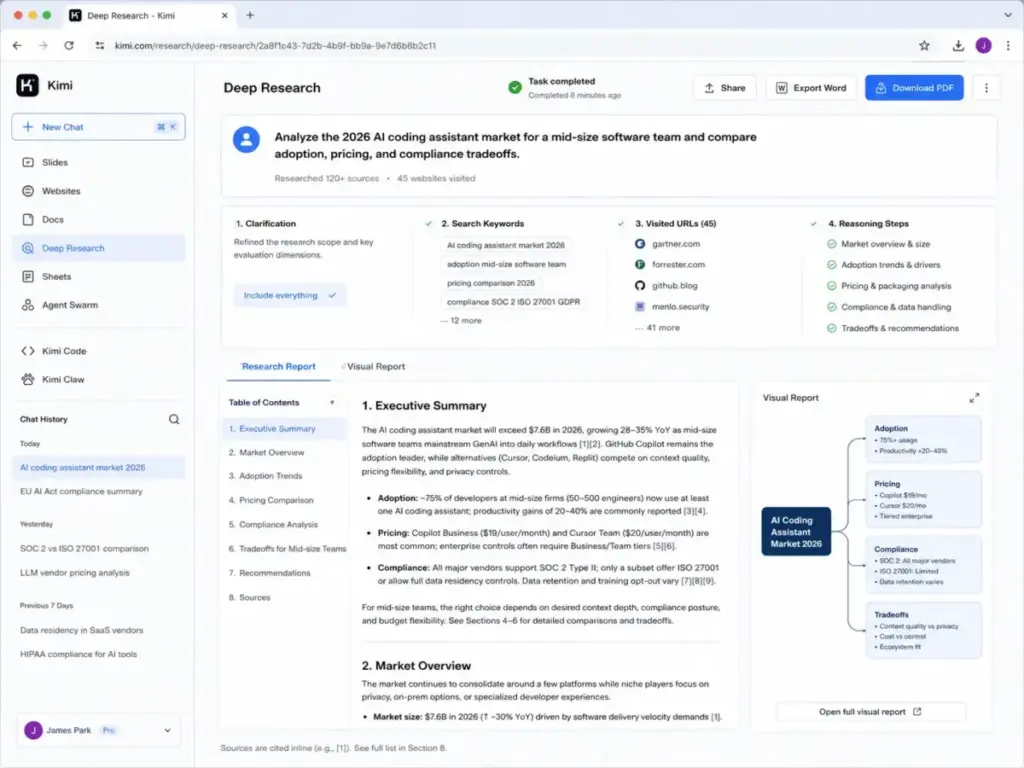
Kimi’s consumer assistant includes Deep Research for extended analysis tasks, plus Docs, Sheets, Slides, and Websites generation workflows. These features use the K2.6 model for multimodal reasoning. For a 2-person content team generating slide decks from research documents, this consolidates what would otherwise require separate subscriptions to a slide tool and an AI assistant.
API ToolCalls Ecosystem
The Kimi API extends beyond basic chat completion. Official documentation describes ToolCalls support, JSON Mode, Partial Mode, and built-in tools: Web Search, Memory, Excel, Code Runner, QuickJS, Fetch, Convert, and Base64. For AI app builders, this tool ecosystem means fewer external API integrations. The Web Search tool costs $0.005 per triggered call on top of token charges, so high-frequency search-augmented workflows need cost modeling.
Ease of Use, Integrations, and Support
Setup and Onboarding
Consumer chat setup is immediate: sign up, start chatting. The learning curve ramps up with Kimi Code (requires CLI installation or VS Code extension setup) and the API (requires account funding, API key generation, model selection, and token billing understanding). For a developer comfortable with API-first tools, onboarding is standard. For a marketing manager expecting a ChatGPT-like experience, the quota system and plan gates will cause confusion.
Integrations
Kimi connects through CLI, VS Code, OpenAI-compatible API endpoints, Anthropic-compatible endpoints for Kimi Code, and browser/mobile/desktop apps. The API tool ecosystem (Web Search, Memory, Excel, Code Runner, QuickJS, Fetch, Convert, Base64) reduces dependency on third-party integrations for common development tasks. Native integrations with business tools like Slack, Salesforce, or Notion are not documented in the reviewed sources.
Support
General support runs through support@moonshot.ai, membership issues through membership@moonshot.ai, and API issues through api-service@moonshot.ai. The API FAQ states a target response time of two business days. Paid members get priority handling. Enterprise accounts may include dedicated account management, but the terms are not public. Compared to Anthropic’s or OpenAI’s support infrastructure for enterprise customers, this is thinner.
Security and Privacy
Moonshot AI describes encryption, data security measures, limited employee access, and no sale of personal information. The opt-out for content training is available by contacting support, not through a self-service dashboard toggle. For teams evaluating Kimi’s autonomous capabilities, understanding what agentic AI means helps explain why data handling policies matter more for tools that act on your behalf.
Who Wins and Who Loses with Kimi
After mapping every plan tier, quota limit, and compliance gap, my verdict splits cleanly by buyer type. The question is not whether Kimi is good. It is whether your procurement process, technical comfort, and billing tolerance match what Kimi demands.
Kimi works for:
- Solo developers and indie hackers who want affordable AI coding assistance through Kimi Code at $39/month (Allegretto) with API access for prototyping
- AI app builders who need a cost-competitive API with built-in tools (Web Search, Code Runner, Memory) and long-context K2.6 access at competitive token rates
- Research-heavy operators and analysts processing large documents, running Deep Research, and using Agent Swarm for parallelized analysis tasks
- Cost-sensitive technical teams experimenting with agentic workflows who can tolerate fast-changing product surfaces and limited third-party review coverage
Kimi does not work for:
- Regulated US enterprises (healthcare, finance, government, legal) that require public SOC 2, HIPAA, or data residency attestation before procurement approval
- Nontechnical teams expecting fixed-price simplicity without quotas, API billing complexity, or plan-gate tradeoffs
- Teams needing mature admin controls and governance features, SSO/SCIM, or audit logging at enterprise scale
- Users who rely on established third-party review consensus before adopting a tool (Kimi has minimal G2/Capterra/TrustRadius review coverage as of May 2026)
Better Alternatives If Kimi Does Not Fit
If Kimi’s compliance gaps, quota limits, or billing complexity are dealbreakers, consider these alternatives based on your exit reason.
ChatGPT: Best for Ecosystem Maturity and Enterprise Features
Choose ChatGPT if your team needs a proven enterprise support structure, SOC 2 attestation, admin controls, and the broadest plugin/integration ecosystem. ChatGPT pricing starts higher for comparable features, but the procurement path is clearer for regulated organizations. Read the full ChatGPT review for plan-gate details.
Claude: Best for Coding Reliability and Safety
Choose Claude if coding accuracy and safety controls matter more than cost-per-token. Claude’s API and Claude Code offer strong coding performance with clearer data handling policies for enterprise buyers. Token pricing is higher than Kimi K2.6, but the compliance documentation is more mature. See the Claude AI review for direct comparison.
Perplexity: Best for Research-First Workflows
Choose Perplexity if your primary use case is citation-backed research rather than coding or agentic execution. Perplexity’s search-grounded approach produces sourced answers by default. It lacks Kimi’s API platform depth and coding tools but delivers cleaner research output for nontechnical teams. Pricing starts free with Pro at $20/month.
Google Gemini: Best for Google Workspace Integration
Choose Gemini if your team lives inside Google Workspace and needs AI embedded in Docs, Sheets, and Gmail. Gemini’s integration depth with Google’s productivity suite is unmatched. API pricing through Vertex AI offers enterprise-grade infrastructure with clear compliance documentation. Gemini Advanced starts at $19.99/month.
| Alternative | Best for | Starting price | Key advantage over Kimi |
|---|---|---|---|
| ChatGPT | Enterprise procurement, ecosystem maturity | $20/month (Plus) | Public SOC 2, broader integrations, admin tools |
| Claude | Coding reliability, safety, compliance | $20/month (Pro) | Stronger compliance documentation, coding accuracy |
| Perplexity | Research-first, citation-backed answers | Free; $20/month (Pro) | Built-in source citation, nontechnical friendly |
| Gemini | Google Workspace teams | Free; $19.99/month (Advanced) | Native Google integration, Vertex AI infrastructure |
What this means: Kimi wins on raw API cost and long-context capability. It loses on procurement readiness, ecosystem breadth, and review-platform trust signals. Your choice depends on whether price-per-token or compliance-per-dollar drives the decision.
Final Verdict: Is Moonshot AI Worth It?
Moonshot AI is worth it for technical teams that can separate consumer membership from API billing, tolerate plan-gate complexity, and do not need public compliance attestations to start. The K2.6 model at $0.95/M input tokens and $4.00/M output tokens is competitive for API-powered applications. Agent Swarm at $39/month opens parallelized workflows that most competitors charge more for or do not offer.
Kimi is not worth it for regulated US enterprises, nontechnical buyers who want one predictable bill, or teams that need established third-party review consensus before adoption. The compliance gap is not a minor caveat. It is a procurement blocker for any organization with a security review process.
Daniel Rivera’s recommendation: If you are a developer or AI app builder comparing best AI coding assistants and your compliance bar is low, start with Allegretto at $39/month and test Kimi Code plus Agent Swarm for 30 days. If your compliance bar is high, shortlist Claude or ChatGPT Enterprise first, then revisit Kimi after confirming their enterprise terms match your requirements.
Choose Kimi if: you want competitive API pricing, long-context processing, and agentic tools at consumer pricing, and you can manage quota mechanics.
Choose an alternative if: you need public compliance attestation, mature admin controls, or a simpler billing model.
FAQ
Is Moonshot AI the same as Kimi?
Yes. Moonshot AI is the parent company, and Kimi is the consumer-facing AI assistant and API platform. Official sources list Moonshot AI PTE. LTD. and Beijing Moonshot AI Technology Co., Ltd. as affiliated entities. Other products using the “Moonshot” name for ecommerce or visual collaboration are unrelated to the Kimi ecosystem described in this review.
How much does Moonshot AI cost in the US?
Kimi consumer membership starts free (Adagio) with paid plans from $19/month (Moderato) to $199/month (Vivace). Annual billing drops effective monthly cost by about 20%. Kimi API pricing is separate and usage-based: K2.6 costs $0.95/M input tokens and $4.00/M output tokens. Enterprise API pricing is contact-sales only.
Does Kimi Code quota expire?
Yes. Kimi Code quota refreshes with your membership cycle and unused quota does not carry over. The quota is shared across your account. If you exhaust the 5x allocation on Allegretto mid-period, you wait for the next refresh. This is one of the limits most reviews fail to mention.
Is Kimi AI safe for business documents?
Kimi’s privacy materials confirm encryption and no sale of personal data. The terms allow content to be used for service improvement, with opt-out by contacting support. Public SOC 2, HIPAA, or US data residency attestations were not found. For sensitive documents in regulated industries, treat this as an open question requiring direct verification with Moonshot AI before procurement.
What plan unlocks Kimi Agent Swarm?
Agent Swarm starts at Allegretto ($39/month) with 50 uses and 4 concurrent subtasks. It is not available on Adagio (free) or Moderato ($19/month). Higher tiers increase usage limits: Allegro gets 120 uses, Vivace gets 240 uses with 8 concurrent subtasks.
Is Kimi API cheaper than Claude or OpenAI?
On a per-token basis, Kimi K2.6 input pricing ($0.95/M tokens) and cache-hit pricing ($0.16/M tokens) are competitive. Output pricing at $4.00/M tokens is in the same range as frontier models from Anthropic and OpenAI. The true cost depends on your input-to-output ratio, document ingestion volume, and web search tool usage. API cost comparisons require modeling your specific workload.
Can Kimi connect to VS Code?
Yes. Kimi Code supports VS Code through an extension and CLI tool. It uses an Anthropic-compatible endpoint. The feature requires a paid membership (Moderato or higher) and consumes your Kimi Code quota. Setup involves installing the extension, generating an API key, and configuring the connection, which takes roughly 10-15 minutes for a developer familiar with API tooling.
Is Moonshot AI better than ChatGPT?
For raw API cost and long-context processing, Kimi K2.6 is competitive. For ecosystem maturity, enterprise features, admin controls, compliance documentation, and third-party integration breadth, ChatGPT currently has the advantage. The answer depends on whether your primary decision filter is price-per-token or procurement-readiness. Understanding what generative AI is helps frame why these tradeoffs exist across all frontier models.
Does Moonshot AI have a mobile app?
Yes. Kimi is available on iOS/iPadOS and Android through the Apple App Store and Google Play. The app offers free access with in-app purchases for membership upgrades. Google Play sentiment should be treated as directional only. The listing shows strong overall adoption, but user reviews for fast-moving AI apps can change quickly after model updates, feature launches, or quota changes.
What is Kimi K2.6?
Kimi K2.6 is Moonshot AI’s latest large language model. It supports a 262,144-token context window, multimodal reasoning, and the API tool ecosystem including ToolCalls, JSON Mode, Web Search, Memory, and Code Runner. K2.6 is the default model powering both the consumer Kimi assistant and the API platform. It succeeds K2.5, which remains available at lower API pricing for cost-sensitive workloads.