Every sprint planning session I have watched go sideways had the same root cause: the team copied Scrum ceremonies from a blog post but never agreed on what problem they were solving for the customer. That gap between process and purpose is exactly where Agile lives, and where most teams lose the thread.
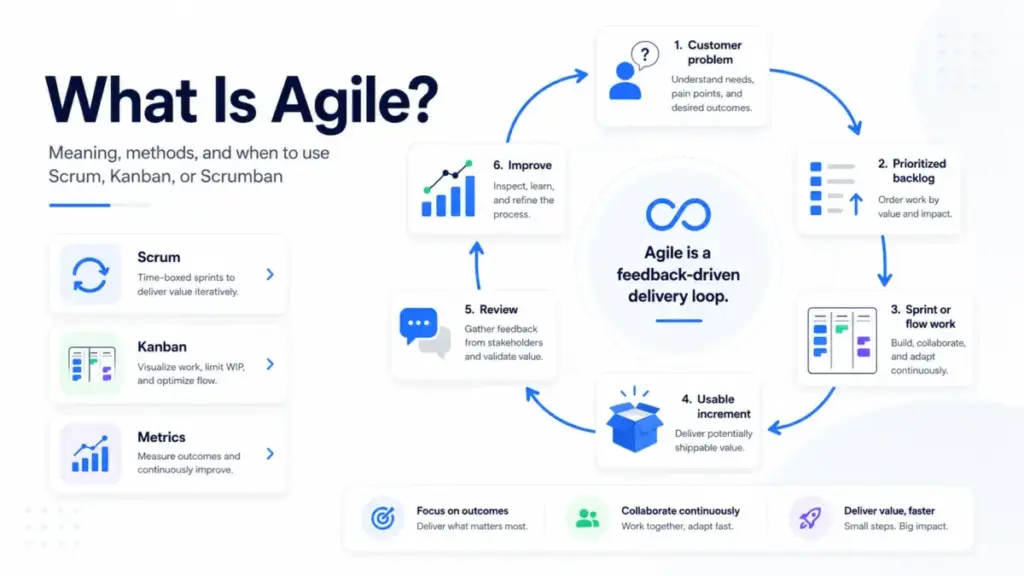
Agile is a feedback-driven way of delivering value under uncertainty. It breaks work into short cycles, prioritizes the most important items, delivers usable output frequently, and adjusts direction based on evidence. The Agile Alliance defines Agile as “the ability to create and respond to change.” That definition still holds, but in 2026, Agile is adapting to AI-assisted development, hybrid work, and growing pressure to connect delivery work to measurable outcomes. If your team builds project management software products or manages any SaaS delivery workflow, understanding Agile correctly saves months of wasted ceremony.
This article explains what Agile actually means, how Scrum and Kanban differ, when Agile improves delivery, when it becomes overhead, which metrics matter beyond velocity, and which tools support it with verified pricing.
Quick Answer: Agile is a mindset and work approach for creating and responding to change through short feedback loops, early delivery, customer collaboration, empowered teams, and continuous improvement. It is not a single framework. Scrum, Kanban, and Scrumban are operating models within Agile. Use Agile when requirements are uncertain and stakeholders can adapt scope based on evidence.
What Agile Actually Means
Agile is a set of values and principles for delivering work in short, iterative cycles where feedback shapes what happens next. The Agile Manifesto anchors the concept in four value preferences: individuals and interactions over processes, working software over documentation, customer collaboration over contracts, and responding to change over following a plan.
That is the foundation. Here is how the definition layers up for different audiences.
The Simple Explanation
Agile means breaking work into small pieces, finishing and shipping each piece, checking whether it created value, and adjusting course. Instead of spending six months building something based on an early guess, Agile teams deliver in weeks and correct fast.
The Technical Explanation
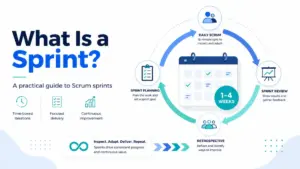
Agile operates through iterative delivery cycles. In Scrum, that cycle is a sprint (typically 1-4 weeks) with a Product Backlog, Sprint Planning, Daily Scrum, Sprint Review, and Retrospective. The Scrum Guide describes Scrum as “a lightweight framework that helps people, teams and organizations generate value through adaptive solutions for complex problems.” In Kanban, there are no sprints. Work flows continuously through a visual board with WIP (work-in-progress) limits, and throughput is the primary metric.
The Business Explanation
Agile matters because it reduces the cost of being wrong. Traditional waterfall projects assume requirements are stable. Agile assumes they will change, so the delivery model builds in feedback checkpoints. McKinsey describes agile organizations as technology-enabled networks operating in rapid-learning and fast-decision cycles. For SaaS product teams, that translates to shorter release cycles, faster customer feedback, and budgets tied to outcomes rather than output.
How Agile Works Step by Step
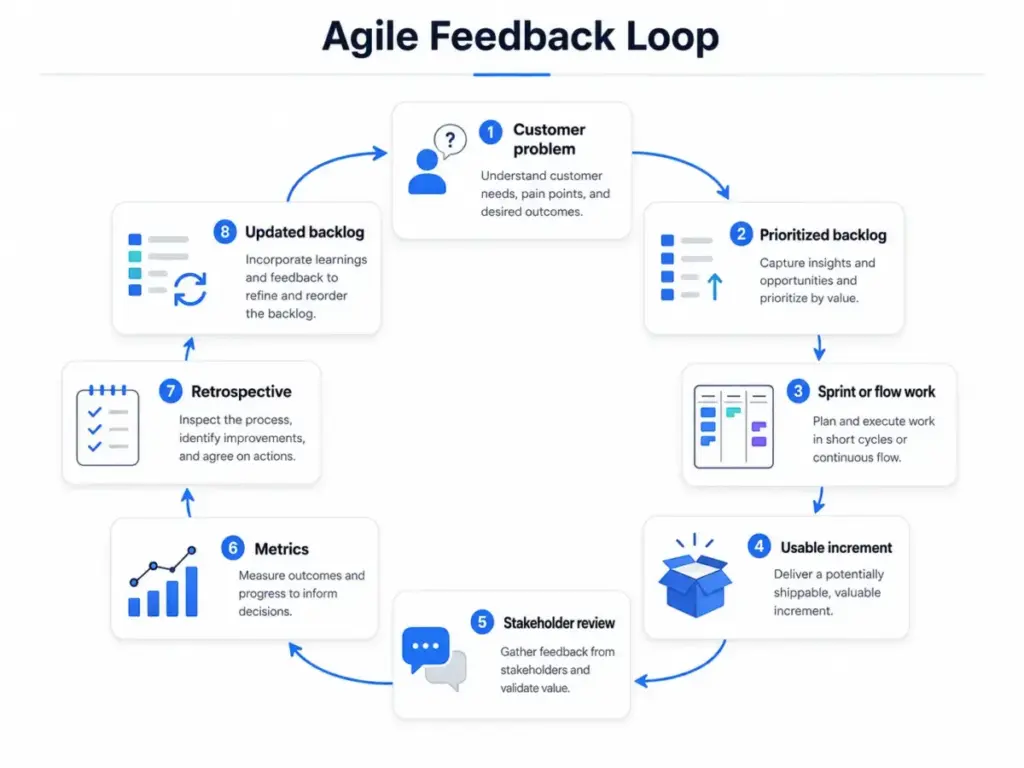
Agile works by reducing the time between assumption, build, feedback, and adjustment. The underlying mechanism is not speed for its own sake. It is learning faster than uncertainty can grow.
Here is the practical pipeline:
- Clarify the outcome. Define who the customer is, what value the team delivers, and what evidence proves progress.
- Choose the operating model. Use Scrum when the team can commit to a sprint goal. Use Kanban when work is interrupt-driven. Use Scrumban when the team needs cadence plus flow.
- Create a single prioritized backlog. Capture problems, user stories, bugs, technical work, and stakeholder requests in one visible system.
- Define ready and done criteria. Prevent vague work from entering delivery and unfinished work from being counted as complete.
- Plan a short delivery cycle. For Scrum, create a sprint goal and select work the team believes it can finish. For Kanban, set WIP limits and replenish work regularly.
- Deliver a usable increment. Keep scope small enough that feedback arrives before assumptions become expensive.
- Review with stakeholders. Inspect whether the work created value, not just whether tickets moved columns.
- Run a retrospective. Improve one thing in the next cycle: remove blockers, clarify ownership, reduce waste, or improve quality.
- Track outcome and flow metrics. Combine delivery metrics with customer, revenue, adoption, quality, or operational measures.
- Reassess the framework. Keep Agile principles, but change the process when Scrum, Kanban, tooling, or meeting cadence stops helping the team learn and deliver.
Where things go wrong: teams skip steps 1 and 4, jump straight to sprint planning, and end up building features nobody validated. Practitioner discussions frequently highlight that sprint planning problems often stem from insufficient discovery, unclear stories, and stakeholder asks entering the backlog without enough context.
Agile vs Scrum vs Kanban
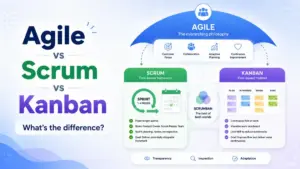
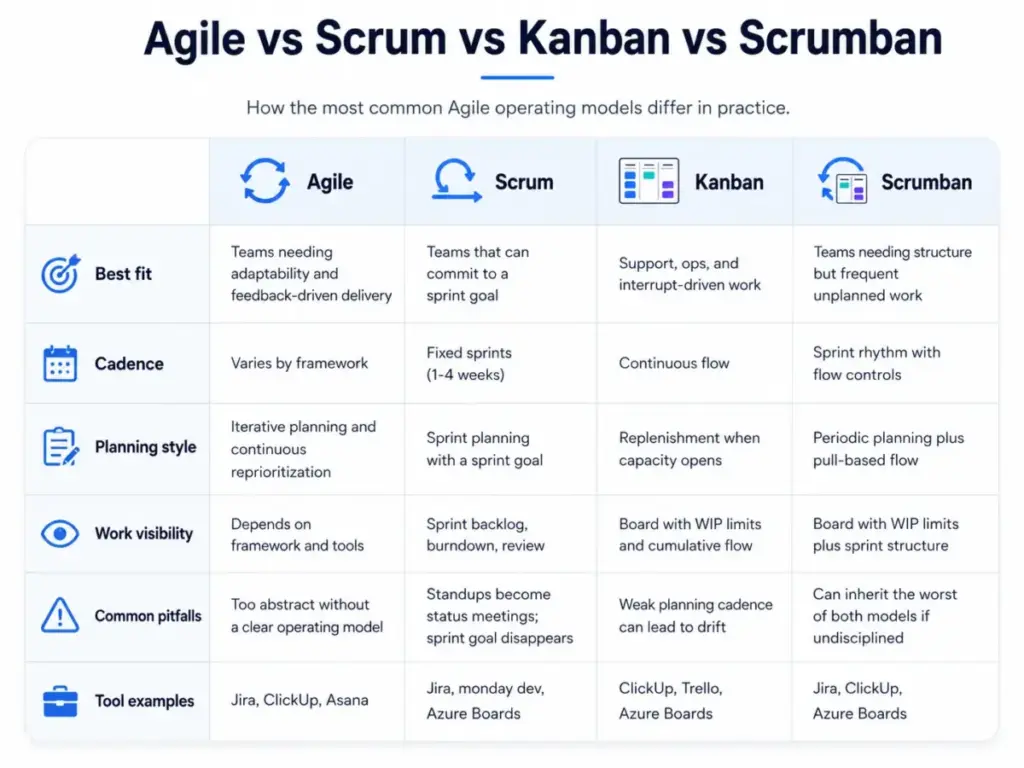
Most confusion starts here. Agile is the umbrella. Scrum and Kanban are operating models underneath it. Choosing the wrong one creates the meeting overload and ceremony theater that practitioners complain about.
| Dimension | Scrum | Kanban | Scrumban |
|---|---|---|---|
| Cadence | Fixed sprints (1-4 weeks) | Continuous flow | Sprint cadence with flow controls |
| Planning style | Sprint planning with a sprint goal | Replenishment when capacity opens | Periodic planning plus on-demand pull |
| Work visibility | Sprint backlog, burndown | Board with WIP limits, cumulative flow | Board with WIP limits plus sprint structure |
| Best fit | Teams that can commit to a defined scope for a fixed period | Support, ops, or interrupt-driven teams | Teams needing some structure but frequent unplanned work |
| Common pitfall | Sprint goal disappears, standups become status meetings | No planning cadence leads to drift | Adopting worst of both models without the discipline of either |
| Tool examples | Jira, monday dev, Azure Boards | ClickUp, Trello, Azure Boards | Any Agile tool with board + sprint support |
What this means: if your team can commit to a goal for two weeks, Scrum gives you the inspection-and-adaptation rhythm. If your work arrives unpredictably (think customer support escalations or DevOps incident response), Kanban gives you flow without forced sprint boundaries. Scrumban works for teams that need a planning heartbeat but cannot protect sprint scope from interrupts.
Beyond these three, other Agile approaches include Extreme Programming (XP), which emphasizes pair programming, test-first development, and continuous integration, and Lean Agile, which combines Agile feedback loops with Lean principles such as reducing waste and optimizing flow. Scaled frameworks like SAFe exist for coordinating Agile across multiple teams, but scaling ceremonies before one team can deliver well is a common anti-pattern.
How to Implement Agile in Practice
The 12 Agile principles emphasize early and continuous delivery, welcoming change, daily collaboration, motivated individuals, working software as the primary progress measure, sustainable development, and regular reflection. Translating those principles into daily operations requires more than posting them on a wall.
Getting a Backlog Sprint-Ready
The most common failure in Agile implementation is vague backlog items entering a sprint. A mini workflow for backlog readiness:
- Start with a customer problem, not a feature request.
- Gather evidence that the problem exists (user feedback, data, support tickets).
- Write a user story with acceptance criteria specific enough to verify.
- Estimate using story points, T-shirt sizes, or time ranges.
- Define Done for the increment: coded, tested, reviewed, deployed, and documented.
- Sprint-ready decision: if any of the above is missing, the item stays in refinement.
Role Clarity
| Role | Decision Rights | Common Dysfunction |
|---|---|---|
| Product Owner | Orders the backlog, accepts or rejects increments, negotiates scope | Becomes a ticket clerk instead of a decision-maker |
| Developers | Plan the sprint work, own the how, adapt daily | Lose autonomy when managers dictate task assignments |
| Scrum Master | Coaches the framework, removes blockers, protects the team | Becomes a meeting scheduler or a project manager in disguise |
| Stakeholders | Provide feedback at review, request backlog items through the PO | Bypass the backlog and inject work mid-sprint |
What this means: if nobody on the team has the authority to say “no” to a stakeholder request, the sprint goal becomes meaningless, and Agile collapses into waterfall with tickets.
Common Mistakes and Misconceptions
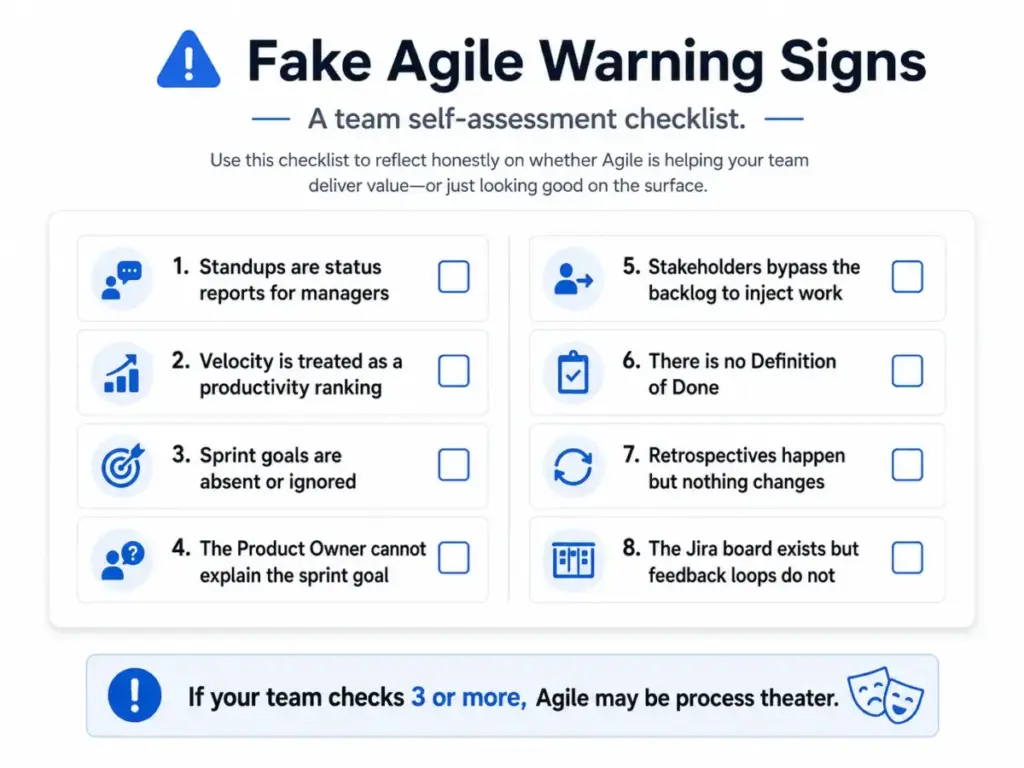
Fake Agile Warning Signs
If your team checks three or more of these boxes, the process is Agile in name only:
- Standups are status reports for managers, not developer coordination
- Velocity is treated as a productivity ranking across teams
- Sprint goals are absent or ignored
- The Product Owner cannot explain the sprint goal in one sentence
- Stakeholders bypass the backlog to inject work directly
- There is no Definition of Done, or nobody enforces it
- Retrospectives happen but nothing changes afterward
- The Jira board exists but feedback loops do not
The Scrum Guide states that the Daily Scrum is a 15-minute event for Developers to inspect progress toward the Sprint Goal and adapt the Sprint Backlog. Practitioner discussions show recurring complaints that standups often become management status meetings, which defeats the purpose entirely.
Five Misconceptions That Hurt Adoption
| Misconception | Reality |
|---|---|
| Agile means no planning | Agile still plans, but in smaller increments and updates plans as evidence changes |
| Agile equals Scrum | Scrum is one Agile framework. Kanban, XP, Lean, and hybrids qualify too |
| Daily standups are for managers | The Scrum Guide says the Daily Scrum is for Developers to inspect and adapt |
| Buying a tool makes a team Agile | Tools support backlogs and boards, but Agile depends on feedback, empowered teams, and working increments |
| Agile always means faster delivery | Agile can shorten feedback cycles, but poor discovery, unclear ownership, or overloaded teams make delivery slower |
Limitations and When NOT to Use Agile
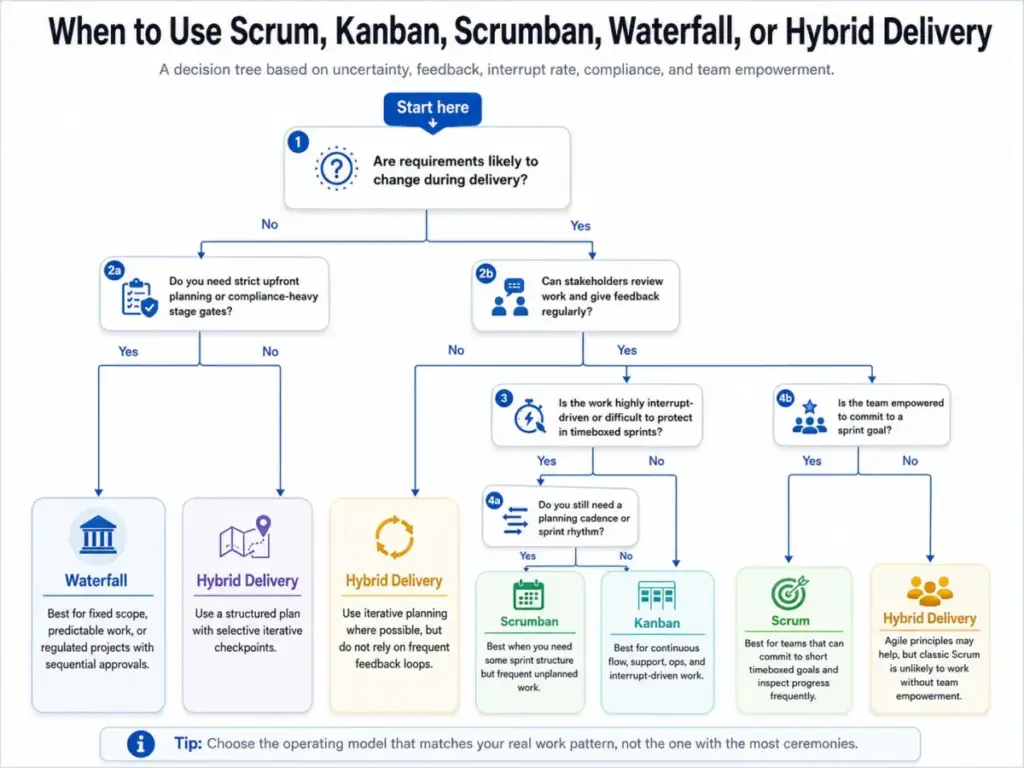
Agile is not universal. These are the conditions where pure Scrum or even Agile-influenced delivery needs modification.
Avoid or modify Agile when:
- Stakeholders demand fixed scope, fixed date, fixed budget, and will not negotiate trade-offs
- Regulatory or safety requirements force staged approvals with no room for iterative release
- The team cannot be empowered to make daily decisions about the work
- Stakeholder access during delivery is unavailable (no one shows up to sprint reviews)
- Interrupt volume makes sprint commitments meaningless (use Kanban instead)
- Work is highly repeatable with near-zero uncertainty (standard operating procedures work better)
Use Agile when:
- Requirements are uncertain and will change
- User or customer feedback matters during the build
- The team can deliver in increments
- Stakeholders are willing to inspect evidence and adapt scope
- The organization supports empowered, cross-functional teams
The Scrum Guide notes that shorter sprints generate more learning cycles and limit risk. That works only if the team actually inspects and adapts. If the Sprint Review is treated as a gate rather than a feedback session, shorter sprints just create more meetings.
How to Measure Agile Success
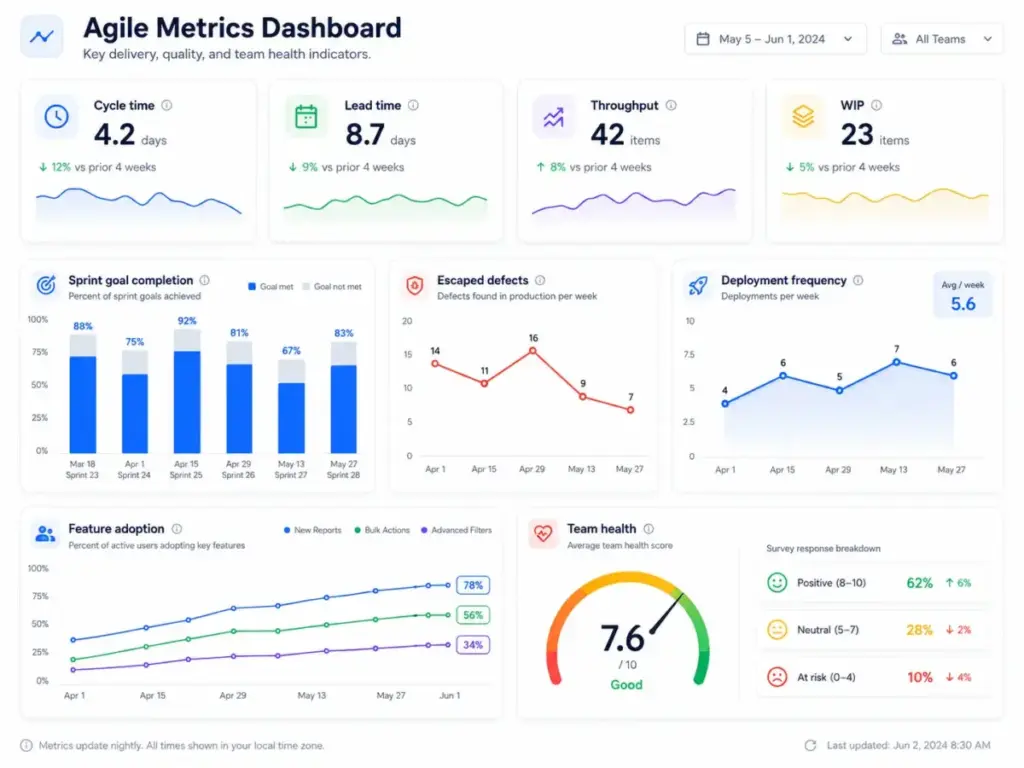
Velocity alone is dangerous. It measures output, not outcome. Here are the metrics that matter for workflow automation and delivery effectiveness.
| Metric | What It Measures | Why It Matters |
|---|---|---|
| Cycle time | Time from work started to work done | Shorter cycles mean faster learning |
| Lead time | Time from request to delivery | Measures total responsiveness |
| Throughput | Items completed per unit of time | Shows delivery capacity |
| WIP count | Items in progress simultaneously | High WIP signals multitasking overhead |
| Sprint goal completion | Percentage of sprints that meet their goal | Measures planning and commitment reliability |
| Escaped defects | Bugs found in production after release | Tracks quality of the Definition of Done |
| Deployment frequency | How often the team ships to production | Connects Agile to DevOps maturity |
| Feature adoption | Usage of shipped features by real users | Measures outcome, not just output |
| Team health | Self-reported team morale and sustainability | Prevents burnout from hiding behind velocity numbers |
What this means: if your team tracks only velocity and burndown, you are measuring how fast the team moves but not whether it is moving toward something valuable. Pair flow metrics (cycle time, throughput) with outcome metrics (feature adoption, customer feedback response time) and team health for a complete picture.
According to Digital.ai’s 18th State of Agile report, “Agile is adapting, not fading.” The current period is an adaptation era where AI, automation, hybrid work, data quality, governance, and outcome measurement are reshaping Agile practice. Digital.ai’s 17th report noted that 42% of respondents reported hybrid models combining Agile, DevOps, or other approaches.
Tools That Support Agile Delivery
Tools do not create agility. A Jira board can still hide waterfall planning if feedback loops are absent. That said, the right tool reduces friction in backlog management, sprint tracking, reporting, and team coordination.
| Tool | Best Fit | Agile Features | Starting Price (as of May 2026) | Free Plan | Key Caveat |
|---|---|---|---|---|---|
| Jira | Software teams needing Scrum/Kanban, issue tracking, and release management | Scrum/Kanban boards, backlog, sprint reports, timeline, goals, automation | $0 (up to 10 users); Standard $7.91/user/mo | Yes, 10 users, 2 GB storage, 100 automation runs/month | Cross-team planning and dependency management require Premium at $14.54/user/mo |
| monday dev | Product teams wanting sprint management with visual roadmaps and retrospectives | Sprint management, Agile insights, automations, roadmap, retrospectives, bug tracking, CI/CD integrations | Paid plans start around $9/seat/mo (Basic, annual) | No free plan for monday dev; Work Management has a free tier | Verify exact pricing at checkout; US annual rates may differ from localized pages |
| Azure Boards | Teams in the Microsoft/Azure DevOps ecosystem needing Scrum, Kanban, and delivery plans | Work items, boards, backlogs, sprints, queries, delivery plans, team scoping | $0 (first 5 users); Basic $6/user/mo | Yes, 5 free users with Basic access | Pipelines, Artifacts, and Test Plans are separate paid services |
| ClickUp | Teams wanting all-in-one PM with sprint management, dashboards, and docs | Kanban boards, sprints, sprint points, burndown/burnup/velocity/cumulative flow cards, automations, goals | $0 (Free Forever); Unlimited $7/user/mo (annual) | Yes, unlimited tasks, 60 MB storage | Sprint Cards and Sprint Automations start on Business ($12/user/mo); Sprint Points capped at 100 uses on Free/Unlimited |
| Asana | Cross-functional and product teams needing board views, timeline, portfolios, and AI features | Tasks, board/list/timeline views, dashboards, automations, portfolios, AI Studio | $0 (Personal, up to 2 users); Starter $10.99/user/mo (annual) | Yes, 2 users, unlimited tasks, 100 MB max per file | No native sprint management; timeline and Gantt require Starter; portfolios require Advanced at $24.99/user/mo |
What this means: Jira pricing is the most accessible entry point for software teams, but its automation and cross-team features gate at higher tiers. ClickUp offers the widest feature set on its free plan, but serious Agile reporting requires Business. Asana is strong for cross-functional delivery but lacks native sprint mechanics.
monday dev combines sprint management with product roadmaps but has no free developer-specific plan. Azure Boards fits teams already inside Azure DevOps and offers strong value for Visual Studio subscribers. Teams evaluating Jira for Agile should compare Jira alternatives by automation gates, cross-team planning, native sprint mechanics, developer ecosystem fit, and the upgrade path from free to paid.
Agile Readiness Checklist
Use this checklist before adopting Agile or diagnosing why your current implementation is not working:
- The team has a clear customer or user whose problems drive the backlog
- Someone has authority to order the backlog and say no to requests
- Work can be broken into increments deliverable in 1-4 weeks
- Stakeholders will attend reviews and give feedback
- The team has a Definition of Done that everyone follows
- Retrospectives produce at least one change per cycle
- Metrics include outcomes (adoption, feedback), not only output (velocity)
- The delivery model (Scrum, Kanban, Scrumban) matches the team’s work pattern
- The tool supports the chosen operating model without forcing process mismatch
- Leadership supports empowered teams and does not override sprint goals
FAQ
Is Agile just Scrum with a different name?
No. Agile is the umbrella mindset. Scrum is one framework under it. Kanban, XP, Lean, and Scrumban all qualify as Agile approaches. Teams that equate Agile with Scrum often miss that Kanban or a hybrid model is a better fit for interrupt-driven work.
Should my team use Scrum or Kanban?
Use Scrum if the team can commit to a defined goal for a fixed period (usually 2 weeks). Use Kanban if work arrives unpredictably, like support escalations or DevOps incidents. Use Scrumban if you need a planning heartbeat but cannot protect sprint scope from frequent interrupts.
Can Agile work for non-software teams?
Yes, if the work involves uncertainty and benefits from iterative delivery. Marketing campaigns, product launches, and content operations can all run Agile-style cycles. The Association for Project Management defines Agile project management as an iterative approach applicable beyond software.
What Agile metrics matter besides velocity?
Cycle time, lead time, throughput, escaped defects, sprint goal completion, deployment frequency, and feature adoption all provide more useful signals than velocity alone. Velocity measures output. Outcome metrics measure whether users benefit from what the team ships.
Is Agile micromanagement in disguise?
It can become that if standups turn into manager status meetings and velocity becomes a performance ranking. The Scrum Guide says the Daily Scrum is for Developers, not managers. If leadership uses Agile ceremonies to monitor rather than empower, the team loses the autonomy that makes Agile work.
Why do Agile meetings feel like they take too long?
Usually because the team is running every ceremony without a clear sprint goal. When meetings lack a decision to make or evidence to inspect, they become status theater. Shorter sprints generate more meetings, so each ceremony needs a clear purpose. The Scrum Guide recommends a 15-minute Daily Scrum, not an hour-long round-robin.
How do I stop Agile from becoming waterfall with tickets?
Make sure every sprint has a goal, every review inspects value (not just ticket completion), every retrospective produces a change, and the Product Owner has real authority to adapt scope. If the backlog is just a project plan broken into tickets with fixed dates, it is waterfall wearing an Agile label.
What tool should a small Agile team start with?
For software teams under 10 people, Jira’s free plan covers Scrum and Kanban boards, backlog, and reports. ClickUp’s Free Forever plan offers sprint management with unlimited tasks. For cross-functional teams that do not need native sprint mechanics, Asana pricing starts at $0 for up to 2 users. Pick the tool that matches your operating model, not the one with the longest feature list.
What are the 4 values of Agile?
The Agile Manifesto lists four value preferences: individuals and interactions over processes and tools, working software over comprehensive documentation, customer collaboration over contract negotiation, and responding to change over following a plan.
When should a team NOT use Agile?
Avoid pure Agile when work is highly repeatable with near-zero uncertainty, when regulatory or safety gates require strict upfront approval, when stakeholders refuse to engage during delivery, or when the team cannot be empowered to make daily decisions. In these cases, Kanban, staged governance, or a hybrid model is a better fit.