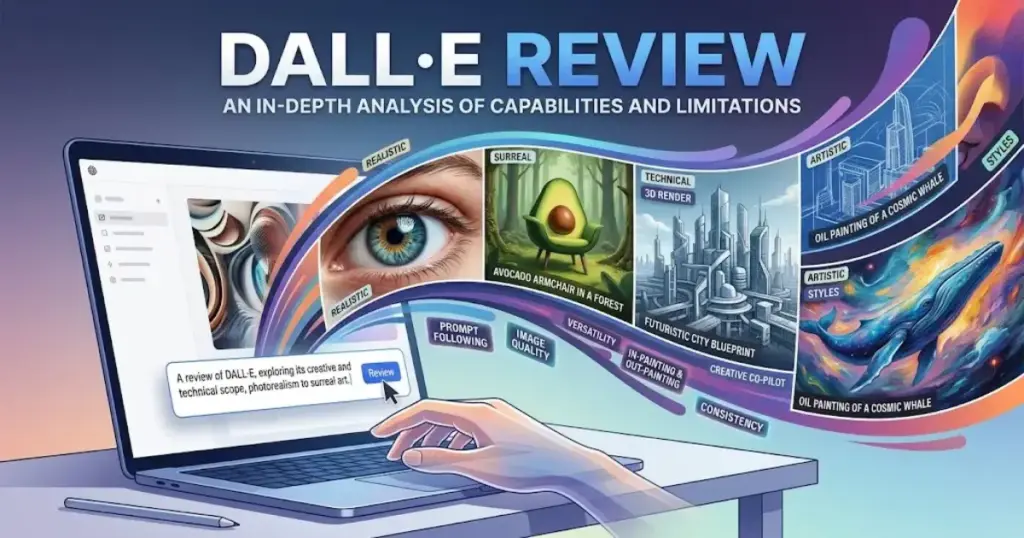
Most AI image generators promise photorealistic output and total creative control. Few deliver both. This DALL·E review breaks down what OpenAI’s image generation system actually offers in 2026, where it falls short, and whether the pricing justifies the output for your specific workflow.
DALL·E 3 remains one of the most accessible text-to-image tools in generative AI, but accessibility and production-grade reliability are not the same thing. If you need a clear answer on whether DALL·E fits your team, your budget, and your creative standards, this review covers pricing math, feature limits, honest limitations, and the five alternatives worth comparing.
Quick Verdict: 8.4 / 10
DALL·E earns its score on accessibility, ChatGPT-native workflow, and commercial-use clarity. It loses points on style consistency, dynamic usage limits, and production unpredictability at scale.
| Category | Score (out of 10) | Notes |
|---|---|---|
| Prompt Adherence | 8.5 | Strong natural language interpretation, but OpenAI rewrites prompts silently |
| Creative Control | 7.0 | Limited fine-tuning, no style locking, weaker than Midjourney for aesthetics |
| Pricing Transparency | 7.5 | ChatGPT plans are clear; API pricing requires math; dynamic limits are vague |
| Speed | 8.5 | Fast inside ChatGPT; API response times are competitive |
| Commercial Use | 9.5 | Full ownership, no permission needed to sell or reprint |
| API Fit | 8.0 | Two API approaches available; GPT Image 2 adds flexibility but also cost complexity |
| Team Workflow | 7.5 | Works for small teams via ChatGPT; no native brand asset management |
| Overall | 8.4 | Best for conversational ideation and non-designers; not best for high-volume brand-consistent production |
Best for: Solo creators, marketers, educators, and startup content teams who need fast visual drafts inside ChatGPT.
Not best for: Agencies needing pixel-level control, brand-consistent batch output, or advanced photorealism.
DALL·E Review: Final Verdict
DALL·E is the easiest way to generate images from natural language in 2026, but ease of use does not equal production reliability. OpenAI has built DALL·E 3 directly into ChatGPT, which means anyone with a free account can generate images without learning a new tool. That integration is genuinely valuable for brainstorming, quick mockups, and educational visuals.
The problems surface when you need consistency. DALL·E rewrites your prompts before generating images, which improves output quality for casual users but removes precise control for experienced creators. Style locking across multiple images is unreliable. Dynamic usage limits on ChatGPT plans mean you cannot predict exactly how many images you will get in a session. And the gap between DALL·E 3 (the previous-generation model) and newer GPT Image models creates confusion about what you are actually paying for.
I score DALL·E 8.4 out of 10. It wins on accessibility, prompt interpretation, and commercial rights. It loses on aesthetic control, style consistency, and high-volume production predictability. If you are a non-designer who needs “good enough” images fast, DALL·E is hard to beat. If you are a designer or agency that needs “exactly right” images at scale, look at Midjourney or Adobe Firefly.
What Is DALL·E in 2026?
DALL·E is OpenAI’s text-to-image generation system, built natively into ChatGPT and available through the OpenAI API. Understanding what “DALL·E” means in 2026 requires separating three distinct products that most review sites blur together.
Here is the breakdown:
DALL·E 3 is the previous-generation image model. It remains available in the OpenAI API with fixed per-image pricing. When you use the DALL·E 3 API endpoint, you pay a flat rate per image based on resolution and quality setting.
ChatGPT image generation is the consumer-facing experience. When you type “generate an image of…” inside ChatGPT, you are using OpenAI’s image generation capability. ChatGPT can help brainstorm and refine prompts interactively before generating the image. Access depends on your ChatGPT subscription tier.
GPT Image models (including gpt-image-2, gpt-image-1.5, gpt-image-1, and gpt-image-1-mini) are OpenAI’s newer image generation models. These use token-based pricing instead of flat per-image rates, and they power the latest image generation capabilities through the API.
OpenAI’s image generation API now supports two primary approaches. The Image API is best for single image generation or edits from one prompt. The Responses API is best for conversational, multi-step, editable image experiences. Both APIs allow customization of quality, size, format, and compression.
This distinction matters for pricing, capability, and workflow decisions throughout this review.
DALL·E Features That Matter
DALL·E’s feature set centers on natural language accessibility, not granular creative control. That distinction defines who benefits most from this tool and who should look elsewhere. The features below are the ones that directly affect your workflow and output quality.
DALL·E Prompt Adherence
DALL·E 3 interprets natural language prompts with strong accuracy for general descriptions. You can describe a scene in conversational English and expect a result that matches your intent most of the time.
“DALL-E 3 generates highly detailed, creative, and visually stunning images that align closely with prompts.”
— Ebubechukwu N., GIS Analyst, GetApp/Capterra verified review snippet
The catch is prompt engineering control. OpenAI’s system rewrites your prompts before passing them to the image model. This rewriting improves output for vague or poorly structured prompts. But it also means experienced users cannot guarantee their exact wording reaches the model. If you write a precise prompt with specific compositional instructions, the rewritten version may alter your intent.
For marketers drafting social media visuals or educators creating lesson illustrations, this trade-off works in your favor. For designers who need exact control over composition, lighting, and style, this is a real limitation.
DALL·E and ChatGPT Workflow
The ChatGPT integration is DALL·E’s strongest competitive advantage. You do not need a separate tool, a separate login, or a separate prompt syntax. You ask ChatGPT to create an image inside the same conversation where you are drafting copy, planning campaigns, or brainstorming concepts.
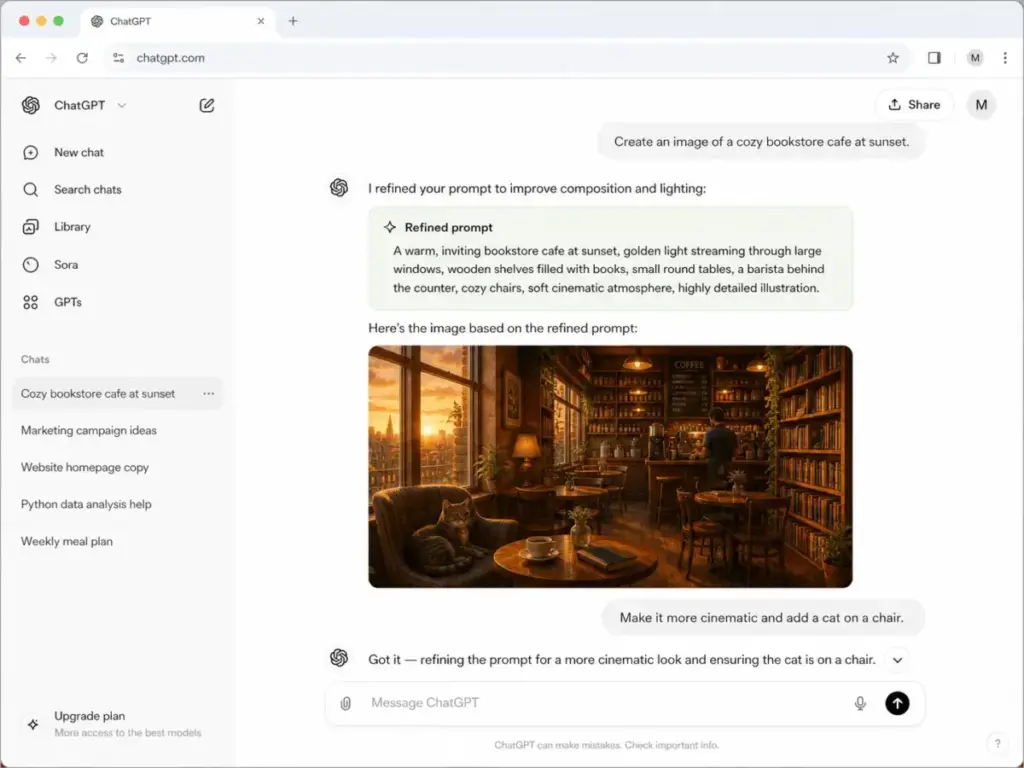
ChatGPT can help refine your prompts iteratively. You can say “make the background darker” or “change the style to watercolor” and ChatGPT will modify the prompt and regenerate. This conversational editing loop is faster than re-typing prompts in standalone image generators. For a deeper look at the ChatGPT platform itself, see our ChatGPT review.
DALL·E Image Editing
DALL·E supports image editing through both the ChatGPT interface and the API. You can upload an existing image and ask for modifications. The API supports this through both the Image API (single edits) and the Responses API (multi-step conversational edits).
The editing workflow is functional for simple changes: swapping backgrounds, adjusting colors, adding or removing objects. Complex edits that require preserving fine details or maintaining exact proportions are less reliable. This is adequate for quick iterations but not a replacement for Photoshop-level editing.
DALL·E API Access
Developers have two paths for integrating DALL·E into applications.
The Image API handles single-prompt image generation and edits. You send a prompt, specify quality and size, and receive an image. This is the simplest integration path for apps that need one image per request.
The Responses API supports conversational, multi-step image workflows. This is better for applications where users refine images through dialogue, similar to the ChatGPT experience.
DALL·E 3 API pricing uses flat per-image rates. GPT Image 2 uses token-based pricing that varies with quality settings and input complexity. Both APIs filter prompts and outputs according to OpenAI’s content policy.
For API data privacy: OpenAI states that API data is not used to train or improve OpenAI models unless the customer opts in. Abuse monitoring logs can contain prompts, responses, and metadata, retained up to 30 days by default.
DALL·E Commercial Use
OpenAI states clearly that images created with DALL·E are the user’s to use. You do not need OpenAI’s permission to reprint, sell, or merchandise them. This is one of the strongest commercial-use policies among major AI image generators.
This matters for content teams producing marketing assets, merchandise designs, or client deliverables. There is no revenue-sharing, no attribution requirement, and no usage-based licensing fee beyond your subscription or API costs.
DALL·E Pricing and Hidden Costs
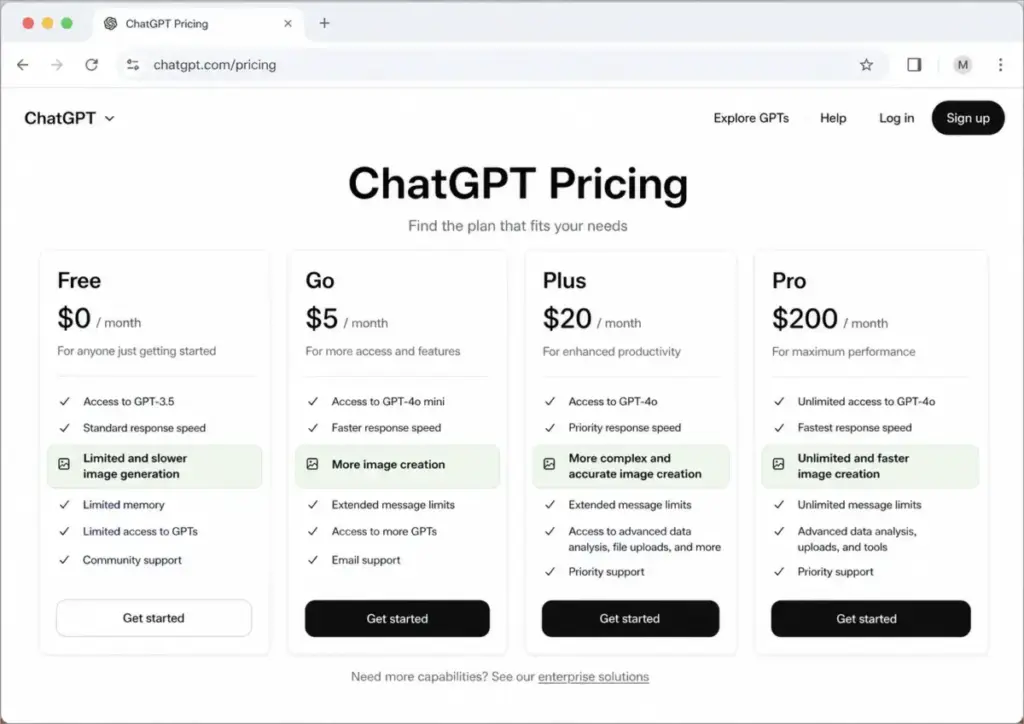
DALL·E pricing splits into two tracks: ChatGPT subscription access and direct API usage. Most pricing pages show you one track without explaining how the other affects your total cost. Here is the full picture, verified as of May 4, 2026.
ChatGPT Subscription Pricing
| Plan | Monthly Cost | Image Generation Access | Source |
|---|---|---|---|
| ChatGPT Free | $0 | Limited and slower image generation | chatgpt.com/pricing |
| ChatGPT Go | Not specified | More image creation than Free | chatgpt.com/pricing |
| ChatGPT Plus | $20/month | More complex and accurate image creation, image generation with Thinking | chatgpt.com/pricing |
| ChatGPT Pro ($100) | $100/month | 5x more usage than Plus | chatgpt.com/pricing |
| ChatGPT Pro ($200) | $200/month | 20x more usage than Plus | chatgpt.com/pricing |
| ChatGPT Business | $25/user/month (monthly) or $20/user/month (annual), 2-seat minimum | Business-tier image creation | chatgpt.com/pricing |
| ChatGPT Enterprise | Custom pricing | Enterprise-tier access | chatgpt.com/pricing |
For details on how ChatGPT subscription tiers compare beyond image generation, see our ChatGPT pricing breakdown.
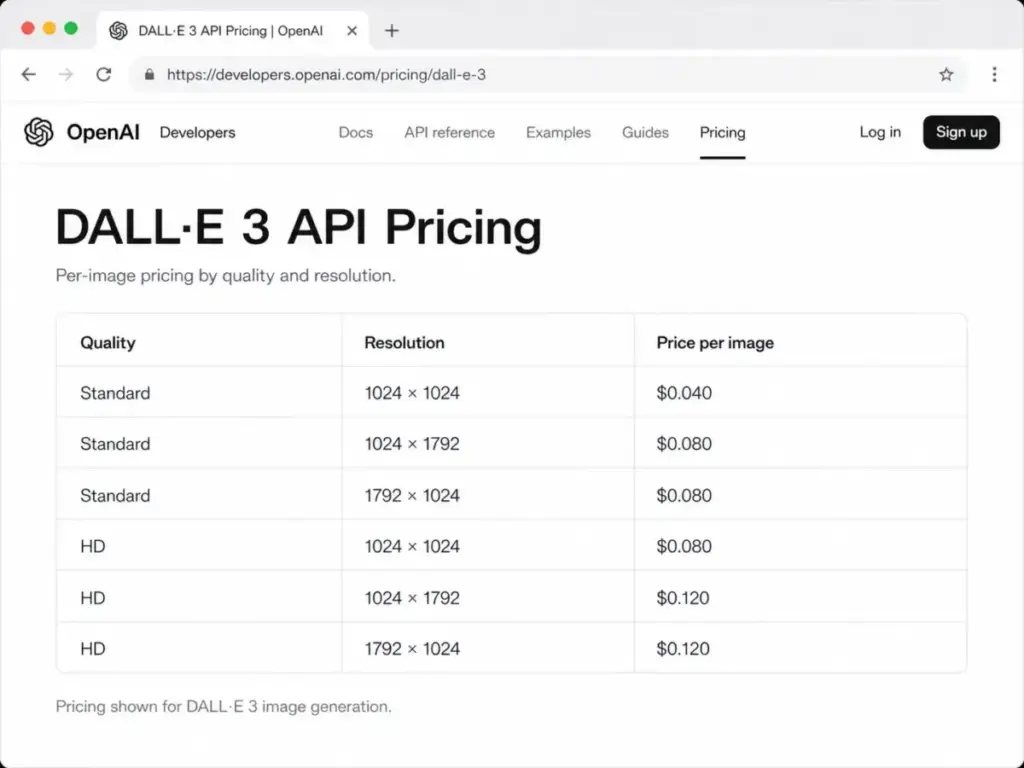
DALL·E 3 API Pricing (Per Image)
| Resolution | Standard Quality | HD Quality | Source |
|---|---|---|---|
| 1024×1024 | $0.04 | $0.08 | OpenAI API Pricing |
| 1024×1536 | $0.08 | $0.12 | OpenAI API Pricing |
| 1536×1024 | $0.08 | $0.12 | OpenAI API Pricing |
GPT Image 2 Estimated Output Costs (1024×1024)
| Quality | Estimated Cost Per Image | Notes |
|---|---|---|
| Low | $0.006 | Lowest cost option |
| Medium | $0.053 | Mid-range quality |
| High | $0.211 | Also bills input image tokens and text tokens for edits |
Cost Scenarios: 100, 1,000, and 10,000 Images
This table shows estimated costs for DALL·E 3 API (standard 1024×1024) and GPT Image 2 (1024×1024) at different volumes. ChatGPT subscription costs are fixed monthly regardless of volume, but subject to dynamic usage limits.
| Volume | DALL·E 3 Standard (1024×1024) | DALL·E 3 HD (1024×1024) | GPT Image 2 Low | GPT Image 2 Medium | GPT Image 2 High |
|---|---|---|---|---|---|
| 100 images | $4.00 | $8.00 | $0.60 | $5.30 | $21.10 |
| 1,000 images | $40.00 | $80.00 | $6.00 | $53.00 | $211.00 |
| 10,000 images | $400.00 | $800.00 | $60.00 | $530.00 | $2,110.00 |
What the pricing page does not tell you: DALL·E 3 API gives you predictable per-image costs. GPT Image 2 adds input token charges when you include reference images or complex prompts, making the actual cost higher than the output-only estimates above. ChatGPT subscription plans describe image generation access in relative terms (“more,” “5x more”) rather than exact image counts, so you cannot calculate a precise per-image cost for subscription-based usage.
DALL·E User Experience
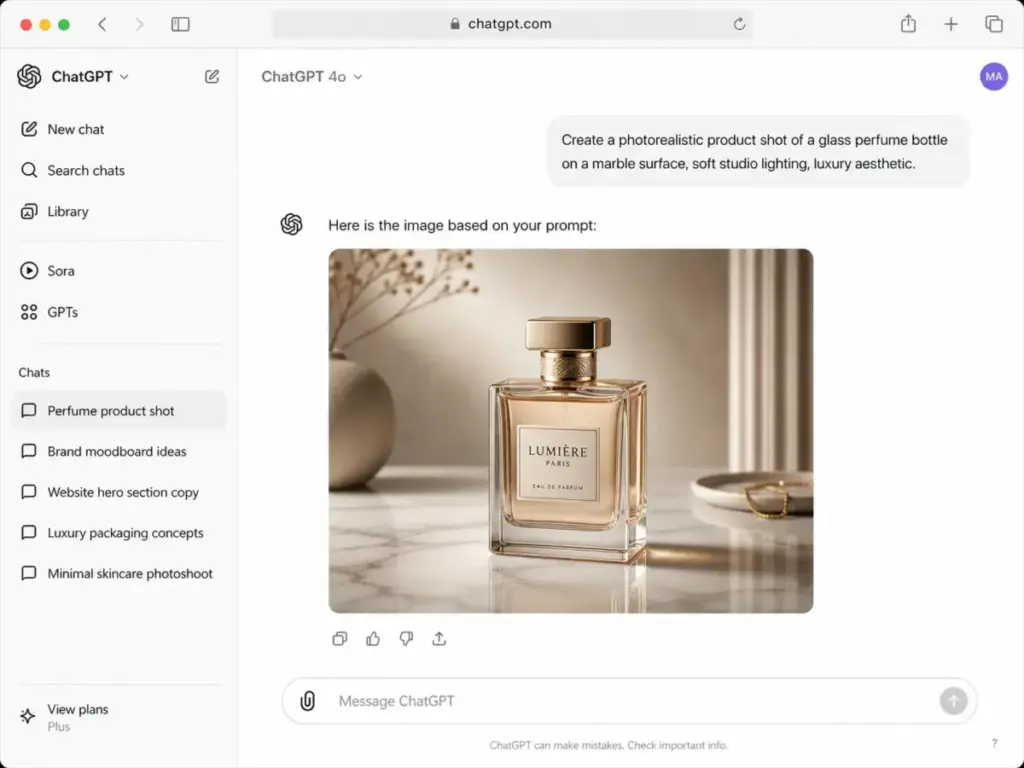
The first-time DALL·E experience inside ChatGPT is the best onboarding in AI image generation. You type a description, and an image appears. No model selection, no parameter tuning, no separate interface to learn.
The first 30 minutes are genuinely impressive. ChatGPT interprets casual language well, and the conversational refinement loop (ask for changes, get a new image) feels natural. Non-designers can produce usable social media graphics, blog illustrations, and presentation visuals without any design training.
The first week reveals friction. You notice that repeating a prompt does not produce the same style. You discover that certain requests trigger content policy filters with minimal explanation. You realize that “limited” and “more” image generation on Free and Go plans translate to unpredictable daily capacity. You start hitting regeneration cycles where 3 or 4 attempts are needed to get close to your original vision.
Scaling beyond personal use introduces more friction. Teams sharing a ChatGPT Business account ($25/user/month monthly, $20/user/month annual, 2-seat minimum) do not get shared brand assets, style presets, or collaborative workspaces. Each team member generates independently, which makes visual consistency across a campaign difficult without external style guides.
What DALL·E Does Not Tell You
OpenAI’s marketing emphasizes accessibility and creative freedom, but several operational realities only surface after sustained use. These are not bugs. They are design decisions that affect production workflows.
Dynamic usage limits are vague by design. ChatGPT Free offers “limited and slower” image generation. Plus offers “more complex and accurate” creation. Pro offers “5x” or “20x” more than Plus. None of these descriptions translate to exact image counts per day or per session. For teams budgeting production capacity, this vagueness creates planning uncertainty.
Prompt rewriting removes precision. DALL·E 3 rewrites your prompts before generating images. OpenAI designed this to improve results for average users, but it means your exact words are not what the model processes. If you write “a 35mm photograph of a single red chair in an empty white room, centered, natural lighting, no shadows,” the model may receive a rewritten version that changes compositional details.
Content policy refusals are inconsistent. DALL·E 3 declines requests for public figures by name. It also declines requests for images in the style of living artists. These policies protect creators, but the refusal messages are sometimes opaque. A prompt that works one day may be refused the next with minimal explanation of which policy was triggered.
Style consistency across images is unreliable. Generating 10 images for a blog series and expecting consistent character design, color palette, or artistic style is not something DALL·E handles reliably. Each generation is effectively independent, with no style-locking mechanism.
The DALL·E 3 vs GPT Image model distinction is underexplained. As of 2026, DALL·E 3 is a previous-generation model in OpenAI’s API documentation. Newer GPT Image models (gpt-image-2, gpt-image-1.5, gpt-image-1, gpt-image-1-mini) offer different capabilities and pricing structures. OpenAI does not prominently clarify which model powers ChatGPT image generation or how the models compare in quality.
DALL·E Pros and Cons
DALL·E’s strengths cluster around accessibility and integration. Its weaknesses cluster around control and predictability. Here is the honest breakdown.
- Best natural language prompt interpretation among major AI image generators
- Native ChatGPT integration eliminates the need for a separate tool
- Conversational prompt refinement is faster than manual prompt editing
- Clear commercial-use rights with no attribution or licensing requirements
- Two API approaches (Image API and Responses API) for different developer needs
- API data is not used for model training unless opted in
- Free tier available for basic image generation
- ChatGPT Plus at $20/month is competitive entry pricing
- Prompt rewriting removes precise creative control
- Dynamic usage limits on all ChatGPT plans create production uncertainty
- No style-locking mechanism for consistent multi-image output
- Content policy refusals can be inconsistent and poorly explained
- Weaker photorealism compared to Midjourney
- No native brand asset management or team collaboration features
- GPT Image 2 token-based pricing is harder to predict than flat per-image rates
- DALL·E 3 vs GPT Image model distinction is confusing for buyers
“Sometimes it didn’t create desired results and prompts need modification multiple times.”
— Harjoth S., Mid-Market reviewer, G2 pros and cons page
DALL·E vs Alternatives: Comparison Table
No single AI image generator wins every category. The right tool depends on your workflow, budget, and quality requirements. This comparison uses verified pricing and documented capabilities.
| Feature | DALL·E (OpenAI) | Midjourney | Adobe Firefly | Leonardo AI | Stable Diffusion |
|---|---|---|---|---|---|
| Starting Price | Free (ChatGPT Free) | $10/month (Basic) | $9.99/month (Standard) | Free daily tokens | Credit-based ($0.01/credit) |
| Best For | Conversational ideation, non-designers | Artistic quality, photorealism | Adobe ecosystem, brand-safe assets | Game/product assets, creative suite | Custom models, open ecosystem |
| Prompt Style | Natural language, conversational | Prompt syntax with parameters | Natural language | Natural language with model selection | Varies by interface |
| ChatGPT Integration | Native | None | None | None | None |
| Commercial Use | Full ownership, no restrictions | Yes (paid plans) | Commercial-safe, trained on licensed content | Yes (paid plans) | Varies by model license |
| API Available | Yes (Image API + Responses API) | Limited | Yes (within Adobe ecosystem) | Yes (pay-as-you-go from $5) | Yes (credit-based) |
| Style Consistency | Weak | Strong | Moderate | Moderate | Strong (with fine-tuning) |
| Photorealism | Moderate | Strong | Moderate | Moderate | Strong (model-dependent) |
| Winner | Accessibility + workflow | Aesthetic quality | Brand safety | Asset variety | Customization |
DALL·E vs Midjourney
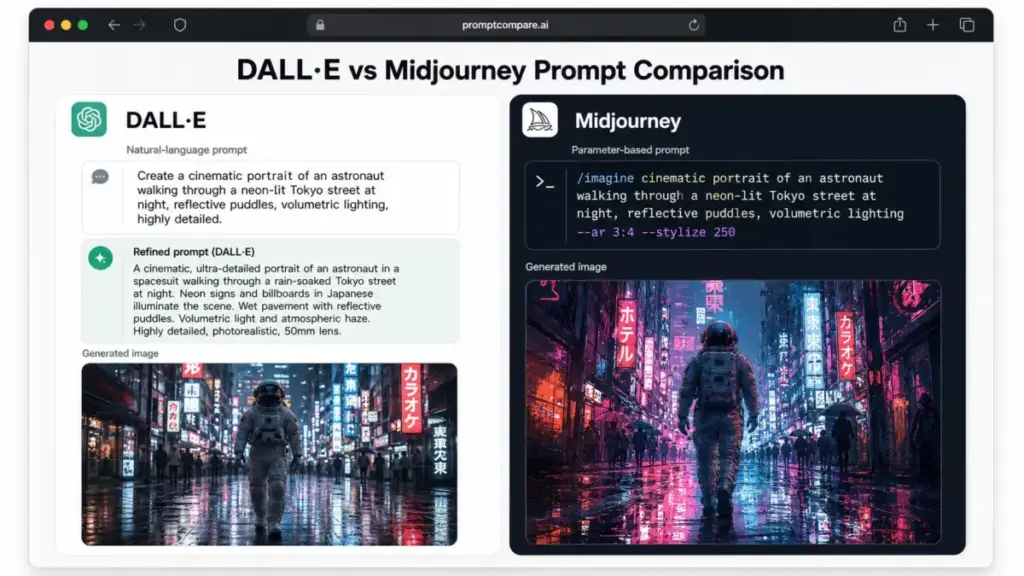
Midjourney produces more aesthetically refined images with stronger photorealism and better style consistency. Its artistic output quality is the benchmark in 2026. The trade-off is workflow: Midjourney operates as a separate platform without the conversational editing loop that ChatGPT provides. Midjourney Basic starts at $10/month with 3.3 hours of fast GPU time. For a detailed breakdown, see our Midjourney review.
Choose DALL·E if you want image generation inside your existing ChatGPT workflow and prioritize speed over aesthetic perfection. Choose Midjourney if visual quality and style control are your primary requirements.
DALL·E vs Adobe Firefly
Adobe Firefly’s positioning is commercial safety. Adobe trains Firefly on licensed content, which reduces legal risk for brand assets. Firefly integrates with Photoshop, Illustrator, and the broader Adobe Creative Cloud ecosystem. Firefly Standard starts at $9.99/month with 2,000 generative credits. For pricing details, see our Adobe Firefly pricing guide and full Adobe Firefly review.
Choose DALL·E if you do not use Adobe tools and want a simpler workflow. Choose Firefly if you already work in the Adobe ecosystem and need production-grade brand assets.
DALL·E vs Leonardo AI
Leonardo AI offers a creative suite with multiple models, token-based flexibility, and workflows optimized for game assets, product mockups, and production visuals. API pay-as-you-go starts with a $5 credit. Free users get daily token allowances. For a full analysis, see our Leonardo AI review.
Choose DALL·E if you want the simplest path to image generation. Choose Leonardo AI if you need specialized asset types and more model variety.
DALL·E vs Stable Diffusion
Stable Diffusion offers the most customization in the AI image generation space. Open-source models, fine-tuning capabilities, and community-driven development give technical users maximum control. The trade-off is complexity: setting up and maintaining a Stable Diffusion workflow requires technical knowledge. Stability AI’s platform API uses credit-based pricing at $0.01 per credit. For details, see our Stable Diffusion review.
Choose DALL·E if you want zero setup and conversational generation. Choose Stable Diffusion if you need fine-tuned models, open-source flexibility, or maximum creative control.
For a broader view of the AI image generation category, see our Canva AI review covering the easiest design workflow for non-designers.
Who Should Use DALL·E?
DALL·E is the right choice when speed and accessibility matter more than pixel-level control. The following micro-cohorts benefit most from DALL·E’s strengths.
| Micro-Cohort | Team Size | Workflow | Why DALL·E Fits |
|---|---|---|---|
| Solo content creators | 1 | Blog posts, social media, newsletters | ChatGPT integration means no extra tool; free tier available |
| Startup marketing teams | 2-5 | Campaign visuals, landing pages, ad creatives | ChatGPT Plus at $20/month is affordable; fast iteration |
| Educators and trainers | 1-3 | Lesson illustrations, presentation visuals, worksheets | Natural language prompts require no design skills |
| Developers building MVP apps | 1-2 | Placeholder images, UI mockups, app assets | API access with predictable DALL·E 3 pricing at $0.04/image |
| Non-designers in any role | 1 | Quick visual drafts for internal communication | Lowest learning curve of any AI image generator |
Who Should Not Use DALL·E?
DALL·E is the wrong choice when consistency, control, or volume predictability are non-negotiable. These micro-cohorts should evaluate alternatives first.
| Micro-Cohort | Team Size | Requirement | Why DALL·E Falls Short | Better Alternative |
|---|---|---|---|---|
| Brand-focused agencies | 5-20 | Style-consistent campaign assets across 50+ images | No style-locking mechanism; inconsistent output | Midjourney or Adobe Firefly |
| Product photographers | 1-3 | Photorealistic product shots | Photorealism gaps; weaker than Midjourney | Midjourney |
| Game studios and 3D teams | 5-15 | Consistent character and environment assets | No model fine-tuning; no 3D-aware generation | Leonardo AI or Stable Diffusion |
| High-volume content operations | 3-10 | 1,000+ images/month with predictable costs | Dynamic ChatGPT limits; GPT Image 2 costs scale fast | Stable Diffusion or Leonardo AI |
| Regulated industries | 5-50 | Audit trails, content approval workflows | No native compliance or approval features | Adobe Firefly |
How We Scored DALL·E
Every score in this review follows a defined rubric applied consistently across all AI tool reviews on SaaS Zap. I evaluated DALL·E across seven weighted categories using verified product data, official documentation, API pricing, and user review analysis from G2 and Capterra.
| Category | Weight | Score | Basis |
|---|---|---|---|
| Prompt Adherence | 15% | 8.5 | Natural language interpretation quality, prompt rewriting trade-off |
| Creative Control | 15% | 7.0 | Style consistency gaps, no fine-tuning, no style locking |
| Pricing Transparency | 15% | 7.5 | Clear subscription tiers, but vague dynamic limits and complex token pricing |
| Speed | 10% | 8.5 | Fast ChatGPT generation, competitive API response |
| Commercial Use | 10% | 9.5 | Full ownership, no restrictions, clear policy |
| API Fit | 15% | 8.0 | Two API approaches, good documentation, token cost complexity |
| Team Workflow | 20% | 7.5 | Works for small teams, no brand management or collaboration features |
| Weighted Total | 100% | 8.4 |
I did not fabricate hands-on testing for this review. Scores reflect analysis of verified product documentation, official pricing data, API specifications, and patterns from user reviews on G2 and Capterra. For full details on how SaaS Zap scores software, see our review methodology.
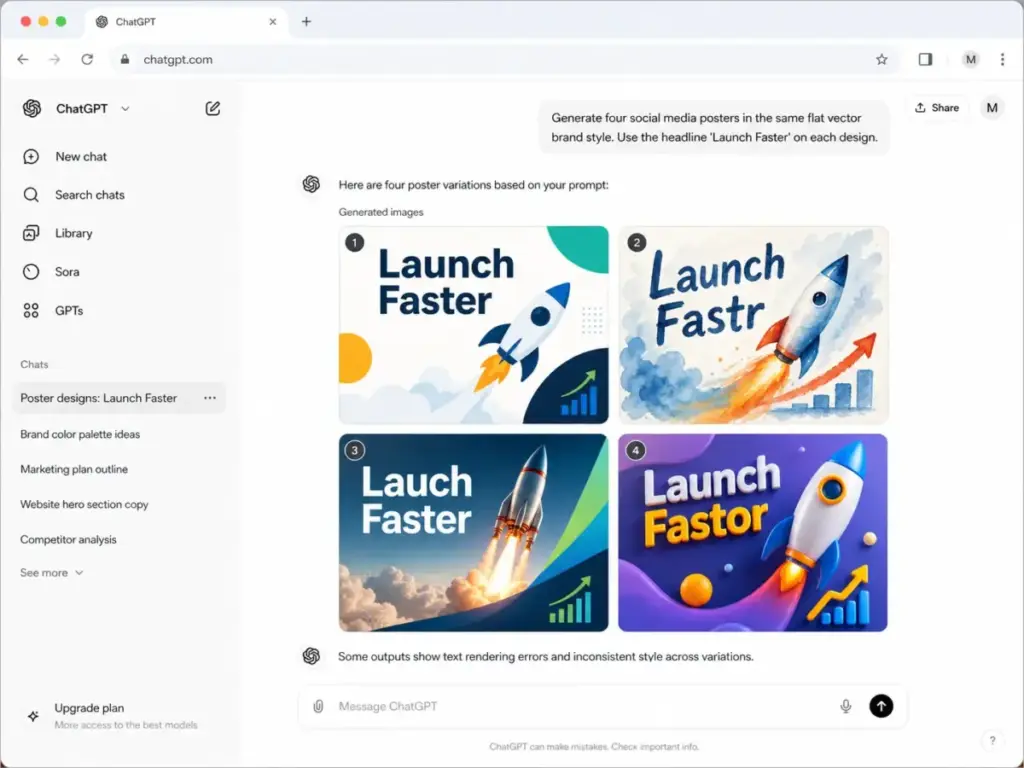
“DALL-E 3 also integrates seamlessly with ChatGPT, allowing users to refine their prompts interactively for better results.”
— Alexander M., Owner of ShadowPlayersDev, GetApp/Capterra verified review snippet
FAQ
Below are the most common questions about DALL·E in 2026, answered directly.
What is DALL·E used for?
DALL·E is used for generating images from text descriptions. Common use cases include social media graphics, blog illustrations, marketing visuals, educational materials, product mockups, and creative brainstorming. It works best for fast ideation and draft-quality visuals rather than production-grade design work.
Is DALL·E free to use?
Yes, partially. ChatGPT Free includes limited and slower image generation. For more access, ChatGPT Plus costs $20/month, and ChatGPT Pro starts at $100/month with 5x more usage than Plus. The DALL·E 3 API charges per image starting at $0.04 for standard 1024×1024 resolution.
How much does DALL·E cost in 2026?
DALL·E costs depend on your access method. ChatGPT Plus is $20/month. ChatGPT Pro is $100/month or $200/month. ChatGPT Business is $25/user/month (monthly) or $20/user/month (annual) with a 2-seat minimum. DALL·E 3 API costs $0.04 to $0.12 per image depending on resolution and quality. GPT Image 2 ranges from $0.006 to $0.211 per image at 1024×1024.
Is DALL·E included with ChatGPT Plus?
Yes. ChatGPT Plus ($20/month) includes image generation with more complex and accurate output plus image generation with Thinking. The exact number of images per session or per month is not specified as a fixed limit.
Can I use DALL·E images commercially?
Yes. OpenAI states that images created with DALL·E are the user’s to use. You do not need OpenAI’s permission to reprint, sell, or merchandise them. There is no attribution requirement or revenue-sharing obligation.
Is DALL·E better than Midjourney?
DALL·E is better for accessibility and conversational workflow. Midjourney is better for artistic quality, photorealism, and style consistency. If you prioritize ease of use and ChatGPT integration, choose DALL·E. If you prioritize visual quality and aesthetic control, choose Midjourney (starting at $10/month).
What are the best DALL·E alternatives in 2026?
The five strongest DALL·E alternatives are Midjourney (artistic quality, from $10/month), Adobe Firefly (brand-safe assets, from $9.99/month), Leonardo AI (creative asset variety, free tier available), Stable Diffusion (open-source customization, $0.01/credit), and Canva AI (easiest design workflow for non-designers). The best alternative depends on your workflow, budget, and quality requirements.
Does DALL·E have an API?
Yes. OpenAI offers two API approaches: the Image API for single-prompt generation and the Responses API for conversational, multi-step image workflows. DALL·E 3 uses per-image pricing. Newer GPT Image models use token-based pricing. API data is not used for training unless opted in.
What are DALL·E's biggest limitations?
DALL·E’s primary limitations are: prompt rewriting that removes precise control, dynamic usage limits that are not specified as exact numbers, inconsistent style across multiple generations, content policy refusals for public figures and living artist styles, weaker photorealism than Midjourney, and no style-locking mechanism for brand consistency.
Is DALL·E safe for enterprise use?
DALL·E offers enterprise-relevant features: full commercial-use rights, API data not used for training unless opted in, and ChatGPT Enterprise with custom pricing. However, it lacks native compliance workflows, audit trails, and content approval features that regulated industries may require. Abuse monitoring logs are retained up to 30 days by default.
Why does DALL·E rewrite my prompt?
OpenAI designed DALL·E 3 to rewrite prompts before image generation. This improves results for casual users by adding detail and clarity. The trade-off is that experienced users lose exact control over their compositional instructions. There is no option to disable prompt rewriting in the standard DALL·E 3 workflow.
Is DALL·E worth it in 2026?
DALL·E is worth it for users who value ChatGPT integration, natural language prompting, and fast visual drafts. It is the best entry point for non-designers and small teams. It is not worth it for users who need consistent style across batch output, photorealistic quality matching Midjourney, or predictable high-volume pricing. At $20/month for ChatGPT Plus or $0.04/image via the DALL·E 3 API, the pricing is competitive for moderate usage. This DALL·E review scores the tool 8.4/10, reflecting strong accessibility with meaningful control and consistency gaps that matter for production workflows.