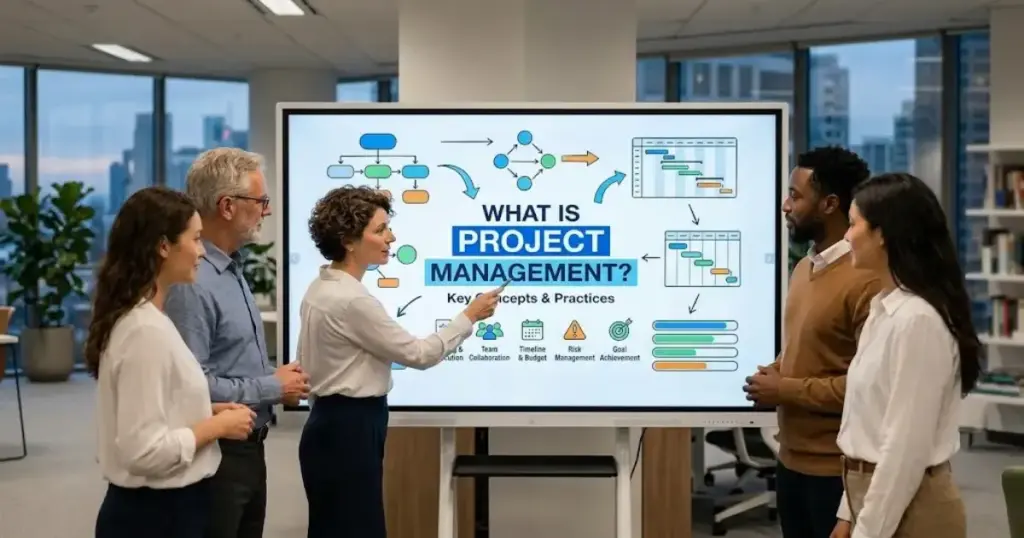
Work breaks down when nobody knows who owns the outcome, what the deadline is, or what “done” actually means. Project management is the discipline of turning a goal into scoped work with assigned owners, defined timelines, tracked risks, and measurable delivery.
If your team is already comparing platforms, our guide to best project management software covers the tools in detail. This guide covers the concept itself: what project management is, how it works across team sizes and industries, which methods fit which teams, and when adding formal PM structure creates more overhead than value.
What Is Project Management?
Project management is the practice of applying knowledge, skills, tools, and techniques to project activities to meet project requirements. That is the official definition from the Project Management Institute, and it holds up in practice. The key word in every definition is “project”: a temporary endeavor with a unique deliverable, a start date, and an end condition. Running payroll every month is an operation. Building the payroll system is a project.
That boundary matters. Operations management handles recurring, predictable work. Project management handles work that is bounded, uncertain, and cross-functional. Without that distinction, teams apply the wrong tools to the wrong problems.
Atlassian defines project management as applying specific skills and tools to plan, execute, and monitor work within defined constraints. Those constraints are the triangle most project managers know: scope, time, and cost. Change one corner and you affect the others.
Project management gives temporary work a structure: a defined scope, a decision owner, a budget boundary, a risk register, milestones, and a process for tracking progress. Without that structure, teams drift. Scope grows without accountability. Deadlines shift without anyone flagging the cost. Deliverables arrive incomplete because nobody agreed on what “done” meant.
Project Management vs Task Management vs Product Management vs Operations
| Concept | What It Manages | Time Horizon | Primary Output | Typical Failure Mode |
|---|---|---|---|---|
| Task management | Individual actions and to-dos | Days to weeks | Completed tasks | Tasks finish but outcomes miss |
| Project management | Scoped, time-bounded deliverables | Weeks to months | Defined deliverable with sign-off | Over-planning delays execution |
| Product management | Product roadmap and user outcomes | Quarters to years | Product strategy and feature releases | Roadmap disconnected from delivery |
| Operations management | Repeatable ongoing processes | Ongoing | Throughput, SLA compliance | No improvement loop, process stagnates |
A two-person team running a content calendar does not need project management. They need task management and a clear editorial schedule. A team of eight launching a product with dependencies across engineering, design, legal, and marketing needs project management: a defined scope, a named decision owner, a risk register, and a status cadence that surfaces problems before they become failures.
This distinction is what most beginner guides miss. Project management is not a tool category. It is an accountability system applied to temporary, cross-functional work.
How Does Project Management Work?
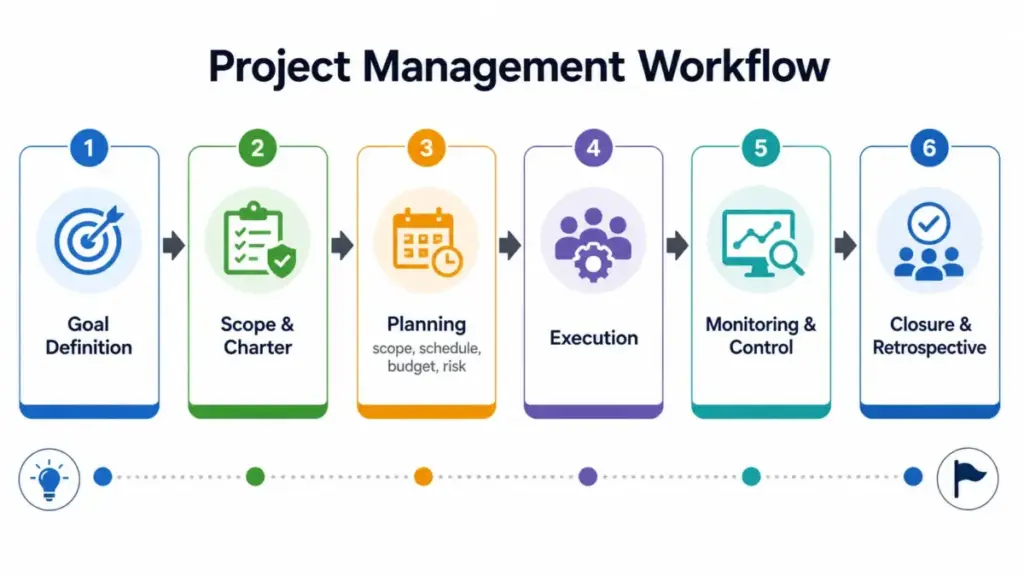
Project management converts an ambiguous goal into a set of structured decisions about scope, ownership, constraints, and delivery. It does not start with a task list. It starts with questions: What specific outcome are we committing to? Who owns the decision when something changes? What constraints are non-negotiable? From those answers, a project manager builds the plan, assigns owners, sequences dependencies, tracks execution, manages changes, and closes out with documented lessons.
The work is not linear. Scope changes. Resources shift. Risks materialize. The project manager surfaces those changes quickly, brings them to the right decision-maker, and adjusts the plan. A project plan is not a promise. It is a living agreement between the team and stakeholders about what will be delivered, when, and at what cost.
What the Five Phases of Project Management Look Like in Practice
Most frameworks, including the PMBOK guide published by PMI, organize projects into five phases. Each phase has a core question the team must answer, a key output, and a common failure mode when teams rush or skip it.
| Phase | Core Question | Key Output | Common Failure |
|---|---|---|---|
| Initiation | Should we do this project? | Project charter, stakeholder list | No defined sponsor or success metric |
| Planning | How will we deliver it? | Scope, schedule, budget, risk register | Tasks assigned before constraints are defined |
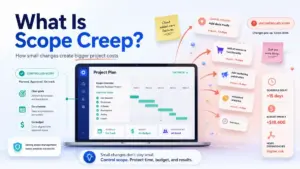
| Execution | Are we building the right thing? | Deliverables, change requests, status updates | Scope creep with no change control |
| Monitoring & Control | Are we on track? | Variance reports, risk log updates | Status reported but no decision follows |
| Closure | Did we deliver? What did we learn? | Acceptance sign-off, lessons learned | Team moves on before closure is formalized |
Initiation: Define Before You Plan
Initiation answers one question: is this project worth doing, and do we have the authority and resources to proceed? The output is a project charter naming the objective, the sponsor, the constraints, and the definition of done. Many teams skip this step entirely and go straight to a task list. That is where scope confusion starts.
Planning: Constraints Before Tasks
Planning translates the project charter into a work breakdown structure, a schedule, a resource plan, a budget estimate, and a risk register. The planning phase does not mean the plan is fixed. It means the team has a shared baseline to measure against. Changes from that baseline require an explicit decision, not a silent adjustment.
Execution: Coordination Over Control
Execution is where the team builds deliverables. The project manager’s role shifts to coordination: clearing blockers, managing scope change requests, and keeping stakeholders informed. Execution without active monitoring is the fastest path to a project that finishes late and over budget.
Monitoring and Control: Status That Drives Decisions
Monitoring and control run in parallel with execution. The project manager tracks actual progress against the baseline, flags variances, updates the risk log, and escalates decisions that exceed their authority. Wellingtone’s State of Project Management research found that 42% of respondents spend one or more days per week manually collating project reports. That is reporting overhead, not project management value.
Closure: The Step Most Teams Skip
Closure formalizes the end of the project. The sponsor or client accepts the deliverable, the team documents lessons learned, resources are released, and the project is officially closed. Skipping closure means the next similar project starts without the institutional knowledge the current one produced. That is a compounding cost, not a one-time shortcut.
Project Management vs Task Management
Task management tracks units of work. Project management coordinates outcomes, constraints, dependencies, and stakeholders. This is the distinction most teams miss when they adopt a tool without thinking about what they actually need. A task list tells you what to do. A project structure tells you why it matters, who decides when it changes, and what happens if the deadline moves.
The confusion is common. A Reddit user in r/projectmanagement asked: “How do I learn how to manage projects as someone with very little inherent project management skills?” That question reflects a genuine gap: many people managing projects have only ever used task tools and assume that is the same discipline. It is not. Managing tasks is about personal productivity. Managing projects is about coordinating outcomes across people with competing priorities and limited resources.
The practical threshold: if work involves more than one person, a hard deadline with external accountability, and a risk of scope or resource conflict, you need project management. If it is one person’s to-do list with no external dependency, task management is the right tool. For that lighter case, Todoist app alternatives fit better than PM suites.
For teams choosing between project management and adjacent SaaS categories, our guide to SaaS tools explains how these platforms sit within a broader software stack, and where CRM software covers a different workflow layer (customer relationships rather than project delivery).
Types of Project Management Methods
Project management methods differ by how much structure they impose and how well they handle uncertainty and change. The right method depends on your team’s work type, how fixed the scope is, and how often requirements shift. No single method is universally correct. PMI’s Pulse of the Profession 2024 found a 57% increase in hybrid approaches, which reflects teams adapting methods to context rather than following one framework rigidly.
The matrix below maps methods to team types. Use it as a starting point, not a rule. Real teams almost always blend elements from more than one approach.
| Method | Best Team Type | Scope Flexibility | Not Recommended For |
|---|---|---|---|
| Waterfall | Construction, compliance, large IT rollouts | Low (fixed scope) | Discovery work, evolving requirements |
| Agile | Product teams, software development | High | Fixed-budget client contracts with defined specs |
| Scrum | Software teams with sprint cadence | Medium-High | Operations teams, solo operators |
| Kanban | Support, ops, marketing, maintenance | High (continuous flow) | Projects with hard sequential milestones |
| Hybrid | Agency, SaaS, enterprise cross-functional | Medium | Teams that need one pure framework for certification |
| Critical Path | Event planning, infrastructure, ERP rollouts | Low | Iterative product work |
| PRINCE2 | Government, enterprise, regulated industries | Low-Medium | Small startup or agency teams |
Waterfall Project Management
Waterfall organizes work into sequential phases where each phase must complete before the next begins. Scope is defined upfront and changes are costly to absorb. Waterfall works when requirements are stable and the delivery sequence is predictable. It fails when the client or team discovers requirements as they build, which is most software and product work.
Agile Project Management
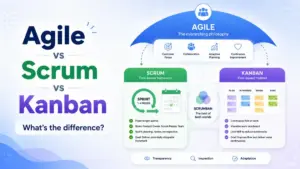
Agile values working deliverables, customer collaboration, and responding to change over following a fixed plan. It is not a single method; it is a set of values that frameworks like Scrum, Kanban, and SAFe implement differently. Agile fits teams building products where the right answer emerges through iteration rather than upfront specification. It does not fit fixed-budget client contracts where the client expects to pay a set price for a defined output.
Scrum
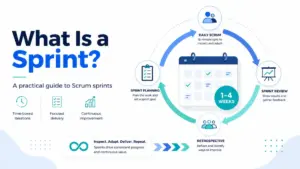
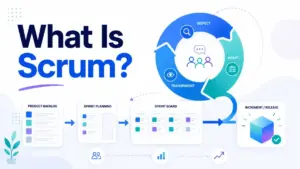
Scrum structures Agile delivery into fixed-length sprints, typically two weeks, with defined roles (Product Owner, Scrum Master, Development Team) and ceremonies (sprint planning, daily standup, sprint review, retrospective). Scrum is the most widely adopted Agile framework in software development. It requires consistent team availability and a maintained, prioritized backlog to function. Teams that call their weekly meeting a “standup” without maintaining a backlog or a definition of done are not running Scrum. They are running meetings with Agile vocabulary.
Kanban
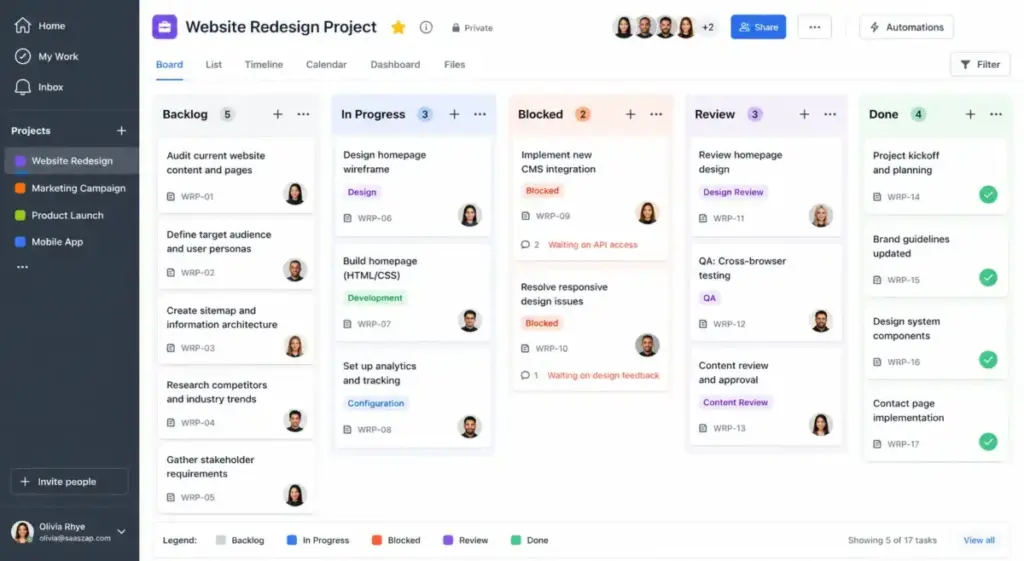
Kanban manages work as a continuous flow through visual stages: backlog, in progress, review, and done. Work items are pulled when capacity exists rather than pushed on a fixed schedule. Kanban is the right fit for support queues, marketing content pipelines, and operations teams where work arrives unpredictably and sprint commitments do not apply.
One important clarification: a Kanban board in a tool like Trello is a visual board, not necessarily a full Kanban system. A genuine Kanban implementation tracks work-in-progress limits, cycle time, and flow efficiency, not just card columns. The board is the visible layer; the method requires the discipline underneath it.
Hybrid Project Management
Hybrid combines elements of Waterfall and Agile. A common pattern is Waterfall-style planning for scope, budget, and milestones with Agile-style sprint execution within each phase. This approach fits agency and SaaS teams that need stakeholder-facing predictability on a fixed contract while preserving execution flexibility inside the team. The 57% increase in hybrid approaches reported by PMI in 2024 reflects how most teams in practice are not dogmatic about methods.
Critical Path Method
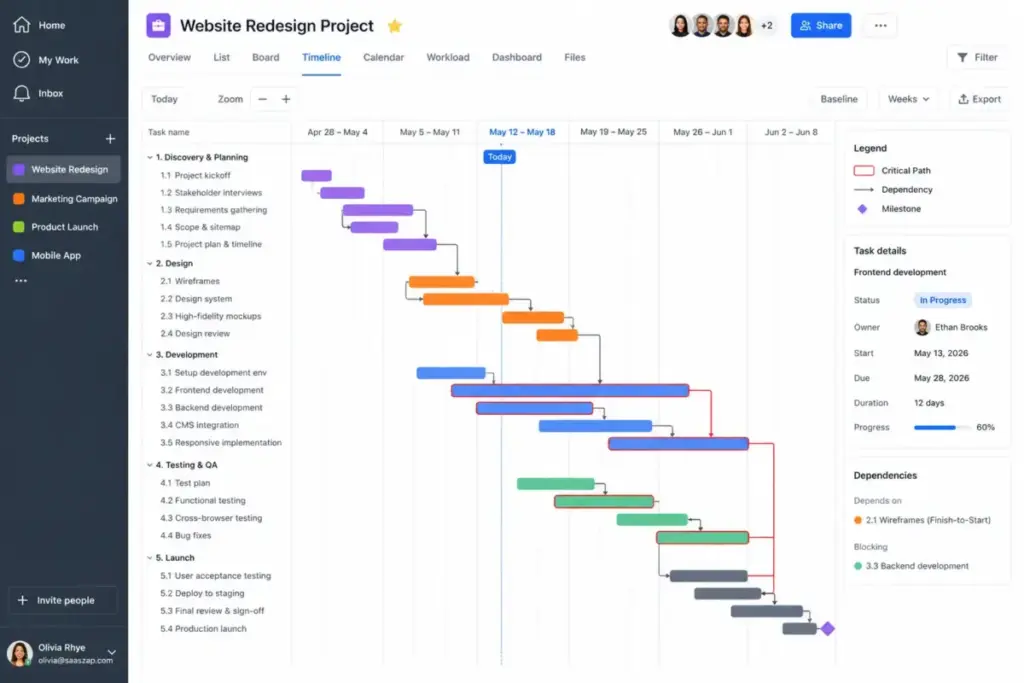
The critical path method identifies the longest sequence of dependent tasks that determines the earliest possible project finish date. Any delay on a critical path task delays the entire project. This method is standard in event planning, infrastructure builds, and enterprise ERP rollouts where task dependencies are complex and hard deadlines are non-negotiable.
Benefits of Project Management
Project management gives teams a shared operating system for work that has stakes, dependencies, and external accountability. The benefits below are specific, not generic claims about “better communication.” Each addresses a real failure mode that appears when complex work is managed without structure.
- Clear ownership: Every deliverable has a named owner, not a team or a shared inbox. Named ownership reduces the need for follow-up meetings because accountability is explicit.
- Earlier deadline visibility: Milestones on a shared timeline make slippage visible early. Teams can course-correct before a deadline is missed, not after a stakeholder asks why it was missed.
- Controlled scope: A defined scope document and a change control process force stakeholders to make an explicit decision before adding work. That decision gets recorded. Without it, scope grows silently.
- Faster risk detection: A maintained risk register surfaces threats before they become delivery problems. Teams that review risks weekly catch issues earlier than teams that surface risks only during retrospectives.
- Better resource tradeoffs: When resource constraints are documented, the team can negotiate tradeoffs (reduce scope, extend timeline, add headcount) before a deadline passes.
- Institutional learning: Projects that close with documented lessons learned build knowledge the next team can start from. Without closure documentation, every similar project starts at the same baseline.
PMI’s Pulse of the Profession 2024 reports a 73.8% average project performance rate across respondents, and that 64% of senior leaders say their teams need new technical skills to keep pace with the changing nature of project work. Project management is one of those skills, particularly as AI-assisted planning tools change how teams forecast and track delivery.
Challenges and Limitations of Project Management
Project management is a coordination tool, not a substitute for clear strategy, capable teams, or empowered decision-makers. Teams that adopt PM frameworks without the underlying conditions get process overhead without the coordination benefit. These are honest limitations, not edge cases.
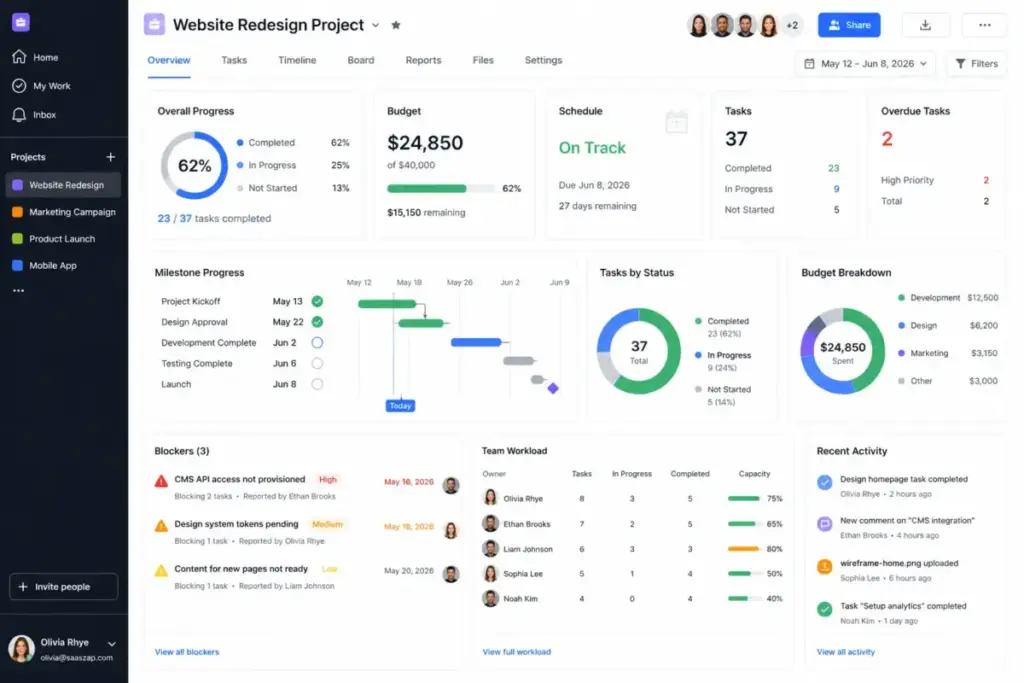
- Reporting overhead is real. Wellingtone’s State of Project Management research found that 42% of respondents spend one or more days per week manually collating project reports. That is time spent describing status rather than delivering work. When status reporting becomes a weekly ritual that produces no decisions, it is pure overhead.
- Tools do not fix unclear ownership. Adding Asana or Jira to a team that cannot agree on who makes decisions surfaces the confusion faster. It does not resolve it.
- Too much process slows small teams. A three-person startup running sprint planning, backlog grooming, daily standups, and sprint retrospectives spends more time on process than delivery. Match process to coordination cost, not to a framework manual.
- Agile vocabulary gets misused. Many teams call their task list a “backlog” and their weekly meeting a “standup” without adopting the decision structures Agile requires: a maintained backlog with priorities, a Product Owner with authority, and a definition of done per sprint.
- Plans decay without update rituals. A plan updated once and never revisited becomes a historical document, not a working tool. Plans require a regular cadence to stay relevant to the work happening now.
- Scope of PM responsibilities is changing. Wellingtone also found that 72% of respondents believe project management scope and responsibilities are changing, driven by remote work, AI-assisted planning, and cross-functional team structures.
When Project Management Does Not Work
Project management fails when leaders use it as reporting theater instead of a decision structure. The symptoms are recognizable: weekly status meetings where problems surface but nobody has the authority to change the plan; dashboards showing red that nobody escalates; scope expanding without a recorded decision. The tool and the framework are both present, but the governance is missing.
This is James Carter’s practical take, not a documented research finding: the biggest PM failure mode is not missed deadlines. It is unclear ownership hidden behind software activity. A tool full of tasks, comments, and status updates creates the appearance of managed work. But if nobody has the authority to say “we are dropping this feature to protect the deadline,” the tool is decoration.
Specific conditions where formal project management creates more overhead than value:
- Teams of 1-2 people: Solo operators and two-person teams need task management and priority alignment, not project governance. The coordination cost of PM ceremonies exceeds the benefit at this scale.
- No named project sponsor: If nobody owns the outcome at the decision-making level, the project manager has nobody to escalate to when scope, time, or budget tradeoffs arise.
- Undefined success metric: A project without a measurable definition of done cannot close. Stakeholders keep requesting changes, and the project expands indefinitely.
- Tool-first rollout: Buying software before defining project governance means the team spends the first two weeks configuring the tool instead of planning the project.
- Operational work misclassified as a project: Running customer support, publishing a weekly newsletter, or processing monthly invoices is operations work. Applying project ceremonies to ongoing operations creates overhead without improving throughput.
For teams under five people, the honest starting point is a shared ownership agreement and a lightweight visual board before introducing any formal PM governance. Add structure when coordination cost outgrows what informal communication can handle.
Best Practices for Project Management
The most effective project management practices reduce coordination cost rather than adding ceremony. Teams that manage projects well share one habit: they make implicit work explicit before the first task is assigned. The list below is both a best-practice framework and a first-week adoption guide for teams new to formal project management.
The First 7 Days of Adopting Project Management
- Day 1: Define the outcome in one sentence. Write what success looks like in a single, measurable sentence. If the team cannot agree on this sentence, the project is not ready to plan. Do not open a tool until this sentence exists.
- Day 2: Name the decision owner. Identify one person with the authority to trade scope against time or cost. That person is the project sponsor. Without a named sponsor, escalations stop at the project manager’s desk.
- Day 3: Write constraints before tasks. Budget ceiling, hard deadline, headcount limit, and non-negotiable requirements go on paper before any work breakdown begins. Tasks should fit the constraints, not the other way around.
- Day 4: Map dependencies. Which deliverable cannot start until another is complete? Which team is blocked waiting for a third party? Dependencies on the critical path require active monitoring, not passive tracking.
- Day 5: Set a status rhythm. Decide once: how often does the team check status, in what format, and who receives it? A weekly async update in a shared document is enough for most business projects. Frequency should match decision speed, not reporting habit.
- Day 6: Open a risk register. A risk register is not a task list. It records what could go wrong, how likely it is, what the impact would be, and who owns the response. Review it every status cycle.
- Day 7: Plan the closure criteria. Before execution begins, define what acceptance looks like. Who signs off? What does the deliverable need to include? What happens to open items after closure? Agreeing on closure criteria at the start prevents scope drift at the end.
These seven steps also function as a mid-project diagnostic. If you are taking over a project already in flight, ask these seven questions in order. The answers reveal where structure is missing.
Project Management in Practice vs Theory
Theory says projects move sequentially through phases. Practice says phases overlap, risks materialize mid-execution, and scope conversations happen continuously. The gap between theory and practice is where most project managers struggle.
In practice, the most valuable project management habit is not running ceremonies. It is creating decision records. When scope changes, write down the decision that authorized it, who made it, and what was traded to absorb the change. When a risk materializes, write down how it was resolved. Those records protect the team in reviews and build the institutional knowledge that makes the next project faster.
A practical SaaS team example: a 10-person SaaS company launches a new pricing page. The project involves product (copy and pricing logic), engineering (front-end build and payment integration), design (layout and brand), and marketing (SEO, launch email, paid media). The project manager defines scope, names the decision owner (Head of Product), maps dependencies (design must sign off before engineering starts, legal must approve pricing language before launch), sets a four-week milestone, and runs a weekly async status update in a shared doc. Engineering finishes the build two days early. Marketing needs three more days for the email sequence. The PM documents the scope change, gets sign-off from the Head of Product, and updates the milestone. The project closes on day 30 with a one-page retrospective. That is project management in a small team without a PMO.
Best Tools for Project Management
Project management software organizes the decisions and deliverables a team has already agreed on. It does not create that agreement. The right tool depends on your team’s size, workflow type, and the complexity of work you manage. Every tool review on SaaS Zap follows a consistent SaaS Zap review methodology so evaluations are comparable across tools. Below, tools are grouped by use case rather than ranked.
Visual Task Boards: Trello
Our Trello review covers its Kanban-first design: cards, lists, and boards that give small teams a fast visual workspace. Trello’s Free plan suits individuals or small teams wanting basic organization. Premium adds timeline, calendar, and dashboard views for teams needing more project visibility. Trello’s limitation is depth: it has no native dependency mapping, no built-in Gantt view in lower tiers, and no resource allocation. It is the right fit for straightforward projects with simple workflows and is not the right fit for cross-functional projects with sequential dependencies.
Trello pricing includes Standard, Premium, and Enterprise tiers, with Atlassian Guard available as a separate security subscription for enterprise controls. Teams that like Trello’s board model but need more control should compare Trello alternatives by dependency mapping, Gantt access, resource allocation, security add-ons, and whether a simple workflow is becoming a managed project system.
Software and Issue Tracking: Jira
Our Jira review examines its position as the standard for software and technical teams. Jira tracks projects through issues, sprints, backlogs, and release workflows. It is purpose-built for Agile and Scrum teams and integrates deeply with the Atlassian ecosystem (Confluence, Bitbucket, Loom).
The limitation for non-technical teams: Jira’s issue-centric model and sprint terminology create a learning curve for teams not already working in Agile. For teams evaluating Jira’s cost structure, the Jira pricing page maps the current tier breakdown. Teams that need software delivery structure but not Jira’s full Atlassian model should compare Jira alternatives by issue tracking, sprint planning, release workflows, stakeholder visibility, and how much Agile terminology the team can support.
Cross-Functional Project Planning: Asana
Our Asana review covers its core use case: cross-functional project work with multiple stakeholders, dependencies, and timeline views. Asana’s timeline view maps tasks against a Gantt-style calendar, making it practical for teams that need to communicate milestones to non-technical stakeholders. Asana offers project, task, goals, reporting, and portfolio work-management features across its plans. One cost note: the Timesheets and Budgets add-on costs extra on top of the base plan. Factor that in if budget tracking is a core requirement. For tier details, the Asana pricing page covers the current structure.
All-in-One Workspace: ClickUp
Our ClickUp review details its strength: a broad work hub supporting list, board, timeline, calendar, and Gantt views in a single workspace. ClickUp’s Unlimited plan is priced at $7 per user per month billed yearly; Business is $12 per user per month billed yearly, per ClickUp’s official pricing page. The tradeoff is setup time. ClickUp’s flexibility means more configuration choices upfront, which can slow onboarding for teams that need a tool running in a day.
ClickUp’s billing also varies by feature usage, add-ons, and invited people, so total cost at scale can exceed the base per-seat figure. For full cost details, the ClickUp pricing breakdown covers current plans and add-on costs. For teams that need an all-in-one workspace but worry about setup time, compare ClickUp alternatives by workflow maturity, onboarding speed, pricing predictability, and how much configuration the team can realistically maintain.
Flexible Work Management: monday.com
monday.com supports project, portfolio, and operations work in a highly configurable interface. Its automations and integrations layer makes it practical for teams managing recurring project types (client onboarding, campaign delivery, product launches) where repeatable workflows save setup time. monday.com’s automation and integration usage is subject to action limits by plan, which affects teams with high-volume workflows.
Enterprise Portfolio and Reporting: Wrike and Smartsheet
Wrike and Smartsheet both target operations-heavy project and portfolio work at larger team sizes. Smartsheet uses a spreadsheet-style interface familiar to finance and operations teams managing large project portfolios. Wrike provides request forms, time tracking, and approval workflows suited for marketing and creative operations teams.
Both are heavier tools with steeper per-seat costs than Trello or Asana, and both require meaningful setup before returning value. For budget-conscious teams at any size, the guide to best free project management software covers the strongest no-cost options available in 2026. If that heavier setup is a concern, compare Smartsheet alternatives before choosing a portfolio tool.
Tool Recommendation Matrix by Team Need
| Team Type | Recommended Tool | Key Reason | Watch Out For |
|---|---|---|---|
| Solo or 2-person team | Trello or Notion | Fast setup, visual, low overhead | No dependency tracking |
| Small business (3-10) | Asana or ClickUp | Timeline views, ownership, integrations | Add-on costs at scale |
| Software dev team | Jira | Sprint tracking, issue linking, Agile native | Learning curve for non-technical members |
| Marketing or agency | monday.com or Asana | Campaign templates, timeline, client view | Automation limits on lower plans |
| Enterprise PMO | Wrike or Smartsheet | Portfolio views, resource management, reporting | High per-seat cost, long implementation |
| Ops or support team | Trello or Kanban in ClickUp | Continuous flow, no sprint required | Not built for milestone tracking |
One hidden cost applies to all tools: seat pricing, guest access limitations, automations, storage caps, and security add-ons often push total cost above the base per-seat figure. Before committing to a platform, map your actual usage against the plan tier, not the marketing headline.
James Carter’s Quick Take
Project management is not making a perfect plan. It is creating a shared operating system for uncertain work. When a project goes sideways, the failure is almost never that someone did not work hard enough. The failure is usually one of four things: nobody agreed on what “done” meant; the person responsible for a decision did not know they were responsible; a risk everyone could see never got escalated; or the scope grew without anyone recording the decision to grow it.
Project management fixes all four. It gives the team one place where scope is written down, one person with authority to make tradeoff decisions, one register for risks with named owners, and one rhythm for surfacing problems before they become crises.
You do not need a PMP certification to manage projects well. You need a clear outcome, a named decision-maker, constraints written before tasks, and a habit of updating the plan when reality diverges from it. That is the whole system. The tools support the system. They do not replace it.
My practical threshold for when a team needs project management: more than two people, a hard deadline with external accountability, and work that depends on decisions made by more than one function. Below that threshold, a shared task list and a weekly priorities conversation is enough. Above it, invest in structure early. It is always cheaper to define scope before execution than to renegotiate it mid-project.
Project Management FAQs
Direct answers to the most common questions about project management, project planning, and project delivery.
What is project management in simple words?
Project management is the practice of turning a goal into structured work with defined scope, owners, timelines, risks, and a measurable definition of done. It is a system for making decisions when things change, and they always do.
What are the five phases of project management?
The five phases are initiation, planning, execution, monitoring and control, and closure. Initiation defines whether the project should happen and who owns it. Planning defines how it will be delivered. Execution builds the deliverables. Monitoring and control tracks progress against the plan. Closure formalizes the outcome and captures lessons learned.
What does a project manager actually do?
A project manager defines scope, assigns ownership, sequences dependencies, tracks risks, manages change requests, runs status updates, escalates decisions, and closes the project formally. The role is fundamentally about keeping the team aligned on what is being delivered and surfacing problems before they become failures.
What is the difference between project management and task management?
Task management tracks individual actions: what to do, by when, by whom. Project management coordinates outcomes across people: scope, milestones, risks, dependencies, stakeholders, and budget. Task management is what happens inside a project. Project management is the system that connects those tasks to a deliverable with accountability and a clear definition of done.
What is the difference between project management and product management?
Product management owns the product roadmap and user outcomes over a long time horizon, often quarters to years. Project management delivers a specific, time-bounded output. A product manager decides what to build and why. A project manager coordinates how it gets built and by when. In many organizations, the same person handles both roles, which creates scope and priority conflicts worth naming explicitly.
What are examples of project management in business?
Common examples include a SaaS product launch (scoping features, assigning cross-functional owners, tracking a release milestone), a website redesign (mapping dependencies across design, copy, development, and QA), a marketing campaign (coordinating paid media, email, landing page, and analytics deliverables), a software migration (managing cutover timing, data integrity, and rollback criteria), and a customer onboarding system build (defining the playbook, automation, and owner assignments).
Why is project management important?
Project management matters because complex work fails predictably without it. Scope grows without a decision record. Deadlines slip without visible escalation. Deliverables miss because nobody agreed on the definition of done. PMI’s Pulse of the Profession 2024 reports a 73.8% average project performance rate across respondents, which means roughly one in four projects is not meeting its original goals. Structured project management is the primary lever teams have to move that number.
What are the main project management methods?
The main methods are Waterfall (sequential, fixed scope), Agile (iterative, flexible), Scrum (sprint-based Agile framework), Kanban (continuous flow), Hybrid (Waterfall planning with Agile execution), and Critical Path Method (dependency-sequenced scheduling). PRINCE2 is common in government and regulated industries. The right method depends on how stable requirements are and how the team delivers work.
What is Agile project management?
Agile project management applies the Agile values (working deliverables over documentation, customer collaboration over contract negotiation, responding to change over following a fixed plan) to project delivery. In practice, most Agile teams use Scrum or Kanban as their implementation framework. Agile fits teams building products where the right answer emerges through iteration, not upfront specification.
What skills does a project manager need?
The most important skills are scope definition, stakeholder communication, risk identification, dependency mapping, and decision facilitation. Business acumen (connecting delivery choices to business outcomes) is increasingly relevant. PMI’s Pulse of the Profession 2024 found that 64% of senior leaders say their teams need new technical skills, which reflects how AI-assisted planning and remote coordination are changing what project management requires in practice.
Do small teams need project management software?
Small teams need project management software when their work has dependencies across more than one person, a hard deadline with external accountability, and a risk of scope conflict. A two-person team with aligned priorities and a shared task list does not need a dedicated project tool.
What is the best project management tool for beginners?
Trello is the lowest barrier to entry for visual project tracking. Asana is the better step up once a team needs timeline views, dependencies, and cross-functional ownership. ClickUp offers the broadest feature set but requires more configuration time. The right starting point depends on team size and workflow type, not on which tool has the most features.
Key Takeaways
- Project management is the discipline of turning a goal into scoped, time-bounded work with named owners, defined constraints, tracked risks, and a measurable definition of done. It applies to temporary, cross-functional work, not ongoing operations.
- The five phases of the project lifecycle are initiation, planning, execution, monitoring and control, and closure. Skipping initiation creates undefined scope. Skipping closure destroys institutional knowledge.
- Project management, task management, product management, and operations management are four distinct disciplines. Applying the wrong one to a given work type creates overhead without benefit.
- Method choice depends on scope stability. Waterfall fits fixed-scope sequential work. Agile and Scrum fit iterative product delivery. Kanban fits continuous flow work. Hybrid, which now accounts for the majority of real-world PM approaches per PMI’s 2024 data, fits cross-functional business projects.
- The biggest project management failure mode is unclear ownership hidden behind software activity. A tool full of tasks and updates is not the same as a team with a named decision-maker and a documented scope.
- Project management software organizes decisions; it does not make them. Define scope, ownership, and governance before choosing a tool. Configuration work is not the same as project planning.
- The first seven steps for any new project: define the outcome in one sentence, name the decision owner, write constraints before tasks, map dependencies, set a status rhythm, open a risk register, and define closure criteria before execution begins.
- Teams of one to two people need task management. Teams of three or more with external deadlines and cross-functional dependencies need project management. Add structure when coordination cost outgrows informal communication.