Asana costs nothing for a team of up to 10. That is genuinely free, no asterisk. The pain starts at user 11 or when anyone needs the Timeline view. Suddenly you are on Starter at $10.99/user/month (as of May 2026), paying $109.90 every month for a tool the team was using for free last week. I have seen managers freeze headcount just to avoid the billing jump.
That is not a pricing decision. That is a product dictating your org chart.
Finding the best project management software options to replace Asana is not about chasing a longer feature list. It is about identifying the exact tool that resolves the friction pushing you out, whether that is the steep per-seat cost or the constant notification noise.
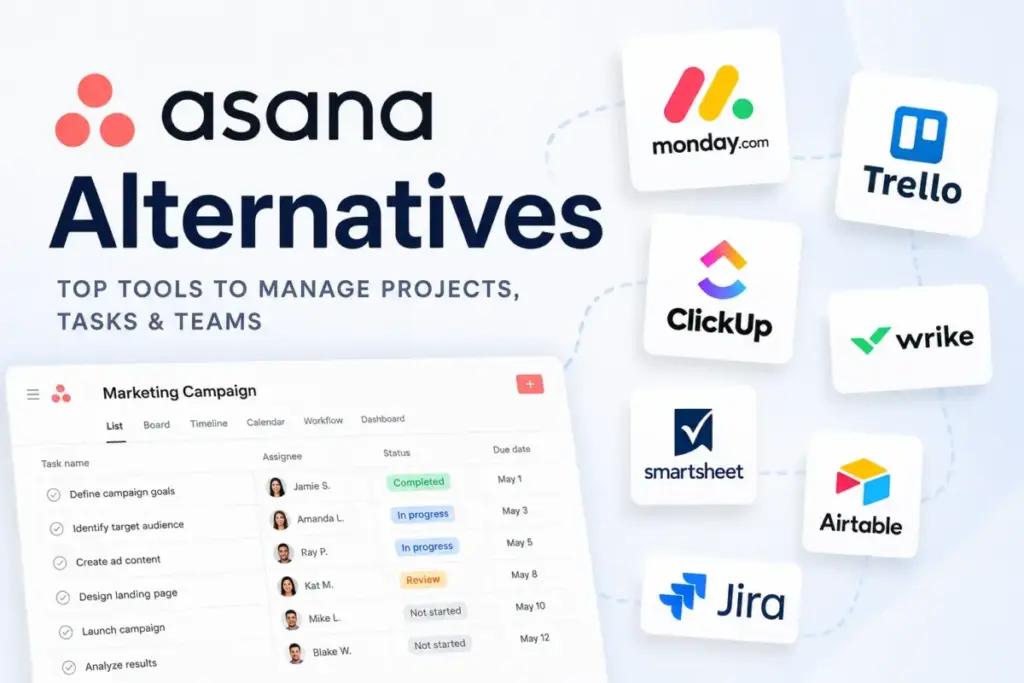
Before rushing into a migration, stepping back to define exactly what project management is for your specific workflow will save you from buying another wrong tool. After reviewing 35+ collaboration platforms, I have learned that the right alternative depends entirely on your failure mode. This guide compares 10 replacements by their switching triggers, actual cost at scale, and how hard they are to deploy.
Quick Verdict: Best Asana Alternatives by Switching Trigger
The table below maps the best Asana replacement to the primary reason your team is leaving.
| If you are leaving Asana because… | Best alternative | Why |
|---|---|---|
| Pricing gets expensive at scale | ClickUp | Lower entry pricing with native time tracking |
| Notification noise is too high | Basecamp | Clean message boards and simple inbox controls |
| You need deeper customization | monday work management | Flexible board-first layout and visual dashboards |
| You run database-style operations | Smartsheet | Spreadsheet-native grid views and cell formulas |
| You need developer-centric planning | Jira | Purpose-built Scrum/Kanban boards and sprint tools |
| You do client work and billing | Teamwork.com | Built-in billable hours, budgets, and free client seats |
| You want to consolidate wikis and docs | Notion | Document-first workspace with database connections |
What this means:
If you are moving away from Asana, your choice should align with your primary operational bottleneck. Teams seeking pure cost relief often look to ClickUp or Trello, while agencies focus on Teamwork.com for client-facing features.
If you struggle with coordination across departments, monday work management provides the most flexible visual workspace. If ClickUp is the leading candidate for cost relief, compare ClickUp alternatives by setup complexity, native docs, time tracking, automation limits, and whether a simpler PM tool solves the same Asana pain with less governance.
The Asana Problem Map
While Asana remains a strong choice for structured task collaboration, teams often look for alternatives when they hit these major friction points:
- The Seat-Purchase Escalation: Asana’s paid plans are billed per user. As teams grow, the difference between a free tier and a paid tier becomes a major budget item. Our analysis of the Asana pricing guide reveals how quickly costs climb when you add user seats.
- Notification Noise: Review patterns on Capterra frequently flag Asana’s notification settings as a major point of confusion. Teams spend too much time filtering updates rather than doing work.
- Automation Ceilings: Starter plans restrict the complexity and volume of workflow rules. If you need multi-step logic, you must pay for the Advanced tier.
- Ecosystem Gaps: Agencies and professional services firms often miss native time tracking, invoicing, and client profitability reporting. This requires buying third-party add-ons.
- Agile Limits: Software developers often find that Asana lacks the deep Scrum reporting, release management, and code repository integrations they require.
For a deeper look at these limitations, you can check our detailed Asana review which breaks down the platform’s core task structure.
Alternatives That Fix Cost at Scale
These tools provide budget relief for teams that find Asana’s per-user pricing too high for their current headcounts.
ClickUp: Best all-in-one replacement for customization

ClickUp positions itself as the single app to replace all others, offering tasks, docs, whiteboards, goals, and chat in one workspace. For teams leaving Asana, the primary draw is the visual flexibility combined with lower pricing.
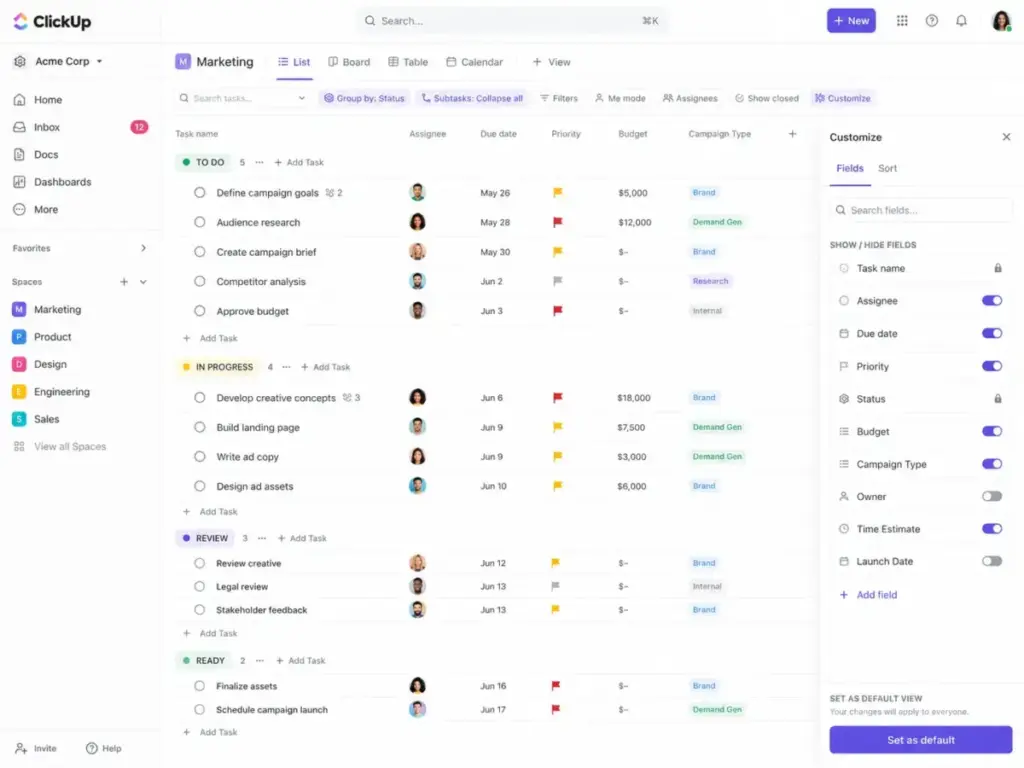
The Unlimited plan costs $7 per user/month billed annually, which is 36% cheaper than Asana Starter ($7/month versus $10.99/month). The Unlimited tier includes native time tracking, custom fields, and unlimited tasks. However, the sheer volume of options can make the initial setup feel cluttered. We analyzed this in our ClickUp cost analysis to see how the tiers compare.
- What it does better than Asana: Includes native time tracking, document management, and whiteboards on the Unlimited tier without requiring external integrations.
- What it does worse than Asana: The interface can feel slower, and the setup requires more administrative work due to the number of customizable parameters.
- Avoid if: Your team wants a simple task list and lacks the time to configure a complex workspace.
- Migration difficulty: Medium. The built-in Asana importer handles tasks and descriptions, but custom fields and permissions require manual reassignment.
Verdict: Choose ClickUp if you want to replace multiple tools (like Asana, Google Docs, and Toggl) under a single, lower-cost billing account. You can read our hands-on ClickUp evaluation to assess its usability under daily load.
Trello: Best lightweight Kanban alternative

Trello uses simple board, list, and card structures to manage work. It is the closest match for teams that only use Asana’s board view and want to skip the complex task hierarchies.
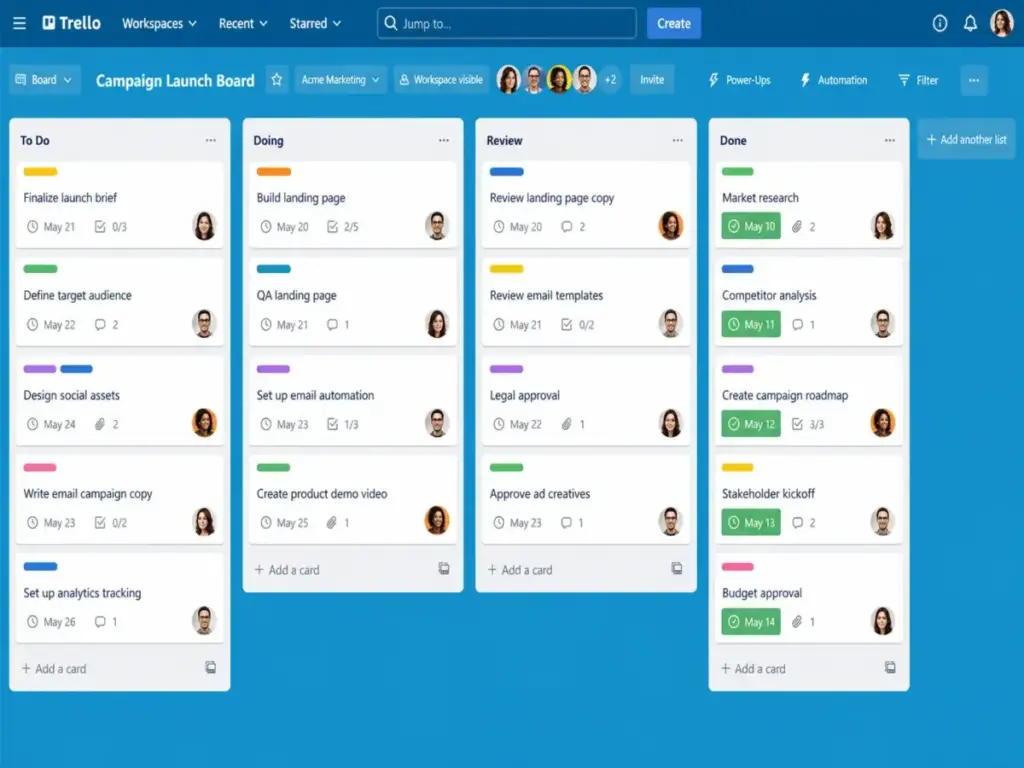
The Standard plan starts at $5 per user/month billed annually. It unlocks unlimited boards, custom fields, and advanced checklists. Trello uses Power-Ups to connect with other services, which keeps the core interface simple. But if your team needs to track task dependencies, Trello’s simple cards will feel too limited. Teams choosing Trello for simplicity should still compare Trello alternatives when dependencies, timeline planning, portfolio reporting, or cross-functional ownership become recurring requirements.
- What it does better than Asana: Faster loading times and a simpler board view that requires almost zero user training.
- What it does worse than Asana: Lacks built-in Gantt charts, workload views, and native portfolio dashboards on Standard.
- Avoid if: Your projects require multi-step task dependencies or cross-project resource planning.
- Migration difficulty: Low. You can export Asana JSON files and upload them to Trello, though card descriptions may lose some formatting.
Verdict: Choose Trello if your team consists of 5 to 10 people who only need simple visual stages to track their daily tasks. Check our Trello software review for a complete breakdown of its board capabilities.
Basecamp: Best simple flat-fee collaboration alternative

Basecamp avoids per-user pricing entirely with its Pro Unlimited plan, which costs $299/month flat (billed annually) for unlimited users. This makes it a popular choice for teams with 20+ users who want predictable software costs.
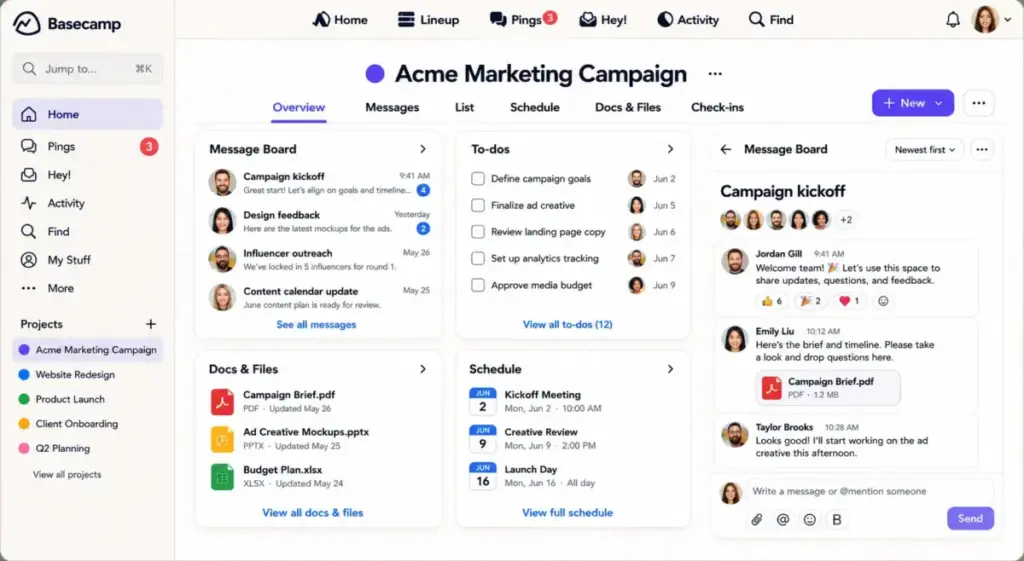
Basecamp consolidates messages, to-do lists, schedules, files, and chat. It is designed around project communication rather than complex database fields. The tradeoff is that you lose the custom fields, table calculations, and Gantt charts that Asana provides. If that tradeoff is too limiting, compare Basecamp alternatives before leaving Asana.
- What it does better than Asana: Predictable flat-rate pricing for large teams and a unified workspace that includes client communication tools.
- What it does worse than Asana: No native Kanban view adjustments, no custom fields, and very basic task dependency settings.
- Avoid if: Your managers depend on Gantt charts, resource allocation reports, or automated task rules.
- Migration difficulty: Low. The text-first structure makes importing files simple, but you will have to rebuild task hierarchies from scratch.
Verdict: Choose Basecamp if your team has more than 15 members and is tired of fluctuating per-user bills and constant email notifications.
Alternatives That Fix Notification Noise and Customization Gaps
These options focus on visual layouts and custom databases for teams that find Asana too rigid or distracting.
monday work management: Best overall visual workflow replacement

monday.com is built around highly customizable tables that let you define different column types, status markers, and board integrations. For teams leaving Asana, it provides a more visual approach to project tracking.
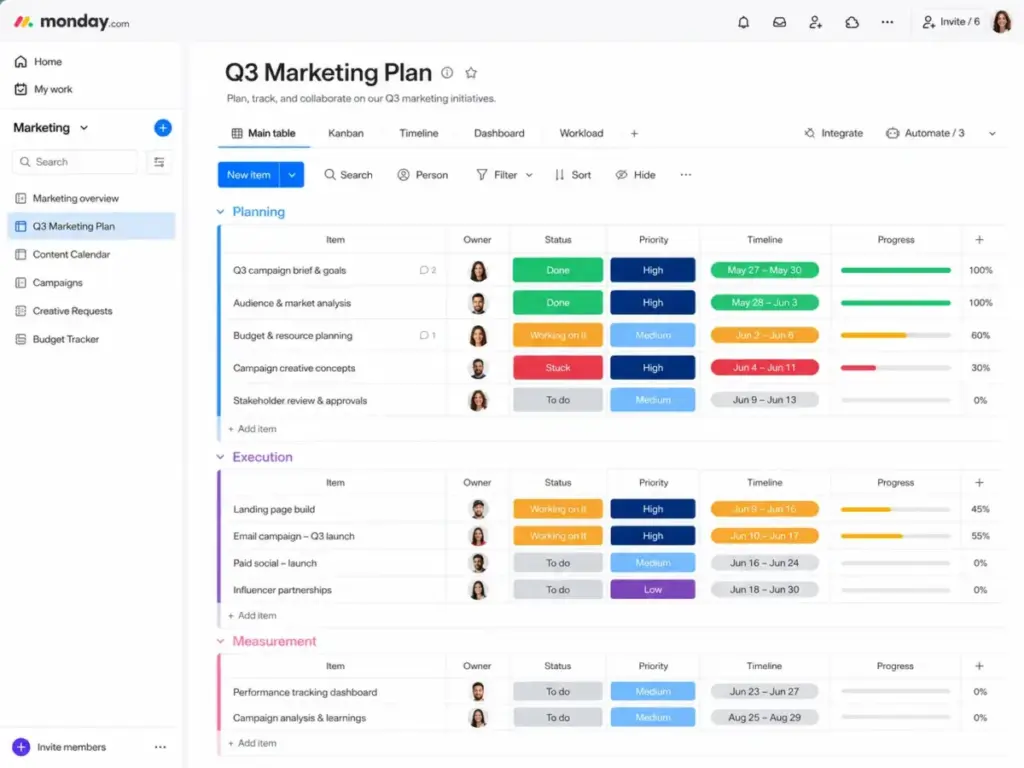
The Standard plan costs $12 per seat/month billed annually. This plan unlocks timeline views, calendar views, and up to 250 automation actions per month. The main drawback is that monday.com sells seats in groups (like 3, 5, 10, or 15), meaning a 4-person team must pay for 5 seats. If you are debating between these two systems, our Asana vs monday.com comparison explains the structural differences in detail.
Teams choosing monday.com as an Asana replacement should compare monday.com alternatives when seat buckets, automation caps, timeline needs, or dashboard expectations change the real cost of visual workflow management.
- What it does better than Asana: More visual dashboard widgets and a board builder that feels closer to a spreadsheet than a task list.
- What it does worse than Asana: Seat-purchasing groups make it expensive for small teams, and automation limits require careful management.
- Avoid if: You have a team of exactly 11 or 16 people and do not want to pay for unused seat blocks.
- Migration difficulty: Medium. The monday.com importer brings over most Asana fields, but complex dependency paths must be remapped manually.
Verdict: Choose monday work management if your projects require custom database fields, visual dashboard metrics, and automation rules that are easy to build.
Wrike: Best for complex cross-team operations

Wrike is designed for mid-market and enterprise departments that require structured intake forms, Gantt charts, and custom dashboards. It focuses on operational visibility across multiple teams.
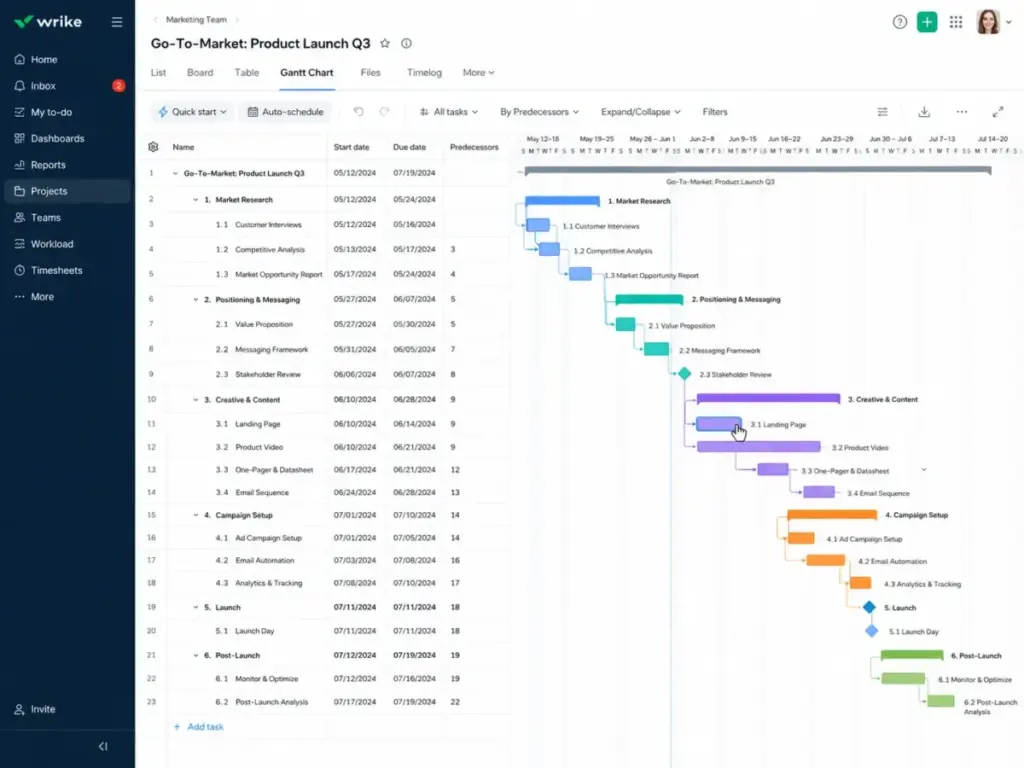
The Team plan starts at $10 per user/month, while the Business plan costs $25 per user/month. Wrike locks its advanced resource management and custom fields behind the Business plan, which makes it an expensive option. The dashboard reports are highly detailed, but the interface takes longer to master.
- What it does better than Asana: Stronger cross-project resource allocation reports and detailed request forms that auto-create tasks.
- What it does worse than Asana: The interface feels corporate and requires a dedicated system administrator for larger setups.
- Avoid if: Your team consists of less than 10 people who need a simple, self-serve project manager.
- Migration difficulty: High. Due to Wrike’s deep folder structure, migration requires careful field mapping and staff retraining.
Verdict: Choose Wrike if you have a marketing or creative operations department of 20+ people who need to manage incoming requests and workload allocation.
Notion: Best docs and wiki-first alternative

Notion connects documents, wikis, meeting notes, and project databases in a single workspace. It is the best alternative for teams that want to store all company knowledge alongside tasks.
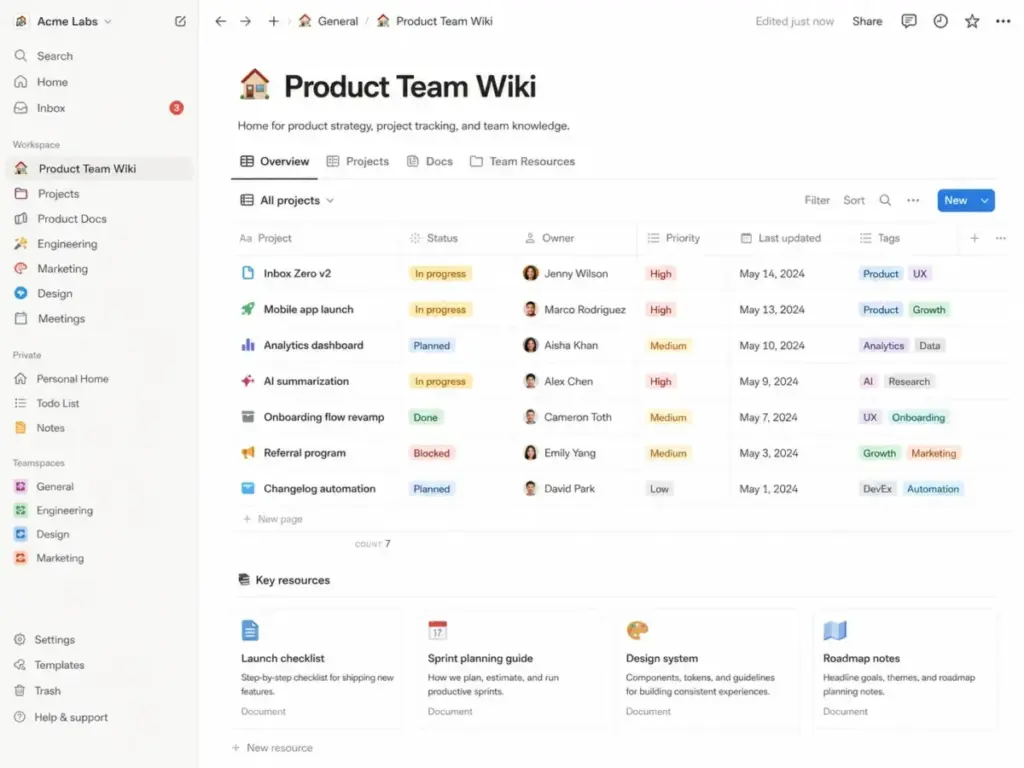
The Plus plan starts at $10 per member/month billed annually. It unlocks unlimited database rows, custom templates, and page history. While Notion is highly flexible, it does not send structured task alerts like Asana. Teams must build their own notification views to keep work on track.
- What it does better than Asana: Combines company wikis and notes directly with project databases, reducing the need for separate doc editors.
- What it does worse than Asana: Lacks out-of-the-box task dependencies, portfolio management tools, and structured alert queues.
- Avoid if: Your team requires automated reminders and strict task due-date controls.
- Migration difficulty: Medium. Notion can import Asana boards, but the resulting pages require formatting cleanup to align with your wiki layout.
Verdict: Choose Notion if you want to build a central knowledge base where tasks are linked directly to project briefs and meeting notes. You can read our Notion tool evaluation to understand how its databases behave.
Alternatives That Fix Database Operations, Dev Workflows, and Client Work
These specialized tools serve teams with workflows that go beyond general task tracking.
Smartsheet: Best spreadsheet-style Asana alternative

Smartsheet uses a grid interface that mimics Microsoft Excel but includes project views, card layouts, and automations. It is built for operations teams that manage projects via data rows.
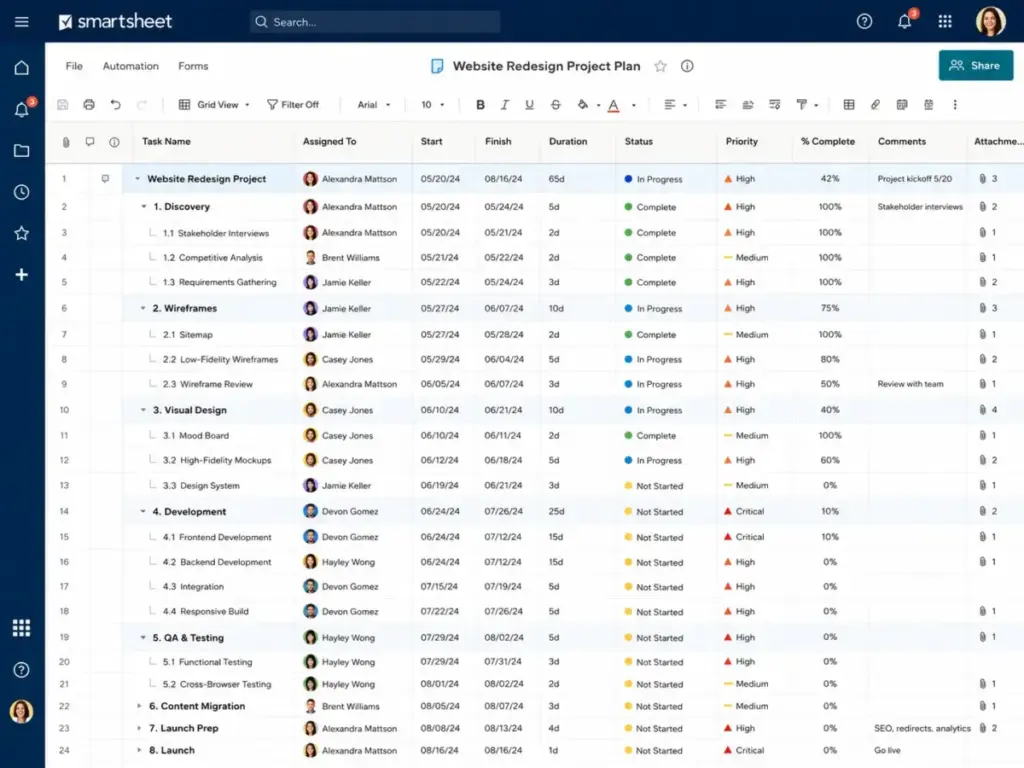
The Pro plan starts at $9 per member/month billed annually, while the Business plan costs $19 per member/month billed annually. Smartsheet allows unlimited free collaborators to view and edit sheets, which helps control costs. The grid handles complex formulas, but it lacks the modern look of Asana’s task lists. If the grid feels too dated, compare Smartsheet alternatives before choosing a spreadsheet-style tool.
- What it does better than Asana: Advanced formulas, cell linking, and spreadsheet calculations that sync across multiple projects.
- What it does worse than Asana: Lacks a simple task-first interface, making it harder for non-technical users to adopt.
- Avoid if: Your team wants a simple drag-and-drop Kanban board for daily tasks.
- Migration difficulty: High. Moving Asana task lists into a grid requires redesigning your sheets and manual field alignment.
Verdict: Choose Smartsheet if your project management is led by PMO managers who rely on spreadsheet formulas, grids, and budget sheets.
Airtable: Best relational database alternative

Airtable is a relational database that lets teams build custom apps, content pipelines, and inventory trackers. It is designed for operations departments that need structured data.
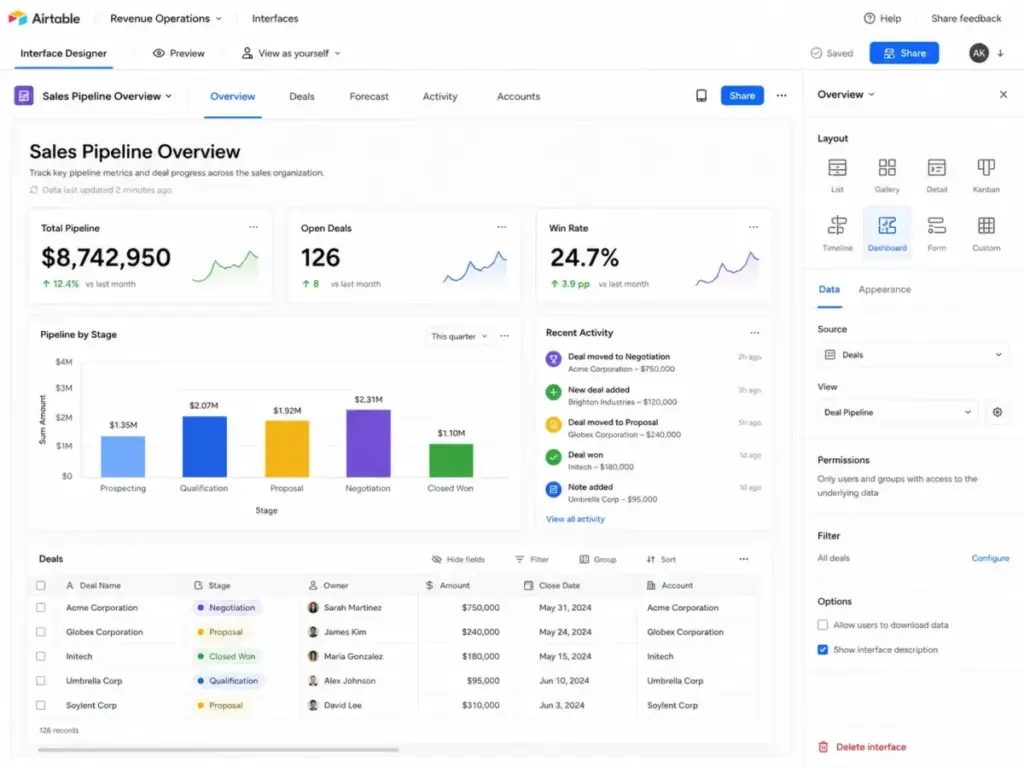
The Team plan costs $20 per seat/month billed annually, which is more expensive than Asana’s entry plans. Airtable’s power lies in its relational database structure. You can link client records directly to tasks, campaigns, and assets. The main tradeoff is that the pricing scale can escalate quickly as your database grows.
- What it does better than Asana: Relational databases that allow you to link records across different tables without duplicating data.
- What it does worse than Asana: The per-seat pricing is high, and the platform has strict record limits per workspace.
- Avoid if: You want a simple to-do list manager that is ready to use right after signing up.
- Migration difficulty: High. Rebuilding a task list into a relational database requires structuring tables and links from scratch.
Verdict: Choose Airtable if your team manages marketing campaigns, content calendars, or product inventory that requires structured relational databases.
Jira: Best for software and Agile teams

Jira is the standard tool for software engineering teams that use Scrum or Kanban frameworks. It focuses on sprint cycles, backlog grooming, and code deployments.
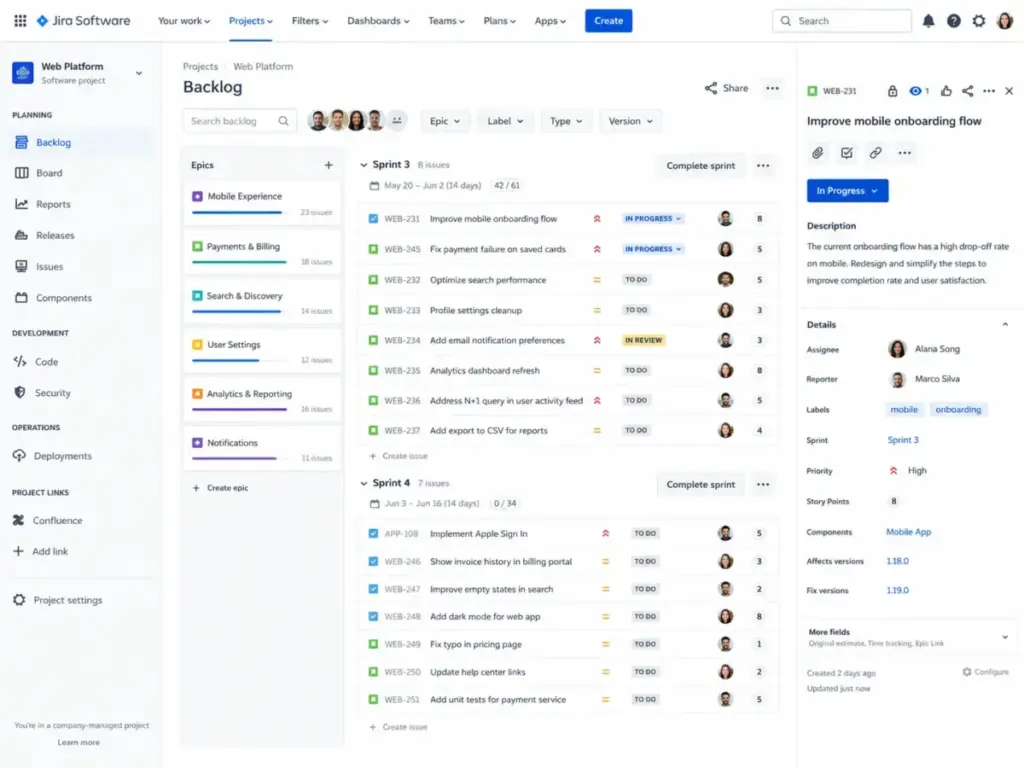
Jira’s Standard plan is available via Atlassian’s pricing calculator. For small teams, Standard is priced around $8.15 per user/month billed annually. Jira includes sprint reports, burn-down charts, and direct integrations with GitHub and GitLab. However, the interface is highly technical and often feels overwhelming for marketing or sales teams. Teams considering Jira mainly for sprint reporting should compare Jira alternatives by developer workflow depth, business-team usability, Git integration, release tracking, and the cost of training non-technical users.
- What it does better than Asana: Dedicated sprint planning tools, release management, and issue tracking built for software developers.
- What it does worse than Asana: The complex interface makes it difficult for non-technical departments to collaborate.
- Avoid if: You are a general operations, creative, or marketing team with no software development workflows.
- Migration difficulty: High. Software teams must map development fields, sprint histories, and epic structures, which requires technical planning.
Verdict: Choose Jira if you are a software development team that needs to manage sprints, releases, and codebase issues. For more details on licensing, check our Jira pricing breakdown.
Teamwork.com: Best Asana alternative for agencies

Teamwork.com is built specifically for client services, agencies, and professional services teams. It focuses on billable hours, project margins, and client access.
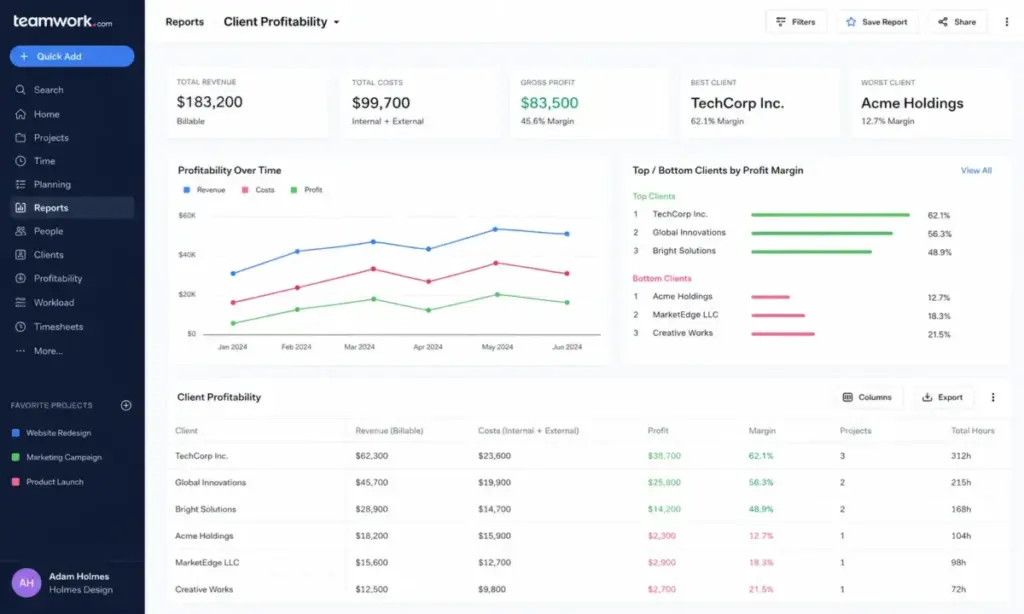
The Basics plan starts at $9.99 per user/month billed annually, while the Accelerate plan costs $24.99 per user/month. Teamwork.com allows you to invite clients to view projects for free, which saves you from purchasing extra user seats. The interface includes native time tracking, billing integrations, and project profitability metrics. Without billing needs, Teamwork alternative tools may be easier to justify.
- What it does better than Asana: Native time tracking, project budgeting, invoicing, and free guest client users who can write comments.
- What it does worse than Asana: Less visual simplicity and a steeper learning curve for teams that do not manage client projects.
- Avoid if: Your team only works on internal projects and does not need to track time or client budgets.
- Migration difficulty: Medium. Task lists and files import easily, but you must manually configure client permission profiles.
Verdict: Choose Teamwork.com if you run an agency or consulting firm and need to verify project profitability alongside task deadlines.
Pricing Comparison: Starting Price vs Practical Tier
The table below shows the starting prices, the practical tiers for teams, and the estimated cost for a 10-user team in the US market.
| Product | Starting Price | Practical Tier for Teams | Cost for 10 Users | Free Plan | Trial Details |
|---|---|---|---|---|---|
| Asana | Free | Starter ($10.99/user/month) | $109.90/month | Yes (10 users) | 30-day trial |
| monday.com | Free | Standard ($12/seat/month) | $120.00/month | Yes (2 seats) | 14-day trial |
| ClickUp | Free | Unlimited ($7/user/month) | $70.00/month | Yes (60MB storage) | Free Forever plan |
| Wrike | Free | Team ($10/user/month) | $100.00/month | Yes | 14-day trial |
| Smartsheet | Paid | Pro ($9/member/month) | $90.00/month | No | 30-day trial |
| Trello | Free | Standard ($5/user/month) | $50.00/month | Yes (10 boards) | Free Forever plan |
| Notion | Free | Plus ($10/member/month) | $100.00/month | Yes | Free Forever plan |
| Airtable | Free | Team ($20/seat/month) | $200.00/month | Yes (1,000 records) | 14-day trial |
| Jira | Free | Standard (approx. $8.15/user/month) | ~$81.50/month | Yes (10 users) | 14-day trial |
| Basecamp | Free | Pro ($15/user/month) | $150.00/month | Yes (1 project) | 30-day trial |
| Teamwork.com | Paid | Basics ($9.99/user/month) | $99.90/month | No | 30-day trial |
Note: Pricing is verified as of May 28, 2026, and is subject to change. Check official pricing pages for current US rates.
What this means:
While starting prices look close, the cost gap widens at 10 seats. ClickUp and Trello offer the lowest paid entry tiers, while Airtable sits at the top. For teams of 20 or more, Basecamp Pro Unlimited’s flat-fee billing becomes a highly cost-effective option, avoiding the seat-by-seat cost scale of Asana.
Feature Gate Comparison
This comparison maps where core project capabilities are unlocked across plans.
| Feature Gate | Asana | monday.com | ClickUp | Smartsheet | Trello | Basecamp |
|---|---|---|---|---|---|---|
| Timeline/Gantt | Locked at Starter | Locked at Standard | Included on Unlimited | Included on Pro | Locked at Premium | Not Included |
| Custom Fields | Locked at Starter | Included on Basic | Included on Unlimited | Included on Pro | Included on Standard | Not Included |
| Automations | Locked at Starter | Action limits by tier | Action limits by tier | Included on Pro | Limit runs by tier | Basic settings |
| Time Tracking | Not Included | Locked at Pro | Included on Unlimited | Locked at Business | Locked at Premium | Not Included |
| Client Portals | Guest access only | Locked at Standard | Guest access only | Included on Pro | Guest access only | Included on Pro |
What this means:
Asana gates custom fields and timeline views behind the Starter tier, making the free plan very limited for teams. ClickUp includes custom fields and time tracking on its lowest paid plan (Unlimited). Trello requires the Premium plan for timeline views, while Smartsheet includes timelines on the Pro level.
Setup and Migration Difficulty
Transitioning your project database requires rebuilding workflows and re-linking tools.
| Alternative | Migration Level | Typical Timeline | Primary Setup Risk |
|---|---|---|---|
| Trello | Low | 1–3 Days | Rebuilding task dependencies manually |
| Basecamp | Low | 1–3 Days | Rebuilding folder hierarchies from scratch |
| ClickUp | Medium | 1–2 Weeks | Remapping custom fields and dashboard widgets |
| monday.com | Medium | 1–2 Weeks | Reconfiguring visual automation triggers |
| Teamwork.com | Medium | 1–2 Weeks | Mapping client access permission levels |
| Notion | Medium | 2–3 Weeks | Reformatting task tables to match wiki databases |
| Jira | High | 3–4 Weeks | Reconfiguring epic workflows and sprint tracking |
| Smartsheet | High | 3–4 Weeks | Rebuilding cell formulas and reports |
| Airtable | High | 3–4 Weeks | Redesigning relational databases from scratch |
| Wrike | High | 4–6 Weeks | Administrative training and request forms |
Disclaimer: Migration difficulty is an editorial estimate based on database models, custom configurations, and team training requirements.
What this means:
Simple tools like Trello and Basecamp can be set up in a few days. High-difficulty databases like Airtable or Smartsheet require several weeks to map fields, test links, and train team members. Plan for a transitional period where both services are running to prevent data loss.
Which Asana Alternative Should You Avoid?
Not every alternative is a safe fit for your specific business structure.
| Product | Who should avoid | Why |
|---|---|---|
| Jira | Non-technical marketing or sales teams | Highly technical interface that creates user friction |
| Airtable | Teams needing simple checklist templates | Rebuilding simple checklists in a database is over-engineered |
| Trello | Large teams with multi-project dependencies | Simple boards get cluttered when projects scale past 15 people |
| Basecamp | Teams that rely on visual Gantt reports | Lacks custom fields and visual timeline views |
| Wrike | Small teams with under 5 members | High cost and administrative overhead are unnecessary |
What this means:
Avoid switching to a tool that duplicates the exact problems you are leaving behind. A small team leaving Asana because of high costs should avoid Wrike or Airtable. A creative team frustrated by Asana’s task structure should avoid the developer-focused Jira workspace.
The Alternative Nobody Mentions
While ClickUp and monday.com dominate search results, Teamwork.com is often overlooked.
For agencies and client-facing teams, the true cost of project software includes the guest seats you must purchase for external clients. In Asana, client access is limited unless you assign them a paid seat or adjust complex permission menus.
Teamwork.com resolves this by offering free client users who can view progress, assign tasks, and log comments. It also includes native time tracking, billing integrations, and project profitability metrics. If your business depends on billable hours, Teamwork.com is the most direct way to track whether your projects are profitable.
When to Stay with Asana
Before migrating your database, consider whether staying with Asana makes the most business sense:
- Deep Integration Dependency: If your workflows are tied to Asana’s API, Salesforce integration, or Slack automations, rebuilding these connections can cost more than the annual subscription savings.
- Cross-Project Portfolios: Asana’s Portfolio view is highly efficient at summarizing progress across 20+ different projects. Few tools, other than Wrike or Smartsheet, handle this without complex setups.
- Low Administrative Capacity: If your team lacks the time to build a custom monday.com board or configure a ClickUp workspace, Asana’s out-of-the-box task structure is the safest path.
If your team is happy with the interface but concerned about costs, cleaning up inactive user seats is often cheaper than retraining your staff on a new system.
Final Verdict: Best Asana Alternative for Most Teams
Your best path forward depends on your specific organizational size and workload structure:
- For 5-person creative teams: monday work management is the best option due to its visual templates and flexible columns.
- For budget-conscious teams under 10: ClickUp provides the most features at a lower entry cost on its Unlimited tier.
- For teams of 20+ seeking cost control: Basecamp Pro Unlimited’s flat-fee billing provides the most predictable software costs.
- For client services and agencies: Teamwork.com is the clearest fit for tracking billable hours and managing client access.
- For software engineering teams: Jira is the standard for Scrum sprints and issue tracking.
FAQs
What is the cheapest Asana alternative for 10 users?
ClickUp Unlimited is the cheapest option for 10 users, costing $70 per month when billed annually in the US. Trello Standard is another budget option at $50 per month. Both plans include custom fields and task tracking at a lower cost than Asana Starter.
Which Asana alternative includes native time tracking?
ClickUp and Teamwork.com include native time tracking. ClickUp includes it on the Unlimited plan, which starts at $7 per user/month. Teamwork.com includes time tracking on its Basics tier, which starts at $9.99 per user/month.
Is Trello a good replacement for Asana?
Trello is a good replacement for small teams that only use Asana’s Kanban board view. It starts at $5 per user/month and requires very little training. However, it lacks the Gantt charts and portfolios needed for complex projects.
Can Notion replace Asana?
Notion can replace Asana if your team wants a wiki-first database workspace. It connects documents, meeting notes, and tasks in one tool. But it lacks out-of-the-box task alerts, so your team must configure notification databases.
Which alternative is best for client collaboration?
Teamwork.com is the best alternative for client work. It allows you to invite external clients to view and edit projects for free. It also includes native time tracking, budgets, and billing features to manage client campaigns.
Is monday.com better than Asana?
monday.com is better if you need highly visual boards, custom database columns, and visual dashboards. Asana is better if you prefer a task-first interface with clean task dependencies. Both cost roughly the same for a 10-person team.